
×

Papua New Guinea🇵🇬 | regionsSepik RiverDugout canoes, spirit houses, Chambri Lake, Angoram departure | things to do and best time to go

Explore Rai CoastExplore Kimbe Bay

Backpacking in Sepik River
🌟 Highlightregion ranked #7
By Johan Kruseman 🇳🇱 | Updated October 15, 2026

Spirit houses (haus tambaran) on the Middle Sepik have carved posts and crocodile-jawed gables, and you duck inside one in villages like Kaminimbit and Tambanum to meet carved ancestors face to face. The Sepik River runs through the Sepik basin in the north of Papua New Guinea, a mix of dugout canoe, motorboat and village paths rather than a classic mountain hike. Scenery is endless brown water, floating grass islands and sago swamp, with dawn mist that makes every paddle stroke worth the early start. Length is flexible, difficulty is low on legs but high on heat, mosquitoes and logistics. Public transport reaches Wewak and Angoram by PMV or flight, then you hire boats. Book a local guide and a boat through a village guesthouse before you arrive.

Discover everything you want to know in the 📖 Papua New Guinea Travel Guide.
Best time to go: May - October
Duration: 5 days
Distance: 150 kilometers
Total ascent: 50 meters


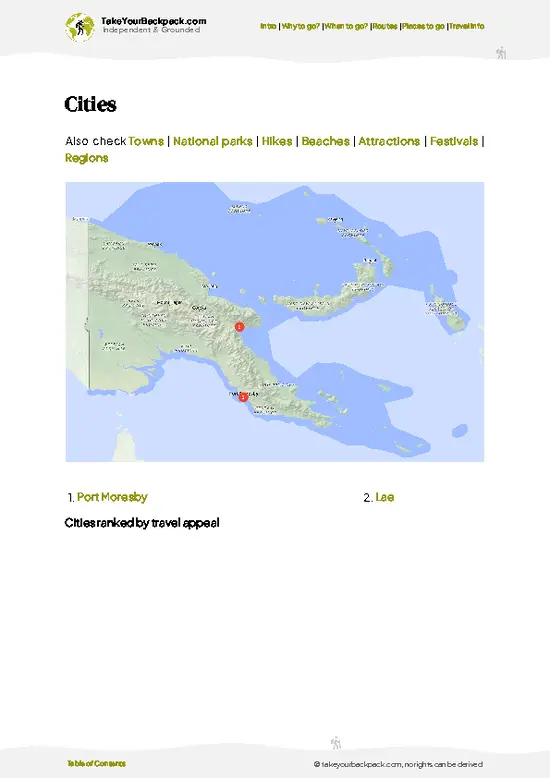
example page 0 from our offline Travel Guide for Papua New Guinea
example page 1 from our offline Travel Guide for Papua New Guinea
example page 2 from our offline Travel Guide for Papua New Guinea
example page 3 from our offline Travel Guide for Papua New Guinea
example page 4 from our offline Travel Guide for Papua New Guinea
example page 5 from our offline Travel Guide for Papua New Guinea
example page 6 from our offline Travel Guide for Papua New Guinea
example page 7 from our offline Travel Guide for Papua New Guinea
Loading the map 🌍
CLICK TO FILTER
cities
towns
national parks
hikes
beaches
attractions
festivals
regions
SHOW COUNTRY’S BESTSHOW ALL

✨ Why go?
Ranked #7 region in Papua New Guinea
The unique appeal for travelers

Backpackers come for the haus tambaran spirit houses and the chance to sleep in villages where carving is still a working trade. Few places in the Pacific let you travel through an art tradition this alive, with carvers selling masks and story boards straight from the verandah. The second draw is flexibility. You can paddle a single day from Angoram or string together a week of stops, pitching a mosquito net in village guesthouses for a modest fee that goes straight to the host family. It also fits a longer loop, flying into Wewak, travelling up the river, then continuing to the Highlands or back to Madang. The river itself sets the pace: you sit, watch, and the landscape arrives. Expect no trails to follow, so the experience is about people, water and carved wood.

💡 HighlightsTop highlights of Sepik River

  1. Haus Tambaran at Kanganaman: One of the most photographed spirit houses on the Middle Sepik, with a towering gabled roof and carved posts. Ask permission and pay the village fee before entering.
  2. Tambanum Village: Known for its tall, ceremonial house and for the carved canoe prows and masks sold along the bank. Good for watching carvers work.
  3. Chambri Lake: A shallow lake with villages famed for woodcarving and crocodile stories. The paddle across open water at dawn is calm and bird-filled.
  4. Angoram Waterfront: The usual starting town, where boats are hired and the Sepik first feels like a highway of dugouts. Its small market is useful for supplies.
  5. Crocodile Initiation Scars: In some villages, men bear raised skin patterns carved to mimic crocodile hide, a living tradition tied to initiation. Ask
… read more 👉
  1. Haus Tambaran at Kanganaman: One of the most photographed spirit houses on the Middle Sepik, with a towering gabled roof and carved posts. Ask permission and pay the village fee before entering.
  2. Tambanum Village: Known for its tall, ceremonial house and for the carved canoe prows and masks sold along the bank. Good for watching carvers work.
  3. Chambri Lake: A shallow lake with villages famed for woodcarving and crocodile stories. The paddle across open water at dawn is calm and bird-filled.
  4. Angoram Waterfront: The usual starting town, where boats are hired and the Sepik first feels like a highway of dugouts. Its small market is useful for supplies.
  5. Crocodile Initiation Scars: In some villages, men bear raised skin patterns carved to mimic crocodile hide, a living tradition tied to initiation. Ask your guide how to approach this respectfully.
For a first visit, start with Kanganaman, since the spirit house shows exactly what makes this river special.
Spotted a mistake or missing something? Contact us.

⌛️ 5 days5-day itinerary for Sepik River

Day 1: Wewak: Mornings start early here, before the heat flattens everything, and the day is paced by the one thing nobody controls: when a dugout canoe or motorboat actually leaves. Fly into Wewak, shop for rice, tinned fish and small notes, then take a shared PMV inland toward Pagwi, since the river is reached by road and then by water.
Day 2-3: Middle Sepik via Pagwi: From Pagwi, hire a motorized canoe and push upriver toward Kaminabit and Palembei. The boat fixes your schedule, so sleep in village guesthouses and let the current, fuel and weather set the hours. Stop at Kaminabit for carved crocodile stools, then continue to Palembei, where the haus tambaran stands tall above the riverbank. Midday heat is for sitting in shade; carving and sago-making are best watched in the cooler late afternoon. … read more 👉
Day 1: Wewak: Mornings start early here, before the heat flattens everything, and the day is paced by the one thing nobody controls: when a dugout canoe or motorboat actually leaves. Fly into Wewak, shop for rice, tinned fish and small notes, then take a shared PMV inland toward Pagwi, since the river is reached by road and then by water.
Day 2-3: Middle Sepik via Pagwi: From Pagwi, hire a motorized canoe and push upriver toward Kaminabit and Palembei. The boat fixes your schedule, so sleep in village guesthouses and let the current, fuel and weather set the hours. Stop at Kaminabit for carved crocodile stools, then continue to Palembei, where the haus tambaran stands tall above the riverbank. Midday heat is for sitting in shade; carving and sago-making are best watched in the cooler late afternoon.
Day 4: Kambot and the Detour to Chambri Lake: Turn off the main channel into Chambri Lake, a short side trip that adds a lot without breaking the schedule. Villages here are known for woven baskets, crocodile carvings and ritual houses, and the water is calm enough that boats keep time. Return to the main channel for your final night so the return run to Pagwi stays manageable.
Day 5: Return to Pagwi and Wewak: Leave at first light, because road vehicles from Pagwi fill and go in the morning, and a missed one can strand you until the next day. Back in Wewak, cool off by the water and sort your carvings for the flight.

If you only get one day to justify the trip, make it Day 3 at Palembei. Spirit house, riverside carvers and the glide past reed banks at dusk show what the Sepik is.

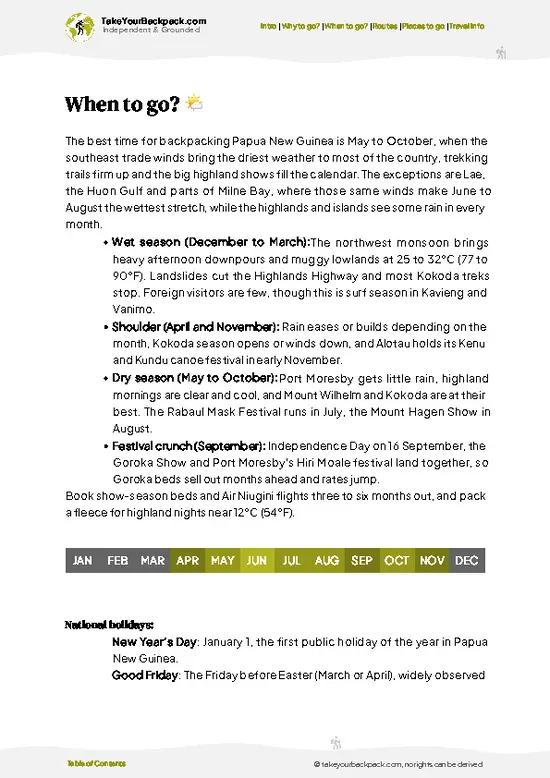
🌤️ When to go?When to go for the best experience

  • Dry Season (May to October): Water levels drop, mosquitoes thin out slightly, and village paths and sandbars are easier to walk. Days run 30 to 33°C (86 to 91°F), nights 22 to 24°C (72 to 75°F). Sunrise and sunset sit near 6am and 6pm.
  • Wet Season (November to April): Heavy afternoon downpours, 28 to 32°C (82 to 90°F), and a swollen river that floods low villages and mud-slicks tracks. Canoe travel works, but hiking legs between villages get slow.
  • Festival Timing: The Crocodile Festival at Ambunti, usually held in the dry season around August, fills guesthouses and pushes up canoe hire prices.
  • Prices: Boat fuel is the main cost swing, and it climbs when demand peaks in July and August.
Book your canoe and guide at least a month ahead for July to September, and aim for early June or October to find quieter villages.

source: climatestotravel.comJANJanuary: below average for travelingFEBFebruary: below average for travelingMARMarch: below average for travelingAPRApril: fair for travelingMAYMay: excellent for travelingJUNJune: excellent for travelingJULJuly: excellent for travelingAUGAugust: excellent for travelingSEPSeptember: excellent for travelingOCTOctober: highly recommended for travelingNOVNovember: fair for travelingDECDecember: below average for traveling
when-to-go

✈️ The backpacker research shortcutPapua New Guinea Travel Guide

An offline-friendly backpacking guide with optimized travel routes, ranked highlights, transport advice, and the best areas to stay.
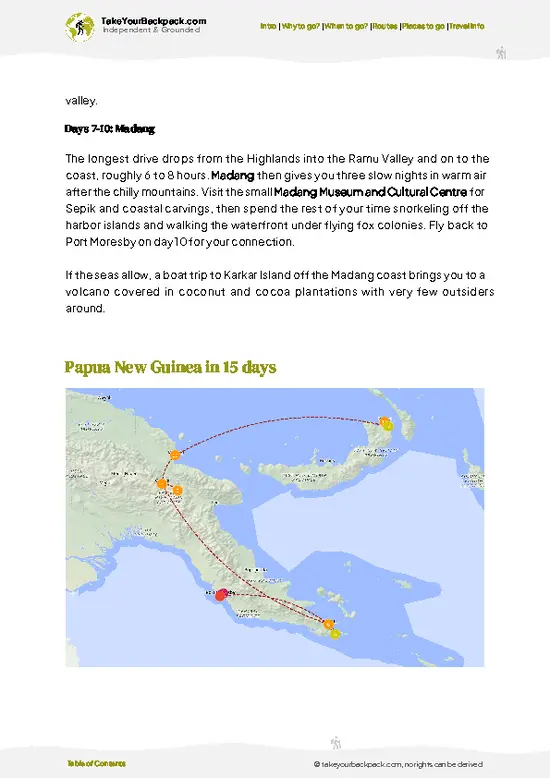
example page 0 from our offline Travel Guide for Papua New Guinea
example page 1 from our offline Travel Guide for Papua New Guinea
example page 2 from our offline Travel Guide for Papua New Guinea
example page 3 from our offline Travel Guide for Papua New Guinea
example page 4 from our offline Travel Guide for Papua New Guinea
example page 5 from our offline Travel Guide for Papua New Guinea
example page 6 from our offline Travel Guide for Papua New Guinea
example page 7 from our offline Travel Guide for Papua New Guinea
The digital guide (251 pages) contains:
✅ 81 highlights, ranked by travel appeal
✅ Optimized 5, 10 & 15-day travel routes
✅ Cities, national parks, landmarks, beaches
✅ How to get around
✅ Offline-friendly for travel without Wi-Fi
👉 Click to see all 30+ guide features

📅 Plan smarter in minutes, not weeks
✅ Month by month travel advice
✅ Festivals & national holidays
✅ Budget expectations

🗺️ Go to the right places, skip the overrated ones
✅ Honest pros & cons of destinations
✅ Top hikes, parks & viewpoints
✅ Lesser-known places most travelers miss
✅ Clear “worth it vs skip it” guidance

🛏️ Travel smoothly without rookie mistakes
✅ Best areas to stay
✅ Transport systems explained simply
✅ Common scams & safety advice
✅ SIM cards, money & practical tips

🌍 Understand the country, not just visit it
✅ Culture & traditions
✅ 52 Essential phrases & customs
✅ Festivals worth planning around
✅ Traveler-friendly historical context
✅ Insights that make places more meaningful

📱 Built for real travel conditions
✅ Fully downloadable PDF
✅ Works completely offline
✅ Optimized for phone use
✅ Useful in remote areas & buses
✅ Everything in one place
Stop searching, start planning
Get instant access to your full guide. 30‑day money-back guarantee.
+ Add another guide for just

By proceeding you agree to our terms.
Sent to your inbox immediately after payment • 100% Secure Checkout
Best Backpacking Travel Advisor 2025 tourism awardBest Backpacking
Travel Advisor
2025
What others say about Take Your Backpack Guides:
⭐⭐⭐⭐⭐
Fantastic, amazing amount of information!
⭐⭐⭐⭐⭐
My goodness this is amazing, it's what I've been looking for hats off too you!
⭐⭐⭐⭐⭐
I think this is absolutely BRILLIANT
⭐⭐⭐⭐
Very complete and informative. It's still missing places, but I gotta to commend you
⭐⭐⭐⭐⭐
This is truly amazing, thank you, can't wait to explore it with my kids!
⭐⭐⭐⭐⭐
Awesome resource, thank you!
⭐⭐⭐⭐⭐
This is amazing! Can't wait to explore the ones I haven't seen
⭐⭐⭐⭐
I love this! Well done, great idea.
⭐⭐⭐⭐⭐
Thanks for taking the time to make this gem!
⭐⭐⭐⭐⭐
This might be the best website I've ever seen.
⭐⭐⭐⭐⭐
Congratulations, and thank you so much for your work; it's incredibly valuable.
⭐⭐⭐⭐
In all seriousness I think you did a great job pointing out the important spots
⭐⭐⭐⭐⭐
10/10 very good
⭐⭐⭐⭐⭐
As someone who's only just starting to visit regularly this is awesome, thank you.
⭐⭐⭐⭐
Thank you very much! I'm going to visit my dad, it's going to be very useful!
⭐⭐⭐⭐⭐
This is really cool! We'll be travelling for the first time and this definitely come in handy.
⭐⭐⭐⭐⭐
You are now our minister of culture, congratulations 👨‍💼
⭐⭐⭐⭐⭐
Just wanted to tell you that this is a pearl! Going to follow your recommendations.
⭐⭐⭐⭐⭐
This is so cool. I'll definitely be using the resource for my travels soon.
⭐⭐⭐⭐⭐
This is very impressive! Good work.
⭐⭐⭐⭐⭐
This is an amazing and informative site. Very well done!

🛏️ Where to stay?Best areas to stay in Papua New Guinea

Wewak is the easiest first night, with a few guesthouses, a market, banks and the airport, plus beaches where you can swim and stock up on supplies before heading inland. Expect dorm-style or basic rooms from roughly US$15 to 40 a night.

Angoram, on the lower river, is the gateway for trips to the Sepik’s lower reaches and for boats upriver. It has simple lodging and a lively Saturday market where you can sort out transport and meet guides.

Pagwi is a busy landing where roads meet water. It works for a night of connecting to boats, but little else.

The real stays are in villages along the river. … read more 👉
Wewak is the easiest first night, with a few guesthouses, a market, banks and the airport, plus beaches where you can swim and stock up on supplies before heading inland. Expect dorm-style or basic rooms from roughly US$15 to 40 a night.

Angoram, on the lower river, is the gateway for trips to the Sepik’s lower reaches and for boats upriver. It has simple lodging and a lively Saturday market where you can sort out transport and meet guides.

Pagwi is a busy landing where roads meet water. It works for a night of connecting to boats, but little else.

The real stays are in villages along the river. Kaminabit, Palembei, Kanganaman and Tambanum all offer homestays or haus kiap-style guesthouses, usually US$10 to 25 a night with meals often extra. You sleep under a mosquito net in a stilt house, share the evening with the family and wake to canoe traffic. Chambri Lake villages are especially welcoming. Solo travelers find safety in community hosts, so arrange your stay through a recommended contact.

🚌 Getting aroundHow to get around Sepik River

Wewak and Angoram, the two towns where most Sepik trips start or finish, are small enough to cross on foot in 15 to 20 minutes, but walking stops making sense the moment you leave them: villages sit hours apart by water, and the river is the only real road. Most backpackers combine a bus or PMV (shared minibus) along the highway with a motorized dugout canoe, and it works if you accept that schedules here are suggestions.

  • Motorized dugout canoe (charter): This is the main way to travel the river, and it costs the most, roughly US$100 to 250 a day for boat, driver and fuel, which splits nicely among three or four people. You get speed, 20 to 40 km/h depending on current, and a front-row seat to stilt villages. Comfort is a plank seat and a tarp roof. For the experience per dollar, this wins.
… read more 👉
Wewak and Angoram, the two towns where most Sepik trips start or finish, are small enough to cross on foot in 15 to 20 minutes, but walking stops making sense the moment you leave them: villages sit hours apart by water, and the river is the only real road. Most backpackers combine a bus or PMV (shared minibus) along the highway with a motorized dugout canoe, and it works if you accept that schedules here are suggestions.

  • Motorized dugout canoe (charter): This is the main way to travel the river, and it costs the most, roughly US$100 to 250 a day for boat, driver and fuel, which splits nicely among three or four people. You get speed, 20 to 40 km/h depending on current, and a front-row seat to stilt villages. Comfort is a plank seat and a tarp roof. For the experience per dollar, this wins.
  • PMV minibus: Wewak to Pagwi (the busy river landing) takes about 4 to 6 hours on a rough road and costs around US$10 to 20. It is cramped and loud, but nothing else covers the distance so cheaply, and you meet half the district on board.
  • Public dugout or small passenger boat: Locals hop between villages on shared canoes for a few dollars a leg. Cheap and wonderfully social, though departures happen when the boat fills, so you may sit and wait half a day. Good when you have spare time, poor when you do not.
  • Domestic flight: Air Niugini and regional carriers link Port Moresby with Wewak (about 1.5 to 2 hours), with fares typically US$150 to 300 one way. It is the priciest option, but it saves two days of overland travel and a lot of aching hips.
  • Paddle canoe: For short hops between neighboring villages or into side channels, a paddled dugout costs a few dollars and is silent, slow and beautiful. Perfect for wildlife at dawn.

Book your boat and driver through a village homestay contact before arriving, then buy fuel in town yourself so the price stays clear.

🍲 FoodLocal Cuisine & Drinks

Sago is the soul of the table here. Villagers beat the pith of the sago palm into starchy pancakes or thick, gluey sago porridge, often served with smoked river fish, boiled greens and a fiery chili paste. The fish tastes of woodsmoke and mud and is far better than it sounds.

On the riverbanks you will also find taro, yams, bananas roasted in the coals, and coconut crab or prawns near Wewak. Wewak’s waterfront has street stalls selling grilled fish, fried flour balls and cooked bananas for a couple of dollars, while the town market is the place for pineapples, cucumbers and fresh coconuts. Angoram’s Saturday market fills with fish, smoked meat and betel nut.

In homestays you eat what the family eats, usually rice or sago with fish, so bring snacks, instant coffee and tea. Betel nut is chewed … read more 👉
Sago is the soul of the table here. Villagers beat the pith of the sago palm into starchy pancakes or thick, gluey sago porridge, often served with smoked river fish, boiled greens and a fiery chili paste. The fish tastes of woodsmoke and mud and is far better than it sounds.

On the riverbanks you will also find taro, yams, bananas roasted in the coals, and coconut crab or prawns near Wewak. Wewak’s waterfront has street stalls selling grilled fish, fried flour balls and cooked bananas for a couple of dollars, while the town market is the place for pineapples, cucumbers and fresh coconuts. Angoram’s Saturday market fills with fish, smoked meat and betel nut.

In homestays you eat what the family eats, usually rice or sago with fish, so bring snacks, instant coffee and tea. Betel nut is chewed everywhere, and its red-stained smiles are part of daily life, so decline politely if you do not want it. Wait to be served, accept food with your right hand and share your biscuits. Drink only boiled or bottled water, and buy supplies in Wewak before you leave.

🛡️ SafetyTraveler Safety Guide

Malaria is the most likely health problem on the Sepik, so start prophylaxis before you arrive, sleep under a treated net every night, and cover up at dusk. Water in the river is silty and unsafe, so carry a filter or purification tablets. Trails between villages turn to ankle-deep mud after rain, and log bridges can be slick, so wear boots with grip and move slowly. Crocodiles live in the river and lagoons. Avoid swimming, stay out of dugout canoes when you are tired, and never wash dishes at the water’s edge at night. Local tensions between villages sometimes flare up, so travel with a guide arranged through a trusted guesthouse, ask before photographing people or carvings, and carry small kina notes for fees. Pack a full first-aid kit, since clinics are far apart.

FAQFrequently asked questions about Sepik River

Most travelers spend 5 to 10 days on a Sepik River trek, mixing dugout canoe or motorized boat travel with short village walks. A typical route runs from Ambunti downriver toward Angoram, covering roughly 300 to 400 kilometers by water. Walking days are usually 2 to 5 hours, since the river does the heavy lifting.
The trek is easy to moderate in effort, since most distance is covered by boat and walking is mainly flat. Heat, humidity of 80 percent or more, and muddy tracks make even short walks tiring. Long days in a narrow canoe and basic village stays with no hot water are the real tests of stamina.
A local guide is strongly recommended, and in practice you will need one to arrange canoes, village access, and safe stops. Guides typically charge about K150 to K300 (US$40 to 80) per day, with boat hire and fuel extra. Villages and landowners often ask for a small visitor fee of K20 to K50 (US$5 to 13), while no national permit is generally required for the river itself. Arrange everything in Ambunti or Wewak before you set out.
⚠️ Things can change over time, so always validate details locally before you go.

Other Papua New Guinean regions near Sepik River

Explore more nearby:

  • Sinasina—Simbu sing-sings, coffee terraces, ridge paths, kaukau markets| 335 km away
  • Rai Coast—Maclay Coast, Saidor wartime relics, black-sand bays, village homestays, Finisterre foothills| 376 km away
  • Manus Island—Empty Admiralty sand, Lorengau harbor, outrigger trips, Allied base relics| 507 km away

💡 Not sure where to go next?
Create a personalized itinerary for Papua New Guinea including Sepik River and the places that fit your trip.

Generate my itinerary

👉 Discover all regions

Or checkout all Papua New Guinea has to offer (think cities, towns, villages, national parks, hikes, beaches, festivals)
Country photo of Papua New Guinea

We 💚 feedbackIs it worth it?

Go at dawn, when the river is glassy, the mist lifts off the grass islands and the first dugouts slide past carrying firewood. Drier months make paths and boat travel easier, so I would aim for those. Bring small bills for village fees and carvings.

✍️ Help improve this page!
The information on this page is based on in-depth research, insights shared by experienced travelers, and feedback from the local travel community in Papua New Guinea. While every effort is made to keep the information accurate and current, conditions can change — so if you spot anything incorrect or outdated, please get in touch.


🙋‍♂️ Give feedback

👋 Meet the founderWho’s Behind Take Your Backpack?

Johan, backpacker and founder of TakeYourBackpackHi, I’m Johan (Netherlands 🇳🇱), the creator of TakeYourBackpack. Over the past 3 decades, I’ve backpacked through 90+ countries across six continents, gaining extensive experience with independent travel, long-term trips, and overland routes.

This site is built on a combination of firsthand travel experience and carefully curated insights from other backpackers. Many guides are based on places I’ve personally visited, while others bring together tips, observations, and practical advice shared by trusted travelers I’ve met along the way.

The goal is to provide realistic, experience-driven guidance — not generic itineraries — so you can explore destinations with better context, clearer expectations, and more confidence.