×

Peru🇵🇪 | landmarksGocta WaterfallTwo-tier falls, cloud forest trail, cock-of-the-rock, Cocachimba start | things to do and best time to go

Explore Cerro BlancoExplore Kuélap

Backpacking in Gocta Waterfall
🌟 Highlightunique site ranked #4
By Johan Kruseman 🇳🇱 | Updated October 19, 2026

Gocta is not a single drop. It falls in two tiers, a combined height of about 771 meters, and it was known to locals long before outsiders "discovered" it in 2006. It sits in the north of Peru, in the Amazonas region, north of Chachapoyas. I came expecting a quick roadside photo stop. What surprised me was the forest: the trail drops through coffee plots and cloud forest alive with orange cock-of-the-rock displays, and the falls stay hidden until a final bend where the roar suddenly hits your chest. Do the hike. Skip any plan to rush it as a half-day tick. The mist soaks you at the base, the swim is cold but fun, and the walk is half the thrill. Compared with Catarata Yumbilla, which is quieter and mostly viewed from a distance, Gocta lets you walk right up to the spray.

Discover everything you want to know in the 📖 Peru Travel Guide.


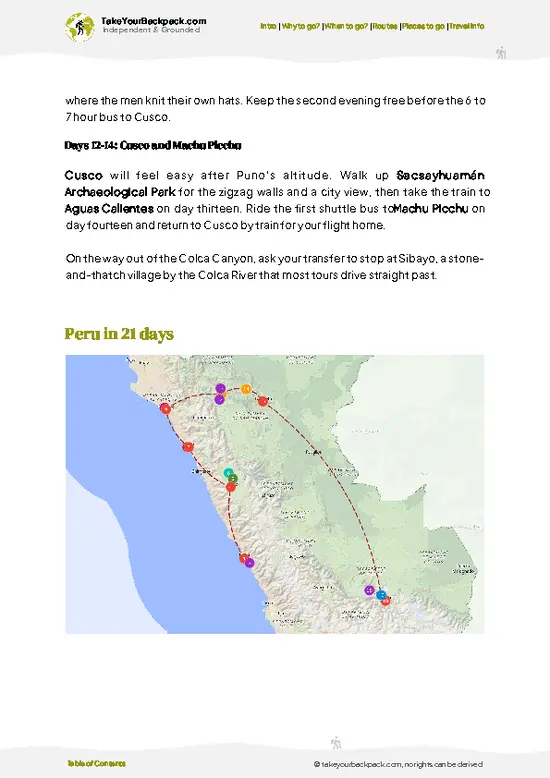
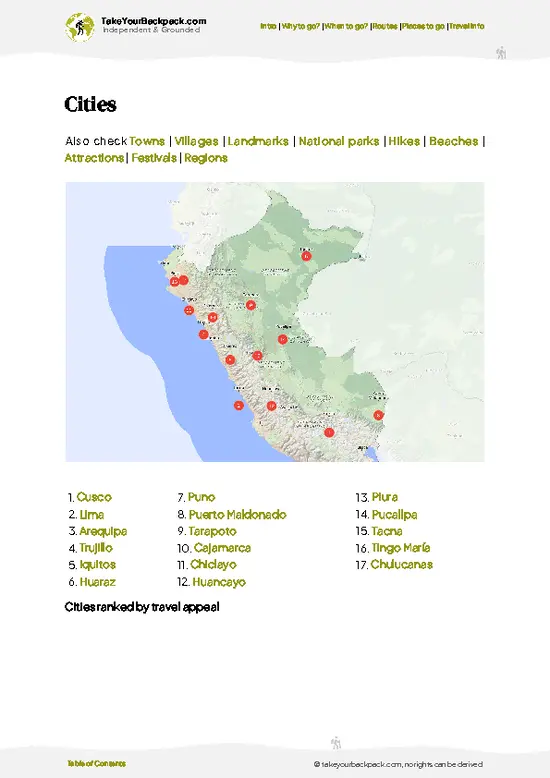
example page 0 from our offline Travel Guide for Peru
example page 1 from our offline Travel Guide for Peru
example page 2 from our offline Travel Guide for Peru
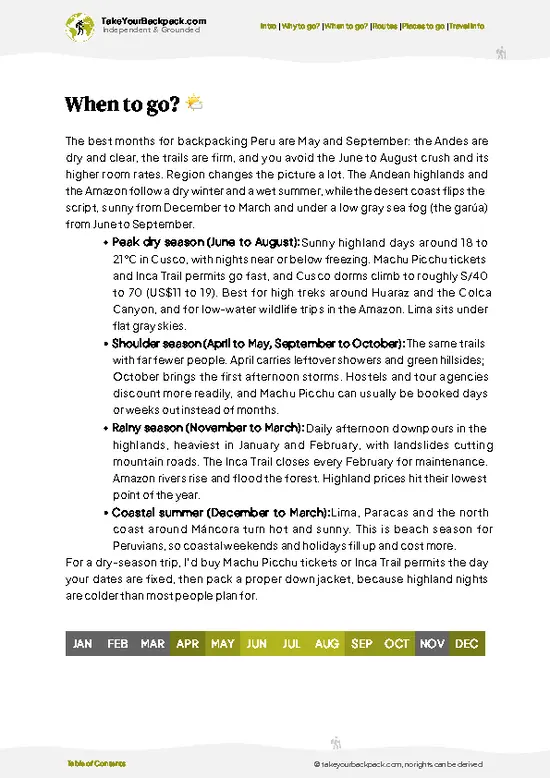
example page 3 from our offline Travel Guide for Peru
example page 4 from our offline Travel Guide for Peru
example page 5 from our offline Travel Guide for Peru
example page 6 from our offline Travel Guide for Peru
example page 7 from our offline Travel Guide for Peru
Loading the map 🌍
CLICK TO FILTER
cities
towns
villages
landmarks
national parks
hikes
beaches
attractions
festivals
regions
SHOW COUNTRY’S BESTSHOW ALL

✨ Why go?
Ranked #4 unique site in Peru
What sets this place apart

Gocta Waterfall earns the long, winding approach because the walk is part of the destination. You hike through farmland and dense cloud forest, cross streams, and arrive at a plunge pool where spray drifts across the rocks. Few waterfalls of this scale let you get this close on foot, with local guides who actually live in the villages along the trail.

It also fits a classic northern Peru loop. Base yourself near Chachapoyas and you can combine the falls with Kuelap, the cloud-top fortress of the Chachapoya people, plus the Karajía sarcophagi and Revash tombs. Gocta is the natural-world counterpart to those archaeological days, so the circuit never gets repetitive.

Finally, the two villages, Cocachimba and San Pablo, give you a choice of route and a chance to spend money directly with community … read more 👉
Gocta Waterfall earns the long, winding approach because the walk is part of the destination. You hike through farmland and dense cloud forest, cross streams, and arrive at a plunge pool where spray drifts across the rocks. Few waterfalls of this scale let you get this close on foot, with local guides who actually live in the villages along the trail.

It also fits a classic northern Peru loop. Base yourself near Chachapoyas and you can combine the falls with Kuelap, the cloud-top fortress of the Chachapoya people, plus the Karajía sarcophagi and Revash tombs. Gocta is the natural-world counterpart to those archaeological days, so the circuit never gets repetitive.

Finally, the two villages, Cocachimba and San Pablo, give you a choice of route and a chance to spend money directly with community guides, homestays and small cafes, which makes the visit feel far more grounded than a standard day tour.

💡 HighlightsTop highlights of Gocta Waterfall

  1. Gocta Waterfall Lower Viewpoint and Base: The headline sight is the walk to the plunge pool at the bottom of the lower tier, where mist soaks you well before you reach the water. It is the payoff for the full hike.
  2. Mirador Gocta: A viewpoint on the approach where both tiers of the falls appear together against the green cliff. It is the best place for wide photos before the forest swallows the view.
  3. Cocachimba Trailhead: The main starting village, with a visitor office where you register and hire a local guide. The path begins among small farms and cattle fields.
  4. San Pablo Route: The longer, quieter alternative from the other village. It gives you a different angle on the falls and fewer people, though it asks for more stamina.
  5. Cloud Forest Trail: The stretch of shaded path with ferns, bromeliads,
… read more 👉
  1. Gocta Waterfall Lower Viewpoint and Base: The headline sight is the walk to the plunge pool at the bottom of the lower tier, where mist soaks you well before you reach the water. It is the payoff for the full hike.
  2. Mirador Gocta: A viewpoint on the approach where both tiers of the falls appear together against the green cliff. It is the best place for wide photos before the forest swallows the view.
  3. Cocachimba Trailhead: The main starting village, with a visitor office where you register and hire a local guide. The path begins among small farms and cattle fields.
  4. San Pablo Route: The longer, quieter alternative from the other village. It gives you a different angle on the falls and fewer people, though it asks for more stamina.
  5. Cloud Forest Trail: The stretch of shaded path with ferns, bromeliads, and orchids where birdlife is dense. Guides point out species you would walk past alone.
  6. Cock-of-the-Rock Sightings: The Andean cock-of-the-rock, Peru’s national bird, with its bright red-orange crest, is often seen in the forest here. Early morning gives the best odds.
  7. Local Village Cafes: After the hike, small family-run spots in Cocachimba serve hot coffee grown on nearby slopes and simple plates, a fair way to rest tired legs.
Allow a full day for everything together, with the round-trip hike to the base taking most of it.
Spotted a mistake or missing something? Contact us.

Things to do around Gocta Waterfall

Ratings based on Tripadvisor reviews. When you book through this link, you support our work at no extra cost to you.

🌤️ When to go?Best time to visit Gocta Waterfall

  • Dry Season (June to September): The most reliable window for the trail, with mostly sunny days at 18 to 26°C (64 to 79°F) and cool nights near 10°C (50°F). Mud is minimal and the falls are still impressive. Expect the most hikers, especially July and August.
  • Shoulder Months (April, May, October): Showers arrive in the afternoons, so start walking by 8 am. Highs of 20 to 25°C (68 to 77°F) and fewer people on the path.
  • Wet Season (November to March): Rain is frequent, the trail turns slick and clay-heavy, and clouds often hide the upper drop. The water volume is at its biggest, though. Guesthouse rates dip and you may have the viewpoints to yourself.
  • Daylight: Near the equator, days run about 12 hours all year, so finish the loop well before dusk.
Arrive on a weekday outside Peruvian holidays such … read more 👉
  • Dry Season (June to September): The most reliable window for the trail, with mostly sunny days at 18 to 26°C (64 to 79°F) and cool nights near 10°C (50°F). Mud is minimal and the falls are still impressive. Expect the most hikers, especially July and August.
  • Shoulder Months (April, May, October): Showers arrive in the afternoons, so start walking by 8 am. Highs of 20 to 25°C (68 to 77°F) and fewer people on the path.
  • Wet Season (November to March): Rain is frequent, the trail turns slick and clay-heavy, and clouds often hide the upper drop. The water volume is at its biggest, though. Guesthouse rates dip and you may have the viewpoints to yourself.
  • Daylight: Near the equator, days run about 12 hours all year, so finish the loop well before dusk.
Arrive on a weekday outside Peruvian holidays such as late July, when domestic visitors fill the villages.


source: climatestotravel.comJANJanuary: fair for travelingFEBFebruary: fair for travelingMARMarch: fair for travelingAPRApril: fair for travelingMAYMay: highly recommended for travelingJUNJune: excellent for travelingJULJuly: excellent for travelingAUGAugust: excellent for travelingSEPSeptember: highly recommended for travelingOCTOctober: fair for travelingNOVNovember: fair for travelingDECDecember: fair for traveling
when-to-go

✈️ The backpacker research shortcutPeru Travel Guide

An offline-friendly backpacking guide with optimized travel routes, ranked highlights, transport advice, and the best areas to stay.
example page 0 from our offline Travel Guide for Peru
example page 1 from our offline Travel Guide for Peru
example page 2 from our offline Travel Guide for Peru
example page 3 from our offline Travel Guide for Peru
example page 4 from our offline Travel Guide for Peru
example page 5 from our offline Travel Guide for Peru
example page 6 from our offline Travel Guide for Peru
example page 7 from our offline Travel Guide for Peru
The digital guide (310 pages) contains:
✅ 102 highlights, ranked by travel appeal
✅ Optimized 7, 14 & 21-day travel routes
✅ Cities, national parks, landmarks, beaches
✅ How to get around
✅ Offline-friendly for travel without Wi-Fi
👉 Click to see all 30+ guide features

📅 Plan smarter in minutes, not weeks
✅ Month by month travel advice
✅ Festivals & national holidays
✅ Budget expectations

🗺️ Go to the right places, skip the overrated ones
✅ Honest pros & cons of destinations
✅ Top hikes, parks & viewpoints
✅ Lesser-known places most travelers miss
✅ Clear “worth it vs skip it” guidance

🛏️ Travel smoothly without rookie mistakes
✅ Best areas to stay
✅ Transport systems explained simply
✅ Common scams & safety advice
✅ SIM cards, money & practical tips

🌍 Understand the country, not just visit it
✅ Culture & traditions
✅ 52 Essential phrases & customs
✅ Festivals worth planning around
✅ Traveler-friendly historical context
✅ Insights that make places more meaningful

📱 Built for real travel conditions
✅ Fully downloadable PDF
✅ Works completely offline
✅ Optimized for phone use
✅ Useful in remote areas & buses
✅ Everything in one place
Stop searching, start planning
Get instant access to your full guide. 30‑day money-back guarantee.
+ Add another guide for just

By proceeding you agree to our terms.
Sent to your inbox immediately after payment • 100% Secure Checkout
Best Backpacking Travel Advisor 2025 tourism awardBest Backpacking
Travel Advisor
2025
What others say about Take Your Backpack Guides:
⭐⭐⭐⭐⭐
Fantastic, amazing amount of information!
⭐⭐⭐⭐⭐
My goodness this is amazing, it's what I've been looking for hats off too you!
⭐⭐⭐⭐⭐
I think this is absolutely BRILLIANT
⭐⭐⭐⭐
Very complete and informative. It's still missing places, but I gotta to commend you
⭐⭐⭐⭐⭐
This is truly amazing, thank you, can't wait to explore it with my kids!
⭐⭐⭐⭐⭐
Awesome resource, thank you!
⭐⭐⭐⭐⭐
This is amazing! Can't wait to explore the ones I haven't seen
⭐⭐⭐⭐
I love this! Well done, great idea.
⭐⭐⭐⭐⭐
Thanks for taking the time to make this gem!
⭐⭐⭐⭐⭐
This might be the best website I've ever seen.
⭐⭐⭐⭐⭐
Congratulations, and thank you so much for your work; it's incredibly valuable.
⭐⭐⭐⭐
In all seriousness I think you did a great job pointing out the important spots
⭐⭐⭐⭐⭐
10/10 very good
⭐⭐⭐⭐⭐
As someone who's only just starting to visit regularly this is awesome, thank you.
⭐⭐⭐⭐
Thank you very much! I'm going to visit my dad, it's going to be very useful!
⭐⭐⭐⭐⭐
This is really cool! We'll be travelling for the first time and this definitely come in handy.
⭐⭐⭐⭐⭐
You are now our minister of culture, congratulations 👨‍💼
⭐⭐⭐⭐⭐
Just wanted to tell you that this is a pearl! Going to follow your recommendations.
⭐⭐⭐⭐⭐
This is so cool. I'll definitely be using the resource for my travels soon.
⭐⭐⭐⭐⭐
This is very impressive! Good work.
⭐⭐⭐⭐⭐
This is an amazing and informative site. Very well done!

🛏️ Where to stay?Choosing the right base

Cocachimba is the best base for Gocta Waterfall, the village where the main trail starts. It has small family guesthouses, simple campsites, and a handful of hostel-style places where solo travelers swap trail stories over dinner. Rooms or dorm beds run roughly US$8 to 25. You can walk to the ticket office at the start of the trail, and the village feels safe, with locals who know every guide by name.
San Pablo, the other trailhead village, is quieter and has fewer beds. It suits anyone aiming for the southern route and wanting a calm night, though evening food options are limited.
For more choice, … read more 👉
Cocachimba is the best base for Gocta Waterfall, the village where the main trail starts. It has small family guesthouses, simple campsites, and a handful of hostel-style places where solo travelers swap trail stories over dinner. Rooms or dorm beds run roughly US$8 to 25. You can walk to the ticket office at the start of the trail, and the village feels safe, with locals who know every guide by name.
San Pablo, the other trailhead village, is quieter and has fewer beds. It suits anyone aiming for the southern route and wanting a calm night, though evening food options are limited.
For more choice, Chachapoyas sits about 1.5 to 2 hours away by road and has the biggest cluster of budget hostels, tour agencies, cafes and ATMs. It is the social hub for backpackers, handy if you also plan Kuelap, Karajia or the Revash tombs. Cuispes and Pedro Ruiz are quieter options along the highway, mainly useful for transit connections. Book ahead in July and August, since Cocachimba has limited beds.

👛 Costs (as of 19 October 2026)What things cost and how to budget

Budget about US$38 a day for Gocta Waterfall if you sleep in Cocachimba, hike with a local guide and eat in village kitchens.
CategoryBudget RangeLocal Reality
Accommodation (high season)US$8 to 25Dorm beds or basic family rooms in Cocachimba. Low season is often US$6 to 18.
Trail Entry and GuideUS$4 to 14Community entry fee is a few dollars. A mandatory local guide for the lower and upper falls costs around US$8 to 12 per group, so splitting helps.
FoodUS$6 to 12Set lunches (menú) with soup and a main dish cost US$3 to 5. Dinner at guesthouses is similar.
TransportUS$2 to 6Shared vans or colectivos from Chachapoyas to the villages cost US$3 to 5. A moto-taxi to the trailhead is about US$2 to 3.
ExtrasUS$2 to 5Bottled water, snacks, rain poncho, boot or horse hire. Pay in Peruvian soles, cash only.
… read more 👉
Budget about US$38 a day for Gocta Waterfall if you sleep in Cocachimba, hike with a local guide and eat in village kitchens.
CategoryBudget RangeLocal Reality
Accommodation (high season)US$8 to 25Dorm beds or basic family rooms in Cocachimba. Low season is often US$6 to 18.
Trail Entry and GuideUS$4 to 14Community entry fee is a few dollars. A mandatory local guide for the lower and upper falls costs around US$8 to 12 per group, so splitting helps.
FoodUS$6 to 12Set lunches (menú) with soup and a main dish cost US$3 to 5. Dinner at guesthouses is similar.
TransportUS$2 to 6Shared vans or colectivos from Chachapoyas to the villages cost US$3 to 5. A moto-taxi to the trailhead is about US$2 to 3.
ExtrasUS$2 to 5Bottled water, snacks, rain poncho, boot or horse hire. Pay in Peruvian soles, cash only.
Total Daily BudgetUS$38Based on mid-range of each row with high-season accommodation. Splurging on a private room and a horse pushes it toward US$55.


source: peru.travel
⚠️ Prices can change and everyone travels differently, so take this as a rough guide. Hope it helps you plan your adventure!

FAQTraveler FAQ

Gocta Waterfall is a two-tiered cascade in the Amazonas region, with a total drop of about 771 m (2,530 ft), among the tallest in the world. It was brought to international attention by a 2006 expedition, though locals had always known it. The falls drain into lush cloud forest near the villages of Cocachimba and San Pablo.
Plan a full day for Gocta Waterfall. The round-trip hike to the base of the lower fall from Cocachimba takes about 5 to 6 hours over roughly 11 km (7 miles), including stops for photos and a swim-free rest. Add a second day if you want a gentler pace, the upper fall viewpoints or an overnight in the village.
Most travelers reach Gocta Waterfall from Chachapoyas, about 1.5 to 2 hours by road to Cocachimba. Take a colectivo or van toward Cocachimba or San Pablo for US$3 to 5, or hire a taxi for around US$25 to 40 one way. Moto-taxis can cover the last stretch from the village to the trailhead for a couple of dollars.
⚠️ Things can change over time, so always validate details locally before you go.

Other Peruvian landmarks near Gocta Waterfall

Explore more nearby:

  • Kuélap—Cable car approach, 20-meter walls, round houses, El Tintero| 44 km away
  • Kotosh—Crossed Hands relief, sunken chamber, stone platforms, Río Higueras| 469 km away
  • Pachacamac—Lurín valley, oracle shrine, pilgrim plaza, Pacific summit| 697 km away

💡 Not sure where to go next?
Create a personalized itinerary for Peru including Gocta Waterfall and the places that fit your trip.

Generate my itinerary

👉 Discover all landmarks

Or checkout all Peru has to offer (think cities, towns, villages, national parks, hikes, beaches, festivals)
Country photo of Peru

We 💚 feedbackWhat to keep in mind

Gocta Waterfall suits hikers who like earning their views, birders, and anyone building a Chachapoyas loop who wants nature after ruins. Casual stoppers expecting a roadside view will feel shortchanged. I would hire a local guide, start early, and bring a dry change of clothes for the spray.

✈️ When did I visit Peru?
Peru I visited during my half year trip through South and Central America back in 2003

✍️ Help improve this page!
The information on this page is based on my own backpacking experience in Peru, supplemented with up-to-date research and feedback from other travelers. Travel details can change, so if you notice anything outdated or incomplete, feel free to let me know.


🙋‍♂️ Give feedback

👋 Meet the founderWho’s Behind Take Your Backpack?

Johan, backpacker and founder of TakeYourBackpackHi, I’m Johan (Netherlands 🇳🇱), the creator of TakeYourBackpack. Over the past 3 decades, I’ve backpacked through 90+ countries across six continents, gaining extensive experience with independent travel, long-term trips, and overland routes.

This site is built on a combination of firsthand travel experience and carefully curated insights from other backpackers. Many guides are based on places I’ve personally visited, while others bring together tips, observations, and practical advice shared by trusted travelers I’ve met along the way.

The goal is to provide realistic, experience-driven guidance — not generic itineraries — so you can explore destinations with better context, clearer expectations, and more confidence.