



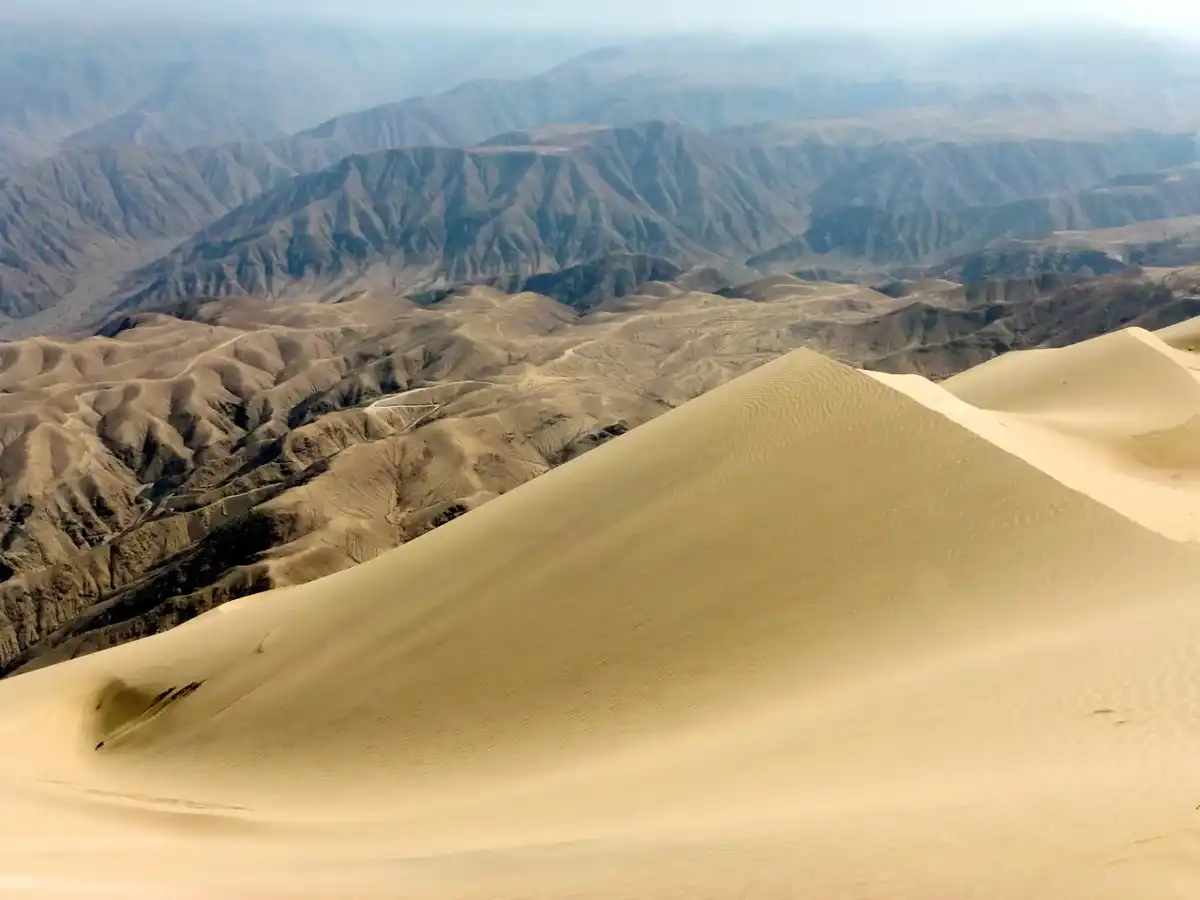
- The summit of Cerro Blanco: The dune rises roughly 2,070 meters above sea level and about 1,200 meters above the Nasca valley floor, and it is often billed as the world’s highest dune, though a taller one stands in Argentina. The climb is a steep, hot slog up a sand ridge that takes several hours, and the view from the top over the desert and the valleys below makes the sweat worthwhile.
- The sandboarding descent: Boards are waxed at the base, and the run down the lee face is long enough that you will feel your thighs before the bottom. Falling is soft but you will end up with sand in every pocket. Beginners can take the first section sitting down, and the sand is fine enough that wipeouts rarely hurt.
- The summit ridge walk: The crest is a knife-edge line of sand, with wind-carved ripples on
- The summit of Cerro Blanco: The dune rises roughly 2,070 meters above sea level and about 1,200 meters above the Nasca valley floor, and it is often billed as the world’s highest dune, though a taller one stands in Argentina. The climb is a steep, hot slog up a sand ridge that takes several hours, and the view from the top over the desert and the valleys below makes the sweat worthwhile.
- The sandboarding descent: Boards are waxed at the base, and the run down the lee face is long enough that you will feel your thighs before the bottom. Falling is soft but you will end up with sand in every pocket. Beginners can take the first section sitting down, and the sand is fine enough that wipeouts rarely hurt.
- The summit ridge walk: The crest is a knife-edge line of sand, with wind-carved ripples on both sides. Walking it in the cooler hours of the day gives you the sharpest shadows and the best photos, and the quiet up there is complete apart from the wind hissing across the grains.
- The Nasca Valley panorama: From the upper slopes you can pick out green irrigated fields squeezed between brown ridges and the pale scar of the desert beyond. The contrast between the oasis farmland and the bare mountains explains why people have lived in this valley for thousands of years.
- The approach across the desert plain: The drive in crosses a flat stony pampa where the dune appears slowly, a pale pyramid against darker brown hills. Seeing its scale build over the final stretch is part of the experience, and it is worth having the camera ready before you arrive.
- The dune’s shifting faces: The windward slope is packed and rippled while the lee side is soft and avalanches in small slides under your boots. Watching the sand flow downhill in sheets is an odd, fascinating sight, and it shows how the dune keeps moving with the wind.
- Sunset from the lower slopes: Late in the day the dune turns warm gold and the hills behind take on deep shadows. You do not need to go all the way up for this, and a spot partway up gives a good frame with less effort.
Spotted a mistake or missing something? Contact us.

Flight over the Nazca Lines from Nazca (35 min)

Nazca Lines + Cantalloc Aqueducts

Nazca Lines Flight Fly with the Experts – English-Speaking Guide

Tour Pyramids of Cahuachi and Textile Workshop

Nazca Lines Tour by Land

Palpa and Nazca Lookouts tour – Highly Recommended

Fly over the Enigmatic Nazca Lines

Nazca Lines flight and Chauchilla Cemetery

Cahuachi Pyramids Tour and Artisanal Workshop in Nazca

 Best Backpacking

 Hi, I’m Johan (Netherlands 🇳🇱), the creator of TakeYourBackpack. Over the past 3 decades, I’ve backpacked through 90+ countries across six continents, gaining extensive experience with independent travel, long-term trips, and overland routes.