

×

Peru🇵🇪 | regionsUros Floating IslandsTotora reeds, floating islands, crescent boats, family hosts | things to do and best time to go

Explore Paracas and the Ballestas IslandsExplore Aguas Calientes

Backpacking in Uros Floating Islands
👌 Worth visitingregion ranked #6
By Johan Kruseman 🇳🇱 | Updated October 18, 2026

Each island is anchored with long stakes driven into the lake bottom, and the reed underfoot gives a soft, springy bounce that you notice on your first step off the boat. The Uros Floating Islands sit on Lake Titicaca in Peru, a short boat ride from the port of Puno. They are touristy, no question, and some islands run like rehearsed demonstrations. Experienced travelers skip the big group boats, pay the community directly on a smaller island, and ask to be dropped where fewer boats dock, because the family gets the money and you get real conversation. I still hear the dry rustle and creak of fresh totora reeds being laid by hand, a sound like walking on stacked straw. Go for the reed boats, the weaving, and the cold lake light. Then end by tasting a raw totora stalk, crunchy and faintly sweet.

Discover everything you want to know in the 📖 Peru Travel Guide.


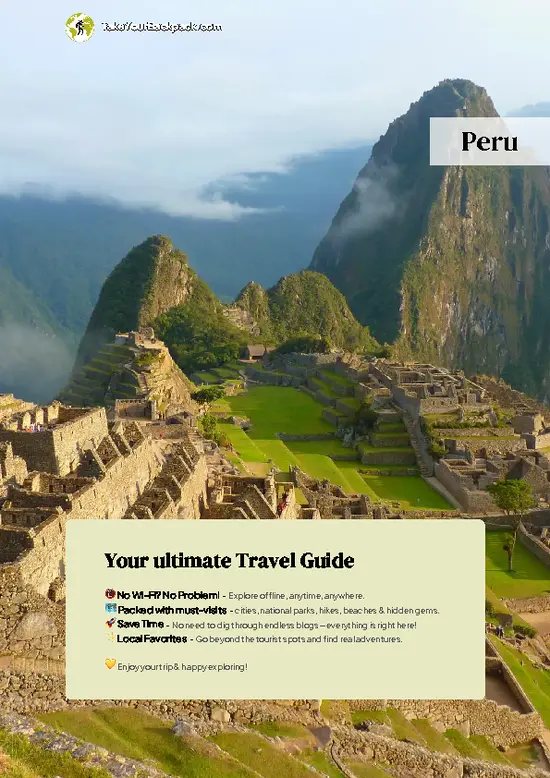
example page 0 from our offline Travel Guide for Peru
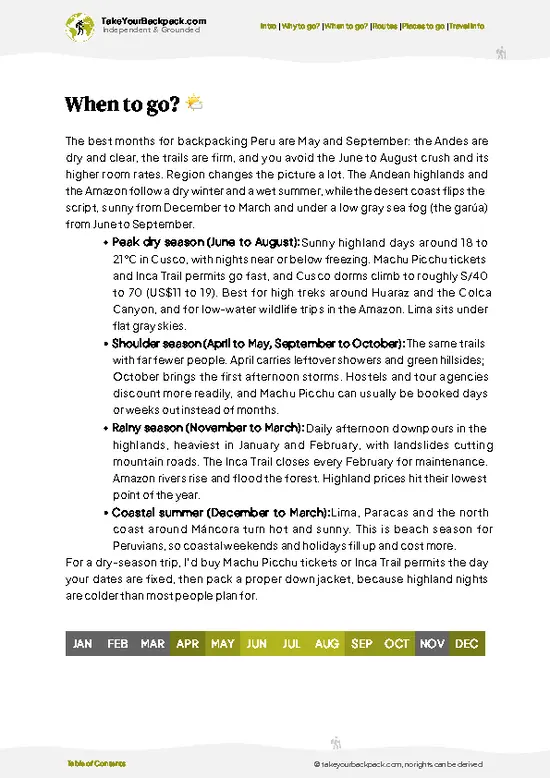
example page 1 from our offline Travel Guide for Peru
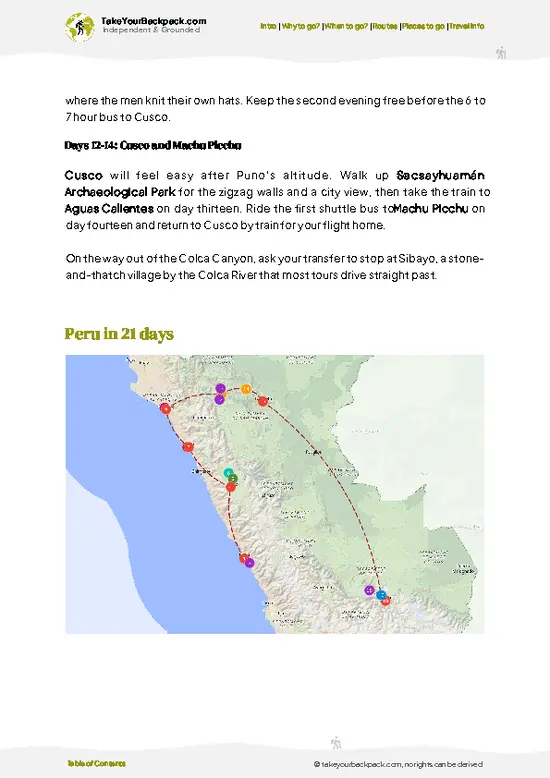
example page 2 from our offline Travel Guide for Peru
example page 3 from our offline Travel Guide for Peru
example page 4 from our offline Travel Guide for Peru
example page 5 from our offline Travel Guide for Peru
example page 6 from our offline Travel Guide for Peru
example page 7 from our offline Travel Guide for Peru
Loading the map 🌍
CLICK TO FILTER
cities
towns
villages
landmarks
national parks
hikes
beaches
attractions
festivals
regions
SHOW COUNTRY’S BESTSHOW ALL

✨ Why go?
Ranked #6 region in Peru
Reasons people choose to visit here

Uros Floating Islands gives you a living culture on the water, which is the whole reason backpackers add it to a Puno stay. Dozens of man-made islands are built from layered totora reeds, and families still rebuild the surface every few weeks as the bottom layer rots. You see how houses, kitchens, and even watchtowers are made from one plant, and you can eat the white base of the stalk. Logistics are easy. Boats leave from Puno harbor, so you can see the islands in a morning and still have the afternoon free for the city or a bus onward. The trip also pairs well with an overnight on Amantaní or Taquile, letting you combine culture and slow lake travel without constant repacking. Staying overnight with an Uros family is possible on some islands, and it is the quieter way to see them once the … read more 👉
Uros Floating Islands gives you a living culture on the water, which is the whole reason backpackers add it to a Puno stay. Dozens of man-made islands are built from layered totora reeds, and families still rebuild the surface every few weeks as the bottom layer rots. You see how houses, kitchens, and even watchtowers are made from one plant, and you can eat the white base of the stalk. Logistics are easy. Boats leave from Puno harbor, so you can see the islands in a morning and still have the afternoon free for the city or a bus onward. The trip also pairs well with an overnight on Amantaní or Taquile, letting you combine culture and slow lake travel without constant repacking. Staying overnight with an Uros family is possible on some islands, and it is the quieter way to see them once the day boats leave. Expect simple beds, thick blankets, and an early morning silence over the water.

💡 HighlightsMust-see experiences and standout moments

  1. Totora reed island visit: Walk on a floating island of layered reeds and watch families explain how they cut, stack, and renew the base.
  2. Totora reed boat ride: The crescent-shaped balsa boats, some with dragon-like prows, cross between islands for a small fee.
  3. Reed house interiors: Step inside a one-room home to see woven mats, solar panels, and bedding stacked on the reed floor.
  4. Eating totora stalks: Peel the white base and chew it; locals eat it as a snack, and it tastes mildly sweet and crisp.
  5. Handmade textile stalls: Embroidered panels depict island life, and buying directly from the maker is the best way to support families.
  6. Watchtower viewpoint: Many islands have a reed tower that gives a flat, wide view across the lake and the channels between islands.
  7. Island model demonstrations: A short
… read more 👉
  1. Totora reed island visit: Walk on a floating island of layered reeds and watch families explain how they cut, stack, and renew the base.
  2. Totora reed boat ride: The crescent-shaped balsa boats, some with dragon-like prows, cross between islands for a small fee.
  3. Reed house interiors: Step inside a one-room home to see woven mats, solar panels, and bedding stacked on the reed floor.
  4. Eating totora stalks: Peel the white base and chew it; locals eat it as a snack, and it tastes mildly sweet and crisp.
  5. Handmade textile stalls: Embroidered panels depict island life, and buying directly from the maker is the best way to support families.
  6. Watchtower viewpoint: Many islands have a reed tower that gives a flat, wide view across the lake and the channels between islands.
  7. Island model demonstrations: A short talk using small reed models shows how islands are cut, anchored, and joined.
  8. Overnight homestay on a small island: A lesser-known option; you share dinner and wake to the lake before the day boats arrive.
  9. Quiet outer islands: Fewer boats stop at the farther islands, so you get longer conversations and less sales pressure.
  10. Reed-ringed channel paddling: Some families offer a slow paddle through the narrow channels away from the main dock, a calm way to see how the islands are connected.
Do the island visit and reed boat ride first, because the morning light is calmer and the groups are smaller before midday.
Spotted a mistake or missing something? Contact us.

Things to do around Uros Floating Islands

Ratings based on Tripadvisor reviews. When you book through this link, you support our work at no extra cost to you.

⌛️ 5 daysA smart one-week plan

Day 1: Puno: Spend the first day in Puno to adjust to the altitude of the lake, which sits above 3,800 meters. Walk the harbor, book a small-group boat, and keep the day easy. Transport here is boat-driven, so timing is set by departures from the harbor each morning.
Day 2: Uros Floating Islands: Take an early boat to the Uros Floating Islands, when the water is flat and the reed mats are still damp from the night. Ask to visit a smaller island so your money goes to a family directly. Try the reed boat, eat a stalk, and buy one textile from the maker. Return to Puno by early afternoon.
Day 3: Amantaní: Continue by boat to Amantaní for a homestay. This is the detour: the boat can stop at the islands on the way, so you gain a night of village life without extra backtracking. Climb the island’s … read more 👉
Day 1: Puno: Spend the first day in Puno to adjust to the altitude of the lake, which sits above 3,800 meters. Walk the harbor, book a small-group boat, and keep the day easy. Transport here is boat-driven, so timing is set by departures from the harbor each morning.
Day 2: Uros Floating Islands: Take an early boat to the Uros Floating Islands, when the water is flat and the reed mats are still damp from the night. Ask to visit a smaller island so your money goes to a family directly. Try the reed boat, eat a stalk, and buy one textile from the maker. Return to Puno by early afternoon.
Day 3: Amantaní: Continue by boat to Amantaní for a homestay. This is the detour: the boat can stop at the islands on the way, so you gain a night of village life without extra backtracking. Climb the island’s hill shrine at dusk, then eat with your host family.
Day 4: Taquile: Move on to Taquile, where the knitting culture and stone terraces contrast with the reed islands. Boats link the two islands in a short ride, which keeps the pace unhurried.
Day 5: Puno: Return to Puno by midday boat and catch an onward bus.

If you only keep one day, make it Day 2. A quiet reed island in early light is the whole reason to come.

🌤️ When to go?When to go for the best experience

Visit between May and September for the driest, sunniest weather on Lake Titicaca, with the Uros islands sitting at about 3,810 m (12,500 ft).
  • Dry Season (May to September): Days run 15 to 18°C (59 to 64°F), skies are bright, and nights drop to -2 to 3°C (28 to 37°F). Daylight lasts roughly 11 to 12 hours. Boats fill by late morning in July and August, and prices for homestays creep up.
  • Wet Season (December to March): Afternoon storms are common, days reach 14 to 17°C (57 to 63°F), and nights stay milder at 3 to 6°C (37 to 43°F). Crowds thin, and boat trips are cheaper, though choppy water can cancel departures.
  • Shoulder Months (April, October, November): Mixed sun and clouds, quiet islands, and fair prices.
  • Festival Time: Puno’s Virgen de la Candelaria celebrations in February bring crowds and
… read more 👉
Visit between May and September for the driest, sunniest weather on Lake Titicaca, with the Uros islands sitting at about 3,810 m (12,500 ft).
  • Dry Season (May to September): Days run 15 to 18°C (59 to 64°F), skies are bright, and nights drop to -2 to 3°C (28 to 37°F). Daylight lasts roughly 11 to 12 hours. Boats fill by late morning in July and August, and prices for homestays creep up.
  • Wet Season (December to March): Afternoon storms are common, days reach 14 to 17°C (57 to 63°F), and nights stay milder at 3 to 6°C (37 to 43°F). Crowds thin, and boat trips are cheaper, though choppy water can cancel departures.
  • Shoulder Months (April, October, November): Mixed sun and clouds, quiet islands, and fair prices.
  • Festival Time: Puno’s Virgen de la Candelaria celebrations in February bring crowds and higher lodging rates.
Board the first boat from Puno around 8 a.m. to reach the reed islands before the tour groups.


source: climatestotravel.comJANJanuary: fair for travelingFEBFebruary: fair for travelingMARMarch: fair for travelingAPRApril: good for travelingMAYMay: highly recommended for travelingJUNJune: excellent for travelingJULJuly: excellent for travelingAUGAugust: highly recommended for travelingSEPSeptember: highly recommended for travelingOCTOctober: highly recommended for travelingNOVNovember: fair for travelingDECDecember: fair for traveling
peru-region-uros-floating-islands
© Google |

✈️ The backpacker research shortcutPeru Travel Guide

An offline-friendly backpacking guide with optimized travel routes, ranked highlights, transport advice, and the best areas to stay.
example page 0 from our offline Travel Guide for Peru
example page 1 from our offline Travel Guide for Peru
example page 2 from our offline Travel Guide for Peru
example page 3 from our offline Travel Guide for Peru
example page 4 from our offline Travel Guide for Peru
example page 5 from our offline Travel Guide for Peru
example page 6 from our offline Travel Guide for Peru
example page 7 from our offline Travel Guide for Peru
The digital guide (310 pages) contains:
✅ 102 highlights, ranked by travel appeal
✅ Optimized 7, 14 & 21-day travel routes
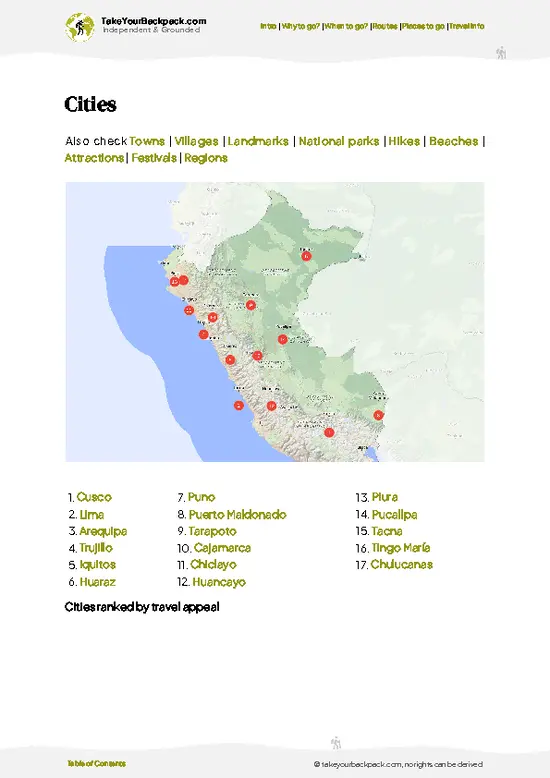
✅ Cities, national parks, landmarks, beaches
✅ How to get around
✅ Offline-friendly for travel without Wi-Fi
👉 Click to see all 30+ guide features

📅 Plan smarter in minutes, not weeks
✅ Month by month travel advice
✅ Festivals & national holidays
✅ Budget expectations

🗺️ Go to the right places, skip the overrated ones
✅ Honest pros & cons of destinations
✅ Top hikes, parks & viewpoints
✅ Lesser-known places most travelers miss
✅ Clear “worth it vs skip it” guidance

🛏️ Travel smoothly without rookie mistakes
✅ Best areas to stay
✅ Transport systems explained simply
✅ Common scams & safety advice
✅ SIM cards, money & practical tips

🌍 Understand the country, not just visit it
✅ Culture & traditions
✅ 52 Essential phrases & customs
✅ Festivals worth planning around
✅ Traveler-friendly historical context
✅ Insights that make places more meaningful

📱 Built for real travel conditions
✅ Fully downloadable PDF
✅ Works completely offline
✅ Optimized for phone use
✅ Useful in remote areas & buses
✅ Everything in one place
Stop searching, start planning
Get instant access to your full guide. 30‑day money-back guarantee.
+ Add another guide for just

By proceeding you agree to our terms.
Sent to your inbox immediately after payment • 100% Secure Checkout
Best Backpacking Travel Advisor 2025 tourism awardBest Backpacking
Travel Advisor
2025
What others say about Take Your Backpack Guides:
⭐⭐⭐⭐⭐
Fantastic, amazing amount of information!
⭐⭐⭐⭐⭐
My goodness this is amazing, it's what I've been looking for hats off too you!
⭐⭐⭐⭐⭐
I think this is absolutely BRILLIANT
⭐⭐⭐⭐
Very complete and informative. It's still missing places, but I gotta to commend you
⭐⭐⭐⭐⭐
This is truly amazing, thank you, can't wait to explore it with my kids!
⭐⭐⭐⭐⭐
Awesome resource, thank you!
⭐⭐⭐⭐⭐
This is amazing! Can't wait to explore the ones I haven't seen
⭐⭐⭐⭐
I love this! Well done, great idea.
⭐⭐⭐⭐⭐
Thanks for taking the time to make this gem!
⭐⭐⭐⭐⭐
This might be the best website I've ever seen.
⭐⭐⭐⭐⭐
Congratulations, and thank you so much for your work; it's incredibly valuable.
⭐⭐⭐⭐
In all seriousness I think you did a great job pointing out the important spots
⭐⭐⭐⭐⭐
10/10 very good
⭐⭐⭐⭐⭐
As someone who's only just starting to visit regularly this is awesome, thank you.
⭐⭐⭐⭐
Thank you very much! I'm going to visit my dad, it's going to be very useful!
⭐⭐⭐⭐⭐
This is really cool! We'll be travelling for the first time and this definitely come in handy.
⭐⭐⭐⭐⭐
You are now our minister of culture, congratulations 👨‍💼
⭐⭐⭐⭐⭐
Just wanted to tell you that this is a pearl! Going to follow your recommendations.
⭐⭐⭐⭐⭐
This is so cool. I'll definitely be using the resource for my travels soon.
⭐⭐⭐⭐⭐
This is very impressive! Good work.
⭐⭐⭐⭐⭐
This is an amazing and informative site. Very well done!

🛏️ Where to stay?Choosing the right base

Puno is the town to stay in, and nearly every backpacker visiting the Uros islands sleeps there. It sits on the lake shore, and the harbor lies a short mototaxi ride from the center. Dorm beds usually run US$8 to 15 a night, with private rooms from US$20 to 40.
The streets around the Plaza de Armas and the pedestrian Jirón Lima are the most social area. Cafés, pizza places, tour desks, and evening bars sit within a few blocks, so solo travelers meet others easily. The area is well lit and busy into the evening, though you should still watch your bag on crowded corners.
A quieter option is the zone … read more 👉
Puno is the town to stay in, and nearly every backpacker visiting the Uros islands sleeps there. It sits on the lake shore, and the harbor lies a short mototaxi ride from the center. Dorm beds usually run US$8 to 15 a night, with private rooms from US$20 to 40.
The streets around the Plaza de Armas and the pedestrian Jirón Lima are the most social area. Cafés, pizza places, tour desks, and evening bars sit within a few blocks, so solo travelers meet others easily. The area is well lit and busy into the evening, though you should still watch your bag on crowded corners.
A quieter option is the zone near the lakefront and the harbor, which gets you to the first boats quickly and costs a little less. Some visitors also choose a homestay on one of the reed islands for a night, which costs about US$20 to 35 with meals. Expect a basic mattress, cold nights, and no hot showers, but you get the lake to yourself at dawn.

🚌 Getting aroundTransportation options and practical tips

A shared boat from Puno to the Uros islands costs about US$3 to 5 per person, and you pay the boat operator in cash at the dock in soles. Most backpackers stick to that route, and it is reliable in the dry season. Expect a short ride of about 20 to 30 minutes each way.
  • Shared Tourist Boat: Boats leave the Puno harbor throughout the morning and cost US$3 to 5 for the Uros stop only. Buying at the dock beats the agency desks in town, which add a commission for the identical seat. Prices on the pier are posted, so check them before you hand over cash.
  • Combined Tour with Taquile: Half-day Uros trips cost about US$8 to 12, while a full day with Taquile runs US$15 to 25. Agencies bundle them because Taquile is two to three hours farther by boat. If you have the time, go direct and skip the extra hustle.
… read more 👉
A shared boat from Puno to the Uros islands costs about US$3 to 5 per person, and you pay the boat operator in cash at the dock in soles. Most backpackers stick to that route, and it is reliable in the dry season. Expect a short ride of about 20 to 30 minutes each way.
  • Shared Tourist Boat: Boats leave the Puno harbor throughout the morning and cost US$3 to 5 for the Uros stop only. Buying at the dock beats the agency desks in town, which add a commission for the identical seat. Prices on the pier are posted, so check them before you hand over cash.
  • Combined Tour with Taquile: Half-day Uros trips cost about US$8 to 12, while a full day with Taquile runs US$15 to 25. Agencies bundle them because Taquile is two to three hours farther by boat. If you have the time, go direct and skip the extra hustle.
  • Mototaxi to the Dock: A three-wheeler from central Puno costs about US$1 to 2. Hail one on the street rather than at the hotel door, where the price jumps. Agree on the fare before you climb in.
  • Walking: The harbor sits roughly 15 to 25 minutes from Puno’s main plaza, and a downhill stroll through the morning market streets is part of the fun. Carry small bills for the stalls on the way.
  • Private Boat: A charter for a small group costs roughly US$20 to 40, and it lets you head out before the crowds or linger as the light shifts. It helps most if you want photographs without a tour group in the frame.
Bring small coins and bills, since island families rarely have change for large notes and the extra reed boat rides cost about US$1 to 2.

🍲 FoodEating & Drinking in Uros Floating Islands

Lake Titicaca food is built on the water and the altiplano. Trucha (lake trout) arrives grilled, fried, or in a lime-sharp ceviche, with crisp skin and sweet pink flesh. On the islands, families sometimes offer fried fish and boiled potatoes with huacatay sauce. Warm quinoa soup is the cold-morning fix, thick with vegetables and herbs, and mate de coca helps at this altitude.
In Puno, the central market is the best value, with set lunches (menú) at roughly US$2 to 4 and fresh bread and fruit juices at dawn. Cafés around Jirón Lima serve alpaca steaks, coffee, and trout for US$6 to 12. For a snack, try choclo con queso, large-kernel corn with a slab of fresh cheese.
Greet people before ordering, and expect your meal to arrive in courses, soup first. Tipping is small, around 10 percent where service … read more 👉
Lake Titicaca food is built on the water and the altiplano. Trucha (lake trout) arrives grilled, fried, or in a lime-sharp ceviche, with crisp skin and sweet pink flesh. On the islands, families sometimes offer fried fish and boiled potatoes with huacatay sauce. Warm quinoa soup is the cold-morning fix, thick with vegetables and herbs, and mate de coca helps at this altitude.
In Puno, the central market is the best value, with set lunches (menú) at roughly US$2 to 4 and fresh bread and fruit juices at dawn. Cafés around Jirón Lima serve alpaca steaks, coffee, and trout for US$6 to 12. For a snack, try choclo con queso, large-kernel corn with a slab of fresh cheese.
Greet people before ordering, and expect your meal to arrive in courses, soup first. Tipping is small, around 10 percent where service is not added. Bring your own water bottle to refill, since island meals are plain and drinks are limited. Eat before a boat trip rather than after.

FAQTraveler FAQ

Half a day is enough for Uros Floating Islands, though a full day works better if you add Taquile. The boat from Puno takes about 20 to 30 minutes each way, and a typical visit lasts one to two hours. A half-day tour costs around US$8 to 12, and a Taquile combination runs about US$15 to 25.
Reach Uros Floating Islands by shared boat from the Puno harbor, with no car needed. Tickets cost about US$3 to 5, and boats leave regularly through the morning. A mototaxi from central Puno to the dock costs about US$1 to 2, or you can walk in 15 to 25 minutes.
Uros Floating Islands is known for its artificial islands built from layers of totora reeds on Lake Titicaca, home to the Uros people. Families live in reed houses, travel in reed boats, and sell woven textiles. The islands lie roughly 5 to 7 km from Puno, and they sit at about 3,810 m above sea level.
⚠️ Things can change over time, so always validate details locally before you go.

Other Peruvian regions near Uros Floating Islands

Explore more nearby:

  • Lake Titicaca—Island homestays, reed boats, chullpa towers, Puno shoreline| 48 km away
  • Sacred Valley—Inca terraces, salt pans, Sunday markets, fortress towns| 360 km away
  • Huacachina Desert Oasis—Dune buggies, sandboarding, lagoon boardwalk, pisco vineyards| 651 km away

💡 Not sure where to go next?
Create a personalized itinerary for Peru including Uros Floating Islands and the places that fit your trip.

Generate my itinerary

👉 Discover all regions

Or checkout all Peru has to offer (think cities, towns, villages, national parks, hikes, beaches, festivals)
Country photo of Peru

We 💚 feedbackKey takeaways before you go

Uros Floating Islands needs half a day, and that is enough for the reeds, boats, and textiles. Stay overnight only if you want a quiet evening with a family and are happy with basic beds. I would choose a smaller island, go early, and bring small bills to buy directly from the makers.

✈️ When did I visit Peru?
Peru I visited during my half year trip through South and Central America back in 2003

✍️ Help improve this page!
The information on this page is based on my own backpacking experience in Peru, supplemented with up-to-date research and feedback from other travelers. Travel details can change, so if you notice anything outdated or incomplete, feel free to let me know.


🙋‍♂️ Give feedback

👋 Meet the founderWho’s Behind Take Your Backpack?

Johan, backpacker and founder of TakeYourBackpackHi, I’m Johan (Netherlands 🇳🇱), the creator of TakeYourBackpack. Over the past 3 decades, I’ve backpacked through 90+ countries across six continents, gaining extensive experience with independent travel, long-term trips, and overland routes.

This site is built on a combination of firsthand travel experience and carefully curated insights from other backpackers. Many guides are based on places I’ve personally visited, while others bring together tips, observations, and practical advice shared by trusted travelers I’ve met along the way.

The goal is to provide realistic, experience-driven guidance — not generic itineraries — so you can explore destinations with better context, clearer expectations, and more confidence.