×

Puerto Rico🇵🇷 | landmarksFajardo Bioluminescent BayMangrove channel, blue-green glow, moonless night, Las Croabas | things to do and best time to go

Explore Cueva VentanaExplore Old San Juan’s hidden plazas

Backpacking in Fajardo Bioluminescent Bay
🏆 Top pickunique site ranked #2
By Johan Kruseman 🇳🇱 | Updated October 22, 2026

The route in starts in a narrow, dark channel through red mangroves, where the first flashes show up as fish dart away from your paddle, well before the open lagoon appears. That channel is the real opening act at Laguna Grande, the bioluminescent bay in Las Croabas, on the northeast coast of Puerto Rico, east of San Juan. The glow comes from dinoflagellates that flare blue-green when the water moves. It is worth doing, and the wow is real, but it is quiet and subtle rather than a light show. Book a kayak tour on a moonless night, because a bright moon washes it out, and skip bug spray beforehand. Guided groups can be big and the glow is faint in photos, so put the camera away. Electric boats are easier but less magical. Spend the afternoon at the Las Croabas waterfront, eat early, and paddle after dark.

Discover everything you want to know in the 📖 Puerto Rico Travel Guide.


example page 0 from our offline Travel Guide for Puerto Rico
example page 1 from our offline Travel Guide for Puerto Rico
example page 2 from our offline Travel Guide for Puerto Rico
example page 3 from our offline Travel Guide for Puerto Rico
example page 4 from our offline Travel Guide for Puerto Rico
example page 5 from our offline Travel Guide for Puerto Rico
example page 6 from our offline Travel Guide for Puerto Rico
example page 7 from our offline Travel Guide for Puerto Rico
Loading the map 🌍
CLICK TO FILTER
cities
towns
villages
landmarks
national parks
hikes
beaches
attractions
festivals
regions
SHOW COUNTRY’S BESTSHOW ALL

✨ Why go?
Ranked #2 unique site in Puerto Rico
What makes this unique site worth visiting

Fajardo Bioluminescent Bay is one of only a handful of places on earth where this glow is stable enough to schedule a night around, and it lives in a protected lagoon on Puerto Rico’s main island. You can reach it without a ferry or a flight, which makes it the easiest bioluminescence on the island and a much simpler option than the famous bay on Vieques.

The mangrove channel is the part that sticks with you. Paddling through it in near darkness, with fish sparking light under your blade and your hand trailing blue-green fire, is a physical experience you will not get from a photo. Kayaking also lets you choose your effort level, and first-timers manage it fine in a tandem boat.

The site fits well into an east coast loop. Daytime belongs to the Las Cabezas de San Juan reserve and the beaches … read more 👉
Fajardo Bioluminescent Bay is one of only a handful of places on earth where this glow is stable enough to schedule a night around, and it lives in a protected lagoon on Puerto Rico’s main island. You can reach it without a ferry or a flight, which makes it the easiest bioluminescence on the island and a much simpler option than the famous bay on Vieques.

The mangrove channel is the part that sticks with you. Paddling through it in near darkness, with fish sparking light under your blade and your hand trailing blue-green fire, is a physical experience you will not get from a photo. Kayaking also lets you choose your effort level, and first-timers manage it fine in a tandem boat.

The site fits well into an east coast loop. Daytime belongs to the Las Cabezas de San Juan reserve and the beaches near Fajardo, with the lagoon as the evening finale. That gives you a full day from one base, and the night tour then feels like a reward rather than a detour.

💡 HighlightsWhat this place is best known for

  1. Bioluminescence in Laguna Grande: The headline act. Microscopic dinoflagellates light up wherever the water is disturbed, so each paddle stroke leaves a blue-green trail. The glow is strongest on dark, moonless nights and fades under a bright moon or heavy cloud.
  2. The mangrove channel: A narrow passage lined with red mangroves leads into the lagoon. It is tight, dark, and busy with fish, and many people find it more exciting than the open water.
  3. Night kayak tour: The classic way in, with guides who handle the paddling logistics and explain the biology. Tandem kayaks are common, and you stay close to the group in the dark.
  4. Electric boat tour: The seated alternative for anyone who cannot paddle. It is quieter than a motor, but you sit higher above the water, so the glow is harder to see up close.
… read more 👉
  1. Bioluminescence in Laguna Grande: The headline act. Microscopic dinoflagellates light up wherever the water is disturbed, so each paddle stroke leaves a blue-green trail. The glow is strongest on dark, moonless nights and fades under a bright moon or heavy cloud.
  2. The mangrove channel: A narrow passage lined with red mangroves leads into the lagoon. It is tight, dark, and busy with fish, and many people find it more exciting than the open water.
  3. Night kayak tour: The classic way in, with guides who handle the paddling logistics and explain the biology. Tandem kayaks are common, and you stay close to the group in the dark.
  4. Electric boat tour: The seated alternative for anyone who cannot paddle. It is quieter than a motor, but you sit higher above the water, so the glow is harder to see up close.
  5. Las Croabas waterfront: The small fishing village where the tours launch. The seafood kiosks and restaurants make a good pre-tour meal, and the sunset sky over the water is worth a short wait.
  6. Las Cabezas de San Juan Nature Reserve: A daytime counterpart to the lagoon, with a restored Spanish lighthouse called El Faro, boardwalks through mangroves, and a coastal dry forest. Entry is by guided visit, so reserve ahead.
  7. Playa Seven Seas: A calm, shallow beach in Fajardo with soft sand and shade, handy for a swim before an evening tour.
  8. Stargazing from the lagoon: With the sky dark and no streetlights close by, the stars sit low over the mangroves. A clear night gives you a double show, in the water and overhead.
For a first visit, the night kayak tour through the mangrove channel is the one to book, since it puts you right at the water where the glow is brightest.
Spotted a mistake or missing something? Contact us.

Things to do around Fajardo Bioluminescent Bay

Ratings based on Tripadvisor reviews. When you book through this link, you support our work at no extra cost to you.

🌤️ When to go?Best time to visit Fajardo Bioluminescent Bay

  • New Moon Weeks: Darkness decides everything here. Book tours within a few days of the new moon, when the glow of dinoflagellates is strongest. A full moon washes it out noticeably.
  • Winter and Spring (December to April): Drier, with highs of 27 to 29°C (81 to 84°F) and nights near 21 to 23°C (70 to 73°F). Sunset comes early, so evening tours start sooner. Tour prices and beds run highest, and weekend slots sell out.
  • Summer (June to September): Hotter, at 30 to 32°C (86 to 90°F), with humid nights and afternoon thunderstorms. Rain can cancel a tour or cloud the experience, but cancellations are usually rebooked. Evenings stay light longer. Rates soften a bit.
  • Hurricane Season (August to October): Storms can close the bay for days and sometimes longer. Flexible plans help.
  • Holiday Weekends: Christmas,
… read more 👉
  • New Moon Weeks: Darkness decides everything here. Book tours within a few days of the new moon, when the glow of dinoflagellates is strongest. A full moon washes it out noticeably.
  • Winter and Spring (December to April): Drier, with highs of 27 to 29°C (81 to 84°F) and nights near 21 to 23°C (70 to 73°F). Sunset comes early, so evening tours start sooner. Tour prices and beds run highest, and weekend slots sell out.
  • Summer (June to September): Hotter, at 30 to 32°C (86 to 90°F), with humid nights and afternoon thunderstorms. Rain can cancel a tour or cloud the experience, but cancellations are usually rebooked. Evenings stay light longer. Rates soften a bit.
  • Hurricane Season (August to October): Storms can close the bay for days and sometimes longer. Flexible plans help.
  • Holiday Weekends: Christmas, Easter week and long weekends fill tours weeks ahead.
Book your tour for a weekday evening within three days of a new moon, and keep a spare night in your plans in case of rain.


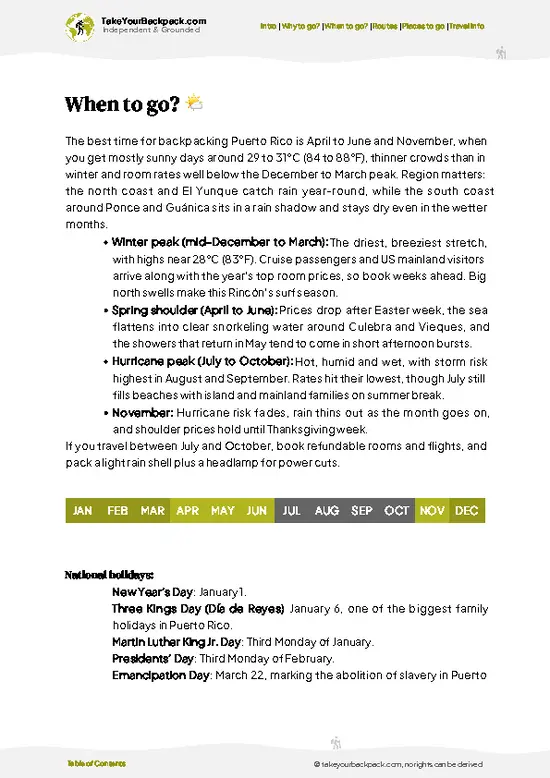
source: climatestotravel.comJANJanuary: excellent for travelingFEBFebruary: excellent for travelingMARMarch: excellent for travelingAPRApril: highly recommended for travelingMAYMay: fair for travelingJUNJune: fair for travelingJULJuly: fair for travelingAUGAugust: fair for travelingSEPSeptember: below average for travelingOCTOctober: below average for travelingNOVNovember: fair for travelingDECDecember: excellent for traveling
when-to-go

✈️ The backpacker research shortcutPuerto Rico Travel Guide

An offline-friendly backpacking guide with optimized travel routes, ranked highlights, transport advice, and the best areas to stay.
example page 0 from our offline Travel Guide for Puerto Rico
example page 1 from our offline Travel Guide for Puerto Rico
example page 2 from our offline Travel Guide for Puerto Rico
example page 3 from our offline Travel Guide for Puerto Rico
example page 4 from our offline Travel Guide for Puerto Rico
example page 5 from our offline Travel Guide for Puerto Rico
example page 6 from our offline Travel Guide for Puerto Rico
example page 7 from our offline Travel Guide for Puerto Rico
The digital guide (310 pages) contains:
✅ 81 highlights, ranked by travel appeal
✅ Optimized 5, 10 & 15-day travel routes
✅ Cities, national parks, landmarks, beaches
✅ How to get around
✅ Offline-friendly for travel without Wi-Fi
👉 Click to see all 30+ guide features

📅 Plan smarter in minutes, not weeks
✅ Month by month travel advice
✅ Festivals & national holidays
✅ Budget expectations

🗺️ Go to the right places, skip the overrated ones
✅ Honest pros & cons of destinations
✅ Top hikes, parks & viewpoints
✅ Lesser-known places most travelers miss
✅ Clear “worth it vs skip it” guidance

🛏️ Travel smoothly without rookie mistakes
✅ Best areas to stay
✅ Transport systems explained simply
✅ Common scams & safety advice
✅ SIM cards, money & practical tips

🌍 Understand the country, not just visit it
✅ Culture & traditions
✅ 52 Essential phrases & customs
✅ Festivals worth planning around
✅ Traveler-friendly historical context
✅ Insights that make places more meaningful

📱 Built for real travel conditions
✅ Fully downloadable PDF
✅ Works completely offline
✅ Optimized for phone use
✅ Useful in remote areas & buses
✅ Everything in one place
Stop searching, start planning
Get instant access to your full guide. 30‑day money-back guarantee.
+ Add another guide for just

By proceeding you agree to our terms.
Sent to your inbox immediately after payment • 100% Secure Checkout
Best Backpacking Travel Advisor 2025 tourism awardBest Backpacking
Travel Advisor
2025
What others say about Take Your Backpack Guides:
⭐⭐⭐⭐⭐
Fantastic, amazing amount of information!
⭐⭐⭐⭐⭐
My goodness this is amazing, it's what I've been looking for hats off too you!
⭐⭐⭐⭐⭐
I think this is absolutely BRILLIANT
⭐⭐⭐⭐
Very complete and informative. It's still missing places, but I gotta to commend you
⭐⭐⭐⭐⭐
This is truly amazing, thank you, can't wait to explore it with my kids!
⭐⭐⭐⭐⭐
Awesome resource, thank you!
⭐⭐⭐⭐⭐
This is amazing! Can't wait to explore the ones I haven't seen
⭐⭐⭐⭐
I love this! Well done, great idea.
⭐⭐⭐⭐⭐
Thanks for taking the time to make this gem!
⭐⭐⭐⭐⭐
This might be the best website I've ever seen.
⭐⭐⭐⭐⭐
Congratulations, and thank you so much for your work; it's incredibly valuable.
⭐⭐⭐⭐
In all seriousness I think you did a great job pointing out the important spots
⭐⭐⭐⭐⭐
10/10 very good
⭐⭐⭐⭐⭐
As someone who's only just starting to visit regularly this is awesome, thank you.
⭐⭐⭐⭐
Thank you very much! I'm going to visit my dad, it's going to be very useful!
⭐⭐⭐⭐⭐
This is really cool! We'll be travelling for the first time and this definitely come in handy.
⭐⭐⭐⭐⭐
You are now our minister of culture, congratulations 👨‍💼
⭐⭐⭐⭐⭐
Just wanted to tell you that this is a pearl! Going to follow your recommendations.
⭐⭐⭐⭐⭐
This is so cool. I'll definitely be using the resource for my travels soon.
⭐⭐⭐⭐⭐
This is very impressive! Good work.
⭐⭐⭐⭐⭐
This is an amazing and informative site. Very well done!

🛏️ Where to stay?Where staying makes the most sense

Fajardo town is the practical base for backpackers, with the pick-up points for tours and the most affordable beds in the area. Staying within a short ride of the Las Croabas waterfront puts you close to the departure docks and the seafood kiosks there. That matters because tours run after dark, when getting back by rideshare or bus is harder.

Fajardo proper has hostels, guesthouses and small inns in the US$40 to 90 range, along with a few budget rooms near the town center. Buses and shared vans run here during the day, and local eateries stay open late enough for a post-tour meal. It is the … read more 👉
Fajardo town is the practical base for backpackers, with the pick-up points for tours and the most affordable beds in the area. Staying within a short ride of the Las Croabas waterfront puts you close to the departure docks and the seafood kiosks there. That matters because tours run after dark, when getting back by rideshare or bus is harder.

Fajardo proper has hostels, guesthouses and small inns in the US$40 to 90 range, along with a few budget rooms near the town center. Buses and shared vans run here during the day, and local eateries stay open late enough for a post-tour meal. It is the best choice for solo travelers who want other people around and a lower bill.

Las Croabas, a fishing village at the end of the road, is quieter and more local. Rooms are fewer, and guesthouses or rentals run roughly US$70 to 140. You can walk to the water and kiosks, and it feels safe in the evening because it is small and lively with families.

Luquillo, about 20 minutes west, offers cheaper rentals, a beachfront kiosk strip and an easy-going crowd. It works if you have a car or share rides with new friends.

👛 Costs (as of 22 October 2026)How expensive it really is

A night at Fajardo Bioluminescent Bay costs a backpacker roughly US$125 to 245 per day, with the tour itself the biggest single expense. Travelers pay in US dollars, and prices below are typical ranges.
CategoryBudget RangeLocal Reality
Bioluminescent bay tourUS$55 to 80Kayak tours run about 2 to 3 hours and cost more than electric boat rides. Prices rise on weekends and holidays.
Accommodation (high season)US$40 to 90Hostel beds and simple guesthouse rooms in Fajardo. Low season rates can drop by US$10 to 20.
FoodUS$20 to 35Fried snacks, fish plates and rice-and-beans lunches at kiosks in Las Croabas. Sit-down seafood costs more.
Local transportUS$10 to 30Rideshare or taxi between town and the tour dock, which is a short ride. Late returns cost more.
Parking and extrasUS$0 to 10Some tour operators
… read more 👉
A night at Fajardo Bioluminescent Bay costs a backpacker roughly US$125 to 245 per day, with the tour itself the biggest single expense. Travelers pay in US dollars, and prices below are typical ranges.
CategoryBudget RangeLocal Reality
Bioluminescent bay tourUS$55 to 80Kayak tours run about 2 to 3 hours and cost more than electric boat rides. Prices rise on weekends and holidays.
Accommodation (high season)US$40 to 90Hostel beds and simple guesthouse rooms in Fajardo. Low season rates can drop by US$10 to 20.
FoodUS$20 to 35Fried snacks, fish plates and rice-and-beans lunches at kiosks in Las Croabas. Sit-down seafood costs more.
Local transportUS$10 to 30Rideshare or taxi between town and the tour dock, which is a short ride. Late returns cost more.
Parking and extrasUS$0 to 10Some tour operators include parking or lockers. Bring insect repellent and cash for tips.
Total Daily BudgetUS$125 to 245Midpoint of about US$135 to 195 for a typical day with one tour night.
⚠️ Prices can change and everyone travels differently, so take this as a rough guide. Hope it helps you plan your adventure!

FAQTraveler FAQ

Fajardo Bioluminescent Bay, also known as Laguna Grande, is a lagoon in Las Croabas where microscopic dinoflagellates light up bright blue when the water is disturbed. It is one of three permanent bioluminescent bays in Puerto Rico, alongside Mosquito Bay in Vieques and La Parguera in Lajas. Tours run after dark by kayak or electric boat and cost roughly US$55 to 80.
Plan on about 2 to 3 hours for the tour itself at Fajardo Bioluminescent Bay, plus travel to the dock. Most travelers spend one evening, ideally within a few days of the new moon. Adding a morning for the beaches or the Cabezas de San Juan reserve makes a half-day out of the visit.
Most travelers drive about 45 minutes from San Juan east to Fajardo Bioluminescent Bay, then continue a short way to Las Croabas. Without a car, take a rideshare or taxi from San Juan, which usually runs US$60 to 90 each way, or book a tour that includes transport. Public buses and vans reach Fajardo, but returning after a night tour is hard without a ride arranged.
⚠️ Things can change over time, so always validate details locally before you go.

Other Puerto Rican landmarks near Fajardo Bioluminescent Bay

Explore more nearby:


💡 Not sure where to go next?
Create a personalized itinerary for Puerto Rico including Fajardo Bioluminescent Bay and the places that fit your trip.

Generate my itinerary

👉 Discover all landmarks

Or checkout all Puerto Rico has to offer (think cities, towns, villages, national parks, hikes, beaches, festivals)
Country photo of Puerto Rico

We 💚 feedbackWhat to keep in mind

Fajardo Bioluminescent Bay is best on a clear, moonless night, ideally in the days around a new moon, when the water reads darkest and the glow looks brightest. I would book the first tour slot after full dark, arrive early to eat in Las Croabas, and leave the phone in the car.

✍️ Help improve this page!
The information on this page is based on in-depth research, insights shared by experienced travelers, and feedback from the local travel community in Puerto Rico. While every effort is made to keep the information accurate and current, conditions can change — so if you spot anything incorrect or outdated, please get in touch.


🙋‍♂️ Give feedback

👋 Meet the founderWho’s Behind Take Your Backpack?

Johan, backpacker and founder of TakeYourBackpackHi, I’m Johan (Netherlands 🇳🇱), the creator of TakeYourBackpack. Over the past 3 decades, I’ve backpacked through 90+ countries across six continents, gaining extensive experience with independent travel, long-term trips, and overland routes.

This site is built on a combination of firsthand travel experience and carefully curated insights from other backpackers. Many guides are based on places I’ve personally visited, while others bring together tips, observations, and practical advice shared by trusted travelers I’ve met along the way.

The goal is to provide realistic, experience-driven guidance — not generic itineraries — so you can explore destinations with better context, clearer expectations, and more confidence.