×

Sierra Leone🇸🇱 | townsYengemaDiamond-era company quarter, Kono worship, junction food stalls | things to do and best time to go

Explore Mattru JongExplore Pendembu

Backpacking in Yengema
🌟 Highlighttown ranked #6
By Johan Kruseman 🇳🇱 | Updated October 22, 2026

Yengema is a town of its own, with its own market and its own mining history, and it is not a suburb of Koidu or a place where you can tour a diamond mine. It sits in the east of Sierra Leone, in Kono District, northwest of Koidu. Expect red laterite dust that coats your sandals by noon, motorbike taxis whining along cracked roads and generators humming after dark. Guesthouses are few and basic, so an experienced traveler books ahead through a local contact and carries cash, because ATMs and cards are unreliable here. Evenings are slow, with radio music and grilled snacks, and meeting other backpackers is rare. You come for Kono life without Koidu’s traffic. Koidu is louder and bigger; Yengema is calmer and easier to walk.

Discover everything you want to know in the 📖 Sierra Leone Travel Guide.


example page 0 from our offline Travel Guide for Sierra Leone
example page 1 from our offline Travel Guide for Sierra Leone
example page 2 from our offline Travel Guide for Sierra Leone
example page 3 from our offline Travel Guide for Sierra Leone
example page 4 from our offline Travel Guide for Sierra Leone
example page 5 from our offline Travel Guide for Sierra Leone
example page 6 from our offline Travel Guide for Sierra Leone
example page 7 from our offline Travel Guide for Sierra Leone
Loading the map 🌍
CLICK TO FILTER
cities
towns
landmarks
national parks
hikes
beaches
attractions
festivals
regions
SHOW COUNTRY’S BESTSHOW ALL

✨ Why go?
Ranked #6 town in Sierra Leone
What makes it a must-see town

Yengema suits the slow traveler who wants to see Kono District away from its busiest town. Most people stay one night, maybe two, using it as a quiet base while they talk to locals, wander the market and watch how a former mining-company town has changed. The older Yengema mining quarter still has the layout of company housing, which tells you more about the diamond era than any museum could. The market days bring farmers and traders in from surrounding villages, and the food is simple, filling and eaten with your hands. Solo travelers will find people curious and friendly, but there is no hostel scene, no nightlife and no ready-made backpacker crowd. Come if you are comfortable improvising, speaking a little Krio and accepting basic rooms. If you need amenities, a day in Koidu is the better fit.

💡 HighlightsMust-see experiences and standout moments

  1. Yengema Mining Quarter: The old company-built neighborhood of the diamond era, with wide streets and bungalow-style houses that are now weathered and lived in. It is the best way to read the town’s story. Go in the cool of the morning. Free, allow 1 to 1.5 hours, and ask permission before photographing houses.
  2. Yengema Main Market: Piles of cassava, palm oil, peppers, dried fish and secondhand clothes under tarps, with plenty of chatting and bargaining. Early morning is liveliest. Entry is free, a few dollars buys snacks and fruit, and an hour is enough.
  3. Yengema Roadside Food Stalls: Evening stalls near the main junction sell rice with cassava-leaf or potato-leaf sauce, grilled fish and fried plantain. A plate runs about US$1.50 to 3. Go at dusk when charcoal is lit, and allow about 45 minutes.
… read more 👉
  1. Yengema Mining Quarter: The old company-built neighborhood of the diamond era, with wide streets and bungalow-style houses that are now weathered and lived in. It is the best way to read the town’s story. Go in the cool of the morning. Free, allow 1 to 1.5 hours, and ask permission before photographing houses.
  2. Yengema Main Market: Piles of cassava, palm oil, peppers, dried fish and secondhand clothes under tarps, with plenty of chatting and bargaining. Early morning is liveliest. Entry is free, a few dollars buys snacks and fruit, and an hour is enough.
  3. Yengema Roadside Food Stalls: Evening stalls near the main junction sell rice with cassava-leaf or potato-leaf sauce, grilled fish and fried plantain. A plate runs about US$1.50 to 3. Go at dusk when charcoal is lit, and allow about 45 minutes.
  4. Local Mosques and Churches on Friday and Sunday: Kono communities are both Muslim and Christian, and worship here is a public, musical part of the week. Visitors who dress modestly and ask politely are usually welcomed to observe. It is free, and a service takes 1 to 2 hours.
Yengema is a small place, and a half day covers all of it comfortably. For day trips, Koidu has the larger market and the district’s main services, and the artisanal diamond diggings around Kono’s river valleys can be visited with a local guide, which I would arrange in advance.
Spotted a mistake or missing something? Contact us.

🏘️ NeighborhoodsKey areas and districts to know

Yengema is a small diamond-mining town in Kono District, and its areas blur into one another, so you can cover everything on foot in an afternoon. Distances are short because the town grew around the mine, not a grid. Go in the cooler morning, since red dust and midday heat make long walks tiring.
  • Main road and market area: This is the noisy core. Motorbike horns, generator hum and radios compete, and the air smells of palm oil, frying dough and diesel. Stalls sell rice, cassava leaf ingredients, phone credit and cheap clothes. Buy street snacks here because turnover is quick. Carry small notes, since vendors rarely have change for large ones.
  • Old mining quarter: Older concrete buildings from the mining era sit along wider, quieter lanes, shaded by mango trees. It is calm after dark and nearly
… read more 👉
Yengema is a small diamond-mining town in Kono District, and its areas blur into one another, so you can cover everything on foot in an afternoon. Distances are short because the town grew around the mine, not a grid. Go in the cooler morning, since red dust and midday heat make long walks tiring.
  • Main road and market area: This is the noisy core. Motorbike horns, generator hum and radios compete, and the air smells of palm oil, frying dough and diesel. Stalls sell rice, cassava leaf ingredients, phone credit and cheap clothes. Buy street snacks here because turnover is quick. Carry small notes, since vendors rarely have change for large ones.
  • Old mining quarter: Older concrete buildings from the mining era sit along wider, quieter lanes, shaded by mango trees. It is calm after dark and nearly empty in the afternoon heat. Walk it for the architecture and the lived-in feel. Ask a local before photographing mine property, because the sites are sensitive and people watch outsiders closely.
  • Outer residential edges: Mud-brick and zinc-roofed houses give way to farm plots and footpaths. Children call out greetings, and cooking smoke drifts through the evening. Paths turn to slick red mud in the rains, so wear closed shoes. Have a local guide you along, since tracks fork unmarked.

⌛️ 1 dayWhat you can realistically do in a day

A slow town-walk day, built around mornings in the market and an afternoon with the mining history.
7:30 AM, Yengema Main Market: Arrive while traders are setting up. Buy fruit or a fried snack for breakfast, then browse the palm oil, peppers and dried fish. Greet people before you photograph anything, and walk on once you have had enough.
9:30 AM, Yengema Mining Quarter: Walk slowly through the old company streets. Notice the grid layout and the bungalow rooflines, and stop to chat if someone invites you onto a veranda. It is a short walk from the market.
11:30 AM, Shade and Water Break: Sit at a local guesthouse or shop porch and rest through the hottest hours. Drink bottled or treated water and refill your bottle.
1:00 PM, Roadside Lunch: Choose a busy stall, since turnover keeps food fresh. … read more 👉
A slow town-walk day, built around mornings in the market and an afternoon with the mining history.
7:30 AM, Yengema Main Market: Arrive while traders are setting up. Buy fruit or a fried snack for breakfast, then browse the palm oil, peppers and dried fish. Greet people before you photograph anything, and walk on once you have had enough.
9:30 AM, Yengema Mining Quarter: Walk slowly through the old company streets. Notice the grid layout and the bungalow rooflines, and stop to chat if someone invites you onto a veranda. It is a short walk from the market.
11:30 AM, Shade and Water Break: Sit at a local guesthouse or shop porch and rest through the hottest hours. Drink bottled or treated water and refill your bottle.
1:00 PM, Roadside Lunch: Choose a busy stall, since turnover keeps food fresh. Rice with cassava-leaf sauce is the standard order.
3:00 PM, Edge-of-Town Paths: This is the off-route stop. Follow a farm track on the outskirts, past cassava plots and palm trees, to see everyday village life that visitors rarely see. Take a local guide or a neighbor as company and go back before dusk.
5:30 PM, Evening Junction Stalls: Return as charcoal fires are lit, order grilled fish and plantain, and watch motorbikes and lanterns light up the main road. Then head to your guesthouse early.

🌤️ When to go?Choosing the right time of year

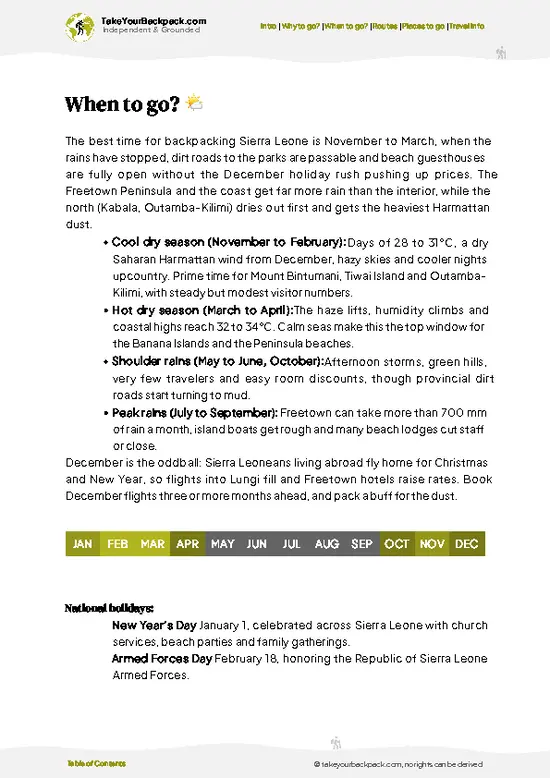
  • Dry season (November to April): Days run 28 to 34°C (82 to 93°F), with dusty harmattan haze from December to February that softens the light and dries your throat. Roads are firmest, so travel is most predictable. Prices for transport edge up around Christmas.
  • Early rains (May to June): Heat eases to 25 to 31°C (77 to 88°F) with afternoon downpours. Red tracks turn slippery but remain passable.
  • Peak rains (July to September): Expect 24 to 29°C (75 to 84°F), near-daily storms and grey skies. Rural roads can become badly rutted, and shared vehicles slow down or fill late.
  • Late rains (October): Showers taper off and the hills turn deep green. Daylight stays steady at about 12 hours all year.
Aim for late November or early December, when the roads have dried but the haze has not yet thickened.

source: climatestotravel.comJANJanuary: highly recommended for travelingFEBFebruary: highly recommended for travelingMARMarch: excellent for travelingAPRApril: excellent for travelingMAYMay: fair for travelingJUNJune: fair for travelingJULJuly: below average for travelingAUGAugust: below average for travelingSEPSeptember: fair for travelingOCTOctober: fair for travelingNOVNovember: highly recommended for travelingDECDecember: highly recommended for traveling
when-to-go

✈️ The backpacker research shortcutSierra Leone Travel Guide

An offline-friendly backpacking guide with optimized travel routes, ranked highlights, transport advice, and the best areas to stay.
example page 0 from our offline Travel Guide for Sierra Leone
example page 1 from our offline Travel Guide for Sierra Leone
example page 2 from our offline Travel Guide for Sierra Leone
example page 3 from our offline Travel Guide for Sierra Leone
example page 4 from our offline Travel Guide for Sierra Leone
example page 5 from our offline Travel Guide for Sierra Leone
example page 6 from our offline Travel Guide for Sierra Leone
example page 7 from our offline Travel Guide for Sierra Leone
The digital guide (242 pages) contains:
✅ 50 highlights, ranked by travel appeal
✅ Optimized 5, 10 & 15-day travel routes
✅ Cities, national parks, landmarks, beaches
✅ How to get around
✅ Offline-friendly for travel without Wi-Fi
👉 Click to see all 30+ guide features

📅 Plan smarter in minutes, not weeks
✅ Month by month travel advice
✅ Festivals & national holidays
✅ Budget expectations

🗺️ Go to the right places, skip the overrated ones
✅ Honest pros & cons of destinations
✅ Top hikes, parks & viewpoints
✅ Lesser-known places most travelers miss
✅ Clear “worth it vs skip it” guidance

🛏️ Travel smoothly without rookie mistakes
✅ Best areas to stay
✅ Transport systems explained simply
✅ Common scams & safety advice
✅ SIM cards, money & practical tips

🌍 Understand the country, not just visit it
✅ Culture & traditions
✅ 52 Essential phrases & customs
✅ Festivals worth planning around
✅ Traveler-friendly historical context
✅ Insights that make places more meaningful

📱 Built for real travel conditions
✅ Fully downloadable PDF
✅ Works completely offline
✅ Optimized for phone use
✅ Useful in remote areas & buses
✅ Everything in one place
Stop searching, start planning
Get instant access to your full guide. 30‑day money-back guarantee.
+ Add another guide for just

By proceeding you agree to our terms.
Sent to your inbox immediately after payment • 100% Secure Checkout
Best Backpacking Travel Advisor 2025 tourism awardBest Backpacking
Travel Advisor
2025
What others say about Take Your Backpack Guides:
⭐⭐⭐⭐⭐
Fantastic, amazing amount of information!
⭐⭐⭐⭐⭐
My goodness this is amazing, it's what I've been looking for hats off too you!
⭐⭐⭐⭐⭐
I think this is absolutely BRILLIANT
⭐⭐⭐⭐
Very complete and informative. It's still missing places, but I gotta to commend you
⭐⭐⭐⭐⭐
This is truly amazing, thank you, can't wait to explore it with my kids!
⭐⭐⭐⭐⭐
Awesome resource, thank you!
⭐⭐⭐⭐⭐
This is amazing! Can't wait to explore the ones I haven't seen
⭐⭐⭐⭐
I love this! Well done, great idea.
⭐⭐⭐⭐⭐
Thanks for taking the time to make this gem!
⭐⭐⭐⭐⭐
This might be the best website I've ever seen.
⭐⭐⭐⭐⭐
Congratulations, and thank you so much for your work; it's incredibly valuable.
⭐⭐⭐⭐
In all seriousness I think you did a great job pointing out the important spots
⭐⭐⭐⭐⭐
10/10 very good
⭐⭐⭐⭐⭐
As someone who's only just starting to visit regularly this is awesome, thank you.
⭐⭐⭐⭐
Thank you very much! I'm going to visit my dad, it's going to be very useful!
⭐⭐⭐⭐⭐
This is really cool! We'll be travelling for the first time and this definitely come in handy.
⭐⭐⭐⭐⭐
You are now our minister of culture, congratulations 👨‍💼
⭐⭐⭐⭐⭐
Just wanted to tell you that this is a pearl! Going to follow your recommendations.
⭐⭐⭐⭐⭐
This is so cool. I'll definitely be using the resource for my travels soon.
⭐⭐⭐⭐⭐
This is very impressive! Good work.
⭐⭐⭐⭐⭐
This is an amazing and informative site. Very well done!

🛏️ Where to stay?Best areas and accommodation options

Stay in or near the old mining quarter in Yengema, because its quiet lanes and few through-roads make nights calmer and walking after dark easier. Accommodation is limited to a handful of guesthouses and basic lodges, with no real hostel scene, so expect private rooms at roughly US$10 to 25 a night, often with a fan and a bucket shower. Power cuts are frequent, so a room with a working generator or backup is worth paying a little extra for.

The second option is the area around the main road, which suits you if you want food stalls and transport right outside the door. The trade-off is noise, … read more 👉
Stay in or near the old mining quarter in Yengema, because its quiet lanes and few through-roads make nights calmer and walking after dark easier. Accommodation is limited to a handful of guesthouses and basic lodges, with no real hostel scene, so expect private rooms at roughly US$10 to 25 a night, often with a fan and a bucket shower. Power cuts are frequent, so a room with a working generator or backup is worth paying a little extra for.

The second option is the area around the main road, which suits you if you want food stalls and transport right outside the door. The trade-off is noise, with horns, music and generators running until late and starting again around dawn. Earplugs help. Shared vehicles gather there, so early departures are simple.

Book ahead by phone when possible, since the few decent rooms fill when mining contractors or NGO staff are in town. Arrive in daylight and check that the door locks properly and the water runs before you hand over cash.

🚌 Getting aroundMoving around without the hassle

Yengema is small enough that you can walk from one end to the other in about 30 minutes, and walking stops making sense once you head for outlying villages or mining areas, where tracks stretch long and shadeless. Roads are a mix of patched tarmac and packed red dirt that turns to soup in the rains. Public transport is informal. Vehicles leave when full, not on a schedule, so patience matters more than a timetable.
  • Walking: Free and the fastest way across the center. Dust coats your shoes by midday, and the sun is strong, so carry water and wear a hat. Use it for the market and main road.
  • Okada (motorbike taxi): The default for short hops, usually US$0.50 to 2 depending on distance and the rain. You will weave past potholes with a rumbling engine under you. Agree the price before climbing on,
… read more 👉
Yengema is small enough that you can walk from one end to the other in about 30 minutes, and walking stops making sense once you head for outlying villages or mining areas, where tracks stretch long and shadeless. Roads are a mix of patched tarmac and packed red dirt that turns to soup in the rains. Public transport is informal. Vehicles leave when full, not on a schedule, so patience matters more than a timetable.
  • Walking: Free and the fastest way across the center. Dust coats your shoes by midday, and the sun is strong, so carry water and wear a hat. Use it for the market and main road.
  • Okada (motorbike taxi): The default for short hops, usually US$0.50 to 2 depending on distance and the rain. You will weave past potholes with a rumbling engine under you. Agree the price before climbing on, because there are no meters. Ask for a helmet, as they are often not offered.
  • Shared taxis and minibuses: These link Yengema with Koidu, about 20 to 30 minutes away, for roughly US$1 to 2. They wait until every seat is taken, which can mean an hour of sitting in the heat. Come early in the morning, since fewer run after mid-afternoon and almost none after dark.
  • Long-distance vans to Freetown or Kenema: Fares are roughly US$12 to 20 for a seat, and the journey is typically 7 to 10 hours, longer in the rains. Book a front seat if you can, since the back bounces hard. Leave at dawn so you arrive before dark. Pack snacks, because stops are unpredictable.
  • Chartered motorbike or car: For reaching villages or forest areas, a motorbike with a rider costs about US$10 to 20 a day, and a car with driver costs more. Bargain politely and confirm fuel is included.

👛 Costs (as of 22 October 2026)What things cost and how to budget

Yengema costs roughly US$38 to 62 a day for a backpacker, with the total budget landing near US$52 in high season. It is a small mining town with few tourist services, so prices follow local rates, but lodging and transfers to bigger towns cost more than you might expect.
CategoryBudget RangeLocal Reality
Dorm accommodationUS$10 to 25 (private room)No true dorms. Basic guesthouse rooms with a fan, often with a bucket shower and unreliable power.
MealsUS$6 to 12Rice with sauce, grilled fish, fried plantain and street snacks from market stalls. Sit-down meals cost more.
Local transportUS$3 to 8Okadas and shared taxis within the area. Long-distance vans cost extra.
Basic activities/entry feesUS$5 to 10Mostly guides and motorbike hire for village and forest visits. Few formal entry fees.
Miscellaneous
… read more 👉
Yengema costs roughly US$38 to 62 a day for a backpacker, with the total budget landing near US$52 in high season. It is a small mining town with few tourist services, so prices follow local rates, but lodging and transfers to bigger towns cost more than you might expect.
CategoryBudget RangeLocal Reality
Dorm accommodationUS$10 to 25 (private room)No true dorms. Basic guesthouse rooms with a fan, often with a bucket shower and unreliable power.
MealsUS$6 to 12Rice with sauce, grilled fish, fried plantain and street snacks from market stalls. Sit-down meals cost more.
Local transportUS$3 to 8Okadas and shared taxis within the area. Long-distance vans cost extra.
Basic activities/entry feesUS$5 to 10Mostly guides and motorbike hire for village and forest visits. Few formal entry fees.
Miscellaneous expensesUS$4 to 7Phone credit, bottled water, small gifts and snacks.
Total Daily BudgetUS$52Comfortable on a tight budget in high season.
Carry plenty of small notes in local currency, since change is scarce and vendors often round prices up. Eating where locals queue keeps meals cheap and fresh.
⚠️ Prices can change and everyone travels differently, so take this as a rough guide. Hope it helps you plan your adventure!

🚌 Day tripsWhere to go beyond the main area

Yengema works well as a base for short outings around Kono District, though everything depends on shared transport, so start early and plan to be back before dark.
Koidu:
The district capital is the easiest trip, with a much larger market, banks that change money and a wider choice of food. Shared taxis take about 20 to 30 minutes and cost US$1 to 2 each way. Go on a weekday morning, since banks close early and many stalls thin out by late afternoon. A common mistake is arriving without enough cash, as card use is rare.

Village visits around Kono:
Small farming and artisanal digging villages surround the town, and a half-day visit with a local guide gives you a look at everyday life, from rice fields to hand-washed gravel. Budget US$5 to 15 for a guide and a motorbike. Dry season is best, … read more 👉
Yengema works well as a base for short outings around Kono District, though everything depends on shared transport, so start early and plan to be back before dark.
Koidu:
The district capital is the easiest trip, with a much larger market, banks that change money and a wider choice of food. Shared taxis take about 20 to 30 minutes and cost US$1 to 2 each way. Go on a weekday morning, since banks close early and many stalls thin out by late afternoon. A common mistake is arriving without enough cash, as card use is rare.

Village visits around Kono:
Small farming and artisanal digging villages surround the town, and a half-day visit with a local guide gives you a look at everyday life, from rice fields to hand-washed gravel. Budget US$5 to 15 for a guide and a motorbike. Dry season is best, as tracks turn impassable after heavy rain. First-timers often turn up without introductions, so greet the village head and ask before taking photographs.
👉 Explore Kono District
Tombo Hills and forest edges:
Gentle hills and patches of forest within an hour or two by motorbike give you cooler air and birdsong, a break from the dusty main road. Expect US$10 to 20 including a rider and a guide. Go early to avoid the midday heat, and wear boots, since paths are muddy and steep after rain.

🛡️ SafetyTraveler Safety Guide

Yengema is generally calm, and most problems are small ones like overcharging and dust-and-heat fatigue. Foreigners are rare enough to attract attention, so expect friendly curiosity, and occasional requests for money or gifts, which you can decline with a smile. Mining areas are sensitive, and guards or locals may object to photographs, so ask first and never wander onto company or digging sites alone. Quote a price for okadas before riding and carry small notes to avoid inflated change. At night, streetlights are scarce and power cuts are common, so carry a headlamp and avoid walking unlit roads alone, especially if you are a solo traveler. Take a motorbike taxi from the main road after dark instead. Keep cash split between pockets, and use a money belt in crowded market corners. Drink only … read more 👉
Yengema is generally calm, and most problems are small ones like overcharging and dust-and-heat fatigue. Foreigners are rare enough to attract attention, so expect friendly curiosity, and occasional requests for money or gifts, which you can decline with a smile. Mining areas are sensitive, and guards or locals may object to photographs, so ask first and never wander onto company or digging sites alone. Quote a price for okadas before riding and carry small notes to avoid inflated change. At night, streetlights are scarce and power cuts are common, so carry a headlamp and avoid walking unlit roads alone, especially if you are a solo traveler. Take a motorbike taxi from the main road after dark instead. Keep cash split between pockets, and use a money belt in crowded market corners. Drink only bottled or treated water, and take malaria prevention seriously.

FAQTraveler FAQ

Yengema is worth a short visit if you want to see a working diamond-mining town far from the Freetown circuit, but it is not a destination with major sights. You will find a lively market, old mining-era buildings and village walks around Kono District. Koidu is only 20 to 30 minutes away by shared taxi for about US$1 to 2, so pairing the two makes sense.
One to two days is enough for Yengema itself. A full day covers the market, the old quarter and a guided village visit for US$5 to 15, and a second day lets you add Koidu or the forest edges. Stay longer only if you are volunteering or working in the area.
Yengema is not a typical day trip from a major city, because Freetown is a 7 to 10 hour drive away by road. From Koidu, though, it is easy, with shared taxis taking 20 to 30 minutes for roughly US$1 to 2. Leave Koidu before mid-afternoon so you are not stuck with fewer vehicles after dark.
⚠️ Things can change over time, so always validate details locally before you go.

Other Sierra Leonean towns near Yengema

Explore more nearby:

  • Tongo—Diamond pits, chiefdom barray, Kenema District hills| 14 km away
  • Bumbuna—Seli River dam, reservoir ridges, riverbank laundry| 73 km away
  • Kailahun—Moa River crossing, chiefs’ barri, eastern border country| 82 km away

💡 Not sure where to go next?
Create a personalized itinerary for Sierra Leone including Yengema and the places that fit your trip.

Generate my itinerary

👉 Discover all towns

Or checkout all Sierra Leone has to offer (think cities, towns, villages, national parks, hikes, beaches, festivals)
Country photo of Sierra Leone

We 💚 feedbackWhat to keep in mind

Yengema works best as one night, two if you want to get properly talking with people. Beyond that, you will run out of sights, though not of conversations. I would carry small bills, a headlamp for power cuts and a few Krio greetings, and I would arrive in the morning so you can sort a bed before dark.

✍️ Help improve this page!
The information on this page is based on in-depth research, insights shared by experienced travelers, and feedback from the local travel community in Sierra Leone. While every effort is made to keep the information accurate and current, conditions can change — so if you spot anything incorrect or outdated, please get in touch.


🙋‍♂️ Give feedback

👋 Meet the founderWho’s Behind Take Your Backpack?

Johan, backpacker and founder of TakeYourBackpackHi, I’m Johan (Netherlands 🇳🇱), the creator of TakeYourBackpack. Over the past 3 decades, I’ve backpacked through 90+ countries across six continents, gaining extensive experience with independent travel, long-term trips, and overland routes.

This site is built on a combination of firsthand travel experience and carefully curated insights from other backpackers. Many guides are based on places I’ve personally visited, while others bring together tips, observations, and practical advice shared by trusted travelers I’ve met along the way.

The goal is to provide realistic, experience-driven guidance — not generic itineraries — so you can explore destinations with better context, clearer expectations, and more confidence.