×

Slovenia🇸🇮 | best hikesExplore the 5 Best hikes in Slovenia

Hikes in Slovenia are short on distance and long on variety, because a country roughly the size of New Jersey packs in the Julian Alps, the Karavanke and Kamnik-Savinja ranges, the Soča valley, and a limestone Karst plateau. The northwest is the high-alpine core: dramatic, well marked and busiest around Bled and Bohinj, with huts that charge more per night. The northeast and center are gentler, with forested ridges and farm-lined trails that stay quiet and cheap. Trails are marked with red-white circles and linked by public buses, which suits independent travel and backpacking without a car. Choose alps for drama, hills for solitude.

By Johan Kruseman 🇳🇱 | Updated October 17, 2026
Explore the best beaches in Slovenia

Why go?What Makes Them Special

Slovenia suits hiking because of density and organization. The country has about 10,000 kilometers of marked trails, maintained by the Alpine Association of Slovenia (PZS), founded in 1893. Hiking is a national habit rather than a niche pursuit: a large share of Slovenes climb Triglav, the highest peak, at least once, and it shows on the standardized waymarks, the dense network of staffed mountain huts, and the way ordinary families climb on weekends. That culture means signage, hut food and route information are consistently good.

Geography explains the variety. The Alps, Dinaric karst and Pannonian plain meet within a few hours of each other, so alpine ridges, forest and vineyard walking sit in one trip. Short distances between valleys mean you can base in one place and reach several trailheads … read more 👉
Slovenia suits hiking because of density and organization. The country has about 10,000 kilometers of marked trails, maintained by the Alpine Association of Slovenia (PZS), founded in 1893. Hiking is a national habit rather than a niche pursuit: a large share of Slovenes climb Triglav, the highest peak, at least once, and it shows on the standardized waymarks, the dense network of staffed mountain huts, and the way ordinary families climb on weekends. That culture means signage, hut food and route information are consistently good.

Geography explains the variety. The Alps, Dinaric karst and Pannonian plain meet within a few hours of each other, so alpine ridges, forest and vineyard walking sit in one trip. Short distances between valleys mean you can base in one place and reach several trailheads by bus or short drive.

Before choosing Slovenia, know that the Julian Alps are steep and limestone-heavy, so many routes include exposed sections with cables or fixed pegs (via ferrata style). Weather turns fast in the mountains, with afternoon thunderstorms common in summer. Huts fill up in July and August, and prices in the alpine northwest run well above the rest of the country. Lower regions offer quiet, easy walking with far fewer people.
Why These Made the Cut
The list of best hikes in Slovenia is created based on scenery, challenge, trail quality, landmarks, and overall enjoyment. If you feel a hike is missing in this list, please let us know.

When to go?Timing Your Visit for the Best Experience

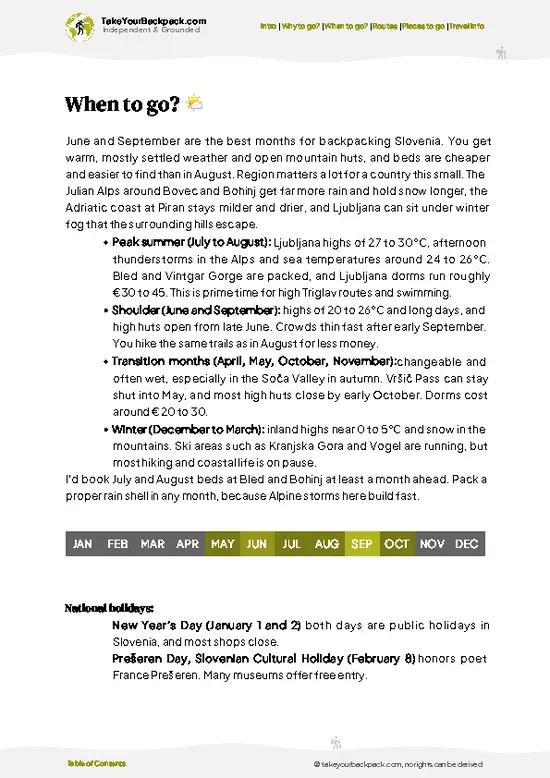
Best Months for Hiking: Late June to mid-September is the best window for high-alpine hikes in Slovenia, because snow has usually melted from the Julian Alps trails by then and mountain huts are staffed. Valley temperatures sit around 20 to 28°C in summer, while summits above 2,000 meters run 5 to 15°C, and afternoon thunderstorms are frequent, so start early. Rainfall in the Julian Alps is among the highest in Europe, often 2,000 mm or more a year, with heavy showers possible in any month.

Shoulder Seasons and Peak Crowds: May to mid-June and late September to October suit lower hills, forests and the Karst, where temperatures run 10 to 20°C. In spring, high routes can still hold snow and huts may be closed, so stay below roughly 1,500 meters. October brings golden larch and beech color … read more 👉
Best Months for Hiking: Late June to mid-September is the best window for high-alpine hikes in Slovenia, because snow has usually melted from the Julian Alps trails by then and mountain huts are staffed. Valley temperatures sit around 20 to 28°C in summer, while summits above 2,000 meters run 5 to 15°C, and afternoon thunderstorms are frequent, so start early. Rainfall in the Julian Alps is among the highest in Europe, often 2,000 mm or more a year, with heavy showers possible in any month.

Shoulder Seasons and Peak Crowds: May to mid-June and late September to October suit lower hills, forests and the Karst, where temperatures run 10 to 20°C. In spring, high routes can still hold snow and huts may be closed, so stay below roughly 1,500 meters. October brings golden larch and beech color and thinner crowds, though days are short and nights near freezing at altitude.

July and August are peak: huts around Triglav and parking near Bled and Bohinj fill, and accommodation can cost 20 to 40 percent more than in shoulder months. Book huts weeks ahead. Winter hiking on the lowlands is possible but cold, and alpine routes then require snow and avalanche experience.

Regional Differences: The northeast and the coastal Karst stay walkable almost year-round, with milder winters. Coastal areas can be pleasant in March and April when the mountains are still closed.

hike hoppingTips for Visiting Multiple Destinations

How Many Days to Allow: A trip combining several hikes in Slovenia needs 7 to 10 days, because mountain weather forces rest or swap days and the regions are close but not instant to cross. The country is compact, so most transfers take 1 to 2.5 hours, which makes the pacing question more important than the distance.

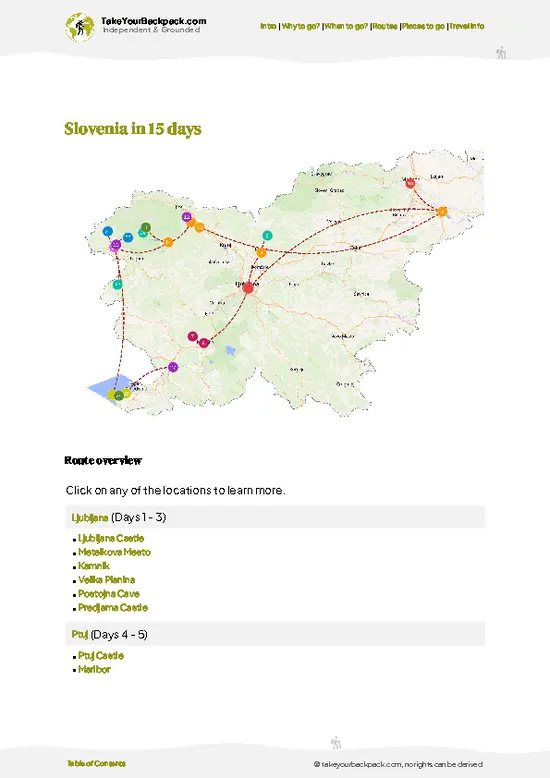
Grouping Regions and Direction: Cluster by mountain range. The Julian Alps (Bled, Bohinj, Kranjska Gora, Bovec and the Soča valley) form one group, with Ljubljana as the transport hub 40 to 90 minutes away by bus or train to Lesce-Bled. The Kamnik-Savinja Alps sit just east and pair with Ljubljana. Start in the capital, move northwest into the Julian Alps, then finish with lower or coastal terrain as legs recover. Travelers going north to south usually end in the Karst or near … read more 👉
How Many Days to Allow: A trip combining several hikes in Slovenia needs 7 to 10 days, because mountain weather forces rest or swap days and the regions are close but not instant to cross. The country is compact, so most transfers take 1 to 2.5 hours, which makes the pacing question more important than the distance.

Grouping Regions and Direction: Cluster by mountain range. The Julian Alps (Bled, Bohinj, Kranjska Gora, Bovec and the Soča valley) form one group, with Ljubljana as the transport hub 40 to 90 minutes away by bus or train to Lesce-Bled. The Kamnik-Savinja Alps sit just east and pair with Ljubljana. Start in the capital, move northwest into the Julian Alps, then finish with lower or coastal terrain as legs recover. Travelers going north to south usually end in the Karst or near Piran, a 1.5-hour trip from Ljubljana.

Allow 2 to 3 days per alpine base, which gives one big day, one buffer and one easier outing. Lowland stops need only 1 to 2 days.

Common Planning Mistakes: The first is stacking hard summit days back to back. Alternate demanding days with shorter ones. The second is changing bases every night; bus links between valleys such as Bohinj and Soča are infrequent and sometimes need a detour through Ljubljana or a long mountain-pass drive, so pick two or three bases. The third is fixing dates before checking the forecast. Keep one flexible day per alpine stop.

The ListMust-Visit hikes in Slovenia

1 Triglav Lakes Valley

glacial lakes, rocky cirques, high-altitude refuge

Traverse a chain of mountain basins, where each lake reflects rugged peaks and the route demands steady footing and careful pacing.

slovenia-hike-triglav-lakes-valley
© Google |

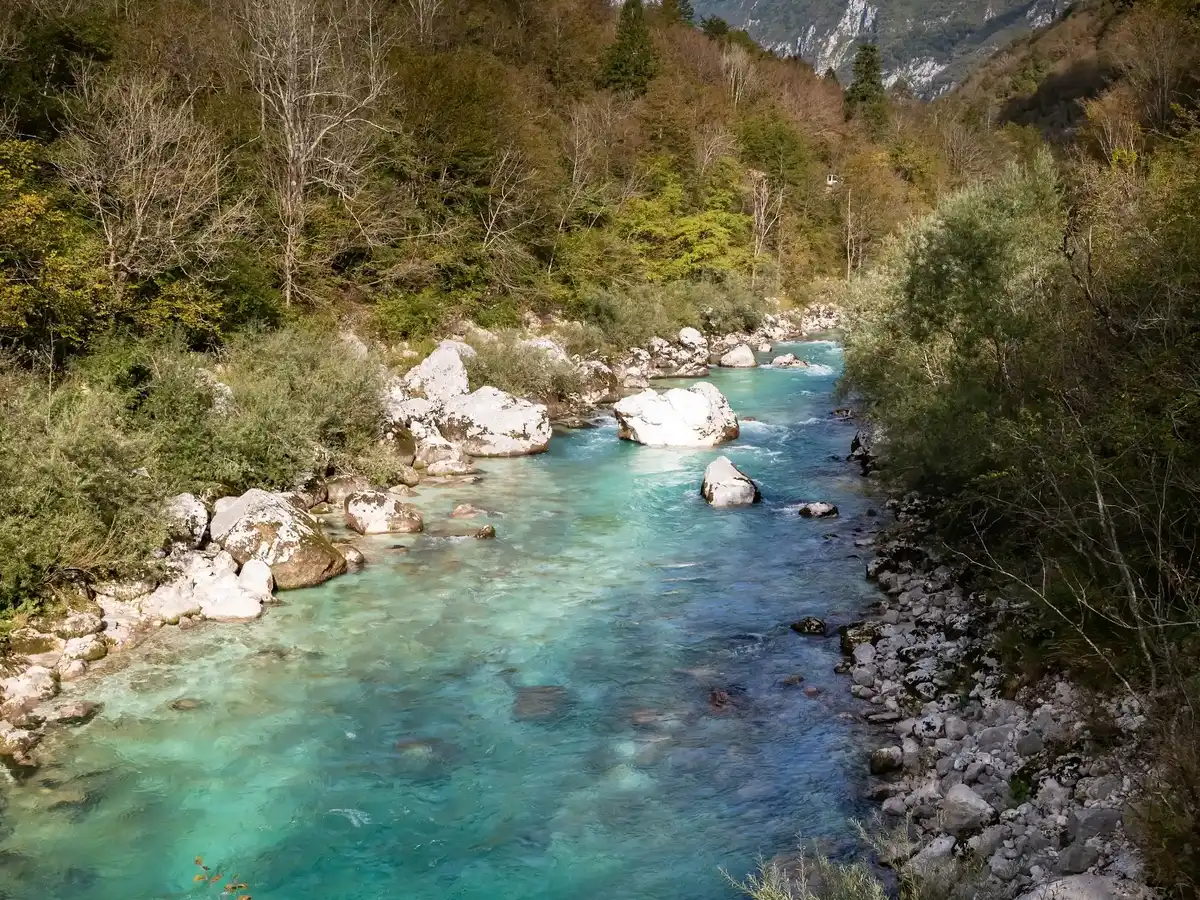
2 Soča Trail

turquoise river, hanging bridges, WWI history

Follow a winding path along clear waters and through forested banks, passing relics and quiet villages shaped by the river’s course.

3 Velika Planina

shepherd huts, karst plateau, seasonal pastures

Walk among traditional wooden dwellings and grazing herds, experiencing a highland landscape that changes with each season’s arrival.

4 Mount Stol

border ridge, panoramic summit, alpine meadows

Ascend a prominent peak straddling Slovenia and Austria, where open slopes give way to wide views and shifting weather patterns.

5 Robanov Kot

secluded valley, family farms, limestone cliffs

Enter a quiet glen framed by steep rock faces, where rural life continues at a slow rhythm and trails remain lightly traveled.

Loading the map 🌍

Expert viewTips and Advice from Travelers

How Many Hikes to Plan: Plan on four to six hikes in a week, because Slovenian alpine days are long (6 to 9 hours on the bigger routes) and weather regularly cancels one. A short list leaves room to swap, and mountain fatigue builds quickly on steep limestone. Experienced hikers keep one spare day rather than squeezing in a seventh route.

Choosing Between Kinds of Hikes: Alpine ridge and summit routes in the Julian Alps deliver the signature experience, but they cost more and need fitness and a head for heights. First-timers and families do better with lake circuits, gorge walks and forested valleys, which need little gear. Budget travelers who want solitude should look to the Pohorje hills, the Kamnik-Savinja valleys and the Karst, where huts are cheaper and trails far quieter. Anyone aiming … read more 👉
How Many Hikes to Plan: Plan on four to six hikes in a week, because Slovenian alpine days are long (6 to 9 hours on the bigger routes) and weather regularly cancels one. A short list leaves room to swap, and mountain fatigue builds quickly on steep limestone. Experienced hikers keep one spare day rather than squeezing in a seventh route.

Choosing Between Kinds of Hikes: Alpine ridge and summit routes in the Julian Alps deliver the signature experience, but they cost more and need fitness and a head for heights. First-timers and families do better with lake circuits, gorge walks and forested valleys, which need little gear. Budget travelers who want solitude should look to the Pohorje hills, the Kamnik-Savinja valleys and the Karst, where huts are cheaper and trails far quieter. Anyone aiming for Triglav should treat it as a project in itself: it is a serious climb with exposed, cabled sections, and a guide makes sense for those without via ferrata experience.

What It Costs: Budget about US$55 to 90 (50 to 80 euros) a day, with the low end using hostels, supermarket food and public buses. Hut dorm beds run roughly 25 to 40 euros, and half board adds about 15 to 25 euros. A simple hut meal such as jota stew or sausage with sauerkraut costs 8 to 14 euros. Most trails are free, though some sites charge entry, such as gorges at roughly 10 to 20 euros. A guide for a day in the high Alps runs about 200 to 350 euros per group, and Triglav guiding costs more. Intercity buses usually cost 5 to 15 euros per leg. Parking near popular lakes can cost 10 euros or more a day in summer, and it often fills by mid-morning, so buses save both money and stress.

Safety and Local Etiquette: Slovenia’s mountain rescue is excellent, but it can be expensive if you lack insurance. Many policies exclude hiking above a set altitude or via ferrata, so check yours, and consider the Alpine Association’s coverage, which members get. The emergency number is 112. Storms build after noon, and exposed ridges are dangerous, so the practical habit is to summit before 1 p.m. Carry a paper map or offline map, since signal fails in deep valleys.

Greet other hikers with “Dober dan” (good day), a custom on trails and at huts. Take your boots off at hut entrances where shoe racks are provided, and pack out your trash. Wild camping is prohibited in Slovenia, and the fines are real, so book huts or campsites. Carry cash for huts, since small ones may not take cards, and reserve in advance for July and August.

✈️ The backpacker research shortcutSlovenia Travel Guide

An offline-friendly backpacking guide with optimized travel routes, ranked highlights, transport advice, and the best areas to stay.
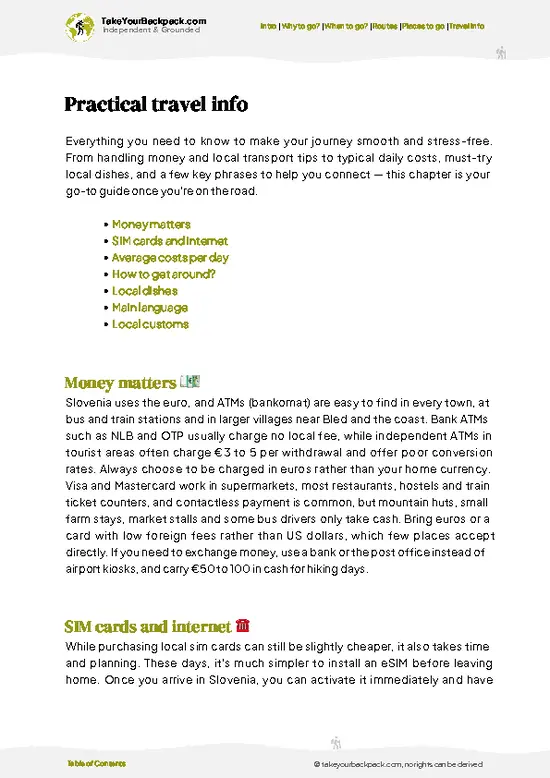
example page 0 from our offline Travel Guide for Slovenia
example page 1 from our offline Travel Guide for Slovenia
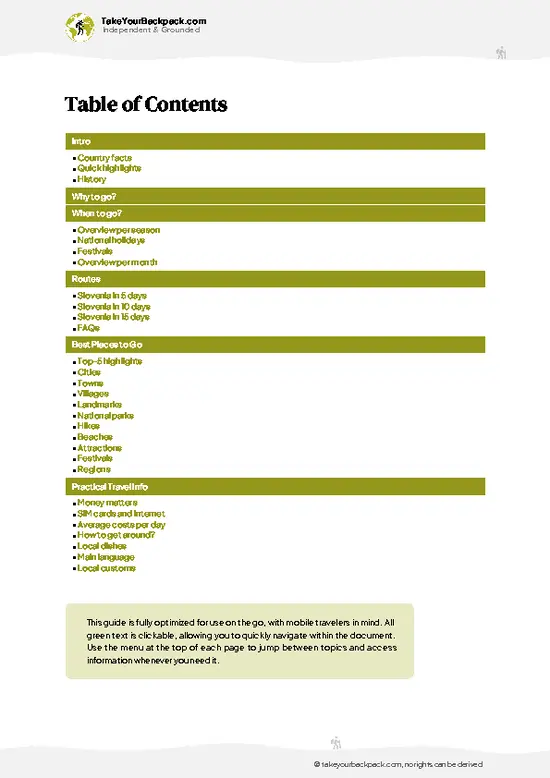
example page 2 from our offline Travel Guide for Slovenia
example page 3 from our offline Travel Guide for Slovenia
example page 4 from our offline Travel Guide for Slovenia
example page 5 from our offline Travel Guide for Slovenia
example page 6 from our offline Travel Guide for Slovenia
example page 7 from our offline Travel Guide for Slovenia
The digital guide (310 pages) contains:
✅ 77 highlights, ranked by travel appeal
✅ Optimized 5, 10 & 15-day travel routes
✅ Cities, national parks, landmarks, beaches
✅ How to get around
✅ Offline-friendly for travel without Wi-Fi
👉 Click to see all 30+ guide features

📅 Plan smarter in minutes, not weeks
✅ Month by month travel advice
✅ Festivals & national holidays
✅ Budget expectations

🗺️ Go to the right places, skip the overrated ones
✅ Honest pros & cons of destinations
✅ Top hikes, parks & viewpoints
✅ Lesser-known places most travelers miss
✅ Clear “worth it vs skip it” guidance

🛏️ Travel smoothly without rookie mistakes
✅ Best areas to stay
✅ Transport systems explained simply
✅ Common scams & safety advice
✅ SIM cards, money & practical tips

🌍 Understand the country, not just visit it
✅ Culture & traditions
✅ 52 Essential phrases & customs
✅ Festivals worth planning around
✅ Traveler-friendly historical context
✅ Insights that make places more meaningful

📱 Built for real travel conditions
✅ Fully downloadable PDF
✅ Works completely offline
✅ Optimized for phone use
✅ Useful in remote areas & buses
✅ Everything in one place
Stop searching, start planning
Get instant access to your full guide. 30‑day money-back guarantee.
+ Add another guide for just

By proceeding you agree to our terms.
Sent to your inbox immediately after payment • 100% Secure Checkout
Best Backpacking Travel Advisor 2025 tourism awardBest Backpacking
Travel Advisor
2025
What others say about Take Your Backpack Guides:
⭐⭐⭐⭐⭐
Fantastic, amazing amount of information!
⭐⭐⭐⭐⭐
My goodness this is amazing, it's what I've been looking for hats off too you!
⭐⭐⭐⭐⭐
I think this is absolutely BRILLIANT
⭐⭐⭐⭐
Very complete and informative. It's still missing places, but I gotta to commend you
⭐⭐⭐⭐⭐
This is truly amazing, thank you, can't wait to explore it with my kids!
⭐⭐⭐⭐⭐
Awesome resource, thank you!
⭐⭐⭐⭐⭐
This is amazing! Can't wait to explore the ones I haven't seen
⭐⭐⭐⭐
I love this! Well done, great idea.
⭐⭐⭐⭐⭐
Thanks for taking the time to make this gem!
⭐⭐⭐⭐⭐
This might be the best website I've ever seen.
⭐⭐⭐⭐⭐
Congratulations, and thank you so much for your work; it's incredibly valuable.
⭐⭐⭐⭐
In all seriousness I think you did a great job pointing out the important spots
⭐⭐⭐⭐⭐
10/10 very good
⭐⭐⭐⭐⭐
As someone who's only just starting to visit regularly this is awesome, thank you.
⭐⭐⭐⭐
Thank you very much! I'm going to visit my dad, it's going to be very useful!
⭐⭐⭐⭐⭐
This is really cool! We'll be travelling for the first time and this definitely come in handy.
⭐⭐⭐⭐⭐
You are now our minister of culture, congratulations 👨‍💼
⭐⭐⭐⭐⭐
Just wanted to tell you that this is a pearl! Going to follow your recommendations.
⭐⭐⭐⭐⭐
This is so cool. I'll definitely be using the resource for my travels soon.
⭐⭐⭐⭐⭐
This is very impressive! Good work.
⭐⭐⭐⭐⭐
This is an amazing and informative site. Very well done!

🛏️ Where to stay?Top Places to Consider Staying

Slovenia has a solid hostel network, with dorm beds running roughly €20 to €35 a night in summer and private guesthouse rooms (look for “sobe” signs) from about €50 to €80. In Ljubljana, the Old Town puts you on foot to the castle and riverside bars but gets loud on weekend nights, while the streets around the train station and Metelkova are cheaper, close to transport and the alternative club scene, though grittier after dark (still very safe by European standards). Outside the capital, Bled and Bohinj fill up fast in July and August with quiet, lake-close options, and Piran on the coast has few beds inside its car-free old core, so book weeks ahead.

If you enjoy meeting fellow travelers, consider … read more 👉
Slovenia has a solid hostel network, with dorm beds running roughly €20 to €35 a night in summer and private guesthouse rooms (look for “sobe” signs) from about €50 to €80. In Ljubljana, the Old Town puts you on foot to the castle and riverside bars but gets loud on weekend nights, while the streets around the train station and Metelkova are cheaper, close to transport and the alternative club scene, though grittier after dark (still very safe by European standards). Outside the capital, Bled and Bohinj fill up fast in July and August with quiet, lake-close options, and Piran on the coast has few beds inside its car-free old core, so book weeks ahead.

If you enjoy meeting fellow travelers, consider choosing hostels with high ratings for atmosphere. On the other hand, if you prefer having your own space, a hotel might be a better option.

SloveniaMore Places Across Slovenia

👋 Meet the founderWho’s Behind Take Your Backpack?

Johan, backpacker and founder of TakeYourBackpackHi, I’m Johan (Netherlands 🇳🇱), the creator of TakeYourBackpack. Over the past 3 decades, I’ve backpacked through 90+ countries across six continents, gaining extensive experience with independent travel, long-term trips, and overland routes.

This site is built on a combination of firsthand travel experience and carefully curated insights from other backpackers. Many guides are based on places I’ve personally visited, while others bring together tips, observations, and practical advice shared by trusted travelers I’ve met along the way.

The goal is to provide realistic, experience-driven guidance — not generic itineraries — so you can explore destinations with better context, clearer expectations, and more confidence.