×

Slovenia🇸🇮 | best landmarksExplore the 4 Best landmarks in Slovenia

Landmarks in Slovenia come in compact, varied packages because the country is only about 20,000 square kilometers and sits where the Alps, the Karst and the Pannonian plain meet. In the Julian Alps in the northwest, sights are lakeside and mountain-based, so they draw the biggest summer crowds and the highest prices. The Karst and coast favor caves, castles and Venetian-era towns, with fees that add up. Ljubljana and the eastern wine country are cheaper and quieter. Because buses and trains link most hubs, independent travelers can reach nearly everything without a car, though alpine trailheads and rural sights are easier with one.

By Johan Kruseman 🇳🇱 | Updated October 17, 2026
Explore the best national parks in Slovenia

Why go?What Makes Them Special

Slovenia packs an unusual range of heritage into a small area because it has long been a crossroads of Slavic, Germanic, Latin and Hungarian influence. Habsburg rule left the architecture of towns and castles, Venice shaped the coast, and the limestone Karst region gave the world the very word for such terrain, along with caves and underground rivers. The Julian Alps add glacial lakes and high peaks. That mix means the country offers cultural, natural and historical sights within a single trip, rarely more than a few hours apart.

Infrastructure is the second advantage. Roads are good, English is widely spoken, signage is clear, and most major sights have set opening hours and ticketing. The country is also compact, so distance rarely limits what you can see.

Before choosing Slovenia for … read more 👉
Slovenia packs an unusual range of heritage into a small area because it has long been a crossroads of Slavic, Germanic, Latin and Hungarian influence. Habsburg rule left the architecture of towns and castles, Venice shaped the coast, and the limestone Karst region gave the world the very word for such terrain, along with caves and underground rivers. The Julian Alps add glacial lakes and high peaks. That mix means the country offers cultural, natural and historical sights within a single trip, rarely more than a few hours apart.

Infrastructure is the second advantage. Roads are good, English is widely spoken, signage is clear, and most major sights have set opening hours and ticketing. The country is also compact, so distance rarely limits what you can see.

Before choosing Slovenia for landmarks, know what it is not. It has no monumental ancient ruins on the scale of Greece or Italy, and the appeal lies in setting and scale rather than grand monuments. Many of the best-known sights are outdoors and depend on weather, while popular spots near Lake Bled and the Postojna area can feel crowded in summer. Seeing them on your own terms takes some timing, but the small size makes that easy.
Evaluating the Top Choices
The list of best unique sites in Slovenia is created based on history or culture, wow factor, atmosphere, quirks, and memorability. If you feel a unique site is missing in this list, please let us know.

When to go?Timing Your Visit for the Best Experience

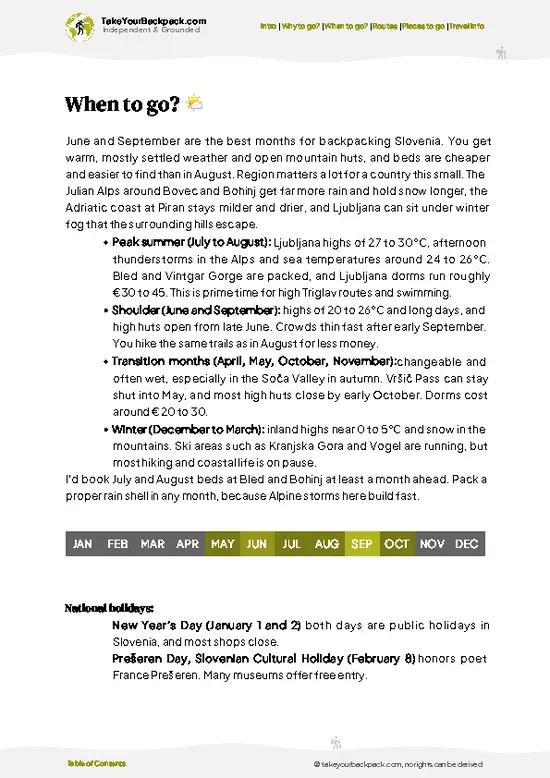
Best months and why: The best months for landmarks in Slovenia are May to June and September, when daytime temperatures run about 18 to 26°C, most outdoor sites and mountain roads are open, and crowds stay below the July and August peak. Lakes and castles are at their clearest, and rain is manageable, though the country is wet overall, with roughly 1,000 to 1,500 mm a year and more in the Alps.
Summer peak: July and August bring highs of 26 to 32°C inland and warm coastal days. This is when the Julian Alps and the lake areas are busiest, and accommodation there can cost 30 to 60 percent more than in shoulder months. Afternoon thunderstorms are common in the mountains, so early starts matter. The coast is hot and crowded, while Ljubljana empties a little in August as locals leave.
Shoulder and … read more 👉
Best months and why: The best months for landmarks in Slovenia are May to June and September, when daytime temperatures run about 18 to 26°C, most outdoor sites and mountain roads are open, and crowds stay below the July and August peak. Lakes and castles are at their clearest, and rain is manageable, though the country is wet overall, with roughly 1,000 to 1,500 mm a year and more in the Alps.
Summer peak: July and August bring highs of 26 to 32°C inland and warm coastal days. This is when the Julian Alps and the lake areas are busiest, and accommodation there can cost 30 to 60 percent more than in shoulder months. Afternoon thunderstorms are common in the mountains, so early starts matter. The coast is hot and crowded, while Ljubljana empties a little in August as locals leave.
Shoulder and winter seasons: April and October are cooler, at 10 to 18°C, with changeable showers and autumn color in the east and the wine hills. High-altitude roads and some alpine sights stay closed or snowy until late spring. November to March is cold, with highs around 0 to 6°C in Ljubljana and deep snow in the Alps. Some castles and caves shorten hours, but prices drop sharply and the Christmas markets in December add a different draw to the city.

unique site hoppingTips for Visiting Multiple Destinations

How many days to plan: A trip combining several landmarks in Slovenia needs 5 to 8 days, because the country is small but mountain roads and rural bus links slow the pace. Distances look short on a map, yet most transfers take 1 to 3 hours.
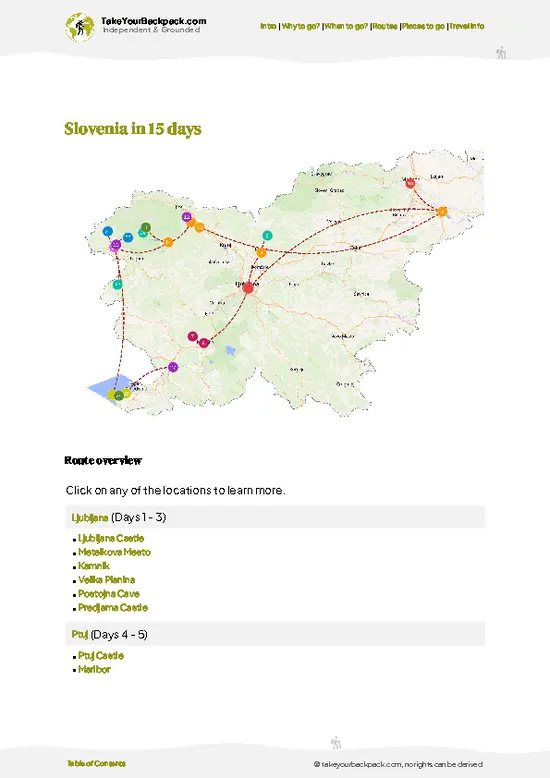
Grouping regions and direction: Ljubljana is the natural hub, with rail and bus lines fanning out. A sensible loop runs Ljubljana to the Julian Alps (about 1 to 1.5 hours to Bled by bus or car), then south to the Karst and Postojna area (about 1 hour from the capital), and finally to the coast around Piran, roughly 1.5 to 2 hours onward. Eastern Slovenia, such as Maribor and Ptuj, takes 2 to 2.5 hours from Ljubljana and works best as a separate add-on of two days. Going north first lets you use clear early-trip weather for the mountains and finish by the … read more 👉
How many days to plan: A trip combining several landmarks in Slovenia needs 5 to 8 days, because the country is small but mountain roads and rural bus links slow the pace. Distances look short on a map, yet most transfers take 1 to 3 hours.
Grouping regions and direction: Ljubljana is the natural hub, with rail and bus lines fanning out. A sensible loop runs Ljubljana to the Julian Alps (about 1 to 1.5 hours to Bled by bus or car), then south to the Karst and Postojna area (about 1 hour from the capital), and finally to the coast around Piran, roughly 1.5 to 2 hours onward. Eastern Slovenia, such as Maribor and Ptuj, takes 2 to 2.5 hours from Ljubljana and works best as a separate add-on of two days. Going north first lets you use clear early-trip weather for the mountains and finish by the sea.
Time per stop and common mistakes: Allow 2 to 4 hours for a castle or cave, and a half to full day for an alpine area. The usual error is trying to cover the Alps, Karst and coast in two days, which leaves most time on the road. Another is counting on frequent rural buses, which thin out sharply on weekends and in the evening. Pick two or three regions, stay two nights in each, and use Ljubljana for day trips instead of moving bags daily.

The ListMust-Visit landmarks in Slovenia

1 Škocjan Caves

subterranean river, colossal chambers, UNESCO site

Descend into a vast underground world where a powerful river carves through immense caverns, offering a sense of scale rarely found above ground.

slovenia-unique-site-skocjan-caves
© Google | Herbert Ledolter

2 Vintgar Gorge

wooden walkways, rushing river, narrow canyon

Trace a winding path above clear rapids and through tight rock walls, with every turn revealing new perspectives on the wild Radovna.

slovenia-unique-site-vintgar-gorge
© Google | Damir Habuš

3 Kozjak Waterfall

mossy gorge, emerald pool, secluded cascade

Follow a shaded forest trail to a hidden waterfall, where cool mist and green water create a tranquil retreat from summer heat.

slovenia-unique-site-kozjak-waterfall
© Google | Miro Četrtič

4 Celje Castle

hilltop ruins, medieval towers, panoramic valley views

Climb through stone corridors and battlements, then pause to take in the broad Savinja valley and the city below from ancient ramparts.

Loading the map 🌍

Expert viewTips and Advice from Travelers

How many landmarks to aim for: Plan on one or two sights a day, so about 8 to 12 over a week. Slovenia’s roads and buses are slower than distances suggest, and many sights involve a hike, a cave tour on a fixed schedule or a lake walk that deserves time. An experienced traveler spaces them out so the best light and weather are not wasted rushing between stops.
Choosing between kinds of sights: Mountain and lake sights suit hikers and photographers, and they are weather-dependent, so keep them flexible. Caves and castles suit rainy days because they are covered and run on set schedules. Towns and old quarters suit those on tight budgets, since walking them is mostly free. Food and wine routes in the east suit slower travelers. A smart mix pairs one outdoor day with one indoor one, so a wet forecast … read more 👉
How many landmarks to aim for: Plan on one or two sights a day, so about 8 to 12 over a week. Slovenia’s roads and buses are slower than distances suggest, and many sights involve a hike, a cave tour on a fixed schedule or a lake walk that deserves time. An experienced traveler spaces them out so the best light and weather are not wasted rushing between stops.
Choosing between kinds of sights: Mountain and lake sights suit hikers and photographers, and they are weather-dependent, so keep them flexible. Caves and castles suit rainy days because they are covered and run on set schedules. Towns and old quarters suit those on tight budgets, since walking them is mostly free. Food and wine routes in the east suit slower travelers. A smart mix pairs one outdoor day with one indoor one, so a wet forecast never wipes out a plan.
What it costs: Budget about US$60 to 110 a day (roughly €55 to 100), covering a dorm bed at about €25 to 45, food and local transport. Prices in the Alps and on the coast sit at the upper end in summer. Entry to castles typically runs €8 to 20, and the larger cave systems cost more, around €25 to 40, with discounts for students and online booking. Many guided options add €10 to 30. Intercity buses and trains between hubs cost roughly €5 to 15 a ride. Buying a combined ticket where offered usually saves money, and booking cave tours ahead in summer avoids selling-out.
Safety and etiquette: Slovenia is among Europe’s safest countries, and petty theft is low even at busy sights. The real risks are mountain conditions. Weather turns fast in the Julian Alps, snow can linger on high trails into June, and thunderstorms build in the afternoon, so start early and carry layers. Check trail status locally before heading up, and know that the mountain rescue number is 112. Caves stay around 8 to 10°C all year, so a jacket matters even in August.

Culturally, Slovenes value quiet and tidiness. Staying on marked paths, taking rubbish with you and keeping voices down in churches and rural areas is expected. Dress modestly in churches. Drone use is restricted near many sights, so check the rules first. Card payment is widespread, though small huts and rural stops may want cash, so carry some euros.

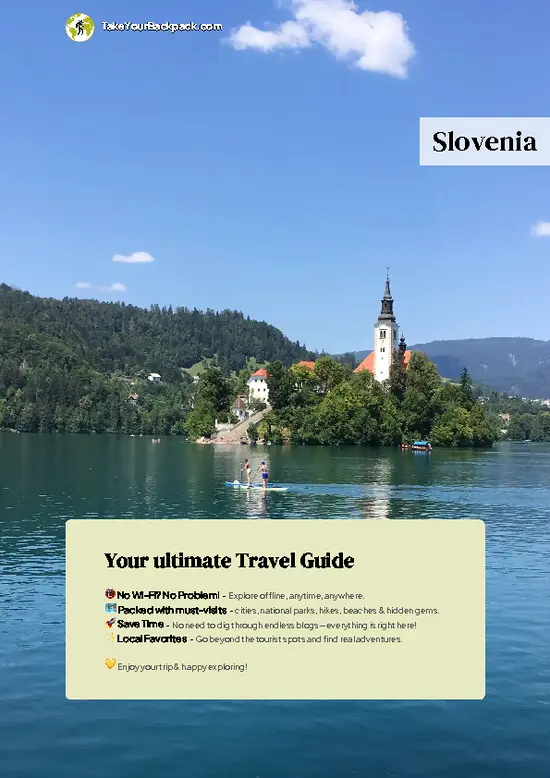
✈️ The backpacker research shortcutSlovenia Travel Guide

An offline-friendly backpacking guide with optimized travel routes, ranked highlights, transport advice, and the best areas to stay.
example page 0 from our offline Travel Guide for Slovenia
example page 1 from our offline Travel Guide for Slovenia
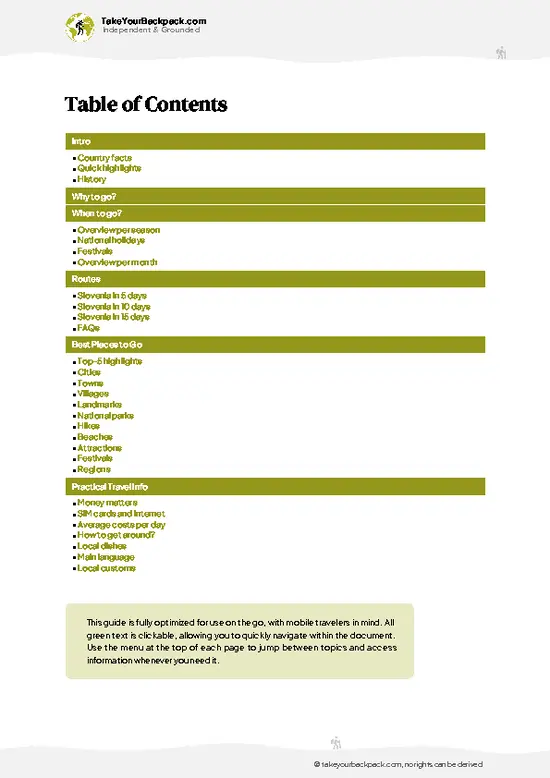
example page 2 from our offline Travel Guide for Slovenia
example page 3 from our offline Travel Guide for Slovenia
example page 4 from our offline Travel Guide for Slovenia
example page 5 from our offline Travel Guide for Slovenia
example page 6 from our offline Travel Guide for Slovenia
example page 7 from our offline Travel Guide for Slovenia
The digital guide (310 pages) contains:
✅ 77 highlights, ranked by travel appeal
✅ Optimized 5, 10 & 15-day travel routes
✅ Cities, national parks, landmarks, beaches
✅ How to get around
✅ Offline-friendly for travel without Wi-Fi
👉 Click to see all 30+ guide features

📅 Plan smarter in minutes, not weeks
✅ Month by month travel advice
✅ Festivals & national holidays
✅ Budget expectations

🗺️ Go to the right places, skip the overrated ones
✅ Honest pros & cons of destinations
✅ Top hikes, parks & viewpoints
✅ Lesser-known places most travelers miss
✅ Clear “worth it vs skip it” guidance

🛏️ Travel smoothly without rookie mistakes
✅ Best areas to stay
✅ Transport systems explained simply
✅ Common scams & safety advice
✅ SIM cards, money & practical tips

🌍 Understand the country, not just visit it
✅ Culture & traditions
✅ 52 Essential phrases & customs
✅ Festivals worth planning around
✅ Traveler-friendly historical context
✅ Insights that make places more meaningful

📱 Built for real travel conditions
✅ Fully downloadable PDF
✅ Works completely offline
✅ Optimized for phone use
✅ Useful in remote areas & buses
✅ Everything in one place
Stop searching, start planning
Get instant access to your full guide. 30‑day money-back guarantee.
+ Add another guide for just

By proceeding you agree to our terms.
Sent to your inbox immediately after payment • 100% Secure Checkout
Best Backpacking Travel Advisor 2025 tourism awardBest Backpacking
Travel Advisor
2025
What others say about Take Your Backpack Guides:
⭐⭐⭐⭐⭐
Fantastic, amazing amount of information!
⭐⭐⭐⭐⭐
My goodness this is amazing, it's what I've been looking for hats off too you!
⭐⭐⭐⭐⭐
I think this is absolutely BRILLIANT
⭐⭐⭐⭐
Very complete and informative. It's still missing places, but I gotta to commend you
⭐⭐⭐⭐⭐
This is truly amazing, thank you, can't wait to explore it with my kids!
⭐⭐⭐⭐⭐
Awesome resource, thank you!
⭐⭐⭐⭐⭐
This is amazing! Can't wait to explore the ones I haven't seen
⭐⭐⭐⭐
I love this! Well done, great idea.
⭐⭐⭐⭐⭐
Thanks for taking the time to make this gem!
⭐⭐⭐⭐⭐
This might be the best website I've ever seen.
⭐⭐⭐⭐⭐
Congratulations, and thank you so much for your work; it's incredibly valuable.
⭐⭐⭐⭐
In all seriousness I think you did a great job pointing out the important spots
⭐⭐⭐⭐⭐
10/10 very good
⭐⭐⭐⭐⭐
As someone who's only just starting to visit regularly this is awesome, thank you.
⭐⭐⭐⭐
Thank you very much! I'm going to visit my dad, it's going to be very useful!
⭐⭐⭐⭐⭐
This is really cool! We'll be travelling for the first time and this definitely come in handy.
⭐⭐⭐⭐⭐
You are now our minister of culture, congratulations 👨‍💼
⭐⭐⭐⭐⭐
Just wanted to tell you that this is a pearl! Going to follow your recommendations.
⭐⭐⭐⭐⭐
This is so cool. I'll definitely be using the resource for my travels soon.
⭐⭐⭐⭐⭐
This is very impressive! Good work.
⭐⭐⭐⭐⭐
This is an amazing and informative site. Very well done!

🛏️ Where to stay?Top Areas to Stay

Slovenia has a solid hostel network, with dorm beds running roughly €20 to €35 a night in summer and private guesthouse rooms (look for “sobe” signs) from about €50 to €80. In Ljubljana, the Old Town puts you on foot to the castle and riverside bars but gets loud on weekend nights, while the streets around the train station and Metelkova are cheaper, close to transport and the alternative club scene, though grittier after dark (still very safe by European standards). Outside the capital, Bled and Bohinj fill up fast in July and August with quiet, lake-close options, and Piran on the coast has few beds inside its car-free old core, so book weeks ahead.

If you enjoy meeting fellow travelers, consider … read more 👉
Slovenia has a solid hostel network, with dorm beds running roughly €20 to €35 a night in summer and private guesthouse rooms (look for “sobe” signs) from about €50 to €80. In Ljubljana, the Old Town puts you on foot to the castle and riverside bars but gets loud on weekend nights, while the streets around the train station and Metelkova are cheaper, close to transport and the alternative club scene, though grittier after dark (still very safe by European standards). Outside the capital, Bled and Bohinj fill up fast in July and August with quiet, lake-close options, and Piran on the coast has few beds inside its car-free old core, so book weeks ahead.

If you enjoy meeting fellow travelers, consider choosing hostels with high ratings for atmosphere. On the other hand, if you prefer having your own space, a hotel might be a better option.

SloveniaDiscover the Country

👋 Meet the founderWho’s Behind Take Your Backpack?

Johan, backpacker and founder of TakeYourBackpackHi, I’m Johan (Netherlands 🇳🇱), the creator of TakeYourBackpack. Over the past 3 decades, I’ve backpacked through 90+ countries across six continents, gaining extensive experience with independent travel, long-term trips, and overland routes.

This site is built on a combination of firsthand travel experience and carefully curated insights from other backpackers. Many guides are based on places I’ve personally visited, while others bring together tips, observations, and practical advice shared by trusted travelers I’ve met along the way.

The goal is to provide realistic, experience-driven guidance — not generic itineraries — so you can explore destinations with better context, clearer expectations, and more confidence.