×

South Korea🇰🇷 | townsBukchon Hanok Villagetraditional alleys, tiled rooftops, city views | things to do and best time to go

Explore Jeju IslandExplore Inje

Backpacking in Bukchon Hanok Village
🏆 Top picktown ranked #2
By Johan Kruseman 🇳🇱 | Updated September 4, 2026

Most people only realize on their last day that Bukchon Hanok Village is one of the easiest places in Seoul to feel “old Korea” without burning half a day on transport. It sits right between Gyeongbokgung and Changdeokgung in central Seoul, on a low hill where tiled hanok roofs step up toward the sky and traffic noise drops to a murmur. For backpackers, it’s not a place to base for weeks, but a half‑day or lazy‑day stop that stitches together palace‑hopping, Insadong’s teahouses, and the livelier food streets of Jongno. The lanes are steep, crowded, and heavily touristed; you’ll dodge selfie sticks more than meet other travelers, and there are far more cafés and photo studios than cheap hostels. But it’s walkable from multiple subway lines, safe even after dark, and cheaper to visit than to stay. Compared with Hongdae or Itaewon, Bukchon is calmer, more scenic, and less social—an atmospheric detour, not your home base.

Discover everything you want to know in the 📖 South Korea Travel Guide.
Loading the map 🌍
CLICK TO FILTER
cities
towns
villages
landmarks
national parks
hikes
beaches
attractions
festivals
regions
SHOW COUNTRY’S BESTSHOW ALL

✨ Why go?
Ranked #2 town in South Korea
What sets this place apart

In Bukchon Hanok Village, backpackers find a unique blend of cultural immersion and convenience. The traditional hanoks create a serene backdrop, perfect for those seeking a quieter pace. It’s a strategic stop for hikers heading to nearby trails or those wanting to explore Gyeongbokgung Palace and Insadong. The walkable streets invite leisurely strolls, where you can sample local street food or sip tea in a quaint café. Accommodations range from small-scale hostels to cozy guesthouses, fostering a friendly atmosphere ideal for solo travelers or small groups. Most visitors linger a couple of days, soaking in the authenticity before moving on, making it a rewarding stop on any backpacking route.
Want to include Bukchon Hanok Village in your South Korea route?
Create a personalized South Korea itinerary that includes Bukchon Hanok Village and the places that fit your trip — based on your travel style, budget, and available time. Get your route in seconds.

Generate my trip

💡 HighlightsThe experiences that define the visit

Bukchon Hanok Village Walking Routes
The real Bukchon experience isn’t a single building or viewpoint—it’s the act of wandering. The village is a living museum of over 900 preserved hanok (traditional Korean houses), but the magic is in the alleys themselves. Early morning, when the air is cool and the stone lanes are empty except for the soft sweep of a shopkeeper’s broom, is when you’ll feel the centuries pressing close. The best time is before 10am or after 5pm, when tour groups thin and the light slants golden across the tiled roofs. Free to wander; allow 1-2 hours to get lost and found again.


Baek In-je House Museum
This 1913 hanok is a rare chance to step inside the world of Korea’s early 20th-century elite. The house is a study in contrasts: polished wood floors, delicate paper doors, … read more 👉
Bukchon Hanok Village Walking Routes
The real Bukchon experience isn’t a single building or viewpoint—it’s the act of wandering. The village is a living museum of over 900 preserved hanok (traditional Korean houses), but the magic is in the alleys themselves. Early morning, when the air is cool and the stone lanes are empty except for the soft sweep of a shopkeeper’s broom, is when you’ll feel the centuries pressing close. The best time is before 10am or after 5pm, when tour groups thin and the light slants golden across the tiled roofs. Free to wander; allow 1-2 hours to get lost and found again.


Baek In-je House Museum
This 1913 hanok is a rare chance to step inside the world of Korea’s early 20th-century elite. The house is a study in contrasts: polished wood floors, delicate paper doors, and a view over a private garden that feels like a secret. The scent of pine and old paper lingers in the air. Unlike most hanok, which are private homes, this one is open for you to explore at your own pace. Go on a weekday afternoon for the quietest experience. Entry is about 3,000 KRW; plan for 30-45 minutes.


Gahoe-dong Alleyway Views
There’s a reason every photographer in Seoul makes a pilgrimage to the Gahoe-dong ridge. The alleys here climb steeply, and at the top, you get a layered view: hanok rooftops in the foreground, modern Seoul’s skyline and Bukhansan’s granite peaks in the distance. The contrast is electric. The best light hits just before sunset, when the city glows and the air smells faintly of pine and street food. Free; 20-30 minutes for the climb and the view.


Bukchon Traditional Crafts Experience Center
Skip the souvenir shops and make something with your own hands: knotting a norigae (traditional ornament), painting a fan, or learning the basics of hanji (Korean paper) craft. The instructors are patient, and the rooms are filled with the quiet focus of creation—plus the faint, earthy scent of hanji glue. Workshops run throughout the day, but late morning is best for smaller groups. Costs range from 5,000-20,000 KRW depending on the craft; set aside 1-1.5 hours.


Choong Ang High School Campus
This isn’t your average school visit. The campus, founded in 1916, is a time capsule of colonial-era architecture and leafy courtyards. The main building’s red brick and arched windows feel almost European, but the setting—surrounded by hanok and pine—roots you firmly in Seoul. It’s open to respectful visitors outside of school hours. Early evening, when the campus is quiet and the city hums just beyond the gates, is the sweet spot. Free; 20-30 minutes.


If you’re hungry for more, Gyeongbokgung Palace, Changdeokgung’s Secret Garden, and the Insadong arts district are all within walking distance—each a worthy day trip that deepens the story you start in Bukchon.
Spotted a mistake or missing something? Contact us.

Things to do around Bukchon Hanok Village

Ratings based on Tripadvisor reviews. When you book through this link, you support our work at no extra cost to you.

🏘️ NeighborhoodsNeighborhood guide to Bukchon Hanok Village

Bukchon Hanok Village is a captivating blend of history and modernity, where traditional Korean houses (hanoks) line the narrow, winding streets. Each area has its own character, making it essential to choose wisely.

Gahoe-dong: This area is the heart of Bukchon, filled with beautifully preserved hanoks. The vibe is tranquil, perfect for leisurely strolls. Costs here can be higher due to its popularity, but the proximity to cultural sites makes it worth it. Ideal for short stays, you can soak in the atmosphere without feeling rushed.

Jongno 3-ga: A bit busier, this neighborhood offers a mix of nightlife and local eateries. It’s walkable, with easy access to public transport. If you want to experience the local buzz while still being close to traditional sights, this is your spot. Great for … read more 👉
Bukchon Hanok Village is a captivating blend of history and modernity, where traditional Korean houses (hanoks) line the narrow, winding streets. Each area has its own character, making it essential to choose wisely.

Gahoe-dong: This area is the heart of Bukchon, filled with beautifully preserved hanoks. The vibe is tranquil, perfect for leisurely strolls. Costs here can be higher due to its popularity, but the proximity to cultural sites makes it worth it. Ideal for short stays, you can soak in the atmosphere without feeling rushed.

Jongno 3-ga: A bit busier, this neighborhood offers a mix of nightlife and local eateries. It’s walkable, with easy access to public transport. If you want to experience the local buzz while still being close to traditional sights, this is your spot. Great for longer stays, you’ll find plenty to explore.

Samcheong-dong: Known for its artsy vibe, this area is dotted with galleries and cafes. It’s quieter than Jongno but still lively enough to feel vibrant. Costs can vary, but you’ll find unique accommodations. Perfect for those wanting a longer immersion into local culture.

⌛️ 1 dayWhat you can realistically do in a day

Bukchon Hanok Village is a living museum, where traditional Korean houses, or hanoks, stand shoulder to shoulder with modern life. The air is filled with the scent of simmering kimchi and the sound of laughter echoing off the tiled roofs. This is a place where history breathes, and you can feel it in every step.

Start your morning with a stroll through the narrow alleyways. The light filters through the wooden eaves, casting playful shadows on the cobblestones. Stop by the Bukchon Traditional Culture Center for a quick introduction to the area’s history. It’s a great way to ground yourself before diving deeper.

As the sun climbs higher, make your way to the lesser-known neighborhood of Samcheong-dong. Here, chic cafes and art galleries mingle with traditional architecture. Grab a cup of … read more 👉
Bukchon Hanok Village is a living museum, where traditional Korean houses, or hanoks, stand shoulder to shoulder with modern life. The air is filled with the scent of simmering kimchi and the sound of laughter echoing off the tiled roofs. This is a place where history breathes, and you can feel it in every step.

Start your morning with a stroll through the narrow alleyways. The light filters through the wooden eaves, casting playful shadows on the cobblestones. Stop by the Bukchon Traditional Culture Center for a quick introduction to the area’s history. It’s a great way to ground yourself before diving deeper.

As the sun climbs higher, make your way to the lesser-known neighborhood of Samcheong-dong. Here, chic cafes and art galleries mingle with traditional architecture. Grab a cup of matcha at a local café, and let the atmosphere wash over you.

In the afternoon, visit the iconic Gyeongbokgung Palace, just a short walk away. The grandeur of the palace is breathtaking, but don’t miss the nearby National Folk Museum for a deeper dive into Korean culture.

As evening approaches, wander back to Bukchon. The golden hour casts a warm glow on the hanoks, perfect for photos. For dinner, seek out a local eatery serving bibimbap. The flavors will linger long after you leave, a delicious reminder of your day spent in this enchanting village.
Turn your Bukchon Hanok Village visit into an South Korea adventure
Build a complete South Korea route with Bukchon Hanok Village, hidden gems, must-see destinations, and realistic travel times included.

Generate my trip

🌤️ When to go?Weather, crowds, and seasonal trade-offs


  • Weather: Spring (April to June) and autumn (September to November) offer mild, dry conditions perfect for wandering Bukchon’s narrow alleys without sweating through your shirt or dodging sudden downpours. Summers can hit 30°C (86°F) with sticky humidity, while winters dip below freezing, making outdoor strolls brisk and less inviting.

  • Temperature: Spring days hover around 15-22°C (59-72°F), ideal for layering. Autumn cools down similarly but with crisper air that sharpens the village’s wooden textures and tiled roofs under clear skies. Winter chills can drop to -5°C (23°F), turning the scene quiet but less accessible.

  • Daylight Hours: Longer days in spring and autumn—about 12 to 14 hours—mean more time to explore the intricate hanok architecture in natural light, catching shadows and
read more 👉

  • Weather: Spring (April to June) and autumn (September to November) offer mild, dry conditions perfect for wandering Bukchon’s narrow alleys without sweating through your shirt or dodging sudden downpours. Summers can hit 30°C (86°F) with sticky humidity, while winters dip below freezing, making outdoor strolls brisk and less inviting.

  • Temperature: Spring days hover around 15-22°C (59-72°F), ideal for layering. Autumn cools down similarly but with crisper air that sharpens the village’s wooden textures and tiled roofs under clear skies. Winter chills can drop to -5°C (23°F), turning the scene quiet but less accessible.

  • Daylight Hours: Longer days in spring and autumn—about 12 to 14 hours—mean more time to explore the intricate hanok architecture in natural light, catching shadows and details that vanish by dusk. Winter’s shorter days limit your window to soak in the atmosphere.

  • Crowds: Peak tourist seasons in spring and autumn bring busloads of visitors, especially weekends. Early mornings or late afternoons on weekdays are your best bet to experience Bukchon’s charm without the selfie-stick swarm.

  • Seasonal Activities: Spring blooms and autumn foliage add a natural frame to the village’s historic vibe, while cultural festivals often pop up in these shoulder seasons, offering a richer, sensory experience beyond just sightseeing.

  • Price Fluctuations: Accommodation and flights tend to spike during cherry blossom season and autumn foliage peaks. Booking well in advance or targeting early spring or late autumn can save you a few won without sacrificing the experience.


Pro-tip: Aim for a weekday morning in late April or early October—cool air, soft light, fewer crowds, and the scent of pine and wood smoke weaving through the hanoks make for a backpacker’s dream stroll.


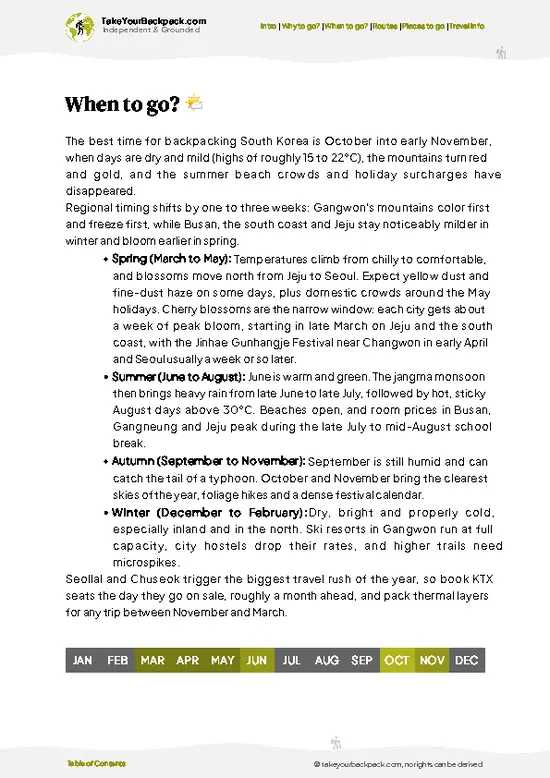
source: climatestotravel.comJANJanuary: fair for travelingFEBFebruary: fair for travelingMARMarch: good for travelingAPRApril: excellent for travelingMAYMay: excellent for travelingJUNJune: highly recommended for travelingJULJuly: fair for travelingAUGAugust: fair for travelingSEPSeptember: excellent for travelingOCTOctober: excellent for travelingNOVNovember: highly recommended for travelingDECDecember: fair for traveling
when-to-go

✈️ The backpacker research shortcutSouth Korea Travel Guide

An offline-friendly backpacking guide with optimized travel routes, ranked highlights, transport advice, and the best areas to stay.
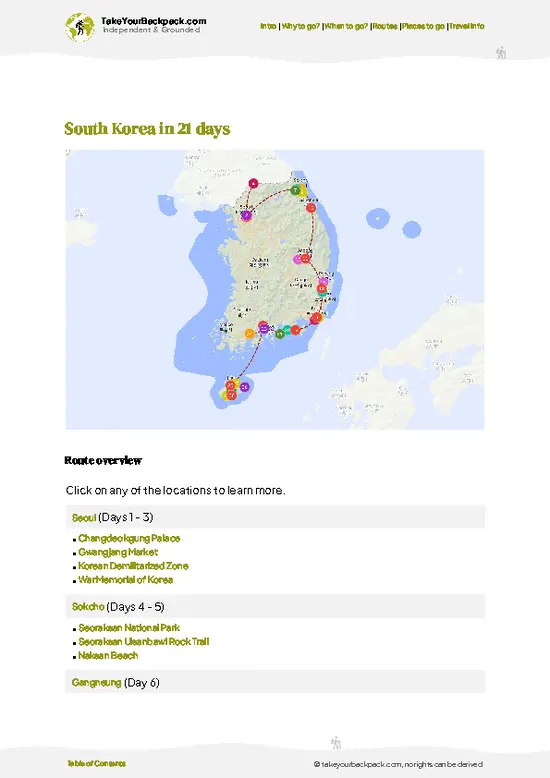
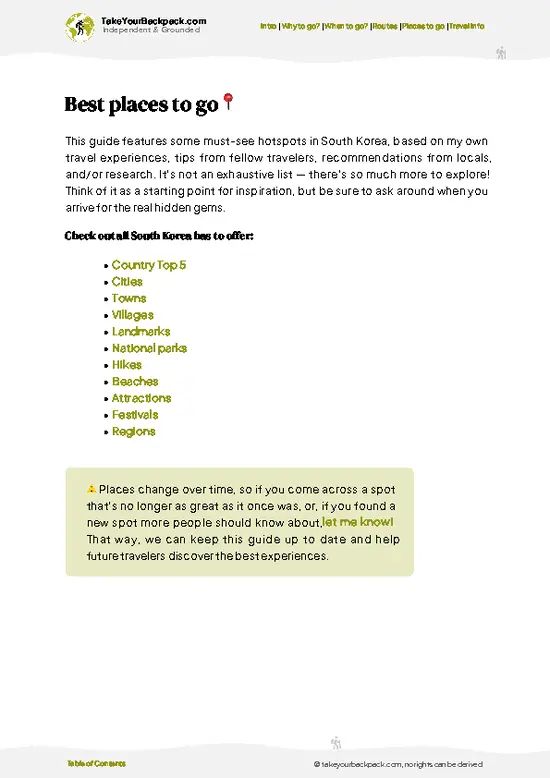
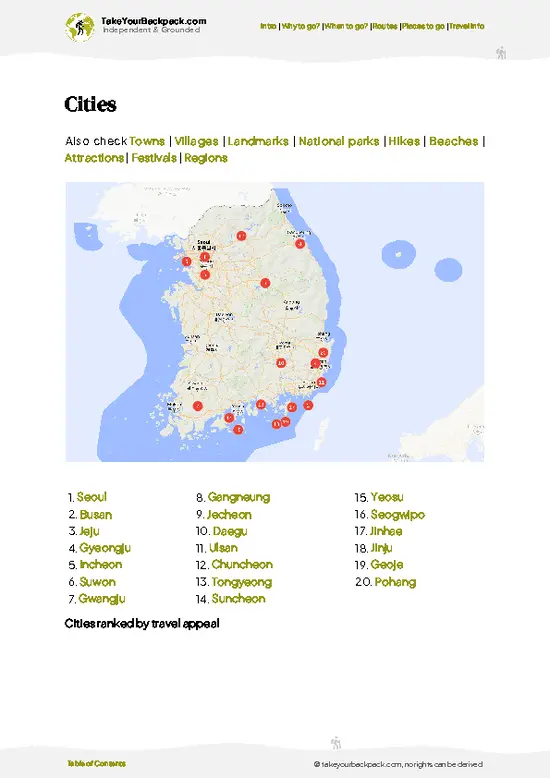
example page 0 from our offline Travel Guide for South Korea
example page 1 from our offline Travel Guide for South Korea
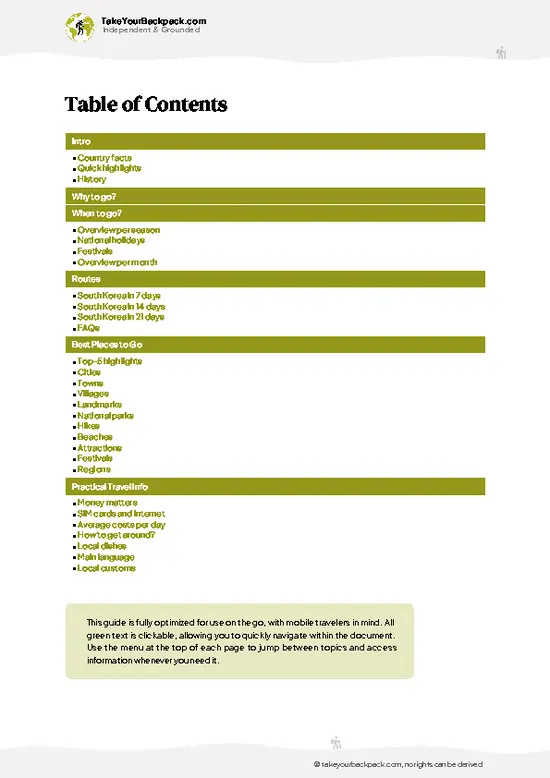
example page 2 from our offline Travel Guide for South Korea
example page 3 from our offline Travel Guide for South Korea
example page 4 from our offline Travel Guide for South Korea
example page 5 from our offline Travel Guide for South Korea
example page 6 from our offline Travel Guide for South Korea
example page 7 from our offline Travel Guide for South Korea
The digital guide (439 pages) contains:
124 highlights, ranked by travel appeal
Optimized 7, 14 & 21-day travel routes
Cities, national parks, landmarks, beaches
How to get around
Offline-friendly for travel without Wi-Fi
👉 Click to see all 30+ guide features

📅 Plan smarter in minutes, not weeks
Month by month travel advice
Festivals & national holidays
Budget expectations

🗺️ Go to the right places, skip the overrated ones
Honest pros & cons of destinations
Top hikes, parks & viewpoints
Lesser-known places most travelers miss
Clear “worth it vs skip it” guidance

🛏️ Travel smoothly without rookie mistakes
Best areas to stay
Transport systems explained simply
Common scams & safety advice
SIM cards, money & practical tips

🌍 Understand the country, not just visit it
Culture & traditions
52 Essential phrases & customs
Festivals worth planning around
Traveler-friendly historical context
Insights that make places more meaningful

📱 Built for real travel conditions
Fully downloadable PDF
Works completely offline
Optimized for phone use
Useful in remote areas & buses
Everything in one place
Save weeks of stressful planning
Get instant access to your full guide. 30‑day money-back guarantee.
+ Add another guide for just US$7.80

By proceeding you agree to our terms.
Sent to your inbox immediately after payment • 100% Secure Checkout
Best Backpacking Travel Advisor 2025 tourism awardBest Backpacking
Travel Advisor
2025
What others say about Take Your Backpack Guides:
⭐⭐⭐⭐⭐
Fantastic, amazing amount of information!
⭐⭐⭐⭐⭐
My goodness this is amazing, it's what I've been looking for hats off too you!
⭐⭐⭐⭐⭐
I think this is absolutely BRILLIANT
⭐⭐⭐⭐
Very complete and informative. It's still missing places, but I gotta to commend you
⭐⭐⭐⭐⭐
This is truly amazing, thank you, can't wait to explore it with my kids!
⭐⭐⭐⭐⭐
Awesome resource, thank you!
⭐⭐⭐⭐⭐
This is amazing! Can't wait to explore the ones I haven't seen
⭐⭐⭐⭐
I love this! Well done, great idea.
⭐⭐⭐⭐⭐
Thanks for taking the time to make this gem!
⭐⭐⭐⭐⭐
This might be the best website I've ever seen.
⭐⭐⭐⭐⭐
Congratulations, and thank you so much for your work; it's incredibly valuable.
⭐⭐⭐⭐
In all seriousness I think you did a great job pointing out the important spots
⭐⭐⭐⭐⭐
10/10 very good
⭐⭐⭐⭐⭐
As someone who's only just starting to visit regularly this is awesome, thank you.
⭐⭐⭐⭐
Thank you very much! I'm going to visit my dad, it's going to be very useful!
⭐⭐⭐⭐⭐
This is really cool! We'll be travelling for the first time and this definitely come in handy.
⭐⭐⭐⭐⭐
You are now our minister of culture, congratulations 👨‍💼
⭐⭐⭐⭐⭐
Just wanted to tell you that this is a pearl! Going to follow your recommendations.
⭐⭐⭐⭐⭐
This is so cool. I'll definitely be using the resource for my travels soon.
⭐⭐⭐⭐⭐
This is very impressive! Good work.
⭐⭐⭐⭐⭐
This is an amazing and informative site. Very well done!

🛏️ Where to stay?Where staying makes the most sense

Bukchon Hanok Village itself is a quiet, almost museum-like pocket of Seoul, where traditional hanok roofs curve against the sky and the air carries a faint scent of wood and earth. It’s not a buzzing nightlife hub, nor is it packed with budget hostels. For backpackers craving safety, social energy, and wallet-friendly digs, the best move is to base yourself just outside Bukchon, in neighborhoods like Jongno and Insadong.

Jongno is a solid choice because it’s a living, breathing part of the city with a pulse that matches your backpacker vibe. Narrow alleys lined with tiny eateries and street … read more 👉
Bukchon Hanok Village itself is a quiet, almost museum-like pocket of Seoul, where traditional hanok roofs curve against the sky and the air carries a faint scent of wood and earth. It’s not a buzzing nightlife hub, nor is it packed with budget hostels. For backpackers craving safety, social energy, and wallet-friendly digs, the best move is to base yourself just outside Bukchon, in neighborhoods like Jongno and Insadong.

Jongno is a solid choice because it’s a living, breathing part of the city with a pulse that matches your backpacker vibe. Narrow alleys lined with tiny eateries and street vendors offer a sensory playground—think sizzling tteokbokki and the sharp tang of kimchi. Hostels here cater to solo travelers and groups alike, with communal spaces that make it easy to swap stories over cheap soju. It’s safe, well-lit, and a short walk or bus ride from Bukchon’s serene lanes.

Insadong, just a stone’s throw away, leans into art and culture. It’s a bit more touristy but still retains a laid-back charm. Hostels here often double as cultural hubs, with workshops or gallery visits that help you connect beyond the usual tourist bubble. The streets hum with the clink of tea cups and the rustle of hanji paper, making it a sensory-rich base for your Bukchon explorations.

Both areas offer a smoother, more social experience than staying inside Bukchon itself, where accommodation options are limited and the vibe is more about quiet appreciation than lively connection. You get the best of both worlds: easy access to Bukchon’s historic calm and a vibrant, budget-friendly launchpad for the rest of Seoul.

🚌 Getting aroundMoving around without the hassle

Bukchon Hanok Village moves at the pace of a quiet morning stroll, not a rush-hour scramble. The narrow alleys, lined with centuries-old wooden houses, invite you to slow down and absorb the subtle creak of wooden floors and the faint scent of pine from traditional rooftops. This isn’t a place where you’ll find a strict timetable or a loud, bustling transit hub. Instead, it’s a patchwork of pedestrian pathways and nearby transit stops that reward patience and curiosity. The rhythm here is intuitive—follow the flow of locals and fellow wanderers, and you’ll unlock the village’s layered history and serene charm without the stress of rigid schedules.


  • Walking: The heart of Bukchon is best explored on foot. The village’s compact layout means you can wander from one hanok to another in 10 to
read more 👉
Bukchon Hanok Village moves at the pace of a quiet morning stroll, not a rush-hour scramble. The narrow alleys, lined with centuries-old wooden houses, invite you to slow down and absorb the subtle creak of wooden floors and the faint scent of pine from traditional rooftops. This isn’t a place where you’ll find a strict timetable or a loud, bustling transit hub. Instead, it’s a patchwork of pedestrian pathways and nearby transit stops that reward patience and curiosity. The rhythm here is intuitive—follow the flow of locals and fellow wanderers, and you’ll unlock the village’s layered history and serene charm without the stress of rigid schedules.


  • Walking: The heart of Bukchon is best explored on foot. The village’s compact layout means you can wander from one hanok to another in 10 to 20 minutes, soaking in the texture of stone walls and the filtered sunlight through paper windows. Walking is free, naturally, and the only speed limit is your own pace—perfect for those who want to linger over every detail.


  • Seoul Subway Line 3 (Anguk Station): Just a 5-minute walk from Bukchon, Anguk Station is your main gateway. Trains run roughly from 5:30 AM to midnight, with fares starting around 1,350 KRW ($1.10 USD). It’s fast and efficient, but expect a crowd during rush hours. Use this if you’re coming from farther out or want to connect quickly to other parts of Seoul.


  • Bus #109 or #151: These buses stop near the village entrance and offer a budget-friendly, scenic route through central Seoul. Buses run every 10-15 minutes during the day, with fares similar to the subway. The ride is slower but gives you a street-level view of the city’s changing neighborhoods, which is a bonus if you want to ease into the village atmosphere.


  • Taxi or Ride-Hailing Apps: For those carrying gear or arriving late, taxis are a convenient option. A short ride from central Seoul costs about 5,000 to 8,000 KRW ($4–7 USD). Traffic can slow you down during peak hours, but the door-to-door service is unbeatable if you want to avoid the walk after dark or with heavy bags.

👛 Costs (as of 4 September 2026)Money, prices, and spending tips

Backpacking in Bukchon Hanok Village offers a unique blend of traditional Korean culture and urban charm, but knowing the daily costs helps you navigate the experience without surprises.
  • Dorm Accommodation: Expect to pay around $20 to $35 per night for a bed in a guesthouse or hostel near Bukchon. These places often have simple, clean rooms with shared bathrooms, and staying here puts you within walking distance of the village’s narrow alleys and hanok rooftops.
  • Meals: Budget about $10 to $15 daily if you stick to local eateries and street food stalls. A bowl of bibimbap or a serving of tteokbokki will cost between $3 and $6, while grabbing a quick coffee or tea adds a couple of dollars. If you want to splurge on a traditional Korean meal in a hanok-style restaurant, expect to pay $15 to
read more 👉
Backpacking in Bukchon Hanok Village offers a unique blend of traditional Korean culture and urban charm, but knowing the daily costs helps you navigate the experience without surprises.
  • Dorm Accommodation: Expect to pay around $20 to $35 per night for a bed in a guesthouse or hostel near Bukchon. These places often have simple, clean rooms with shared bathrooms, and staying here puts you within walking distance of the village’s narrow alleys and hanok rooftops.
  • Meals: Budget about $10 to $15 daily if you stick to local eateries and street food stalls. A bowl of bibimbap or a serving of tteokbokki will cost between $3 and $6, while grabbing a quick coffee or tea adds a couple of dollars. If you want to splurge on a traditional Korean meal in a hanok-style restaurant, expect to pay $15 to $25 for dinner.
  • Local Transport: Bukchon is best explored on foot, but if you need to hop on a bus or subway, a single ride costs roughly $1 to $1.50. A day pass for unlimited rides in Seoul is about $5, which is handy if you plan to explore beyond Bukchon.
  • Basic Activities/Entry Fees: Most of Bukchon Hanok Village itself is free to wander, but some cultural centers or small museums charge entry fees ranging from $2 to $5. Participating in a traditional craft workshop or tea ceremony can push this to $10 to $20, but it’s worth it for the hands-on experience.
  • Miscellaneous Expenses: Budget around $5 to $10 for things like bottled water, snacks, or small souvenirs. Wi-Fi is widely available, but if you need a local SIM card or portable Wi-Fi device, expect to pay about $10 to $15 per day.

All told, a realistic daily budget for backpacking in Bukchon Hanok Village falls between $40 and $70. This range covers the essentials while leaving room for a few cultural extras, making your trip both manageable and richly rewarding.


source: english.visitkorea.or.kr
⚠️ Prices can change and everyone travels differently, so take this as a rough guide. Hope it helps you plan your adventure!

🚌 Day tripsExploring the surroundings

Bukchon Hanok Village is a fantastic base for exploring the rich tapestry of Seoul and beyond. With its traditional hanoks and narrow alleys, it’s a perfect blend of history and modernity. Here are some day trips that will elevate your experience.

**Gyeongbokgung Palace**
Just a short bus ride away, Gyeongbokgung is a must-see. The grandeur of the palace, especially during the changing of the guard ceremony, is breathtaking. Aim to arrive early to avoid crowds and soak in the morning light filtering through the ancient architecture. Entry is around 3,000 KRW, and you can easily spend a few hours wandering the grounds. A common mistake? Skipping the National Folk Museum located on-site—it’s a treasure trove of Korean culture.
👉 Explore Gyeongbokgung Palace

**Insa-dong**
A quick subway … read more 👉
Bukchon Hanok Village is a fantastic base for exploring the rich tapestry of Seoul and beyond. With its traditional hanoks and narrow alleys, it’s a perfect blend of history and modernity. Here are some day trips that will elevate your experience.

**Gyeongbokgung Palace**
Just a short bus ride away, Gyeongbokgung is a must-see. The grandeur of the palace, especially during the changing of the guard ceremony, is breathtaking. Aim to arrive early to avoid crowds and soak in the morning light filtering through the ancient architecture. Entry is around 3,000 KRW, and you can easily spend a few hours wandering the grounds. A common mistake? Skipping the National Folk Museum located on-site—it’s a treasure trove of Korean culture.
👉 Explore Gyeongbokgung Palace

**Insa-dong**
A quick subway hop brings you to Insa-dong, where traditional meets trendy. Stroll through art galleries and tea houses, and don’t miss the street food stalls. Try some hotteok (sweet pancakes) while you browse. This area is best visited in the afternoon when the light softens, creating a cozy atmosphere. Budget around 10,000 KRW for snacks and souvenirs. First-timers often overlook the side alleys, which are filled with unique shops and local artisans.


**Namsan Tower**
For a panoramic view of Seoul, head to Namsan Tower. It’s about a 30-minute hike from the base, and the trail is lined with cherry blossoms in spring. The entrance fee is around 10,000 KRW, but the hike is free and invigorating. Aim for sunset to catch the city lighting up. Many miss the charm of the surrounding park, which is perfect for a picnic.


**DMZ Tour**
While it sounds daunting, a DMZ tour is surprisingly accessible. Book a guided tour from Seoul, which typically costs around 50,000 KRW. The journey takes about an hour, and the experience is profound. You’ll learn about the history of the Korean Peninsula and see the stark contrast between North and South. A common pitfall is not booking in advance—spots fill up quickly.


**Bukhansan National Park**
If you crave nature, Bukhansan is your go-to. A 40-minute subway ride gets you to the park entrance. The trails vary in difficulty, but the views from the top are worth every step. Bring a packed lunch to enjoy at the summit. Expect to spend around 5,000 KRW for entry and snacks. Many first-timers underestimate the time needed for the hike, so plan for a full day.
Want to know what more South Korea offers?
The South Korea Travel Guide describes 124 highlights, from cities to national parks, from beaches to hikes

Get the Travel Guide -

🛡️ SafetyScams, Hazards, and Annoyances

Bukchon Hanok Village is generally safe, but a few practical tips can enhance your experience. Stick to well-lit paths after dark; the narrow alleys can feel a bit isolated. If you’re solo, keep your phone handy for navigation and don’t hesitate to step into a café if you feel uneasy.

While scams are rare, be cautious around overly enthusiastic street vendors. They might push for sales, so a polite but firm “no” works wonders. The biggest annoyance? Crowds. Visit early in the morning or late afternoon to savor the village’s charm without the hustle. Enjoy the tranquility; it’s worth the effort.

FAQFrequently asked questions about Bukchon Hanok Village

Yes, Bukchon Hanok Village is worth visiting for its well-preserved traditional Korean houses and cultural atmosphere. It offers a unique glimpse into Korea's past within Seoul, making it more than just a stopover. Visitors can explore narrow alleys and visit cultural centers and craft workshops.
One day is sufficient to explore Bukchon Hanok Village thoroughly, including walking through the main alleys and visiting a few museums or tea houses. Allocate around 3 to 4 hours to fully appreciate the area without rushing. Early morning or late afternoon visits are best to avoid crowds.
Yes, Bukchon Hanok Village can easily be visited as a day trip from Seoul, as it is located in the city center. It is accessible by subway and bus, with travel times typically under 30 minutes from major Seoul districts like Myeongdong or Insadong.
⚠️ Things can change over time, so always validate details locally before you go.

Other South Korean towns near Bukchon Hanok Village

Explore more nearby:

  • Inje—whitewater rafting, pine forests, mountain lodges| 118 km away
  • Pyeongchang—alpine meadows, ski resorts, Buddhist temples| 127 km away
  • Yeongwol—river bends, literary sites, quiet valleys| 138 km away

💡 Not sure where to go next?
Create a personalized itinerary for South Korea including Bukchon Hanok Village and the places that fit your trip.

Generate my itinerary

👉 Discover all towns

Or checkout all South Korea has to offer (think cities, towns, villages, national parks, hikes, beaches, festivals)
Country photo of South Korea

We 💚 feedbackIs it worth it?

Wandering through Bukchon Hanok Village feels like stepping into a living postcard. The wooden rooftops and narrow alleys whisper stories of the past. Don’t miss the small tea houses; they’re a delightful surprise. Just be ready for the crowds—early mornings are your best bet for a peaceful stroll.

✍️ Help improve this page!
The information on this page is based on in-depth research, insights shared by experienced travelers, and feedback from the local travel community in South Korea. While every effort is made to keep the information accurate and current, conditions can change — so if you spot anything incorrect or outdated, please get in touch.


🙋‍♂️ Give feedback

👋 Meet the founderWho’s Behind Take Your Backpack?

Johan, backpacker and founder of TakeYourBackpackHi, I’m Johan (Netherlands 🇳🇱), the creator of TakeYourBackpack. Over the past decade, I’ve backpacked through 80+ countries across six continents, gaining extensive experience with independent travel, long-term trips, and overland routes.

This site is built on a combination of firsthand travel experience and carefully curated insights from other backpackers. Many guides are based on places I’ve personally visited, while others bring together tips, observations, and practical advice shared by trusted travelers I’ve met along the way.

The goal is to provide realistic, experience-driven guidance — not generic itineraries — so you can explore destinations with better context, clearer expectations, and more confidence.

Get full country guide •
Instant download • 124 highlights • Full Offline guide