×

South Korea🇰🇷 | best attractionsThe 10 Top attractions in South Korea

Attractions in South Korea are dense, cheap and easy to reach, because a small, mountainous country built a fast rail network and a cheap urban transit system around its main sites. Palaces, temples, markets and mountain trails sit within an hour of subway stations, and most entry fees run US$0 to 10 (roughly 0 to 15,000 won). Regional character shifts quickly. Seoul concentrates royal heritage and nightlife, so it is the most crowded and the most polished. Gyeongju and the southeast hold the old Silla kingdom's temples and tombs at a slower pace. Jeju is volcanic, with coastal and crater hikes that reward renting a car or taking buses on a set schedule. The east coast and the Seoraksan area are about mountains and sea, with seasonal crowds. For backpacking and independent travel, the real variable is how much transit time you accept between very different kinds of places.

By Johan Kruseman 🇳🇱 | Updated October 19, 2026
Explore the best festivals in South Korea

Why go?Key Factors That Shape the Experience

South Korea works unusually well for attractions because history, terrain and infrastructure overlap in a compact space. The Joseon dynasty ruled from Seoul for more than five centuries, which left palaces, fortress walls and Confucian shrines in the capital. Buddhism, which thrived under the earlier Silla and Goryeo kingdoms, pushed temples into the mountains, so many sacred sites are also trailheads. Wars, especially the Korean War, destroyed a great deal, so many wooden structures are careful reconstructions. Expect restored detail rather than weathered original timber, and judge them on that basis.

Geography shapes the rest. About 70 percent of the country is mountainous, which is why national parks are close to cities and reachable by local bus. The peninsula has four distinct seasons, … read more 👉
South Korea works unusually well for attractions because history, terrain and infrastructure overlap in a compact space. The Joseon dynasty ruled from Seoul for more than five centuries, which left palaces, fortress walls and Confucian shrines in the capital. Buddhism, which thrived under the earlier Silla and Goryeo kingdoms, pushed temples into the mountains, so many sacred sites are also trailheads. Wars, especially the Korean War, destroyed a great deal, so many wooden structures are careful reconstructions. Expect restored detail rather than weathered original timber, and judge them on that basis.

Geography shapes the rest. About 70 percent of the country is mountainous, which is why national parks are close to cities and reachable by local bus. The peninsula has four distinct seasons, so the same site can look completely different in spring blossom and winter snow. The KTX high-speed rail links Seoul to Busan in about 2.5 hours, and intercity buses reach nearly everywhere else, so independent travel needs little advance planning.

Before committing, know the limits. Signage is good in English at major sites, but smaller rural ones may offer little beyond Korean. Payment is largely by card, though some markets and temples want cash. Holidays such as Lunar New Year and Chuseok empty cities and fill trains and roads. Overall the country suits travelers who prefer varied, well-organized, easy-to-reach sights over remote wilderness.
Why These Made the Cut
The list of best attractions in South Korea is created based on cultural significance or entertainment value. If you feel a attraction is missing in this list, please let us know.

When to go?Optimal Periods for Travel

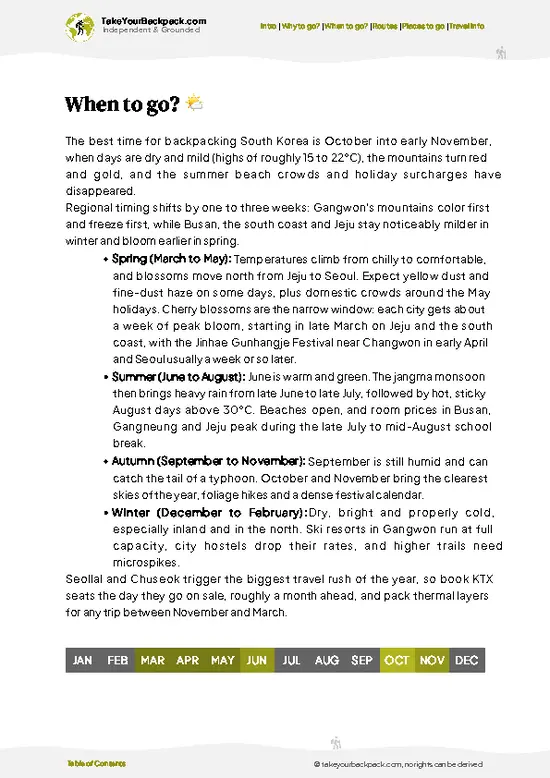
Best months for attractions: The best months for attractions in South Korea are April to early June and September to October, when daytime temperatures sit around 15 to 25°C, skies are clearer, and mountains and palaces are comfortable to walk. Spring brings cherry blossoms, usually late March to mid-April in the south and a week or so later in Seoul. Autumn foliage peaks in mid to late October in the northern mountains and moves south into early November.
Summer and the monsoon: From late June to late July the jangma rainy season brings heavy, frequent rain, and July and August are hot and humid, often 28 to 35°C. Roughly half of the country's annual rainfall, about 1,000 to 1,400 mm, falls from June to September, and typhoons can disrupt ferries and flights to Jeju, mostly in August and September. … read more 👉
Best months for attractions: The best months for attractions in South Korea are April to early June and September to October, when daytime temperatures sit around 15 to 25°C, skies are clearer, and mountains and palaces are comfortable to walk. Spring brings cherry blossoms, usually late March to mid-April in the south and a week or so later in Seoul. Autumn foliage peaks in mid to late October in the northern mountains and moves south into early November.
Summer and the monsoon: From late June to late July the jangma rainy season brings heavy, frequent rain, and July and August are hot and humid, often 28 to 35°C. Roughly half of the country's annual rainfall, about 1,000 to 1,400 mm, falls from June to September, and typhoons can disrupt ferries and flights to Jeju, mostly in August and September. Beaches and coastal areas are busiest in late July and early August, when accommodation prices rise noticeably. Hiking is still possible but slippery, and views are often hazy.
Winter: December to February is cold and dry. Seoul averages around -6 to 3°C, and the northeast gets heavy snow, which suits winter landscapes and ski areas, but exposed ridgelines can be dangerous and some trails close. Jeju stays milder, at around 3 to 8°C. Prices drop at city hotels, though ski resorts rise at weekends.
Peak periods that change plans: Lunar New Year (January or February) and Chuseok (September or October) cause the heaviest domestic travel. Trains sell out days ahead, and some shops and restaurants close for one to three days. Palaces and many museums close one day a week, usually Monday or Tuesday, so check before arriving.

attraction hoppingSuggested Travel Strategies

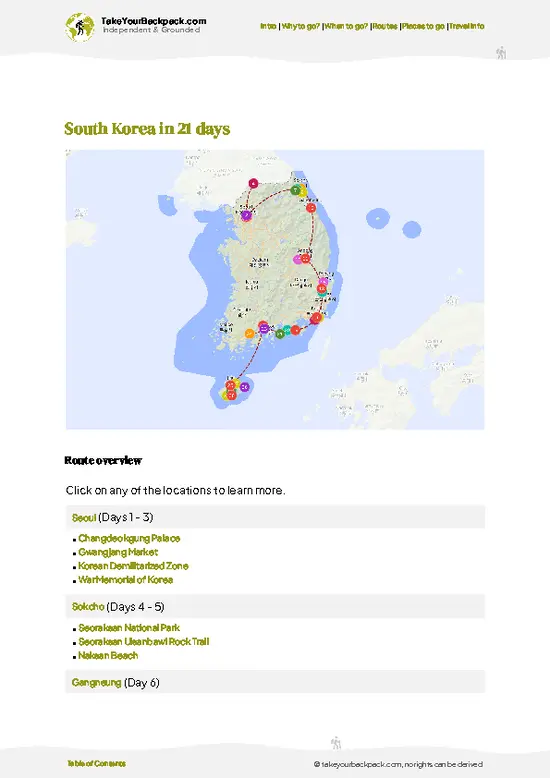
How many days to allow: A trip combining several attractions in South Korea needs 10 to 14 days, which allows three or four regional bases without constant packing. Regions cluster by rail line, so group them that way. The Seoul and northeast cluster pairs the capital with the Gangwon mountains and east coast. The southeast cluster ties Busan, Gyeongju and Daegu together. Jeju sits apart and needs a flight.
Direction of travel: Starting in Seoul and finishing in Busan works best because Incheon Airport is closest to the capital. Busan has the KTX, long-distance buses and flights back to Seoul, so you avoid backtracking. Add the east coast between them only if you have 12 days or more. Put Jeju at the end, flying from Busan or Seoul (about 1 hour), so a weather delay does not strand you before … read more 👉
How many days to allow: A trip combining several attractions in South Korea needs 10 to 14 days, which allows three or four regional bases without constant packing. Regions cluster by rail line, so group them that way. The Seoul and northeast cluster pairs the capital with the Gangwon mountains and east coast. The southeast cluster ties Busan, Gyeongju and Daegu together. Jeju sits apart and needs a flight.
Direction of travel: Starting in Seoul and finishing in Busan works best because Incheon Airport is closest to the capital. Busan has the KTX, long-distance buses and flights back to Seoul, so you avoid backtracking. Add the east coast between them only if you have 12 days or more. Put Jeju at the end, flying from Busan or Seoul (about 1 hour), so a weather delay does not strand you before an onward flight.
Time per stop and transfers: Allow 3 to 4 days in Seoul, 2 to 3 in Gyeongju, 2 to 3 in Busan and 2 to 3 on Jeju. Seoul to Busan by KTX takes about 2.5 hours, Seoul to Gyeongju about 2 to 2.5 hours to Singyeongju station by KTX, and Busan to Gyeongju about 1 hour by bus or train. Seoul to Gangneung by KTX is roughly 2 hours. Mountain parks need a full day, or two with an overnight in the town beside them.
Planning mistakes: The most common error is overpacking with day trips from Seoul, which turns into hours on subways and buses. Pick one or two and stay overnight when the transfer exceeds 2 hours. Another is ignoring closure days and holidays, so book trains early and check opening dates. Many travelers also underestimate Jeju, where bus links are slow, so allocate more days than distance suggests.

The ListTop attractions of South Korea

1 Jeonju Hanok Village

hanok houses, street food, artisan workshops

Stay in traditional wooden homes, taste local specialties, and watch craftspeople at work in a preserved neighborhood at the city’s heart.

2 Gyeongbokgung Palace

grand gates, ceremonial halls, mountain backdrop

Walk through expansive courtyards and reconstructed throne rooms, framed by distant peaks and the city’s changing skyline.

3 Bukchon Hanok Village

traditional alleys, tiled rooftops, city views

Wander narrow lanes lined with historic homes, glimpse Seoul’s skyline, and observe daily life in a living heritage district.

4 Korean Demilitarized Zone

border observatories, military tunnels, security checkpoints

Join guided visits to observation posts and underground passages, gaining insight into the peninsula’s division and ongoing tensions.

5 Everland Resort

theme park rides, safari zone, seasonal festivals

Spend a day navigating roller coasters, animal enclosures, and themed gardens, with frequent events drawing local families and visitors.

6 Lotte World

indoor amusement park, ice rink, themed parades

Navigate interconnected rides, entertainment zones, and shopping arcades, with attractions operating year-round regardless of weather.

South Korea - Lotte World

7 Gamcheon Culture Village

colorful hillside houses, mosaic murals, sea views

Climb winding stairways between painted homes and outdoor art, with panoramic glimpses of the port city and distant ocean.

8 Haedong Yonggungsa Temple

seaside sanctuary, stone pagodas, coastal cliffs

Descend to a Buddhist temple perched above waves, where incense drifts over rocky outcrops and ocean views dominate the horizon.

9 Gwangjang Market

street food stalls, textile vendors, bustling aisles

Sample savory pancakes and raw beef dishes in a crowded market, where food counters and fabric shops compete for attention.

10 Insadong

antique shops, tea houses, calligraphy galleries

Browse for ceramics and handmade paper, pausing in quiet cafés and studios that preserve traditional crafts and rituals.

11 Dongdaemun Design Plaza

futuristic architecture, design exhibitions, night markets

Experience a landmark blending innovative structures with rotating art displays, surrounded by late-night shopping and urban energy.

12 Korean Folk Village

recreated rural homes, folk performances, craft demonstrations

Watch costumed actors reenact seasonal festivals and daily routines in a setting designed to reflect pre-modern village life.

13 War Memorial of Korea

military exhibits, outdoor tanks, memorial halls

Examine weaponry, uniforms, and personal stories in a museum documenting conflicts and commemorating those affected by war.

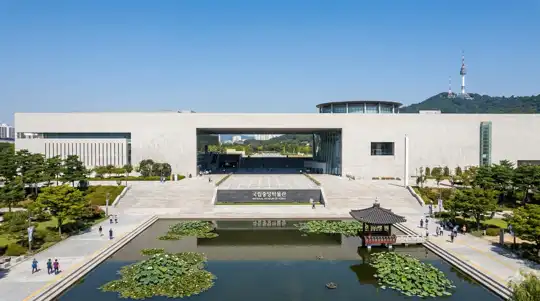
14 National Museum of Korea

ancient artifacts, Buddhist sculptures, rotating exhibitions

Survey galleries spanning prehistoric relics to modern art, with detailed displays that trace the peninsula’s cultural evolution.

South Korea - National Museum of Korea

15 Hongdae

live music venues, graffiti walls, indie boutiques

Absorb the energy of open-air shows and late-night clubs, surrounded by creative street art and independent fashion shops.

16 Namsangol Hanok Village

restored courtyard houses, traditional gardens, cultural workshops

Step into a cluster of period homes and landscaped grounds, participating in hands-on activities that highlight urban heritage.

17 Seoul Arts Center

concert halls, art museums, outdoor sculptures

Explore a multi-venue complex hosting orchestral concerts, visual art shows, and public installations across landscaped grounds.

18 National Theatre of Korea

main stage productions, Korean opera, contemporary dance

Attend performances ranging from traditional masked drama to experimental choreography in a venue dedicated to performing arts.

South Korea - National Theatre of Korea

Think you know South Korea?

Prove you’re a true local — uncover 8 lesser-known attractions in South Korea that locals tend to keep to themselves.
Loading the map 🌍

Expert viewTips and Advice from Travelers

How many attractions to plan: Plan one or two main sights a day, which over 10 to 14 days adds up to roughly 12 to 20 in total. Korean sites are close together and transit is quick, so it is tempting to cram in more. Palaces, temples and mountain trails each need two to four hours to appreciate, and a rushed day of five entries leaves little memory. Spacing also leaves room for the free, unscheduled things (markets, night streets, a bathhouse) that give the country its texture.
Prioritizing by travel style: History-focused travelers should weight palaces, temples and Silla heritage, which are inexpensive and compact. Hikers should put national parks and long trails first and plan around season and weather, because views vary widely. Food and nightlife travelers get the most from city districts … read more 👉
How many attractions to plan: Plan one or two main sights a day, which over 10 to 14 days adds up to roughly 12 to 20 in total. Korean sites are close together and transit is quick, so it is tempting to cram in more. Palaces, temples and mountain trails each need two to four hours to appreciate, and a rushed day of five entries leaves little memory. Spacing also leaves room for the free, unscheduled things (markets, night streets, a bathhouse) that give the country its texture.
Prioritizing by travel style: History-focused travelers should weight palaces, temples and Silla heritage, which are inexpensive and compact. Hikers should put national parks and long trails first and plan around season and weather, because views vary widely. Food and nightlife travelers get the most from city districts and markets, which cost little in entry fees but a lot in meals. If you have limited time, drop themed museums and observation decks first. They are the priciest and the most easily replaced.
What it costs: A comfortable backpacker budget is about US$55 to 90 a day (roughly 75,000 to 125,000 won), including a hostel dorm at US$18 to 30, meals at US$15 to 25 and transit. Attractions account for only a small share. Palaces and temples typically charge about 1,000 to 5,000 won (under US$4), while larger sites, cable cars and observation decks run 10,000 to 30,000 won (US$7 to 22). Many national parks charge little or nothing for entry, though cable cars and shuttles add 10,000 to 20,000 won. Guided tours cost about US$25 to 70 for a half day. Free English-language palace tours run on a fixed schedule, which makes a paid guide less necessary there. A T-money card covers subways and buses almost everywhere, and a combined palace ticket in Seoul saves money if you visit several.
Safety and etiquette: South Korea has very low violent crime, and the main risks are weather and terrain. Mountain trails are well marked but can ice over from late autumn, and weather turns fast, so carry a headlamp, layers and water, and start early because many parks close trail access in the afternoon. Closures for fire risk or heavy rain are enforced, so obey them. Download Naver Map or KakaoMap because Google Maps works poorly for walking directions.
Cultural considerations: Temples are active places of worship, so dress modestly, keep your voice low, and do not photograph monks or worshippers without asking. Remove shoes before entering halls and follow signs about where photography is allowed. Palaces can enforce closing times strictly and bar large backpacks or tripods in certain areas, so check before you go. Wearing a rented hanbok often gives free entry to the main Seoul palaces, which is worth knowing before you buy tickets. On subways, priority seats are for older and disabled passengers. Leave them free even when the train is empty.

✈️ The backpacker research shortcutSouth Korea Travel Guide

An offline-friendly backpacking guide with optimized travel routes, ranked highlights, transport advice, and the best areas to stay.
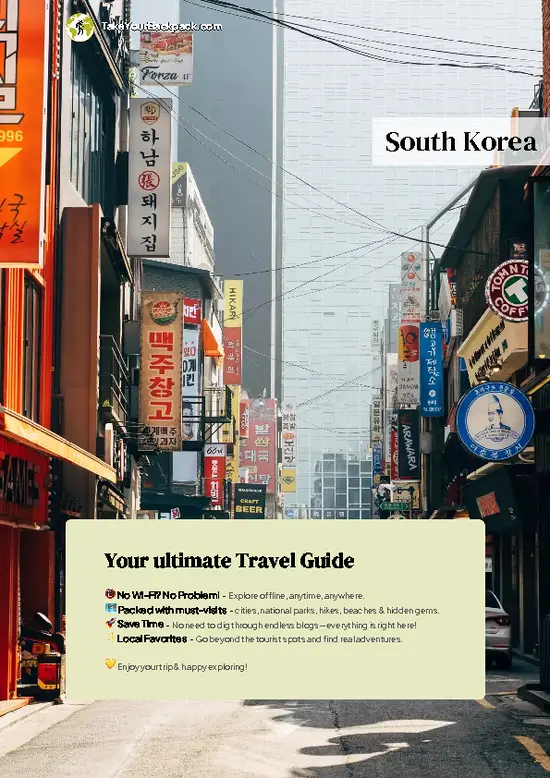
example page 0 from our offline Travel Guide for South Korea
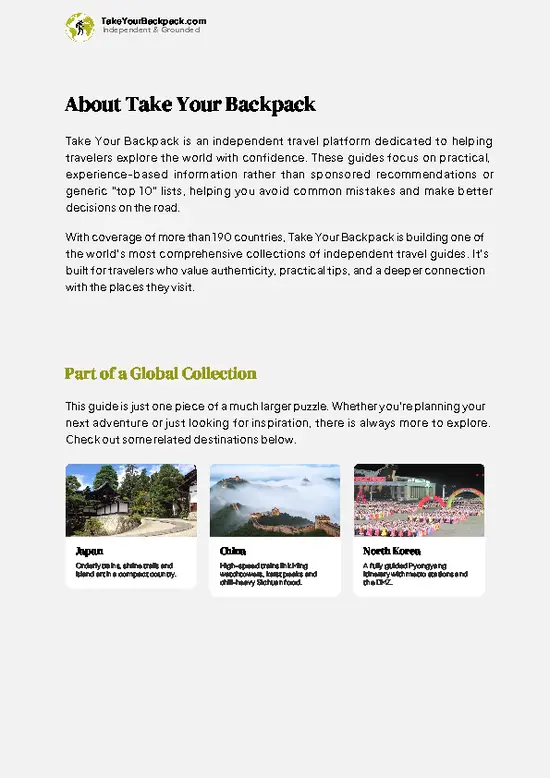
example page 1 from our offline Travel Guide for South Korea
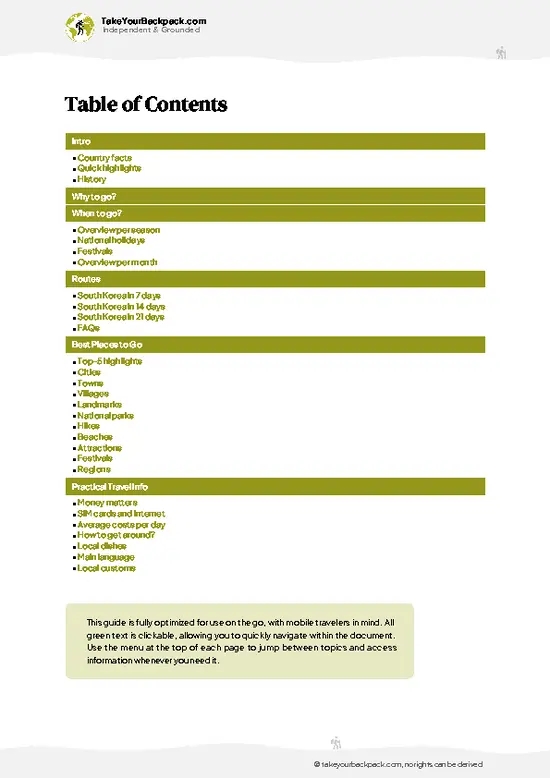
example page 2 from our offline Travel Guide for South Korea
example page 3 from our offline Travel Guide for South Korea
example page 4 from our offline Travel Guide for South Korea
example page 5 from our offline Travel Guide for South Korea
example page 6 from our offline Travel Guide for South Korea
example page 7 from our offline Travel Guide for South Korea
The digital guide (419 pages) contains:
✅ 117 highlights, ranked by travel appeal
✅ Optimized 7, 14 & 21-day travel routes
✅ Cities, national parks, landmarks, beaches
✅ How to get around
✅ Offline-friendly for travel without Wi-Fi
👉 Click to see all 30+ guide features

📅 Plan smarter in minutes, not weeks
✅ Month by month travel advice
✅ Festivals & national holidays
✅ Budget expectations

🗺️ Go to the right places, skip the overrated ones
✅ Honest pros & cons of destinations
✅ Top hikes, parks & viewpoints
✅ Lesser-known places most travelers miss
✅ Clear “worth it vs skip it” guidance

🛏️ Travel smoothly without rookie mistakes
✅ Best areas to stay
✅ Transport systems explained simply
✅ Common scams & safety advice
✅ SIM cards, money & practical tips

🌍 Understand the country, not just visit it
✅ Culture & traditions
✅ 52 Essential phrases & customs
✅ Festivals worth planning around
✅ Traveler-friendly historical context
✅ Insights that make places more meaningful

📱 Built for real travel conditions
✅ Fully downloadable PDF
✅ Works completely offline
✅ Optimized for phone use
✅ Useful in remote areas & buses
✅ Everything in one place
Stop searching, start planning
Get instant access to your full guide. 30‑day money-back guarantee.
+ Add another guide for just

By proceeding you agree to our terms.
Sent to your inbox immediately after payment • 100% Secure Checkout
Best Backpacking Travel Advisor 2025 tourism awardBest Backpacking
Travel Advisor
2025
What others say about Take Your Backpack Guides:
⭐⭐⭐⭐⭐
Fantastic, amazing amount of information!
⭐⭐⭐⭐⭐
My goodness this is amazing, it's what I've been looking for hats off too you!
⭐⭐⭐⭐⭐
I think this is absolutely BRILLIANT
⭐⭐⭐⭐
Very complete and informative. It's still missing places, but I gotta to commend you
⭐⭐⭐⭐⭐
This is truly amazing, thank you, can't wait to explore it with my kids!
⭐⭐⭐⭐⭐
Awesome resource, thank you!
⭐⭐⭐⭐⭐
This is amazing! Can't wait to explore the ones I haven't seen
⭐⭐⭐⭐
I love this! Well done, great idea.
⭐⭐⭐⭐⭐
Thanks for taking the time to make this gem!
⭐⭐⭐⭐⭐
This might be the best website I've ever seen.
⭐⭐⭐⭐⭐
Congratulations, and thank you so much for your work; it's incredibly valuable.
⭐⭐⭐⭐
In all seriousness I think you did a great job pointing out the important spots
⭐⭐⭐⭐⭐
10/10 very good
⭐⭐⭐⭐⭐
As someone who's only just starting to visit regularly this is awesome, thank you.
⭐⭐⭐⭐
Thank you very much! I'm going to visit my dad, it's going to be very useful!
⭐⭐⭐⭐⭐
This is really cool! We'll be travelling for the first time and this definitely come in handy.
⭐⭐⭐⭐⭐
You are now our minister of culture, congratulations 👨‍💼
⭐⭐⭐⭐⭐
Just wanted to tell you that this is a pearl! Going to follow your recommendations.
⭐⭐⭐⭐⭐
This is so cool. I'll definitely be using the resource for my travels soon.
⭐⭐⭐⭐⭐
This is very impressive! Good work.
⭐⭐⭐⭐⭐
This is an amazing and informative site. Very well done!

🛏️ Where to stay?Accommodation Highlights

South Korea has plenty of hostels and guesthouses, with dorm beds typically running ₩20,000 to 35,000 (about US$15 to 25) and private rooms in budget guesthouses from roughly ₩45,000 (US$33). In Seoul, Hongdae has the densest cluster and the loudest nightlife, so expect late noise on weekends. Myeongdong is central with direct airport bus links but gets crowded, Jongno and Insadong put you near the palaces and stay quieter after dark, and Itaewon mixes bars with an international crowd. In Busan, Haeundae means beach access and higher prices, while Seomyeon is cheaper and better connected by metro; all of these areas are safe to walk at night.

If you enjoy meeting fellow travelers, consider choosing … read more 👉
South Korea has plenty of hostels and guesthouses, with dorm beds typically running ₩20,000 to 35,000 (about US$15 to 25) and private rooms in budget guesthouses from roughly ₩45,000 (US$33). In Seoul, Hongdae has the densest cluster and the loudest nightlife, so expect late noise on weekends. Myeongdong is central with direct airport bus links but gets crowded, Jongno and Insadong put you near the palaces and stay quieter after dark, and Itaewon mixes bars with an international crowd. In Busan, Haeundae means beach access and higher prices, while Seomyeon is cheaper and better connected by metro; all of these areas are safe to walk at night.

If you enjoy meeting fellow travelers, consider choosing hostels with high ratings for atmosphere. On the other hand, if you prefer having your own space, a hotel might be a better option.

South KoreaSee More of South Korea

👋 Meet the founderWho’s Behind Take Your Backpack?

Johan, backpacker and founder of TakeYourBackpackHi, I’m Johan (Netherlands 🇳🇱), the creator of TakeYourBackpack. Over the past 3 decades, I’ve backpacked through 90+ countries across six continents, gaining extensive experience with independent travel, long-term trips, and overland routes.

This site is built on a combination of firsthand travel experience and carefully curated insights from other backpackers. Many guides are based on places I’ve personally visited, while others bring together tips, observations, and practical advice shared by trusted travelers I’ve met along the way.

The goal is to provide realistic, experience-driven guidance — not generic itineraries — so you can explore destinations with better context, clearer expectations, and more confidence.