×

South Sudan🇸🇸 | citiesTamburaZande villages, granaries, far-west frontier, long church choirs | things to do and best time to go

Explore MagwiExplore Pariang

Backpacking in Tambura
👌 Worth visitingcity ranked #10
By Johan Kruseman 🇳🇱 | Updated October 22, 2026

Tambura suits self-sufficient, patient travelers who want rural Zande country and have no interest in a checklist. It will disappoint anyone who needs hostels, ATMs, menus or sights with signs, and I would skip it on a short trip. Tambura sits in the far west of South Sudan, in Western Equatoria near the borders with the Central African Republic and the Democratic Republic of the Congo, northwest of Yambio. Services are thin because the area is remote and has seen repeated local conflict, so carry what you need and rely on local contacts instead of improvising. Before going, arrange a host or church or aid-agency contact and check the current security situation locally, since conditions here change quickly.

Discover everything you want to know in the 📖 South Sudan Travel Guide.
Safety warning

The current risk level for South Sudan is high. Check the advice before going.


example page 0 from our offline Travel Guide for South Sudan
example page 1 from our offline Travel Guide for South Sudan
example page 2 from our offline Travel Guide for South Sudan
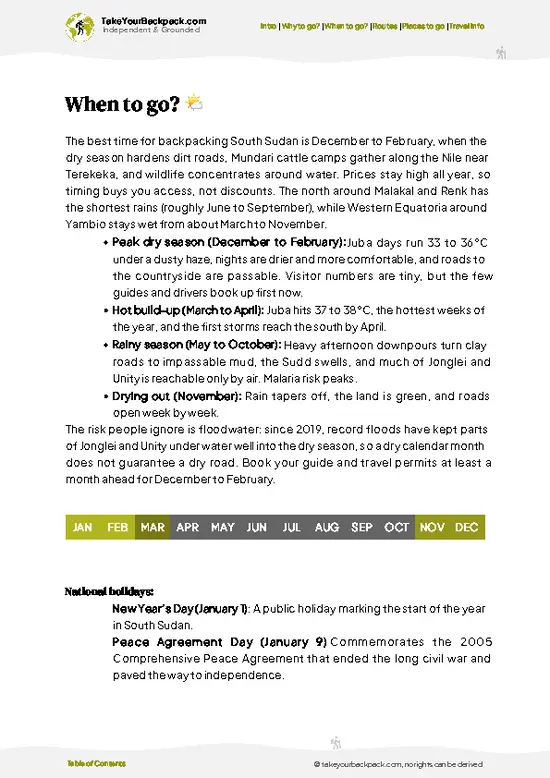
example page 3 from our offline Travel Guide for South Sudan
example page 4 from our offline Travel Guide for South Sudan
example page 5 from our offline Travel Guide for South Sudan
example page 6 from our offline Travel Guide for South Sudan
example page 7 from our offline Travel Guide for South Sudan
Loading the map 🌍
CLICK TO FILTER
cities
towns
landmarks
national parks
hikes
attractions
festivals
regions
SHOW COUNTRY’S BESTSHOW ALL

✨ Why go?
Ranked #10 city in South Sudan
What makes this city worth visiting

Tambura draws the rare traveler who wants to see Zande farming country away from any route, where cassava plots, mango trees and forest edges replace monuments. It makes sense only as a deliberate detour from Western Equatoria, not as a hub: there are no hostel scenes, no nightlife and no easy onward connections, so everything depends on your own preparation. The reason to come is access to people. Markets, church gatherings and village paths give you real conversations, especially if you have a contact who can introduce you, and the Azande cultural identity is strong here. Walking the town takes little time, and the surrounding villages are where the days fill up. Treat it as a short, well-planned stop for experienced travelers, not a place to arrive without plans.

💡 HighlightsTop highlights of Tambura

  1. Tambura Market: The main place to see daily life, with cassava, groundnuts, dried fish, greens and basic goods laid out by sellers. Go in the morning when stock is freshest. Entry is free, snacks run US$1 to 3, and an hour is enough.
  2. Sunday church service: Christianity is central to local life, and services involve loud, harmonized singing that can run long. Visit as a respectful guest, dress modestly and ask a host before attending. It is free and takes 2 to 3 hours.
  3. Zande farm and village walk: Walk out along dirt paths to see cassava fields, granaries, mud-and-thatch homesteads and forest edges. Go with a local guide or host, which may cost US$5 to 15 for a day. Allow 2 to 3 hours, and start early before the heat builds.
  4. Evening on the main road: Late afternoon is when people gather outside
… read more 👉
  1. Tambura Market: The main place to see daily life, with cassava, groundnuts, dried fish, greens and basic goods laid out by sellers. Go in the morning when stock is freshest. Entry is free, snacks run US$1 to 3, and an hour is enough.
  2. Sunday church service: Christianity is central to local life, and services involve loud, harmonized singing that can run long. Visit as a respectful guest, dress modestly and ask a host before attending. It is free and takes 2 to 3 hours.
  3. Zande farm and village walk: Walk out along dirt paths to see cassava fields, granaries, mud-and-thatch homesteads and forest edges. Go with a local guide or host, which may cost US$5 to 15 for a day. Allow 2 to 3 hours, and start early before the heat builds.
  4. Evening on the main road: Late afternoon is when people gather outside shops and tea stalls, and it is the easiest time to talk with locals. Tea and a snack cost US$1 to 2. Stay an hour and head back before dark.
Tambura has few formal sights, so the best day trips are Yambio, the regional center for Western Equatoria, Nzara, known for its agricultural history, and Ezo, near the border, all reached by long rural roads. The market and the church service cost nothing to enter, making them the cheapest items here.
Spotted a mistake or missing something? Contact us.

🏘️ NeighborhoodsNeighborhood guide to Tambura

Tambura is a small town in Western Equatoria, and you can learn its layout in an afternoon on foot. Most of what matters sits within a couple of kilometers, because the town grew along a few dirt roads rather than from a planned center.
  • Market area: This is the one place worth your time. Stalls sell cassava, groundnuts, tomatoes, dried fish and soap, and small tea stands serve sweet tea and fried dough. Go in the morning, when stock is freshest. It is fully walkable.
  • Town center and administrative side: Government offices, churches and aid-agency compounds cluster here. There is nothing to sightsee, but this is where you ask about road conditions and register if officials require it. Walk it, and keep your paperwork on you.
  • Residential outskirts: Homesteads with mango trees and small fields line
… read more 👉
Tambura is a small town in Western Equatoria, and you can learn its layout in an afternoon on foot. Most of what matters sits within a couple of kilometers, because the town grew along a few dirt roads rather than from a planned center.
  • Market area: This is the one place worth your time. Stalls sell cassava, groundnuts, tomatoes, dried fish and soap, and small tea stands serve sweet tea and fried dough. Go in the morning, when stock is freshest. It is fully walkable.
  • Town center and administrative side: Government offices, churches and aid-agency compounds cluster here. There is nothing to sightsee, but this is where you ask about road conditions and register if officials require it. Walk it, and keep your paperwork on you.
  • Residential outskirts: Homesteads with mango trees and small fields line the tracks leading into forest. Walking here shows you daily life, but it turns muddy in the rains and distances stretch quickly. Take a motorbike taxi for anything past a couple of kilometers.
  • Airstrip side: Skip it unless you are flying in or out. It is quiet, with no services beyond the strip itself.

⌛️ 1 daySeeing the highlights in 24 hours

The day works best on foot, with an early start and a long pause when the midday heat settles.
7:30 AM: Tea stall on the main road. Start with sweet tea and chat with whoever is setting up, which is the easiest way to learn what is happening locally. Walk to the market afterward.
8:30 AM: Tambura Market. Mornings are the busiest. Look at the cassava, dried fish and greens, buy fruit, and ask before taking any photos. Allow about an hour.
10:00 AM: Farm paths on the edge of town. Hire a local guide or ask your host to walk with you. The paths pass fields, granaries and homesteads, and this is the part few outsiders see. Turn back before the sun gets high.
12:30 PM: Lunch and rest. Eat a simple meal with cassava or beans, drink plenty of water, and stay in the shade through the hottest hours.
4:00 … read more 👉
The day works best on foot, with an early start and a long pause when the midday heat settles.
7:30 AM: Tea stall on the main road. Start with sweet tea and chat with whoever is setting up, which is the easiest way to learn what is happening locally. Walk to the market afterward.
8:30 AM: Tambura Market. Mornings are the busiest. Look at the cassava, dried fish and greens, buy fruit, and ask before taking any photos. Allow about an hour.
10:00 AM: Farm paths on the edge of town. Hire a local guide or ask your host to walk with you. The paths pass fields, granaries and homesteads, and this is the part few outsiders see. Turn back before the sun gets high.
12:30 PM: Lunch and rest. Eat a simple meal with cassava or beans, drink plenty of water, and stay in the shade through the hottest hours.
4:00 PM: Church grounds and neighborhood walk. Cooler air brings people out, and a short stroll lets you see the churches and school yards, often with children playing nearby.
5:30 PM: Main road at dusk. Finish with tea and conversation, then return to your lodging before dark.

🌤️ When to go?Best time to visit Tambura

The dry months from roughly December to March are easiest for travel here, with firm roads and highs of 32 to 35°C (90 to 95°F).
  • Dry Season (December to March): Roads and tracks are at their most passable and mornings are cooler, around 18 to 21°C (64 to 70°F). Dust and heat build by March.
  • Rainy Season (April to October): Heavy downpours turn laterite roads into mud and can cut off the town for days. Highs sit around 27 to 30°C (81 to 86°F).
  • Transition (November): Roads are drying out and the landscape is green. Daylight stays close to 12 hours all year.
  • Prices: Fuel and food costs rise when roads close, and there is no tourist crowd to speak of.
Aim for a window after the rains have stopped for a few weeks, so bridges and tracks have firmed up.

source: climatestotravel.comJANJanuary: excellent for travelingFEBFebruary: excellent for travelingMARMarch: fair for travelingAPRApril: fair for travelingMAYMay: below average for travelingJUNJune: below average for travelingJULJuly: below average for travelingAUGAugust: below average for travelingSEPSeptember: below average for travelingOCTOctober: fair for travelingNOVNovember: highly recommended for travelingDECDecember: highly recommended for traveling
when-to-go

✈️ The backpacker research shortcutSouth Sudan Travel Guide

An offline-friendly backpacking guide with optimized travel routes, ranked highlights, transport advice, and the best areas to stay.
example page 0 from our offline Travel Guide for South Sudan
example page 1 from our offline Travel Guide for South Sudan
example page 2 from our offline Travel Guide for South Sudan
example page 3 from our offline Travel Guide for South Sudan
example page 4 from our offline Travel Guide for South Sudan
example page 5 from our offline Travel Guide for South Sudan
example page 6 from our offline Travel Guide for South Sudan
example page 7 from our offline Travel Guide for South Sudan
The digital guide (242 pages) contains:
✅ 57 highlights, ranked by travel appeal
✅ Optimized 5, 10 & 15-day travel routes
✅ Cities, national parks, landmarks, beaches
✅ How to get around
✅ Offline-friendly for travel without Wi-Fi
👉 Click to see all 30+ guide features

📅 Plan smarter in minutes, not weeks
✅ Month by month travel advice
✅ Festivals & national holidays
✅ Budget expectations

🗺️ Go to the right places, skip the overrated ones
✅ Honest pros & cons of destinations
✅ Top hikes, parks & viewpoints
✅ Lesser-known places most travelers miss
✅ Clear “worth it vs skip it” guidance

🛏️ Travel smoothly without rookie mistakes
✅ Best areas to stay
✅ Transport systems explained simply
✅ Common scams & safety advice
✅ SIM cards, money & practical tips

🌍 Understand the country, not just visit it
✅ Culture & traditions
✅ 52 Essential phrases & customs
✅ Festivals worth planning around
✅ Traveler-friendly historical context
✅ Insights that make places more meaningful

📱 Built for real travel conditions
✅ Fully downloadable PDF
✅ Works completely offline
✅ Optimized for phone use
✅ Useful in remote areas & buses
✅ Everything in one place
Stop searching, start planning
Get instant access to your full guide. 30‑day money-back guarantee.
+ Add another guide for just

By proceeding you agree to our terms.
Sent to your inbox immediately after payment • 100% Secure Checkout
Best Backpacking Travel Advisor 2025 tourism awardBest Backpacking
Travel Advisor
2025
What others say about Take Your Backpack Guides:
⭐⭐⭐⭐⭐
Fantastic, amazing amount of information!
⭐⭐⭐⭐⭐
My goodness this is amazing, it's what I've been looking for hats off too you!
⭐⭐⭐⭐⭐
I think this is absolutely BRILLIANT
⭐⭐⭐⭐
Very complete and informative. It's still missing places, but I gotta to commend you
⭐⭐⭐⭐⭐
This is truly amazing, thank you, can't wait to explore it with my kids!
⭐⭐⭐⭐⭐
Awesome resource, thank you!
⭐⭐⭐⭐⭐
This is amazing! Can't wait to explore the ones I haven't seen
⭐⭐⭐⭐
I love this! Well done, great idea.
⭐⭐⭐⭐⭐
Thanks for taking the time to make this gem!
⭐⭐⭐⭐⭐
This might be the best website I've ever seen.
⭐⭐⭐⭐⭐
Congratulations, and thank you so much for your work; it's incredibly valuable.
⭐⭐⭐⭐
In all seriousness I think you did a great job pointing out the important spots
⭐⭐⭐⭐⭐
10/10 very good
⭐⭐⭐⭐⭐
As someone who's only just starting to visit regularly this is awesome, thank you.
⭐⭐⭐⭐
Thank you very much! I'm going to visit my dad, it's going to be very useful!
⭐⭐⭐⭐⭐
This is really cool! We'll be travelling for the first time and this definitely come in handy.
⭐⭐⭐⭐⭐
You are now our minister of culture, congratulations 👨‍💼
⭐⭐⭐⭐⭐
Just wanted to tell you that this is a pearl! Going to follow your recommendations.
⭐⭐⭐⭐⭐
This is so cool. I'll definitely be using the resource for my travels soon.
⭐⭐⭐⭐⭐
This is very impressive! Good work.
⭐⭐⭐⭐⭐
This is an amazing and informative site. Very well done!

🛏️ Where to stay?Best areas to stay in South Sudan

Stay in or within walking distance of the market and town center, where the few budget rooms and guesthouses are concentrated. Beds are basic, usually a private room with a fan or net for roughly US$10 to 25, and dorms are essentially nonexistent. Being central means you can reach food, mobile money agents and transport contacts on foot without paying for rides. It is also the part of town where neighbors and staff know who is around, which helps at night.
The residential outskirts are quieter but offer almost no lodging, and getting back after dark means a motorbike ride on unlit tracks. Generator … read more 👉
Stay in or within walking distance of the market and town center, where the few budget rooms and guesthouses are concentrated. Beds are basic, usually a private room with a fan or net for roughly US$10 to 25, and dorms are essentially nonexistent. Being central means you can reach food, mobile money agents and transport contacts on foot without paying for rides. It is also the part of town where neighbors and staff know who is around, which helps at night.
The residential outskirts are quieter but offer almost no lodging, and getting back after dark means a motorbike ride on unlit tracks. Generator power is common, so ask whether electricity runs through the night and whether a mosquito net is provided. Many travelers connected to aid organizations arrange compound beds instead, and it is worth asking locally about church or mission guesthouses, which are often clean and cheap. Book ahead by phone if you can, since rooms are few.

🚌 Getting aroundHow to get from A to B

Tambura is small enough to cross on foot in 20 to 30 minutes, and walking stops making sense only when you head to outlying villages or when rain turns the tracks to slick mud. Traffic is light, mostly motorbikes, NGO vehicles and the odd truck. There is no formal public transport, so everything is informal and negotiated.
  • Walking: Free and the best way to see the market and center. Go in daylight and carry water, since shade is limited at midday.
  • Motorbike taxis (boda-boda): The standard local option. Rides within town cost about US$0.50 to 1.50, and longer runs to outlying areas US$2 to 6. Agree the price first, as there are no meters. Riders are scarce in heavy rain because the tracks become unrideable.
  • Shared trucks and minibuses: Services toward Yambio and other towns run irregularly, usually
… read more 👉
Tambura is small enough to cross on foot in 20 to 30 minutes, and walking stops making sense only when you head to outlying villages or when rain turns the tracks to slick mud. Traffic is light, mostly motorbikes, NGO vehicles and the odd truck. There is no formal public transport, so everything is informal and negotiated.
  • Walking: Free and the best way to see the market and center. Go in daylight and carry water, since shade is limited at midday.
  • Motorbike taxis (boda-boda): The standard local option. Rides within town cost about US$0.50 to 1.50, and longer runs to outlying areas US$2 to 6. Agree the price first, as there are no meters. Riders are scarce in heavy rain because the tracks become unrideable.
  • Shared trucks and minibuses: Services toward Yambio and other towns run irregularly, usually leaving in the morning once full. Fares are roughly US$15 to 40 depending on the road, and journeys can take a full day or more in wet weather. Ask at the market for departures the evening before.
  • Humanitarian and charter flights: A small airstrip serves occasional flights. Seats are limited and tied to aid operations, so do not count on them. Check with organizations on the ground, and expect to pay a steep price if a charter is your only choice.

👛 Costs (as of 22 October 2026)What things cost and how to budget

Tambura costs backpackers about US$45 a day, with imported goods and fuel pushing prices higher than the bare essentials suggest.
CategoryBudget RangeLocal Reality
Dorm accommodation (high season)US$10 to 20No true dorms. A basic private room with a net is the norm.
Dorm accommodation (off-season)US$8 to 15Slightly cheaper in the rains when few travelers arrive.
MealsUS$6 to 12Market stews, beans and fried fish; imported items cost more.
Local transportUS$3 to 8Motorbike taxis, priced by negotiation.
City transport passNot availableNo pass exists; you pay per ride.
Basic activities/entry feesUS$3 to 8Mostly free walking, with a guide fee for village visits.
MiscellaneousUS$3 to 6Water, phone credit and small tips.
Total Daily BudgetUS$45Higher if you rely on charters or long truck rides.
Buy water and … read more 👉
Tambura costs backpackers about US$45 a day, with imported goods and fuel pushing prices higher than the bare essentials suggest.
CategoryBudget RangeLocal Reality
Dorm accommodation (high season)US$10 to 20No true dorms. A basic private room with a net is the norm.
Dorm accommodation (off-season)US$8 to 15Slightly cheaper in the rains when few travelers arrive.
MealsUS$6 to 12Market stews, beans and fried fish; imported items cost more.
Local transportUS$3 to 8Motorbike taxis, priced by negotiation.
City transport passNot availableNo pass exists; you pay per ride.
Basic activities/entry feesUS$3 to 8Mostly free walking, with a guide fee for village visits.
MiscellaneousUS$3 to 6Water, phone credit and small tips.
Total Daily BudgetUS$45Higher if you rely on charters or long truck rides.
Buy water and supplies in bulk when you pass through a larger town, as prices in Tambura are noticeably higher.
⚠️ Prices can change and everyone travels differently, so take this as a rough guide. Hope it helps you plan your adventure!

🚌 Day tripsBest day trips from Tambura

Tambura is a remote base, so day trips mean village and forest outings by motorbike rather than organized tours.
Forest villages near Tambura:
Tracks lead into woodland and farming settlements within 10 to 25 kilometers. A motorbike with a rider costs about US$8 to 20 for the day. Go in the dry season, because the tracks flood otherwise, and hire a local guide so you are introduced properly rather than turning up unannounced.

Source Yubo:
This town to the southwest is reachable in a long day by motorbike or truck, roughly 2 to 4 hours each way in good conditions. Budget US$15 to 35 including transport and food. First-timers often leave too late and get caught by dusk, so start at dawn.

Nzara:
A longer ride east of Tambura toward the Yambio area, Nzara is known for agriculture and textiles … read more 👉
Tambura is a remote base, so day trips mean village and forest outings by motorbike rather than organized tours.
Forest villages near Tambura:
Tracks lead into woodland and farming settlements within 10 to 25 kilometers. A motorbike with a rider costs about US$8 to 20 for the day. Go in the dry season, because the tracks flood otherwise, and hire a local guide so you are introduced properly rather than turning up unannounced.

Source Yubo:
This town to the southwest is reachable in a long day by motorbike or truck, roughly 2 to 4 hours each way in good conditions. Budget US$15 to 35 including transport and food. First-timers often leave too late and get caught by dusk, so start at dawn.

Nzara:
A longer ride east of Tambura toward the Yambio area, Nzara is known for agriculture and textiles history. Allow most of the day, with transport costing about US$20 to 40 each way by shared truck. Check road status first, since rain can wash out sections.
👉 Explore Nzara

🍲 FoodWhat to Eat & Drink

Food in Tambura leans on the fertile Equatoria farmland, so the local table is greener and more varied than in much of the country. Look for cassava leaves cooked down with groundnut paste, fresh maize roasted on charcoal, and mango, papaya and pineapple sold by the pile in season. Fried fish and bush meat turn up too, though bush meat is a choice to make carefully.
The market is where you eat cheaply: tea stands with sweet spiced tea and fried dough, women grilling groundnuts and sweet potato, and small plates of beans or stew with asida or rice for about US$1.50 to 4. Simple local eateries open mostly at lunch and early evening. Alcohol is available in places, and locally brewed beer and spirits exist, but quality is unreliable, so stick to sealed bottles. Drink only bottled or treated water.

🛡️ SafetyStaying Safe: What Travelers Should Know

Tambura is a quiet town, but South Sudan has insecurity that changes quickly, so check the situation with local officials, aid organizations and residents before you arrive and again each morning. Carry your passport and any travel permit, because checkpoints are common and polite, patient behavior smooths them. Petty theft is uncommon, but keep cash out of sight, since the economy is largely cash and your wallet is conspicuous. Solo travelers should be indoors by dusk, as the town has little lighting and unfamiliar tracks are risky. Avoid photographing officials, soldiers and government buildings without permission. Do not wander into the bush off marked paths, as unexploded ordnance exists in parts of the country. Women traveling alone will draw attention, so dress modestly and accept a local companion on longer walks.

FAQFrequently asked questions about Tambura

Two to three days is enough for Tambura, since the town is small and the main sights are the market and nearby villages. Add extra buffer because roads from Yambio can take a full day and flooding in the rainy season may delay departures. Budget about US$45 a day.
Tambura can be manageable for experienced solo travelers who prepare, but conditions in South Sudan change fast and local advice matters. Be indoors by dusk, carry your passport and permits for checkpoints, and check the security situation each morning with local officials or aid organizations. Rooms cost roughly US$10 to 25 a night.
Tambura is known as a remote town in Western Equatoria, set in green farmland and forest near the border with the Central African Republic. Its market sells cassava, groundnuts and tropical fruit, and the surrounding area is among the more fertile parts of the country. It is also a base for humanitarian work, and reaching it from Yambio can take a full day by road.
⚠️ Things can change over time, so always validate details locally before you go.

Other South Sudanese cities near Tambura

Explore more nearby:

  • Maridi—Coffee and teak country, mission-era brick churches, red dirt streets, evening football| 233 km away
  • Wau—Brick cathedral, idle railway terminus, Jur River shade, grain market| 241 km away
  • Kuajok—Warrap capital, Jur River, horned herds, Dinka market| 306 km away

💡 Not sure where to go next?
Create a personalized itinerary for South Sudan including Tambura and the places that fit your trip.

Generate my itinerary

👉 Discover all cities

Or checkout all South Sudan has to offer (think cities, towns, villages, national parks, hikes, beaches, festivals)
Country photo of South Sudan

We 💚 feedbackFinal thoughts on visiting Tambura

Tambura is best in the cool early mornings, when the market fills and the air is still comfortable enough for long village walks. Arrive with a local host already arranged, bring cash in small notes, and plan to be indoors before dark.

✍️ Help improve this page!
The information on this page is based on in-depth research, insights shared by experienced travelers, and feedback from the local travel community in South Sudan. While every effort is made to keep the information accurate and current, conditions can change — so if you spot anything incorrect or outdated, please get in touch.


🙋‍♂️ Give feedback

👋 Meet the founderWho’s Behind Take Your Backpack?

Johan, backpacker and founder of TakeYourBackpackHi, I’m Johan (Netherlands 🇳🇱), the creator of TakeYourBackpack. Over the past 3 decades, I’ve backpacked through 90+ countries across six continents, gaining extensive experience with independent travel, long-term trips, and overland routes.

This site is built on a combination of firsthand travel experience and carefully curated insights from other backpackers. Many guides are based on places I’ve personally visited, while others bring together tips, observations, and practical advice shared by trusted travelers I’ve met along the way.

The goal is to provide realistic, experience-driven guidance — not generic itineraries — so you can explore destinations with better context, clearer expectations, and more confidence.