×

Suriname🇸🇷 | townsAlbinaMarowijne border crossing, pirogue landing, Moiwana memorial, gold-crew market | things to do and best time to go

Explore Boven SaramaccaExplore Domburg

Backpacking in Albina
🏆 Top picktown ranked #1
By Johan Kruseman 🇳🇱 | Updated October 19, 2026

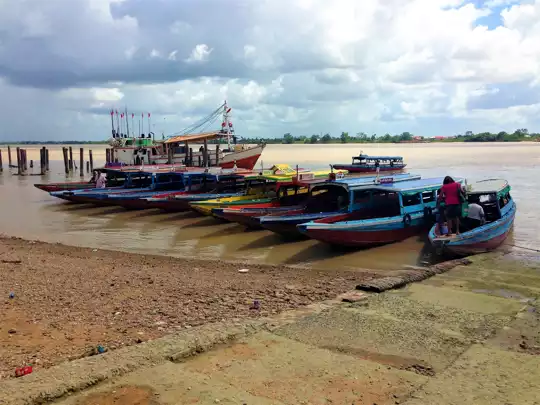
Albina is the only official crossing between Suriname and French Guiana, which means a short boat ride from here puts you in the European Union. The town sits in the northeast of Suriname, on the western bank of the broad, brown Marowijne River. It is small, flat and hot, with diesel and river mud in the air and pirogues knocking against the quay. It offers no old center, no polished sights, and only a handful of simple places to sleep. The riverfront and the market are worth an hour or two, and the quiet memorial at Moiwana earns a real visit. Evenings are slow, and you will meet other travelers mostly at the border, not in bars. Treat Albina as a gateway and a launch point for the turtle beaches and Maroon villages nearby. Get your exit stamp at the Surinamese immigration post before boarding any boat.

Discover everything you want to know in the 📖 Suriname Travel Guide.


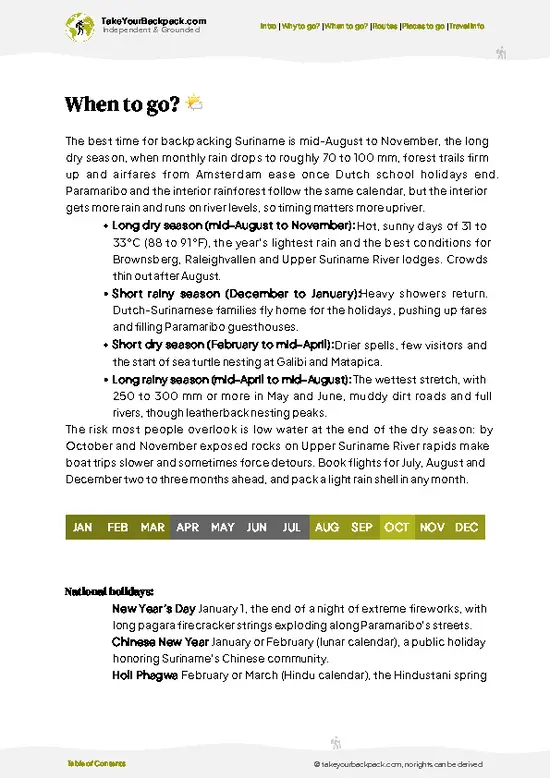
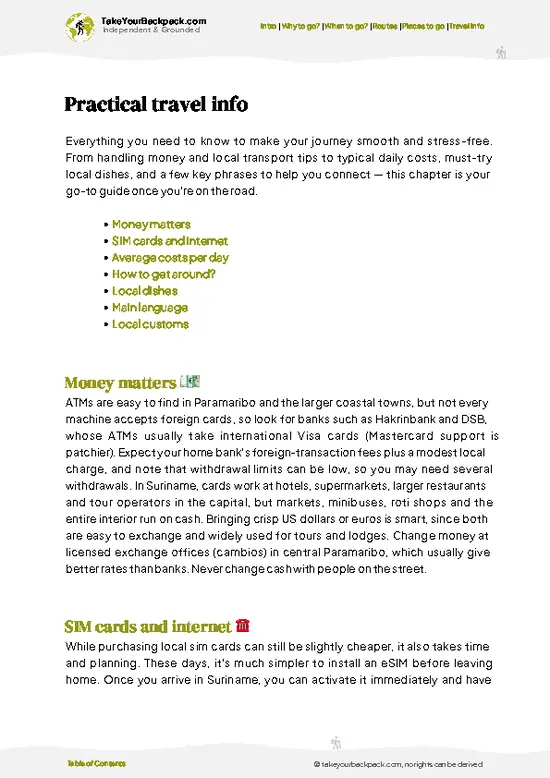
example page 0 from our offline Travel Guide for Suriname
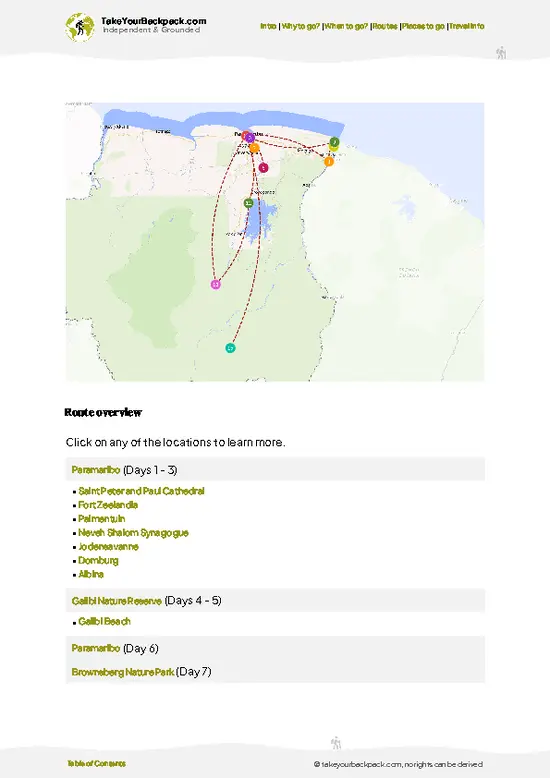
example page 1 from our offline Travel Guide for Suriname
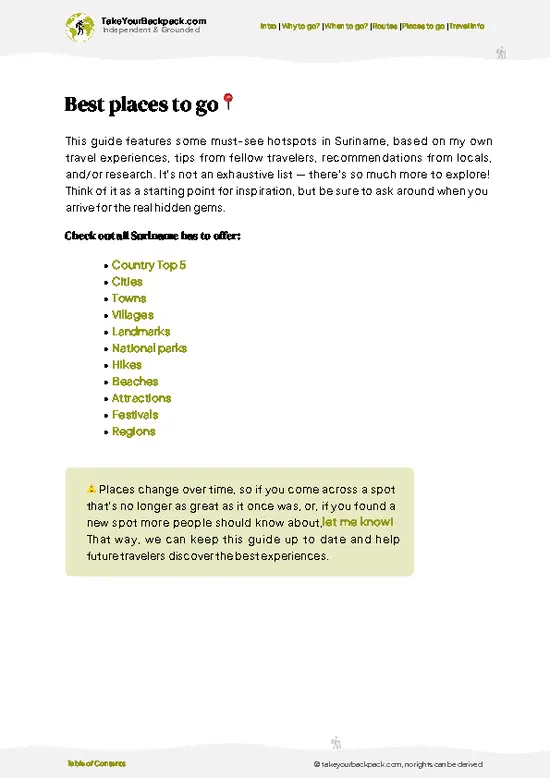
example page 2 from our offline Travel Guide for Suriname
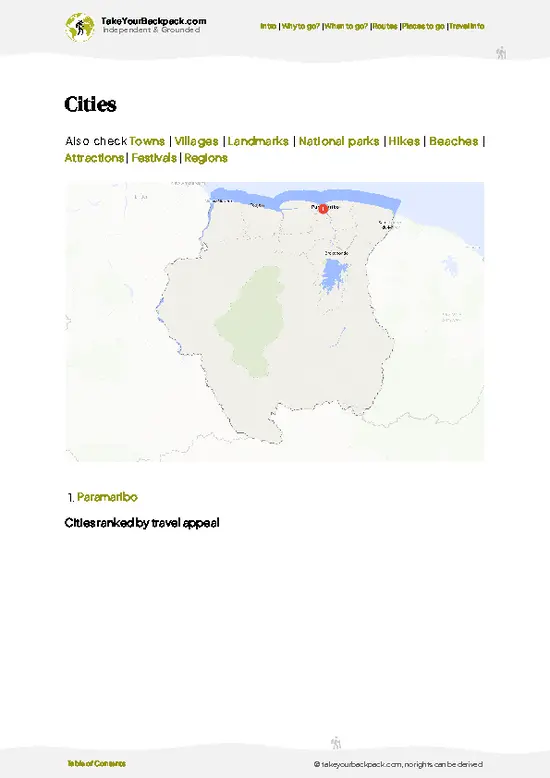
example page 3 from our offline Travel Guide for Suriname
example page 4 from our offline Travel Guide for Suriname
example page 5 from our offline Travel Guide for Suriname
example page 6 from our offline Travel Guide for Suriname
example page 7 from our offline Travel Guide for Suriname
Loading the map 🌍
CLICK TO FILTER
cities
towns
villages
landmarks
national parks
hikes
beaches
attractions
festivals
regions
SHOW COUNTRY’S BESTSHOW ALL

✨ Why go?
Ranked #1 town in Suriname
Why visitors keep coming back

Albina matters because it is the hinge between two worlds: Suriname's Maroon and Indigenous east and the French-run town of Saint-Laurent across the water. Most backpackers pass through in a day, but if you linger one night you get a feel for how the Marowijne River works as a street, with traders, gold miners, families and boat drivers all crossing in the same wooden hulls. The town suits overlanders heading toward Cayenne, slow travelers who like watching a border town go about its business, and small groups arranging a trip to the Galibi turtle-nesting beaches in season. It also gives you a sober, human history lesson at Moiwana, which you will not find in Paramaribo. Do not expect nightlife or a crowded hostel scene. Expect a few stalls, grilled fish, cold drinks, and a very local rhythm that rewards an easy pace.

💡 HighlightsKey sights and experiences for travelers

  1. Marowijne riverfront and boat landing: The town's real stage, where pirogues load goods and passengers in a steady shuffle and the French bank sits low on the horizon. Come in the early morning or late afternoon when it is cooler and the traffic is busiest. Free, 45 minutes to 1 hour.
  2. Moiwana memorial: A memorial to the villagers killed by soldiers in 1986 during the Interior War, set in the Maroon village of Moiwana just outside town. It is quiet, plain and moving. Go in the morning, ideally with a local who can explain the site. Free, 30 to 60 minutes, and a small donation is appropriate.
  3. Albina market: Small stalls selling produce, fish, Javanese snacks, plantains and cheap goods used by gold-mining crews and border traders. Morning is the best time, before the heat flattens everything. Snacks
… read more 👉
  1. Marowijne riverfront and boat landing: The town's real stage, where pirogues load goods and passengers in a steady shuffle and the French bank sits low on the horizon. Come in the early morning or late afternoon when it is cooler and the traffic is busiest. Free, 45 minutes to 1 hour.
  2. Moiwana memorial: A memorial to the villagers killed by soldiers in 1986 during the Interior War, set in the Maroon village of Moiwana just outside town. It is quiet, plain and moving. Go in the morning, ideally with a local who can explain the site. Free, 30 to 60 minutes, and a small donation is appropriate.
  3. Albina market: Small stalls selling produce, fish, Javanese snacks, plantains and cheap goods used by gold-mining crews and border traders. Morning is the best time, before the heat flattens everything. Snacks cost about US$1 to 4, and you need 30 to 45 minutes.
  4. The immigration and ferry quay: Even if you are not crossing, the passport post and the queue of travelers in the shade give you a lively look at the border in action. Late morning is busiest. Free to watch, 20 to 30 minutes. A crossing to Saint-Laurent costs roughly US$6 to 12 each way, depending on boat and bargaining.
Day trips from Albina work well to the sea turtle beaches at Galibi, the Indigenous villages of Christiaankondre and Langamankondre, the old bauxite town of Moengo, and across the river to Saint-Laurent-du-Maroni with its former penal colony buildings. If time is short, skip the market and spend it on the riverfront and Moiwana.
Spotted a mistake or missing something? Contact us.

🏘️ NeighborhoodsNeighborhood guide to Albina

Albina is small enough to cover on foot in an afternoon, and it splits into a few distinct pieces along the Marowijne River.
  • Waterfront and ferry landing: This is the part worth your time. Pirogues and the ferry to Saint-Laurent-du-Maroni in French Guiana come and go with a diesel hum, and the river smells of mud, fuel and frying dough from the stalls. Go in the late afternoon when the heat eases and the brown water turns glassy. Shade is thin, so bring a hat.
  • Main street and market area: A strip of Chinese-run supermarkets, snack counters, money changers and small eateries. Expect roti, fried noodles, bami and cold Parbo beer, plus the clatter of minibuses and shop radios. It is dusty and loud, but it is where you eat and change money, so give it an hour, no more.
  • Residential lanes behind the
… read more 👉
Albina is small enough to cover on foot in an afternoon, and it splits into a few distinct pieces along the Marowijne River.
  • Waterfront and ferry landing: This is the part worth your time. Pirogues and the ferry to Saint-Laurent-du-Maroni in French Guiana come and go with a diesel hum, and the river smells of mud, fuel and frying dough from the stalls. Go in the late afternoon when the heat eases and the brown water turns glassy. Shade is thin, so bring a hat.
  • Main street and market area: A strip of Chinese-run supermarkets, snack counters, money changers and small eateries. Expect roti, fried noodles, bami and cold Parbo beer, plus the clatter of minibuses and shop radios. It is dusty and loud, but it is where you eat and change money, so give it an hour, no more.
  • Residential lanes behind the center: Low wooden houses, painted fences, chickens and kids on bikes. Quiet and flat, easy to walk, though there is nothing to tick off. A short stroll tells you more about daily life than any museum would.
  • Memorial and ruined-town edges: Albina was largely destroyed during the 1980s interior war, and the gaps between buildings still say so. Skip any hunt for monuments. Take it in as you walk and move on.
Nightlife is a few bars with loud speakers and little else. After dark the streets empty quickly.

⌛️ 1 daySeeing the highlights in 24 hours

7:30 AM: Waterfront promenade on the Marowijne
Start where the day starts, on the riverbank. Pirogues are already pushing off for the French side, and the air smells of diesel, wet wood and frying dough from the stalls near the landing. Take ten minutes to watch the crossing before the heat builds.

8:15 AM: Breakfast at a riverside eatery
Walk a few minutes along the main road and sit down for coffee, fried eggs and fresh bread, or a plate of bami if the kitchen is ahead of schedule. Prices run low, portions are big, and the owners will happily tell you which boats are running today.

9:30 AM: Albina’s market streets
Stroll the center on foot. Small shops sell Chinese-run groceries, Brazilian snacks and cheap phone cards, and Maroon and Javanese vendors lay out cassava, peppers and fish. The … read more 👉
7:30 AM: Waterfront promenade on the Marowijne
Start where the day starts, on the riverbank. Pirogues are already pushing off for the French side, and the air smells of diesel, wet wood and frying dough from the stalls near the landing. Take ten minutes to watch the crossing before the heat builds.

8:15 AM: Breakfast at a riverside eatery
Walk a few minutes along the main road and sit down for coffee, fried eggs and fresh bread, or a plate of bami if the kitchen is ahead of schedule. Prices run low, portions are big, and the owners will happily tell you which boats are running today.

9:30 AM: Albina’s market streets
Stroll the center on foot. Small shops sell Chinese-run groceries, Brazilian snacks and cheap phone cards, and Maroon and Javanese vendors lay out cassava, peppers and fish. The town was rebuilt after the interior war of the 1980s, so look for the mix of newer concrete and older wooden houses on stilts.

11:30 AM: Back-street Maroon neighborhoods
This is the part most guests never reach. Walk inland a few blocks from the main road, where wooden homes with carved doors and painted shutters sit among fruit trees. Say hello, ask before taking photos, and you will often be pointed toward a shop selling hand-made baskets or woodwork.

1:00 PM: Lunch and a long break
Midday heat is fierce, so eat something spicy (a roti or a plate of rice with chicken and long beans) and sit in the shade with a cold drink. Use this window to sort out your onward move, whether that is the road back toward Paramaribo or a crossing into French Guiana.

3:00 PM: Boat trip along the river
Negotiate with a boatman for a short ride on the Marowijne. From the water you see the Surinamese bank, the French town of Saint-Laurent-du-Maroni across the way, and low islands with fishing nets drying on poles. Agree on the price and duration before stepping in.

5:30 PM: Riverbank at dusk
Return to the promenade as the light softens and the heat drops. Locals gather to chat and eat grilled snacks, and bats begin to cross the sky. Finish with a plate of fried fish and a cold local beer, then walk back to your guesthouse before dark.

🌤️ When to go?When to go for the best experience

The best months for Albina are August to November, when rain eases and the river crossing and dirt roads are easiest.
  • Long Dry Season (Aug to Nov): Highs of 31 to 33°C (88 to 91°F), lows near 23°C (73°F), and the least mud. Days run roughly 12 hours of daylight. Prices barely move, since Albina sees few tourists.
  • Short Wet Season (Dec to Jan): Showers come in heavy bursts, then the sun returns. Humidity is thick. Dutch-Surinamese families travel around the holidays, so minibuses fill up.
  • Short Dry Season (Feb to Apr): A drier spell with similar temperatures, around 30 to 32°C (86 to 90°F). Good for river trips and walking the town.
  • Long Wet Season (May to July): The heaviest rain, with 28 to 31°C (82 to 88°F) and swollen rivers. Unpaved side roads turn slick, and boat trips can be canceled.
Arrive … read more 👉
The best months for Albina are August to November, when rain eases and the river crossing and dirt roads are easiest.
  • Long Dry Season (Aug to Nov): Highs of 31 to 33°C (88 to 91°F), lows near 23°C (73°F), and the least mud. Days run roughly 12 hours of daylight. Prices barely move, since Albina sees few tourists.
  • Short Wet Season (Dec to Jan): Showers come in heavy bursts, then the sun returns. Humidity is thick. Dutch-Surinamese families travel around the holidays, so minibuses fill up.
  • Short Dry Season (Feb to Apr): A drier spell with similar temperatures, around 30 to 32°C (86 to 90°F). Good for river trips and walking the town.
  • Long Wet Season (May to July): The heaviest rain, with 28 to 31°C (82 to 88°F) and swollen rivers. Unpaved side roads turn slick, and boat trips can be canceled.
Arrive in the morning, since afternoon storms are most common and the ferry timetable is easier to handle before them.


source: climatestotravel.comJANJanuary: excellent for travelingFEBFebruary: excellent for travelingMARMarch: highly recommended for travelingAPRApril: fair for travelingMAYMay: fair for travelingJUNJune: fair for travelingJULJuly: fair for travelingAUGAugust: fair for travelingSEPSeptember: highly recommended for travelingOCTOctober: excellent for travelingNOVNovember: excellent for travelingDECDecember: excellent for traveling
when-to-go

✈️ The backpacker research shortcutSuriname Travel Guide

An offline-friendly backpacking guide with optimized travel routes, ranked highlights, transport advice, and the best areas to stay.
example page 0 from our offline Travel Guide for Suriname
example page 1 from our offline Travel Guide for Suriname
example page 2 from our offline Travel Guide for Suriname
example page 3 from our offline Travel Guide for Suriname
example page 4 from our offline Travel Guide for Suriname
example page 5 from our offline Travel Guide for Suriname
example page 6 from our offline Travel Guide for Suriname
example page 7 from our offline Travel Guide for Suriname
The digital guide (153 pages) contains:
✅ 40 highlights, ranked by travel appeal
✅ Optimized 5, 10 & 15-day travel routes
✅ Cities, national parks, landmarks, beaches
✅ How to get around
✅ Offline-friendly for travel without Wi-Fi
👉 Click to see all 30+ guide features

📅 Plan smarter in minutes, not weeks
✅ Month by month travel advice
✅ Festivals & national holidays
✅ Budget expectations

🗺️ Go to the right places, skip the overrated ones
✅ Honest pros & cons of destinations
✅ Top hikes, parks & viewpoints
✅ Lesser-known places most travelers miss
✅ Clear “worth it vs skip it” guidance

🛏️ Travel smoothly without rookie mistakes
✅ Best areas to stay
✅ Transport systems explained simply
✅ Common scams & safety advice
✅ SIM cards, money & practical tips

🌍 Understand the country, not just visit it
✅ Culture & traditions
✅ 52 Essential phrases & customs
✅ Festivals worth planning around
✅ Traveler-friendly historical context
✅ Insights that make places more meaningful

📱 Built for real travel conditions
✅ Fully downloadable PDF
✅ Works completely offline
✅ Optimized for phone use
✅ Useful in remote areas & buses
✅ Everything in one place
Stop searching, start planning
Get instant access to your full guide. 30‑day money-back guarantee.
+ Add another guide for just

By proceeding you agree to our terms.
Sent to your inbox immediately after payment • 100% Secure Checkout
Best Backpacking Travel Advisor 2025 tourism awardBest Backpacking
Travel Advisor
2025
What others say about Take Your Backpack Guides:
⭐⭐⭐⭐⭐
Fantastic, amazing amount of information!
⭐⭐⭐⭐⭐
My goodness this is amazing, it's what I've been looking for hats off too you!
⭐⭐⭐⭐⭐
I think this is absolutely BRILLIANT
⭐⭐⭐⭐
Very complete and informative. It's still missing places, but I gotta to commend you
⭐⭐⭐⭐⭐
This is truly amazing, thank you, can't wait to explore it with my kids!
⭐⭐⭐⭐⭐
Awesome resource, thank you!
⭐⭐⭐⭐⭐
This is amazing! Can't wait to explore the ones I haven't seen
⭐⭐⭐⭐
I love this! Well done, great idea.
⭐⭐⭐⭐⭐
Thanks for taking the time to make this gem!
⭐⭐⭐⭐⭐
This might be the best website I've ever seen.
⭐⭐⭐⭐⭐
Congratulations, and thank you so much for your work; it's incredibly valuable.
⭐⭐⭐⭐
In all seriousness I think you did a great job pointing out the important spots
⭐⭐⭐⭐⭐
10/10 very good
⭐⭐⭐⭐⭐
As someone who's only just starting to visit regularly this is awesome, thank you.
⭐⭐⭐⭐
Thank you very much! I'm going to visit my dad, it's going to be very useful!
⭐⭐⭐⭐⭐
This is really cool! We'll be travelling for the first time and this definitely come in handy.
⭐⭐⭐⭐⭐
You are now our minister of culture, congratulations 👨‍💼
⭐⭐⭐⭐⭐
Just wanted to tell you that this is a pearl! Going to follow your recommendations.
⭐⭐⭐⭐⭐
This is so cool. I'll definitely be using the resource for my travels soon.
⭐⭐⭐⭐⭐
This is very impressive! Good work.
⭐⭐⭐⭐⭐
This is an amazing and informative site. Very well done!

🛏️ Where to stay?Best areas and accommodation options

The best place to sleep for Albina is the center near the main street and ferry landing, where the few guesthouses and basic rooms cluster. Budget beds here are limited, so dorm-style hostels are essentially absent and a simple private room with a fan or air conditioning, roughly US$25 to 50 a night, is the realistic option. Book ahead for weekends and holidays, because rooms are few.

The center works because everything is within a short walk: food, money changers, the ferry and the minibus stops. Noise is moderate, with early traffic and market sounds from dawn, so bring earplugs. After dark … read more 👉
The best place to sleep for Albina is the center near the main street and ferry landing, where the few guesthouses and basic rooms cluster. Budget beds here are limited, so dorm-style hostels are essentially absent and a simple private room with a fan or air conditioning, roughly US$25 to 50 a night, is the realistic option. Book ahead for weekends and holidays, because rooms are few.

The center works because everything is within a short walk: food, money changers, the ferry and the minibus stops. Noise is moderate, with early traffic and market sounds from dawn, so bring earplugs. After dark the streets are quiet and lit near the main road, though solo travelers should take a taxi for anything beyond a few blocks.

The second option is the quieter residential edge of town a few minutes away. You get less street noise and more space, but fewer places to eat and a longer walk to transport. Many travelers sleep in Paramaribo or Saint-Laurent-du-Maroni and cross the river for the day, since those have a wider range of budget beds and better transport links.

🚌 Getting aroundGetting around like a local

Albina’s center is walkable end to end in 15 to 20 minutes, but the heat makes even that feel longer, and walking stops making sense once you head out of town toward the highway or the villages upriver. Traffic is light apart from minibus rushes at the landing. Public transport is cheap but runs to its own clock, mostly early in the day.
  • Walking: Free and the best choice for the waterfront, market street and ferry landing. Go early or late, because midday sun on the pavement is harsh and shade is rare.
  • Minibus to Paramaribo: The main way out, about 2.5 to 3 hours along the East-West Link, usually US$6 to 10. Buses leave when full, mostly from early morning to early afternoon. Expect loud music and packed seats, and aim for a morning departure because evenings thin out.
  • Shared taxi: Faster and
… read more 👉
Albina’s center is walkable end to end in 15 to 20 minutes, but the heat makes even that feel longer, and walking stops making sense once you head out of town toward the highway or the villages upriver. Traffic is light apart from minibus rushes at the landing. Public transport is cheap but runs to its own clock, mostly early in the day.
  • Walking: Free and the best choice for the waterfront, market street and ferry landing. Go early or late, because midday sun on the pavement is harsh and shade is rare.
  • Minibus to Paramaribo: The main way out, about 2.5 to 3 hours along the East-West Link, usually US$6 to 10. Buses leave when full, mostly from early morning to early afternoon. Expect loud music and packed seats, and aim for a morning departure because evenings thin out.
  • Shared taxi: Faster and a little more comfortable than a minibus, around US$10 to 15 per seat to Paramaribo, or more for a whole car. Worth it if you carry a big pack or arrive late.
  • Ferry and pirogue to Saint-Laurent-du-Maroni: The crossing takes about 10 to 20 minutes and costs roughly US$6 to 10 one way. Passport stamps happen at both sides, so allow an hour in total. Ferry runs are limited in the late afternoon, so cross earlier.
  • Local taxi: Short hops around town cost about US$2 to 5 and are handy after dark when streets empty.
Skip hiring a car just for Albina. The town is too small, and the minibus covers the one route most backpackers need.

👛 Costs (as of 19 October 2026)How expensive it really is

Albina costs roughly US$55 to 90 a day for a backpacker, and the total below works out to US$75 a day with a high-season room. Prices are in US dollars, though you pay in Surinamese dollars or euros.
CategoryBudget RangeLocal Reality
Dorm accommodationUS$25 to 40No true dorms. A simple private room with fan or air conditioning is the usual bed, with little choice in the town.
MealsUS$12 to 22Roti, fried rice, bami and noodles at small eateries cost US$4 to 8 each. Supermarkets help for breakfast.
Local transportUS$3 to 8Short taxi hops cost US$2 to 5. Ferry crossing adds about US$6 to 10 if you go to French Guiana.
Basic activities/entry feesUS$5 to 15The town is mostly free to walk. Boat outings or reserve visits cost far more.
Miscellaneous expensesUS$5 to 10Water, repellent, SIM data and a cold
… read more 👉
Albina costs roughly US$55 to 90 a day for a backpacker, and the total below works out to US$75 a day with a high-season room. Prices are in US dollars, though you pay in Surinamese dollars or euros.
CategoryBudget RangeLocal Reality
Dorm accommodationUS$25 to 40No true dorms. A simple private room with fan or air conditioning is the usual bed, with little choice in the town.
MealsUS$12 to 22Roti, fried rice, bami and noodles at small eateries cost US$4 to 8 each. Supermarkets help for breakfast.
Local transportUS$3 to 8Short taxi hops cost US$2 to 5. Ferry crossing adds about US$6 to 10 if you go to French Guiana.
Basic activities/entry feesUS$5 to 15The town is mostly free to walk. Boat outings or reserve visits cost far more.
Miscellaneous expensesUS$5 to 10Water, repellent, SIM data and a cold beer or two.
Total Daily BudgetUS$75Based on a high-season room and moderate eating out.
Buy lunch at a market counter or snack bar instead of a sit-down restaurant, and share taxis with other travelers to cut costs.
⚠️ Prices can change and everyone travels differently, so take this as a rough guide. Hope it helps you plan your adventure!

🚌 Day tripsExploring the surroundings

Albina makes a workable base for short outings, as long as you start early and treat the ferry and roads as your schedule.
Saint-Laurent-du-Maroni: Cross the river by ferry or pirogue to French Guiana, about 15 minutes on the water and a total of US$15 to 30 with food. The old penal colony buildings and riverfront cafes make it worth the effort. Carry your passport and check entry rules for your nationality first, a step many first-timers forget. Dry months are most comfortable.

Galibi Nature Reserve: A boat trip down the Marowijne toward the coast, where sea turtles nest on beaches from about February to August, peaking around April to June. Most visitors go with a lodge or tour operator, and prices are often US$80 to 150 per person for a day, so share costs with others. The mistake is going … read more 👉
Albina makes a workable base for short outings, as long as you start early and treat the ferry and roads as your schedule.
Saint-Laurent-du-Maroni: Cross the river by ferry or pirogue to French Guiana, about 15 minutes on the water and a total of US$15 to 30 with food. The old penal colony buildings and riverfront cafes make it worth the effort. Carry your passport and check entry rules for your nationality first, a step many first-timers forget. Dry months are most comfortable.

Galibi Nature Reserve: A boat trip down the Marowijne toward the coast, where sea turtles nest on beaches from about February to August, peaking around April to June. Most visitors go with a lodge or tour operator, and prices are often US$80 to 150 per person for a day, so share costs with others. The mistake is going outside nesting season and finding little to see.
👉 Explore Galibi Nature Reserve
Moengo: A former bauxite company town about 40 to 60 minutes by road west. Tidy rows of old company houses and a small art scene make a quiet stop. A minibus or shared taxi costs around US$3 to 8 each way, and returns thin out by afternoon, so leave Moengo by early afternoon.

Paramaribo: Possible in a long day, around 2.5 to 3 hours each way, with minibus fares of US$6 to 10 each way. You get the wooden old town and markets but little time to enjoy them. Better to treat it as an onward move than a round trip.
👉 Explore Paramaribo

🛡️ SafetySafety Tips and Common Scams in Albina

Albina is broadly calm, and most problems are small ones. Petty theft can happen around the ferry landing and market, so keep your phone and wallet in front pockets and your passport out of sight. Money changers on the main street are common, and quoting a rate before handing over cash avoids confusion, so compare with a supermarket or bank rate first.

Solo travelers, including women, generally report no trouble in daytime, though men may call out or ask for money. A polite no and keeping a steady pace usually ends it. After dark the streets empty quickly and lighting is patchy, so take a short taxi instead of walking unlit stretches.

Be careful with river crossings: use official ferries or established pirogue operators and ask the price before boarding. Mosquitoes are a daily annoyance, so bring repellent, and drink bottled water.

FAQCommon questions from travelers

Albina is worth a short visit, but mostly as a border town and a gateway to the Marowijne River. You can see the waterfront, the main street and the ferry landing in half a day, and the real draws are Galibi turtle beaches and a crossing to Saint-Laurent-du-Maroni, about 15 minutes by boat. Most travelers pass through on the road from Paramaribo, around 2.5 to 3 hours away.
Albina needs half a day to a full day if you only want to see the town, and two days if you add a river trip or Galibi. Allow an hour for border formalities if you cross into French Guiana, where the ferry runs about US$6 to 10 one way. A single night is enough for most backpackers, with rooms around US$25 to 50.
Albina can be done in a long day from Paramaribo, though the road takes around 2.5 to 3 hours each way, so you have only a few hours on the ground. Minibuses cost roughly US$6 to 10 each way and leave mostly in the morning, so catch the return before mid-afternoon. A night in town gives more time for the waterfront and a crossing to Saint-Laurent-du-Maroni.
⚠️ Things can change over time, so always validate details locally before you go.

Other Surinamese towns near Albina

Explore more nearby:

  • Domburg—Suriname River bank, Javanese warungs, Sunday crowds, stilt-house lanes| 113 km away
  • Totness—Creole wooden houses, coconut groves, drainage canals, porch evenings| 253 km away
  • Wageningen—Rice polder, irrigation dykes, wading birds, husk mills| 290 km away

💡 Not sure where to go next?
Create a personalized itinerary for Suriname including Albina and the places that fit your trip.

Generate my itinerary

👉 Discover all towns

Or checkout all Suriname has to offer (think cities, towns, villages, national parks, hikes, beaches, festivals)
Country photo of Suriname

We 💚 feedbackWhat to keep in mind

Albina works best as a bridge between Paramaribo and French Guiana, with Galibi's turtle beaches or Moengo tucked in between. I would give it one night, not more, and pair it with a morning at Moiwana. Bring cash, insect repellent and patience for the boat schedule, and plan to arrive early in the day.

✍️ Help improve this page!
The information on this page is based on in-depth research, insights shared by experienced travelers, and feedback from the local travel community in Suriname. While every effort is made to keep the information accurate and current, conditions can change — so if you spot anything incorrect or outdated, please get in touch.


🙋‍♂️ Give feedback

👋 Meet the founderWho’s Behind Take Your Backpack?

Johan, backpacker and founder of TakeYourBackpackHi, I’m Johan (Netherlands 🇳🇱), the creator of TakeYourBackpack. Over the past 3 decades, I’ve backpacked through 90+ countries across six continents, gaining extensive experience with independent travel, long-term trips, and overland routes.

This site is built on a combination of firsthand travel experience and carefully curated insights from other backpackers. Many guides are based on places I’ve personally visited, while others bring together tips, observations, and practical advice shared by trusted travelers I’ve met along the way.

The goal is to provide realistic, experience-driven guidance — not generic itineraries — so you can explore destinations with better context, clearer expectations, and more confidence.