×

Taiwan🇹🇼 | best hikesWhere to Find the 10 Best hikes in Taiwan

Hikes in Taiwan are defined by vertical relief: a island about 380 km long rises to 3,952 m at Yushan, so a trail can run from subtropical forest to alpine meadow in one day. The central mountains bring permits, high huts and few people, while the north offers day trails reached by metro or bus from Taipei for a few dollars. The east coast and Hualien area trade crowds for longer transfers. Because public transit reaches most trailheads in the north and west but thins out in the mountains, independent travelers should match trail type to how much planning they will accept.

By Johan Kruseman 🇳🇱 | Updated October 18, 2026
Explore the best beaches in Taiwan

Why go?Understanding Their Importance

Taiwan packs more than 200 peaks above 3,000 m into an island smaller than Maryland, and that density explains almost everything about hiking here. Tectonic collision pushes the ranges up fast, so elevation gain is steep and the climate zones change quickly, from subtropical broadleaf forest to cypress, fir and alpine grassland.

The country also has a trail culture built by Indigenous peoples, Japanese-era foresters and today’s hiking clubs. Old logging railways, stone-paved paths and mountain huts are part of the network, and Taiwanese hikers are numerous, organized and well equipped, which keeps weekends lively near the cities.

Before choosing Taiwan, know that the most prized high mountain routes require permits, often through a lottery or a quota system with applications weeks or months … read more 👉
Taiwan packs more than 200 peaks above 3,000 m into an island smaller than Maryland, and that density explains almost everything about hiking here. Tectonic collision pushes the ranges up fast, so elevation gain is steep and the climate zones change quickly, from subtropical broadleaf forest to cypress, fir and alpine grassland.

The country also has a trail culture built by Indigenous peoples, Japanese-era foresters and today’s hiking clubs. Old logging railways, stone-paved paths and mountain huts are part of the network, and Taiwanese hikers are numerous, organized and well equipped, which keeps weekends lively near the cities.

Before choosing Taiwan, know that the most prized high mountain routes require permits, often through a lottery or a quota system with applications weeks or months ahead, and some require a registered local guide or team. Huts need advance booking too. Lower trails need nothing but a bus ticket.

Expect humidity, sudden rain and typhoon disruption rather than dry, predictable days. Infrastructure is excellent at the edges (convenience stores, clean toilets, frequent buses) but drops away where roads end. That mix makes Taiwan very easy for casual hiking and demanding for serious alpine trips.
Why These Made the Cut
The list of best hikes in Taiwan is created based on scenery, challenge, trail quality, landmarks, and overall enjoyment. If you feel a hike is missing in this list, please let us know.

When to go?Timing Your Visit for the Best Experience

Best months and why: The best months for hiking in Taiwan are October to early December, plus March to April, because typhoon risk drops, skies clear and daytime temperatures in the lowlands sit around 18 to 28°C. Autumn is the most reliable season for high mountains, with crisp, dry air that gives long views.

Shoulder and difficult seasons: May and June bring the plum rains, with frequent downpours that make steep stone steps slick and cloud out viewpoints. July to September is typhoon season, when trails and mountain roads can close with little notice, although afternoon thunderstorms are the daily pattern even without a storm. Lowland heat then reaches 32 to 36°C with high humidity.

Winter and regional differences: Winter from December to February is cold and wet in the north and northeast, … read more 👉
Best months and why: The best months for hiking in Taiwan are October to early December, plus March to April, because typhoon risk drops, skies clear and daytime temperatures in the lowlands sit around 18 to 28°C. Autumn is the most reliable season for high mountains, with crisp, dry air that gives long views.

Shoulder and difficult seasons: May and June bring the plum rains, with frequent downpours that make steep stone steps slick and cloud out viewpoints. July to September is typhoon season, when trails and mountain roads can close with little notice, although afternoon thunderstorms are the daily pattern even without a storm. Lowland heat then reaches 32 to 36°C with high humidity.

Winter and regional differences: Winter from December to February is cold and wet in the north and northeast, where Taipei and Keelung see drizzle and temperatures of 10 to 18°C. The south and southwest stay drier and warmer, often 18 to 26°C, which makes them better for low-elevation trails. Above 3,000 m, expect frost and occasional snow, and temperatures near or below 0°C.

Crowds and prices: Weekends, national holidays and the Lunar New Year period (usually late January or February) fill buses, trailheads and mountain huts. Permits and hut beds are hardest to secure in autumn and on holiday weekends. Weekdays are noticeably quieter.

hike hoppingPlanning Your Route Efficiently

How long a combined trip takes: A trip combining several hikes in Taiwan needs 10 to 14 days in order to include at least one high mountain area, travel days and some buffer for weather. Without a mountain route, 7 to 9 days covers the lowland trails comfortably.

Which regions group well: The island is long and narrow with mountains in the middle, so the practical clusters are north (Taipei and surroundings), central (Taichung, Nantou, Chiayi) and east (Hualien and Taitung). Moving north to south along the west coast works well because the high-speed rail runs from Taipei to Zuoying (Kaohsiung) in about 1.5 to 2 hours. The east is better kept as a separate leg, reached by train from Taipei to Hualien in roughly 2 to 2.5 hours.

Time per stop: Allow 1 to 2 days for a lowland or day-hike base, … read more 👉
How long a combined trip takes: A trip combining several hikes in Taiwan needs 10 to 14 days in order to include at least one high mountain area, travel days and some buffer for weather. Without a mountain route, 7 to 9 days covers the lowland trails comfortably.

Which regions group well: The island is long and narrow with mountains in the middle, so the practical clusters are north (Taipei and surroundings), central (Taichung, Nantou, Chiayi) and east (Hualien and Taitung). Moving north to south along the west coast works well because the high-speed rail runs from Taipei to Zuoying (Kaohsiung) in about 1.5 to 2 hours. The east is better kept as a separate leg, reached by train from Taipei to Hualien in roughly 2 to 2.5 hours.

Time per stop: Allow 1 to 2 days for a lowland or day-hike base, and 3 to 5 days for a high mountain area, including a rest day before or after because permits and transport leave little room for improvisation. Transfers from rail stations to remote trailheads can add 1 to 3 hours by bus or shared taxi.

Planning mistakes to avoid: Many travelers cross the central mountains by road with tight timing, but mountain highways can close after rain or landslides, so build in a spare day. Another is stacking permit hikes back to back, which leaves no room to swap dates when weather shifts. Book fixed dates for permit trails first, then fit the flexible lowland days around them.

The ListTop hikes of Taiwan

1 Zhuilu Old Trail

Cliffside ledge, Taroko Gorge, narrow pathway

Traverse a historic trail carved into sheer rock, where a narrow path hugs dramatic cliffs high above the river’s turquoise flow.

taiwan-hike-zhuilu-old-trail
© Google |

2 Qixing Mountain Trail

Volcanic vents, grassy slopes, city backdrop

Climb through steaming fumaroles and open meadows to the highest point in Yangmingshan, where Taipei sprawls beneath volcanic ridges.

taiwan-hike-qixing-mountain-trail
© Google |

3 Alishan Forest Railway Hiking Trail

Cypress groves, old railway, misty highlands

Walk alongside vintage train tracks through ancient forests, where cool air and towering trees create a tranquil, otherworldly atmosphere.

taiwan-hike-alishan-forest-railway-hiking-trail
© Google |

4 Wuling Sixiu Trail

Four peaks, subalpine forest, ridge traverses

Tackle a demanding multi-day circuit linking four summits, with shifting terrain and frequent elevation changes testing stamina and planning.

5 Teapot Mountain Trail

Rocky summit, mining relics, sea horizon

Scramble up exposed ridges past abandoned tunnels to a windswept peak, where the coastline stretches far below the jagged rocks.

taiwan-hike-teapot-mountain-trail
© Google |

6 Caoling Historic Trail

Grassy ridges, stone tablets, coastal breezes

Cross windswept hills on a centuries-old route, with open grasslands and distant ocean views marking the journey between villages.

7 Sandiaoling Waterfall Trail

Triple waterfalls, rope ladders, mossy forest

Venture along a muddy, root-strewn path to reach a sequence of waterfalls, each hidden deeper within a damp, green valley.

8 Dajin Waterfall Trail

Steep stone steps, lush ravine, cascading pools

Ascend through dense forest to reach a series of waterfalls, where shaded rest spots and cool mist offer relief from the climb.

taiwan-hike-dajin-waterfall-trail
© Google |

9 Jiantanshan Trail

City skyline, forested ridge, temple overlook

Follow a winding path above Taipei, passing through wooded slopes and open viewpoints that reveal the city’s landmarks from a new angle.

10 Elephant Mountain

Granite outcrops, Taipei 101 views, urban hills

Navigate a short but steep route where stone stairs and exposed rocks lead to iconic city panoramas and breezy rest spots.

Loading the map 🌍

Expert viewExpert Commentary on hikes

How many hikes to plan: Plan three to five hikes on a trip of two weeks. Taiwan’s trails involve steep climbs on humid days, and weather shifts quickly, so two big days in a row tire people more than expected. That number leaves room for rest days, rain delays and one permit-based outing if you can secure it.

Choosing between kinds of hikes: Day hikes near cities suit first-timers and budget travelers, because they need no permits, can be reached by metro or bus, and finish in time for night market food. Choose multi-day high mountain routes if you have trekking experience and can handle altitude, cold and navigation. Coastal and forest trails fit slow travelers who want variety without commitment. Experienced hikers often pick one demanding route and fill the rest with easy ones, because … read more 👉
How many hikes to plan: Plan three to five hikes on a trip of two weeks. Taiwan’s trails involve steep climbs on humid days, and weather shifts quickly, so two big days in a row tire people more than expected. That number leaves room for rest days, rain delays and one permit-based outing if you can secure it.

Choosing between kinds of hikes: Day hikes near cities suit first-timers and budget travelers, because they need no permits, can be reached by metro or bus, and finish in time for night market food. Choose multi-day high mountain routes if you have trekking experience and can handle altitude, cold and navigation. Coastal and forest trails fit slow travelers who want variety without commitment. Experienced hikers often pick one demanding route and fill the rest with easy ones, because permits are limited and weather windows are short.

What it costs: Expect US$40 to 70 a day (about NT$1,300 to 2,300) for a mix of hostels, local transport and meals. Day hikes themselves cost little: most trails are free, and national park entrances are mostly free as well, with a few paid sites in the range of NT$50 to 200. Mountain huts run roughly NT$400 to 1,000 per night, and some require paying for meals or bedding. Permit applications are usually low in cost, but a required guide or porter team can add US$100 to 300 or more per person on guided routes. Bus rides to trailheads cost US$2 to 10, while shared taxis are higher. Experienced travelers reduce costs by sharing taxis and buying food at convenience stores.

Safety on the trail: Weather is the main risk. Afternoon cloud and rain arrive early in the mountains, so hikers start before dawn and aim to finish by mid-afternoon. Typhoon warnings can close trails entirely, so check the Central Weather Administration forecast and park notices. Altitude sickness is possible above 3,000 m, which is why locals ascend gradually and carry warm layers even in summer. Carry a headlamp, rain shell and offline maps, since signal is patchy. Hike with a registered team on routes that require it, and file your plan when asked. Emergency number is 119.

Cultural considerations: Many mountains lie on Indigenous land, and some trails cross villages where permits or local guides are part of the arrangement. Respect closures and local rules, and ask before photographing people. Hikers follow a pack-out-your-trash ethic, and huts are shared spaces with quiet hours, usually from about 8 pm. A friendly greeting on the trail is expected. Taking your shoes off at hut entrances is common, and food is stored away from sleeping areas to avoid animals.

✈️ The backpacker research shortcutTaiwan Travel Guide

An offline-friendly backpacking guide with optimized travel routes, ranked highlights, transport advice, and the best areas to stay.
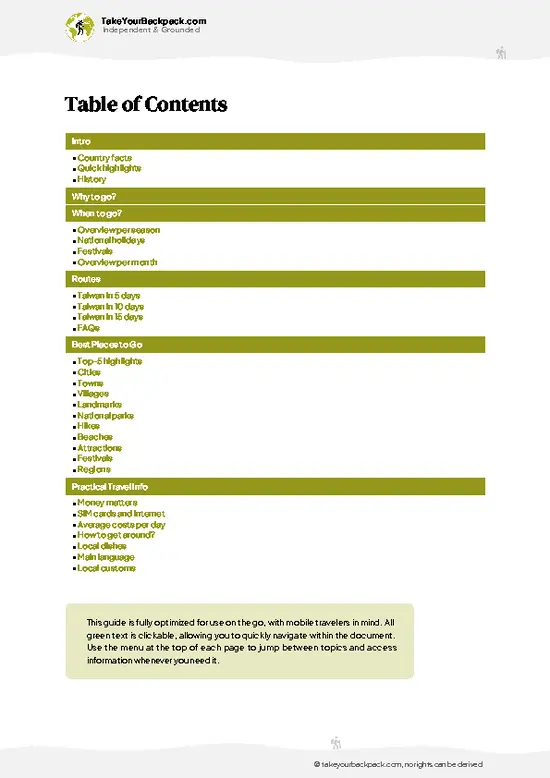
example page 0 from our offline Travel Guide for Taiwan
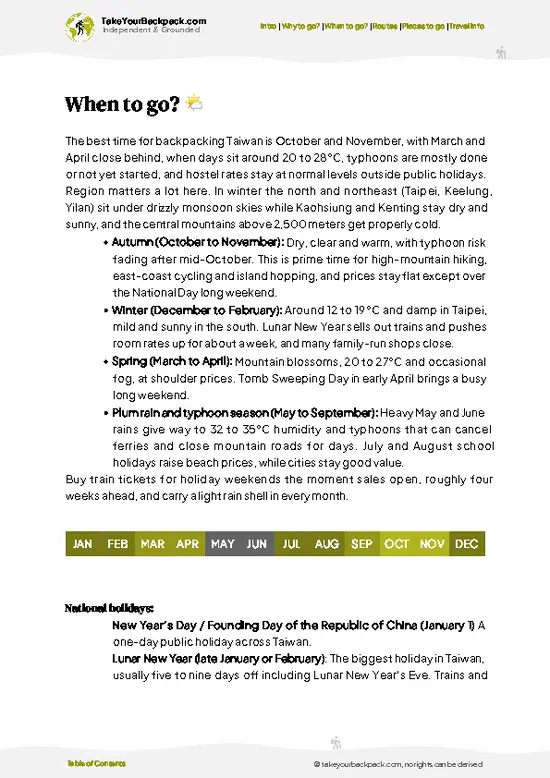
example page 1 from our offline Travel Guide for Taiwan
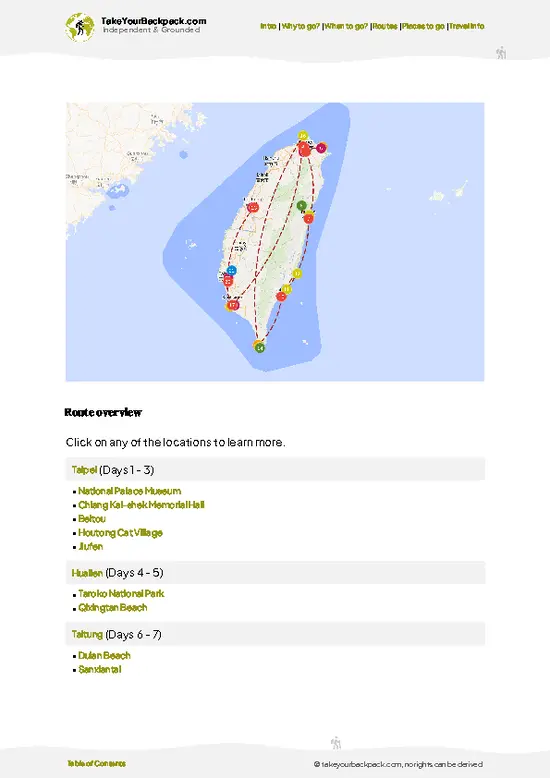
example page 2 from our offline Travel Guide for Taiwan
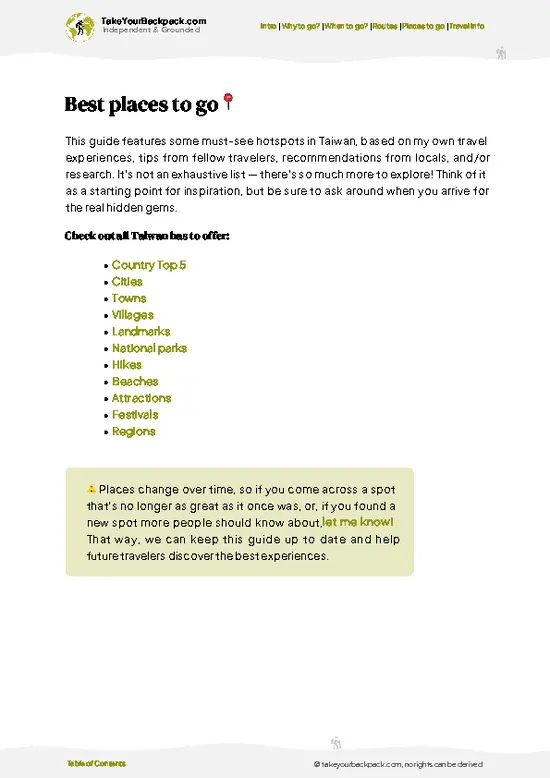
example page 3 from our offline Travel Guide for Taiwan
example page 4 from our offline Travel Guide for Taiwan
example page 5 from our offline Travel Guide for Taiwan
example page 6 from our offline Travel Guide for Taiwan
example page 7 from our offline Travel Guide for Taiwan
The digital guide (425 pages) contains:
✅ 121 highlights, ranked by travel appeal
✅ Optimized 5, 10 & 15-day travel routes
✅ Cities, national parks, landmarks, beaches
✅ How to get around
✅ Offline-friendly for travel without Wi-Fi
👉 Click to see all 30+ guide features

📅 Plan smarter in minutes, not weeks
✅ Month by month travel advice
✅ Festivals & national holidays
✅ Budget expectations

🗺️ Go to the right places, skip the overrated ones
✅ Honest pros & cons of destinations
✅ Top hikes, parks & viewpoints
✅ Lesser-known places most travelers miss
✅ Clear “worth it vs skip it” guidance

🛏️ Travel smoothly without rookie mistakes
✅ Best areas to stay
✅ Transport systems explained simply
✅ Common scams & safety advice
✅ SIM cards, money & practical tips

🌍 Understand the country, not just visit it
✅ Culture & traditions
✅ 52 Essential phrases & customs
✅ Festivals worth planning around
✅ Traveler-friendly historical context
✅ Insights that make places more meaningful

📱 Built for real travel conditions
✅ Fully downloadable PDF
✅ Works completely offline
✅ Optimized for phone use
✅ Useful in remote areas & buses
✅ Everything in one place
Stop searching, start planning
Get instant access to your full guide. 30‑day money-back guarantee.
+ Add another guide for just

By proceeding you agree to our terms.
Sent to your inbox immediately after payment • 100% Secure Checkout
Best Backpacking Travel Advisor 2025 tourism awardBest Backpacking
Travel Advisor
2025
What others say about Take Your Backpack Guides:
⭐⭐⭐⭐⭐
Fantastic, amazing amount of information!
⭐⭐⭐⭐⭐
My goodness this is amazing, it's what I've been looking for hats off too you!
⭐⭐⭐⭐⭐
I think this is absolutely BRILLIANT
⭐⭐⭐⭐
Very complete and informative. It's still missing places, but I gotta to commend you
⭐⭐⭐⭐⭐
This is truly amazing, thank you, can't wait to explore it with my kids!
⭐⭐⭐⭐⭐
Awesome resource, thank you!
⭐⭐⭐⭐⭐
This is amazing! Can't wait to explore the ones I haven't seen
⭐⭐⭐⭐
I love this! Well done, great idea.
⭐⭐⭐⭐⭐
Thanks for taking the time to make this gem!
⭐⭐⭐⭐⭐
This might be the best website I've ever seen.
⭐⭐⭐⭐⭐
Congratulations, and thank you so much for your work; it's incredibly valuable.
⭐⭐⭐⭐
In all seriousness I think you did a great job pointing out the important spots
⭐⭐⭐⭐⭐
10/10 very good
⭐⭐⭐⭐⭐
As someone who's only just starting to visit regularly this is awesome, thank you.
⭐⭐⭐⭐
Thank you very much! I'm going to visit my dad, it's going to be very useful!
⭐⭐⭐⭐⭐
This is really cool! We'll be travelling for the first time and this definitely come in handy.
⭐⭐⭐⭐⭐
You are now our minister of culture, congratulations 👨‍💼
⭐⭐⭐⭐⭐
Just wanted to tell you that this is a pearl! Going to follow your recommendations.
⭐⭐⭐⭐⭐
This is so cool. I'll definitely be using the resource for my travels soon.
⭐⭐⭐⭐⭐
This is very impressive! Good work.
⭐⭐⭐⭐⭐
This is an amazing and informative site. Very well done!

🛏️ Where to stay?Where to Base Yourself

Taiwan has a dense, clean and very safe hostel scene, with dorm beds typically NT$500 to 900 (US$16 to 28) and simple private rooms from about NT$1,200 (US$38). In Taipei, Ximending has the most beds and the liveliest late-night streets but gets loud and crowded on weekends, while the Taipei Main Station area is the most convenient for airport and high-speed rail transfers, and Zhongshan is quieter with good cafés and easy MRT access. Outside the capital, the old center of Tainan puts you within walking distance of temples and snack streets, Kaohsiung hostels around Yancheng and the Formosa Boulevard MRT give you harbor-side nightlife and cheaper rates, and Hualien rooms near the train station … read more 👉
Taiwan has a dense, clean and very safe hostel scene, with dorm beds typically NT$500 to 900 (US$16 to 28) and simple private rooms from about NT$1,200 (US$38). In Taipei, Ximending has the most beds and the liveliest late-night streets but gets loud and crowded on weekends, while the Taipei Main Station area is the most convenient for airport and high-speed rail transfers, and Zhongshan is quieter with good cafés and easy MRT access. Outside the capital, the old center of Tainan puts you within walking distance of temples and snack streets, Kaohsiung hostels around Yancheng and the Formosa Boulevard MRT give you harbor-side nightlife and cheaper rates, and Hualien rooms near the train station work best as a quiet, early-to-bed base for Taroko Gorge.

If you enjoy meeting fellow travelers, consider choosing hostels with high ratings for atmosphere. On the other hand, if you prefer having your own space, a hotel might be a better option.

TaiwanExpand Your Journey

👋 Meet the founderWho’s Behind Take Your Backpack?

Johan, backpacker and founder of TakeYourBackpackHi, I’m Johan (Netherlands 🇳🇱), the creator of TakeYourBackpack. Over the past 3 decades, I’ve backpacked through 90+ countries across six continents, gaining extensive experience with independent travel, long-term trips, and overland routes.

This site is built on a combination of firsthand travel experience and carefully curated insights from other backpackers. Many guides are based on places I’ve personally visited, while others bring together tips, observations, and practical advice shared by trusted travelers I’ve met along the way.

The goal is to provide realistic, experience-driven guidance — not generic itineraries — so you can explore destinations with better context, clearer expectations, and more confidence.