×

Taiwan🇹🇼 | best regionsWhere to Find the 5 Best regions in Taiwan

Taiwan packs subtropical lowlands, a 3,000-meter mountain spine and two very different coastlines into an island roughly 400 kilometers long, so regions here differ more by terrain and rail access than by distance. The densely populated west coast holds the high-speed rail, night markets and the cheapest, most frequent transport. The sparsely settled east is slower to reach, has fewer beds and costs more per trip but stays quiet. Mountain and outlying island areas add permits, weather risk and limited buses. For backpacking or independent travel, the real question is how much transit friction you will tolerate for emptier landscapes.

By Johan Kruseman 🇳🇱 | Updated October 18, 2026
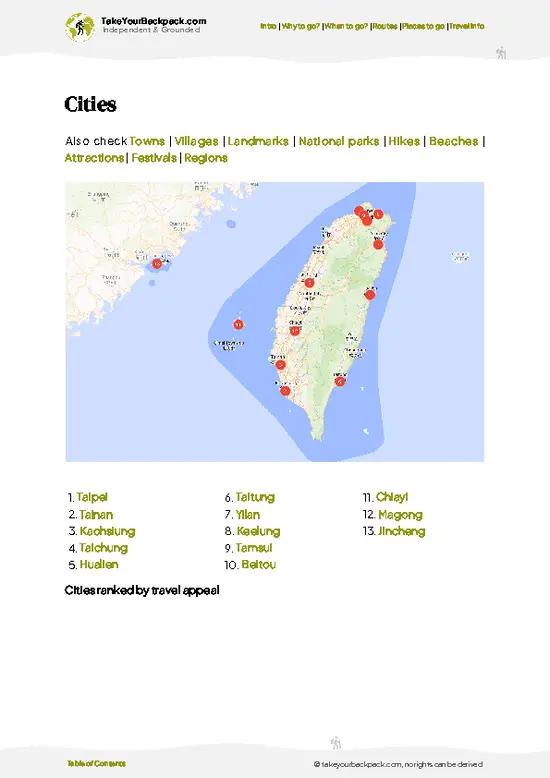
Explore the best cities in Taiwan

Why go?Understanding Their Importance

Taiwan suits regional travel because geography and infrastructure line up unusually well. A central mountain range, with peaks above 3,900 meters, divides the island into a flat, urbanized west and a steep, thinly populated east. Each side has its own weather, history and pace of life. Layered settlement by Indigenous peoples, Han migrants, Dutch and Japanese colonial rule and later postwar arrivals leaves different food, language and architecture from one area to the next.

The transport network is the other reason. The high-speed rail runs the length of the west in about 90 minutes end to end, the conventional rail circles almost the entire island, and the metro systems of the big cities take contactless cards that work nearly everywhere. Convenience stores sell tickets, food and luggage … read more 👉
Taiwan suits regional travel because geography and infrastructure line up unusually well. A central mountain range, with peaks above 3,900 meters, divides the island into a flat, urbanized west and a steep, thinly populated east. Each side has its own weather, history and pace of life. Layered settlement by Indigenous peoples, Han migrants, Dutch and Japanese colonial rule and later postwar arrivals leaves different food, language and architecture from one area to the next.

The transport network is the other reason. The high-speed rail runs the length of the west in about 90 minutes end to end, the conventional rail circles almost the entire island, and the metro systems of the big cities take contactless cards that work nearly everywhere. Convenience stores sell tickets, food and luggage shipping, which removes much of the planning burden.

Before choosing Taiwan, know that distances are short but terrain is not. Mountain roads close after typhoons and earthquakes, and rural buses can run only a few times a day. English signage is good in cities and thin in the countryside, so a translation app and screenshots of place names in Chinese characters help. Scooter rental demands a valid license, and the country is compact enough that depth beats breadth.
Why These Made the Cut
The list of best regions in Taiwan is created based on landscapes, local culture, attractions, vibes, and overall appeal. If you feel a region is missing in this list, please let us know.

When to go?Timing Your Visit for the Best Experience

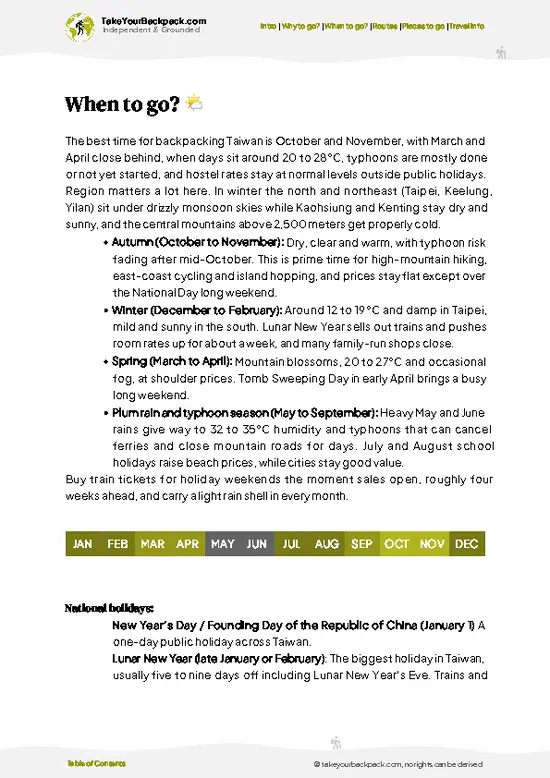
Best months and why: October to November and March to April are the best months for Taiwan’s regions, because temperatures sit around 18 to 28°C (64 to 82°F) and the typhoon and plum-rain seasons are over or yet to start. Humidity is lower, mountain views are clearer and outdoor days are comfortable across most of the island.

Shoulder seasons and peaks: May and June bring the plum rains, with frequent gray, wet days, especially in the north, and heat building toward 30°C. July to September is hot, often 30 to 35°C in the lowlands, and it is the typhoon season, when trains, flights and mountain roads can shut for a day or two. Prices for rooms and domestic transport usually rise around the Lunar New Year (January or February), Tomb Sweeping weekend in early April and the October National Day … read more 👉
Best months and why: October to November and March to April are the best months for Taiwan’s regions, because temperatures sit around 18 to 28°C (64 to 82°F) and the typhoon and plum-rain seasons are over or yet to start. Humidity is lower, mountain views are clearer and outdoor days are comfortable across most of the island.

Shoulder seasons and peaks: May and June bring the plum rains, with frequent gray, wet days, especially in the north, and heat building toward 30°C. July to September is hot, often 30 to 35°C in the lowlands, and it is the typhoon season, when trains, flights and mountain roads can shut for a day or two. Prices for rooms and domestic transport usually rise around the Lunar New Year (January or February), Tomb Sweeping weekend in early April and the October National Day holiday, when high-speed rail seats sell out and rooms can cost 30 to 50 percent more.

Winter and regional differences: December to February is cool, with lows of 10 to 15°C in the lowlands and cold, damp weather in the north, which gets drizzle for weeks. The south stays drier and warmer, often reaching 20 to 25°C, so it works well in winter. The east coast gets rain in autumn and winter from northeast winds and is best in spring and early summer. Mountains can see frost and occasional snow above 2,500 meters in winter.

region hoppingPlanning Your Route Efficiently

How many days to allow: A trip combining several regions of Taiwan needs 10 to 14 days, and 7 days works only if you limit yourself to two or three bases along the west coast. Distances look small on a map but transfers eat half-days.

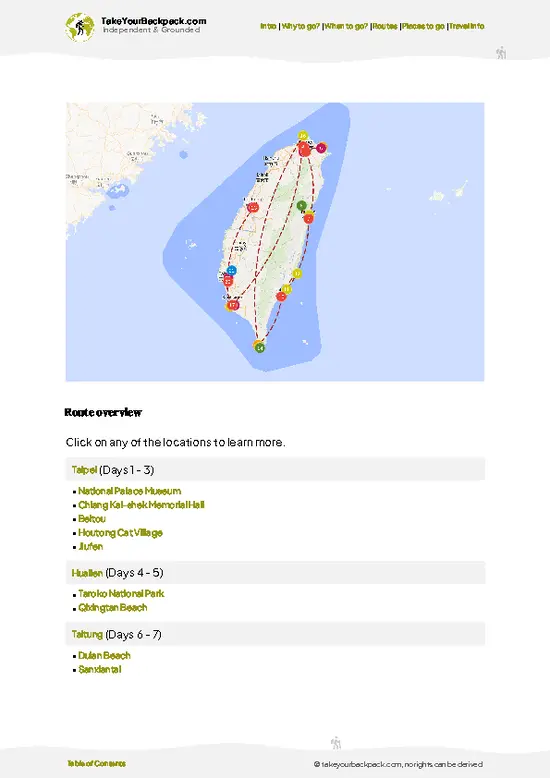
Grouping and direction: Regions group best by rail corridor. The west coast links through Taipei, Taichung, Tainan and Kaohsiung on the high-speed rail, with 1 to 2 hours between most pairs and about 90 minutes from Taipei to Kaohsiung. The east is reached by the Taiwan Railways line from Taipei to Hualien in roughly 2 to 3 hours. A loop works well, going down the west and returning up the east, or the reverse. Starting in Taipei and ending in Kaohsiung or Taitung avoids doubling back, and both have airports. Taiwan Railways links the south to the east in about … read more 👉
How many days to allow: A trip combining several regions of Taiwan needs 10 to 14 days, and 7 days works only if you limit yourself to two or three bases along the west coast. Distances look small on a map but transfers eat half-days.

Grouping and direction: Regions group best by rail corridor. The west coast links through Taipei, Taichung, Tainan and Kaohsiung on the high-speed rail, with 1 to 2 hours between most pairs and about 90 minutes from Taipei to Kaohsiung. The east is reached by the Taiwan Railways line from Taipei to Hualien in roughly 2 to 3 hours. A loop works well, going down the west and returning up the east, or the reverse. Starting in Taipei and ending in Kaohsiung or Taitung avoids doubling back, and both have airports. Taiwan Railways links the south to the east in about 2 to 3 hours.

Time per stop and common mistakes: Give a major city region 2 to 3 nights, and mountain or east coast areas 2 to 4 nights, since local transport is slow and sparse. The most common mistake is one-night stops, which turn the trip into a series of station transfers. Another is booking east coast trains late, because the Taroko Express and other express services sell out on weekends and holidays, so reserve days ahead. Travelers also underestimate typhoon delays, so leave one spare day before an international flight. For rural areas, plan around bus timetables rather than hoping to improvise.

The ListTop regions of Taiwan

1 Sihcao Wetlands

mangrove forests, salt fields, tidal wildlife

Glide through narrow waterways by boat, watch migratory birds gather at dusk, and see how salt harvesting coexists with fragile marsh ecosystems.

2 Sun Moon Lake

Island temples, lakeside cycling, Thao villages

Cycle quiet paths, visit lakeshore shrines, and take ferries between settlements shaped by indigenous and Han Chinese influences.

taiwan-region-sun-moon-lake
© Google |

3 Green Island

volcanic coastline, coral reefs, saltwater hot springs

Swim in clear waters, circle the island by scooter, and soak in rare seaside hot springs while watching the Pacific’s changing moods.

taiwan-region-green-island
© Google |

4 Orchid Island

Tao culture, volcanic coastline, flying fish season

Visit traditional underground houses, snorkel clear bays, and witness seasonal fishing rituals unique to this remote island.

5 Jibei Island

sandspit, turquoise water, remote islet

Walk a narrow sandbar stretching into clear sea, with few visitors and a sense of isolation unique to the outer islands.

taiwan-region-jibei-island
© Google |
Loading the map 🌍

Expert viewExpert Commentary on regions

How many regions to visit: Three to four regions is the sensible number for a trip of two weeks, and two or three for ten days. The reason is that Taiwan’s transit is efficient between hubs but slow from hubs to trailheads, hot springs and villages. Every added region costs a half-day of packing, rail and luggage handling. Fewer bases also let you use day trips by local train, which are cheap and far more relaxing.

Choosing by travel style: Food and culture seekers should lean toward the west coast cities, where night markets, temples and museums are close together and transport runs every few minutes. Hikers and landscape lovers should choose the mountain and east coast areas, accepting slower logistics. Some national park trails need permits applied for online days or weeks ahead, and popular … read more 👉
How many regions to visit: Three to four regions is the sensible number for a trip of two weeks, and two or three for ten days. The reason is that Taiwan’s transit is efficient between hubs but slow from hubs to trailheads, hot springs and villages. Every added region costs a half-day of packing, rail and luggage handling. Fewer bases also let you use day trips by local train, which are cheap and far more relaxing.

Choosing by travel style: Food and culture seekers should lean toward the west coast cities, where night markets, temples and museums are close together and transport runs every few minutes. Hikers and landscape lovers should choose the mountain and east coast areas, accepting slower logistics. Some national park trails need permits applied for online days or weeks ahead, and popular routes release limited spaces. Beach and island visitors should weigh ferry or flight schedules, since weather cancels them. Combining one urban region with one wilder one gives the best contrast without wasting time.

Budget: A backpacker can manage on NT$1,200 to 2,000 (US$37 to 62) a day: dorm beds run NT$450 to 800 (US$14 to 25), street food meals NT$60 to 150 (US$2 to 5), and local trains and metro rides are NT$20 to 150 per trip. A mid-range pace with private rooms is NT$2,500 to 4,000 (US$78 to 125). Long rides cost more: the high-speed rail from Taipei to Kaohsiung is about NT$1,490 (US$46), while regional express trains cost roughly half. Most museums and temples are free or NT$50 to 150, national parks mostly have no entrance fee, and guided hikes or scooter rental add NT$500 to 1,000 (US$16 to 31) per day.

Safety and cultural considerations: Taiwan has very low violent crime, and the main risks are natural. Typhoons, earthquakes and sudden mountain rain can close roads, so check the Central Weather Administration forecast and carry insurance that covers hiking and scooters. Scooter traffic is dense, and foreigners riding without the correct license are not covered by insurance. Heat and humidity make dehydration common in summer, and mountain weather changes fast.

On etiquette, queue patiently, keep quiet on trains and the metro, and avoid eating or drinking on the metro, which carries fines. Remove shoes where asked, and at temples do not point at statues or step on thresholds. Smaller places often take cash only, so carry NT$1,000 to 2,000 outside cities. Some Indigenous communities ask visitors to join guided visits or avoid photographing ceremonies without permission. A transit card such as EasyCard saves time and money.

✈️ The backpacker research shortcutTaiwan Travel Guide

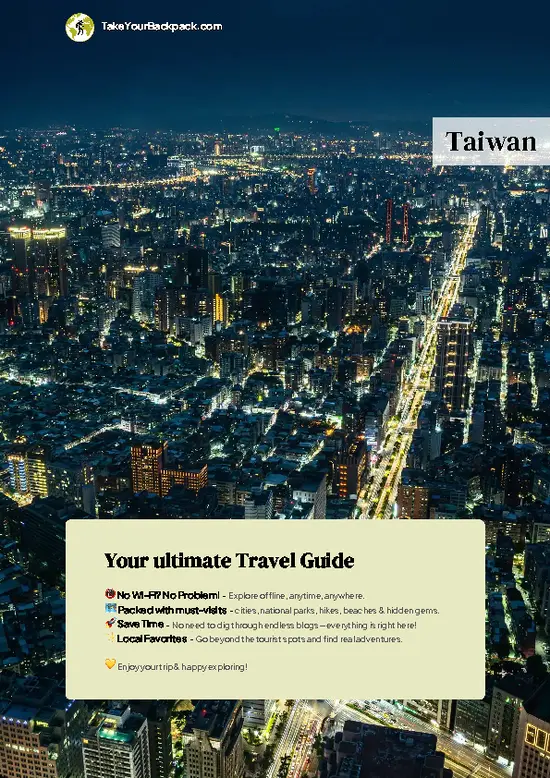
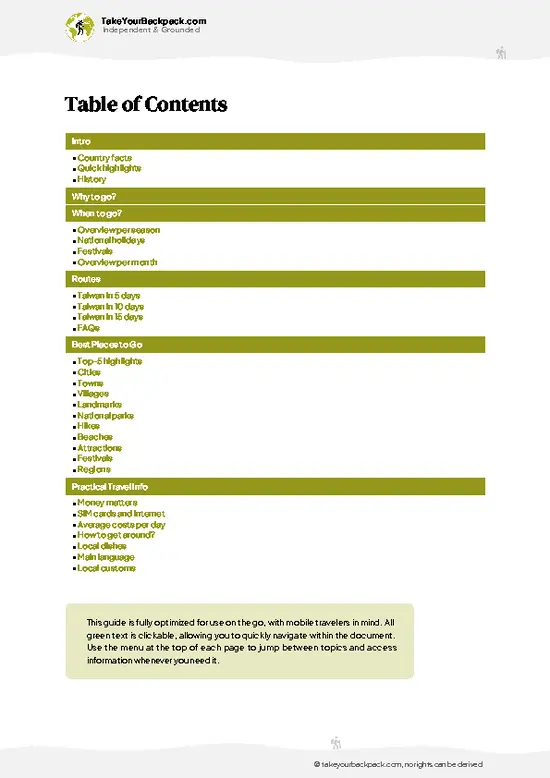
An offline-friendly backpacking guide with optimized travel routes, ranked highlights, transport advice, and the best areas to stay.
example page 0 from our offline Travel Guide for Taiwan
example page 1 from our offline Travel Guide for Taiwan
example page 2 from our offline Travel Guide for Taiwan
example page 3 from our offline Travel Guide for Taiwan
example page 4 from our offline Travel Guide for Taiwan
example page 5 from our offline Travel Guide for Taiwan
example page 6 from our offline Travel Guide for Taiwan
example page 7 from our offline Travel Guide for Taiwan
The digital guide (425 pages) contains:
✅ 121 highlights, ranked by travel appeal
✅ Optimized 5, 10 & 15-day travel routes
✅ Cities, national parks, landmarks, beaches
✅ How to get around
✅ Offline-friendly for travel without Wi-Fi
👉 Click to see all 30+ guide features

📅 Plan smarter in minutes, not weeks
✅ Month by month travel advice
✅ Festivals & national holidays
✅ Budget expectations

🗺️ Go to the right places, skip the overrated ones
✅ Honest pros & cons of destinations
✅ Top hikes, parks & viewpoints
✅ Lesser-known places most travelers miss
✅ Clear “worth it vs skip it” guidance

🛏️ Travel smoothly without rookie mistakes
✅ Best areas to stay
✅ Transport systems explained simply
✅ Common scams & safety advice
✅ SIM cards, money & practical tips

🌍 Understand the country, not just visit it
✅ Culture & traditions
✅ 52 Essential phrases & customs
✅ Festivals worth planning around
✅ Traveler-friendly historical context
✅ Insights that make places more meaningful

📱 Built for real travel conditions
✅ Fully downloadable PDF
✅ Works completely offline
✅ Optimized for phone use
✅ Useful in remote areas & buses
✅ Everything in one place
Stop searching, start planning
Get instant access to your full guide. 30‑day money-back guarantee.
+ Add another guide for just

By proceeding you agree to our terms.
Sent to your inbox immediately after payment • 100% Secure Checkout
Best Backpacking Travel Advisor 2025 tourism awardBest Backpacking
Travel Advisor
2025
What others say about Take Your Backpack Guides:
⭐⭐⭐⭐⭐
Fantastic, amazing amount of information!
⭐⭐⭐⭐⭐
My goodness this is amazing, it's what I've been looking for hats off too you!
⭐⭐⭐⭐⭐
I think this is absolutely BRILLIANT
⭐⭐⭐⭐
Very complete and informative. It's still missing places, but I gotta to commend you
⭐⭐⭐⭐⭐
This is truly amazing, thank you, can't wait to explore it with my kids!
⭐⭐⭐⭐⭐
Awesome resource, thank you!
⭐⭐⭐⭐⭐
This is amazing! Can't wait to explore the ones I haven't seen
⭐⭐⭐⭐
I love this! Well done, great idea.
⭐⭐⭐⭐⭐
Thanks for taking the time to make this gem!
⭐⭐⭐⭐⭐
This might be the best website I've ever seen.
⭐⭐⭐⭐⭐
Congratulations, and thank you so much for your work; it's incredibly valuable.
⭐⭐⭐⭐
In all seriousness I think you did a great job pointing out the important spots
⭐⭐⭐⭐⭐
10/10 very good
⭐⭐⭐⭐⭐
As someone who's only just starting to visit regularly this is awesome, thank you.
⭐⭐⭐⭐
Thank you very much! I'm going to visit my dad, it's going to be very useful!
⭐⭐⭐⭐⭐
This is really cool! We'll be travelling for the first time and this definitely come in handy.
⭐⭐⭐⭐⭐
You are now our minister of culture, congratulations 👨‍💼
⭐⭐⭐⭐⭐
Just wanted to tell you that this is a pearl! Going to follow your recommendations.
⭐⭐⭐⭐⭐
This is so cool. I'll definitely be using the resource for my travels soon.
⭐⭐⭐⭐⭐
This is very impressive! Good work.
⭐⭐⭐⭐⭐
This is an amazing and informative site. Very well done!

🛏️ Where to stay?Top Areas to Stay

Taiwan has a dense, clean and very safe hostel scene, with dorm beds typically NT$500 to 900 (US$16 to 28) and simple private rooms from about NT$1,200 (US$38). In Taipei, Ximending has the most beds and the liveliest late-night streets but gets loud and crowded on weekends, while the Taipei Main Station area is the most convenient for airport and high-speed rail transfers, and Zhongshan is quieter with good cafés and easy MRT access. Outside the capital, the old center of Tainan puts you within walking distance of temples and snack streets, Kaohsiung hostels around Yancheng and the Formosa Boulevard MRT give you harbor-side nightlife and cheaper rates, and Hualien rooms near the train station … read more 👉
Taiwan has a dense, clean and very safe hostel scene, with dorm beds typically NT$500 to 900 (US$16 to 28) and simple private rooms from about NT$1,200 (US$38). In Taipei, Ximending has the most beds and the liveliest late-night streets but gets loud and crowded on weekends, while the Taipei Main Station area is the most convenient for airport and high-speed rail transfers, and Zhongshan is quieter with good cafés and easy MRT access. Outside the capital, the old center of Tainan puts you within walking distance of temples and snack streets, Kaohsiung hostels around Yancheng and the Formosa Boulevard MRT give you harbor-side nightlife and cheaper rates, and Hualien rooms near the train station work best as a quiet, early-to-bed base for Taroko Gorge.

If you enjoy meeting fellow travelers, consider choosing hostels with high ratings for atmosphere. On the other hand, if you prefer having your own space, a hotel might be a better option.

TaiwanDiscover the Country

👋 Meet the founderWho’s Behind Take Your Backpack?

Johan, backpacker and founder of TakeYourBackpackHi, I’m Johan (Netherlands 🇳🇱), the creator of TakeYourBackpack. Over the past 3 decades, I’ve backpacked through 90+ countries across six continents, gaining extensive experience with independent travel, long-term trips, and overland routes.

This site is built on a combination of firsthand travel experience and carefully curated insights from other backpackers. Many guides are based on places I’ve personally visited, while others bring together tips, observations, and practical advice shared by trusted travelers I’ve met along the way.

The goal is to provide realistic, experience-driven guidance — not generic itineraries — so you can explore destinations with better context, clearer expectations, and more confidence.