×

Taiwan🇹🇼 | best beachesWhere to Find the 10 Best beaches in Taiwan

Beaches in Taiwan are shaped by an island that faces two very different oceans. The east coast drops from mountains straight into the Pacific, so you get dark pebble and sand shores, strong currents and few swimmers. The north has accessible sand an hour from Taipei, which means easy trains and crowded weekends. The south and the outlying islands hold the warm, clear water and coral, but cost more in transport and lodging. For independent travel, that split decides how much you pay in time versus money, and how much space you get.

By Johan Kruseman 🇳🇱 | Updated October 18, 2026
Explore the best attractions in Taiwan

Why go?Understanding Their Importance

Taiwan is a mountainous island on the edge of the Pacific, and that geography explains most of what a beach here is like. Steep ranges run down the east side, so shorelines there are often narrow, rocky and exposed to open-ocean swell. The broad western plain faces the Taiwan Strait, where shallow water and river sediment produce long, flat, muddy-to-sandy coasts that are better for sunsets and tidal flats than for clear swimming. Only the far south and the offshore islands have the coral and reef conditions people picture when they hear tropical.

History matters too. For decades, coastlines were militarized and fenced off, and many shores only opened to the public relatively recently. That is why swimming is regulated: lifeguard-patrolled zones, flagged hours and closed seasons are normal, … read more 👉
Taiwan is a mountainous island on the edge of the Pacific, and that geography explains most of what a beach here is like. Steep ranges run down the east side, so shorelines there are often narrow, rocky and exposed to open-ocean swell. The broad western plain faces the Taiwan Strait, where shallow water and river sediment produce long, flat, muddy-to-sandy coasts that are better for sunsets and tidal flats than for clear swimming. Only the far south and the offshore islands have the coral and reef conditions people picture when they hear tropical.

History matters too. For decades, coastlines were militarized and fenced off, and many shores only opened to the public relatively recently. That is why swimming is regulated: lifeguard-patrolled zones, flagged hours and closed seasons are normal, and swimming outside them is often prohibited.

Before choosing Taiwan for beaches, know that the island is better seen as a place with some good coastline than as a beach destination built around resorts. Typhoons and jellyfish shape the swimming season, and rip currents are a real hazard on exposed coasts. Infrastructure is excellent, with clean facilities and reliable public transport, but you should plan around surf, wind and water conditions rather than assume calm lagoons. The reward is uncrowded shores, cheap food nearby and a coast that fits easily into a wider trip.
Behind the Scenes of Selection
The list of best beaches in Taiwan is created based on beauty, vibe, water quality, activities, and surrounding scenery. If you feel a beach is missing in this list, please let us know.

When to go?Timing Your Visit for the Best Experience

Best months and why: The best months for beaches in Taiwan are May to September for swimming, when air temperatures sit around 28 to 34°C and sea water warms to roughly 26 to 29°C, and October for calmer, drier days with lower crowds. The catch is that this same window overlaps with typhoon season, which runs roughly July to October, so conditions can change within days.
Regional differences: The north coast is cooler and wetter, with the northeast monsoon bringing drizzle, wind and gray skies from October through March. Swimming there is realistic mainly from June to September. The south, around Kenting and Pingtung, stays warm year-round, with winter highs around 22 to 26°C, and the east coast is the wettest during typhoon passages and autumn. The outlying islands such as Penghu get strong … read more 👉
Best months and why: The best months for beaches in Taiwan are May to September for swimming, when air temperatures sit around 28 to 34°C and sea water warms to roughly 26 to 29°C, and October for calmer, drier days with lower crowds. The catch is that this same window overlaps with typhoon season, which runs roughly July to October, so conditions can change within days.
Regional differences: The north coast is cooler and wetter, with the northeast monsoon bringing drizzle, wind and gray skies from October through March. Swimming there is realistic mainly from June to September. The south, around Kenting and Pingtung, stays warm year-round, with winter highs around 22 to 26°C, and the east coast is the wettest during typhoon passages and autumn. The outlying islands such as Penghu get strong winter winds, so ferry and flight cancellations are common from November to March.
Shoulder seasons and crowds: April and late October to November are shoulder months with fewer visitors and pleasant air, though water is cooler, around 22 to 25°C. Peak pressure falls on July and August weekends and national holidays, when lodging near popular shores can cost 30 to 100 percent more than on weekdays. Many beaches open official swimming seasons only between roughly May and October, so lifeguard cover disappears outside it.

beach hoppingPlanning Your Route Efficiently

How many days to allow: A trip combining several beaches in Taiwan needs 7 to 12 days, because the best coastlines sit in different corners of the island and the sensible links between them are long. The island is compact, but mountains force transport onto a few corridors.
Grouping and direction: The north coast pairs naturally with Taipei, since it is a 1 to 2 hour trip by bus or train. The east coast links through Hualien and Taitung. The south connects through Kaohsiung, where high-speed rail from Taipei takes about 1 hour 40 minutes to 2 hours. A counterclockwise loop works well: start in Taipei, go down the east on the Taroko Express or regular rail, finish in the south, then return by high-speed rail on the west. Offshore islands such as Penghu and Green Island add 1 to 3 days each because … read more 👉
How many days to allow: A trip combining several beaches in Taiwan needs 7 to 12 days, because the best coastlines sit in different corners of the island and the sensible links between them are long. The island is compact, but mountains force transport onto a few corridors.
Grouping and direction: The north coast pairs naturally with Taipei, since it is a 1 to 2 hour trip by bus or train. The east coast links through Hualien and Taitung. The south connects through Kaohsiung, where high-speed rail from Taipei takes about 1 hour 40 minutes to 2 hours. A counterclockwise loop works well: start in Taipei, go down the east on the Taroko Express or regular rail, finish in the south, then return by high-speed rail on the west. Offshore islands such as Penghu and Green Island add 1 to 3 days each because ferry and flight schedules control your timing.
Time per stop and common mistakes: Allow 1 to 2 nights for each beach area, and 2 to 3 for the south or an island. Hualien to Taitung takes roughly 2 to 3 hours by train. A common mistake is cramming one beach into every day, which burns hours on transfers. Another is booking islands early in a trip, when typhoon cancellations leave no buffer. Put ferries and flights toward the middle with a spare day, and avoid weekend transport by traveling on weekdays, when east coast trains sell out less often.

The ListTop beaches of Taiwan

1 Kenting Beach

southern tip, snorkeling spots, coral reefs

Snorkel above colorful reefs or relax on soft sand, with warm water and a tropical climate year-round.

taiwan-beach-kenting-beach
© Google |

2 Nanwan Beach

water sports, crescent bay, lively bars

Try jet skiing or paddleboarding by day, then unwind at beachfront bars as the sun sets over the curved shoreline.

taiwan-beach-nanwan-beach
© Google |

3 Fulong Beach

golden sand, summer festivals, river mouth

Relax on a broad, sandy expanse where a river meets the sea, with seasonal events and easy train access from Taipei.

taiwan-beach-fulong-beach
© Google |

4 Baishawan Beach

white sand, calm shallows, Penghu archipelago

Swim in gentle waters and walk long stretches of pale sand, with distant islets visible across the horizon and minimal crowds.

taiwan-beach-baishawan-beach
© Google |

5 Jialeshui Beach

rugged cliffs, river mouth, surf point

Surf consistent waves near dramatic headlands, or hike along the river’s edge where freshwater meets the Pacific.

6 Qixingtan Beach

pebble shore, mountain views, cycling paths

Listen to waves on smooth stones and cycle along the coast, with the Central Mountain Range rising dramatically behind you.

7 Wai’ao Beach

black sand, surf schools, Turtle Island view

Take a surf lesson on volcanic sands, with clear views of Guishan Island and a relaxed, youthful vibe.

8 Dawan Beach

central Kenting, surf breaks, boardwalk

Watch surfers ride consistent waves or stroll the lively promenade, with easy access to shops and the heart of Kenting’s nightlife.

taiwan-beach-dawan-beach
© Google |

9 Dulan Beach

black sand, artist village, Pacific views

Experience a laid-back surf scene and striking volcanic sands, with mountain backdrops and a creative local community nearby.

10 Shanyuan Beach

wide bay, soft sand, Taitung coast

Swim in gentle surf and enjoy open space, with views of distant mountains and a quieter atmosphere than most east coast beaches.

11 Dongqing Bay

coral reef, quiet bay, indigenous village

Swim in sheltered water near a small village, with coral reefs close to shore and few outside visitors.

12 Yeyou Beach (Lanyu)

pebble beach, traditional boats, Orchid Island

See hand-carved canoes pulled onto smooth stones, with clear water and a strong sense of local culture.

13 Honeymoon Bay

secluded cove, rocky outcrops, east coast

Find solitude in a sheltered bay, where waves break against rocks and the forest meets the shore.

14 Wushi Harbor Beach

surf town, fishing boats, Yilan coast

Join local surfers or watch fishing boats come and go, with a casual atmosphere and easy train connections.

15 Shimen Beach

wide sands, wind turbines, northern coast

Walk broad, windswept sands beneath spinning turbines, with strong breezes and open views of the Taiwan Strait.

16 Jinsha Beach

fine sand, Penghu main island, gentle slope

Wade into shallow, clear water on a gently sloping beach, with few facilities but excellent swimming conditions.

17 Cijin Beach

urban island, seafood stalls, Kaohsiung harbor

Sample fresh seafood after a swim, with city views and easy ferry access from downtown Kaohsiung.

18 Shalun Beach

coastal park, sunset views, Tamsui River

Watch the sun set over the river mouth, with grassy dunes and a relaxed park atmosphere close to Taipei.

19 Toucheng Beach

long shoreline, sand dunes, paragliding

Walk for miles along shifting dunes, or try paragliding for sweeping views of the Pacific and Yilan plain.

Think you know Taiwan?

Prove you’re a true local — uncover 9 lesser-known beaches in Taiwan that locals tend to keep to themselves.
Loading the map 🌍

Expert viewExpert Commentary on beaches

How many beaches to visit: I advise three to four beach stops in a single trip. Taiwan’s beaches vary by coast, so three gives you one northern, one eastern or southern, and possibly an island, which covers the real differences. Beyond four, you spend more time on trains than in the water, and the ocean here is conditional: weather can erase a day at any stop.
Which kind for which traveler: If you are short on time or money, prioritize the north and Taipei-adjacent sand, which costs almost nothing beyond a metro or bus fare. If you want clear water and snorkeling, prioritize the south or an outlying island, because coral and visibility are much better there. If you like scenery over swimming, the east coast is the pick, since strong currents make it better for walking and watching than for … read more 👉
How many beaches to visit: I advise three to four beach stops in a single trip. Taiwan’s beaches vary by coast, so three gives you one northern, one eastern or southern, and possibly an island, which covers the real differences. Beyond four, you spend more time on trains than in the water, and the ocean here is conditional: weather can erase a day at any stop.
Which kind for which traveler: If you are short on time or money, prioritize the north and Taipei-adjacent sand, which costs almost nothing beyond a metro or bus fare. If you want clear water and snorkeling, prioritize the south or an outlying island, because coral and visibility are much better there. If you like scenery over swimming, the east coast is the pick, since strong currents make it better for walking and watching than for swimming. Most swimmers get more from one good south or island stay than from three average stops.
What it costs: Plan on US$35 to 70 a day (about NT$1,100 to 2,300) including a hostel dorm or budget room at NT$600 to 1,200, food at NT$250 to 500 a day from night markets and convenience stores, and local transport. Most public beaches are free. Managed beaches with showers and lifeguards usually charge about NT$50 to 250 to enter, and snorkel or surf rental runs NT$300 to 800. Guided snorkeling or diving costs NT$800 to 2,500. Scooter rental is about NT$300 to 600 a day, and an international permit with a valid license is required. Weekend lodging near popular beaches runs higher, so book weekdays when possible.
Safety and local rules: Rip currents on the east coast are why many shores look empty. Locals often stay out, so follow them. Swim only where lifeguards and flags are present, since swimming outside designated areas can be prohibited and fines are possible. Check the Central Weather Administration for typhoon and wave warnings, and skip the water when it issues alerts, because conditions can turn quickly. Jellyfish appear in summer on some coasts, so look for warning signs. Sun is strong, and UV levels are high by midday, so reef-safe sunscreen and a rash guard help.
Cultural considerations: Beach culture here is modest. Many locals swim in full-coverage clothing or wetsuits and avoid the sun, so wearing a rash guard is normal and topless sunbathing is not accepted. Take litter out with you, since bins are sometimes absent and beach cleanliness is taken seriously. Drones, fires and camping are often restricted, so check signs before setting up.

✈️ The backpacker research shortcutTaiwan Travel Guide

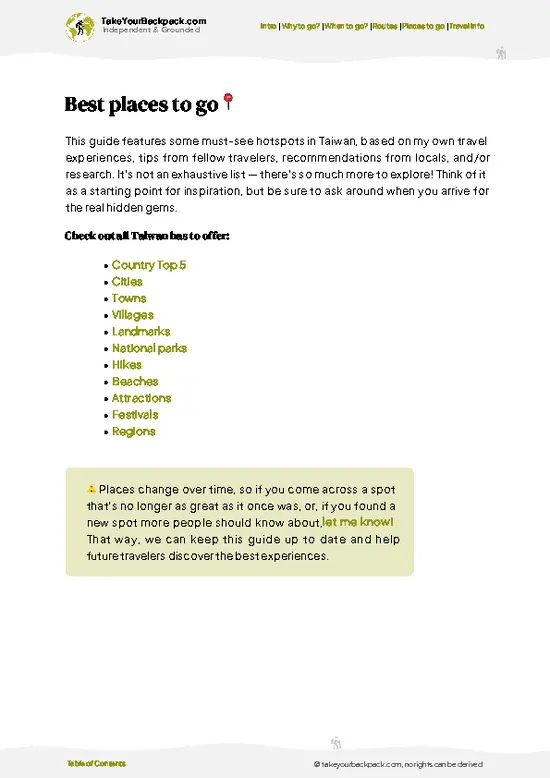
An offline-friendly backpacking guide with optimized travel routes, ranked highlights, transport advice, and the best areas to stay.
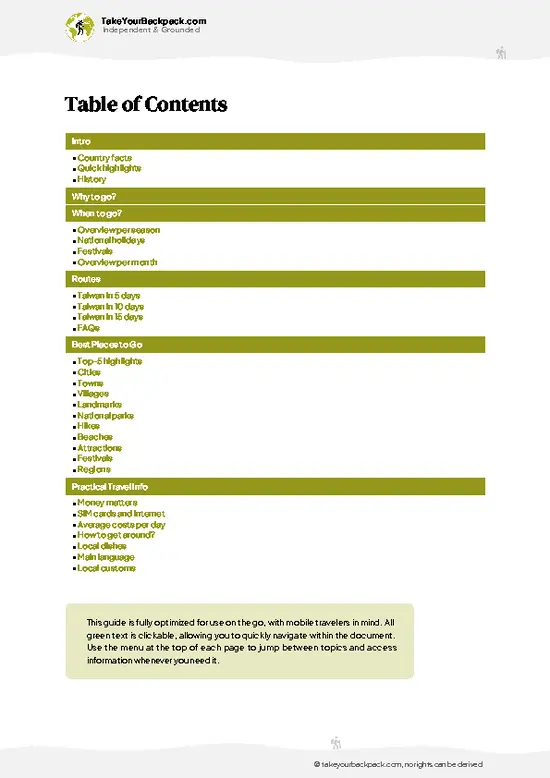
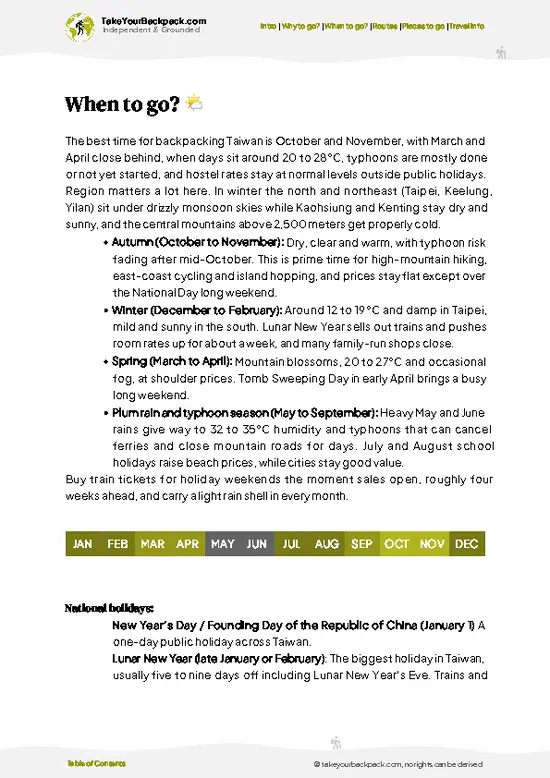
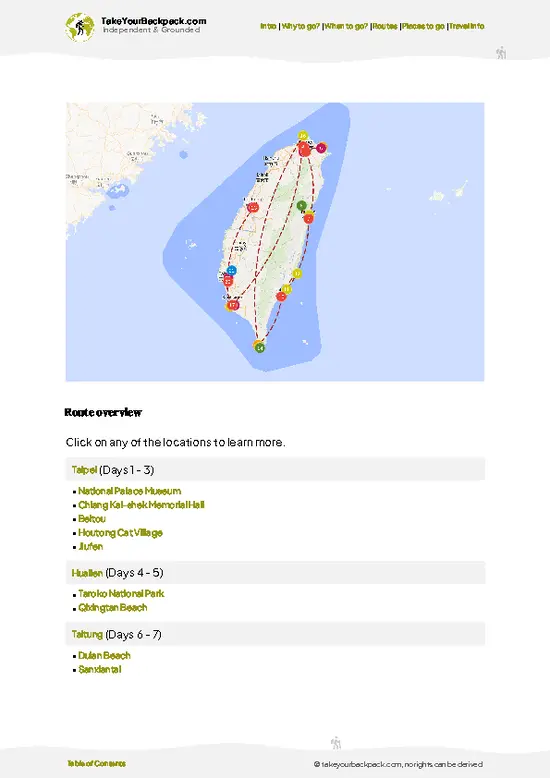
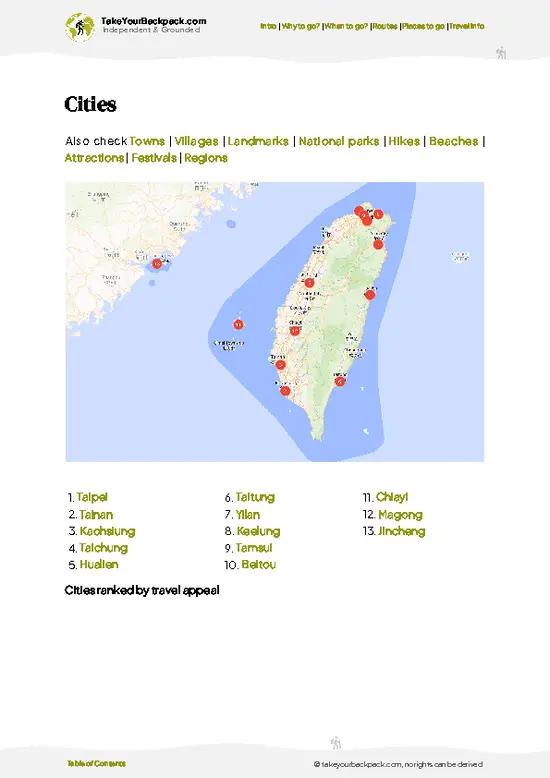
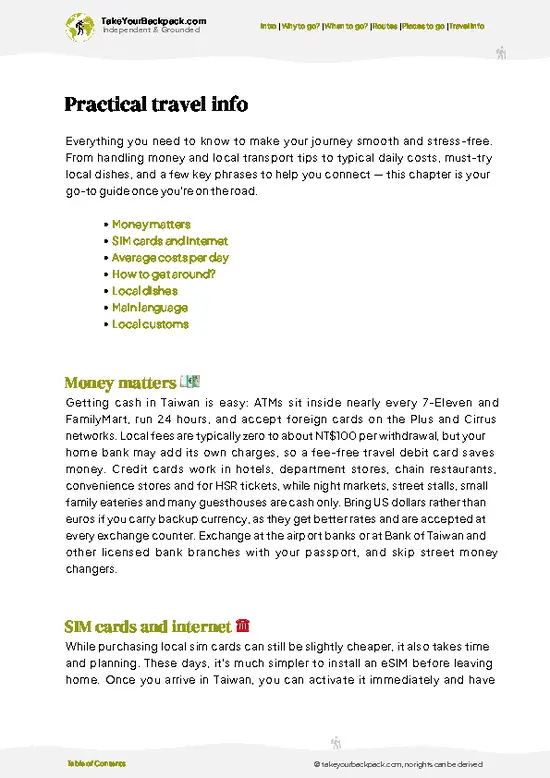
example page 0 from our offline Travel Guide for Taiwan
example page 1 from our offline Travel Guide for Taiwan
example page 2 from our offline Travel Guide for Taiwan
example page 3 from our offline Travel Guide for Taiwan
example page 4 from our offline Travel Guide for Taiwan
example page 5 from our offline Travel Guide for Taiwan
example page 6 from our offline Travel Guide for Taiwan
example page 7 from our offline Travel Guide for Taiwan
The digital guide (425 pages) contains:
✅ 121 highlights, ranked by travel appeal
✅ Optimized 5, 10 & 15-day travel routes
✅ Cities, national parks, landmarks, beaches
✅ How to get around
✅ Offline-friendly for travel without Wi-Fi
👉 Click to see all 30+ guide features

📅 Plan smarter in minutes, not weeks
✅ Month by month travel advice
✅ Festivals & national holidays
✅ Budget expectations

🗺️ Go to the right places, skip the overrated ones
✅ Honest pros & cons of destinations
✅ Top hikes, parks & viewpoints
✅ Lesser-known places most travelers miss
✅ Clear “worth it vs skip it” guidance

🛏️ Travel smoothly without rookie mistakes
✅ Best areas to stay
✅ Transport systems explained simply
✅ Common scams & safety advice
✅ SIM cards, money & practical tips

🌍 Understand the country, not just visit it
✅ Culture & traditions
✅ 52 Essential phrases & customs
✅ Festivals worth planning around
✅ Traveler-friendly historical context
✅ Insights that make places more meaningful

📱 Built for real travel conditions
✅ Fully downloadable PDF
✅ Works completely offline
✅ Optimized for phone use
✅ Useful in remote areas & buses
✅ Everything in one place
Stop searching, start planning
Get instant access to your full guide. 30‑day money-back guarantee.
+ Add another guide for just

By proceeding you agree to our terms.
Sent to your inbox immediately after payment • 100% Secure Checkout
Best Backpacking Travel Advisor 2025 tourism awardBest Backpacking
Travel Advisor
2025
What others say about Take Your Backpack Guides:
⭐⭐⭐⭐⭐
Fantastic, amazing amount of information!
⭐⭐⭐⭐⭐
My goodness this is amazing, it's what I've been looking for hats off too you!
⭐⭐⭐⭐⭐
I think this is absolutely BRILLIANT
⭐⭐⭐⭐
Very complete and informative. It's still missing places, but I gotta to commend you
⭐⭐⭐⭐⭐
This is truly amazing, thank you, can't wait to explore it with my kids!
⭐⭐⭐⭐⭐
Awesome resource, thank you!
⭐⭐⭐⭐⭐
This is amazing! Can't wait to explore the ones I haven't seen
⭐⭐⭐⭐
I love this! Well done, great idea.
⭐⭐⭐⭐⭐
Thanks for taking the time to make this gem!
⭐⭐⭐⭐⭐
This might be the best website I've ever seen.
⭐⭐⭐⭐⭐
Congratulations, and thank you so much for your work; it's incredibly valuable.
⭐⭐⭐⭐
In all seriousness I think you did a great job pointing out the important spots
⭐⭐⭐⭐⭐
10/10 very good
⭐⭐⭐⭐⭐
As someone who's only just starting to visit regularly this is awesome, thank you.
⭐⭐⭐⭐
Thank you very much! I'm going to visit my dad, it's going to be very useful!
⭐⭐⭐⭐⭐
This is really cool! We'll be travelling for the first time and this definitely come in handy.
⭐⭐⭐⭐⭐
You are now our minister of culture, congratulations 👨‍💼
⭐⭐⭐⭐⭐
Just wanted to tell you that this is a pearl! Going to follow your recommendations.
⭐⭐⭐⭐⭐
This is so cool. I'll definitely be using the resource for my travels soon.
⭐⭐⭐⭐⭐
This is very impressive! Good work.
⭐⭐⭐⭐⭐
This is an amazing and informative site. Very well done!

🛏️ Where to stay?Best Stay Options in Taiwan

Taiwan has a dense, clean and very safe hostel scene, with dorm beds typically NT$500 to 900 (US$16 to 28) and simple private rooms from about NT$1,200 (US$38). In Taipei, Ximending has the most beds and the liveliest late-night streets but gets loud and crowded on weekends, while the Taipei Main Station area is the most convenient for airport and high-speed rail transfers, and Zhongshan is quieter with good cafés and easy MRT access. Outside the capital, the old center of Tainan puts you within walking distance of temples and snack streets, Kaohsiung hostels around Yancheng and the Formosa Boulevard MRT give you harbor-side nightlife and cheaper rates, and Hualien rooms near the train station … read more 👉
Taiwan has a dense, clean and very safe hostel scene, with dorm beds typically NT$500 to 900 (US$16 to 28) and simple private rooms from about NT$1,200 (US$38). In Taipei, Ximending has the most beds and the liveliest late-night streets but gets loud and crowded on weekends, while the Taipei Main Station area is the most convenient for airport and high-speed rail transfers, and Zhongshan is quieter with good cafés and easy MRT access. Outside the capital, the old center of Tainan puts you within walking distance of temples and snack streets, Kaohsiung hostels around Yancheng and the Formosa Boulevard MRT give you harbor-side nightlife and cheaper rates, and Hualien rooms near the train station work best as a quiet, early-to-bed base for Taroko Gorge.

If you enjoy meeting fellow travelers, consider choosing hostels with high ratings for atmosphere. On the other hand, if you prefer having your own space, a hotel might be a better option.

TaiwanWhere to Go Next

👋 Meet the founderWho’s Behind Take Your Backpack?

Johan, backpacker and founder of TakeYourBackpackHi, I’m Johan (Netherlands 🇳🇱), the creator of TakeYourBackpack. Over the past 3 decades, I’ve backpacked through 90+ countries across six continents, gaining extensive experience with independent travel, long-term trips, and overland routes.

This site is built on a combination of firsthand travel experience and carefully curated insights from other backpackers. Many guides are based on places I’ve personally visited, while others bring together tips, observations, and practical advice shared by trusted travelers I’ve met along the way.

The goal is to provide realistic, experience-driven guidance — not generic itineraries — so you can explore destinations with better context, clearer expectations, and more confidence.