×

Tajikistan🇹🇯 | best festivalsEssential 7 festivals to Explore in Tajikistan

Festivals in Tajikistan run on mountain time. Nothing here is a ticketed spectacle with a glossy program. Celebrations grow out of village squares, high pastures and Dushanbe’s parks, and they follow the calendar of harvests, spring and the old Persian year. In the capital and the Sughd region you find organized, easy-to-reach events with crowds and cheap taxis. In the Pamirs and the Fann Mountains you trade comfort for raw, local gatherings reached by shared jeep along rough roads. Independent travelers get the best of it: costs stay low, hosts invite you in, and every detour pays off.

By Johan Kruseman 🇳🇱 | Updated October 19, 2026
Explore the best regions in Tajikistan

Why go?Why Travelers Love These Spots

Tajikistan suits festivals because Persian-speaking heritage meets Central Asian mountain life in a country where more than 90 percent of the land is mountainous. Spring and harvest rhythms still matter, so celebrations stay tied to farming, livestock and family, and the Zoroastrian-rooted calendar survives in how people mark seasonal turns. The Pamirs add Ismaili Muslim traditions, and valley communities keep their own languages, music and dress. That variety means a festival in the north feels different from one in the east.

Geography shapes everything. Isolated valleys keep traditions intact, but they also mean long drives, few signs in English and little advance information. Dates often shift with the lunar calendar or local decisions, and many events are announced only days ahead. Infrastructure … read more 👉
Tajikistan suits festivals because Persian-speaking heritage meets Central Asian mountain life in a country where more than 90 percent of the land is mountainous. Spring and harvest rhythms still matter, so celebrations stay tied to farming, livestock and family, and the Zoroastrian-rooted calendar survives in how people mark seasonal turns. The Pamirs add Ismaili Muslim traditions, and valley communities keep their own languages, music and dress. That variety means a festival in the north feels different from one in the east.

Geography shapes everything. Isolated valleys keep traditions intact, but they also mean long drives, few signs in English and little advance information. Dates often shift with the lunar calendar or local decisions, and many events are announced only days ahead. Infrastructure is basic outside Dushanbe and Khujand: guesthouses are simple, cards are rarely accepted, and mobile data fades fast in the mountains.

Before choosing Tajikistan for festivals, accept flexibility as part of the deal. Carry cash in somoni, arrange the Gorno-Badakhshan permit (GBAO) early, and ask guesthouse hosts what is happening nearby. Your reward is access to celebrations where visitors are guests, not an audience, and where a single invitation to a table can outshine any stage show.
Evaluating the Top Choices
The list of best festivals in Tajikistan is created based on energy, traditions, crowd experience, activities, and overall excitement. If you feel a festival is missing in this list, please let us know.

When to go?Seasonal Guide to Visiting

Best months: spring and early autumn: March to June and September to October are the best months for festivals in Tajikistan, because the roads are open, the valleys are green or golden, and daytime temperatures sit around 15 to 28°C in most lowland areas. Late March brings the spring new year season, when the whole country moves outdoors. Dushanbe warms quickly, reaching 20 to 25°C in April and May, with the wettest weather in March and April. Expect rain on and off, around 60 to 80 mm a month in the capital.
Shoulder seasons and mountain timing: Late summer, July and August, is excellent in the Pamirs and Fann Mountains, where daytime highs run 20 to 30°C and nights drop sharply. Dushanbe and the Fergana Valley bake at 35 to 42°C, so plan midday rest. Early autumn is harvest time, and fruit … read more 👉
Best months: spring and early autumn: March to June and September to October are the best months for festivals in Tajikistan, because the roads are open, the valleys are green or golden, and daytime temperatures sit around 15 to 28°C in most lowland areas. Late March brings the spring new year season, when the whole country moves outdoors. Dushanbe warms quickly, reaching 20 to 25°C in April and May, with the wettest weather in March and April. Expect rain on and off, around 60 to 80 mm a month in the capital.
Shoulder seasons and mountain timing: Late summer, July and August, is excellent in the Pamirs and Fann Mountains, where daytime highs run 20 to 30°C and nights drop sharply. Dushanbe and the Fergana Valley bake at 35 to 42°C, so plan midday rest. Early autumn is harvest time, and fruit markets overflow. Late October still works at lower altitudes, though mountain passes can start to snow.
Winter and prices: November to February is cold: Dushanbe sits around 0 to 8°C, and the Pamir Highway can close or become difficult. Higher passes like Ak-Baital (4,655 m) see snow from October. Prices stay fairly flat year-round, but guesthouse beds in the Pamirs fill in July and August, when homestays run US$15 to 30 with meals. Book ahead in peak weeks, and keep a spare day for road delays.

festival hoppingHow to Combine festivals Into One Trip

Plan 10 to 18 days: A trip combining several festivals in Tajikistan needs 10 to 18 days, because the distances are short on a map and long on the road. Group regions by valley: Dushanbe with the Fann Mountains and Khujand form a western and northern cluster, while the Pamirs (Khorog, Murghab, the Wakhan) form a separate eastern loop. Start in Dushanbe, which has the main airport, then work outward. Heading north first lets you finish the Pamirs in warmer months and fly or drive back.
Time per stop and transport: Give Dushanbe 2 to 3 days, the Fann Mountains 2 to 4, Khujand 1 to 2, and each Pamir base 2 to 3. Dushanbe to Khujand takes about 5 to 7 hours by shared taxi through the Anzob Tunnel. Dushanbe to Khorog runs 12 to 16 hours by shared jeep on the southern route, often split into two … read more 👉
Plan 10 to 18 days: A trip combining several festivals in Tajikistan needs 10 to 18 days, because the distances are short on a map and long on the road. Group regions by valley: Dushanbe with the Fann Mountains and Khujand form a western and northern cluster, while the Pamirs (Khorog, Murghab, the Wakhan) form a separate eastern loop. Start in Dushanbe, which has the main airport, then work outward. Heading north first lets you finish the Pamirs in warmer months and fly or drive back.
Time per stop and transport: Give Dushanbe 2 to 3 days, the Fann Mountains 2 to 4, Khujand 1 to 2, and each Pamir base 2 to 3. Dushanbe to Khujand takes about 5 to 7 hours by shared taxi through the Anzob Tunnel. Dushanbe to Khorog runs 12 to 16 hours by shared jeep on the southern route, often split into two days. Flights to Khorog are weather-dependent and cancel without notice. Shared taxis leave when full, usually in the early morning from the main bazaars.
Common planning mistakes: Travelers often pack too many stops into one week and arrive tired. Instead, pick one region per week. Another mistake is fixing dates too early: festival days shift, so keep two buffer days around each stop. Many also forget GBAO permits, which you should arrange online before the Pamir leg. Finally, do not book tight flights home after a mountain drive, since landslides can slow the roads.

The ListMust-Visit festivals in Tajikistan

1 Roof of the World Festival

Cultural exchange, mountain art, cross-border performances

Witness artists from the Pamirs and neighboring countries collaborate in music, dance, and visual arts at high elevation.

3 Dushanbe Ethno-Jazz Festival

Fusion concerts, regional ensembles, late-night jam sessions

Hear jazz blended with Tajik and Central Asian sounds, performed by international and local musicians in Dushanbe’s creative spaces.

4 Badakhshan Folklore Festival

Mountain music, Pamiri dance, traditional instruments

Immerse yourself in remote village life as musicians and dancers revive centuries-old customs unique to the high Pamirs.

5 Khorog Spring Festival

Flower markets, handicraft stalls, riverside gatherings

Experience the shift from winter as Khorog fills with color, local crafts, and open-air celebrations along the Gunt River.

6 Didor International Film Festival

Central Asian cinema, independent screenings, filmmaker Q&As

Watch films rarely shown elsewhere, meet directors, and experience the region’s evolving storytelling in intimate venues across Dushanbe.

7 Khujand Melon Festival

Fruit displays, local growers, open-air tastings

Sample dozens of melon varieties, join locals in lively markets, and learn about the agricultural pride of northern Tajikistan.

Loading the map 🌍

Expert viewExpert Commentary on festivals

How many festivals to visit: Two to three festivals in a single trip is the right number. Mountain roads eat time, and each celebration deserves a full day plus a buffer, so a fourth or fifth stop turns into a sprint through car windows. Two lets you linger over long lunches and unplanned invitations, which is where the best moments happen. A third works if one sits in Dushanbe or Khujand, where access takes hours, not days.
Which kind suits you: First-timers and short trips do best with city and lowland events around Dushanbe and Khujand: paved roads, taxis, and bazaar stalls selling samsa and plov for a few somoni. Experienced travelers who can spare two weeks should aim for village and Pamiri gatherings, where you sit on carpeted floors, share bread and tea, and watch dancing and music that … read more 👉
How many festivals to visit: Two to three festivals in a single trip is the right number. Mountain roads eat time, and each celebration deserves a full day plus a buffer, so a fourth or fifth stop turns into a sprint through car windows. Two lets you linger over long lunches and unplanned invitations, which is where the best moments happen. A third works if one sits in Dushanbe or Khujand, where access takes hours, not days.
Which kind suits you: First-timers and short trips do best with city and lowland events around Dushanbe and Khujand: paved roads, taxis, and bazaar stalls selling samsa and plov for a few somoni. Experienced travelers who can spare two weeks should aim for village and Pamiri gatherings, where you sit on carpeted floors, share bread and tea, and watch dancing and music that has no stage. Hikers can fold in a mountain celebration near a trailhead, finishing the day with a hot meal after the climb. Culture-focused travelers should choose the harvest and spring periods, when almost every village hosts something.
What it costs: Budget US$25 to 45 a day for festival travel: a homestay bed US$10 to 25 with dinner and breakfast often included, shared taxis US$5 to 15 for a typical leg, and meals US$3 to 8. Most community festivals are free to enter. Where a ticket exists it is small, but a driver or guide for a remote valley costs US$50 to 100 a day for the car. Bring small somoni notes, since change is scarce, and keep some US dollars in clean bills for emergencies. ATMs are only reliable in Dushanbe, Khujand and Khorog.
Safety and etiquette: Festival crowds are friendly, but keep your phone and wallet in front pockets in dense city events. Dress modestly: shoulders and knees covered, and women should carry a light scarf. Ask before photographing people, especially women and elders, and accept food with your right hand. Refusing tea is rude, so take at least a sip. Alcohol is uncommon at village gatherings, so do not bring it as a gift; fruit or sweets work better. Tap water is unreliable, so carry a filter or purification tablets, and stay hydrated at altitude. Check the latest border and GBAO advice before leaving, since closures near the Afghan frontier can change quickly. If invited to a home, take off your shoes at the door and eat what your host offers; you walk away fed, welcomed and holding a phone number for next time.

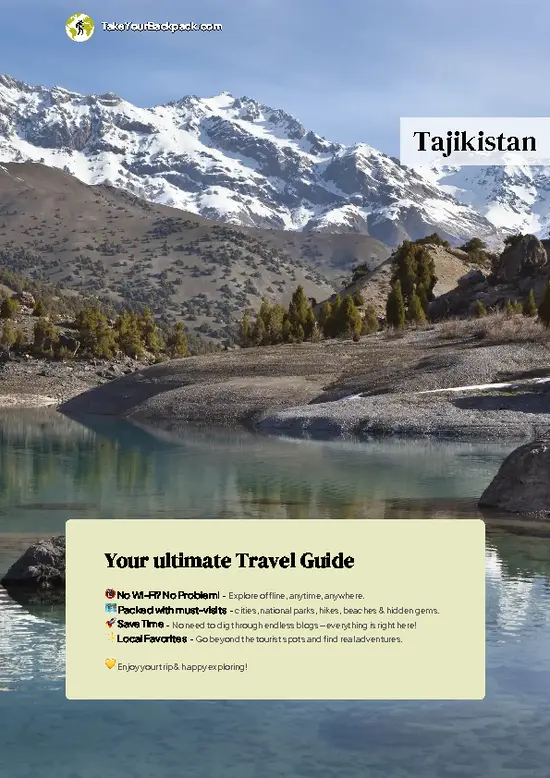
✈️ The backpacker research shortcutTajikistan Travel Guide

An offline-friendly backpacking guide with optimized travel routes, ranked highlights, transport advice, and the best areas to stay.
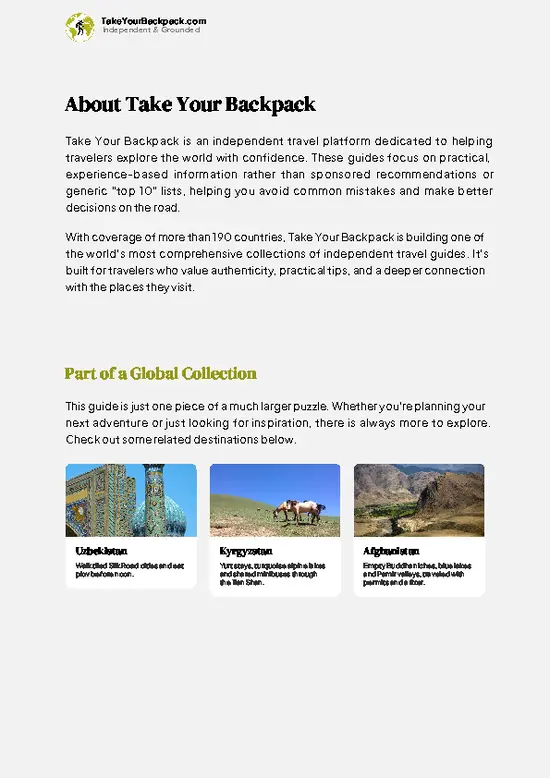
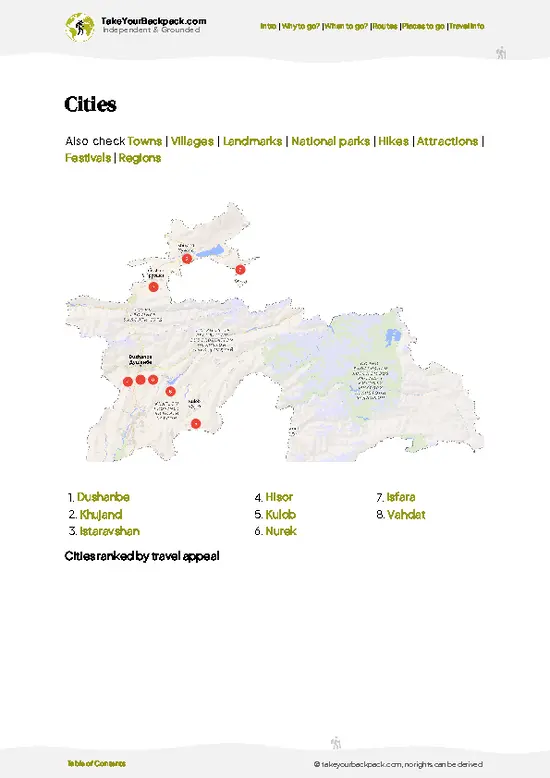
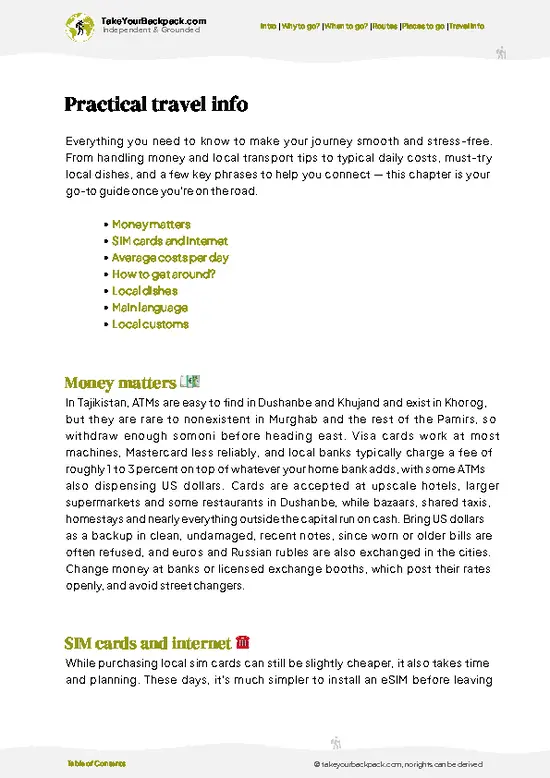
example page 0 from our offline Travel Guide for Tajikistan
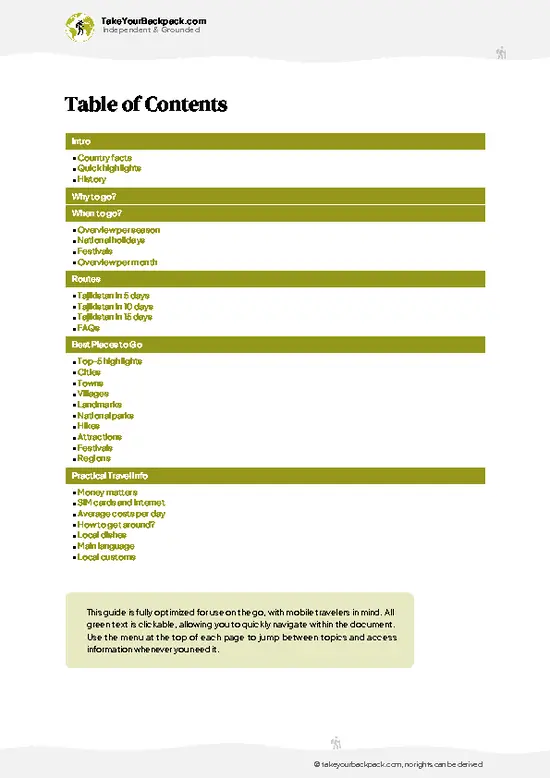
example page 1 from our offline Travel Guide for Tajikistan
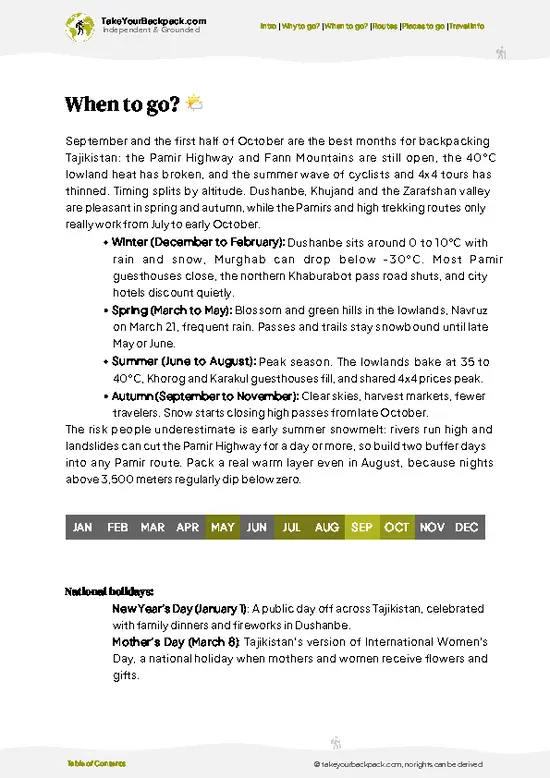
example page 2 from our offline Travel Guide for Tajikistan
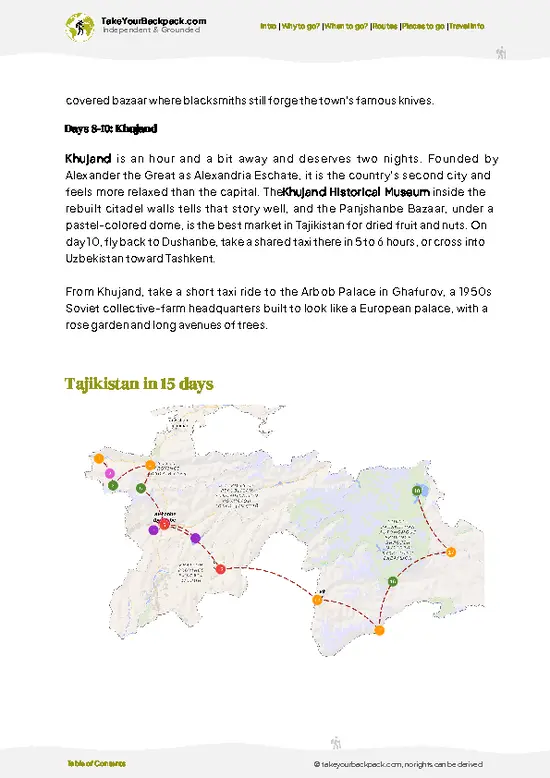
example page 3 from our offline Travel Guide for Tajikistan
example page 4 from our offline Travel Guide for Tajikistan
example page 5 from our offline Travel Guide for Tajikistan
example page 6 from our offline Travel Guide for Tajikistan
example page 7 from our offline Travel Guide for Tajikistan
The digital guide (268 pages) contains:
✅ 64 highlights, ranked by travel appeal
✅ Optimized 5, 10 & 15-day travel routes
✅ Cities, national parks, landmarks, beaches
✅ How to get around
✅ Offline-friendly for travel without Wi-Fi
👉 Click to see all 30+ guide features

📅 Plan smarter in minutes, not weeks
✅ Month by month travel advice
✅ Festivals & national holidays
✅ Budget expectations

🗺️ Go to the right places, skip the overrated ones
✅ Honest pros & cons of destinations
✅ Top hikes, parks & viewpoints
✅ Lesser-known places most travelers miss
✅ Clear “worth it vs skip it” guidance

🛏️ Travel smoothly without rookie mistakes
✅ Best areas to stay
✅ Transport systems explained simply
✅ Common scams & safety advice
✅ SIM cards, money & practical tips

🌍 Understand the country, not just visit it
✅ Culture & traditions
✅ 52 Essential phrases & customs
✅ Festivals worth planning around
✅ Traveler-friendly historical context
✅ Insights that make places more meaningful

📱 Built for real travel conditions
✅ Fully downloadable PDF
✅ Works completely offline
✅ Optimized for phone use
✅ Useful in remote areas & buses
✅ Everything in one place
Stop searching, start planning
Get instant access to your full guide. 30‑day money-back guarantee.
+ Add another guide for just

By proceeding you agree to our terms.
Sent to your inbox immediately after payment • 100% Secure Checkout
Best Backpacking Travel Advisor 2025 tourism awardBest Backpacking
Travel Advisor
2025
What others say about Take Your Backpack Guides:
⭐⭐⭐⭐⭐
Fantastic, amazing amount of information!
⭐⭐⭐⭐⭐
My goodness this is amazing, it's what I've been looking for hats off too you!
⭐⭐⭐⭐⭐
I think this is absolutely BRILLIANT
⭐⭐⭐⭐
Very complete and informative. It's still missing places, but I gotta to commend you
⭐⭐⭐⭐⭐
This is truly amazing, thank you, can't wait to explore it with my kids!
⭐⭐⭐⭐⭐
Awesome resource, thank you!
⭐⭐⭐⭐⭐
This is amazing! Can't wait to explore the ones I haven't seen
⭐⭐⭐⭐
I love this! Well done, great idea.
⭐⭐⭐⭐⭐
Thanks for taking the time to make this gem!
⭐⭐⭐⭐⭐
This might be the best website I've ever seen.
⭐⭐⭐⭐⭐
Congratulations, and thank you so much for your work; it's incredibly valuable.
⭐⭐⭐⭐
In all seriousness I think you did a great job pointing out the important spots
⭐⭐⭐⭐⭐
10/10 very good
⭐⭐⭐⭐⭐
As someone who's only just starting to visit regularly this is awesome, thank you.
⭐⭐⭐⭐
Thank you very much! I'm going to visit my dad, it's going to be very useful!
⭐⭐⭐⭐⭐
This is really cool! We'll be travelling for the first time and this definitely come in handy.
⭐⭐⭐⭐⭐
You are now our minister of culture, congratulations 👨‍💼
⭐⭐⭐⭐⭐
Just wanted to tell you that this is a pearl! Going to follow your recommendations.
⭐⭐⭐⭐⭐
This is so cool. I'll definitely be using the resource for my travels soon.
⭐⭐⭐⭐⭐
This is very impressive! Good work.
⭐⭐⭐⭐⭐
This is an amazing and informative site. Very well done!

🛏️ Where to stay?Top Places to Consider Staying

Tajikistan has a small but growing hostel scene, with dorm beds from roughly US$7 to 12 and guesthouse rooms from about US$15 to 30, most of them in Dushanbe, Khorog and Khujand. In Dushanbe, the streets around Rudaki Avenue put you within walking distance of the parks, museums and the few bars and cafes that stay open late, while the quieter residential lanes south toward the Shohmansur bazaar area are cheaper and closer to shared taxi stands but a longer walk from evening life. In Khorog, places near the center and the Panj River make it easy to arrange Pamir Highway transport, and nights are calm and safe with almost no nightlife, while homestays in the Pamir and Fann Mountain villages trade … read more 👉
Tajikistan has a small but growing hostel scene, with dorm beds from roughly US$7 to 12 and guesthouse rooms from about US$15 to 30, most of them in Dushanbe, Khorog and Khujand. In Dushanbe, the streets around Rudaki Avenue put you within walking distance of the parks, museums and the few bars and cafes that stay open late, while the quieter residential lanes south toward the Shohmansur bazaar area are cheaper and closer to shared taxi stands but a longer walk from evening life. In Khorog, places near the center and the Panj River make it easy to arrange Pamir Highway transport, and nights are calm and safe with almost no nightlife, while homestays in the Pamir and Fann Mountain villages trade hostel social life for home-cooked meals and very early nights.

If you enjoy meeting fellow travelers, consider choosing hostels with high ratings for atmosphere. On the other hand, if you prefer having your own space, a hotel might be a better option.

TajikistanMore Places Across Tajikistan

👋 Meet the founderWho’s Behind Take Your Backpack?

Johan, backpacker and founder of TakeYourBackpackHi, I’m Johan (Netherlands 🇳🇱), the creator of TakeYourBackpack. Over the past 3 decades, I’ve backpacked through 90+ countries across six continents, gaining extensive experience with independent travel, long-term trips, and overland routes.

This site is built on a combination of firsthand travel experience and carefully curated insights from other backpackers. Many guides are based on places I’ve personally visited, while others bring together tips, observations, and practical advice shared by trusted travelers I’ve met along the way.

The goal is to provide realistic, experience-driven guidance — not generic itineraries — so you can explore destinations with better context, clearer expectations, and more confidence.