×

Tajikistan🇹🇯 | best citiesEssential 8 cities to Explore in Tajikistan

Tajikistan’s cities are small, spread out and wildly different from one another, and that is exactly what makes them fun to chase. The capital, Dushanbe, is leafy, orderly and the easiest base for independent travel. The northern Sughd region carries Silk Road bazaars and Soviet-era grids, with more traffic and slightly lower prices. Down south and east, the Pamir towns trade comfort for altitude, thin air and homestays with a view of Afghanistan. Expect low crowds everywhere, cheap food and beds, and long shared-taxi rides between hubs. Pick your region first, then pack for the road.

By Johan Kruseman 🇳🇱 | Updated October 19, 2026
Explore the best towns in Tajikistan

Why go?Why Travelers Love These Spots

Tajikistan is a mountain country first and an urban one a distant second, and that shapes every city you will visit. More than 90 percent of the land is mountainous, so settlements cling to valleys and a handful of flat basins, with the two big lowland clusters around the Fergana Valley in the north and the Vakhsh and Hissar valleys in the south and west. Roads follow rivers and passes, which means distances on the map lie to you.

History adds the second layer. Persian-speaking Sogdian and Samanid roots sit under Soviet planning, so you get ancient bazaars and citadel mounds beside wide boulevards, concrete apartment blocks and Lenin-era mosaics. Tajik, not Turkic, is the language of daily life, and that sets the country apart from its neighbors.

Before choosing Tajikistan for its cities, … read more 👉
Tajikistan is a mountain country first and an urban one a distant second, and that shapes every city you will visit. More than 90 percent of the land is mountainous, so settlements cling to valleys and a handful of flat basins, with the two big lowland clusters around the Fergana Valley in the north and the Vakhsh and Hissar valleys in the south and west. Roads follow rivers and passes, which means distances on the map lie to you.

History adds the second layer. Persian-speaking Sogdian and Samanid roots sit under Soviet planning, so you get ancient bazaars and citadel mounds beside wide boulevards, concrete apartment blocks and Lenin-era mosaics. Tajik, not Turkic, is the language of daily life, and that sets the country apart from its neighbors.

Before choosing Tajikistan for its cities, know the limits. Monuments are modest and sparse, not the tiled spectacle of Uzbekistan. The appeal is atmosphere, tea houses, markets and the mountains standing right behind the last street. Infrastructure is improving but uneven. Cash is king outside the capital, ATMs fail, winter power cuts happen, and English is rare. Most visitors need an e-visa, and the Pamir region needs an extra GBAO permit on the e-visa. Go with curiosity and flexibility, and the country pays you back in warmth and quiet streets.
Why These Made the Cut
The list of best cities in Tajikistan is created based on culture, vibe, attractions, transport ease, and local charm. If you feel a city is missing in this list, please let us know.

When to go?Seasonal Guide to Visiting

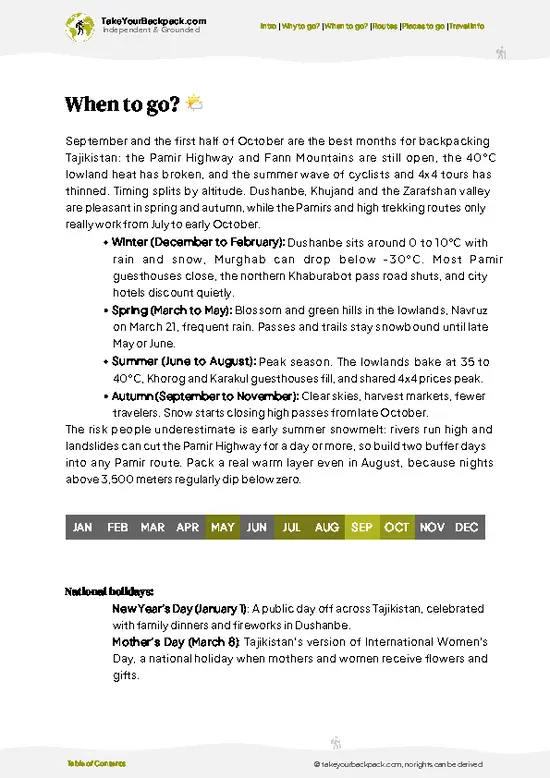
Best months: Late April to June and September to mid-October are the best months for Tajikistan’s cities, with daytime highs of 18 to 30°C in the lowlands and clear skies for mountain views. Spring brings blossom and green hills, while autumn brings fruit-laden bazaars and a harvest buzz. Rain falls mostly March to May, so pack a light shell.

Summer heat: July and August hit hard in the south and west and in the Fergana Valley, with 35 to 42°C common. Walking the streets midday turns into a sweaty sprint between shade and cold drinks. Start early, rest at noon and come out at dusk. The high Pamir towns stay far cooler, around 20 to 28°C by day, and nights drop below 10°C, so summer suits the east best.

Winter: November to March is cold and gray, with lowland temperatures from about -5 to … read more 👉
Best months: Late April to June and September to mid-October are the best months for Tajikistan’s cities, with daytime highs of 18 to 30°C in the lowlands and clear skies for mountain views. Spring brings blossom and green hills, while autumn brings fruit-laden bazaars and a harvest buzz. Rain falls mostly March to May, so pack a light shell.

Summer heat: July and August hit hard in the south and west and in the Fergana Valley, with 35 to 42°C common. Walking the streets midday turns into a sweaty sprint between shade and cold drinks. Start early, rest at noon and come out at dusk. The high Pamir towns stay far cooler, around 20 to 28°C by day, and nights drop below 10°C, so summer suits the east best.

Winter: November to March is cold and gray, with lowland temperatures from about -5 to 8°C and snow possible. Pamir towns can sit at -15°C or lower, and high passes close, which cuts road access. Some guesthouses shut. Rooms are at their cheapest, but heating and electricity can be patchy.

Crowds and prices: Peak season runs July to August, mostly in the Pamirs, where homestay beds may fill. Elsewhere crowds stay thin all year, and prices barely move outside the winter lull.

city hoppingHow to Combine cities Into One Trip

Trip length: A trip linking several Tajik cities needs 10 to 16 days, because the roads are slow and the mountains set the schedule. Cover ground in loops, not zigzags.

Clusters and direction: Three clusters work well. The capital and western valleys form one base, northern Sughd another, and the Pamir in the southeast the third. A sensible direction is to start in Dushanbe, loop north through the Fann Mountains and Sughd (shared taxis and minibuses take about 5 to 8 hours through the Anzob Tunnel), then return and head east. Doing the Pamir Highway last gives you time to acclimatize and keeps flexible days at the end for weather delays. Flying into Dushanbe and out of Khujand, or the reverse, can save a full day of backtracking.

Time per stop: Give lowland city stops 1 to 2 nights. Pamir … read more 👉
Trip length: A trip linking several Tajik cities needs 10 to 16 days, because the roads are slow and the mountains set the schedule. Cover ground in loops, not zigzags.

Clusters and direction: Three clusters work well. The capital and western valleys form one base, northern Sughd another, and the Pamir in the southeast the third. A sensible direction is to start in Dushanbe, loop north through the Fann Mountains and Sughd (shared taxis and minibuses take about 5 to 8 hours through the Anzob Tunnel), then return and head east. Doing the Pamir Highway last gives you time to acclimatize and keeps flexible days at the end for weather delays. Flying into Dushanbe and out of Khujand, or the reverse, can save a full day of backtracking.

Time per stop: Give lowland city stops 1 to 2 nights. Pamir towns deserve 2 to 3 nights each, since the altitude (often 2,000 to 3,500 meters) slows you down. Dushanbe to Khorog takes 12 to 16 hours by shared 4x4 along the Pamir route, or longer via the Bartang road. Allow a buffer day before any onward flight.

Mistakes to avoid: Travelers often cram in too many stops, trust map distances, and forget the GBAO permit. Plan fewer bases, carry cash in somoni, and leave slack for landslides and late departures. Shared taxis leave when full, so go early in the morning.

The ListMust-Visit cities in Tajikistan

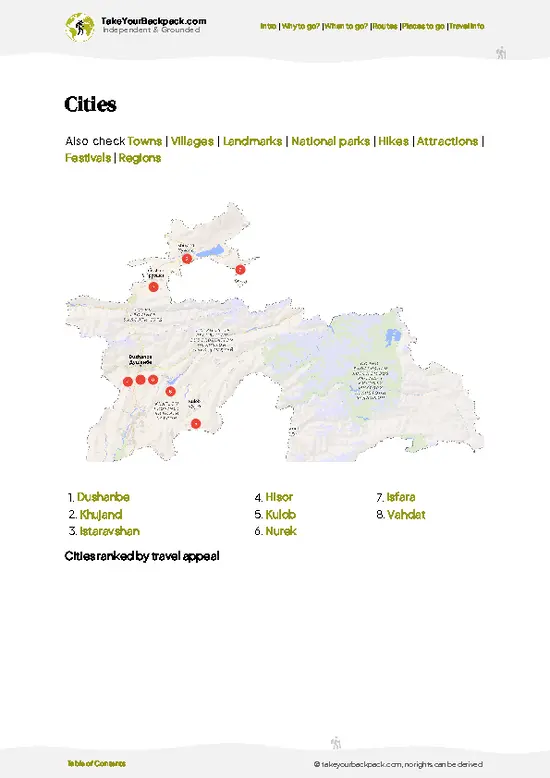
1 Dushanbe

Wide boulevards, museums, leafy parks

Walk beneath plane trees, explore Soviet-era monuments, and visit museums that reveal the country’s complex past and evolving present.

2 Khujand

Riverfront, fortress, lively bazaar

Cross the Syr Darya to reach a city where daily commerce and fortress walls reflect both ancient roots and modern energy.

3 Istaravshan

Craft workshops, blue-domed mosques, Silk Road relics

Watch artisans at work, admire tilework in centuries-old mosques, and trace ancient trade routes through the city’s winding alleys.

4 Hisor

Fortress complex, caravanserai, archaeological layers

Step inside a reconstructed fortress and explore layers of history that reveal the city’s strategic importance over centuries.

5 Kulob

Sufi heritage, mausoleums, southern bazaars

Trace the influence of centuries-old Sufi traditions while navigating lively markets and visiting tombs that draw pilgrims from across the region.

6 Nurek

reservoir views, hydroelectric dam, lakeside settlement

Watch daily life unfold beside one of the world’s tallest dams, where water shapes the landscape and local routines.

7 Isfara

Walnut groves, red-brick houses, borderland culture

Travel through fertile valleys and observe how proximity to Kyrgyzstan and Uzbekistan shapes the food, language, and daily routines.

8 Vahdat

Suburban sprawl, commuter town, roadside stalls

Pass through a city shaped by its proximity to Dushanbe, where roadside commerce and new construction mark rapid change.

Loading the map 🌍

Expert viewExpert Commentary on cities

How Many Cities Are Worth Your Time: Three to four cities is the number I advise for a typical two to three week trip. Tajik distances are measured in switchbacks, not kilometers, and a 300 km hop can swallow a full day in a shared Land Cruiser with the windows rattling over mountain passes. Pack in more stops and you spend the trip staring at the back of a headrest. Pick fewer and you get the tea-house conversations, the bazaar haggling and the evening stroll when the heat finally lets go.
Choosing Between the Kinds of City: Tajikistan offers three flavors. The capital is leafy, wide-avenued and easy, with cafes, ATMs, hostels and the best chance of a decent espresso. Northern Silk Road towns have old bazaars, fortress walls and Fergana Valley bustle, and they suit travelers who want history … read more 👉
How Many Cities Are Worth Your Time: Three to four cities is the number I advise for a typical two to three week trip. Tajik distances are measured in switchbacks, not kilometers, and a 300 km hop can swallow a full day in a shared Land Cruiser with the windows rattling over mountain passes. Pack in more stops and you spend the trip staring at the back of a headrest. Pick fewer and you get the tea-house conversations, the bazaar haggling and the evening stroll when the heat finally lets go.
Choosing Between the Kinds of City: Tajikistan offers three flavors. The capital is leafy, wide-avenued and easy, with cafes, ATMs, hostels and the best chance of a decent espresso. Northern Silk Road towns have old bazaars, fortress walls and Fergana Valley bustle, and they suit travelers who want history and food. Mountain-edge towns in the Pamirs and Fann Mountains are small, quiet and basically gateways to trekking and homestays. Culture seekers should lean north, trekkers should lean toward the mountain towns, and first-timers should start in the capital, where you can sort a SIM card, register questions and gear in one afternoon.
What It Costs: Budget US$25 to 40 a day on a backpacker setup. Dorm beds run roughly US$8 to 15, and a homestay with dinner and breakfast in a smaller town usually costs US$15 to 25 per person. A plate of plov or a bowl of laghman in a canteen is around US$2 to 4, and you leave full. Museum and fortress entries are small, typically US$1 to 5. Shared taxis between towns cost US$5 to 25 depending on distance, with the long mountain runs at the top end. Guides for city walks are optional and run US$20 to 40 for a half day. Cash in somoni is king outside the capital, so pull enough before you leave, because many small-town ATMs run dry.
Safety and Local Etiquette: City streets feel calm and people greet strangers warmly. Petty theft is uncommon, and the more real risks are unlit sidewalks, aggressive driving and the occasional taxi that charges triple. Agree on the fare before you sit down. Police checks of documents do happen, so carry your passport and a photocopy, and a photo of your visa or e-visa too. Photographing government buildings, bridges, military sites and the presidential palace area can bring a stern conversation with an officer, so keep the camera down near them.
Dress and Manners: Tajik hospitality comes with rules. Shoulders and knees covered goes a long way, especially in smaller conservative towns. Remove shoes at the door of any home or guesthouse. Accept the offered tea, take bread with your right hand and expect a toast or two. Alcohol is available in the capital but far scarcer elsewhere. Do all that and you will often find yourself invited to someone’s table, which is the best meal of the trip.

✈️ The backpacker research shortcutTajikistan Travel Guide

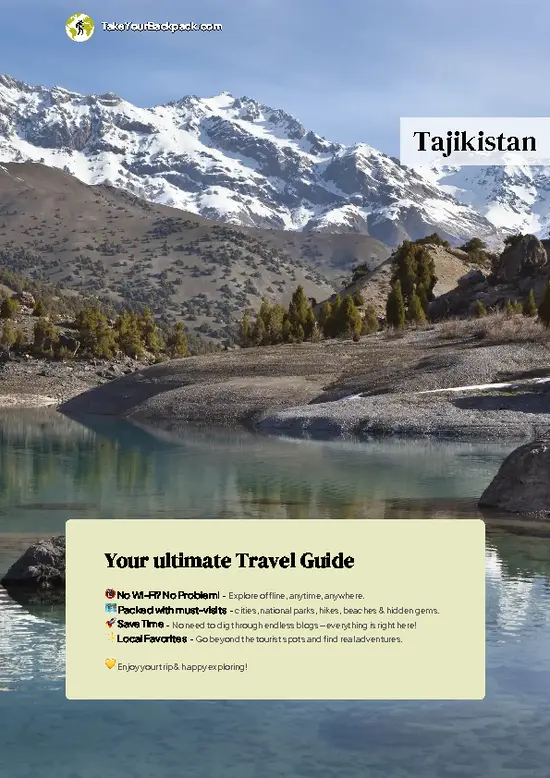
An offline-friendly backpacking guide with optimized travel routes, ranked highlights, transport advice, and the best areas to stay.
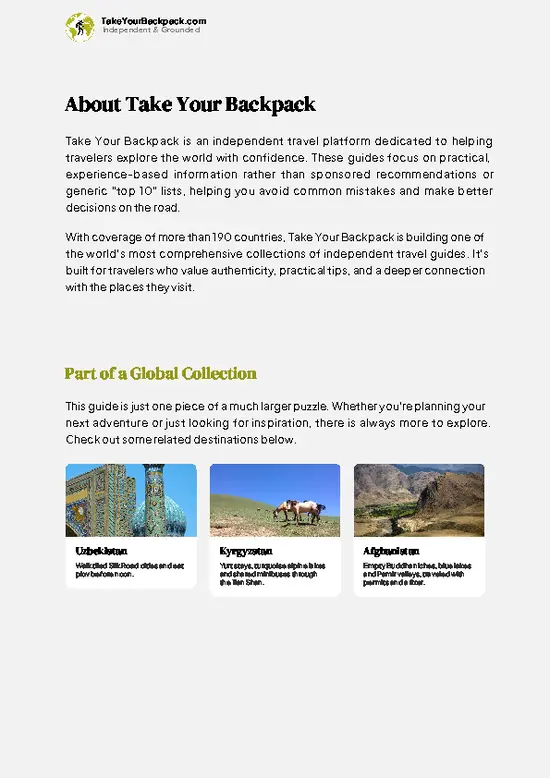
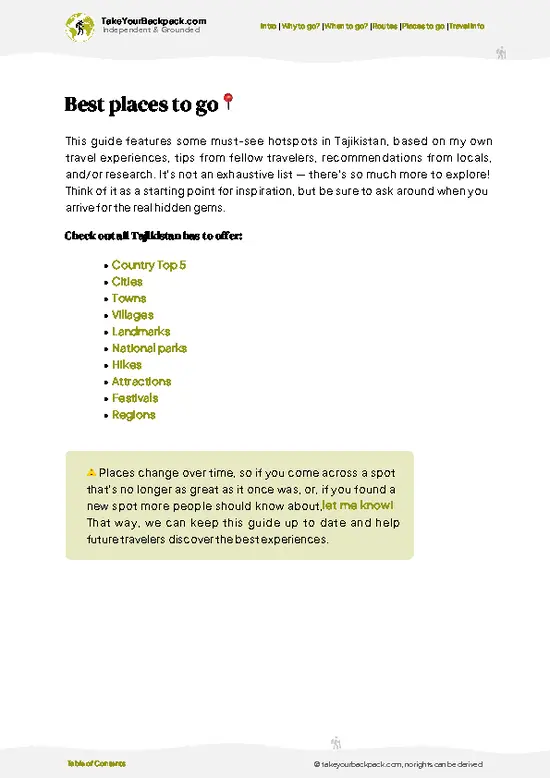
example page 0 from our offline Travel Guide for Tajikistan
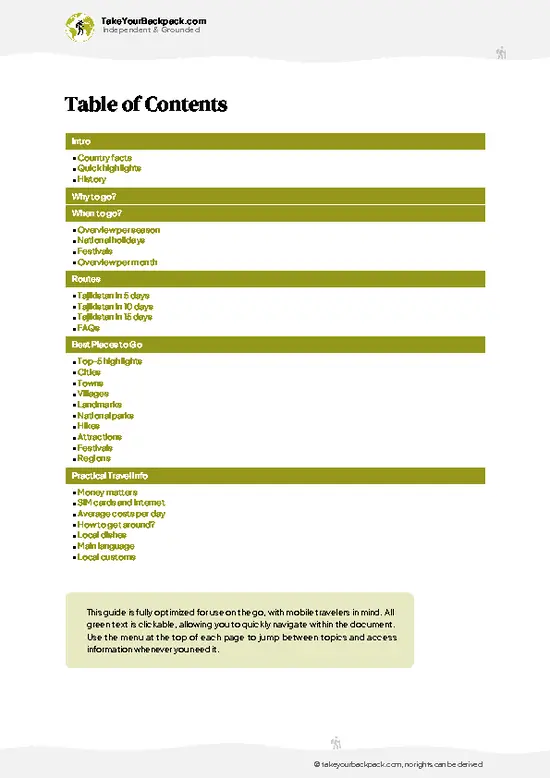
example page 1 from our offline Travel Guide for Tajikistan
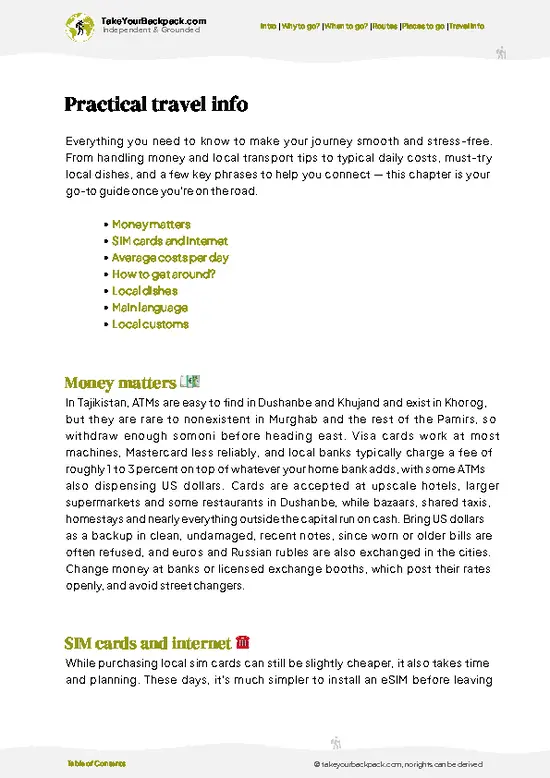
example page 2 from our offline Travel Guide for Tajikistan
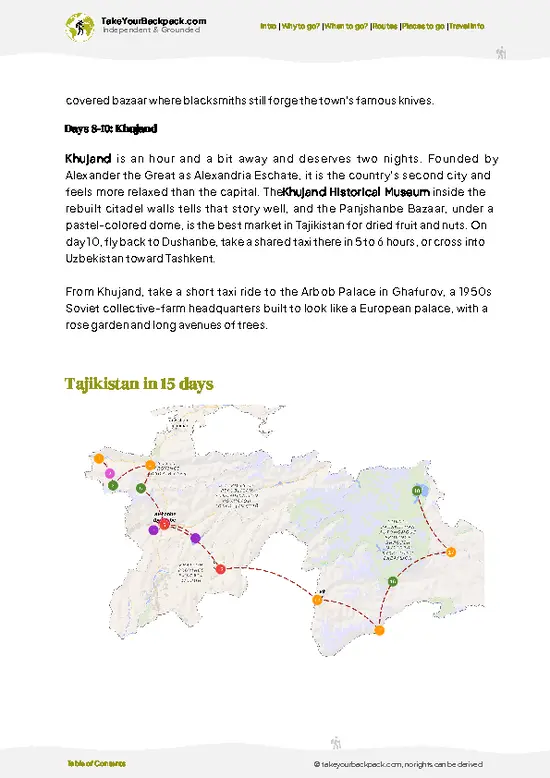
example page 3 from our offline Travel Guide for Tajikistan
example page 4 from our offline Travel Guide for Tajikistan
example page 5 from our offline Travel Guide for Tajikistan
example page 6 from our offline Travel Guide for Tajikistan
example page 7 from our offline Travel Guide for Tajikistan
The digital guide (268 pages) contains:
✅ 64 highlights, ranked by travel appeal
✅ Optimized 5, 10 & 15-day travel routes
✅ Cities, national parks, landmarks, beaches
✅ How to get around
✅ Offline-friendly for travel without Wi-Fi
👉 Click to see all 30+ guide features

📅 Plan smarter in minutes, not weeks
✅ Month by month travel advice
✅ Festivals & national holidays
✅ Budget expectations

🗺️ Go to the right places, skip the overrated ones
✅ Honest pros & cons of destinations
✅ Top hikes, parks & viewpoints
✅ Lesser-known places most travelers miss
✅ Clear “worth it vs skip it” guidance

🛏️ Travel smoothly without rookie mistakes
✅ Best areas to stay
✅ Transport systems explained simply
✅ Common scams & safety advice
✅ SIM cards, money & practical tips

🌍 Understand the country, not just visit it
✅ Culture & traditions
✅ 52 Essential phrases & customs
✅ Festivals worth planning around
✅ Traveler-friendly historical context
✅ Insights that make places more meaningful

📱 Built for real travel conditions
✅ Fully downloadable PDF
✅ Works completely offline
✅ Optimized for phone use
✅ Useful in remote areas & buses
✅ Everything in one place
Stop searching, start planning
Get instant access to your full guide. 30‑day money-back guarantee.
+ Add another guide for just

By proceeding you agree to our terms.
Sent to your inbox immediately after payment • 100% Secure Checkout
Best Backpacking Travel Advisor 2025 tourism awardBest Backpacking
Travel Advisor
2025
What others say about Take Your Backpack Guides:
⭐⭐⭐⭐⭐
Fantastic, amazing amount of information!
⭐⭐⭐⭐⭐
My goodness this is amazing, it's what I've been looking for hats off too you!
⭐⭐⭐⭐⭐
I think this is absolutely BRILLIANT
⭐⭐⭐⭐
Very complete and informative. It's still missing places, but I gotta to commend you
⭐⭐⭐⭐⭐
This is truly amazing, thank you, can't wait to explore it with my kids!
⭐⭐⭐⭐⭐
Awesome resource, thank you!
⭐⭐⭐⭐⭐
This is amazing! Can't wait to explore the ones I haven't seen
⭐⭐⭐⭐
I love this! Well done, great idea.
⭐⭐⭐⭐⭐
Thanks for taking the time to make this gem!
⭐⭐⭐⭐⭐
This might be the best website I've ever seen.
⭐⭐⭐⭐⭐
Congratulations, and thank you so much for your work; it's incredibly valuable.
⭐⭐⭐⭐
In all seriousness I think you did a great job pointing out the important spots
⭐⭐⭐⭐⭐
10/10 very good
⭐⭐⭐⭐⭐
As someone who's only just starting to visit regularly this is awesome, thank you.
⭐⭐⭐⭐
Thank you very much! I'm going to visit my dad, it's going to be very useful!
⭐⭐⭐⭐⭐
This is really cool! We'll be travelling for the first time and this definitely come in handy.
⭐⭐⭐⭐⭐
You are now our minister of culture, congratulations 👨‍💼
⭐⭐⭐⭐⭐
Just wanted to tell you that this is a pearl! Going to follow your recommendations.
⭐⭐⭐⭐⭐
This is so cool. I'll definitely be using the resource for my travels soon.
⭐⭐⭐⭐⭐
This is very impressive! Good work.
⭐⭐⭐⭐⭐
This is an amazing and informative site. Very well done!

🛏️ Where to stay?Top Places to Consider Staying

Tajikistan has a small but growing hostel scene, with dorm beds from roughly US$7 to 12 and guesthouse rooms from about US$15 to 30, most of them in Dushanbe, Khorog and Khujand. In Dushanbe, the streets around Rudaki Avenue put you within walking distance of the parks, museums and the few bars and cafes that stay open late, while the quieter residential lanes south toward the Shohmansur bazaar area are cheaper and closer to shared taxi stands but a longer walk from evening life. In Khorog, places near the center and the Panj River make it easy to arrange Pamir Highway transport, and nights are calm and safe with almost no nightlife, while homestays in the Pamir and Fann Mountain villages trade … read more 👉
Tajikistan has a small but growing hostel scene, with dorm beds from roughly US$7 to 12 and guesthouse rooms from about US$15 to 30, most of them in Dushanbe, Khorog and Khujand. In Dushanbe, the streets around Rudaki Avenue put you within walking distance of the parks, museums and the few bars and cafes that stay open late, while the quieter residential lanes south toward the Shohmansur bazaar area are cheaper and closer to shared taxi stands but a longer walk from evening life. In Khorog, places near the center and the Panj River make it easy to arrange Pamir Highway transport, and nights are calm and safe with almost no nightlife, while homestays in the Pamir and Fann Mountain villages trade hostel social life for home-cooked meals and very early nights.

If you enjoy meeting fellow travelers, consider choosing hostels with high ratings for atmosphere. On the other hand, if you prefer having your own space, a hotel might be a better option.

TajikistanMore Places Across Tajikistan

👋 Meet the founderWho’s Behind Take Your Backpack?

Johan, backpacker and founder of TakeYourBackpackHi, I’m Johan (Netherlands 🇳🇱), the creator of TakeYourBackpack. Over the past 3 decades, I’ve backpacked through 90+ countries across six continents, gaining extensive experience with independent travel, long-term trips, and overland routes.

This site is built on a combination of firsthand travel experience and carefully curated insights from other backpackers. Many guides are based on places I’ve personally visited, while others bring together tips, observations, and practical advice shared by trusted travelers I’ve met along the way.

The goal is to provide realistic, experience-driven guidance — not generic itineraries — so you can explore destinations with better context, clearer expectations, and more confidence.