×

Tajikistan🇹🇯 | best regionsEssential 4 regions to Explore in Tajikistan

Tajikistan is 93 percent mountains, and that single fact sorts its regions better than any border line. The Pamir in the east means thin air, long dirt roads and homestays where one night costs less than a hotel breakfast elsewhere. The Fann Mountains and the northwest pack alpine lakes and trekking within a day of the capital. The Khatlon and Sughd lowlands trade altitude for bazaars, Silk Road towns and heat. Backpacking here means choosing between access and isolation, because crowds thin as the road gets worse. Pick your altitude, pack your sense of adventure, and go.

By Johan Kruseman 🇳🇱 | Updated October 19, 2026
Explore the best cities in Tajikistan

Why go?Why Travelers Love These Spots

Tajikistan squeezes the Pamir, Tien Shan and Hissar-Alay ranges into a country smaller than Wisconsin, and that density shapes everything. Over half the land sits above 3,000 meters, and the Pamir Highway corridor climbs past 4,600 meters at Ak-Baital Pass. Valleys run deep and isolated, so languages, food and customs shift within a day's drive. Pamiri communities speak languages distinct from Tajik and follow Ismaili Islam, while the lowlands lean Sunni and Persian-speaking.

Soviet engineers left a patchy road network, and the infrastructure still reflects it. Main routes are paved or graded, yet mountain passes close under snow, landslides cut roads in spring, and distances in kilometers say little about hours. Public transport means shared taxis and minibuses that leave when full. Regions … read more 👉
Tajikistan squeezes the Pamir, Tien Shan and Hissar-Alay ranges into a country smaller than Wisconsin, and that density shapes everything. Over half the land sits above 3,000 meters, and the Pamir Highway corridor climbs past 4,600 meters at Ak-Baital Pass. Valleys run deep and isolated, so languages, food and customs shift within a day's drive. Pamiri communities speak languages distinct from Tajik and follow Ismaili Islam, while the lowlands lean Sunni and Persian-speaking.

Soviet engineers left a patchy road network, and the infrastructure still reflects it. Main routes are paved or graded, yet mountain passes close under snow, landslides cut roads in spring, and distances in kilometers say little about hours. Public transport means shared taxis and minibuses that leave when full. Regions here are far apart, so expect long days in the vehicle.

Before committing, know the practicalities. Most visitors need an e-visa, and the Gorno-Badakhshan region has required a separate permit, now bundled into the e-visa system. Cash matters, since ATMs vanish outside bigger towns. Altitude demands a slow climb. Tourism is young, so homestays and family hospitality replace polished services, which suits travelers who like unscripted days. Come ready for dust, tea, and surprise.
Behind the Scenes of Selection
The list of best regions in Tajikistan is created based on landscapes, local culture, attractions, vibes, and overall appeal. If you feel a region is missing in this list, please let us know.

When to go?Seasonal Guide to Visiting

Best months: June to September: Summer, June through September, gives high passes their open roads and trekking routes their snow-free trails, which is why it dominates travel planning. In the high Pamir, daytime temperatures run 15 to 25°C in July and August, yet nights near Murghab and Karakul drop to around 0°C or below even in midsummer. Rain is scarce there, with annual precipitation often under 100 mm.

Shoulder seasons: April to May and October: Spring and early autumn work well in the lowlands of Khatlon and Sughd, where April and May bring 18 to 28°C and green hills, and October brings harvest markets and clear days. In the Fann Mountains, trails above 3,000 meters stay snowed in until about mid-June, and September offers crisp air and fewer people. The Pamir turns cold from October, … read more 👉
Best months: June to September: Summer, June through September, gives high passes their open roads and trekking routes their snow-free trails, which is why it dominates travel planning. In the high Pamir, daytime temperatures run 15 to 25°C in July and August, yet nights near Murghab and Karakul drop to around 0°C or below even in midsummer. Rain is scarce there, with annual precipitation often under 100 mm.

Shoulder seasons: April to May and October: Spring and early autumn work well in the lowlands of Khatlon and Sughd, where April and May bring 18 to 28°C and green hills, and October brings harvest markets and clear days. In the Fann Mountains, trails above 3,000 meters stay snowed in until about mid-June, and September offers crisp air and fewer people. The Pamir turns cold from October, with passes risking early snow.

Winter and heat extremes: From November to March, high roads can shut and homestays close in remote valleys; Murghab can fall below minus 25°C. The southern lowlands, including Dushanbe and Kulob, hit 38 to 42°C in July and August, so heat shapes city days more than mountain days.

Crowds and prices: July and August are the busiest weeks, though the crowds remain small by global standards. Homestay rates and shared-jeep costs rise slightly in peak season, and shoulder months offer more room to bargain.

region hoppingHow to Combine regions Into One Trip

How long a multi-region trip takes: A trip linking several regions of Tajikistan needs 14 to 21 days, and the Pamir alone demands 7 to 10 of those. Dushanbe works as the hub, with a major airport, shared-taxi stations and the best selection of currency exchanges and gear shops.

Grouping and direction: Regions near the capital pair naturally, because the roads between them are paved and a day of travel covers the distance. The Pamir Highway deserves its own long block. Many travelers pick one direction, usually Dushanbe to Khorog through the southern road, then north along the highway toward Murghab and Osh in Kyrgyzstan, finishing with a flight or return leg. Starting in the lowlands lets the body adjust to altitude gradually, which beats flying straight to high elevation.

Time per stop … read more 👉
How long a multi-region trip takes: A trip linking several regions of Tajikistan needs 14 to 21 days, and the Pamir alone demands 7 to 10 of those. Dushanbe works as the hub, with a major airport, shared-taxi stations and the best selection of currency exchanges and gear shops.

Grouping and direction: Regions near the capital pair naturally, because the roads between them are paved and a day of travel covers the distance. The Pamir Highway deserves its own long block. Many travelers pick one direction, usually Dushanbe to Khorog through the southern road, then north along the highway toward Murghab and Osh in Kyrgyzstan, finishing with a flight or return leg. Starting in the lowlands lets the body adjust to altitude gradually, which beats flying straight to high elevation.

Time per stop and transit: Plan 2 to 4 days for each mountain base, and 1 to 2 days for lowland towns. Dushanbe to Khorog takes 12 to 16 hours by shared jeep, and Khorog to Murghab another 8 to 10. Dushanbe to Khujand runs 5 to 7 hours through the Anzob Tunnel.

Planning mistakes: The classic error is squeezing too many regions into too few days. Mountain roads slow everything, so build in one buffer day per week for landslides, weather or illness. Another is skipping acclimatization, which brings headaches above 3,500 meters. Trying to rely on a rigid schedule fails here, so book only the first night and keep the rest loose. Carry cash before leaving each hub.

The ListMust-Visit regions in Tajikistan

1 Gorno-Badakhshan

Pamir Highway, high-altitude villages, Wakhan Valley, remote passes

Travel along rugged mountain roads, meet isolated communities, and experience stark landscapes shaped by altitude, weather, and ancient trade routes.

2 Zeravshan Valley

Alpine meadows, Soviet relics, Yagnob villages, fruit orchards

Hike through green valleys dotted with traditional settlements, discover remnants of the Soviet era, and encounter unique languages and customs.

3 Bartang Valley

narrow gorges, stone villages, rugged jeep tracks

Navigate twisting roads and footpaths through a valley where isolation, geology, and human adaptation shape every journey.

4 Rasht

Mountain valley, remote villages, river crossings

Venture into a region defined by rugged terrain, where isolated communities maintain distinct traditions and mountain roads test your resolve.

Loading the map 🌍

Expert viewExpert Commentary on regions

How many regions to visit: Three regions is the number I advise for a trip of two to three weeks. Tajikistan's roads are slow, and each region needs several days to repay the effort of reaching it. Pushing to four or five means most of your time becomes a shared-jeep window view. Three lets you hike properly, linger over a long homestay dinner of plov or qurutob, and still absorb the shift in language and landscape that makes the country special.

Prioritizing by travel style: Trekkers should put the alpine ranges first, where multi-day trails end at turquoise lakes and a cold swim at dusk. Culture seekers do better in the lowland north and south, with bazaars full of bread stacked like wheels, old citadels and tea-house conversations. Road-trip lovers belong on the high plateau, where a jeep … read more 👉
How many regions to visit: Three regions is the number I advise for a trip of two to three weeks. Tajikistan's roads are slow, and each region needs several days to repay the effort of reaching it. Pushing to four or five means most of your time becomes a shared-jeep window view. Three lets you hike properly, linger over a long homestay dinner of plov or qurutob, and still absorb the shift in language and landscape that makes the country special.

Prioritizing by travel style: Trekkers should put the alpine ranges first, where multi-day trails end at turquoise lakes and a cold swim at dusk. Culture seekers do better in the lowland north and south, with bazaars full of bread stacked like wheels, old citadels and tea-house conversations. Road-trip lovers belong on the high plateau, where a jeep rattles across a landscape of bare ridges and the payoff is a night sky with the Milky Way overhead. First-timers can mix one mountain region with one lowland region and avoid the harshest conditions.

Budget: Budget travelers can manage US$25 to 40 a day, covering a homestay with dinner and breakfast (about US$15 to 25), shared transport and snacks. Mid-range travel with a private driver costs US$60 to 100 a day, and a car with driver for the high mountain highway often runs US$100 to 150 a day split among passengers. Guides for trekking cost roughly US$40 to 70 a day, and national park or lake entry fees are small, typically a few dollars. Budget US$300 to 600 per region for a visit of four to five days, including transport.

Safety and culture: Altitude is the main hazard. Ascend gradually, drink water constantly and descend if headaches worsen. Roads can close without notice, so carry spare food and warm layers. Border zones with Afghanistan and some stretches near Kyrgyzstan have restrictions, so carry your passport and permits and expect police checkpoints, where a polite greeting helps. Cash is king and ATMs are rare away from main towns.

On culture, dress modestly, especially women and in rural areas, with covered shoulders and knees. Accept tea and bread when offered, since refusing can offend. Remove shoes indoors, ask before photographing people, and avoid political talk about the government. A small gift such as sweets or fruit brings warm smiles at a homestay, and the welcome you get in return is the best souvenir of the trip.

✈️ The backpacker research shortcutTajikistan Travel Guide

An offline-friendly backpacking guide with optimized travel routes, ranked highlights, transport advice, and the best areas to stay.
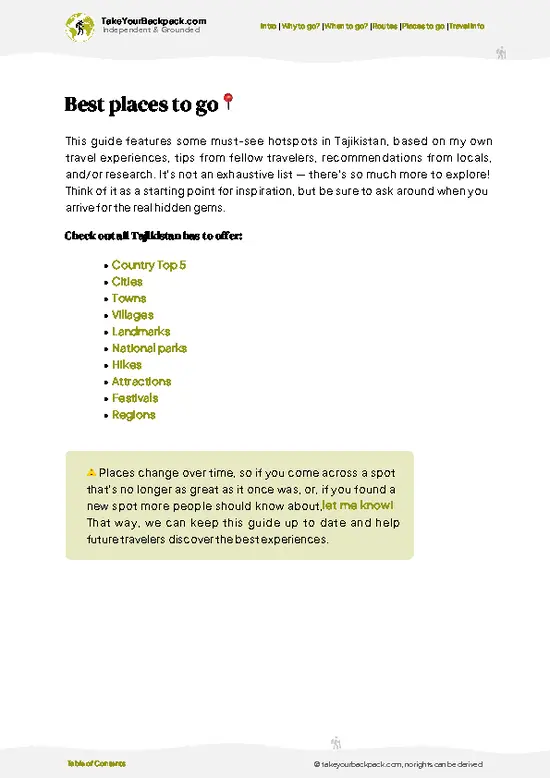
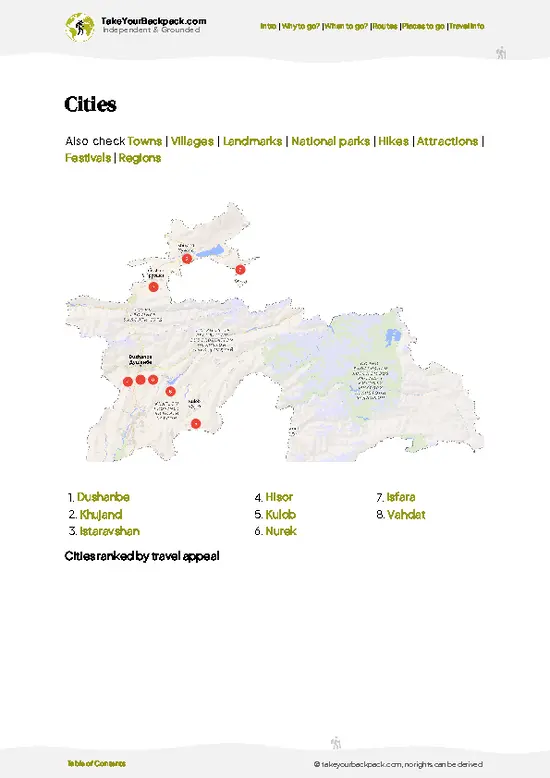
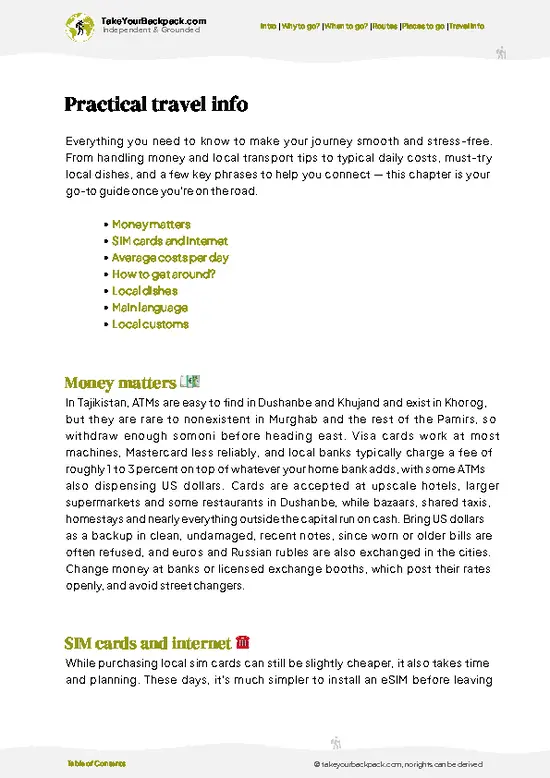
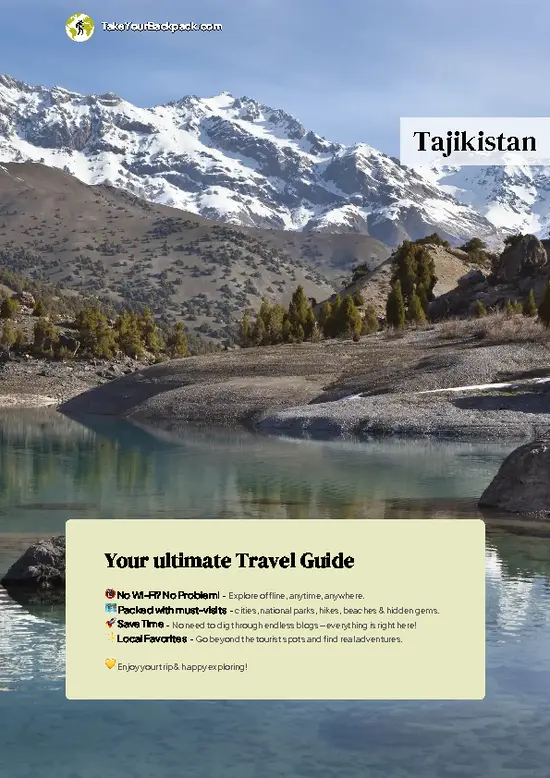
example page 0 from our offline Travel Guide for Tajikistan
example page 1 from our offline Travel Guide for Tajikistan
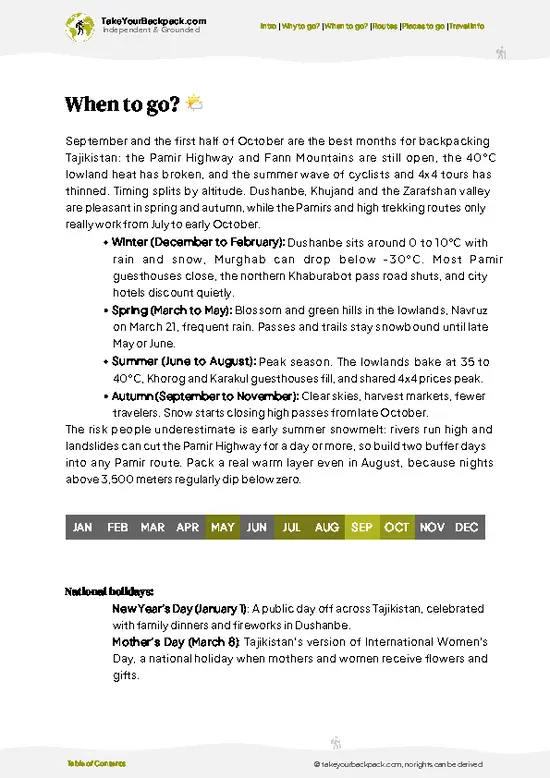
example page 2 from our offline Travel Guide for Tajikistan
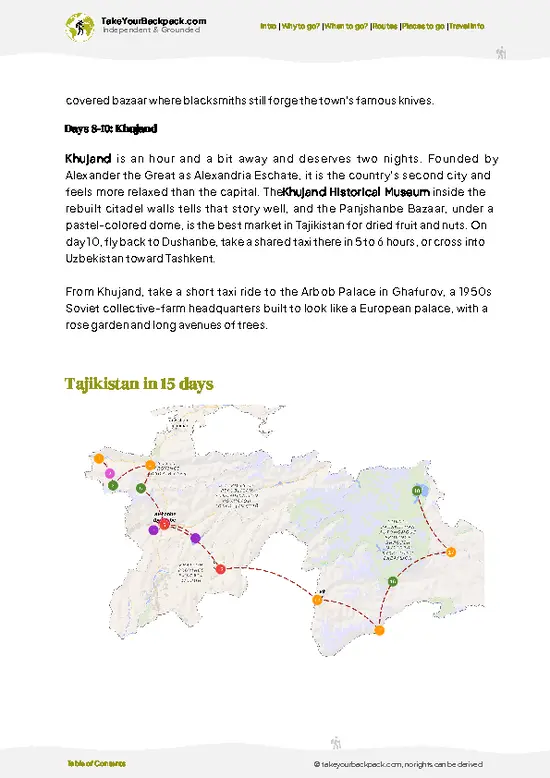
example page 3 from our offline Travel Guide for Tajikistan
example page 4 from our offline Travel Guide for Tajikistan
example page 5 from our offline Travel Guide for Tajikistan
example page 6 from our offline Travel Guide for Tajikistan
example page 7 from our offline Travel Guide for Tajikistan
The digital guide (268 pages) contains:
✅ 64 highlights, ranked by travel appeal
✅ Optimized 5, 10 & 15-day travel routes
✅ Cities, national parks, landmarks, beaches
✅ How to get around
✅ Offline-friendly for travel without Wi-Fi
👉 Click to see all 30+ guide features

📅 Plan smarter in minutes, not weeks
✅ Month by month travel advice
✅ Festivals & national holidays
✅ Budget expectations

🗺️ Go to the right places, skip the overrated ones
✅ Honest pros & cons of destinations
✅ Top hikes, parks & viewpoints
✅ Lesser-known places most travelers miss
✅ Clear “worth it vs skip it” guidance

🛏️ Travel smoothly without rookie mistakes
✅ Best areas to stay
✅ Transport systems explained simply
✅ Common scams & safety advice
✅ SIM cards, money & practical tips

🌍 Understand the country, not just visit it
✅ Culture & traditions
✅ 52 Essential phrases & customs
✅ Festivals worth planning around
✅ Traveler-friendly historical context
✅ Insights that make places more meaningful

📱 Built for real travel conditions
✅ Fully downloadable PDF
✅ Works completely offline
✅ Optimized for phone use
✅ Useful in remote areas & buses
✅ Everything in one place
Stop searching, start planning
Get instant access to your full guide. 30‑day money-back guarantee.
+ Add another guide for just

By proceeding you agree to our terms.
Sent to your inbox immediately after payment • 100% Secure Checkout
Best Backpacking Travel Advisor 2025 tourism awardBest Backpacking
Travel Advisor
2025
What others say about Take Your Backpack Guides:
⭐⭐⭐⭐⭐
Fantastic, amazing amount of information!
⭐⭐⭐⭐⭐
My goodness this is amazing, it's what I've been looking for hats off too you!
⭐⭐⭐⭐⭐
I think this is absolutely BRILLIANT
⭐⭐⭐⭐
Very complete and informative. It's still missing places, but I gotta to commend you
⭐⭐⭐⭐⭐
This is truly amazing, thank you, can't wait to explore it with my kids!
⭐⭐⭐⭐⭐
Awesome resource, thank you!
⭐⭐⭐⭐⭐
This is amazing! Can't wait to explore the ones I haven't seen
⭐⭐⭐⭐
I love this! Well done, great idea.
⭐⭐⭐⭐⭐
Thanks for taking the time to make this gem!
⭐⭐⭐⭐⭐
This might be the best website I've ever seen.
⭐⭐⭐⭐⭐
Congratulations, and thank you so much for your work; it's incredibly valuable.
⭐⭐⭐⭐
In all seriousness I think you did a great job pointing out the important spots
⭐⭐⭐⭐⭐
10/10 very good
⭐⭐⭐⭐⭐
As someone who's only just starting to visit regularly this is awesome, thank you.
⭐⭐⭐⭐
Thank you very much! I'm going to visit my dad, it's going to be very useful!
⭐⭐⭐⭐⭐
This is really cool! We'll be travelling for the first time and this definitely come in handy.
⭐⭐⭐⭐⭐
You are now our minister of culture, congratulations 👨‍💼
⭐⭐⭐⭐⭐
Just wanted to tell you that this is a pearl! Going to follow your recommendations.
⭐⭐⭐⭐⭐
This is so cool. I'll definitely be using the resource for my travels soon.
⭐⭐⭐⭐⭐
This is very impressive! Good work.
⭐⭐⭐⭐⭐
This is an amazing and informative site. Very well done!

🛏️ Where to stay?Best Places to Stay in Tajikistan

Tajikistan has a small but growing hostel scene, with dorm beds from roughly US$7 to 12 and guesthouse rooms from about US$15 to 30, most of them in Dushanbe, Khorog and Khujand. In Dushanbe, the streets around Rudaki Avenue put you within walking distance of the parks, museums and the few bars and cafes that stay open late, while the quieter residential lanes south toward the Shohmansur bazaar area are cheaper and closer to shared taxi stands but a longer walk from evening life. In Khorog, places near the center and the Panj River make it easy to arrange Pamir Highway transport, and nights are calm and safe with almost no nightlife, while homestays in the Pamir and Fann Mountain villages trade … read more 👉
Tajikistan has a small but growing hostel scene, with dorm beds from roughly US$7 to 12 and guesthouse rooms from about US$15 to 30, most of them in Dushanbe, Khorog and Khujand. In Dushanbe, the streets around Rudaki Avenue put you within walking distance of the parks, museums and the few bars and cafes that stay open late, while the quieter residential lanes south toward the Shohmansur bazaar area are cheaper and closer to shared taxi stands but a longer walk from evening life. In Khorog, places near the center and the Panj River make it easy to arrange Pamir Highway transport, and nights are calm and safe with almost no nightlife, while homestays in the Pamir and Fann Mountain villages trade hostel social life for home-cooked meals and very early nights.

If you enjoy meeting fellow travelers, consider choosing hostels with high ratings for atmosphere. On the other hand, if you prefer having your own space, a hotel might be a better option.

TajikistanExplore Tajikistan

👋 Meet the founderWho’s Behind Take Your Backpack?

Johan, backpacker and founder of TakeYourBackpackHi, I’m Johan (Netherlands 🇳🇱), the creator of TakeYourBackpack. Over the past 3 decades, I’ve backpacked through 90+ countries across six continents, gaining extensive experience with independent travel, long-term trips, and overland routes.

This site is built on a combination of firsthand travel experience and carefully curated insights from other backpackers. Many guides are based on places I’ve personally visited, while others bring together tips, observations, and practical advice shared by trusted travelers I’ve met along the way.

The goal is to provide realistic, experience-driven guidance — not generic itineraries — so you can explore destinations with better context, clearer expectations, and more confidence.