×

Tajikistan🇹🇯 | best national parksEssential 10 national parks to Explore in Tajikistan

Tajikistan’s national parks are high-mountain wilderness, not fenced preserves with ticket booths and gift shops. Mountains cover about 93 percent of the country, so expect glaciers, turquoise lakes and passes above 4,000 meters. The Pamirs in the east are remote, sparsely populated and slow to reach, but homestays in valley villages keep costs low. The Fann and Zeravshan ranges in the northwest sit within a day of Dushanbe or Penjikent, with clearer trails and more trekkers in July and August. Independent travel works well here if you can handle shared taxis, thin air and little signage. Choose your range, then go.

By Johan Kruseman 🇳🇱 | Updated October 19, 2026
Explore the best hikes in Tajikistan

Why go?Why Travelers Love These Spots

Tajikistan is built for mountain parks. The Pamir, Alay and Fann ranges hold more than 1,000 glaciers and some of the highest peaks in the former Soviet Union, and the country’s protected areas follow that terrain. Altitude here is the main character: valley floors sit at 1,200 to 3,700 meters, and the passes between them climb past 4,500.

The infrastructure is thin by design and by budget. Expect few visitor centers, patchy trail markings and park fees collected at checkpoints or by local rangers and community groups. In exchange, you get empty trails, shepherd camps and glacier-fed rivers with no queue. Homestays and community tourism networks in Pamiri and Fann villages often stand in for a park lodge, and a night with dinner and breakfast costs far less than a hut in the Alps.

Before … read more 👉
Tajikistan is built for mountain parks. The Pamir, Alay and Fann ranges hold more than 1,000 glaciers and some of the highest peaks in the former Soviet Union, and the country’s protected areas follow that terrain. Altitude here is the main character: valley floors sit at 1,200 to 3,700 meters, and the passes between them climb past 4,500.

The infrastructure is thin by design and by budget. Expect few visitor centers, patchy trail markings and park fees collected at checkpoints or by local rangers and community groups. In exchange, you get empty trails, shepherd camps and glacier-fed rivers with no queue. Homestays and community tourism networks in Pamiri and Fann villages often stand in for a park lodge, and a night with dinner and breakfast costs far less than a hut in the Alps.

Before you choose Tajikistan, know the practical filters. Eastern parks sit inside the GBAO region, so a permit is attached to your e-visa. The Afghan border runs along the Panj River for hundreds of kilometers, and some stretches are restricted. Rescue services are limited, mobile coverage vanishes quickly, and roads close to snow, rockfall and mudflows. Altitude sickness is a real planning factor, not a footnote. Come prepared, move slowly, and these parks pay you back with a scale few countries still offer.
Our Approach to Ranking
The list of best national parks in Tajikistan is created based on landscapes, wildlife, adventure opportunities, facilities, and overall experience. If you feel a national park is missing in this list, please let us know.

When to go?Seasonal Guide to Visiting

Best months: June to September: Plan for late June through early September, when high passes are largely snow-free and daytime temperatures in the mountains run roughly 15 to 25°C. In the Pamirs, July and August are the most dependable for trekking and for driving the high roads. Nights at 3,500 to 4,000 meters still drop to around 0°C or below, so bring a warm sleeping bag even in midsummer.

Shoulder seasons and the cold months: May and early June bring wildflowers and green valleys, but snow blocks higher trails and rivers run high and cold from meltwater. September and early October are crisp and clear, with golden poplars in the villages. Passes can close with the first heavy snow by mid-October. In the Fann Mountains, the trekking window is a little shorter, roughly July to mid-September. … read more 👉
Best months: June to September: Plan for late June through early September, when high passes are largely snow-free and daytime temperatures in the mountains run roughly 15 to 25°C. In the Pamirs, July and August are the most dependable for trekking and for driving the high roads. Nights at 3,500 to 4,000 meters still drop to around 0°C or below, so bring a warm sleeping bag even in midsummer.

Shoulder seasons and the cold months: May and early June bring wildflowers and green valleys, but snow blocks higher trails and rivers run high and cold from meltwater. September and early October are crisp and clear, with golden poplars in the villages. Passes can close with the first heavy snow by mid-October. In the Fann Mountains, the trekking window is a little shorter, roughly July to mid-September.

Winter and crowds: From November to March, the eastern Pamirs turn brutally cold. Murghab can fall to minus 30°C or lower, many homestays shut, and fuel and transport thin out. Lowland Dushanbe swells to 35 to 40°C in July and August, which is another reason to head uphill. Peak season brings the most trekkers to the northwest ranges, so book homestays and drivers ahead in July and August. Prices rise only modestly, usually by 10 to 20 percent for jeeps and guides, while shoulder months often allow haggling.

national park hoppingHow to Combine national parks Into One Trip

Plan 10 to 16 days for a multi-park trip: A trip combining several national parks in Tajikistan needs 10 to 16 days, because the distances are long and the roads are slow. Group by region. The northwest cluster around Penjikent, Dushanbe and the Fann foothills works as a standalone 4 to 6 days. The Pamir cluster along the Pamir Highway, from Khorog to Murghab, needs 7 to 10 days. Fly or drive Dushanbe to Khorog, then travel east, which lets you acclimatize gradually instead of jumping straight to 3,600 meters.

Time per stop and between regions: Give each park or trekking area 2 to 3 days so you can hike a full day and absorb the altitude. Dushanbe to Penjikent takes about 4 to 5 hours by shared taxi through the Anzob tunnel. Dushanbe to Khorog runs 12 to 16 hours by road on the southern route, … read more 👉
Plan 10 to 16 days for a multi-park trip: A trip combining several national parks in Tajikistan needs 10 to 16 days, because the distances are long and the roads are slow. Group by region. The northwest cluster around Penjikent, Dushanbe and the Fann foothills works as a standalone 4 to 6 days. The Pamir cluster along the Pamir Highway, from Khorog to Murghab, needs 7 to 10 days. Fly or drive Dushanbe to Khorog, then travel east, which lets you acclimatize gradually instead of jumping straight to 3,600 meters.

Time per stop and between regions: Give each park or trekking area 2 to 3 days so you can hike a full day and absorb the altitude. Dushanbe to Penjikent takes about 4 to 5 hours by shared taxi through the Anzob tunnel. Dushanbe to Khorog runs 12 to 16 hours by road on the southern route, or about 45 minutes by flight when weather allows. Khorog to Murghab takes roughly 8 to 10 hours, and Murghab to Osh in Kyrgyzstan about 10 to 12 hours.

Planning mistakes to avoid: The classic error is cramming too many transfers. Budget a buffer day for landslides, flight cancellations and drivers who leave when the car fills. Another is starting in the highest area, which invites headaches and exhaustion, so climb in stages instead. Finally, skipping the permit check in Dushanbe or on the e-visa can stall you at checkpoints. Keep a loose schedule and build momentum from the lowest elevations to the highest.

The ListMust-Visit national parks in Tajikistan

1 Tajik National Park

diverse ecosystems, glacier fields, UNESCO site

Move between alpine tundra, icy rivers, and steppe, experiencing the range of habitats that earned this park international recognition.

2 Iskanderkul

triangular lake, waterfall, Sogdian legend

Relax beside a mountain lake linked to ancient tales, with easy access to short hikes and dramatic viewpoints.

3 Seven Lakes (Haft Kul)

stepped lakes, color gradations, Marguzor Valley

Hike a valley where each lake shifts in hue and altitude, offering a sequence of distinct settings for rest and exploration.

4 Alaudin Lakes

turquoise pools, Fan Mountains, rocky cirques

Camp beside clear alpine lakes surrounded by jagged summits, with changing light revealing new colors in the water each hour.

5 Kulikalon Lakes

glacial basins, larch groves, Fan trekking routes

Pitch a tent beneath ancient trees and watch clouds drift over a cluster of lakes, all framed by dramatic rock walls.

6 Karakul Lake

high-altitude basin, stark shoreline, Pamir plateau

Cross a wind-battered moonscape to reach a saline lake where silence, thin air, and distant peaks define the experience.

7 Sarez Lake

earthquake lake, Usoi Dam, remote access

Venture deep into the Pamirs to see a lake formed by disaster, where isolation and scale challenge even seasoned travelers.

8 Yashilkul Lake

broad blue lake, grassy steppe, Murghab region

Cross open plains to reach a vast inland lake, where herders graze livestock and the horizon stretches unbroken for kilometers.

9 Zorkul Nature Reserve

high-altitude wetlands, migratory birds, Afghan border

Travel to a windswept plateau where shallow lakes support nesting waterfowl and the landscape marks a remote international boundary.

10 Tigrovaya Balka Nature Reserve

tugai forest, Amu Darya floodplain, Bactrian deer

Explore a rare riverine forest where endangered mammals and birds find refuge in a shifting mosaic of wetland and woodland.

11 Dashtijum Nature Reserve

riparian woodlands, rare birds, Panj River banks

Watch for elusive wildlife along riverine forests, where the landscape supports unique species and seasonal migrations.

12 Romit National Park

mountain rivers, alpine meadows, medicinal plants

Follow winding trails along cold streams and through wildflower meadows, where local flora supports traditional remedies and village life.

tajikistan-national-park-romit-national-park
© Google |

13 Shirkent National Park

dinosaur footprints, fossil canyons, juniper forests

Trace ancient history through fossil-studded valleys and walk among rare trees in a landscape shaped by prehistoric life.

tajikistan-national-park-shirkent-national-park
© Google |

14 Sangvor National Park

deep river valleys, juniper slopes, Tajik wilderness

Descend into forested canyons and climb steep hillsides, with few signs of settlement and abundant opportunities for solitude.

Think you know Tajikistan?

Prove you’re a true local — uncover 4 lesser-known national parks in Tajikistan that locals tend to keep to themselves.
Loading the map 🌍

Expert viewExpert Commentary on national parks

How many parks to visit: Two to three is the right number for most backpackers. Tajikistan’s roads are slow and the altitude is demanding, so depth beats count. Two areas in different ranges give you contrast without burning your trip on transfers, and a third works only if you have two or more weeks. Pick fewer, stay longer, and you get quiet evenings by a glacier-fed stream instead of another day wedged into a shared taxi.

Which kind suits your style: The Pamir parks suit travelers who want vast, empty plateau country, hot springs, high passes and village homestays. They demand time, permits and decent altitude tolerance. The northwest mountain parks suit first-timers and shorter trips: trails are easier to find, lakes sit within a day of Dushanbe or Penjikent, and multi-day treks run from … read more 👉
How many parks to visit: Two to three is the right number for most backpackers. Tajikistan’s roads are slow and the altitude is demanding, so depth beats count. Two areas in different ranges give you contrast without burning your trip on transfers, and a third works only if you have two or more weeks. Pick fewer, stay longer, and you get quiet evenings by a glacier-fed stream instead of another day wedged into a shared taxi.

Which kind suits your style: The Pamir parks suit travelers who want vast, empty plateau country, hot springs, high passes and village homestays. They demand time, permits and decent altitude tolerance. The northwest mountain parks suit first-timers and shorter trips: trails are easier to find, lakes sit within a day of Dushanbe or Penjikent, and multi-day treks run from camp to camp with clear rewards, such as turquoise water at sunrise. Travelers short on time or nervous about altitude should start there. Seasoned trekkers with more than two weeks should go east.

What it costs: Independent travelers can run on US$25 to 40 a day using homestays (about 150 to 300 somoni, or US$15 to 30, with dinner and breakfast), shared taxis and self-guided hikes. Add roughly US$5 to 20 per visit for park entry, permits and registration fees depending on the area. A local trekking guide typically runs US$30 to 60 a day, and a 4x4 with driver along the Pamir Highway around US$100 to 150 a day split among passengers. A guided or jeep-based trip lands closer to US$60 to 100 a day per person. Carry cash in somoni, since cards and ATMs vanish outside the larger towns. The payoff of paying for a guide is real on glacier routes and unmarked passes, where a wrong turn costs hours.

Safety and cultural considerations: Altitude sickness is the main hazard. Gain no more than 400 to 500 meters of sleeping elevation a day above 3,000 meters, drink plenty, and descend if headache and nausea persist. Rockfall, mudflows and cold river crossings can end a hike quickly, so check conditions with homestay hosts before heading out. Stay clear of the Afghan border strip along the Panj River and obey checkpoint instructions, since some areas are restricted and mines remain a concern in a few border regions. Cell coverage is patchy, so tell your host your route and expected return, and carry a satellite messenger on remote treks.

Culture matters just as much. Villages are conservative, so cover shoulders and knees, accept tea when offered, and ask before photographing people, especially women. Pay herders and homestay hosts directly for food and shelter, and carry out your trash. That respect opens doors: a plate of fresh bread, apricot jam and hot tea in a stone kitchen after a long day above the treeline.

✈️ The backpacker research shortcutTajikistan Travel Guide

An offline-friendly backpacking guide with optimized travel routes, ranked highlights, transport advice, and the best areas to stay.
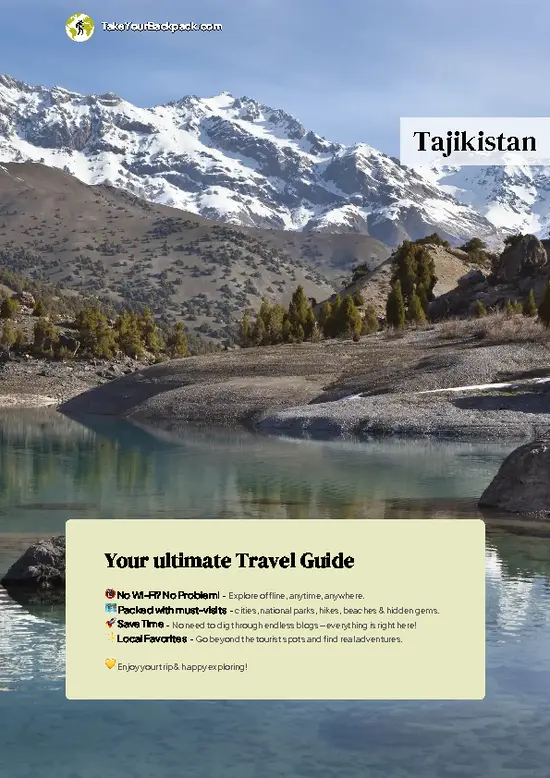
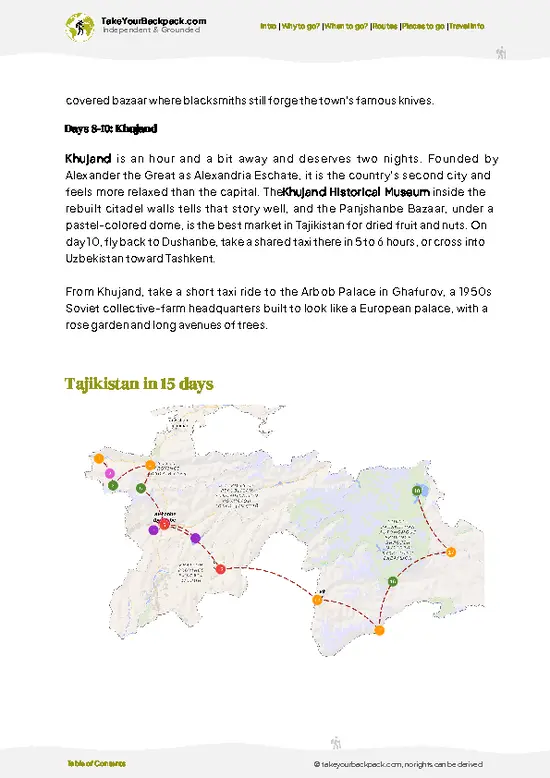
example page 0 from our offline Travel Guide for Tajikistan
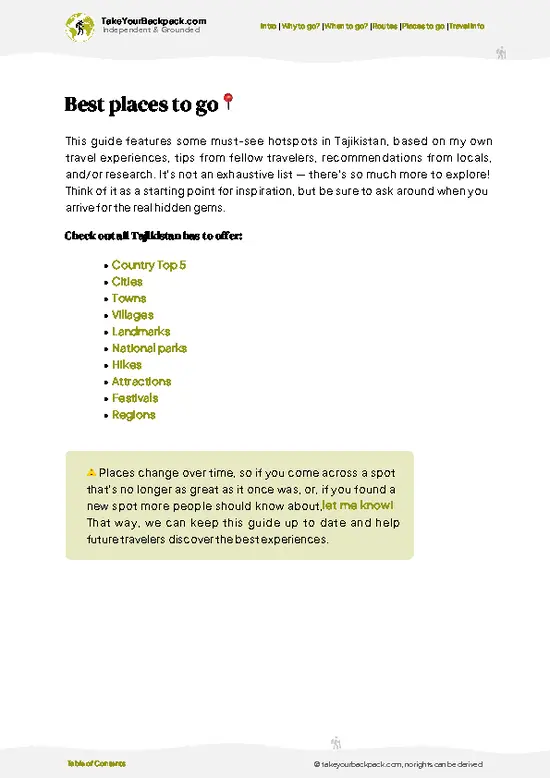
example page 1 from our offline Travel Guide for Tajikistan
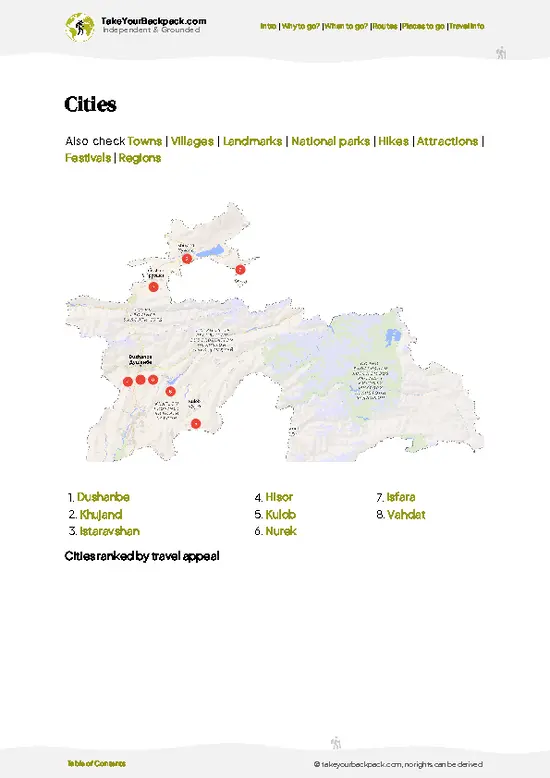
example page 2 from our offline Travel Guide for Tajikistan
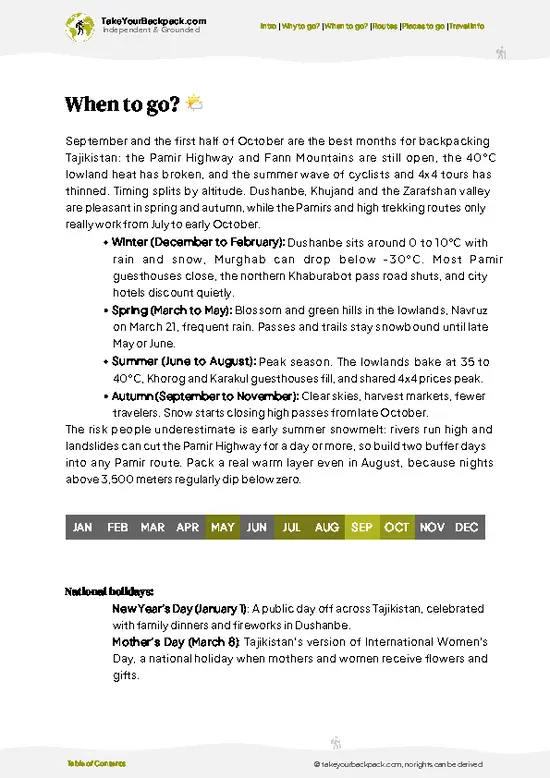
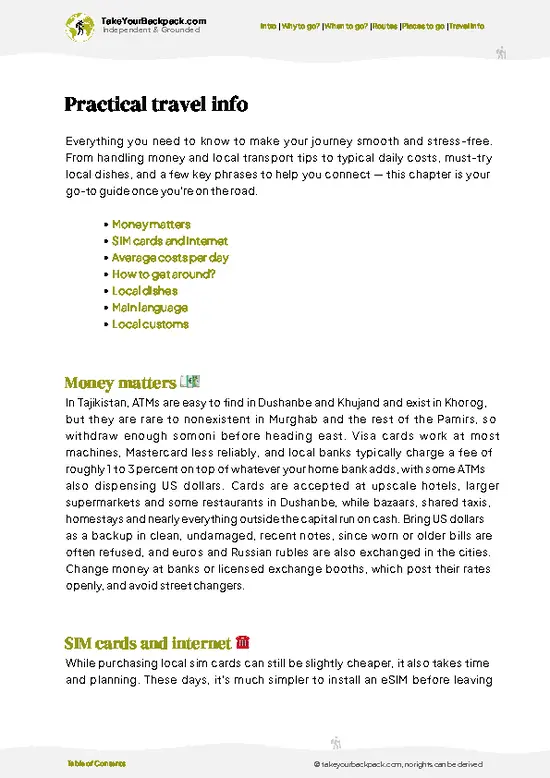
example page 3 from our offline Travel Guide for Tajikistan
example page 4 from our offline Travel Guide for Tajikistan
example page 5 from our offline Travel Guide for Tajikistan
example page 6 from our offline Travel Guide for Tajikistan
example page 7 from our offline Travel Guide for Tajikistan
The digital guide (268 pages) contains:
✅ 64 highlights, ranked by travel appeal
✅ Optimized 5, 10 & 15-day travel routes
✅ Cities, national parks, landmarks, beaches
✅ How to get around
✅ Offline-friendly for travel without Wi-Fi
👉 Click to see all 30+ guide features

📅 Plan smarter in minutes, not weeks
✅ Month by month travel advice
✅ Festivals & national holidays
✅ Budget expectations

🗺️ Go to the right places, skip the overrated ones
✅ Honest pros & cons of destinations
✅ Top hikes, parks & viewpoints
✅ Lesser-known places most travelers miss
✅ Clear “worth it vs skip it” guidance

🛏️ Travel smoothly without rookie mistakes
✅ Best areas to stay
✅ Transport systems explained simply
✅ Common scams & safety advice
✅ SIM cards, money & practical tips

🌍 Understand the country, not just visit it
✅ Culture & traditions
✅ 52 Essential phrases & customs
✅ Festivals worth planning around
✅ Traveler-friendly historical context
✅ Insights that make places more meaningful

📱 Built for real travel conditions
✅ Fully downloadable PDF
✅ Works completely offline
✅ Optimized for phone use
✅ Useful in remote areas & buses
✅ Everything in one place
Stop searching, start planning
Get instant access to your full guide. 30‑day money-back guarantee.
+ Add another guide for just

By proceeding you agree to our terms.
Sent to your inbox immediately after payment • 100% Secure Checkout
Best Backpacking Travel Advisor 2025 tourism awardBest Backpacking
Travel Advisor
2025
What others say about Take Your Backpack Guides:
⭐⭐⭐⭐⭐
Fantastic, amazing amount of information!
⭐⭐⭐⭐⭐
My goodness this is amazing, it's what I've been looking for hats off too you!
⭐⭐⭐⭐⭐
I think this is absolutely BRILLIANT
⭐⭐⭐⭐
Very complete and informative. It's still missing places, but I gotta to commend you
⭐⭐⭐⭐⭐
This is truly amazing, thank you, can't wait to explore it with my kids!
⭐⭐⭐⭐⭐
Awesome resource, thank you!
⭐⭐⭐⭐⭐
This is amazing! Can't wait to explore the ones I haven't seen
⭐⭐⭐⭐
I love this! Well done, great idea.
⭐⭐⭐⭐⭐
Thanks for taking the time to make this gem!
⭐⭐⭐⭐⭐
This might be the best website I've ever seen.
⭐⭐⭐⭐⭐
Congratulations, and thank you so much for your work; it's incredibly valuable.
⭐⭐⭐⭐
In all seriousness I think you did a great job pointing out the important spots
⭐⭐⭐⭐⭐
10/10 very good
⭐⭐⭐⭐⭐
As someone who's only just starting to visit regularly this is awesome, thank you.
⭐⭐⭐⭐
Thank you very much! I'm going to visit my dad, it's going to be very useful!
⭐⭐⭐⭐⭐
This is really cool! We'll be travelling for the first time and this definitely come in handy.
⭐⭐⭐⭐⭐
You are now our minister of culture, congratulations 👨‍💼
⭐⭐⭐⭐⭐
Just wanted to tell you that this is a pearl! Going to follow your recommendations.
⭐⭐⭐⭐⭐
This is so cool. I'll definitely be using the resource for my travels soon.
⭐⭐⭐⭐⭐
This is very impressive! Good work.
⭐⭐⭐⭐⭐
This is an amazing and informative site. Very well done!

🛏️ Where to stay?Where to Stay: Tajikistan Edition

Tajikistan has a small but growing hostel scene, with dorm beds from roughly US$7 to 12 and guesthouse rooms from about US$15 to 30, most of them in Dushanbe, Khorog and Khujand. In Dushanbe, the streets around Rudaki Avenue put you within walking distance of the parks, museums and the few bars and cafes that stay open late, while the quieter residential lanes south toward the Shohmansur bazaar area are cheaper and closer to shared taxi stands but a longer walk from evening life. In Khorog, places near the center and the Panj River make it easy to arrange Pamir Highway transport, and nights are calm and safe with almost no nightlife, while homestays in the Pamir and Fann Mountain villages trade … read more 👉
Tajikistan has a small but growing hostel scene, with dorm beds from roughly US$7 to 12 and guesthouse rooms from about US$15 to 30, most of them in Dushanbe, Khorog and Khujand. In Dushanbe, the streets around Rudaki Avenue put you within walking distance of the parks, museums and the few bars and cafes that stay open late, while the quieter residential lanes south toward the Shohmansur bazaar area are cheaper and closer to shared taxi stands but a longer walk from evening life. In Khorog, places near the center and the Panj River make it easy to arrange Pamir Highway transport, and nights are calm and safe with almost no nightlife, while homestays in the Pamir and Fann Mountain villages trade hostel social life for home-cooked meals and very early nights.

If you enjoy meeting fellow travelers, consider choosing hostels with high ratings for atmosphere. On the other hand, if you prefer having your own space, a hotel might be a better option.

TajikistanExplore Beyond This Category

👋 Meet the founderWho’s Behind Take Your Backpack?

Johan, backpacker and founder of TakeYourBackpackHi, I’m Johan (Netherlands 🇳🇱), the creator of TakeYourBackpack. Over the past 3 decades, I’ve backpacked through 90+ countries across six continents, gaining extensive experience with independent travel, long-term trips, and overland routes.

This site is built on a combination of firsthand travel experience and carefully curated insights from other backpackers. Many guides are based on places I’ve personally visited, while others bring together tips, observations, and practical advice shared by trusted travelers I’ve met along the way.

The goal is to provide realistic, experience-driven guidance — not generic itineraries — so you can explore destinations with better context, clearer expectations, and more confidence.