×

Tajikistan🇹🇯 | best attractionsEssential 11 attractions to Explore in Tajikistan

Tajikistan stacks its attractions in high mountains, not in ticketed monuments. The Pamirs in the east pull you onto the Wakhan corridor with Afghan peaks across the river, homestays and hot springs. The Fann Mountains in the northwest deliver turquoise lakes and day hikes within reach of Dushanbe. The Silk Road towns in the north and the capital add fortresses, bazaars and museums. Expect low crowds, rough roads and few signs. Costs stay modest, but distance and permits eat time. Backpacking here suits anyone who enjoys figuring things out, and every region rewards a different pace.

By Johan Kruseman 🇳🇱 | Updated October 19, 2026
Explore the best festivals in Tajikistan

Why go?Why Travelers Love These Spots

Tajikistan is more than 90 percent mountains, and that single fact shapes everything a traveler will see. The country holds some of the most remote high-altitude terrain in Central Asia, with passes above 4,000 meters and glaciers feeding rivers that cut through deep valleys. Culture follows geography. Persian-speaking Tajiks, Pamiri communities with their own languages and Ismaili faith, and old Silk Road trading towns each developed in separate pockets, so a few hours of driving can change food, dress and hospitality customs entirely.

Infrastructure is the honest limiter. Roads like the Pamir Highway are long, patchy and slow, public transport is mostly shared taxis and minibuses, and information in English is thin. That is also the appeal: sights are uncrowded, entry fees are low, and … read more 👉
Tajikistan is more than 90 percent mountains, and that single fact shapes everything a traveler will see. The country holds some of the most remote high-altitude terrain in Central Asia, with passes above 4,000 meters and glaciers feeding rivers that cut through deep valleys. Culture follows geography. Persian-speaking Tajiks, Pamiri communities with their own languages and Ismaili faith, and old Silk Road trading towns each developed in separate pockets, so a few hours of driving can change food, dress and hospitality customs entirely.

Infrastructure is the honest limiter. Roads like the Pamir Highway are long, patchy and slow, public transport is mostly shared taxis and minibuses, and information in English is thin. That is also the appeal: sights are uncrowded, entry fees are low, and homestays double as your meals and your cultural education.

Before choosing Tajikistan, know the practical basics. Most nationalities need an e-visa, and the GBAO permit for the Pamirs is normally included as an add-on. Altitude sickness is a real risk, mobile coverage fades fast outside towns, and cash matters because cards are rarely accepted beyond Dushanbe. Come ready to adapt, and the country pays you back generously.
Behind the Scenes of Selection
The list of best attractions in Tajikistan is created based on cultural significance or entertainment value. If you feel a attraction is missing in this list, please let us know.

When to go?Seasonal Guide to Visiting

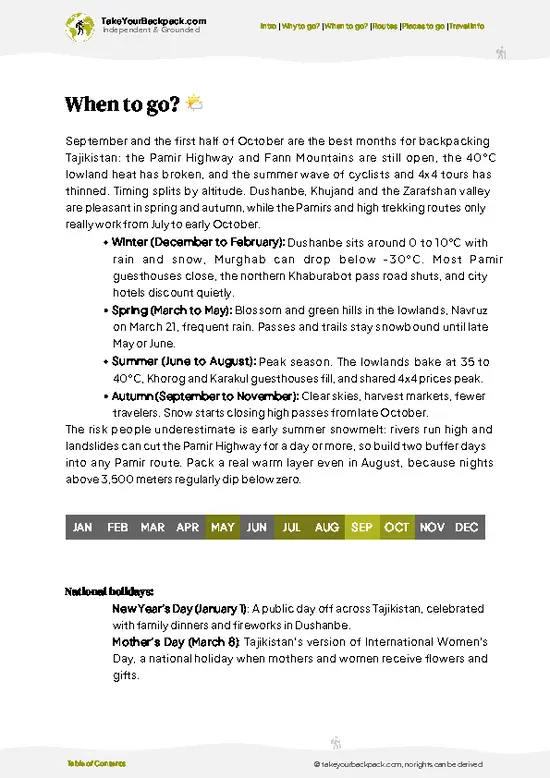
Best months: June to September for the mountains: Plan for June through September, when high passes are clear of snow, trekking trails are open and the Pamir Highway is fully drivable. Daytime temperatures in the Pamirs run roughly 15 to 25°C in summer, but nights at 3,000 to 4,000 meters drop near freezing and can fall below it. Rain is scarce there, since the region is high and dry.
Shoulder seasons and the lowlands: April to May and late September to October suit the south and the cities. Dushanbe and the Khatlon lowlands reach 15 to 25°C in spring and autumn, with spring bringing most of the year's rain and green hills. Higher routes may still be snowbound in May, and passes begin closing from October. Fann Mountain trails are best from late June, once snow melts off the high routes.
Summer … read more 👉
Best months: June to September for the mountains: Plan for June through September, when high passes are clear of snow, trekking trails are open and the Pamir Highway is fully drivable. Daytime temperatures in the Pamirs run roughly 15 to 25°C in summer, but nights at 3,000 to 4,000 meters drop near freezing and can fall below it. Rain is scarce there, since the region is high and dry.
Shoulder seasons and the lowlands: April to May and late September to October suit the south and the cities. Dushanbe and the Khatlon lowlands reach 15 to 25°C in spring and autumn, with spring bringing most of the year's rain and green hills. Higher routes may still be snowbound in May, and passes begin closing from October. Fann Mountain trails are best from late June, once snow melts off the high routes.
Summer heat and winter closures: Dushanbe and the south often exceed 35 to 40°C in July and August, so spend those weeks high rather than low. Winter, from November to March, brings sub-zero days in the Pamirs, closed passes, limited homestays and reduced transport, so it is not practical for most backpackers. Peak season is July and August, but crowds stay small by global standards. Homestay and guesthouse prices shift only modestly, so book ahead mainly for transport and the most popular lakeside stays.

attraction hoppingHow to Combine attractions Into One Trip

How many days to allow: A trip linking several attractions in Tajikistan needs 10 to 21 days, and 14 to 18 gives a comfortable pace. Regions cluster by road. Dushanbe, the Fann Mountains and the northern Silk Road towns form a western loop, while the Pamirs form a separate, longer eastern run.
Direction and transport: Most travelers fly or enter at Dushanbe, then head east toward Khorog and finish at Osh in Kyrgyzstan, since the Pamir Highway runs south to north and ends there. The reverse direction also works, though starting in Dushanbe lets you acclimatize gradually. Dushanbe to Khorog takes roughly 12 to 16 hours by shared 4x4 along the southern route, and Khorog to Murghab about 8 to 10 hours. Murghab to Osh is another 10 to 12 hours. Dushanbe to the Fann gateway of Penjikent is around … read more 👉
How many days to allow: A trip linking several attractions in Tajikistan needs 10 to 21 days, and 14 to 18 gives a comfortable pace. Regions cluster by road. Dushanbe, the Fann Mountains and the northern Silk Road towns form a western loop, while the Pamirs form a separate, longer eastern run.
Direction and transport: Most travelers fly or enter at Dushanbe, then head east toward Khorog and finish at Osh in Kyrgyzstan, since the Pamir Highway runs south to north and ends there. The reverse direction also works, though starting in Dushanbe lets you acclimatize gradually. Dushanbe to Khorog takes roughly 12 to 16 hours by shared 4x4 along the southern route, and Khorog to Murghab about 8 to 10 hours. Murghab to Osh is another 10 to 12 hours. Dushanbe to the Fann gateway of Penjikent is around 5 to 7 hours, and Penjikent to Khujand about 4 to 5 hours.
Time per stop and common mistakes: Give the Fann Mountains 3 to 5 days, the Wakhan valley 2 to 4 days, and a city or town stop 1 to 2 days. Pamir hubs need a night each to recover from long driving days.

The usual mistake is cramming the Pamirs into a week. Roads are slow, weather causes delays and altitude saps energy, so add 2 buffer days. Another is skipping acclimatization. Climb gradually, drink water, and avoid jumping from Dushanbe straight to 4,000 meters. A third is trying to link east and west without enough time. Pick one region well, or fly Dushanbe to Khorog, then travel overland.

The ListMust-Visit attractions in Tajikistan

1 National Museum of Tajikistan

prehistoric fossils, Islamic manuscripts, decorative arts

Trace the country’s natural and cultural evolution through themed galleries featuring objects from prehistory to the present.

2 Rudaki Park

formal gardens, fountains, monument plaza

Relax in landscaped grounds featuring walking paths, water features, and statues commemorating Tajikistan’s national poet.

4 Museum of Antiquities of Tajikistan

Buddhist statues, Greco-Bactrian art, ancient murals

View archaeological finds from across the region, including monumental sculptures and artifacts spanning several millennia.

5 Khujand Historical Museum

fortress setting, Silk Road relics, regional artifacts

Examine ancient coins, pottery, and costumes inside a renovated citadel overlooking the Syr Darya river.

6 Mehrgon Bazaar

fresh produce, textile stalls, local spices

Navigate bustling aisles filled with seasonal fruits, nuts, and handwoven fabrics, offering insight into daily commerce and food culture.

7 Ayni Opera and Ballet Theatre

neoclassical facade, evening performances, cultural landmark

Attend a live opera or ballet in a grand hall where local and international productions highlight Tajikistan’s performing arts traditions.

8 Museum of Ethnography of Tajikistan

folk costumes, traditional jewelry, rural tools

Survey exhibits that illustrate the diversity of Tajik ethnic groups through clothing, crafts, and everyday objects.

9 Khorog Regional Museum

Pamiri heritage, ethnographic exhibits, local crafts

Browse displays of regional textiles, household items, and photographs that document life in the Gorno-Badakhshan Autonomous Region.

10 Gurminj Museum of Musical Instruments

traditional instruments, curated displays, Dushanbe collection

Discover rare string and percussion instruments from across Central Asia, displayed in intimate rooms with detailed explanations of their origins.

11 National Library of Tajikistan

modern architecture, reading halls, research collections

Access extensive archives and contemporary resources in a spacious building designed for study, events, and public exhibitions.

Loading the map 🌍

Expert viewExpert Commentary on attractions

How many attractions to visit: Aim for 6 to 8 major stops on a trip of two to three weeks. Roads eat entire days, and a stop at 3,500 meters demands recovery time. Fewer, longer stays at a mountain valley or lake let you hike, share meals with a host family and catch the light on the peaks, which is the entire point of coming.
Prioritizing by travel style: Trekkers should put the Fann Mountains and Pamir valleys first, since alpine lakes and high passes deliver the strongest scenery and the quietest trails. Culture seekers do better with homestays in the Wakhan and Pamiri villages, where evenings of tea, bread and local music shape the experience. Short-trip travelers should stick to the west: Dushanbe, Penjikent and the Fann, reachable without a week of driving. Cities and museums work as … read more 👉
How many attractions to visit: Aim for 6 to 8 major stops on a trip of two to three weeks. Roads eat entire days, and a stop at 3,500 meters demands recovery time. Fewer, longer stays at a mountain valley or lake let you hike, share meals with a host family and catch the light on the peaks, which is the entire point of coming.
Prioritizing by travel style: Trekkers should put the Fann Mountains and Pamir valleys first, since alpine lakes and high passes deliver the strongest scenery and the quietest trails. Culture seekers do better with homestays in the Wakhan and Pamiri villages, where evenings of tea, bread and local music shape the experience. Short-trip travelers should stick to the west: Dushanbe, Penjikent and the Fann, reachable without a week of driving. Cities and museums work as rest days between mountain stretches, and a bazaar lunch of plov or samsa costs little and fills you up.
Budget per day and per visit: Budget US$25 to 45 a day including homestay beds (US$10 to 20 with dinner and breakfast), meals and local transport. Shared taxis on long routes run roughly US$10 to 30 per seat, and chartering a 4x4 with driver for the Pamirs costs roughly US$100 to 150 a day split among passengers. Entry fees at sites are low, often US$1 to 5, while national park or trek permits and a local guide add US$20 to 50 a day. Carry plenty of Tajik somoni, since ATMs vanish beyond larger towns.
Safety and cultural considerations: Altitude is the main hazard. Ascend gradually, stay hydrated and descend if headaches turn severe. Mountain roads can see rockfalls and landslides, so leave early and keep time in reserve. The Afghan border along the Panj river is visible for long stretches of the Wakhan, and travelers should follow local advice and check current government guidance before heading there. Dress modestly in villages, with covered shoulders and knees, and remove shoes before entering homes. Ask before photographing people, military sites and border posts, which are sensitive. Accept tea and bread when offered, because hospitality is part of the day's rhythm and the cup you share often becomes the memory you keep.

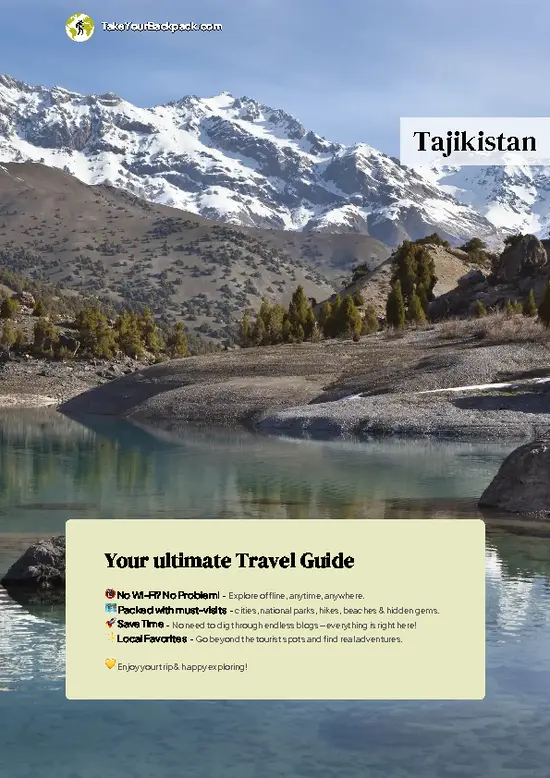
✈️ The backpacker research shortcutTajikistan Travel Guide

An offline-friendly backpacking guide with optimized travel routes, ranked highlights, transport advice, and the best areas to stay.
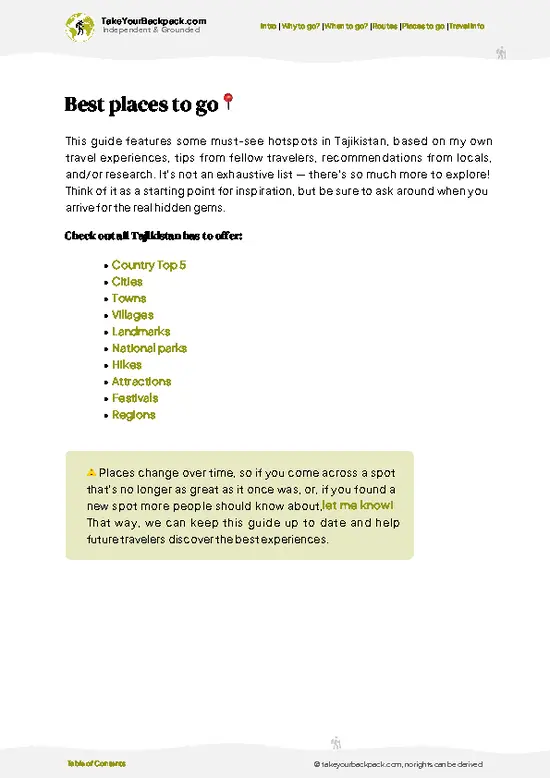
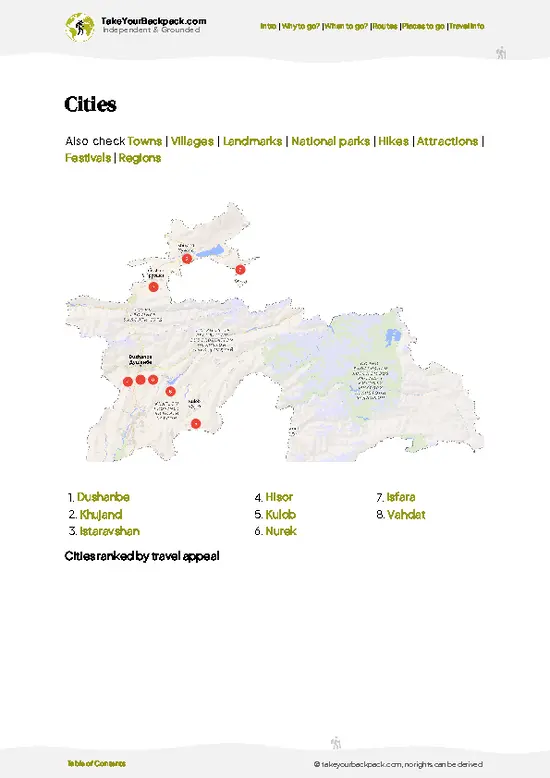
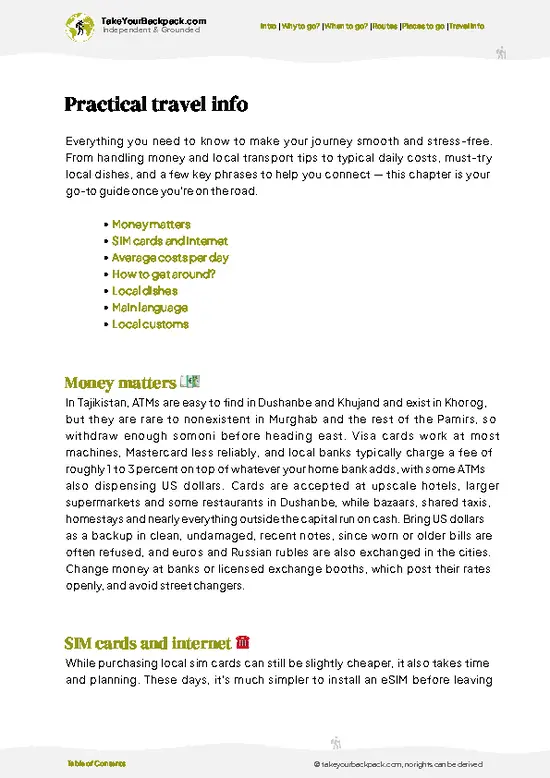
example page 0 from our offline Travel Guide for Tajikistan
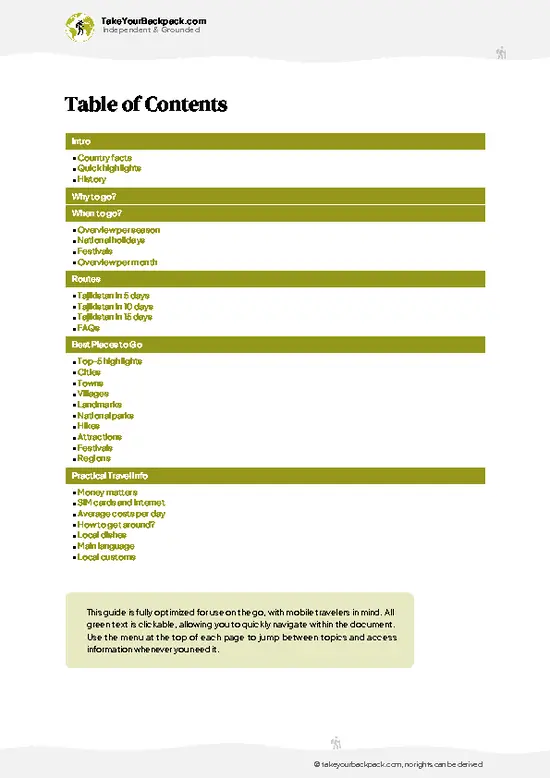
example page 1 from our offline Travel Guide for Tajikistan
example page 2 from our offline Travel Guide for Tajikistan
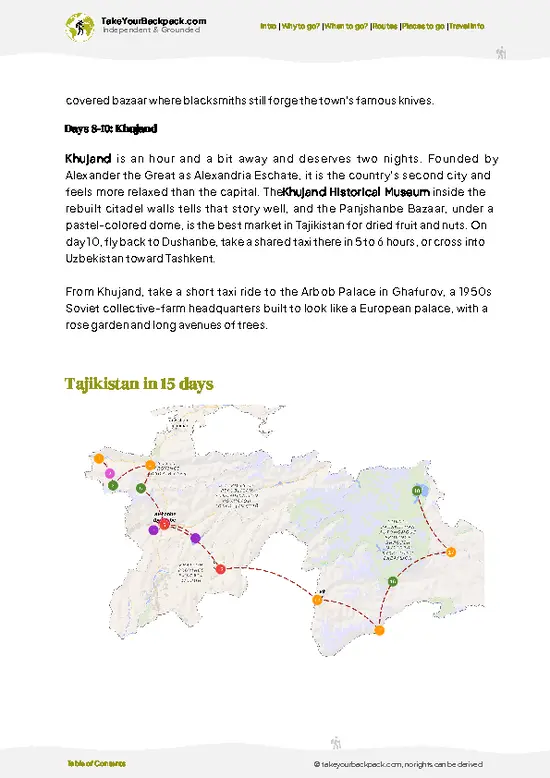
example page 3 from our offline Travel Guide for Tajikistan
example page 4 from our offline Travel Guide for Tajikistan
example page 5 from our offline Travel Guide for Tajikistan
example page 6 from our offline Travel Guide for Tajikistan
example page 7 from our offline Travel Guide for Tajikistan
The digital guide (268 pages) contains:
✅ 64 highlights, ranked by travel appeal
✅ Optimized 5, 10 & 15-day travel routes
✅ Cities, national parks, landmarks, beaches
✅ How to get around
✅ Offline-friendly for travel without Wi-Fi
👉 Click to see all 30+ guide features

📅 Plan smarter in minutes, not weeks
✅ Month by month travel advice
✅ Festivals & national holidays
✅ Budget expectations

🗺️ Go to the right places, skip the overrated ones
✅ Honest pros & cons of destinations
✅ Top hikes, parks & viewpoints
✅ Lesser-known places most travelers miss
✅ Clear “worth it vs skip it” guidance

🛏️ Travel smoothly without rookie mistakes
✅ Best areas to stay
✅ Transport systems explained simply
✅ Common scams & safety advice
✅ SIM cards, money & practical tips

🌍 Understand the country, not just visit it
✅ Culture & traditions
✅ 52 Essential phrases & customs
✅ Festivals worth planning around
✅ Traveler-friendly historical context
✅ Insights that make places more meaningful

📱 Built for real travel conditions
✅ Fully downloadable PDF
✅ Works completely offline
✅ Optimized for phone use
✅ Useful in remote areas & buses
✅ Everything in one place
Stop searching, start planning
Get instant access to your full guide. 30‑day money-back guarantee.
+ Add another guide for just

By proceeding you agree to our terms.
Sent to your inbox immediately after payment • 100% Secure Checkout
Best Backpacking Travel Advisor 2025 tourism awardBest Backpacking
Travel Advisor
2025
What others say about Take Your Backpack Guides:
⭐⭐⭐⭐⭐
Fantastic, amazing amount of information!
⭐⭐⭐⭐⭐
My goodness this is amazing, it's what I've been looking for hats off too you!
⭐⭐⭐⭐⭐
I think this is absolutely BRILLIANT
⭐⭐⭐⭐
Very complete and informative. It's still missing places, but I gotta to commend you
⭐⭐⭐⭐⭐
This is truly amazing, thank you, can't wait to explore it with my kids!
⭐⭐⭐⭐⭐
Awesome resource, thank you!
⭐⭐⭐⭐⭐
This is amazing! Can't wait to explore the ones I haven't seen
⭐⭐⭐⭐
I love this! Well done, great idea.
⭐⭐⭐⭐⭐
Thanks for taking the time to make this gem!
⭐⭐⭐⭐⭐
This might be the best website I've ever seen.
⭐⭐⭐⭐⭐
Congratulations, and thank you so much for your work; it's incredibly valuable.
⭐⭐⭐⭐
In all seriousness I think you did a great job pointing out the important spots
⭐⭐⭐⭐⭐
10/10 very good
⭐⭐⭐⭐⭐
As someone who's only just starting to visit regularly this is awesome, thank you.
⭐⭐⭐⭐
Thank you very much! I'm going to visit my dad, it's going to be very useful!
⭐⭐⭐⭐⭐
This is really cool! We'll be travelling for the first time and this definitely come in handy.
⭐⭐⭐⭐⭐
You are now our minister of culture, congratulations 👨‍💼
⭐⭐⭐⭐⭐
Just wanted to tell you that this is a pearl! Going to follow your recommendations.
⭐⭐⭐⭐⭐
This is so cool. I'll definitely be using the resource for my travels soon.
⭐⭐⭐⭐⭐
This is very impressive! Good work.
⭐⭐⭐⭐⭐
This is an amazing and informative site. Very well done!

🛏️ Where to stay?Top Areas to Stay

Tajikistan has a small but growing hostel scene, with dorm beds from roughly US$7 to 12 and guesthouse rooms from about US$15 to 30, most of them in Dushanbe, Khorog and Khujand. In Dushanbe, the streets around Rudaki Avenue put you within walking distance of the parks, museums and the few bars and cafes that stay open late, while the quieter residential lanes south toward the Shohmansur bazaar area are cheaper and closer to shared taxi stands but a longer walk from evening life. In Khorog, places near the center and the Panj River make it easy to arrange Pamir Highway transport, and nights are calm and safe with almost no nightlife, while homestays in the Pamir and Fann Mountain villages trade … read more 👉
Tajikistan has a small but growing hostel scene, with dorm beds from roughly US$7 to 12 and guesthouse rooms from about US$15 to 30, most of them in Dushanbe, Khorog and Khujand. In Dushanbe, the streets around Rudaki Avenue put you within walking distance of the parks, museums and the few bars and cafes that stay open late, while the quieter residential lanes south toward the Shohmansur bazaar area are cheaper and closer to shared taxi stands but a longer walk from evening life. In Khorog, places near the center and the Panj River make it easy to arrange Pamir Highway transport, and nights are calm and safe with almost no nightlife, while homestays in the Pamir and Fann Mountain villages trade hostel social life for home-cooked meals and very early nights.

If you enjoy meeting fellow travelers, consider choosing hostels with high ratings for atmosphere. On the other hand, if you prefer having your own space, a hotel might be a better option.

TajikistanDiscover the Country

👋 Meet the founderWho’s Behind Take Your Backpack?

Johan, backpacker and founder of TakeYourBackpackHi, I’m Johan (Netherlands 🇳🇱), the creator of TakeYourBackpack. Over the past 3 decades, I’ve backpacked through 90+ countries across six continents, gaining extensive experience with independent travel, long-term trips, and overland routes.

This site is built on a combination of firsthand travel experience and carefully curated insights from other backpackers. Many guides are based on places I’ve personally visited, while others bring together tips, observations, and practical advice shared by trusted travelers I’ve met along the way.

The goal is to provide realistic, experience-driven guidance — not generic itineraries — so you can explore destinations with better context, clearer expectations, and more confidence.