×

Togo🇹🇬 | townsBadouAkloa waterfall, Akposso hills, Woméchi ridges, cocoa market | things to do and best time to go

Explore BlittaExplore Mango

Backpacking in Badou
🌟 Highlighttown ranked #5
By Johan Kruseman 🇳🇱 | Updated October 22, 2026

Badou suits hikers and slow travelers who like red-earth roads, cocoa and coffee hillsides and a village where almost nobody is selling you anything. Anyone chasing nightlife, museums or a tidy checklist of sights will find it thin. The town sits in the west of Togo, in the Plateaux region close to the Ghana border, in the green folds of the Akposso hills. Mornings smell of woodsmoke and wet leaves, motorbike taxis whine up the slopes, and the afternoon heat flattens everything until the market stalls go quiet. The town itself deserves an hour or two, mainly for the market. The real draw is the Woméchi area and the Akloa waterfall, and I would spend nearly all of your time there. It is reachable by road but takes effort, and the choice of beds is small. Evenings are slow, with a beer and a plate of grilled fish, and meeting other backpackers is rare. Hikers will love it. Party seekers won’t.

Discover everything you want to know in the 📖 Togo Travel Guide.


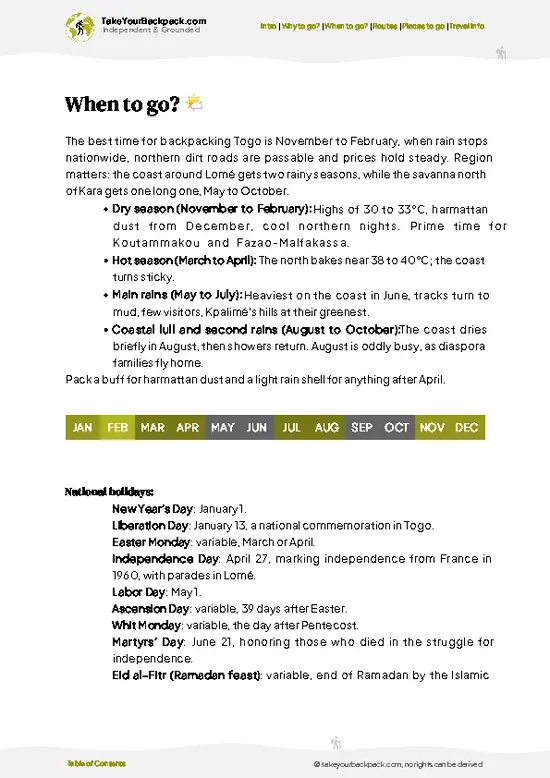
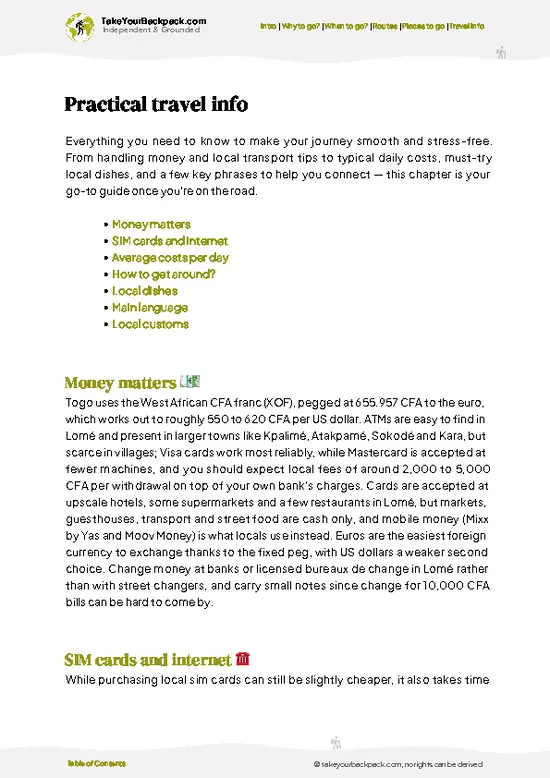
example page 0 from our offline Travel Guide for Togo
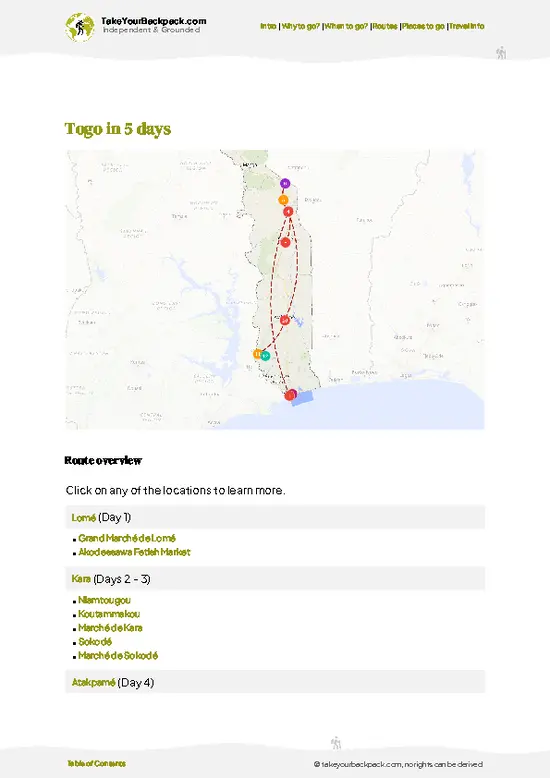
example page 1 from our offline Travel Guide for Togo
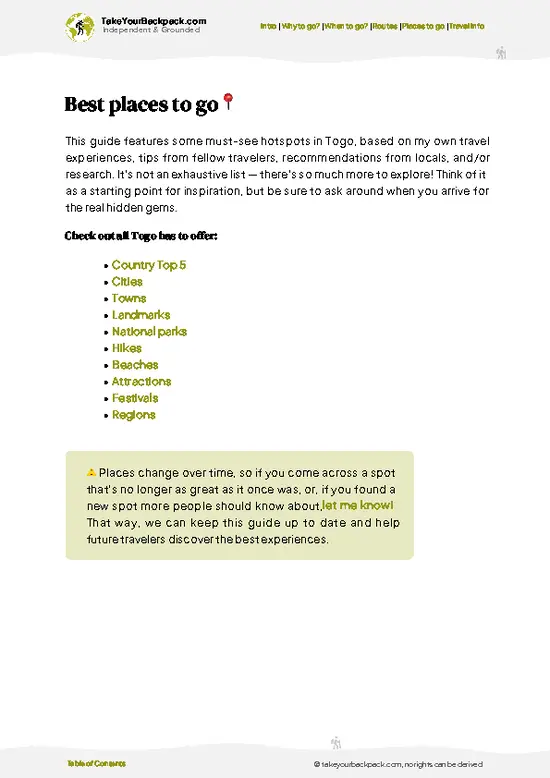
example page 2 from our offline Travel Guide for Togo
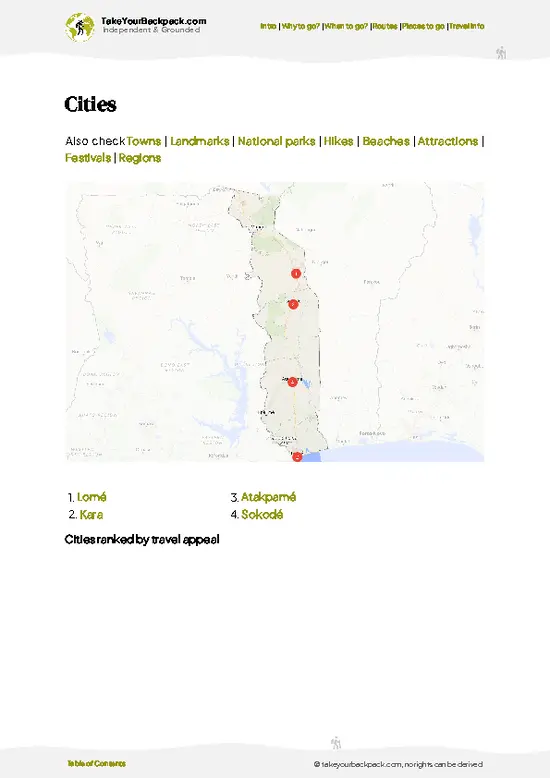
example page 3 from our offline Travel Guide for Togo
example page 4 from our offline Travel Guide for Togo
example page 5 from our offline Travel Guide for Togo
example page 6 from our offline Travel Guide for Togo
example page 7 from our offline Travel Guide for Togo
Loading the map 🌍
CLICK TO FILTER
cities
towns
landmarks
national parks
hikes
beaches
attractions
festivals
regions
SHOW COUNTRY’S BESTSHOW ALL

✨ Why go?
Ranked #5 town in Togo
Reasons people choose to visit here

Badou works because it puts you at the foot of the Togo hills with almost no crowds. The point is walking: forest paths, cocoa and coffee plots, and the roar of the Akloa waterfall a short distance from town, which you can reach with a local guide or a motorbike taxi on rough tracks. Most travelers stay one or two nights, and anyone who enjoys village rhythms can happily stretch that to three. Accommodation is a handful of simple guesthouses, so expect fans, bucket showers and conversation with the owner rather than a hostel crowd. Food is local and direct: pounded yam, rice with sauce and grilled fish at roadside spots. The scene is quiet, which suits solo travelers who like their own company and hikers who want a base near Mont Agou country. If you need buzz, bars and a social dorm, stop in Kpalimé instead and treat Badou as a day out.

💡 HighlightsThe experiences that define the visit

  1. Akloa Waterfall: The area’s best-known sight, a cascade dropping through dense forest a short ride from town. Go in the morning when the air is cooler and the rocks are less slippery. Expect a small village or guide contribution of roughly €2 to 5, and allow 3 to 4 hours including the walk.
  2. Badou Market: Piles of cocoa, coffee, yams, peppers and fabric spread under tin roofs and tarps, with the busiest trading in the morning. Entry is free, and an hour of wandering is plenty. Bring small change if you want to buy fruit or snacks.
  3. Cocoa and Coffee Plantation Walks: Farmers around Badou grow the crops that fund the region, and a guided walk shows you the pods, drying racks and shaded plots. Mornings are best. A local guide costs about €5 to 10, and a visit takes 2 to 3 hours.
  4. Woméchi Viewpoints:
… read more 👉
  1. Akloa Waterfall: The area’s best-known sight, a cascade dropping through dense forest a short ride from town. Go in the morning when the air is cooler and the rocks are less slippery. Expect a small village or guide contribution of roughly €2 to 5, and allow 3 to 4 hours including the walk.
  2. Badou Market: Piles of cocoa, coffee, yams, peppers and fabric spread under tin roofs and tarps, with the busiest trading in the morning. Entry is free, and an hour of wandering is plenty. Bring small change if you want to buy fruit or snacks.
  3. Cocoa and Coffee Plantation Walks: Farmers around Badou grow the crops that fund the region, and a guided walk shows you the pods, drying racks and shaded plots. Mornings are best. A local guide costs about €5 to 10, and a visit takes 2 to 3 hours.
  4. Woméchi Viewpoints: The ridges and rolling forest around the Woméchi zone give long views over the green hills toward the Ghana side. Late afternoon is softest for photos. It is free on foot or costs a few euros by motorbike taxi, with 1 to 2 hours enough.
  5. Evening on the Main Road: Grilled fish, cold local beer and plantain from roadside stalls make the best cheap dinner in town. Go after dark when the charcoal is glowing. A meal runs about €2 to 4 and takes around an hour.
For day trips, Badou makes a good launch point for the Mont Agou region, the Kpalimé area and the forests along the Ghana border. All five stops fit comfortably into one full day, or a relaxed two days if you hike slowly.
Spotted a mistake or missing something? Contact us.

🏘️ NeighborhoodsHow different areas shape the experience

Badou is small enough to cover on foot in an afternoon, and the interest lies at its edges rather than in one grand center.
  • Central market and main road: This is where you spend your first hour. Women sell yams, tomatoes, palm oil and smoked fish from low stalls, motorbike taxis whine past, and the dust turns everything a faint red-brown. Market days are the loudest and best. Walk it, then leave before the midday heat flattens you.
  • Roadside food stretch: Grills and small chop stands cluster along the main road toward evening. Expect charcoal smoke, fried plantain, pounded yam with peanut or palm soup, and cold local beer. It is simple, filling and the best place to talk with locals.
  • Lower town and farm edges: Lanes thin out into cocoa, coffee and banana plots under hazy green hills. Mornings
… read more 👉
Badou is small enough to cover on foot in an afternoon, and the interest lies at its edges rather than in one grand center.
  • Central market and main road: This is where you spend your first hour. Women sell yams, tomatoes, palm oil and smoked fish from low stalls, motorbike taxis whine past, and the dust turns everything a faint red-brown. Market days are the loudest and best. Walk it, then leave before the midday heat flattens you.
  • Roadside food stretch: Grills and small chop stands cluster along the main road toward evening. Expect charcoal smoke, fried plantain, pounded yam with peanut or palm soup, and cold local beer. It is simple, filling and the best place to talk with locals.
  • Lower town and farm edges: Lanes thin out into cocoa, coffee and banana plots under hazy green hills. Mornings are quiet, with roosters and the thud of pestles. It is flat enough to walk, and worth your time more than any single building.
  • Hills toward Mount Agou and the Akposso plateau side: Not a neighborhood, but the reason to come. The air cools, red tracks climb through forest, and waterfalls hum in the distance. You need a motorbike or guide for most of it, so treat it as a half-day outing rather than a stroll.

⌛️ 1 dayA smart one-day plan

Badou is a walking town with a long afternoon pause: you cover the center on foot in the cool morning, hire a moto-taxi for the hills, and retreat to shade when the heat peaks around midday.
7:00 AM: Central market area
Start where the town wakes up. Women set out tomatoes, yams, peppers and dried fish under tarps, and the smell of frying dough drifts from small stalls. Grab a coffee with bread and eggs, then walk the main road at an easy pace to get your bearings.
9:00 AM: Moto-taxi to Akloa Falls
Hire a moto-taxi for the ride into the Mono hills, a short run on red dirt past cocoa and coffee plots. Agree on the round-trip price and waiting time before you climb on. The falls are the town’s best-known sight, with a drop into a green basin and a cool mist on the final stretch of path.
11:30 AM: … read more 👉
Badou is a walking town with a long afternoon pause: you cover the center on foot in the cool morning, hire a moto-taxi for the hills, and retreat to shade when the heat peaks around midday.
7:00 AM: Central market area
Start where the town wakes up. Women set out tomatoes, yams, peppers and dried fish under tarps, and the smell of frying dough drifts from small stalls. Grab a coffee with bread and eggs, then walk the main road at an easy pace to get your bearings.
9:00 AM: Moto-taxi to Akloa Falls
Hire a moto-taxi for the ride into the Mono hills, a short run on red dirt past cocoa and coffee plots. Agree on the round-trip price and waiting time before you climb on. The falls are the town’s best-known sight, with a drop into a green basin and a cool mist on the final stretch of path.
11:30 AM: Swim and walk at the falls
Spend time in the pool or sit on the rocks, then head back before the sun is at full strength. Local guides at the site can point out the easiest footing.
1:00 PM: Lunch and a long break
Eat rice or pounded yam with sauce at a simple chop bar in town, then rest in the shade for two hours. Nobody moves fast now, and you should not either.
3:30 PM: Cocoa and coffee farm paths
This is the part outside the usual route. Walk the tracks at the edge of town where families dry cocoa beans on mats and tend coffee trees on the slopes. Greet people first, ask before taking photos, and expect an invitation to look at the drying beans.
5:30 PM: Evening on the main road
Return as the light softens and the town fills with motorbike buzz and charcoal smoke. Finish with grilled fish or chicken and a cold local beer at an open-air maquis, then walk back to your guesthouse.

🌤️ When to go?Seasonal considerations and timing

The cooler, drier months from November to February suit hiking in the hills around Badou best.
  • Harmattan (December to February): Days reach 30 to 33°C (86 to 91°F), nights drop to 18 to 21°C (64 to 70°F). Dust haze can blur views, but trails are firm.
  • Hot season (March to April): Temperatures climb to 33 to 36°C (91 to 97°F) with humid, heavy afternoons. Walk early.
  • Main rains (May to July): Daily downpours at 24 to 30°C (75 to 86°F) turn tracks to mud and waterfalls roar. Crowds are nil and rooms are easy to get.
  • Short dry spell and second rains (August to October): Greener and cooler, with a brief lull in August and showers returning in September and October.
  • Cocoa and coffee harvest: Roughly October to January, when farms are busiest and drying beans line the roadsides.
Daylight stays near 12 … read more 👉
The cooler, drier months from November to February suit hiking in the hills around Badou best.
  • Harmattan (December to February): Days reach 30 to 33°C (86 to 91°F), nights drop to 18 to 21°C (64 to 70°F). Dust haze can blur views, but trails are firm.
  • Hot season (March to April): Temperatures climb to 33 to 36°C (91 to 97°F) with humid, heavy afternoons. Walk early.
  • Main rains (May to July): Daily downpours at 24 to 30°C (75 to 86°F) turn tracks to mud and waterfalls roar. Crowds are nil and rooms are easy to get.
  • Short dry spell and second rains (August to October): Greener and cooler, with a brief lull in August and showers returning in September and October.
  • Cocoa and coffee harvest: Roughly October to January, when farms are busiest and drying beans line the roadsides.
Daylight stays near 12 hours all year, so start hikes by 7 a.m. to finish before storms.


source: climatestotravel.comJANJanuary: excellent for travelingFEBFebruary: excellent for travelingMARMarch: highly recommended for travelingAPRApril: fair for travelingMAYMay: fair for travelingJUNJune: fair for travelingJULJuly: fair for travelingAUGAugust: fair for travelingSEPSeptember: fair for travelingOCTOctober: fair for travelingNOVNovember: highly recommended for travelingDECDecember: excellent for traveling
when-to-go

✈️ The backpacker research shortcutTogo Travel Guide

An offline-friendly backpacking guide with optimized travel routes, ranked highlights, transport advice, and the best areas to stay.
example page 0 from our offline Travel Guide for Togo
example page 1 from our offline Travel Guide for Togo
example page 2 from our offline Travel Guide for Togo
example page 3 from our offline Travel Guide for Togo
example page 4 from our offline Travel Guide for Togo
example page 5 from our offline Travel Guide for Togo
example page 6 from our offline Travel Guide for Togo
example page 7 from our offline Travel Guide for Togo
The digital guide (194 pages) contains:
✅ 42 highlights, ranked by travel appeal
✅ Optimized 2, 3 & 5-day travel routes
✅ Cities, national parks, landmarks, beaches
✅ How to get around
✅ Offline-friendly for travel without Wi-Fi
👉 Click to see all 30+ guide features

📅 Plan smarter in minutes, not weeks
✅ Month by month travel advice
✅ Festivals & national holidays
✅ Budget expectations

🗺️ Go to the right places, skip the overrated ones
✅ Honest pros & cons of destinations
✅ Top hikes, parks & viewpoints
✅ Lesser-known places most travelers miss
✅ Clear “worth it vs skip it” guidance

🛏️ Travel smoothly without rookie mistakes
✅ Best areas to stay
✅ Transport systems explained simply
✅ Common scams & safety advice
✅ SIM cards, money & practical tips

🌍 Understand the country, not just visit it
✅ Culture & traditions
✅ 52 Essential phrases & customs
✅ Festivals worth planning around
✅ Traveler-friendly historical context
✅ Insights that make places more meaningful

📱 Built for real travel conditions
✅ Fully downloadable PDF
✅ Works completely offline
✅ Optimized for phone use
✅ Useful in remote areas & buses
✅ Everything in one place
Stop searching, start planning
Get instant access to your full guide. 30‑day money-back guarantee.
+ Add another guide for just

By proceeding you agree to our terms.
Sent to your inbox immediately after payment • 100% Secure Checkout
Best Backpacking Travel Advisor 2025 tourism awardBest Backpacking
Travel Advisor
2025
What others say about Take Your Backpack Guides:
⭐⭐⭐⭐⭐
Fantastic, amazing amount of information!
⭐⭐⭐⭐⭐
My goodness this is amazing, it's what I've been looking for hats off too you!
⭐⭐⭐⭐⭐
I think this is absolutely BRILLIANT
⭐⭐⭐⭐
Very complete and informative. It's still missing places, but I gotta to commend you
⭐⭐⭐⭐⭐
This is truly amazing, thank you, can't wait to explore it with my kids!
⭐⭐⭐⭐⭐
Awesome resource, thank you!
⭐⭐⭐⭐⭐
This is amazing! Can't wait to explore the ones I haven't seen
⭐⭐⭐⭐
I love this! Well done, great idea.
⭐⭐⭐⭐⭐
Thanks for taking the time to make this gem!
⭐⭐⭐⭐⭐
This might be the best website I've ever seen.
⭐⭐⭐⭐⭐
Congratulations, and thank you so much for your work; it's incredibly valuable.
⭐⭐⭐⭐
In all seriousness I think you did a great job pointing out the important spots
⭐⭐⭐⭐⭐
10/10 very good
⭐⭐⭐⭐⭐
As someone who's only just starting to visit regularly this is awesome, thank you.
⭐⭐⭐⭐
Thank you very much! I'm going to visit my dad, it's going to be very useful!
⭐⭐⭐⭐⭐
This is really cool! We'll be travelling for the first time and this definitely come in handy.
⭐⭐⭐⭐⭐
You are now our minister of culture, congratulations 👨‍💼
⭐⭐⭐⭐⭐
Just wanted to tell you that this is a pearl! Going to follow your recommendations.
⭐⭐⭐⭐⭐
This is so cool. I'll definitely be using the resource for my travels soon.
⭐⭐⭐⭐⭐
This is very impressive! Good work.
⭐⭐⭐⭐⭐
This is an amazing and informative site. Very well done!

🛏️ Where to stay?Best areas and accommodation options

Stay in or just off the central market and main road area, because that is where the few budget beds, the food stalls and the shared-taxi stop all sit within a short walk. Budget rooms in Badou are basic guesthouses rather than dorm-style hostels, so expect a private room with a fan and a shared or simple bathroom for roughly €8 to 20 a night. Availability is usually fine outside holiday weekends, but with few places in town it helps to call ahead or arrive before late afternoon.

The main road is convenient but gets noisy at dawn with motorbikes, roosters and market traffic, so pack earplugs … read more 👉
Stay in or just off the central market and main road area, because that is where the few budget beds, the food stalls and the shared-taxi stop all sit within a short walk. Budget rooms in Badou are basic guesthouses rather than dorm-style hostels, so expect a private room with a fan and a shared or simple bathroom for roughly €8 to 20 a night. Availability is usually fine outside holiday weekends, but with few places in town it helps to call ahead or arrive before late afternoon.

The main road is convenient but gets noisy at dawn with motorbikes, roosters and market traffic, so pack earplugs and ask for a room at the back. Nights are quiet after about 10 p.m. and the area feels safe for walking to dinner, though a flashlight helps on unlit side lanes.

The quieter option is the leafy edge of town toward the farms and hills. You get cooler air, birdsong and an easier start to hill hikes, but you depend on motorbike taxis to reach food after dark, and choices are thinner. Choose the center if you rely on shared cars, and the edge if sleep matters most.

🚌 Getting aroundMoving around without the hassle

Badou is small, so your own feet are the easiest way around, with a motorbike taxi for anything past the edge of town. Roads are mostly paved on the main axis and red dirt on the side tracks, traffic is light, and public transport means shared cars and minibuses rather than any timetable.
  • Walking: Free, and enough for the market, the food stalls and the farm lanes. Heat peaks by midday and dust coats your calves, so go early or late.
  • Motorbike taxis (zemidjans): The default for short hops. Expect €0.30 to 1 within town and €2 to 6 to reach trailheads or waterfalls, with a wait included if you agree on it first. Settle the price before you climb on. They run from dawn until roughly 9 p.m., and the ride is dusty, loud and the quickest way up a rough hill track.
  • Shared taxis and minibuses: These
… read more 👉
Badou is small, so your own feet are the easiest way around, with a motorbike taxi for anything past the edge of town. Roads are mostly paved on the main axis and red dirt on the side tracks, traffic is light, and public transport means shared cars and minibuses rather than any timetable.
  • Walking: Free, and enough for the market, the food stalls and the farm lanes. Heat peaks by midday and dust coats your calves, so go early or late.
  • Motorbike taxis (zemidjans): The default for short hops. Expect €0.30 to 1 within town and €2 to 6 to reach trailheads or waterfalls, with a wait included if you agree on it first. Settle the price before you climb on. They run from dawn until roughly 9 p.m., and the ride is dusty, loud and the quickest way up a rough hill track.
  • Shared taxis and minibuses: These link Badou with Atakpamé, Kpalimé and the main roads south. Cars leave when full, usually from the motor park in the morning, with the best choice before 10 a.m. Fares run about €3 to 7 depending on distance, and trips of 1.5 to 3 hours are normal. Seats are tight, bags go on the roof, and you will probably share with chickens or sacks of produce.
  • Chartered motorbike with a guide: Worth the money for a full day in the hills. Budget €15 to 25 including fuel, since many forest tracks are impassable for standard cars and the guide knows the paths and the farmers.
Pay in West African francs, carry small notes, and keep a rain layer in the wet months, when the clay roads become slick and drivers slow right down.

👛 Costs (as of 22 October 2026)Travel costs and budget guide for Badou

Badou costs about €32 a day for a backpacker who sleeps in a simple guesthouse, eats local food and rides motorbike taxis, with prices in the table paid in West African francs.
CategoryBudget RangeLocal Reality
Dorm accommodation€8 to 15No true dorms; a basic private room with a fan is the norm, and the higher end gets you a private bathroom.
Meals€4 to 9Pounded yam, rice with sauce, grilled fish and fried plantain at roadside stalls run about €1.50 to 3 a plate.
Local transport€2 to 5Motorbike taxis cost €0.30 to 1 around town, more for trailheads.
Basic activities/entry fees€3 to 8Waterfall and village visits mostly need a small guide or community fee.
Miscellaneous expenses€2 to 4Bottled water, a cold beer at about €1 to 1.50, phone data and small tips.
Total Daily Budget€32Roughly €20 to 40 depending
… read more 👉
Badou costs about €32 a day for a backpacker who sleeps in a simple guesthouse, eats local food and rides motorbike taxis, with prices in the table paid in West African francs.
CategoryBudget RangeLocal Reality
Dorm accommodation€8 to 15No true dorms; a basic private room with a fan is the norm, and the higher end gets you a private bathroom.
Meals€4 to 9Pounded yam, rice with sauce, grilled fish and fried plantain at roadside stalls run about €1.50 to 3 a plate.
Local transport€2 to 5Motorbike taxis cost €0.30 to 1 around town, more for trailheads.
Basic activities/entry fees€3 to 8Waterfall and village visits mostly need a small guide or community fee.
Miscellaneous expenses€2 to 4Bottled water, a cold beer at about €1 to 1.50, phone data and small tips.
Total Daily Budget€32Roughly €20 to 40 depending on guide days.
Eat where locals queue at midday, since the plate of the day is the cheapest and freshest meal in town. Carry cash, because card machines and ATMs are scarce.
⚠️ Prices can change and everyone travels differently, so take this as a rough guide. Hope it helps you plan your adventure!

🚌 Day tripsExploring the surroundings

Badou works well as a base for hill and forest outings, since most good sights lie within an hour or two by motorbike or shared car.Akloa Waterfall: Fed by streams from the surrounding hills, this fall is the classic short outing, about 30 to 45 minutes by motorbike followed by a short forest walk. Budget €5 to 12 with transport and a local guide. Go in or just after the rains for the strongest flow, and don't wear smooth-soled shoes, the rocks are slick.
Mount Agou: Togo's highest peak, at about 986 meters, sits near Kpalimé, roughly 2 to 3 hours away by shared car and bike. The climb through cocoa and coffee slopes is shorter than it looks, but the summit is a military and telecom zone, so a guide helps. Budget €12 to 25. Start early, since clouds close in by noon, which is the usual first-timer … read more 👉
Badou works well as a base for hill and forest outings, since most good sights lie within an hour or two by motorbike or shared car.Akloa Waterfall: Fed by streams from the surrounding hills, this fall is the classic short outing, about 30 to 45 minutes by motorbike followed by a short forest walk. Budget €5 to 12 with transport and a local guide. Go in or just after the rains for the strongest flow, and don't wear smooth-soled shoes, the rocks are slick.
Mount Agou: Togo's highest peak, at about 986 meters, sits near Kpalimé, roughly 2 to 3 hours away by shared car and bike. The climb through cocoa and coffee slopes is shorter than it looks, but the summit is a military and telecom zone, so a guide helps. Budget €12 to 25. Start early, since clouds close in by noon, which is the usual first-timer mistake.
👉 Explore Mount AgouKpalimé: The market town known for crafts, butterflies and hiking is around 2 to 3 hours away by shared taxi, so leave by 7 a.m. to have a real afternoon. Fares are about €4 to 8 each way. Dry months give clearer walking. Many people try to cram in everything, when the market and one short walk is plenty.
👉 Explore KpaliméAtakpamé: A regional hub on the main north-south road, about 1.5 to 3 hours away, with a lively market and viewpoints over the hills. It is easy by shared taxi at about €3 to 7 each way. Come on a market day for the most energy.
👉 Explore Atakpamé

🛡️ SafetyTraveler Safety Guide

Badou is calm and low-key, and most trouble is minor. Petty theft is uncommon, but keep phones and cash out of sight in the market crowd and don't flash a camera at close range without asking, since people may object to being photographed. Walking after dark is generally fine on the main road, though unlit side lanes have potholes and open drains, so carry a flashlight. Solo travelers, including women, usually find people curious and friendly, but dress modestly and avoid isolated forest tracks without a local guide. The most common annoyances are motorbike drivers quoting inflated prices to visitors, so agree on the fare first, and requests for small gifts or money from children and hangers-on, which a polite no handles. Roads and trails turn treacherous in heavy rain, so skip hill rides … read more 👉
Badou is calm and low-key, and most trouble is minor. Petty theft is uncommon, but keep phones and cash out of sight in the market crowd and don't flash a camera at close range without asking, since people may object to being photographed. Walking after dark is generally fine on the main road, though unlit side lanes have potholes and open drains, so carry a flashlight. Solo travelers, including women, usually find people curious and friendly, but dress modestly and avoid isolated forest tracks without a local guide. The most common annoyances are motorbike drivers quoting inflated prices to visitors, so agree on the fare first, and requests for small gifts or money from children and hangers-on, which a polite no handles. Roads and trails turn treacherous in heavy rain, so skip hill rides then. Drink bottled or treated water and use malaria prevention.

FAQCommon questions from travelers

Badou is worth visiting if you like forested hills, waterfalls and cocoa and coffee villages rather than sights ticked off a list. It makes a good two-day detour from the Kpalimé and Atakpamé road, with trails to falls like Akloa that cost about €5 to 12 with a guide. Skip it if you only want beaches or big-city nightlife.
Two days is enough in Badou for a market morning, a waterfall hike and an evening at the roadside food stalls. Add a third day if you want a longer guided hill trek on a chartered motorbike at about €15 to 25. In the rainy months from May to July, allow a spare day for muddy tracks.
Badou is possible as a long day out from Kpalimé or Atakpamé, but it is tight, since shared taxis take roughly 1.5 to 3 hours each way and fares run about €3 to 7. Leave by 7 a.m. to have a few hours for the market and one waterfall. Staying a night is far more relaxed and gets you the cool early-morning light in the hills.
⚠️ Things can change over time, so always validate details locally before you go.

Other Togolese towns near Badou

Explore more nearby:

  • Amlamé—Cocoa and coffee plantations, red-earth tracks, morning market, street grills| 36 km away
  • Kpalimé—Craft center, wax-print cloth, tailor lanes, coffee market| 75 km away
  • Blitta—Highway junction, railway line, shea butter stalls, maquis grills| 95 km away

💡 Not sure where to go next?
Create a personalized itinerary for Togo including Badou and the places that fit your trip.

Generate my itinerary

👉 Discover all towns

Or checkout all Togo has to offer (think cities, towns, villages, national parks, hikes, beaches, festivals)
Country photo of Togo

We 💚 feedbackKey takeaways before you go

Badou trips go wrong when travelers arrive late, skip the guide and try to find the waterfall alone on unmarked tracks. Arrange a local guide the evening before, start early and carry cash, since there is nowhere useful to withdraw it. I would bring a rain layer and good shoes too, because the red clay turns slippery fast.

✍️ Help improve this page!
The information on this page is based on in-depth research, insights shared by experienced travelers, and feedback from the local travel community in Togo. While every effort is made to keep the information accurate and current, conditions can change — so if you spot anything incorrect or outdated, please get in touch.


🙋‍♂️ Give feedback

👋 Meet the founderWho’s Behind Take Your Backpack?

Johan, backpacker and founder of TakeYourBackpackHi, I’m Johan (Netherlands 🇳🇱), the creator of TakeYourBackpack. Over the past 3 decades, I’ve backpacked through 90+ countries across six continents, gaining extensive experience with independent travel, long-term trips, and overland routes.

This site is built on a combination of firsthand travel experience and carefully curated insights from other backpackers. Many guides are based on places I’ve personally visited, while others bring together tips, observations, and practical advice shared by trusted travelers I’ve met along the way.

The goal is to provide realistic, experience-driven guidance — not generic itineraries — so you can explore destinations with better context, clearer expectations, and more confidence.