×

Togo🇹🇬 | best townsTop-Rated 10 towns in Togo

Togo’s towns are small, loud and earthy, strung along one narrow strip from the Gulf of Guinea to the Sahel edge. On the coast, you get salt air, moto-taxi exhaust and cheap beach shacks. The central hills bring red dust, cocoa and cooler nights. The north turns dry and sparse, with mud-walled compounds and harmattan haze. Independent travel here is easy, with few crowds and low prices.

By Johan Kruseman 🇳🇱 | Updated October 23, 2026
Explore the best landmarks in Togo

Why go?What Makes Them Special

Togo packs three climate zones into a country roughly 50 to 100 kilometers wide, so a short ride swaps palm-fringed lagoons for forested hills and then for baked northern savanna. That compression is the main reason towns here feel so distinct from each other. Colonial layers (German, then French) sit over older Ewe, Kabye and Tamberma traditions, which shows in architecture, markets and festivals. Voodoo remains a living practice in the south, and fetish markets smell of dried herbs and animal parts.

Before choosing Togo, know that tourist infrastructure is thin. Expect shared taxis that leave only when full, patchy cards-only payment, and French as the working language. In return, you get low prices, almost no tour groups and conversations that start without a sales pitch. Cash in West African CFA francs is essential.
How the List Was Created
The list of best towns in Togo is created based on charm, local culture, atmosphere, hidden gems, and visitor appeal. If you feel a town is missing in this list, please let us know.

When to go?Best Time to Visit Togo for towns

Best months for towns in Togo: The best window runs November to February, when rain has stopped and daytime highs sit around 28 to 33°C. Roads are dry, the red dirt tracks are passable and the air is clear, apart from the harmattan, a dry wind that fills the sky with pale dust from December to February, especially in the north, where mornings can drop to 15 to 20°C.

Shoulder and wet seasons: March to May is hot and sticky, 30 to 35°C, with the first storms arriving in the south. The main rains fall April to July, with a shorter spell in September and October. The coast gets roughly 800 to 1,000 mm a year, the hills more. Dirt roads turn to slick clay and shared taxis slow down. Prices barely change by season, though beach guesthouses may discount in the rains.

town hoppingPlanning Your Route Efficiently

How many days to plan: A trip linking several towns in Togo needs 7 to 12 days, because the country is small but the roads are not fast. The most logical direction is south to north, starting at Lomé, the main entry and transport hub, then climbing through the central hills and ending in the dry north around Kara or Dapaong. This avoids doubling back and lets you adjust to the heat gradually.

Pacing and transport: Allow one to two nights per stop. Lomé to the central hills takes roughly 3 to 5 hours by minibus or shared taxi, and the hills to Kara another 3 to 4. Kara to Dapaong takes 4 to 6. Vehicles leave when full, so morning departures are the safest bet.

Common mistakes are cramming too many stops in and traveling in the afternoon, when vehicles are scarce and the light fades by 6 p. … read more 👉
How many days to plan: A trip linking several towns in Togo needs 7 to 12 days, because the country is small but the roads are not fast. The most logical direction is south to north, starting at Lomé, the main entry and transport hub, then climbing through the central hills and ending in the dry north around Kara or Dapaong. This avoids doubling back and lets you adjust to the heat gradually.

Pacing and transport: Allow one to two nights per stop. Lomé to the central hills takes roughly 3 to 5 hours by minibus or shared taxi, and the hills to Kara another 3 to 4. Kara to Dapaong takes 4 to 6. Vehicles leave when full, so morning departures are the safest bet.

Common mistakes are cramming too many stops in and traveling in the afternoon, when vehicles are scarce and the light fades by 6 p.m. Instead, pick fewer bases and use day trips by moto-taxi.

The ListHighly Recommended towns of Togo

1 Kpalimé

Craft center, wax-print cloth, tailor lanes, coffee market

Browse carvers, bronze workers and batik makers, then have fabric from the market sewn into a shirt within a day or two.

2 Aného

Lawson palace, decaying colonial quarter, fishing nets, lagoon boats

Wander German-era trading houses and a merchant family mansion, then watch crews haul nets ashore and glide the lagoon by pirogue.

3 Togoville

Lake Togo, Marian pilgrimage, Mlapa palace, Vodun shrines

Cross the lake by boat to a lakeside cathedral, a royal compound with its 1884 treaty story, and shrines explained by local priests.

4 Dapaong

Far north, millet beer, mission cathedral, mosque quarter

Sip tchoukoutou from a calabash at neighborhood stalls, cross a market of spices and shea butter, and base yourself for the northern savanna.

5 Badou

Akloa waterfall, Akposso hills, Woméchi ridges, cocoa market

Hike through forest to a cascade and ridge viewpoints near the Ghana border, with the town market worth an hour on the way.

6 Bassar

Iron smelting furnaces, blacksmith forges, Fête Nano, granite hills

Follow a local guide to slag heaps and clay furnaces, then hear hammers ring in forges that still produce hoes and knives.

7 Mango

Oti-Kéran gateway, elephants and hippos, Oti riverbank, dusk grills

Set out early for savanna drives among elephants and buffalo, then watch the Oti River glow in the afternoon and eat grilled meat.

8 Niamtougou

Guinea fowl grills, Kabye farm paths, airport town, northern market

Order smoky guinea fowl with pounded yam, walk terraced millet and yam plots, and use the town as a launch point toward Koutammakou.

9 Vogan

Inland market, metal workshops, Ewe church singing, open-air bars

Catch cloth and smoked fish trading at dawn, hear Ewe hymns on Sunday and end the day with fried yam and a cold beer.

10 Blitta

Highway junction, railway line, shea butter stalls, maquis grills

Break the journey between Sokodé and Atakpamé with a market stroll, shea butter vendors and chicken grilled over charcoal at dusk.

11 Amlamé

Cocoa and coffee plantations, red-earth tracks, morning market, street grills

Walk shaded plantation tracks past drying beans, then join farmers at the morning market and finish with charcoal-grilled fish on the main road.

12 Tchamba

Tem heritage, weaving workshops, chief’s court, grand mosque

Visit family workshops where cotton is spun and dyed by hand, then greet the chief’s court and watch skewers go on the grill at dusk.

13 Kpélé

Plateau village, dirt lanes, farm tracks, small produce market

Stroll red-dirt lanes and palm-grove tracks where farmers sell cassava, maize and peppers, and mornings start with fried dough.

Think you know Togo?

Prove you’re a true local — uncover 3 lesser-known towns in Togo that locals tend to keep to themselves.
Loading the map 🌍

Expert viewTips and Advice from Travelers

How many towns to visit: I would advise three to five towns on a trip of one to two weeks. Togo’s roads are rough and shared taxis wait to fill, so each transfer swallows half a day. Fewer stops means you actually sit in a market at dusk, with charcoal smoke, grilled fish and pounding fufu mortars, instead of watching it pass through a dusty window.

Which kind suits you: Choose coastal towns if you want easy logistics, fresh seafood and cold beer on a sandy street. Choose hill towns for cooler air, forest walks and cocoa and coffee country, where you get green views and quiet. Choose northern towns if you want mud-walled villages and markets that feel far from the tourist track, though the heat and distances demand more stamina.

What it costs: Plan on US$25 to 45 a day (roughly 15,000 to … read more 👉
How many towns to visit: I would advise three to five towns on a trip of one to two weeks. Togo’s roads are rough and shared taxis wait to fill, so each transfer swallows half a day. Fewer stops means you actually sit in a market at dusk, with charcoal smoke, grilled fish and pounding fufu mortars, instead of watching it pass through a dusty window.

Which kind suits you: Choose coastal towns if you want easy logistics, fresh seafood and cold beer on a sandy street. Choose hill towns for cooler air, forest walks and cocoa and coffee country, where you get green views and quiet. Choose northern towns if you want mud-walled villages and markets that feel far from the tourist track, though the heat and distances demand more stamina.

What it costs: Plan on US$25 to 45 a day (roughly 15,000 to 27,000 CFA francs) for a simple guesthouse, street food and shared transport. Rooms run US$12 to 25, a plate of rice or grilled fish US$2 to 4, and moto-taxi rides in town US$0.50 to 2. Local guides for villages or fetish sites usually ask US$10 to 25 a day, and small site or visit fees run US$2 to 8. Longer shared-taxi legs cost US$5 to 15.

Safety and etiquette: Towns are generally relaxed, but petty theft happens in crowded markets and at night on poorly lit streets, so keep phones tucked away and take a moto-taxi after dark. Check current advice for the far north near the Burkina Faso border. Ask before photographing people, ceremonies or voodoo shrines, and expect to pay a small fee. Greet people with a handshake and a bonjour before asking anything. Dress modestly, especially in the north, where the respect shows and doors open.

✈️ The backpacker research shortcutTogo Travel Guide

An offline-friendly backpacking guide with optimized travel routes, ranked highlights, transport advice, and the best areas to stay.
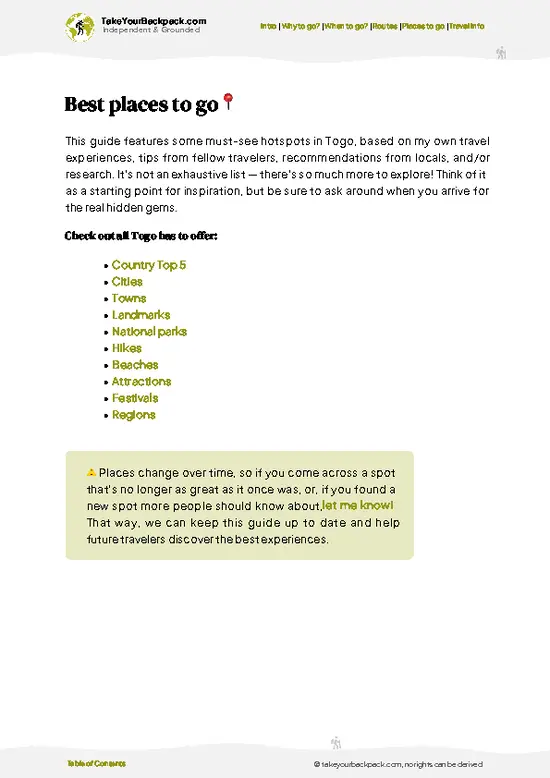
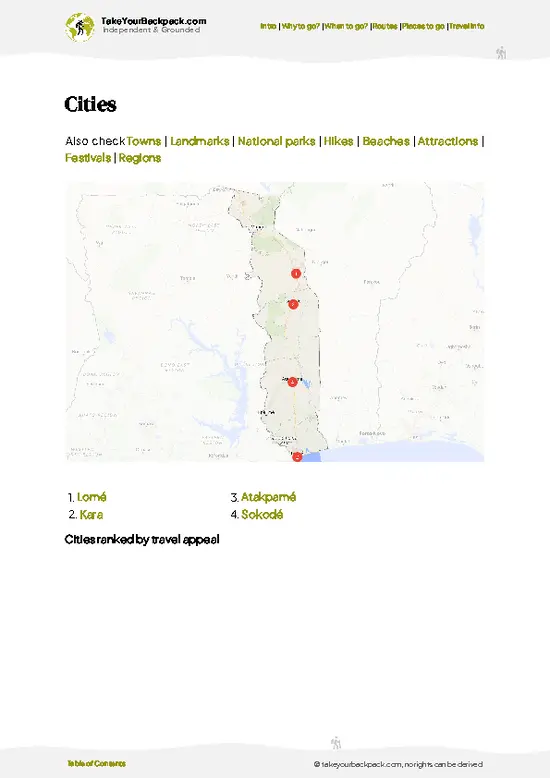
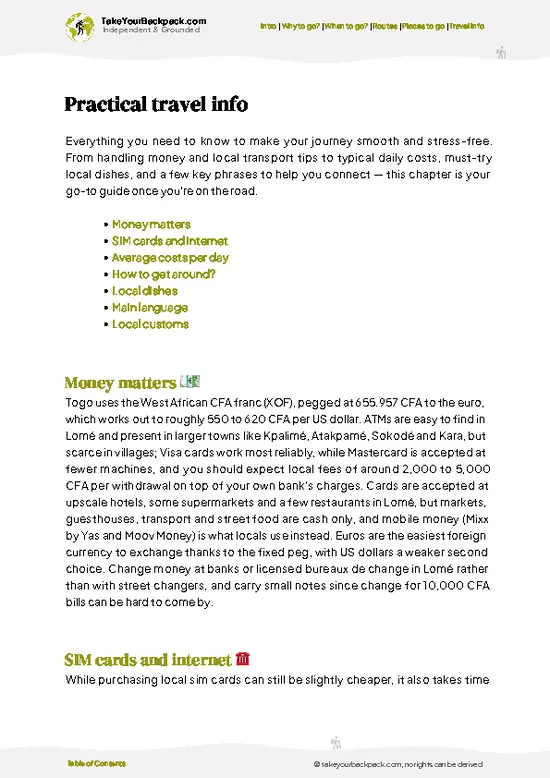
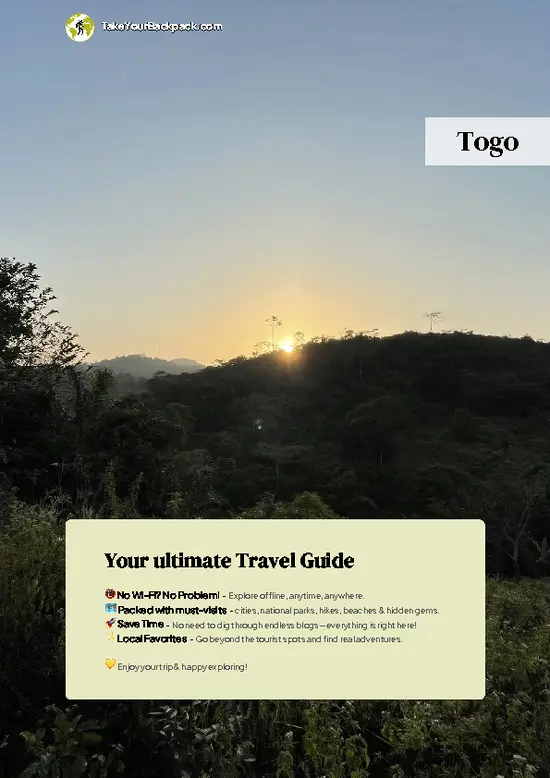
example page 0 from our offline Travel Guide for Togo
example page 1 from our offline Travel Guide for Togo
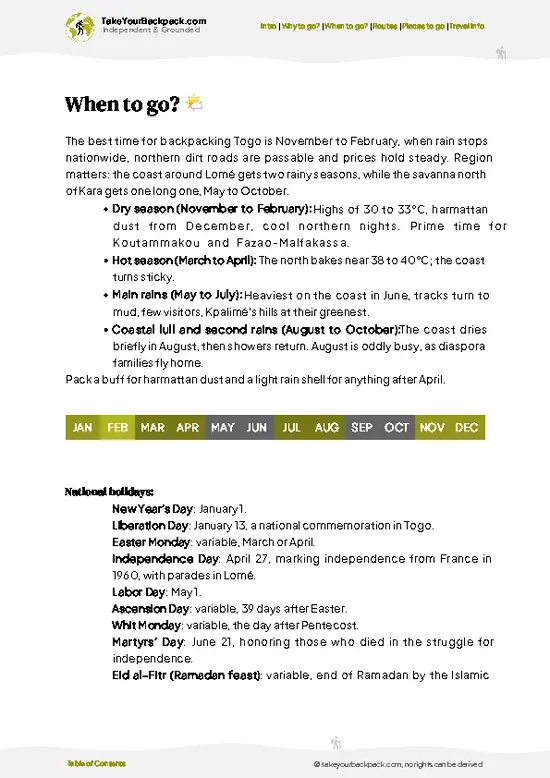
example page 2 from our offline Travel Guide for Togo
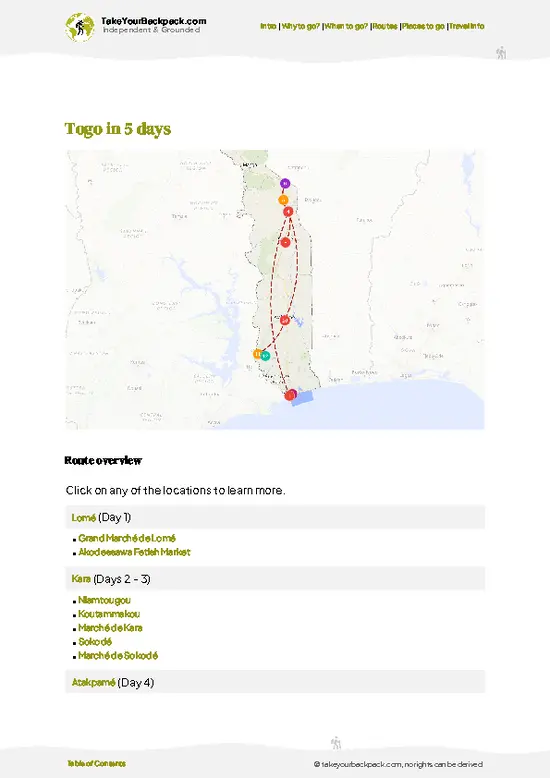
example page 3 from our offline Travel Guide for Togo
example page 4 from our offline Travel Guide for Togo
example page 5 from our offline Travel Guide for Togo
example page 6 from our offline Travel Guide for Togo
example page 7 from our offline Travel Guide for Togo
The digital guide (194 pages) contains:
✅ 42 highlights, ranked by travel appeal
✅ Optimized 2, 3 & 5-day travel routes
✅ Cities, national parks, landmarks, beaches
✅ How to get around
✅ Offline-friendly for travel without Wi-Fi
👉 Click to see all 30+ guide features

📅 Plan smarter in minutes, not weeks
✅ Month by month travel advice
✅ Festivals & national holidays
✅ Budget expectations

🗺️ Go to the right places, skip the overrated ones
✅ Honest pros & cons of destinations
✅ Top hikes, parks & viewpoints
✅ Lesser-known places most travelers miss
✅ Clear “worth it vs skip it” guidance

🛏️ Travel smoothly without rookie mistakes
✅ Best areas to stay
✅ Transport systems explained simply
✅ Common scams & safety advice
✅ SIM cards, money & practical tips

🌍 Understand the country, not just visit it
✅ Culture & traditions
✅ 52 Essential phrases & customs
✅ Festivals worth planning around
✅ Traveler-friendly historical context
✅ Insights that make places more meaningful

📱 Built for real travel conditions
✅ Fully downloadable PDF
✅ Works completely offline
✅ Optimized for phone use
✅ Useful in remote areas & buses
✅ Everything in one place
Stop searching, start planning
Get instant access to your full guide. 30‑day money-back guarantee.
+ Add another guide for just

By proceeding you agree to our terms.
Sent to your inbox immediately after payment • 100% Secure Checkout
Best Backpacking Travel Advisor 2025 tourism awardBest Backpacking
Travel Advisor
2025
What others say about Take Your Backpack Guides:
⭐⭐⭐⭐⭐
Fantastic, amazing amount of information!
⭐⭐⭐⭐⭐
My goodness this is amazing, it's what I've been looking for hats off too you!
⭐⭐⭐⭐⭐
I think this is absolutely BRILLIANT
⭐⭐⭐⭐
Very complete and informative. It's still missing places, but I gotta to commend you
⭐⭐⭐⭐⭐
This is truly amazing, thank you, can't wait to explore it with my kids!
⭐⭐⭐⭐⭐
Awesome resource, thank you!
⭐⭐⭐⭐⭐
This is amazing! Can't wait to explore the ones I haven't seen
⭐⭐⭐⭐
I love this! Well done, great idea.
⭐⭐⭐⭐⭐
Thanks for taking the time to make this gem!
⭐⭐⭐⭐⭐
This might be the best website I've ever seen.
⭐⭐⭐⭐⭐
Congratulations, and thank you so much for your work; it's incredibly valuable.
⭐⭐⭐⭐
In all seriousness I think you did a great job pointing out the important spots
⭐⭐⭐⭐⭐
10/10 very good
⭐⭐⭐⭐⭐
As someone who's only just starting to visit regularly this is awesome, thank you.
⭐⭐⭐⭐
Thank you very much! I'm going to visit my dad, it's going to be very useful!
⭐⭐⭐⭐⭐
This is really cool! We'll be travelling for the first time and this definitely come in handy.
⭐⭐⭐⭐⭐
You are now our minister of culture, congratulations 👨‍💼
⭐⭐⭐⭐⭐
Just wanted to tell you that this is a pearl! Going to follow your recommendations.
⭐⭐⭐⭐⭐
This is so cool. I'll definitely be using the resource for my travels soon.
⭐⭐⭐⭐⭐
This is very impressive! Good work.
⭐⭐⭐⭐⭐
This is an amazing and informative site. Very well done!

🛏️ Where to stay?Where to Stay: Togo Edition

Dedicated backpacker hostels are rare in Togo, but simple guesthouses and auberges are easy to find, usually at 8,000 to 15,000 CFA (about €12 to 23) for a fan room and a bit more with air-conditioning. In Lomé, Kodjoviakopé and Nyékonakpoè near the beach and the Ghana border hold the most budget rooms and are quiet and walkable to the coast road, while Bè puts you closer to cheap maquis bars and late music but gets rowdier at night, and the area around the Grand Marché is central for errands yet empties out after dark. Up-country, Kpalimé has a good spread of cheap, calm guesthouses within easy reach of the hills and waterfalls, and Aného offers a handful of laid-back lagoon-side options.

If … read more 👉
Dedicated backpacker hostels are rare in Togo, but simple guesthouses and auberges are easy to find, usually at 8,000 to 15,000 CFA (about €12 to 23) for a fan room and a bit more with air-conditioning. In Lomé, Kodjoviakopé and Nyékonakpoè near the beach and the Ghana border hold the most budget rooms and are quiet and walkable to the coast road, while Bè puts you closer to cheap maquis bars and late music but gets rowdier at night, and the area around the Grand Marché is central for errands yet empties out after dark. Up-country, Kpalimé has a good spread of cheap, calm guesthouses within easy reach of the hills and waterfalls, and Aného offers a handful of laid-back lagoon-side options.

If you enjoy meeting fellow travelers, consider choosing hostels with high ratings for atmosphere. On the other hand, if you prefer having your own space, a hotel might be a better option.

TogoExplore Beyond This Category

👋 Meet the founderWho’s Behind Take Your Backpack?

Johan, backpacker and founder of TakeYourBackpackHi, I’m Johan (Netherlands 🇳🇱), the creator of TakeYourBackpack. Over the past 3 decades, I’ve backpacked through 90+ countries across six continents, gaining extensive experience with independent travel, long-term trips, and overland routes.

This site is built on a combination of firsthand travel experience and carefully curated insights from other backpackers. Many guides are based on places I’ve personally visited, while others bring together tips, observations, and practical advice shared by trusted travelers I’ve met along the way.

The goal is to provide realistic, experience-driven guidance — not generic itineraries — so you can explore destinations with better context, clearer expectations, and more confidence.