
×

Togo🇹🇬 | townsTogovilleLake Togo, Marian pilgrimage, Mlapa palace, Vodun shrines | things to do and best time to go

Explore KpéléExplore Blitta

Backpacking in Togoville
🏆 Top picktown ranked #3
By Johan Kruseman 🇳🇱 | Updated October 22, 2026

Togoville sits on a lake, not the ocean, and plenty of travelers expect a beach village because of how close it is to the coast. It lies on the northern shore of Lake Togo in the south of Togo, east of Lomé. The air smells of woodsmoke and brackish water, and the only sounds are paddles knocking on wood, roosters and church bells. Streets are sandy and the heat sits on your shoulders by mid-morning. There is little here beyond a cathedral, a palace compound, shrines and lake views, so it works as a half-day or overnight stop between Lomé and the coast road east. Evenings are quiet, with a few basic guesthouses and few other backpackers, so you meet people over a beer, not in dorms. Boats are the usual route because the lake gets crossed more easily than the road loops around it. Carry small bills in West African francs, since boatmen rarely have change and fix their price before you step in.

Discover everything you want to know in the 📖 Togo Travel Guide.


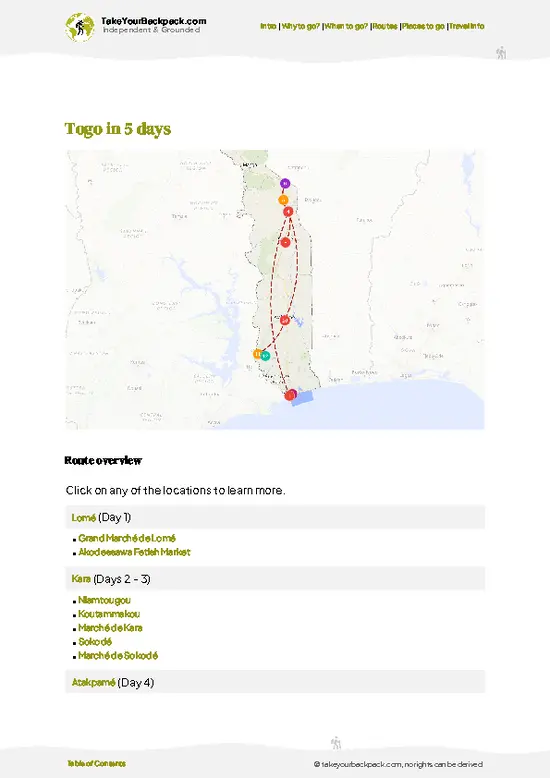
example page 0 from our offline Travel Guide for Togo
example page 1 from our offline Travel Guide for Togo
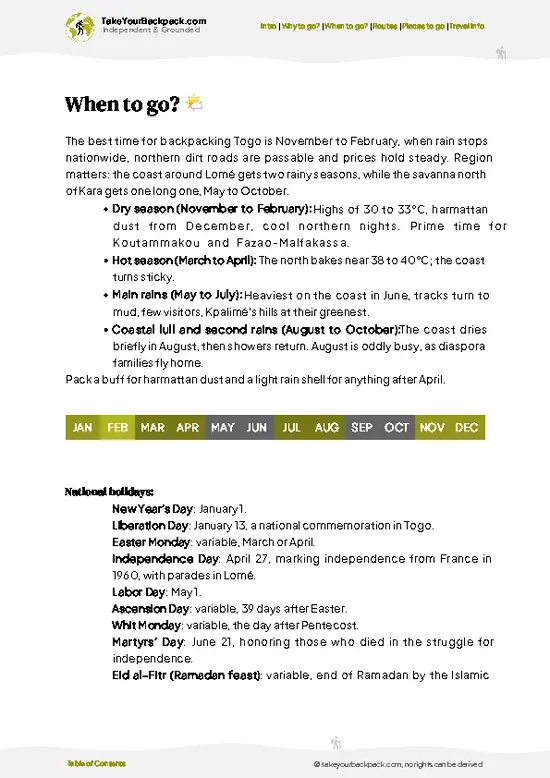
example page 2 from our offline Travel Guide for Togo
example page 3 from our offline Travel Guide for Togo
example page 4 from our offline Travel Guide for Togo
example page 5 from our offline Travel Guide for Togo
example page 6 from our offline Travel Guide for Togo
example page 7 from our offline Travel Guide for Togo
Loading the map 🌍
CLICK TO FILTER
cities
towns
landmarks
national parks
hikes
beaches
attractions
festivals
regions
SHOW COUNTRY’S BESTSHOW ALL

✨ Why go?
Ranked #3 town in Togo
Reasons people choose to visit here

Togoville gives you something rare on the Togolese coast: a place where colonial history, Catholic pilgrimage and vodun practice sit within a few minutes’ walk of each other. It was the seat of King Mlapa III, who signed the 1884 protectorate treaty with Germany, and the lakeside church later drew a papal visit. Most people come for a few hours and leave by the afternoon boat, but staying a night lets you see the village after the day-trippers go, when fishing canoes slide out and the lake turns still. It suits slow travelers, solo travelers who like a guide for company, and anyone curious about vodun without wanting a staged show. The pirogue crossing is half the appeal, and a lakeside sunset beer is the other half. If you need nightlife, cafés or fast internet, you will be bored. If you … read more 👉
Togoville gives you something rare on the Togolese coast: a place where colonial history, Catholic pilgrimage and vodun practice sit within a few minutes’ walk of each other. It was the seat of King Mlapa III, who signed the 1884 protectorate treaty with Germany, and the lakeside church later drew a papal visit. Most people come for a few hours and leave by the afternoon boat, but staying a night lets you see the village after the day-trippers go, when fishing canoes slide out and the lake turns still. It suits slow travelers, solo travelers who like a guide for company, and anyone curious about vodun without wanting a staged show. The pirogue crossing is half the appeal, and a lakeside sunset beer is the other half. If you need nightlife, cafés or fast internet, you will be bored. If you like small places where one conversation with a priest or palace guardian can fill an afternoon, this works well, especially paired with Lake Togo’s fishing villages.

💡 HighlightsDon't-miss highlights and experiences

  1. Cathedral Notre Dame du Lac: The lakeside church, built in the early twentieth century, became a pilgrimage site after Marian apparitions reported in the 1970s, and Pope John Paul II prayed here in 1985. Inside, painted statues and a cool, quiet nave make a break from the heat. Morning or late afternoon is best, outside Sunday service. Donation of about €1 to 2, 30 to 45 minutes.
  2. Grotto of Our Lady: A small shrine near the church where pilgrims light candles and leave offerings. It is calm, local and rarely crowded, and the lake breeze helps in the afternoon. Free, 15 to 20 minutes.
  3. Palace of King Mlapa: The royal compound holds relics of the Mlapa dynasty and the story of the 1884 treaty with Germany. A guide from the family or village explains the objects, which makes the visit. Go in the
… read more 👉
  1. Cathedral Notre Dame du Lac: The lakeside church, built in the early twentieth century, became a pilgrimage site after Marian apparitions reported in the 1970s, and Pope John Paul II prayed here in 1985. Inside, painted statues and a cool, quiet nave make a break from the heat. Morning or late afternoon is best, outside Sunday service. Donation of about €1 to 2, 30 to 45 minutes.
  2. Grotto of Our Lady: A small shrine near the church where pilgrims light candles and leave offerings. It is calm, local and rarely crowded, and the lake breeze helps in the afternoon. Free, 15 to 20 minutes.
  3. Palace of King Mlapa: The royal compound holds relics of the Mlapa dynasty and the story of the 1884 treaty with Germany. A guide from the family or village explains the objects, which makes the visit. Go in the morning. Around €1 to 3 plus a tip, 45 minutes.
  4. Vodun shrines and fetish sites: The village has working shrines where priests explain the role of the spirits and the lake in daily life. Ask permission, dress modestly and photograph only when invited. A local guide is worthwhile, about €3 to 6, 1 to 2 hours.
  5. Pirogue ride on Lake Togo: A paddle among fishing nets, stilt houses and reed shores, with egrets and kingfishers along the edge. Early morning is calmest and coolest. Roughly €3 to 8 per boat, 1 to 2 hours.
Beyond Togoville, easy extra stops are the slave-trade memorial house at Agbodrafo, the old colonial town of Aného with its crumbling German-era buildings, and Lomé’s Grand Marché. For a first visit, start with Cathedral Notre Dame du Lac and then walk to the palace, because together they tell the village’s whole story.
Spotted a mistake or missing something? Contact us.

Things to do near Togoville

Ratings based on Tripadvisor reviews. When you book through this link, you support our work at no extra cost to you.

🏘️ NeighborhoodsKey areas and districts to know

Togoville is small enough to cover on foot in a morning, and its few areas differ sharply in feel, so it pays to know where each one sits before the heat builds.
  • Lakeshore and the pirogue landing: This is where you arrive, and it is the busiest patch. Wooden canoes knock against each other, fishermen mend nets, and the air smells of wet wood, smoke and drying fish. Boats are poled out at fixed moments of the day, so linger here early when the water is flat and the light is soft. Prices for crossings are negotiated, so agree before stepping aboard.
  • Cathedral quarter: The Sacred Heart church and the grotto of Our Lady of Lake Togo anchor the upper village. Red earth paths run between low houses, hens scatter, and church bells carry across the water. It is quiet and shaded in patches, and the old
… read more 👉
Togoville is small enough to cover on foot in a morning, and its few areas differ sharply in feel, so it pays to know where each one sits before the heat builds.
  • Lakeshore and the pirogue landing: This is where you arrive, and it is the busiest patch. Wooden canoes knock against each other, fishermen mend nets, and the air smells of wet wood, smoke and drying fish. Boats are poled out at fixed moments of the day, so linger here early when the water is flat and the light is soft. Prices for crossings are negotiated, so agree before stepping aboard.
  • Cathedral quarter: The Sacred Heart church and the grotto of Our Lady of Lake Togo anchor the upper village. Red earth paths run between low houses, hens scatter, and church bells carry across the water. It is quiet and shaded in patches, and the old German-era buildings sit close by. Visit outside Sunday service if you want silence rather than singing.
  • Vodun sites and fetish shrines: Scattered through the village are shrines and the royal compound of the Mlapa dynasty. Powder, red cloth and animal horns make the textures here strange and tactile. A local guide is the practical choice, because shrines have rules about photos and offerings that a guide explains on the spot.
  • Market and village lanes: Small stalls sell grilled lake fish, fried plantain and pâte with sauce, and the smell of palm oil hangs over everything. Evenings are dark and calm, with no nightlife beyond a couple of simple bars. Walking is flat and easy, though sandy lanes are slippery after rain.

⌛️ 1 dayHow to make the most of one day

7:30 AM, Agbodrafo landing: Take coffee and bread at the jetty, then agree a price and board a pirogue across the lake. The early light is soft and the water flat, and boatmen are easier to bargain with before the day-trippers arrive.
8:30 AM, Togoville landing: Step off onto sandy paths and walk up through the village. Pass nets drying on the shore and women selling fried fish and doughnuts.
9:00 AM, Cathedral Notre Dame du Lac: Spend half an hour inside and around the grounds while it is still cool. Then walk the short path to the grotto.
10:30 AM, Palace of King Mlapa: Ask for a guide to explain the relics and the 1884 treaty. It is worth the time because the stories are told by people connected to the royal family.
12:30 PM, Lunch by the lake: Find a simple spot for grilled tilapia, pounded … read more 👉
7:30 AM, Agbodrafo landing: Take coffee and bread at the jetty, then agree a price and board a pirogue across the lake. The early light is soft and the water flat, and boatmen are easier to bargain with before the day-trippers arrive.
8:30 AM, Togoville landing: Step off onto sandy paths and walk up through the village. Pass nets drying on the shore and women selling fried fish and doughnuts.
9:00 AM, Cathedral Notre Dame du Lac: Spend half an hour inside and around the grounds while it is still cool. Then walk the short path to the grotto.
10:30 AM, Palace of King Mlapa: Ask for a guide to explain the relics and the 1884 treaty. It is worth the time because the stories are told by people connected to the royal family.
12:30 PM, Lunch by the lake: Find a simple spot for grilled tilapia, pounded yam or rice with sauce. Eat slowly, since the midday heat makes walking unpleasant.
2:30 PM, Vodun shrine visit: This is the off-route stop. With a local guide, visit a small family shrine away from the main path, listen to the priest, and leave a modest offering.
4:30 PM, Quiet shoreline paddle: Hire a small canoe for an hour among the reeds and fishing stakes. Birds are most active now, and the air cools.
6:00 PM, Return crossing: Take the last boat back before dusk, or stay in a guesthouse and have a beer on the shore.

🌤️ When to go?Best time to visit Togoville

The dry months from November to March suit Togoville best, with sunny days and the lake calm enough for easy canoe crossings.
  • Main dry season (November to March): Daytime highs sit around 30 to 33°C (86 to 91°F), nights near 23 to 25°C (73 to 77°F). The harmattan wind can leave a dusty haze from December to February. Prices stay flat, and crowds are small except around Christmas.
  • Long rains (April to July): Heavy downpours, humid 28 to 31°C (82 to 88°F) days, and muddy lanes. The lake gets choppier and boat rides are less pleasant, though everything is green and quiet.
  • Short dry spell (August to September): Cloudier and cooler, around 25 to 28°C (77 to 82°F), with fewer storms. A good compromise month.
  • Short rains (October to November): Showers return, but they usually pass quickly.
Daylight stays … read more 👉
The dry months from November to March suit Togoville best, with sunny days and the lake calm enough for easy canoe crossings.
  • Main dry season (November to March): Daytime highs sit around 30 to 33°C (86 to 91°F), nights near 23 to 25°C (73 to 77°F). The harmattan wind can leave a dusty haze from December to February. Prices stay flat, and crowds are small except around Christmas.
  • Long rains (April to July): Heavy downpours, humid 28 to 31°C (82 to 88°F) days, and muddy lanes. The lake gets choppier and boat rides are less pleasant, though everything is green and quiet.
  • Short dry spell (August to September): Cloudier and cooler, around 25 to 28°C (77 to 82°F), with fewer storms. A good compromise month.
  • Short rains (October to November): Showers return, but they usually pass quickly.
Daylight stays close to 12 hours all year, so start crossings early before the afternoon heat. Aim for a weekday if you want the shrines to yourself.


source: climatestotravel.comJANJanuary: excellent for travelingFEBFebruary: excellent for travelingMARMarch: highly recommended for travelingAPRApril: fair for travelingMAYMay: fair for travelingJUNJune: fair for travelingJULJuly: fair for travelingAUGAugust: fair for travelingSEPSeptember: fair for travelingOCTOctober: fair for travelingNOVNovember: highly recommended for travelingDECDecember: excellent for traveling
when-to-go

✈️ The backpacker research shortcutTogo Travel Guide

An offline-friendly backpacking guide with optimized travel routes, ranked highlights, transport advice, and the best areas to stay.
example page 0 from our offline Travel Guide for Togo
example page 1 from our offline Travel Guide for Togo
example page 2 from our offline Travel Guide for Togo
example page 3 from our offline Travel Guide for Togo
example page 4 from our offline Travel Guide for Togo
example page 5 from our offline Travel Guide for Togo
example page 6 from our offline Travel Guide for Togo
example page 7 from our offline Travel Guide for Togo
The digital guide (194 pages) contains:
✅ 42 highlights, ranked by travel appeal
✅ Optimized 2, 3 & 5-day travel routes
✅ Cities, national parks, landmarks, beaches
✅ How to get around
✅ Offline-friendly for travel without Wi-Fi
👉 Click to see all 30+ guide features

📅 Plan smarter in minutes, not weeks
✅ Month by month travel advice
✅ Festivals & national holidays
✅ Budget expectations

🗺️ Go to the right places, skip the overrated ones
✅ Honest pros & cons of destinations
✅ Top hikes, parks & viewpoints
✅ Lesser-known places most travelers miss
✅ Clear “worth it vs skip it” guidance

🛏️ Travel smoothly without rookie mistakes
✅ Best areas to stay
✅ Transport systems explained simply
✅ Common scams & safety advice
✅ SIM cards, money & practical tips

🌍 Understand the country, not just visit it
✅ Culture & traditions
✅ 52 Essential phrases & customs
✅ Festivals worth planning around
✅ Traveler-friendly historical context
✅ Insights that make places more meaningful

📱 Built for real travel conditions
✅ Fully downloadable PDF
✅ Works completely offline
✅ Optimized for phone use
✅ Useful in remote areas & buses
✅ Everything in one place
Stop searching, start planning
Get instant access to your full guide. 30‑day money-back guarantee.
+ Add another guide for just

By proceeding you agree to our terms.
Sent to your inbox immediately after payment • 100% Secure Checkout
Best Backpacking Travel Advisor 2025 tourism awardBest Backpacking
Travel Advisor
2025
What others say about Take Your Backpack Guides:
⭐⭐⭐⭐⭐
Fantastic, amazing amount of information!
⭐⭐⭐⭐⭐
My goodness this is amazing, it's what I've been looking for hats off too you!
⭐⭐⭐⭐⭐
I think this is absolutely BRILLIANT
⭐⭐⭐⭐
Very complete and informative. It's still missing places, but I gotta to commend you
⭐⭐⭐⭐⭐
This is truly amazing, thank you, can't wait to explore it with my kids!
⭐⭐⭐⭐⭐
Awesome resource, thank you!
⭐⭐⭐⭐⭐
This is amazing! Can't wait to explore the ones I haven't seen
⭐⭐⭐⭐
I love this! Well done, great idea.
⭐⭐⭐⭐⭐
Thanks for taking the time to make this gem!
⭐⭐⭐⭐⭐
This might be the best website I've ever seen.
⭐⭐⭐⭐⭐
Congratulations, and thank you so much for your work; it's incredibly valuable.
⭐⭐⭐⭐
In all seriousness I think you did a great job pointing out the important spots
⭐⭐⭐⭐⭐
10/10 very good
⭐⭐⭐⭐⭐
As someone who's only just starting to visit regularly this is awesome, thank you.
⭐⭐⭐⭐
Thank you very much! I'm going to visit my dad, it's going to be very useful!
⭐⭐⭐⭐⭐
This is really cool! We'll be travelling for the first time and this definitely come in handy.
⭐⭐⭐⭐⭐
You are now our minister of culture, congratulations 👨‍💼
⭐⭐⭐⭐⭐
Just wanted to tell you that this is a pearl! Going to follow your recommendations.
⭐⭐⭐⭐⭐
This is so cool. I'll definitely be using the resource for my travels soon.
⭐⭐⭐⭐⭐
This is very impressive! Good work.
⭐⭐⭐⭐⭐
This is an amazing and informative site. Very well done!

🛏️ Where to stay?Best areas and accommodation options

Togoville has only a few simple guesthouses, so most backpackers sleep in nearby Aného or in Lomé and visit by boat or bike.
Aného is the better choice for a budget stay close to the lake. Basic rooms and small guesthouses cost around €10 to 20 a night, there are no true dorm hostels, and the streets are calm after dark. Transport links are reasonable, with shared taxis to Lomé and zem to the lake landing, and the sea breeze helps with sleeping. Noise is mostly roosters and the occasional generator.

Lomé is the second option and has by far the widest range, including a handful of dorm beds at … read more 👉
Togoville has only a few simple guesthouses, so most backpackers sleep in nearby Aného or in Lomé and visit by boat or bike.
Aného is the better choice for a budget stay close to the lake. Basic rooms and small guesthouses cost around €10 to 20 a night, there are no true dorm hostels, and the streets are calm after dark. Transport links are reasonable, with shared taxis to Lomé and zem to the lake landing, and the sea breeze helps with sleeping. Noise is mostly roosters and the occasional generator.

Lomé is the second option and has by far the widest range, including a handful of dorm beds at roughly €8 to 15 and cheap private rooms. Neighborhoods near the Grand Marché and the beach area are the easiest bases, with plentiful taxis and food stalls. Nights can be loud with traffic and bars, and it is wiser to take a taxi than walk long distances after dark. The trade-off is travel time, about 1.5 to 2 hours to reach Togoville, so an early start is needed.

If you do stay in the village itself, expect fans rather than air conditioning, intermittent power and cold-water showers, and book ahead through a local contact when possible.

🚌 Getting aroundHow to get around Togoville

Togoville is best explored on foot, because the village is flat and compact and the one thing you cannot walk is the lake crossing itself. Roads are sandy red earth, traffic is almost nonexistent, and public transport is thin, so you rely on the water and a few motorbikes.
  • Walking: Free, and the whole village takes about one to two hours at an easy pace. Lanes are shaded by palms and mango trees but turn slick after rain, so go early when the air is cooler.
  • Pirogue from Aného or lakeshore towns: Wooden canoes cross the lake at roughly €1 to 3 per person for a shared run, or about €8 to 15 if you hire a whole boat. The ride takes about 15 to 30 minutes depending on the point of departure, and boats go from early morning until late afternoon. The boatman poles or paddles with only the sound of
… read more 👉
Togoville is best explored on foot, because the village is flat and compact and the one thing you cannot walk is the lake crossing itself. Roads are sandy red earth, traffic is almost nonexistent, and public transport is thin, so you rely on the water and a few motorbikes.
  • Walking: Free, and the whole village takes about one to two hours at an easy pace. Lanes are shaded by palms and mango trees but turn slick after rain, so go early when the air is cooler.
  • Pirogue from Aného or lakeshore towns: Wooden canoes cross the lake at roughly €1 to 3 per person for a shared run, or about €8 to 15 if you hire a whole boat. The ride takes about 15 to 30 minutes depending on the point of departure, and boats go from early morning until late afternoon. The boatman poles or paddles with only the sound of water and creaking wood, which is why the crossing feels slow. Settle the fare before sitting down, and ask about the return time so you are not stranded as dusk comes.
  • Zem (motorbike taxi): The usual way in from the main road at Aného or Lomé. Short hops in the village cost about €0.50 to 1.50, and the trip from Lomé area often runs €6 to 12 depending on bargaining. Dust and engine noise come with it. Ask the rider to slow down on sandy stretches, and wear a helmet if offered.
  • Shared taxi and minibus: Cars run from Lomé toward Aného for about €2 to 4, taking roughly 1.5 to 2 hours. They leave when full, so mornings are fastest and vehicles can be cramped and hot. From the drop-off, continue by zem or boat to the village.
Carry small bills, since boatmen rarely have change, and pay in CFA francs. Avoid traveling back after dark, as there is little lighting and few vehicles.

👛 Costs (as of 22 October 2026)How expensive it really is

Togoville costs about €22 to 43 a day for a backpacker, with most of the spending going on meals, boat rides and a guide. The village has few formal services, so many travelers combine it with a base in nearby Aného or Lomé.
CategoryBudget RangeLocal Reality
Dorm accommodation€8 to 15 (high season)Few true dorms exist, so expect a basic guesthouse room or a bed in Lomé. Low season runs €6 to 12.
Meals€5 to 9Grilled lake fish, rice with sauce and fried plantain at village stalls cost €1.50 to 3 each. Restaurants cost more.
Local transport€4 to 8Pirogue crossings, zem rides and shared taxis add up, and a hired boat is the biggest single item.
Basic activities/entry fees€3 to 7Shrine visits and the cathedral grounds ask for small donations, and a local guide costs about €3 to 7.
Miscellaneous expenses€2
… read more 👉
Togoville costs about €22 to 43 a day for a backpacker, with most of the spending going on meals, boat rides and a guide. The village has few formal services, so many travelers combine it with a base in nearby Aného or Lomé.
CategoryBudget RangeLocal Reality
Dorm accommodation€8 to 15 (high season)Few true dorms exist, so expect a basic guesthouse room or a bed in Lomé. Low season runs €6 to 12.
Meals€5 to 9Grilled lake fish, rice with sauce and fried plantain at village stalls cost €1.50 to 3 each. Restaurants cost more.
Local transport€4 to 8Pirogue crossings, zem rides and shared taxis add up, and a hired boat is the biggest single item.
Basic activities/entry fees€3 to 7Shrine visits and the cathedral grounds ask for small donations, and a local guide costs about €3 to 7.
Miscellaneous expenses€2 to 4Water, snacks, a SIM top-up and small tips.
Total Daily Budget€22 to 43Plan around €33 on a normal day.
Carry small CFA franc notes and share boat rides with other travelers to cut the per-person fare.
⚠️ Prices can change and everyone travels differently, so take this as a rough guide. Hope it helps you plan your adventure!

🚌 Day tripsShort trips worth adding

Togoville works well as a base for short trips along the coast and lake, since everything sits within a couple of hours and most routes use shared taxis and zem.
Aného:
This old colonial capital has crumbling German and Brazilian-style houses, a lively market and a long beach. Allow about 30 to 45 minutes by boat and zem, with a total cost of around €5 to 10 including food. Go in the dry months when roads are firm, and avoid arriving at midday when the heat shuts the town down.
👉 Explore Aného
Lake Togo:
A slow canoe loop around the lake lets you watch fishermen casting nets and egrets on the reeds. Hiring a boat runs about €8 to 20 for a few hours, and it is best in the morning when the water is glassy. First-timers often skip bargaining and overpay, so agree on duration and price first.
👉 Explore … read more 👉
Togoville works well as a base for short trips along the coast and lake, since everything sits within a couple of hours and most routes use shared taxis and zem.
Aného:
This old colonial capital has crumbling German and Brazilian-style houses, a lively market and a long beach. Allow about 30 to 45 minutes by boat and zem, with a total cost of around €5 to 10 including food. Go in the dry months when roads are firm, and avoid arriving at midday when the heat shuts the town down.
👉 Explore Aného
Lake Togo:
A slow canoe loop around the lake lets you watch fishermen casting nets and egrets on the reeds. Hiring a boat runs about €8 to 20 for a few hours, and it is best in the morning when the water is glassy. First-timers often skip bargaining and overpay, so agree on duration and price first.
👉 Explore Lake Togo
Agbodrafo:
This lakeside spot has the Zomayi slave-trade memorial house and the Adjido beach and fishing quarter nearby. It is a short zem ride of 20 to 30 minutes and costs about €3 to 8 round trip. The site rewards a guided visit, so allow an hour for explanations.

Lomé:
The capital offers the Grand Marché, the Fetish Market (Akodessewa) with its heaps of skulls and charms, and a busy waterfront. Shared taxis take about 1.5 to 2 hours each way and a day costs around €12 to 25. Leave before 7 a.m. to be back before dark.
👉 Explore Lomé

🛡️ SafetySafety Tips and Common Scams in Togoville

Togoville is calm and the main risks are everyday ones rather than crime. The most common issue is overcharging on boat rides and guided shrine visits, so agree on prices before you start and carry small change in CFA francs. Some touts at the landing may claim a fixed rate that is really an opening bid. Politely stand firm or ask another boatman.

Solo travelers, including women, generally report few problems in daylight. After dark the lanes have little lighting and sandy ruts, so carry a headlamp and avoid walking alone to the lake edge. Boats stop late in the afternoon, so plan your return early.

Ask permission before photographing shrines, ceremonies and people, because it can cause offense and may lead to demands for payment. Keep valuables out of sight on zem rides, drink only bottled … read more 👉
Togoville is calm and the main risks are everyday ones rather than crime. The most common issue is overcharging on boat rides and guided shrine visits, so agree on prices before you start and carry small change in CFA francs. Some touts at the landing may claim a fixed rate that is really an opening bid. Politely stand firm or ask another boatman.

Solo travelers, including women, generally report few problems in daylight. After dark the lanes have little lighting and sandy ruts, so carry a headlamp and avoid walking alone to the lake edge. Boats stop late in the afternoon, so plan your return early.

Ask permission before photographing shrines, ceremonies and people, because it can cause offense and may lead to demands for payment. Keep valuables out of sight on zem rides, drink only bottled or filtered water, and use mosquito repellent at dusk. On the lake itself, ask whether a life jacket is available, since canoes tip easily.

FAQTraveler FAQ

Togoville is worth visiting rather than just passing through, mainly for its Vodun shrines, the Sacred Heart church and the quiet canoe crossing on Lake Togo. A half day covers the main sites, and a guide costs about €3 to 7. Anyone interested in West African spirituality or colonial history gets far more from it than a rushed stop would suggest.
One full day is plenty for Togoville, and a half day works if you only want the church, shrines and lakeshore. Allow roughly 2 to 3 hours for the village and another hour for a canoe ride on the lake. Add a second day only if you want to pair it with Aného, about 30 to 45 minutes away, or Agbodrafo.
Togoville can be done as a day trip from Lomé, which lies about 1.5 to 2 hours away by shared taxi and boat or zem. A round trip costs around €12 to 25 including transport, a guide and lunch. Leave before 7 a.m. so you are back in the city before dark, since boats and cars thin out in the late afternoon.
⚠️ Things can change over time, so always validate details locally before you go.

Other Togolese towns near Togoville

Explore more nearby:

  • Aného—Lawson palace, decaying colonial quarter, fishing nets, lagoon boats| 12 km away
  • Vogan—Inland market, metal workshops, Ewe church singing, open-air bars| 13 km away
  • Kpélé—Plateau village, dirt lanes, farm tracks, small produce market| 77 km away

💡 Not sure where to go next?
Create a personalized itinerary for Togo including Togoville and the places that fit your trip.

Generate my itinerary

👉 Discover all towns

Or checkout all Togo has to offer (think cities, towns, villages, national parks, hikes, beaches, festivals)
Country photo of Togo

We 💚 feedbackParting advice and final tips

Togoville fits neatly between Lomé and Aného, with Agbodrafo as the natural bridge, so build a lakeside day around the other two instead of making it your only stop. I would stay one night to see the village after the boats leave, and bring small bills, mosquito repellent and a charged phone, since evenings are dark.

✍️ Help improve this page!
The information on this page is based on in-depth research, insights shared by experienced travelers, and feedback from the local travel community in Togo. While every effort is made to keep the information accurate and current, conditions can change — so if you spot anything incorrect or outdated, please get in touch.


🙋‍♂️ Give feedback

👋 Meet the founderWho’s Behind Take Your Backpack?

Johan, backpacker and founder of TakeYourBackpackHi, I’m Johan (Netherlands 🇳🇱), the creator of TakeYourBackpack. Over the past 3 decades, I’ve backpacked through 90+ countries across six continents, gaining extensive experience with independent travel, long-term trips, and overland routes.

This site is built on a combination of firsthand travel experience and carefully curated insights from other backpackers. Many guides are based on places I’ve personally visited, while others bring together tips, observations, and practical advice shared by trusted travelers I’ve met along the way.

The goal is to provide realistic, experience-driven guidance — not generic itineraries — so you can explore destinations with better context, clearer expectations, and more confidence.