×

Tunisia🇹🇳 | citiesEl KefOttoman kasbah, hillside alleys, Roman cisterns, northwest border | things to do and best time to go

Explore SfaxExplore Monastir

Backpacking in El Kef
👍 Recommendedcity ranked #8
By Johan Kruseman 🇳🇱 | Updated October 22, 2026

El Kef is best known for its Kasbah, a sprawling Ottoman-era fortress that sits on a rocky spur with the whole town tumbling down the hillside beneath it. The city lies in the northwest of Tunisia, close to the Algerian border, and it feels a world away from the beach resorts. It suits travelers who like steep alleys, Roman and Ottoman layers and a slower pace. It does not suit anyone who wants nightlife or polished tourism, and the hills will punish bad shoes. Hostels are few, so a simple guesthouse in the old town gives you the best mix of comfort and savings, while a taxi up to the Kasbah costs little and spares your legs. Start your first day by climbing the old town streets on foot, then let a cafe terrace do the rest.

Discover everything you want to know in the 📖 Tunisia Travel Guide.


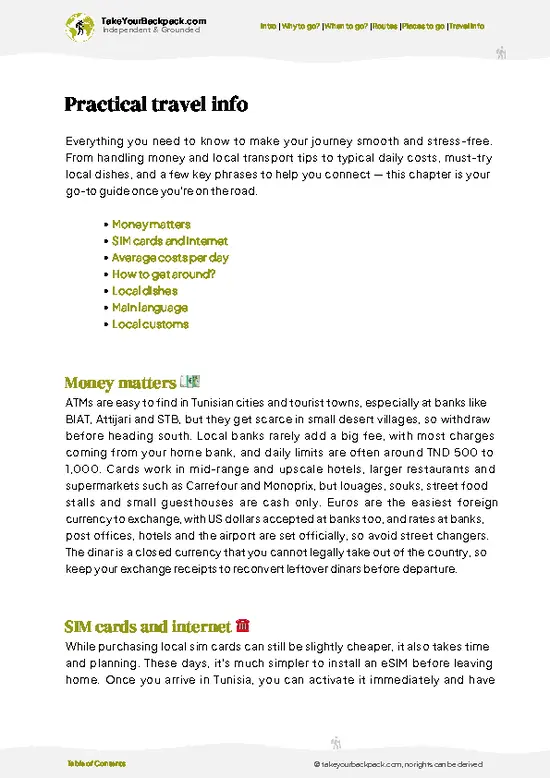
example page 0 from our offline Travel Guide for Tunisia
example page 1 from our offline Travel Guide for Tunisia
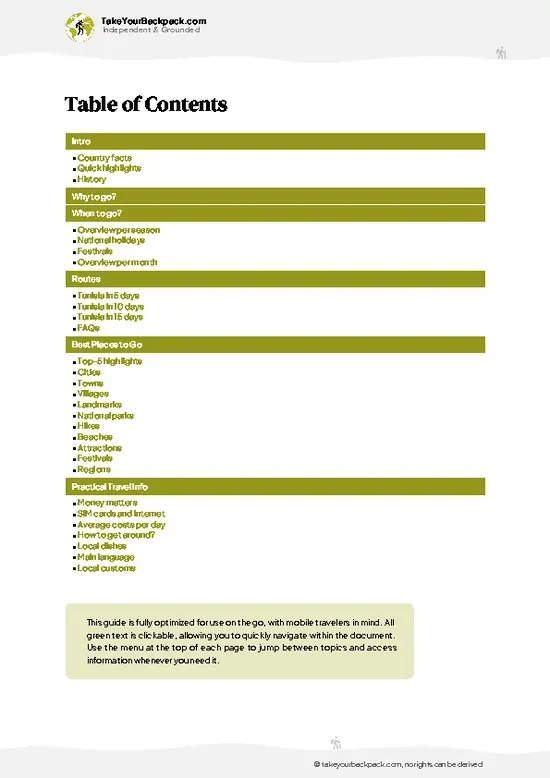
example page 2 from our offline Travel Guide for Tunisia
example page 3 from our offline Travel Guide for Tunisia
example page 4 from our offline Travel Guide for Tunisia
example page 5 from our offline Travel Guide for Tunisia
example page 6 from our offline Travel Guide for Tunisia
example page 7 from our offline Travel Guide for Tunisia
Loading the map 🌍
CLICK TO FILTER
cities
towns
villages
landmarks
national parks
hikes
beaches
attractions
festivals
regions
SHOW COUNTRY’S BESTSHOW ALL

✨ Why go?
Ranked #8 city in Tunisia
Why El Kef should be on your travel list

El Kef earns its place on a northwest Tunisia route because it packs a Roman cistern, an Ottoman fortress, a Sufi shrine and a tiny Ottoman-era mosque into a hillside town you can cross on foot in an hour. Crowds are almost absent, so you will often have the sights to yourself and be greeted as a curiosity rather than a customer. It also works as a base for the ruins of the high tell country and the Algerian-border hills, with Dougga and Sicca Veneria history close by. Louages and buses run to Tunis, Jendouba and Tébessa direction, so onward travel is simple. The food leans toward hearty northwestern cooking, including lamb and bread cooked in the oven. Expect few hostels and little nightlife. For two nights, it is a genuinely rewarding detour. For a rushed itinerary, skip it.

💡 HighlightsPlaces and moments you shouldn't skip

  1. Kasbah of El Kef: The hilltop fortress dates from the Ottoman period and overlooks the town and plains. Walk the ramparts, then look out toward Algeria. Entry is about US$2 to 3, allow 1 to 1.5 hours, and late afternoon gives the softest views.
  2. Zaouia of Sidi Bou Makhlouf: A shrine complex of a local saint, with domes and quiet courtyards. Dress modestly and ask before entering. Often free or a small donation, 30 minutes.
  3. Great Mosque and Roman cisterns: The cisterns in the old town are a vaulted Roman-era water system, interesting for the scale of the stonework. Around US$2, 30 to 45 minutes.
  4. Dar el Kous: A former Byzantine basilica turned cultural venue, set in the lower town. Hours vary, so check at the door. Usually a small fee, 30 minutes.
  5. Ras el Ain Spring: The source that gave El Kef its
… read more 👉
  1. Kasbah of El Kef: The hilltop fortress dates from the Ottoman period and overlooks the town and plains. Walk the ramparts, then look out toward Algeria. Entry is about US$2 to 3, allow 1 to 1.5 hours, and late afternoon gives the softest views.
  2. Zaouia of Sidi Bou Makhlouf: A shrine complex of a local saint, with domes and quiet courtyards. Dress modestly and ask before entering. Often free or a small donation, 30 minutes.
  3. Great Mosque and Roman cisterns: The cisterns in the old town are a vaulted Roman-era water system, interesting for the scale of the stonework. Around US$2, 30 to 45 minutes.
  4. Dar el Kous: A former Byzantine basilica turned cultural venue, set in the lower town. Hours vary, so check at the door. Usually a small fee, 30 minutes.
  5. Ras el Ain Spring: The source that gave El Kef its ancient role as a settlement, with a pleasant walk around it. Free, 30 minutes, best in the morning.
  6. Museum of Popular Arts and Traditions: Housed in a restored building in the old town, with displays of local life and craft. Around US$2, 45 minutes.
  7. Old town walk: Wander the steep alleys, the souk and the cafes around the main square. Free, 1 to 2 hours, best in the evening when the town fills up.
Beyond the city, El Kef puts you within reach of Dougga, Makthar and Sicca Veneria ruins for day trips. The Kasbah and the old town walk combine well in one afternoon.
Spotted a mistake or missing something? Contact us.

🏘️ NeighborhoodsHow different areas shape the experience

El Kef climbs a hillside under the Kasbah, so every area is a slope, and your calves will have opinions. The good news is that everything worth seeing sits within about 1.5 km (1 mile) of the main square.
  • Place de l’Indépendance and the center: Cafés, pharmacies, the main street and the shared-taxi pickups cluster here. It is flat enough to be forgiving and the best use of your time if you only have an evening. Men dominate the café terraces, so expect some people-watching to be mutual.
  • Medina and Kasbah quarter: Uphill, the old streets hold the Ottoman-era Kasbah fortress, the Sidi Bou Makhlouf zaouia and Roman cisterns. Steep lanes mean zero cars and plenty of cats. It costs only effort, and it gives the most character per step. Go for the views over the Algerian border hills.
  • Ras el Aïn spring
… read more 👉
El Kef climbs a hillside under the Kasbah, so every area is a slope, and your calves will have opinions. The good news is that everything worth seeing sits within about 1.5 km (1 mile) of the main square.
  • Place de l’Indépendance and the center: Cafés, pharmacies, the main street and the shared-taxi pickups cluster here. It is flat enough to be forgiving and the best use of your time if you only have an evening. Men dominate the café terraces, so expect some people-watching to be mutual.
  • Medina and Kasbah quarter: Uphill, the old streets hold the Ottoman-era Kasbah fortress, the Sidi Bou Makhlouf zaouia and Roman cisterns. Steep lanes mean zero cars and plenty of cats. It costs only effort, and it gives the most character per step. Go for the views over the Algerian border hills.
  • Ras el Aïn spring area: Below the Kasbah, the old spring and Roman baths mark where the town began. It is quiet, photogenic and a gentle downhill stroll, though the climb back is your penalty.
  • Souk and lower town: Bakers, hardware stalls and cheap grilled-meat counters sit here. It is the cheapest place to eat, loud by day and nearly silent after dark, since nightlife in El Kef means one more mint tea.

⌛️ 1 daySeeing the highlights in 24 hours

9:00 AM: Kasbah of El Kef Start with the fortress, while the light is gentle and the ramparts are quiet. Climb the walls for the view over the red-roofed town and the plains. Walk down the lanes afterward, about 15 minutes.
11:00 AM: Old town and Roman cisterns Browse the alleys and visit the cisterns, where the vaulting shows how seriously ancient builders took water. The stone is cool inside, a welcome break.
1:00 PM: Lunch near the main square Find a simple local spot for grilled meat or a hearty stew with fresh bread. Sit outside and watch daily life pass.
3:00 PM: Zaouia of Sidi Bou Makhlouf Walk uphill to the shrine, dress modestly and enjoy the courtyards. It is quiet and rarely crowded.
4:30 PM: Ras el Ain Spring Head down to the spring, an area locals use to stroll, away from the standard … read more 👉
9:00 AM: Kasbah of El Kef Start with the fortress, while the light is gentle and the ramparts are quiet. Climb the walls for the view over the red-roofed town and the plains. Walk down the lanes afterward, about 15 minutes.
11:00 AM: Old town and Roman cisterns Browse the alleys and visit the cisterns, where the vaulting shows how seriously ancient builders took water. The stone is cool inside, a welcome break.
1:00 PM: Lunch near the main square Find a simple local spot for grilled meat or a hearty stew with fresh bread. Sit outside and watch daily life pass.
3:00 PM: Zaouia of Sidi Bou Makhlouf Walk uphill to the shrine, dress modestly and enjoy the courtyards. It is quiet and rarely crowded.
4:30 PM: Ras el Ain Spring Head down to the spring, an area locals use to stroll, away from the standard route. It is a calm corner, and the walk is mostly downhill.
6:30 PM: Cafe terrace Finish with mint tea or strong coffee on a terrace in the center, watching the town slow down for the evening.

🌤️ When to go?Choosing the right time of year

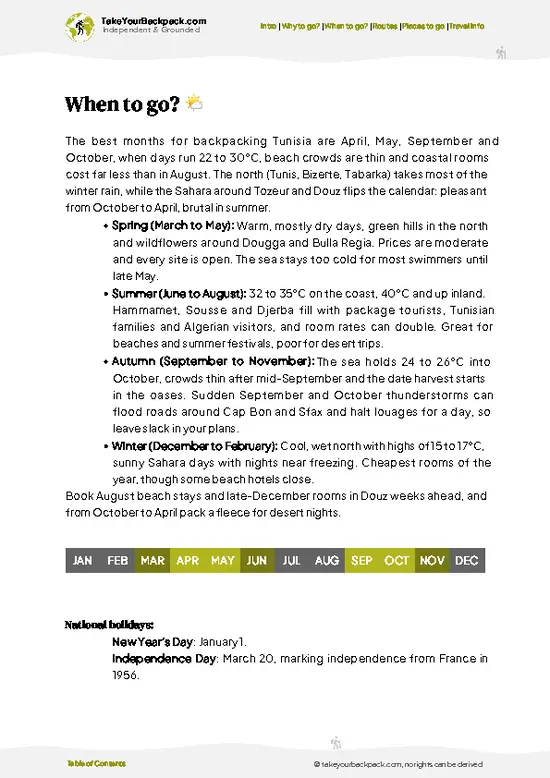
Spring and early autumn give El Kef its easiest weather, since the town sits at about 780 m (2,560 ft) and runs cooler than the Tunisian coast.
  • Spring (March to May): 12 to 24°C (54 to 75°F), green hills, wildflowers and long daylight. Prices stay flat and crowds are thin.
  • Summer (June to August): 20 to 35°C (68 to 95°F), dry and sunny. Evenings cool off, and the summer festival season brings concerts at the Kasbah.
  • Autumn (September to November): 15 to 28°C (59 to 82°F), clear skies and good hiking conditions.
  • Winter (December to February): 2 to 13°C (36 to 55°F), with rain, cold nights and occasional snow. Pack a real jacket, since many budget rooms have weak heating.
Book nothing far ahead; walk-in rates barely move, except during festivals.

source: climatestotravel.comJANJanuary: good for travelingFEBFebruary: good for travelingMARMarch: highly recommended for travelingAPRApril: excellent for travelingMAYMay: highly recommended for travelingJUNJune: fair for travelingJULJuly: below average for travelingAUGAugust: below average for travelingSEPSeptember: highly recommended for travelingOCTOctober: excellent for travelingNOVNovember: highly recommended for travelingDECDecember: good for traveling
when-to-go

✈️ The backpacker research shortcutTunisia Travel Guide

An offline-friendly backpacking guide with optimized travel routes, ranked highlights, transport advice, and the best areas to stay.
example page 0 from our offline Travel Guide for Tunisia
example page 1 from our offline Travel Guide for Tunisia
example page 2 from our offline Travel Guide for Tunisia
example page 3 from our offline Travel Guide for Tunisia
example page 4 from our offline Travel Guide for Tunisia
example page 5 from our offline Travel Guide for Tunisia
example page 6 from our offline Travel Guide for Tunisia
example page 7 from our offline Travel Guide for Tunisia
The digital guide (355 pages) contains:
✅ 90 highlights, ranked by travel appeal
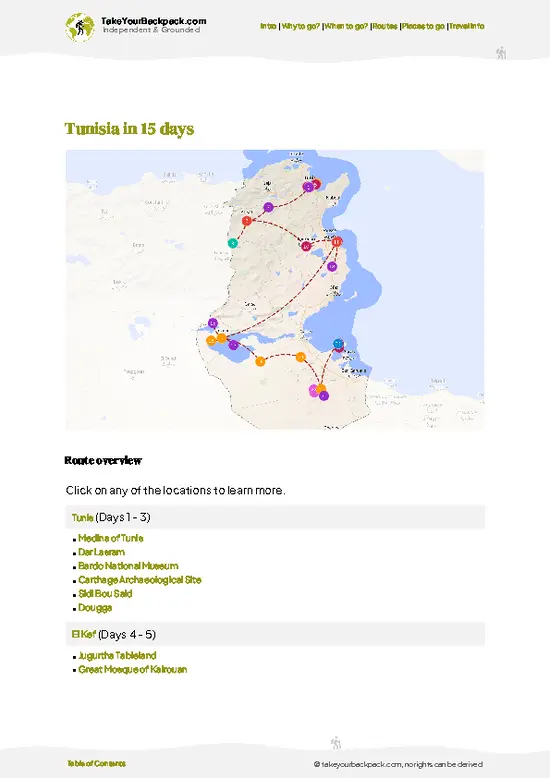
✅ Optimized 5, 10 & 15-day travel routes
✅ Cities, national parks, landmarks, beaches
✅ How to get around
✅ Offline-friendly for travel without Wi-Fi
👉 Click to see all 30+ guide features

📅 Plan smarter in minutes, not weeks
✅ Month by month travel advice
✅ Festivals & national holidays
✅ Budget expectations

🗺️ Go to the right places, skip the overrated ones
✅ Honest pros & cons of destinations
✅ Top hikes, parks & viewpoints
✅ Lesser-known places most travelers miss
✅ Clear “worth it vs skip it” guidance

🛏️ Travel smoothly without rookie mistakes
✅ Best areas to stay
✅ Transport systems explained simply
✅ Common scams & safety advice
✅ SIM cards, money & practical tips

🌍 Understand the country, not just visit it
✅ Culture & traditions
✅ 52 Essential phrases & customs
✅ Festivals worth planning around
✅ Traveler-friendly historical context
✅ Insights that make places more meaningful

📱 Built for real travel conditions
✅ Fully downloadable PDF
✅ Works completely offline
✅ Optimized for phone use
✅ Useful in remote areas & buses
✅ Everything in one place
Stop searching, start planning
Get instant access to your full guide. 30‑day money-back guarantee.
+ Add another guide for just

By proceeding you agree to our terms.
Sent to your inbox immediately after payment • 100% Secure Checkout
Best Backpacking Travel Advisor 2025 tourism awardBest Backpacking
Travel Advisor
2025
What others say about Take Your Backpack Guides:
⭐⭐⭐⭐⭐
Fantastic, amazing amount of information!
⭐⭐⭐⭐⭐
My goodness this is amazing, it's what I've been looking for hats off too you!
⭐⭐⭐⭐⭐
I think this is absolutely BRILLIANT
⭐⭐⭐⭐
Very complete and informative. It's still missing places, but I gotta to commend you
⭐⭐⭐⭐⭐
This is truly amazing, thank you, can't wait to explore it with my kids!
⭐⭐⭐⭐⭐
Awesome resource, thank you!
⭐⭐⭐⭐⭐
This is amazing! Can't wait to explore the ones I haven't seen
⭐⭐⭐⭐
I love this! Well done, great idea.
⭐⭐⭐⭐⭐
Thanks for taking the time to make this gem!
⭐⭐⭐⭐⭐
This might be the best website I've ever seen.
⭐⭐⭐⭐⭐
Congratulations, and thank you so much for your work; it's incredibly valuable.
⭐⭐⭐⭐
In all seriousness I think you did a great job pointing out the important spots
⭐⭐⭐⭐⭐
10/10 very good
⭐⭐⭐⭐⭐
As someone who's only just starting to visit regularly this is awesome, thank you.
⭐⭐⭐⭐
Thank you very much! I'm going to visit my dad, it's going to be very useful!
⭐⭐⭐⭐⭐
This is really cool! We'll be travelling for the first time and this definitely come in handy.
⭐⭐⭐⭐⭐
You are now our minister of culture, congratulations 👨‍💼
⭐⭐⭐⭐⭐
Just wanted to tell you that this is a pearl! Going to follow your recommendations.
⭐⭐⭐⭐⭐
This is so cool. I'll definitely be using the resource for my travels soon.
⭐⭐⭐⭐⭐
This is very impressive! Good work.
⭐⭐⭐⭐⭐
This is an amazing and informative site. Very well done!

🛏️ Where to stay?Where staying makes the most sense

The center around Place de l’Indépendance is the best base, with most of El Kef’s few budget rooms and guesthouses within a 10 minute walk. Dorm beds are rare, so most backpackers take a cheap private room, often US$15 to 25 a night. It is also close to cafés, ATMs and shared-taxi stops, and the streets are lit and busy into the evening.

The lower medina near the Kasbah is the second option. You get atmosphere, quiet nights and historic houses converted into small guesthouses, though prices are a little higher and the uphill walk with a backpack is steep. Noise is minimal, apart from the dawn … read more 👉
The center around Place de l’Indépendance is the best base, with most of El Kef’s few budget rooms and guesthouses within a 10 minute walk. Dorm beds are rare, so most backpackers take a cheap private room, often US$15 to 25 a night. It is also close to cafés, ATMs and shared-taxi stops, and the streets are lit and busy into the evening.

The lower medina near the Kasbah is the second option. You get atmosphere, quiet nights and historic houses converted into small guesthouses, though prices are a little higher and the uphill walk with a backpack is steep. Noise is minimal, apart from the dawn call to prayer and the occasional rooster.

Stay near the center if you arrive late or rely on louages, since the vans leave from the station area and you will want an easy morning. In winter, ask about heating before you commit, as it can be patchy. In summer, rooms higher up the hill tend to stay cooler.

🚌 Getting aroundMoving around without the hassle

From the louage and bus station, the center is a 10 to 15 minute uphill walk or a short taxi ride for about US$1 to 2. The town is compact and hilly, traffic is light, and public transport is sparse, so your feet do most of the work.
  • Walking: Free and the fastest way to cover the medina, Kasbah and main square, since lanes are narrow and cars give up. Expect some steep stretches, so plan the climb for cooler hours.
  • Local taxis: Yellow taxis run on the meter and most rides in town cost US$1 to 3. They are worth it for the station, your bags or a tired evening, and they save more time than any bus will.
  • Louages (shared vans): The best value for leaving town. Vans leave when full, so waiting is the real fare. Tunis takes roughly 2.5 to 3 hours for US$6 to 8, and Jendouba and Dahmani are cheaper
… read more 👉
From the louage and bus station, the center is a 10 to 15 minute uphill walk or a short taxi ride for about US$1 to 2. The town is compact and hilly, traffic is light, and public transport is sparse, so your feet do most of the work.
  • Walking: Free and the fastest way to cover the medina, Kasbah and main square, since lanes are narrow and cars give up. Expect some steep stretches, so plan the climb for cooler hours.
  • Local taxis: Yellow taxis run on the meter and most rides in town cost US$1 to 3. They are worth it for the station, your bags or a tired evening, and they save more time than any bus will.
  • Louages (shared vans): The best value for leaving town. Vans leave when full, so waiting is the real fare. Tunis takes roughly 2.5 to 3 hours for US$6 to 8, and Jendouba and Dahmani are cheaper and shorter. They run mainly from early morning to late afternoon.
  • Intercity buses: Slower than louages, but cheaper and more comfortable, with a seat guaranteed. Tunis takes around 3.5 to 4 hours for roughly US$5 to 7. Departures are few, so ask at the station for the schedule.
  • Rental or taxi for ruins: Sites like Dougga or Jugurtha’s Table are awkward by public transport. Hiring a taxi for the day costs roughly US$35 to 60, which is pricey solo but sensible when split.

👛 Costs (as of 22 October 2026)Typical daily expenses

El Kef costs about US$30 to 56 a day for a backpacker, which is cheaper than coastal Tunisia. Prices are in Tunisian dinars, but figures here are in US dollars.
CategoryBudget RangeLocal Reality
Dorm or budget bed (high season)US$15 to 25Few true dorms exist, so a basic private room is typical.
Dorm or budget bed (off-season)US$12 to 20Winter rates dip slightly, but heating can be weak.
MealsUS$8 to 14Sandwiches, grilled lamb and couscous at local counters.
Local transportUS$2 to 5Short meter taxi rides; most things are walkable.
City transport passNot availableNo pass exists; pay per ride.
Activities and entry feesUS$2 to 6Kasbah and museums charge small entry fees.
MiscellaneousUS$3 to 6Café drinks, water, SIM data.
Total Daily BudgetUS$30 to 56Mid-range of this lands near US$42.
Eat at the lower … read more 👉
El Kef costs about US$30 to 56 a day for a backpacker, which is cheaper than coastal Tunisia. Prices are in Tunisian dinars, but figures here are in US dollars.
CategoryBudget RangeLocal Reality
Dorm or budget bed (high season)US$15 to 25Few true dorms exist, so a basic private room is typical.
Dorm or budget bed (off-season)US$12 to 20Winter rates dip slightly, but heating can be weak.
MealsUS$8 to 14Sandwiches, grilled lamb and couscous at local counters.
Local transportUS$2 to 5Short meter taxi rides; most things are walkable.
City transport passNot availableNo pass exists; pay per ride.
Activities and entry feesUS$2 to 6Kasbah and museums charge small entry fees.
MiscellaneousUS$3 to 6Café drinks, water, SIM data.
Total Daily BudgetUS$30 to 56Mid-range of this lands near US$42.
Eat at the lower souk grill counters and sandwich stands rather than central restaurants to cut food costs by about half.
⚠️ Prices can change and everyone travels differently, so take this as a rough guide. Hope it helps you plan your adventure!

🚌 Day tripsBest day trips from El Kef

El Kef sits in the northwest highlands, close to some of Tunisia’s best Roman sites that most coach tours skip, though public transport makes a few of these harder than they look.
Dougga: Tunisia’s best-preserved Roman town, with a hillside theater and the Capitol, is about 1.5 to 2 hours away via Téboursouk. Take a louage to Téboursouk, then a taxi for the last 6 km. Budget US$15 to 25 total plus about US$5 entry. Spring is best; first-timers often forget the site has almost no shade.
👉 Explore Dougga
Jugurtha’s Table: This flat-topped mesa rises near Kalaat es Senam, around 40 to 60 minutes south. A shared van reaches the village, and a taxi runs to the base for a few dollars. Climbing the rock takes about an hour and rewards you with sweeping plains. Count on US$8 to 15 all in. Go in spring … read more 👉
El Kef sits in the northwest highlands, close to some of Tunisia’s best Roman sites that most coach tours skip, though public transport makes a few of these harder than they look.
Dougga: Tunisia’s best-preserved Roman town, with a hillside theater and the Capitol, is about 1.5 to 2 hours away via Téboursouk. Take a louage to Téboursouk, then a taxi for the last 6 km. Budget US$15 to 25 total plus about US$5 entry. Spring is best; first-timers often forget the site has almost no shade.
👉 Explore Dougga
Jugurtha’s Table: This flat-topped mesa rises near Kalaat es Senam, around 40 to 60 minutes south. A shared van reaches the village, and a taxi runs to the base for a few dollars. Climbing the rock takes about an hour and rewards you with sweeping plains. Count on US$8 to 15 all in. Go in spring or autumn, never midday summer.

Sers and Haidra: Haidra, with Byzantine fortress ruins and a triumphal arch near the Algerian border, is about 2 hours by road, so a hired taxi at US$40 to 60 suits it best. Few visitors reach it, so you may have the ruins to yourself. Carry ID, since checkpoints are common.

Chemtou: Roman marble quarries and a small museum lie near Jendouba, about 2 hours away by louage with a change. Costs run US$12 to 20. Spring is greenest.

🍲 FoodLocal Cuisine & Drinks

El Kef sits in a grain and sheep region, so the food leans toward lamb and hearty couscous rather than seafood. Look for kesra, the flat, dense bread baked in clay ovens, and slow-cooked lamb stews eaten with it. The area is also known for rfissa-style shredded bread dishes served at celebrations, and for honeyed sweets from small pastry shops near the center.

You will eat best in the lower souk and around the main square, where grill counters serve lamb skewers, salad and bread for roughly US$3 to 6. Sandwich stands sell hot fresh baguettes stuffed with tuna, egg and harissa for about US$1.5 to 3, and they are the fuel of local backpackers. For coffee, the terrace cafés on Place de l’Indépendance are where the town talks, and one drink buys you a seat for an hour. Alcohol is hard to find, so do not count on a bar crawl.

🛡️ SafetyStaying Safe: What Travelers Should Know

El Kef is calm and small, and most visitors feel comfortable walking at night in the center. Petty theft is uncommon, but keep your phone and wallet out of back pockets in the souk. Aggressive scams are rare. The usual annoyance is overly helpful strangers steering you to a shop or guesthouse for a commission, which a polite no handles. Taxis should use the meter, so say so before getting in. Solo women will draw attention, mostly stares and calls on café-lined streets, and dressing modestly and keeping a steady pace helps. Quieter lanes in the medina are dark after dinner, so stick to the main streets. The Algerian border area to the west has military checkpoints, so carry your passport and check local advice before heading to remote sites.

FAQFrequently asked questions about El Kef

Two days cover El Kef itself: one for the Kasbah, medina, Ras el Aïn spring and the Sidi Bou Makhlouf zaouia, and one for a trip to Dougga or Jugurtha’s Table. Add a third day if you want Haidra or Chemtou. Louage rides from Tunis take roughly 2.5 to 3 hours.
El Kef is generally safe for solo backpackers, and its small size and light traffic make evening walks in the center comfortable. Expect some staring, mainly for solo women, and the occasional commission-hunting helper in the souk. Use metered taxis (rides cost about US$1 to 3) and carry your passport near the Algerian border.
El Kef is known for its hilltop Kasbah, its Ottoman and Roman remains and the old spring at Ras el Aïn. It sits about 780 m (2,560 ft) up near the Algerian border, so summers are cooler than the coast. It is also a base for Dougga, around 1.5 to 2 hours away, and Jugurtha’s Table.
⚠️ Things can change over time, so always validate details locally before you go.

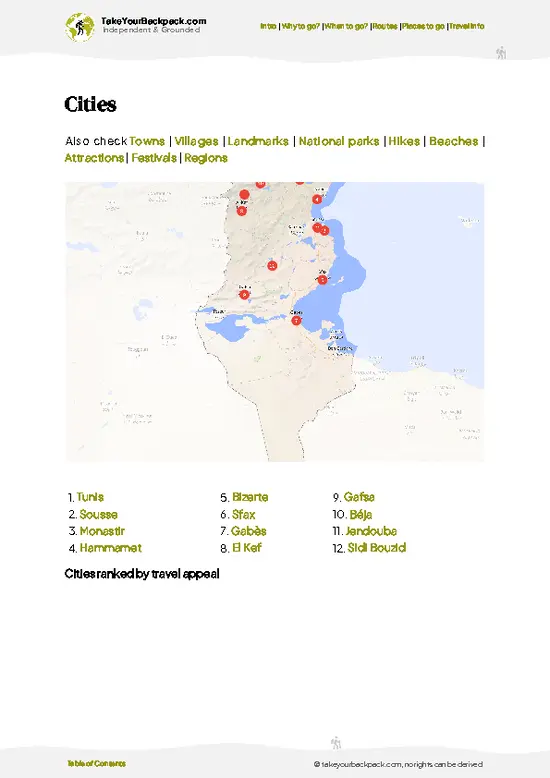
Other Tunisian cities near El Kef

Explore more nearby:

  • Jendouba—Underground Roman villas, Medjerda valley, farm-belt market| 38 km away
  • Béja—Byzantine kasbah walls, grain-town souk, weekly farm market| 76 km away
  • Sidi Bouzid—Uprising memorials, orchard country, charcoal grills, central market| 144 km away

💡 Not sure where to go next?
Create a personalized itinerary for Tunisia including El Kef and the places that fit your trip.

Generate my itinerary

👉 Discover all cities

Or checkout all Tunisia has to offer (think cities, towns, villages, national parks, hikes, beaches, festivals)
Country photo of Tunisia

We 💚 feedbackKey takeaways before you go

Give El Kef two nights, which is enough for the Kasbah, the old town and one outing to nearby ruins without rushing. One night feels like a drive-by, three starts to feel quiet. Bring sturdy shoes for the hills and a warm layer, because the evenings here cool off fast.

✍️ Help improve this page!
The information on this page is based on in-depth research, insights shared by experienced travelers, and feedback from the local travel community in Tunisia. While every effort is made to keep the information accurate and current, conditions can change — so if you spot anything incorrect or outdated, please get in touch.


🙋‍♂️ Give feedback

👋 Meet the founderWho’s Behind Take Your Backpack?

Johan, backpacker and founder of TakeYourBackpackHi, I’m Johan (Netherlands 🇳🇱), the creator of TakeYourBackpack. Over the past 3 decades, I’ve backpacked through 90+ countries across six continents, gaining extensive experience with independent travel, long-term trips, and overland routes.

This site is built on a combination of firsthand travel experience and carefully curated insights from other backpackers. Many guides are based on places I’ve personally visited, while others bring together tips, observations, and practical advice shared by trusted travelers I’ve met along the way.

The goal is to provide realistic, experience-driven guidance — not generic itineraries — so you can explore destinations with better context, clearer expectations, and more confidence.