×

Tunisia🇹🇳 | best citiesDiscover the 12 Best cities Across Tunisia

Tunisia’s cities offer a fascinating blend of cultural richness and local vibe, each with its own character. Major hubs like Tunis and Sousse buzz with life, featuring vibrant markets and nightlife, while smaller towns like Kairouan provide a more laid-back atmosphere steeped in history. The size of these cities affects everything from transport connections to safety; larger cities often have better infrastructure but can be crowded and chaotic. Seasonal nuances also play a role—summer brings tourists, while spring and fall offer a more authentic experience. Choosing the right city impacts your budget, ease of travel, and level of cultural immersion, making it essential for backpackers and independent travelers to consider their options carefully.

By Johan Kruseman 🇳🇱 | Updated June 14, 2026
Explore the best towns in Tunisia

Why go?What Makes Them Special

Tunisian cities are a fascinating blend of cultural diversity and historical depth, shaped by millennia of trade, conquest, and coexistence. Unlike many countries, Tunisia’s urban landscapes reflect a rich tapestry of Berber, Arab, and Mediterranean influences, creating a unique cultural mosaic. This diversity is not just a backdrop; it informs everything from local cuisine to architectural styles, making each city a microcosm of the nation’s broader identity.

However, the trade-offs are real. While Tunisia boasts a relatively compact size, allowing for easy travel between cities, the infrastructure can be a mixed bag. Public transport options exist but may not always be reliable or timely. This means that while you can hop from one city to another, you might find yourself spending more time … read more 👉
Tunisian cities are a fascinating blend of cultural diversity and historical depth, shaped by millennia of trade, conquest, and coexistence. Unlike many countries, Tunisia’s urban landscapes reflect a rich tapestry of Berber, Arab, and Mediterranean influences, creating a unique cultural mosaic. This diversity is not just a backdrop; it informs everything from local cuisine to architectural styles, making each city a microcosm of the nation’s broader identity.

However, the trade-offs are real. While Tunisia boasts a relatively compact size, allowing for easy travel between cities, the infrastructure can be a mixed bag. Public transport options exist but may not always be reliable or timely. This means that while you can hop from one city to another, you might find yourself spending more time waiting than exploring.

Climate also plays a role. The hot, dry summers can deter some travelers, while the milder winters offer a more pleasant experience. Yet, this seasonal variability can affect accessibility to certain sites, especially in more remote areas.

Ultimately, Tunisia offers a rich urban experience, but it requires a willingness to embrace the grind of travel. The depth of exploration often comes at the cost of time, but the rewards—a genuine connection to the local culture and history—are well worth the effort.
Evaluating the Top Choices
The list of best cities in Tunisia is created based on culture, vibe, attractions, transport ease, and local charm. If you feel a city is missing in this list, please let us know.

When to go?Timing Your Visit for the Best Experience

Weather and Crowds


Tunisia’s climate can be as unpredictable as a cat on a hot tin roof. Summers are sweltering, with temperatures soaring, especially in urban areas. Expect crowds during this peak season, as tourists flock to soak up the sun. If you enjoy sweating profusely while dodging selfie sticks, this is your time.

Optimal Months


The sweet spot for visiting falls in spring and fall. These shoulder seasons offer milder temperatures and fewer tourists. The weather is pleasant, making it ideal for wandering through bustling markets or sipping mint tea in a café. However, be prepared for some local festivals that might draw larger crowds, adding a lively twist to your experience.

Trade-offs


Visiting during the shoulder seasons means balancing the allure of cultural events with … read more 👉

Weather and Crowds


Tunisia’s climate can be as unpredictable as a cat on a hot tin roof. Summers are sweltering, with temperatures soaring, especially in urban areas. Expect crowds during this peak season, as tourists flock to soak up the sun. If you enjoy sweating profusely while dodging selfie sticks, this is your time.

Optimal Months


The sweet spot for visiting falls in spring and fall. These shoulder seasons offer milder temperatures and fewer tourists. The weather is pleasant, making it ideal for wandering through bustling markets or sipping mint tea in a café. However, be prepared for some local festivals that might draw larger crowds, adding a lively twist to your experience.

Trade-offs


Visiting during the shoulder seasons means balancing the allure of cultural events with the desire for a quieter experience. While you might miss the peak tourist buzz, you could also miss out on vibrant local celebrations that showcase Tunisia’s rich heritage.

Peak Periods


Winter can be chilly, especially in the north, but it’s a quieter time to explore. Just remember, some attractions may have reduced hours or be closed altogether. The trade-off here is a more intimate experience, but with fewer options.

Plan wisely, and embrace the rhythm of Tunisia’s seasons.

city hoppingSuggested Travel Strategies

Transport Networks and Regional Clustering


Tunisia’s cities are like pieces of a puzzle, and fitting them together requires a bit of strategy. Start in Tunis, the capital, where you can easily hop on a train or bus to other major cities. The rail network is decent, but don’t expect high-speed thrills; it’s more of a leisurely ride through the countryside.

General Routing Logic


Cluster cities by region. For example, after Tunis, head to the coastal cities like Sousse and Monastir. They’re close enough to make a day trip feel worthwhile, but don’t rush it. Each has its own vibe, and a few hours won’t do justice to their charm.

Next, consider the south. Cities like Kairouan and Tozeur offer a stark contrast to the coastal scene. The drive can be long, so plan for at least a full day in … read more 👉

Transport Networks and Regional Clustering


Tunisia’s cities are like pieces of a puzzle, and fitting them together requires a bit of strategy. Start in Tunis, the capital, where you can easily hop on a train or bus to other major cities. The rail network is decent, but don’t expect high-speed thrills; it’s more of a leisurely ride through the countryside.

General Routing Logic


Cluster cities by region. For example, after Tunis, head to the coastal cities like Sousse and Monastir. They’re close enough to make a day trip feel worthwhile, but don’t rush it. Each has its own vibe, and a few hours won’t do justice to their charm.

Next, consider the south. Cities like Kairouan and Tozeur offer a stark contrast to the coastal scene. The drive can be long, so plan for at least a full day in each.

Common Planning Mistakes


One common pitfall is trying to see too much too quickly. It’s tempting to tick off cities like a checklist, but that often leads to burnout. Instead, prioritize depth over speed.

Trade-offs and Constraints


Budget travelers might lean toward buses, which are cheaper but can be slow. If comfort is a priority, consider private taxis or shared rides, especially for longer distances. Flexibility is key; plans may change, and that’s part of the adventure. Embrace it.

The ListTop cities of Tunisia

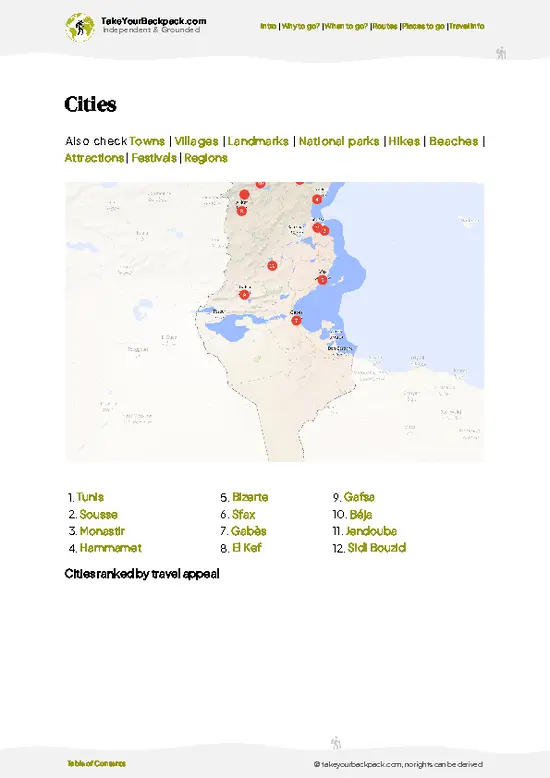
1 Tunis

Labyrinthine medina, French quarter, Bardo Museum, city trams

Move between centuries in a capital where narrow alleys, colonial boulevards, and world-class museums reveal Tunisia’s layered identity.

2 Djerba

Whitewashed villages, Jewish heritage, palm groves, island markets

Experience an island where Berber, Arab, and Jewish influences meet, with quiet lanes, artisan workshops, and a distinct island pace.

3 Sousse

UNESCO medina, ribat tower, beachfront cafés, mosaic museum

Absorb the energy of a city where medieval walls enclose busy markets, and the coastline offers a lively mix of old and new.

4 Hammamet

Sandy beaches, medina walls, resort hotels, citrus orchards

Relax in a town where the scent of orange blossoms drifts from gardens, and the sea is never far from the old quarter.

5 Bizerte

Mediterranean port, Ottoman forts, fishing harbor, French colonial streets

Wander a northern city where daily life unfolds along the waterfront, with old stone ramparts and a working marina shaping the atmosphere.

6 Sfax

Walled medina, olive oil trade, fishing port, industrial zone

Engage with a working city where commerce and tradition intersect, and the medina’s daily bustle reflects a strong local economy.

7 Gabès

Coastal oasis, date palms, souks, troglodyte dwellings

Navigate a southern city where the desert meets the sea, and daily commerce thrives under the shade of palm groves.

8 El Kef

hilltop kasbah, Ottoman relics, mountain views

Climb to panoramic fortresses, discover quiet shrines, and experience a town shaped by its highland setting and layered past.

9 Gafsa

Roman pools, phosphate mines, oasis gardens, mountain backdrop

Discover a city shaped by ancient springs and mining, where oasis greenery contrasts with the arid hills surrounding the urban core.

10 Beja

grain silos, Roman ruins, rolling farmland

Travel through a region shaped by agriculture, with traces of empire and a landscape of fields and gentle hills.

11 Jendouba

market town, railway hub, rural crossroads

Connect with local life in a practical center for exploring the northwest’s archaeological sites and green valleys.

12 Sidi Bouzid

agricultural center, olive groves, rural heartland

Travel through a town at the core of Tunisia’s farming region, where fields and orchards stretch to the horizon.

Loading the map 🌍

Expert viewInsights from Locals and Experts

Transport Hubs
Tunis is your main gateway, the bustling heart where the train and bus networks converge. You’ll find a mix of modernity and chaos here—think of it as a symphony of honking horns and street vendors. The train system is decent, but don’t expect Swiss precision. Delays are part of the charm. If you’re planning to hop between cities, be prepared for a bit of a wait. Buses are cheaper but can feel like a game of sardines. The trade-off? You’ll save money but lose time. If you’re in a hurry, consider a rental car, but be ready for the local driving style, which is a blend of daring and desperation.

Urban Pacing
Tunisia’s cities have their own rhythms. Some are frenetic, while others move at a leisurely pace. If you’re the type who thrives on the buzz, you’ll love the energy of … read more 👉
Transport Hubs
Tunis is your main gateway, the bustling heart where the train and bus networks converge. You’ll find a mix of modernity and chaos here—think of it as a symphony of honking horns and street vendors. The train system is decent, but don’t expect Swiss precision. Delays are part of the charm. If you’re planning to hop between cities, be prepared for a bit of a wait. Buses are cheaper but can feel like a game of sardines. The trade-off? You’ll save money but lose time. If you’re in a hurry, consider a rental car, but be ready for the local driving style, which is a blend of daring and desperation.

Urban Pacing
Tunisia’s cities have their own rhythms. Some are frenetic, while others move at a leisurely pace. If you’re the type who thrives on the buzz, you’ll love the energy of the more populated areas. But if you prefer to soak in the local culture, aim for a slower pace. Spending a few days in one city allows you to peel back the layers and discover the real magic—like that hole-in-the-wall café where the owner remembers your name by the second visit. The trade-off here is between breadth and depth. You could zip through three or four cities in a week, but you’d miss the nuances that make each place unique.

Local Costs
Budgeting in Tunisia can feel like a rollercoaster. Street food is a steal, while dining in touristy spots can make your wallet weep. Expect to pay more in cities that cater to tourists, but don’t shy away from local eateries. You’ll get a meal that’s not only cheaper but also bursting with flavor. The trade-off? Eating where the locals eat might mean a bit of a language barrier, but it’s worth it for the authentic experience. As for accommodation, you can find everything from budget hostels to mid-range hotels. Just remember, the more you pay, the less character you often get.

Exploring More Cities vs. Deeper Immersion
The temptation to tick off multiple cities in a short time is real. But here’s the kicker: the more you rush, the less you’ll actually see. If you’re on a tight schedule, consider focusing on two or three cities. This allows you to explore without feeling like you’re on a travel treadmill. You’ll have time to chat with locals, visit markets, and maybe even get lost in the winding streets. The trade-off? Less Instagrammable moments but more genuine connections. You’ll leave with stories that go beyond the surface.

Safety & Cultural Considerations
Tunisian cities are generally safe, but like anywhere, stay aware of your surroundings. Dress modestly, especially in rural areas, to respect local customs. It’s not just about blending in; it’s about showing respect. The trade-off here is between comfort and cultural sensitivity. You might feel more at ease in shorts and a tank top, but you’ll likely have a richer experience if you adapt to local norms.

Navigating Tunisia is a balancing act. Embrace the quirks, laugh at the absurdities, and remember that the journey is just as important as the destination.

✈️ The backpacker research shortcutTunisia Travel Guide

An offline-friendly backpacking guide with optimized travel routes, ranked highlights, transport advice, and the best areas to stay.
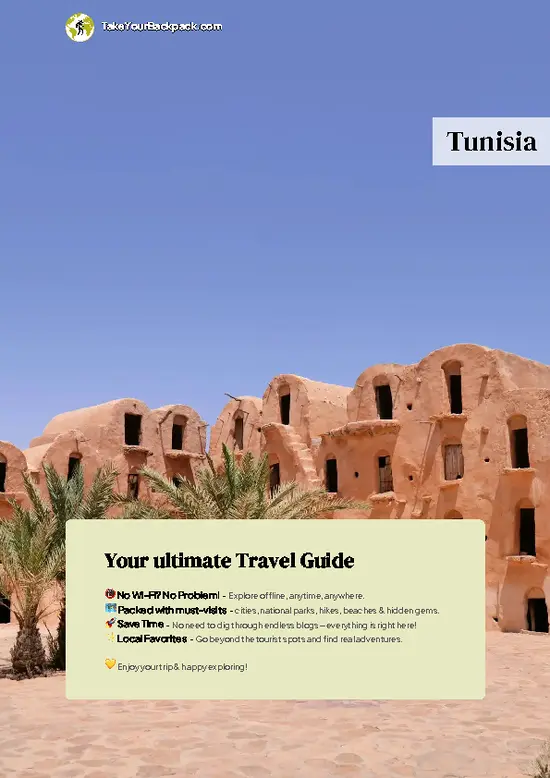
example page 0 from our offline Travel Guide for Tunisia
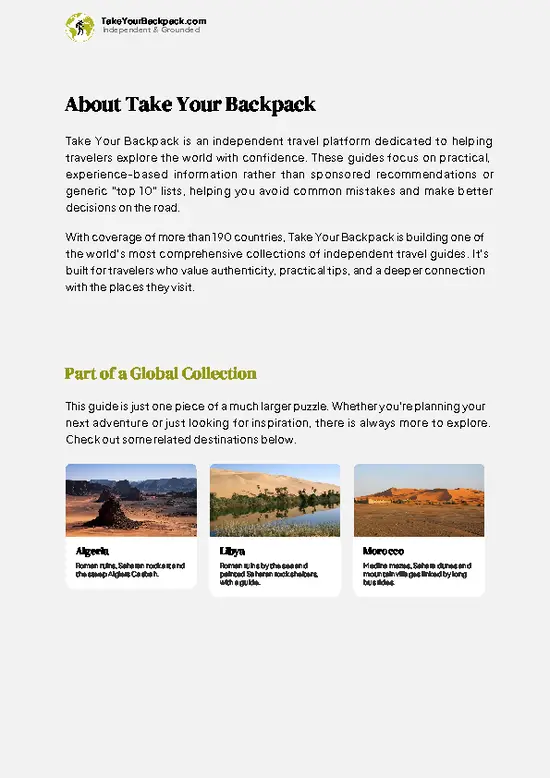
example page 1 from our offline Travel Guide for Tunisia
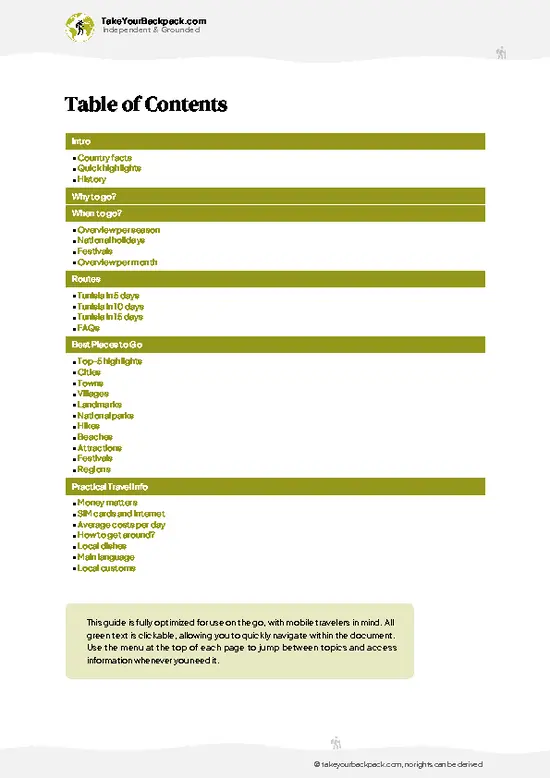
example page 2 from our offline Travel Guide for Tunisia
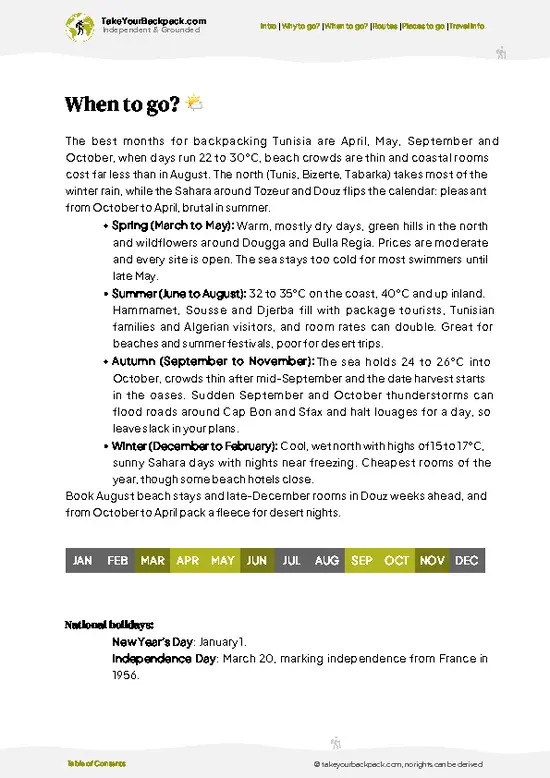
example page 3 from our offline Travel Guide for Tunisia
example page 4 from our offline Travel Guide for Tunisia
example page 5 from our offline Travel Guide for Tunisia
example page 6 from our offline Travel Guide for Tunisia
example page 7 from our offline Travel Guide for Tunisia
The digital guide (372 pages) contains:
97 highlights, ranked by travel appeal
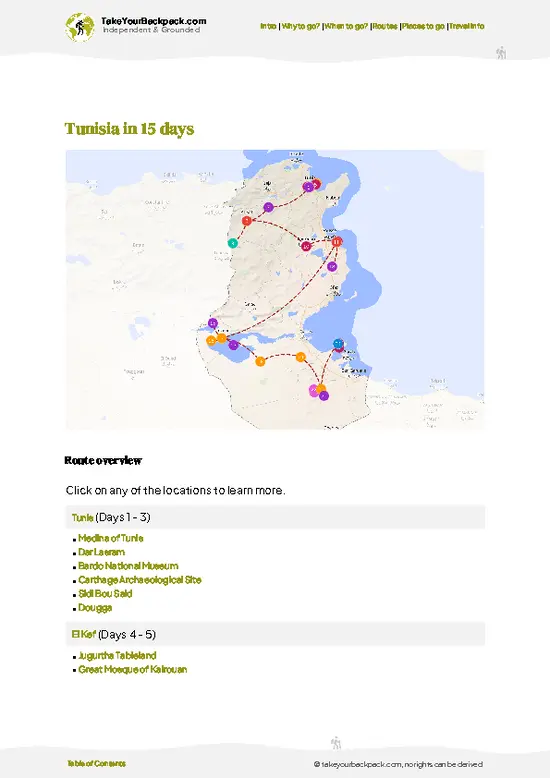
Optimized 5, 10 & 15-day travel routes
Cities, national parks, landmarks, beaches
How to get around
Offline-friendly for travel without Wi-Fi
👉 Click to see all 30+ guide features

📅 Plan smarter in minutes, not weeks
Month by month travel advice
Festivals & national holidays
Budget expectations

🗺️ Go to the right places, skip the overrated ones
Honest pros & cons of destinations
Top hikes, parks & viewpoints
Lesser-known places most travelers miss
Clear “worth it vs skip it” guidance

🛏️ Travel smoothly without rookie mistakes
Best areas to stay
Transport systems explained simply
Common scams & safety advice
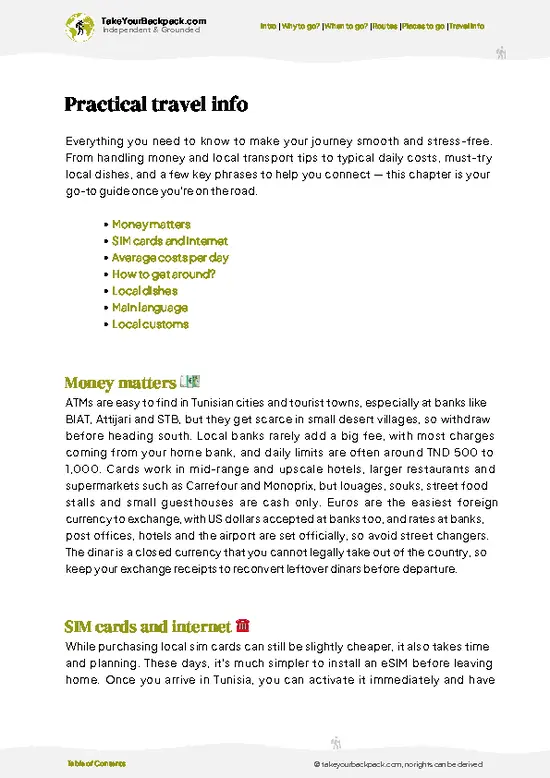
SIM cards, money & practical tips

🌍 Understand the country, not just visit it
Culture & traditions
52 Essential phrases & customs
Festivals worth planning around
Traveler-friendly historical context
Insights that make places more meaningful

📱 Built for real travel conditions
Fully downloadable PDF
Works completely offline
Optimized for phone use
Useful in remote areas & buses
Everything in one place
Save weeks of stressful planning
Get instant access to your full guide. 30‑day money-back guarantee.


By proceeding you agree to our terms.
Sent to your inbox immediately after payment • 100% Secure Checkout
Best Backpacking Travel Advisor 2025 tourism awardBest Backpacking
Travel Advisor
2025
What others say about Take Your Backpack Guides:
⭐⭐⭐⭐⭐
Fantastic, amazing amount of information!
⭐⭐⭐⭐⭐
My goodness this is amazing, it's what I've been looking for hats off too you!
⭐⭐⭐⭐⭐
I think this is absolutely BRILLIANT
⭐⭐⭐⭐
Very complete and informative. It's still missing places, but I gotta to commend you
⭐⭐⭐⭐⭐
This is truly amazing, thank you, can't wait to explore it with my kids!
⭐⭐⭐⭐⭐
Awesome resource, thank you!
⭐⭐⭐⭐⭐
This is amazing! Can't wait to explore the ones I haven't seen
⭐⭐⭐⭐
I love this! Well done, great idea.
⭐⭐⭐⭐⭐
Thanks for taking the time to make this gem!
⭐⭐⭐⭐⭐
This might be the best website I've ever seen.
⭐⭐⭐⭐⭐
Congratulations, and thank you so much for your work; it's incredibly valuable.
⭐⭐⭐⭐
In all seriousness I think you did a great job pointing out the important spots
⭐⭐⭐⭐⭐
10/10 very good
⭐⭐⭐⭐⭐
As someone who's only just starting to visit regularly this is awesome, thank you.
⭐⭐⭐⭐
Thank you very much! I'm going to visit my dad, it's going to be very useful!
⭐⭐⭐⭐⭐
This is really cool! We'll be travelling for the first time and this definitely come in handy.
⭐⭐⭐⭐⭐
You are now our minister of culture, congratulations 👨‍💼
⭐⭐⭐⭐⭐
Just wanted to tell you that this is a pearl! Going to follow your recommendations.
⭐⭐⭐⭐⭐
This is so cool. I'll definitely be using the resource for my travels soon.
⭐⭐⭐⭐⭐
This is very impressive! Good work.
⭐⭐⭐⭐⭐
This is an amazing and informative site. Very well done!

🛏️ Where to stay?Where to Stay in Tunisia

Yes — hostels and budget accommodation are widely available in Tunisia, concentrated in Tunis (Medina and Ville Nouvelle), Sousse (Medina and waterfront), Hammamet, Djerba, with smaller backpacker options in Tozeur and Kairouan.
Medina areas put you within historic highlights and cheap local food but expect narrow streets, basic rooms and limited nightlife; Ville Nouvelle and Sousse waterfront offer easier transport, more social hostels and livelier evenings at slightly higher rates; Hammamet and Djerba are quieter beach bases with seasonal service drops and fewer cheap beds outside high season.
Budget places usually mean communal bathrooms, simple cleaning standards and crowded summer months, … read more 👉
Yes — hostels and budget accommodation are widely available in Tunisia, concentrated in Tunis (Medina and Ville Nouvelle), Sousse (Medina and waterfront), Hammamet, Djerba, with smaller backpacker options in Tozeur and Kairouan.
Medina areas put you within historic highlights and cheap local food but expect narrow streets, basic rooms and limited nightlife; Ville Nouvelle and Sousse waterfront offer easier transport, more social hostels and livelier evenings at slightly higher rates; Hammamet and Djerba are quieter beach bases with seasonal service drops and fewer cheap beds outside high season.
Budget places usually mean communal bathrooms, simple cleaning standards and crowded summer months, so book early in peak season, carry cash, and bring a light sleeping liner and mosquito protection to avoid common small-trip mistakes.

If you enjoy meeting fellow travelers, consider choosing hostels with high ratings for atmosphere. On the other hand, if you prefer having your own space, a hotel might be a better option.

TunisiaMore of Tunisia

👋 Meet the founderWho’s Behind Take Your Backpack?

Johan, backpacker and founder of TakeYourBackpackHi, I’m Johan (Netherlands 🇳🇱), the creator of TakeYourBackpack. Over the past decade, I’ve backpacked through 80+ countries across six continents, gaining extensive experience with independent travel, long-term trips, and overland routes.

This site is built on a combination of firsthand travel experience and carefully curated insights from other backpackers. Many guides are based on places I’ve personally visited, while others bring together tips, observations, and practical advice shared by trusted travelers I’ve met along the way.

The goal is to provide realistic, experience-driven guidance — not generic itineraries — so you can explore destinations with better context, clearer expectations, and more confidence.

Get full Tunisia guide •
Instant download • 97 highlights • Full Offline guide