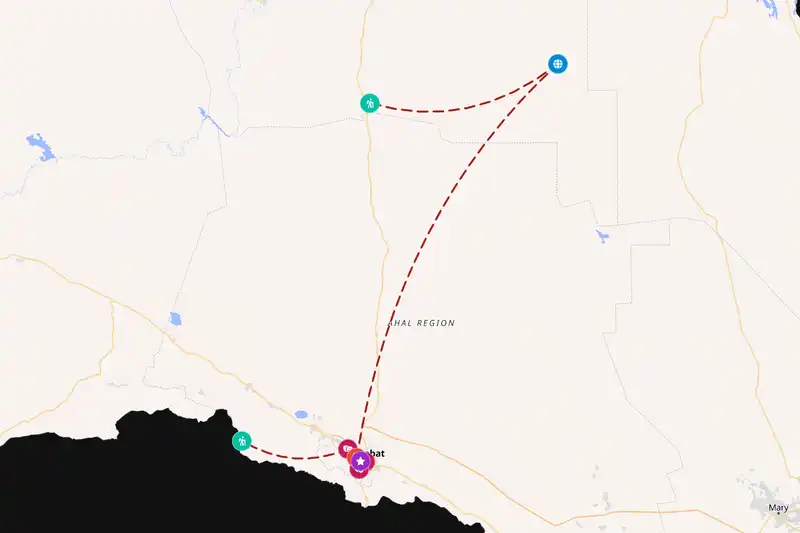
This ten-day route through Turkmenistan is for travelers who want the Silk Road east and the wild, little-visited southeast corner, trading the Caspian for dinosaur tracks and canyons near the Afghan border. You will need a tourist visa through a licensed agency, plus an advance border-zone permit for Köýtendag. The pace is moderate, with two-night stays and only one demanding road day. Transport mixes the Ashgabat to Mary train or road transfer, hired drivers in the east, a 4x4 for Köýtendag, and a one-hour Turkmenistan Airlines flight from Turkmenabat back to the capital.
Days 1-2: Ashgabat
Ashgabat gets two focused days. Head first to the
Turkmen Carpet Museum, because carpets explain Turkmen identity better than any monument: each tribe has its own gül pattern, and the national flag carries five of them. The giant carpet on display, around 300 square meters, gives you a sense of the labor behind the craft. On Day 2, take a taxi 12 km west to the
Turkmenbashi Ruhy Mosque Complex, one …
read more 👉This ten-day route through Turkmenistan is for travelers who want the Silk Road east and the wild, little-visited southeast corner, trading the Caspian for dinosaur tracks and canyons near the Afghan border. You will need a tourist visa through a licensed agency, plus an advance border-zone permit for Köýtendag. The pace is moderate, with two-night stays and only one demanding road day. Transport mixes the Ashgabat to Mary train or road transfer, hired drivers in the east, a 4x4 for Köýtendag, and a one-hour Turkmenistan Airlines flight from Turkmenabat back to the capital.
Days 1-2: Ashgabat
Ashgabat gets two focused days. Head first to the Turkmen Carpet Museum, because carpets explain Turkmen identity better than any monument: each tribe has its own gül pattern, and the national flag carries five of them. The giant carpet on display, around 300 square meters, gives you a sense of the labor behind the craft. On Day 2, take a taxi 12 km west to the Turkmenbashi Ruhy Mosque Complex, one of the largest mosques in Central Asia, and spend the rest of the day wandering the marble city center at your own speed.Days 3-4: Mary and Merv
Travel east to Mary, roughly 5 to 6 hours by road or a little longer by train, across cotton country fed by the Karakum Canal. Mary itself is a pleasant, low-key regional center, and its main job is to put you within 30 km of Merv. Give Merv a full day. Several walled cities from different centuries sit side by side here: the oldest, Erk Kala, dates back to the Achaemenid era, while the 12th-century Sultan Sanjar mausoleum has a double dome that has survived earthquakes and Mongol sieges. The Kyz Kala, fortified mansions with walls ribbed like folded cloth, are best in low afternoon light.Day 5: Repetek and Turkmenabat
A drive of about 4 hours brings you to Turkmenabat, with a stop at Repetek on the way, a sand-desert reserve founded in the 1920s to study the Karakum. Saxaul trees and dunes are all you see, and the summer heat here is among the most extreme in Central Asia. Turkmenabat sits on the Amu Darya and is a practical overnight stop.Days 6-8: Köýtendag
This is the longest road day, 5 to 6 hours south along the river toward the Uzbek and Afghan borders, and it leads to the most dramatic landscapes in the country. Köýtendag is the one range here that feels truly alpine, with Aýrybaba, the country’s highest peak at 3,139 meters. Spend Day 7 on the plateau near Hojapil, where hundreds of Jurassic dinosaur footprints march across a tilted rock slab, and then in the red-walled Kyrk Gyz canyon. If the season allows, walk to the Umbar Dere waterfall. Two nights here keeps the drive in proportion, and on Day 8 you head back to Turkmenabat.Days 9-10: Fly back to Ashgabat
The morning flight from Turkmenabat takes about an hour and saves a full day on the road. Use your last evening in Ashgabat to see the illuminated monuments after dark, when the marble glows under colored floodlights, before flying out on Day 10.
If your agency can add one long day from Mary, drive out to Gonur Depe, a Bronze Age city in the open desert where you can still see the outlines of the palace walls and the fire temple in the sand.v2.webp)






 Best Backpacking