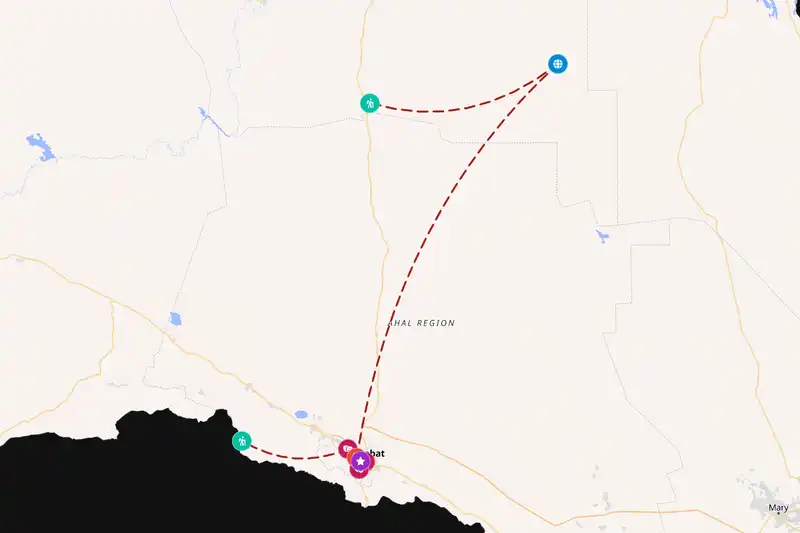
This fifteen-day traverse of Turkmenistan suits travelers who want the whole country in one go: the Khorezmian ruins of the north, the burning crater, the marble capital, the Caspian shore with its layered canyons, and the Silk Road cities of the east. It works as an overland link between Khiva and Bukhara in Uzbekistan, entering at Dashoguz and leaving at Farap near Turkmenabat. The pace is relaxed, with no back-to-back long road days and several nights in each base. You will need a tourist visa arranged through a licensed agency, which means a guide for most of the trip. Transport combines hired 4x4s with drivers for the desert and canyon legs, two short domestic flights on Turkmenistan Airlines, road transfers between eastern cities, and city taxis in Ashgabat.
Days 1-2: Dashoguz and Kunya-Urgench
Crossing from Khiva puts you in
Dashoguz by midday, a flat, quiet Soviet-planned city that works purely as a base. Day 2 is the reason you came this way:
Kunya-Urgench, about 100 km northwest …
read more 👉This fifteen-day traverse of Turkmenistan suits travelers who want the whole country in one go: the Khorezmian ruins of the north, the burning crater, the marble capital, the Caspian shore with its layered canyons, and the Silk Road cities of the east. It works as an overland link between Khiva and Bukhara in Uzbekistan, entering at Dashoguz and leaving at Farap near Turkmenabat. The pace is relaxed, with no back-to-back long road days and several nights in each base. You will need a tourist visa arranged through a licensed agency, which means a guide for most of the trip. Transport combines hired 4x4s with drivers for the desert and canyon legs, two short domestic flights on Turkmenistan Airlines, road transfers between eastern cities, and city taxis in Ashgabat.
Days 1-2: Dashoguz and Kunya-Urgench
Crossing from Khiva puts you in Dashoguz by midday, a flat, quiet Soviet-planned city that works purely as a base. Day 2 is the reason you came this way: Kunya-Urgench, about 100 km northwest (1.5 to 2 hours by road), was the capital of Khorezm until the Mongols razed it in 1221. The Kunya-Urgench Archaeological Site is spread across open ground, so plan on walking several kilometers between monuments. The Kutlug Timur minaret leans slightly at around 60 meters, the tallest medieval minaret in Central Asia. The Kunya-Urgench Mausoleum of Turabeg Khanum holds the real showpiece: a dome lined with a turquoise and gold mosaic of interlocking stars, and pilgrims circling the site with prayers and small offerings. Go in the late afternoon when the brick turns amber.Days 3-4: Karakum Desert and Darvaza
From Dashoguz, the highway runs south through the Karakum Desert, roughly 4 to 5 hours to the Darvaza Gas Crater. Arrive before sunset so you see the crater (about 70 meters wide) in daylight first, then again after dark when the flames light the rim orange and the heat hits your face from several meters back. You sleep in a tent or yurt camp nearby, with a sky full of stars once you walk away from the glow. The next morning is a 4-hour drive to Ashgabat, short enough to arrive by lunch.Days 4-7: Ashgabat, Nisa and the Kopet Dag
Ashgabat gets four nights here because it is the logistics hub and because its strangeness needs time. Spend the first afternoon at the Turkmen Carpet Museum, where you can see how each tribe’s gül (the octagonal motif) differs, plus one of the largest hand-woven carpets ever made, at roughly 300 square meters. The National Museum of Turkmenistan deserves a separate morning for its Parthian ivory rhytons and Bronze Age finds from Margiana. Day 6 covers the city’s western edge: the Parthian royal fortress of Nisa, about 18 km out, with eroded mud-brick walls above the plain, and then the Turkmenbashi Ruhy Mosque Complex at Gypjak, the vast gold-domed mosque and mausoleum of the first president. On Day 7, head into the Kopet Dag Mountains, the ridge that rises straight out of the city’s southern suburbs toward Iran, for a day hike among juniper and dry gorges with your guide (border-zone rules make independent rambling impractical). If the Ashgabat Circus has a show on, its horseback acrobatics by Turkmen riders make a fine evening.Days 8-10: Avaza, Yangykala Canyon and the Caspian
A one-hour flight west lands you in Turkmenbashi, and you base at Avaza Beach, a planned resort zone of large hotels along the Caspian, often half empty, with warm, shallow water from June to September. Day 9 is the big excursion: Yangykala Canyon, 3 to 4 hours each way with the last stretch off asphalt, where cliffs banded in red, pink, cream and white drop to the bed of an ancient sea. Stay until the late light deepens the colors, then return in the dark. Day 10 is for recovery: a swim, a seafood lunch, and a walk along Turkmenbashi Beach near the old port town.Days 11-14: Anau, Mary, Merv and Repetek
Fly back to Ashgabat on Day 11 and use the afternoon for two sites on the eastern side: Anau, around 12 km out, where the ruined Seyit Jamal-ad-Din mosque (felled by the 1948 earthquake) still shows fragments of dragon tilework, and the Ertuğrul Gazi Mosque back in town, a Turkish-built mosque with four slender minarets. Day 12 is a 5 to 6 hour road trip east to Mary, and Day 13 belongs entirely to Merv, 30 km away. Its walled cities from different eras sit side by side across a huge site, from the Achaemenid-era Erk Kala to the 12th-century Sultan Sanjar mausoleum and the corrugated walls of the Kyz Kala. Bring water and a hat, because shade is rare. On Day 14, drive about 4 hours to Turkmenabat with a stop at Repetek, a sand-desert reserve of saxaul trees and dunes that ranks among the hottest places in Central Asia in July. A final night by the Amu Darya sets you up for the Farap crossing toward Bukhara on Day 15.
If you can squeeze in one more day in the west, ask your agency about the ruins of Dehistan near Etrek, where two lone minarets stand over an abandoned medieval city close to the Iranian border.v2.webp)






 Best Backpacking