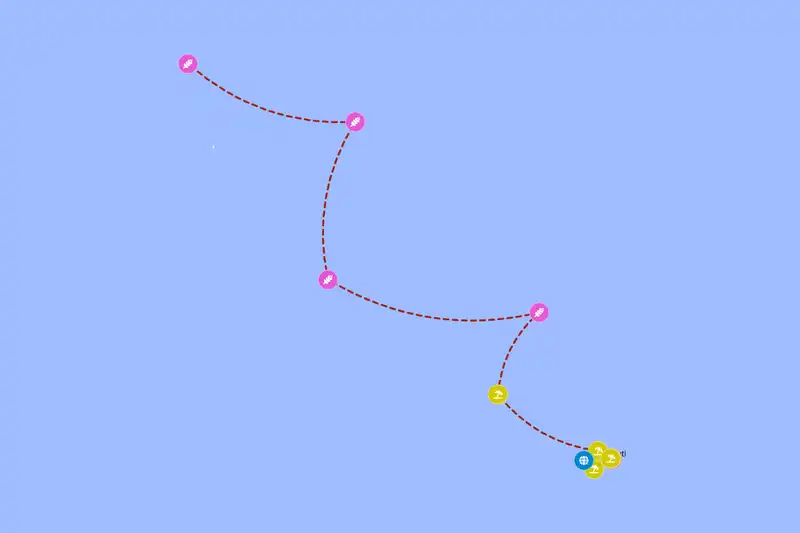
Yes, Tuvalu is easy to travel independently on Funafuti, because everything sits on one narrow islet and people are relaxed and helpful with visitors. The hard part is the outer islands, which depend on infrequent government ships.
Fiji Airways flies from Suva to
Funafuti roughly 2 to 4 times a week in about 2.5 hours, so your trip is shaped by that schedule. Book lodging ahead, since there are only a handful of hotels and guesthouses at around A$60 to 150 (US$40 to 100) a night. Scooters rent for about A$10 to 20 a day. Reaching
Nanumea or
Vaitupu means waiting for a ship that may sail only every few weeks.
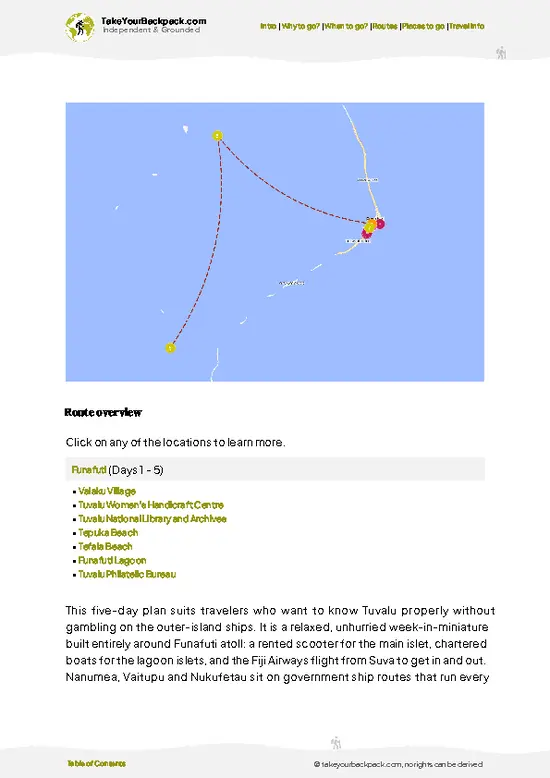
Three to five days covers Funafuti well in Tuvalu, and that is what most visitors realistically get between flights. Any outer-island trip needs two weeks or more of flexible time.
With 2 days you can see
Vaiaku Village, the Handicraft Centre and swim in
Funafuti Lagoon. With 3 to 5 days, add boat days to
Tepuka Beach and
Tefala Beach in the conservation area. Flights from Suva run only a few times a week, so your stay usually matches the gap between two departures. Government ships to atolls like
Nukufetau or
Nanumea take from several hours to over a day each way and run irregularly.
Yes, you can get around Tuvalu without a car; on Funafuti almost everyone rides a scooter, and the main islet is only about 12 kilometers long. Walking works for the Vaiaku area.
Scooters rent for around A$10 to 20 (US$6 to 13) a day through lodgings or locals, and riding the full length of Fongafale takes 20 to 30 minutes. For
Tepuka Beach or
Tefala Beach you charter a boat across the lagoon, typically A$150 to 300 for the day, so sharing with other travelers helps. Outer islands are reached only by government ships, which sail every few weeks.
In Tuvalu, the essential stops are
Funafuti Lagoon, the
Funafuti Women’s Handicraft Centre and a boat trip to
Tepuka Beach. Together they show the country’s culture and its water in a short stay.
Base yourself in
Funafuti near
Vaiaku Village, where the Handicraft Centre and the
Tuvalu Philatelic Bureau are a short walk from the airport. Spend a day snorkeling in the conservation area on the western rim, a 30 to 60 minute boat ride depending on conditions. With weeks to spare and ship timing on your side,
Nanumea Atoll in the far north is the outer island most worth the voyage.
If you are short on time in Tuvalu, skip the outer islands entirely and the
Tuvalu National Library and Archives. Focus on Funafuti’s lagoon and handicrafts instead.
Ships to
Nukulaelae Atoll,
Niutao or
Nui run every few weeks and can take a day or more each way, so they do not fit a 2 to 5 day trip. On Funafuti, choose one boat day to
Tepuka Beach rather than two islet trips if you only have 3 days. The Philatelic Bureau needs only 15 to 30 minutes and sits beside the airport, so leave it for departure day.
Yes, our itinerary-planner does exactly that. Set your trip length in days, give your interests and travel style, optionally give start- and end location and/or some mandatory stops you would like to include and the itinerary planner creates your personalized routes for Tuvalu in seconds. Try it out!
Try the itinerary plannerv2.webp)



 Best Backpacking