
×

Uruguay🇺🇾 | best hikesThe 3 Top hikes in Uruguay

Hikes in Uruguay are gentle, low-altitude walks across rolling grassland, rocky hills and Atlantic coast, with almost no mountain terrain. The country tops out near 500 meters, so effort comes from distance, sun and wind rather than climbs. In the southeast (Rocha, Maldonado), long beach and lagoon trails get busier and pricier in summer. The interior sierras (Lavalleja, Minas) offer quieter hill paths and cheaper lodging. Along the Río Uruguay in the west, wetland and river walks are the least visited. Independent travelers manage well, but trailheads often need a bus plus a taxi or hitched ride.

By Johan Kruseman 🇳🇱 | Updated October 20, 2026
Explore the best beaches in Uruguay

Why go?Why These hike Stand Out

Uruguay is a lowland country of grassland, wetlands and a long coast, shaped by cattle ranching rather than mountaineering. That history means few formal long-distance trails and little of the hut or refuge network found in Andean neighbors. Hiking here is mostly day walking in protected areas, many managed by the national protected-areas system, with modest signage and short, often guided routes. Much of the countryside is private estancia land, so access follows fences and permissions, not open-ended right-to-roam.

The upside is infrastructure and safety. Roads are paved and reliable, towns are small and walkable, and Uruguay has among the lowest crime rates in South America. Distances between regions are short, so a country-wide trip needs little time.

Travelers should know what Uruguay … read more 👉
Uruguay is a lowland country of grassland, wetlands and a long coast, shaped by cattle ranching rather than mountaineering. That history means few formal long-distance trails and little of the hut or refuge network found in Andean neighbors. Hiking here is mostly day walking in protected areas, many managed by the national protected-areas system, with modest signage and short, often guided routes. Much of the countryside is private estancia land, so access follows fences and permissions, not open-ended right-to-roam.

The upside is infrastructure and safety. Roads are paved and reliable, towns are small and walkable, and Uruguay has among the lowest crime rates in South America. Distances between regions are short, so a country-wide trip needs little time.

Travelers should know what Uruguay does not offer: no high peaks, no multi-day wilderness treks, and limited public transport to trailheads outside July and summer peaks. Shade is scarce, wind off the Atlantic is constant, and ticks and sun exposure matter more than altitude. Choose Uruguay for quiet landscapes, birdlife, coastal light and easy logistics, and not for technical or extreme walking.
Why These Made the Cut
The list of best hikes in Uruguay is created based on scenery, challenge, trail quality, landmarks, and overall enjoyment. If you feel a hike is missing in this list, please let us know.

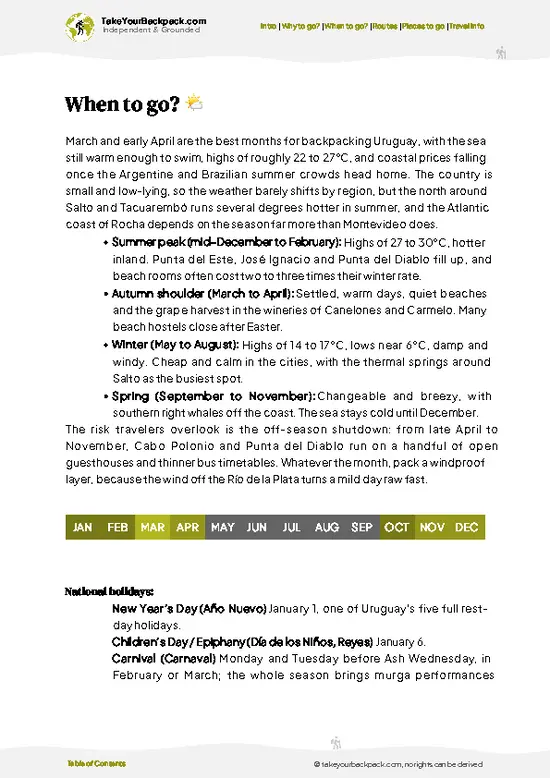
When to go?Timing Your Visit for the Best Experience

Best months for walking: The best months are October to November and March to April, when daytime highs sit around 18 to 26°C and the summer heat and crowds have not yet arrived or have already left. Spring brings green grassland and flowering hills, while autumn offers clear, stable days and warm sea water on the coast.
Summer and winter: December to February is hot, with highs of 28 to 35°C across the interior and little shade on exposed paths. Rain tends to come in short, heavy storms. Coastal Rocha and Maldonado are at their most crowded from late December to mid-February, when accommodation prices can rise 50 to 100 percent and dorm beds and campsites fill. Book ahead for that window, or choose the interior, where the effect is smaller.

June to August is cool and damp, with highs of 11 … read more 👉
Best months for walking: The best months are October to November and March to April, when daytime highs sit around 18 to 26°C and the summer heat and crowds have not yet arrived or have already left. Spring brings green grassland and flowering hills, while autumn offers clear, stable days and warm sea water on the coast.
Summer and winter: December to February is hot, with highs of 28 to 35°C across the interior and little shade on exposed paths. Rain tends to come in short, heavy storms. Coastal Rocha and Maldonado are at their most crowded from late December to mid-February, when accommodation prices can rise 50 to 100 percent and dorm beds and campsites fill. Book ahead for that window, or choose the interior, where the effect is smaller.

June to August is cool and damp, with highs of 11 to 16°C, nights near 3 to 7°C, and occasional frost inland. Rainfall is spread fairly evenly through the year, roughly 1,000 to 1,300 mm annually, so no month is truly dry. Winter suits the sierras for clear, quiet walking, but many coastal campsites and seasonal businesses in beach towns close or run reduced hours, and wet clay tracks can be slippery.

hike hoppingTips for Visiting Multiple Destinations

Trip length and direction: A trip combining several hikes in Uruguay needs 7 to 10 days, which allows two or three regions without rushing. Distances are short, but bus connections run mostly through Montevideo, so the capital works as the hub.
Grouping regions: The southeast coast (Maldonado to Rocha) and the interior sierras (Minas, Lavalleja) group well, since Minas is about 2 hours by bus from Montevideo and Punta del Este about 2 to 2.5 hours. A sensible direction is Montevideo to the sierras first, then east to the coast, finishing along the Atlantic where onward buses to Brazil leave from Chuy. The western river area around Colonia and Río Uruguay fits as a separate leg, 2.5 to 3 hours from Montevideo by bus.
Time per stop and common mistakes: Allow 2 to 3 nights per region, giving at … read more 👉
Trip length and direction: A trip combining several hikes in Uruguay needs 7 to 10 days, which allows two or three regions without rushing. Distances are short, but bus connections run mostly through Montevideo, so the capital works as the hub.
Grouping regions: The southeast coast (Maldonado to Rocha) and the interior sierras (Minas, Lavalleja) group well, since Minas is about 2 hours by bus from Montevideo and Punta del Este about 2 to 2.5 hours. A sensible direction is Montevideo to the sierras first, then east to the coast, finishing along the Atlantic where onward buses to Brazil leave from Chuy. The western river area around Colonia and Río Uruguay fits as a separate leg, 2.5 to 3 hours from Montevideo by bus.
Time per stop and common mistakes: Allow 2 to 3 nights per region, giving at least one full walking day and one flexible day. Typical transfers between regions take 2 to 5 hours, and rural services thin out in the afternoon and on Sundays.

The common mistake is trying to link coast and sierra directly, since many cross-country routes pass back through Montevideo or Pan de Azúcar and add hours. Plan transfers around the hub. Another is assuming buses reach trailheads. Many do not, so book a local taxi or a transfer from the nearest town the day before. Packing too many stops into one week leaves little slack for wind, rain or late buses.

The ListMust-Visit hikes in Uruguay

1 Cerro Pan de Azúcar

White summit cross, granite slabs, river and ocean view, 2 to 3 hours

Climb a marked path to a wind-swept cross at about 389 meters, where Piriápolis, the Río de la Plata and the Atlantic come into view.

uruguay-hike-cerro-pan-de-azucar
© Google | Robson Cardoso

2 Sierra de las Ánimas

Rounded granite hills, multi-peak range, ranchland views, no water refills

Link short climbs to Cerro de las Ánimas, Pan de Azúcar and quieter Cerro del Toro, with the Castillo de Piria along the way.

3 Cerro Arequita

Volcanic scree, 360-degree crest, lagoon stop, half-day from Minas

Scramble up dark volcanic rock above grazing land to a crest that opens over the folded Sierras de Minas, with hawks circling close.

uruguay-hike-cerro-arequita
© Google |
Loading the map 🌍

Expert viewPro Tips for Exploring the Best

How many hikes to plan: Plan three to five hikes in total. Uruguay’s walks are mostly half-day to full-day, and the landscapes change gradually, so more than five tends to repeat the same grassland, hill or beach views. Fewer than three leaves out a region. Spreading them over a week also keeps time for weather days, which cancel more walks than difficulty ever does.
Choosing the kind of hike: Match the walk to your travel style. Beach and lagoon walks suit travelers who want swimming, birdwatching and easy terrain, and they cost more in summer. Sierra and hill walks suit those who want quiet, a bit of elevation gain (a few hundred meters at most) and cheaper lodging. Wetland and river walks suit birders and photographers, and are the least crowded. On a short trip, pick one coastal and one … read more 👉
How many hikes to plan: Plan three to five hikes in total. Uruguay’s walks are mostly half-day to full-day, and the landscapes change gradually, so more than five tends to repeat the same grassland, hill or beach views. Fewer than three leaves out a region. Spreading them over a week also keeps time for weather days, which cancel more walks than difficulty ever does.
Choosing the kind of hike: Match the walk to your travel style. Beach and lagoon walks suit travelers who want swimming, birdwatching and easy terrain, and they cost more in summer. Sierra and hill walks suit those who want quiet, a bit of elevation gain (a few hundred meters at most) and cheaper lodging. Wetland and river walks suit birders and photographers, and are the least crowded. On a short trip, pick one coastal and one inland walk. Long-distance trekkers will find the country too gentle and should treat it as a rest stop in a wider South American route.
What it costs: Budget US$40 to 70 a day for independent travel, as Uruguay is one of South America’s pricier countries. Dorm beds run about US$15 to 30 (roughly UYU 600 to 1,200), campsites US$8 to 15 per person, and meals US$8 to 15. Entry to protected areas is often free or about US$2 to 8. Local guides cost roughly US$30 to 80 for a half day, which matters where land is private or tracks are poorly marked. Taxis to a remote trailhead run US$20 to 50 each way, so sharing with other walkers cuts cost. A realistic total for four or five hikes with transport is US$100 to 250 on top of lodging.
Safety and local etiquette: The main hazards are environmental. Sun is strong even in spring, and shade is rare, so carry 2 to 3 liters of water, a hat and sunscreen. Check ticks after walking through long grass. Weather can turn fast, with sudden storms in summer and cold, wet wind in winter, and clay tracks become slick. Cell coverage is patchy in the sierras, so download offline maps.

Crime is low, but do not leave valuables visible in parked cars at coastal trailheads. Much land is private ranch property, so close gates behind you and stay on marked paths. Uruguayans are reserved and polite, and a greeting goes a long way in small towns. Carry cash in pesos, since small rural shops and guides often do not take cards. The smarter move is to carry your own water and food, because services near trailheads are minimal.

✈️ The backpacker research shortcutUruguay Travel Guide

An offline-friendly backpacking guide with optimized travel routes, ranked highlights, transport advice, and the best areas to stay.
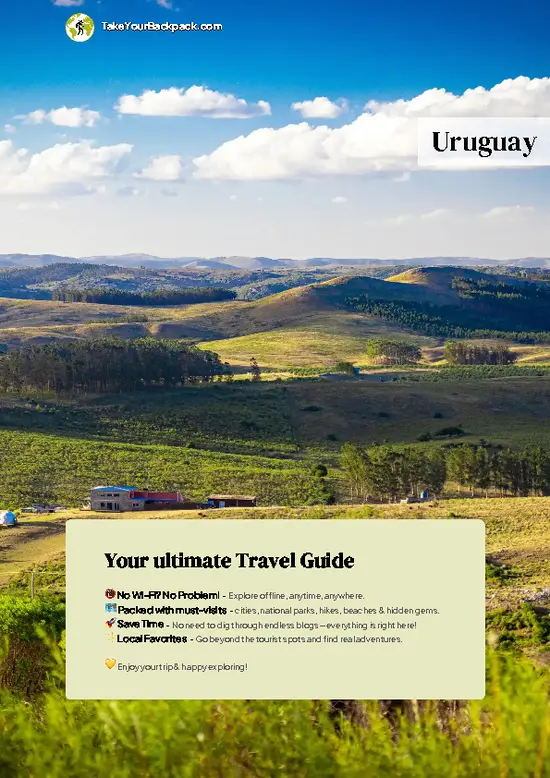
example page 0 from our offline Travel Guide for Uruguay
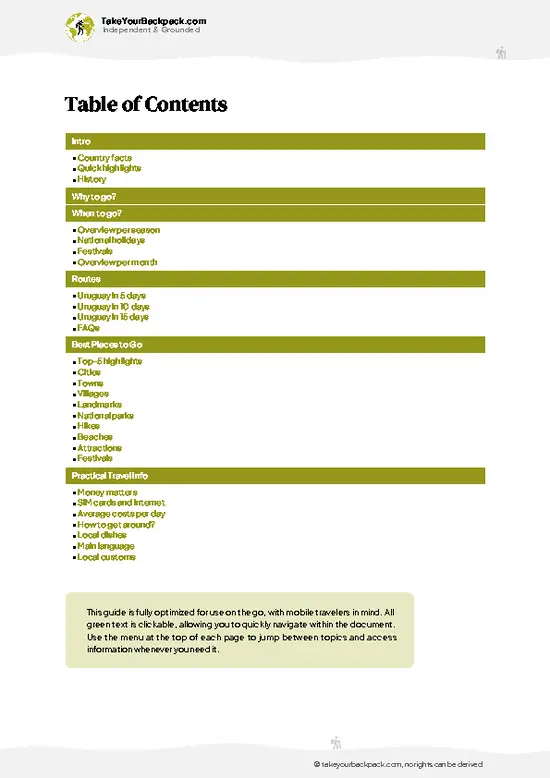
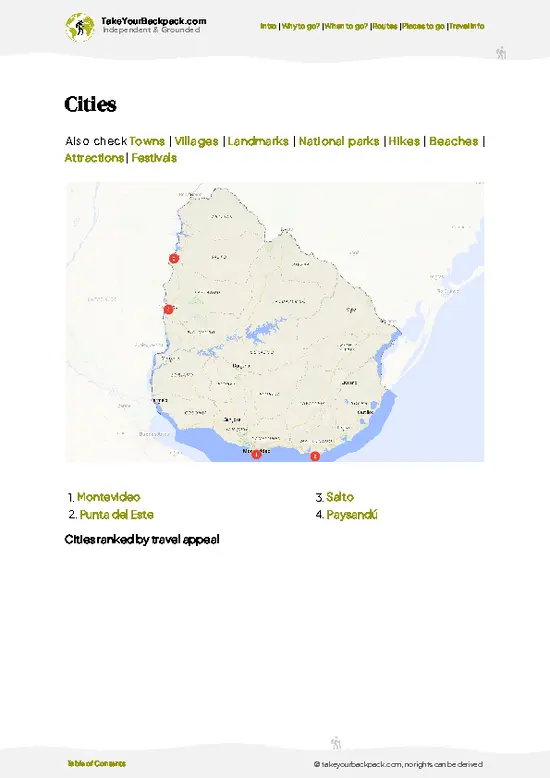
example page 1 from our offline Travel Guide for Uruguay
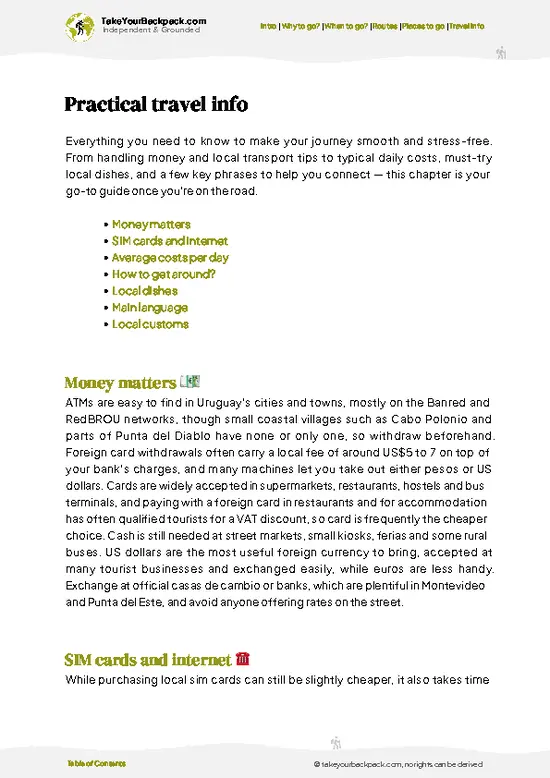
example page 2 from our offline Travel Guide for Uruguay
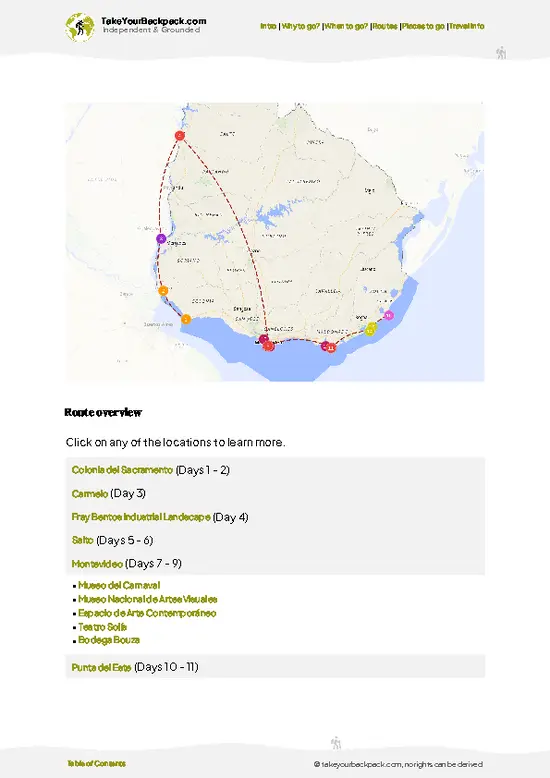
example page 3 from our offline Travel Guide for Uruguay
example page 4 from our offline Travel Guide for Uruguay
example page 5 from our offline Travel Guide for Uruguay
example page 6 from our offline Travel Guide for Uruguay
example page 7 from our offline Travel Guide for Uruguay
The digital guide (198 pages) contains:
✅ 56 highlights, ranked by travel appeal
✅ Optimized 5, 10 & 15-day travel routes
✅ Cities, national parks, landmarks, beaches
✅ How to get around
✅ Offline-friendly for travel without Wi-Fi
👉 Click to see all 30+ guide features

📅 Plan smarter in minutes, not weeks
✅ Month by month travel advice
✅ Festivals & national holidays
✅ Budget expectations

🗺️ Go to the right places, skip the overrated ones
✅ Honest pros & cons of destinations
✅ Top hikes, parks & viewpoints
✅ Lesser-known places most travelers miss
✅ Clear “worth it vs skip it” guidance

🛏️ Travel smoothly without rookie mistakes
✅ Best areas to stay
✅ Transport systems explained simply
✅ Common scams & safety advice
✅ SIM cards, money & practical tips

🌍 Understand the country, not just visit it
✅ Culture & traditions
✅ 52 Essential phrases & customs
✅ Festivals worth planning around
✅ Traveler-friendly historical context
✅ Insights that make places more meaningful

📱 Built for real travel conditions
✅ Fully downloadable PDF
✅ Works completely offline
✅ Optimized for phone use
✅ Useful in remote areas & buses
✅ Everything in one place
Stop searching, start planning
Get instant access to your full guide. 30‑day money-back guarantee.
+ Add another guide for just

By proceeding you agree to our terms.
Sent to your inbox immediately after payment • 100% Secure Checkout
Best Backpacking Travel Advisor 2025 tourism awardBest Backpacking
Travel Advisor
2025
What others say about Take Your Backpack Guides:
⭐⭐⭐⭐⭐
Fantastic, amazing amount of information!
⭐⭐⭐⭐⭐
My goodness this is amazing, it's what I've been looking for hats off too you!
⭐⭐⭐⭐⭐
I think this is absolutely BRILLIANT
⭐⭐⭐⭐
Very complete and informative. It's still missing places, but I gotta to commend you
⭐⭐⭐⭐⭐
This is truly amazing, thank you, can't wait to explore it with my kids!
⭐⭐⭐⭐⭐
Awesome resource, thank you!
⭐⭐⭐⭐⭐
This is amazing! Can't wait to explore the ones I haven't seen
⭐⭐⭐⭐
I love this! Well done, great idea.
⭐⭐⭐⭐⭐
Thanks for taking the time to make this gem!
⭐⭐⭐⭐⭐
This might be the best website I've ever seen.
⭐⭐⭐⭐⭐
Congratulations, and thank you so much for your work; it's incredibly valuable.
⭐⭐⭐⭐
In all seriousness I think you did a great job pointing out the important spots
⭐⭐⭐⭐⭐
10/10 very good
⭐⭐⭐⭐⭐
As someone who's only just starting to visit regularly this is awesome, thank you.
⭐⭐⭐⭐
Thank you very much! I'm going to visit my dad, it's going to be very useful!
⭐⭐⭐⭐⭐
This is really cool! We'll be travelling for the first time and this definitely come in handy.
⭐⭐⭐⭐⭐
You are now our minister of culture, congratulations 👨‍💼
⭐⭐⭐⭐⭐
Just wanted to tell you that this is a pearl! Going to follow your recommendations.
⭐⭐⭐⭐⭐
This is so cool. I'll definitely be using the resource for my travels soon.
⭐⭐⭐⭐⭐
This is very impressive! Good work.
⭐⭐⭐⭐⭐
This is an amazing and informative site. Very well done!

🛏️ Where to stay?Top Areas to Stay

Uruguay has a solid hostel scene, with dorm beds typically running UYU 600 to 1,200 (about US$15 to 30), and the widest choice is in Montevideo, where Ciudad Vieja puts you steps from the old town’s plazas and port market but gets very quiet and a bit sketchy after dark, while Pocitos trades walkable sights for a safe beachfront rambla and plenty of restaurants, and Parque Rodó with neighboring Cordón is cheaper and closest to the bars. Outside the capital, Colonia del Sacramento has calm, compact hostels within walking distance of the cobbled historic quarter, Punta del Este fills with party hostels in January and February when prices jump sharply, and beach villages like Punta del Diablo and … read more 👉
Uruguay has a solid hostel scene, with dorm beds typically running UYU 600 to 1,200 (about US$15 to 30), and the widest choice is in Montevideo, where Ciudad Vieja puts you steps from the old town’s plazas and port market but gets very quiet and a bit sketchy after dark, while Pocitos trades walkable sights for a safe beachfront rambla and plenty of restaurants, and Parque Rodó with neighboring Cordón is cheaper and closest to the bars. Outside the capital, Colonia del Sacramento has calm, compact hostels within walking distance of the cobbled historic quarter, Punta del Este fills with party hostels in January and February when prices jump sharply, and beach villages like Punta del Diablo and Cabo Polonio offer simple, sociable stays that shut down or thin out heavily outside summer.

If you enjoy meeting fellow travelers, consider choosing hostels with high ratings for atmosphere. On the other hand, if you prefer having your own space, a hotel might be a better option.

UruguayDiscover the Country

👋 Meet the founderWho’s Behind Take Your Backpack?

Johan, backpacker and founder of TakeYourBackpackHi, I’m Johan (Netherlands 🇳🇱), the creator of TakeYourBackpack. Over the past 3 decades, I’ve backpacked through 90+ countries across six continents, gaining extensive experience with independent travel, long-term trips, and overland routes.

This site is built on a combination of firsthand travel experience and carefully curated insights from other backpackers. Many guides are based on places I’ve personally visited, while others bring together tips, observations, and practical advice shared by trusted travelers I’ve met along the way.

The goal is to provide realistic, experience-driven guidance — not generic itineraries — so you can explore destinations with better context, clearer expectations, and more confidence.