×

Uruguay🇺🇾 | best attractionsThe 12 Top attractions in Uruguay

Uruguay’s attractions are defined less by grandiosity and more by their approachable scale and cultural authenticity, making it a unique playground for backpackers and independent travelers. The country’s compact size means regional differences—like the laid-back beach towns of Rocha versus the urban pulse of Montevideo—directly shape the travel experience. Seasonal shifts, especially the summer surge along the coast, influence not only crowd levels but also budget and safety considerations. Choosing the right attraction here isn’t just about ticking off sights; it’s about aligning your itinerary with your preferred vibe, whether that’s quiet immersion in gaucho culture or lively street festivals, ensuring smoother logistics and deeper local connection throughout your journey.

By Johan Kruseman 🇳🇱 | Updated June 14, 2026
Explore the best festivals in Uruguay

Why go?Why These attraction Stand Out

Why These Attractions Matter

Uruguay’s attractions stand out because they offer a rare blend of accessibility and authenticity within a compact geographic footprint. Unlike larger South American neighbors where travel between highlights can consume days, Uruguay’s modest size means less time lost in transit and more time engaging with its cultural and natural offerings. This creates a practical advantage for travelers seeking depth without the endurance test of long-distance travel.

However, this accessibility comes with trade-offs. The country’s relatively flat terrain and temperate climate limit dramatic landscapes, so the appeal lies less in grand natural spectacles and more in subtle, lived-in environments shaped by history and tradition. Uruguay’s attractions are deeply tied to its colonial … read more 👉
Why These Attractions Matter

Uruguay’s attractions stand out because they offer a rare blend of accessibility and authenticity within a compact geographic footprint. Unlike larger South American neighbors where travel between highlights can consume days, Uruguay’s modest size means less time lost in transit and more time engaging with its cultural and natural offerings. This creates a practical advantage for travelers seeking depth without the endurance test of long-distance travel.

However, this accessibility comes with trade-offs. The country’s relatively flat terrain and temperate climate limit dramatic landscapes, so the appeal lies less in grand natural spectacles and more in subtle, lived-in environments shaped by history and tradition. Uruguay’s attractions are deeply tied to its colonial heritage, gaucho culture, and coastal lifestyle, which require a willingness to appreciate nuance over spectacle.

Infrastructure is another key factor. Uruguay’s well-maintained roads and reliable public transport make many sites reachable, but the country’s smaller tourism scale means fewer crowds and less commercial development. This can be a double-edged sword: it preserves authenticity but demands more planning for services and amenities that larger tourist hubs take for granted.

Ultimately, the value of Uruguay’s attractions lies in their ability to offer a measured, immersive experience that rewards patience and curiosity rather than rapid checklist tourism. Understanding these dynamics helps travelers set realistic expectations and unlock a richer, more manageable exploration of the country’s character.
Our Approach to Ranking
The list of best attractions in Uruguay is created based on cultural significance or entertainment value. If you feel a attraction is missing in this list, please let us know.

When to go?Timing Your Visit for the Best Experience

Seasonal Patterns and Their Impact on Visiting Attractions

Uruguay’s climate follows a temperate pattern with distinct seasons that shape the experience of its attractions. Summers bring warm to hot temperatures, often accompanied by humidity, which makes outdoor activities and coastal visits more appealing but also busier. This period is the peak season, drawing the largest crowds and pushing prices higher, especially for accommodations and local services. The influx can affect availability and the overall pace of exploration.

In contrast, winters are mild but cooler, with fewer tourists and quieter surroundings. This season offers a more relaxed pace but limits some outdoor options due to lower temperatures and occasional rain. Attractions that rely on good weather or open-air access may … read more 👉

Seasonal Patterns and Their Impact on Visiting Attractions

Uruguay’s climate follows a temperate pattern with distinct seasons that shape the experience of its attractions. Summers bring warm to hot temperatures, often accompanied by humidity, which makes outdoor activities and coastal visits more appealing but also busier. This period is the peak season, drawing the largest crowds and pushing prices higher, especially for accommodations and local services. The influx can affect availability and the overall pace of exploration.

In contrast, winters are mild but cooler, with fewer tourists and quieter surroundings. This season offers a more relaxed pace but limits some outdoor options due to lower temperatures and occasional rain. Attractions that rely on good weather or open-air access may have reduced hours or less vibrant conditions. The trade-off here is between solitude and the full range of activities.

Shoulder seasons—spring and autumn—strike a balance. Temperatures are moderate, and the landscape shifts with seasonal blooms or changing foliage, enhancing the visual appeal of natural sites. Crowds thin out compared to summer, and prices tend to be more reasonable. However, weather can be less predictable, with occasional rain or wind, so flexibility in planning is essential.

Understanding these patterns helps align expectations with reality. Choosing when to visit depends on prioritizing either vibrant activity and social energy or quieter, more contemplative experiences, while managing costs and weather-related constraints effectively.

attraction hoppingTips for Visiting Multiple Destinations

Efficiently Linking Uruguay’s Highlights

Uruguay’s compact size invites a logical flow that clusters attractions by region, minimizing backtracking. Start with Montevideo’s cultural and culinary scene, then move east toward the coastal resorts and historic towns. This eastward progression aligns with transport routes and maximizes time on the ground rather than in transit.

Allocating two to three days per major stop strikes a balance between depth and momentum. Urban centers demand more time to absorb museums, markets, and nightlife, while beach towns and rural areas often reward a day or two of exploration. Overloading the itinerary with too many stops dilutes the experience and adds logistical friction.

Common pitfalls include underestimating travel times on secondary roads and overcommitting … read more 👉

Efficiently Linking Uruguay’s Highlights

Uruguay’s compact size invites a logical flow that clusters attractions by region, minimizing backtracking. Start with Montevideo’s cultural and culinary scene, then move east toward the coastal resorts and historic towns. This eastward progression aligns with transport routes and maximizes time on the ground rather than in transit.

Allocating two to three days per major stop strikes a balance between depth and momentum. Urban centers demand more time to absorb museums, markets, and nightlife, while beach towns and rural areas often reward a day or two of exploration. Overloading the itinerary with too many stops dilutes the experience and adds logistical friction.

Common pitfalls include underestimating travel times on secondary roads and overcommitting to distant locations in a single trip. Uruguay’s charm often lies in its slower rhythms, so rushing through multiple towns sacrifices the local character that defines each place.

Trade-offs are inevitable: speeding through reduces costs but risks superficial encounters; lingering longer enhances immersion but raises expenses and may require more flexible scheduling. Budget travelers should prioritize regional clusters to cut transport costs, while those seeking comfort might accept longer stays for better accommodations.

Ultimately, a successful trip hinges on realistic pacing and strategic sequencing—allowing enough time to engage meaningfully with each stop while maintaining forward momentum across the country’s diverse landscapes.

The ListMust-Visit attractions in Uruguay

1 Colonia del Sacramento Historic Quarter Museums

cobblestone lanes, colonial artifacts, riverfront houses

Step into preserved rooms filled with everyday relics, trace Portuguese and Spanish influences, and glimpse centuries-old life by the Río de la Plata.

uruguay-attraction-colonia-del-sacramento-historic-quarter-museums
© Google |

2 Casapueblo

cliffside architecture, artist’s home, sunset views

Wander through sculpted white walls, discover the legacy of Carlos Páez Vilaró, and watch the sun set over the Atlantic horizon.

uruguay-attraction-casapueblo
© Google |

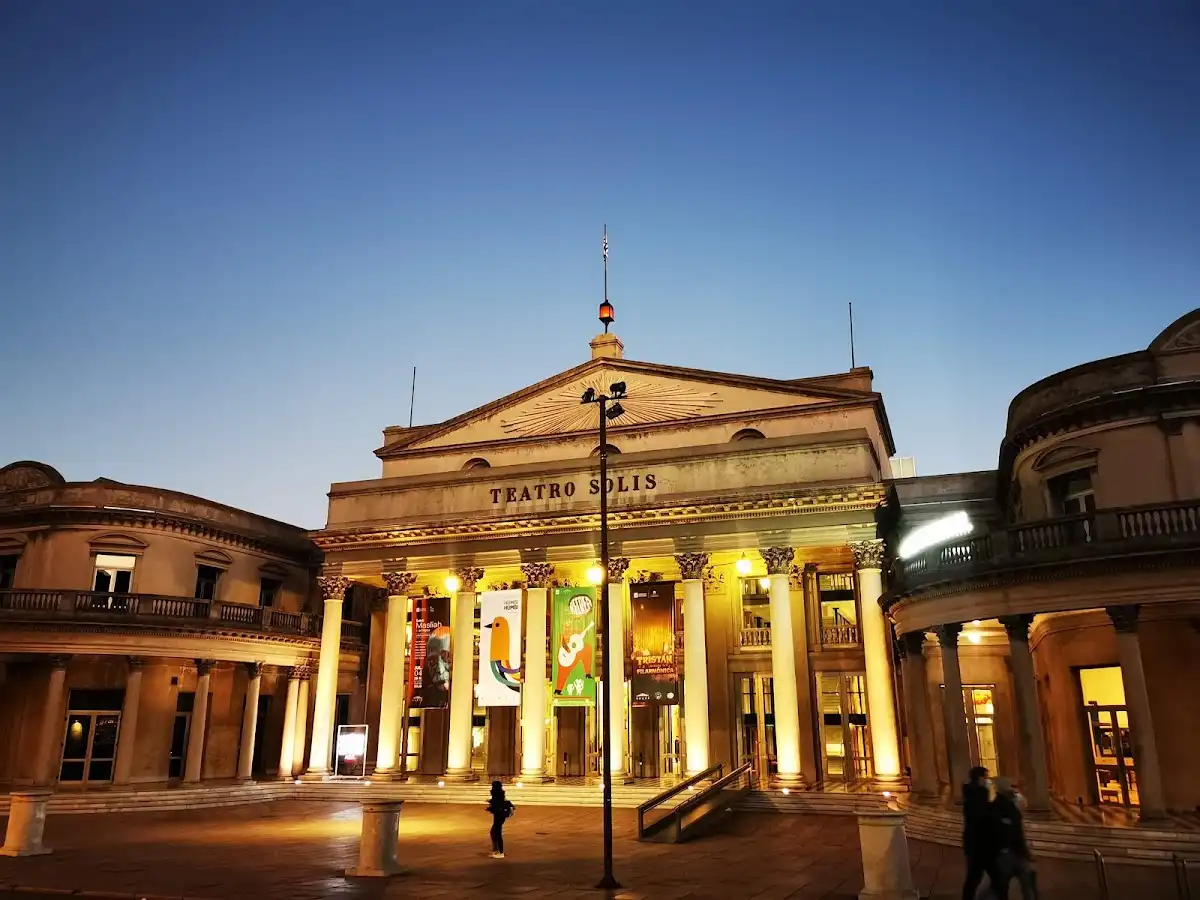
3 Teatro Solís

neoclassical façade, grand auditorium, guided tours

Attend a performance or tour backstage, admire period architecture, and learn about Montevideo’s cultural scene in Uruguay’s oldest theater.

uruguay-attraction-teatro-solis
© Google |

4 Mercado del Puerto

iron market hall, parrilla grills, artisan stalls

Savor grilled meats at communal tables, browse handmade goods, and observe daily rhythms in Montevideo’s central gathering spot.

uruguay-attraction-mercado-del-puerto
© Google |

5 Bodega Garzón

hilltop estate, olive groves, panoramic terrace

Taste regional varietals overlooking rolling fields, walk among olive trees, and experience modern Uruguayan winemaking in a rural landscape.

uruguay-attraction-bodega-garzon v1
© Google |

6 Bodega Bouza

family-run winery, barrel room, vineyard views

Sample small-batch wines in a tranquil setting, tour cellars lined with oak, and enjoy local cuisine paired with estate vintages.

7 Museo Andes 1972

survival artifacts, crash site relics, personal testimonies

Reflect on the Andes plane tragedy through objects, photographs, and survivor accounts that reveal the endurance of the human spirit.

uruguay-attraction-museo-andes-1972 v1
© Google |

8 Museo Nacional de Artes Visuales

national art collection, modernist paintings, sculpture garden

Survey Uruguayan visual arts from the nineteenth century onward, including works by Torres García and contemporary installations.

9 Museo del Carnaval

costume displays, parade masks, candombe drums

Delve into Uruguay’s carnival traditions, examine vibrant attire, and learn how music and dance define the country’s festive season.

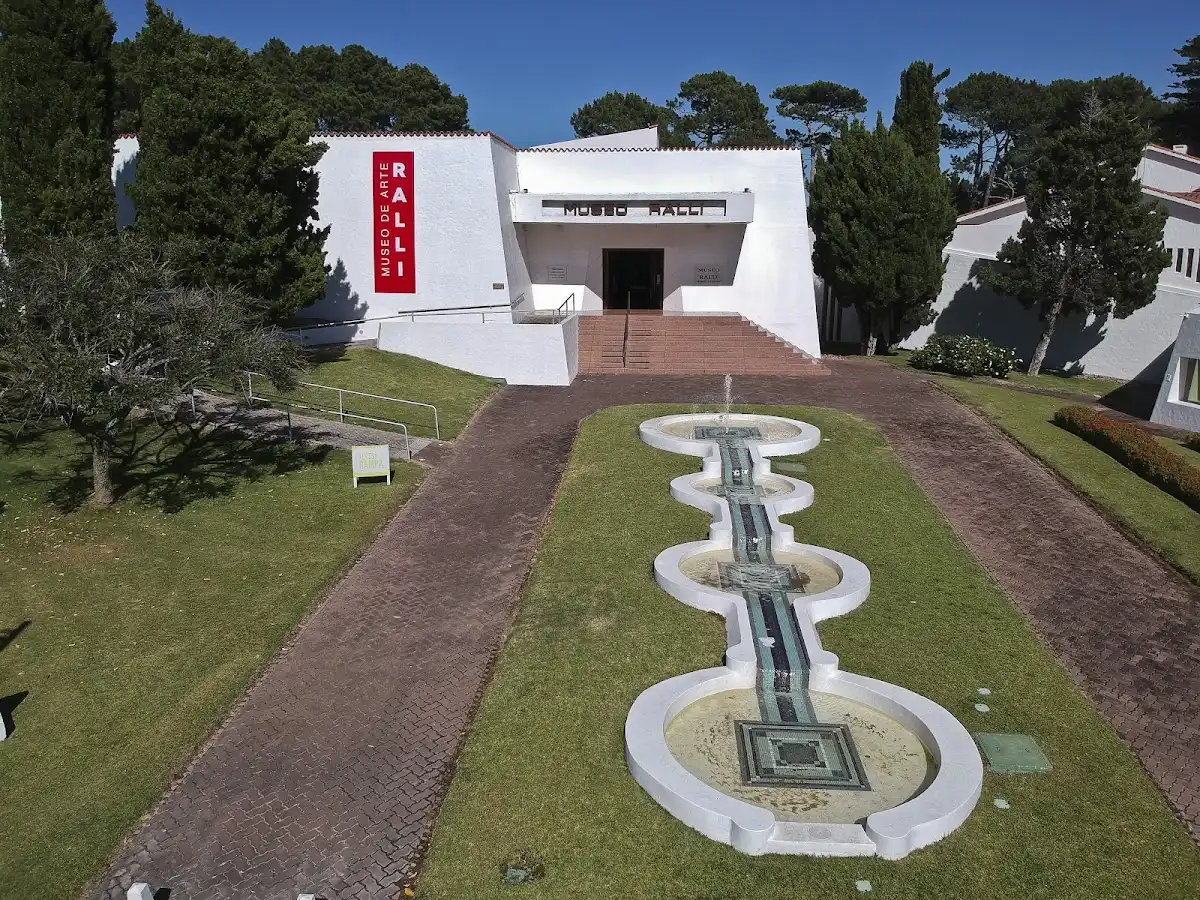
10 Museo Ralli

Latin American art, surrealist works, private collection

View paintings and sculptures by regional artists, explore surrealist pieces, and appreciate a diverse array of modern art in Punta del Este.

uruguay-attraction-museo-ralli
© Google |

11 Espacio de Arte Contemporáneo

converted prison, site-specific installations, local artists

Experience contemporary works in former cells, engage with experimental exhibitions, and see how artists reinterpret a historic urban space.

12 Museo del Azulejo

ceramic tiles, decorative panels, architectural fragments

Trace the evolution of tilework in Uruguay, view intricate patterns from multiple eras, and see how ceramics shaped local design.

Loading the map 🌍

Expert viewPro Tips for Exploring the Best

Expert Commentary


When tackling the best attractions in Uruguay, the first practical step is to accept that you won’t see everything—and that’s a good thing. Uruguay’s charm lies in its manageable scale and the distinct character each region offers. Trying to cram more than three to five major attractions into a single trip often backfires, turning what should be an immersive experience into a rushed checklist. Instead, focus on quality over quantity. This approach respects the country’s slower pace and allows you to absorb the subtle cultural rhythms that define it.

Budget and time are your primary constraints here. Uruguay is not a budget backpacker’s paradise, but it’s far from exorbitant either. Expect mid-range costs for accommodation and meals, with some attractions requiring entrance … read more 👉

Expert Commentary


When tackling the best attractions in Uruguay, the first practical step is to accept that you won’t see everything—and that’s a good thing. Uruguay’s charm lies in its manageable scale and the distinct character each region offers. Trying to cram more than three to five major attractions into a single trip often backfires, turning what should be an immersive experience into a rushed checklist. Instead, focus on quality over quantity. This approach respects the country’s slower pace and allows you to absorb the subtle cultural rhythms that define it.

Budget and time are your primary constraints here. Uruguay is not a budget backpacker’s paradise, but it’s far from exorbitant either. Expect mid-range costs for accommodation and meals, with some attractions requiring entrance fees or guided tours that add up. The key is to plan your itinerary around clusters of attractions rather than hopping across the country. This reduces transport expenses and fatigue. Public transport is reliable but can be slow and infrequent outside main corridors, so renting a car or using private transfers might be necessary if you want to maximize your time. This trade-off between cost and convenience is crucial to understand before you commit.

The country’s infrastructure supports a relaxed travel style. Roads are generally in good condition, but distances can be deceptive. What looks like a short drive on the map might take longer due to winding routes or local traffic patterns. Factor in extra time for travel between attractions, especially if you’re aiming to visit natural reserves or coastal areas. This isn’t a place for tight schedules; it rewards those who leave room for spontaneity and downtime.

Cultural context is another layer that shapes how you experience Uruguay’s attractions. The local pace is unhurried, and social interactions tend to be warm but reserved. This means that rushing through sites or expecting constant activity will leave you out of sync. Instead, lean into the slower tempo. Spend time at cafes or markets near attractions to observe daily life. This adds depth to your visit and often reveals more than the attractions themselves. Also, keep in mind that many cultural sites close early in the evening, so plan your days accordingly to avoid disappointment.

Safety is generally not a major concern, but standard precautions apply. Petty theft can occur in crowded areas, so keep valuables secure and stay alert, especially in tourist-heavy spots. Night travel outside urban centers is best avoided unless you have local guidance or reliable transport arranged. Respect for local customs and a low profile go a long way in ensuring smooth interactions.

One subtle but important consideration is the seasonal variation in attractions. Uruguay’s appeal shifts with the calendar. Coastal areas, for example, come alive in the summer months but can be quiet and less accessible in the off-season. Inland attractions tied to agriculture or festivals may only be fully appreciated at certain times of year. This means your timing will shape not just what you see but how you experience it. If your schedule is fixed, prioritize attractions that remain accessible year-round or adjust expectations accordingly.

In practice, this means your best bet is to pick a few core interests—whether that’s nature, history, or local culture—and build your itinerary around them. Trying to cover every type of attraction dilutes the experience and increases logistical headaches. Instead, dive deeper into fewer sites. For example, if you’re drawn to natural landscapes, allocate more time to parks and rural areas, accepting that urban cultural sites will have to wait for another trip. Conversely, if museums and colonial architecture are your focus, plan your days to maximize visits within a compact area.

Ultimately, the best attractions in Uruguay reward patience and thoughtful pacing. They are not about ticking boxes but about tuning into the country’s understated charm. By limiting your list to a handful of well-chosen sites, budgeting realistically for transport and entrance fees, and respecting local rhythms, you unlock a smoother, richer experience. This is a destination where less truly is more, and where the real value lies in the details you take the time to notice.

✈️ The backpacker research shortcutUruguay Travel Guide

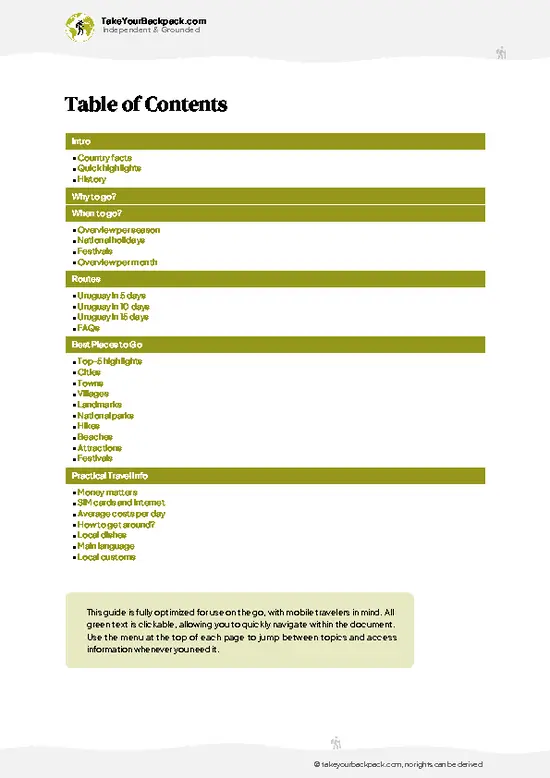
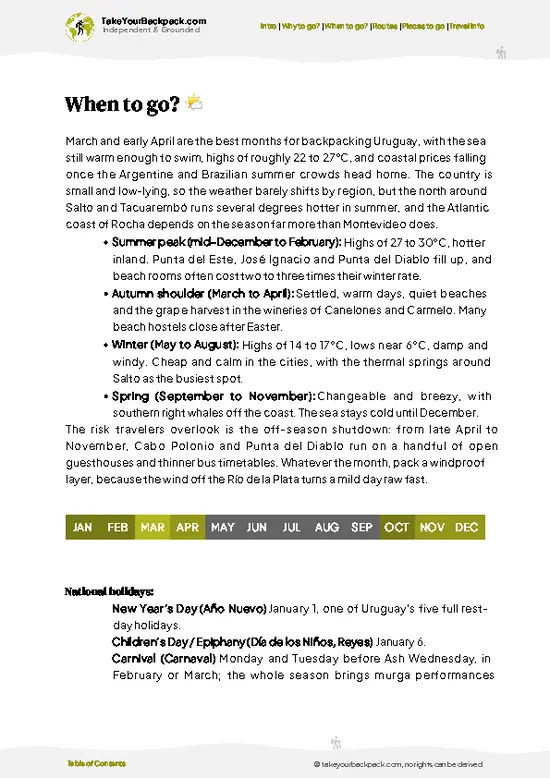
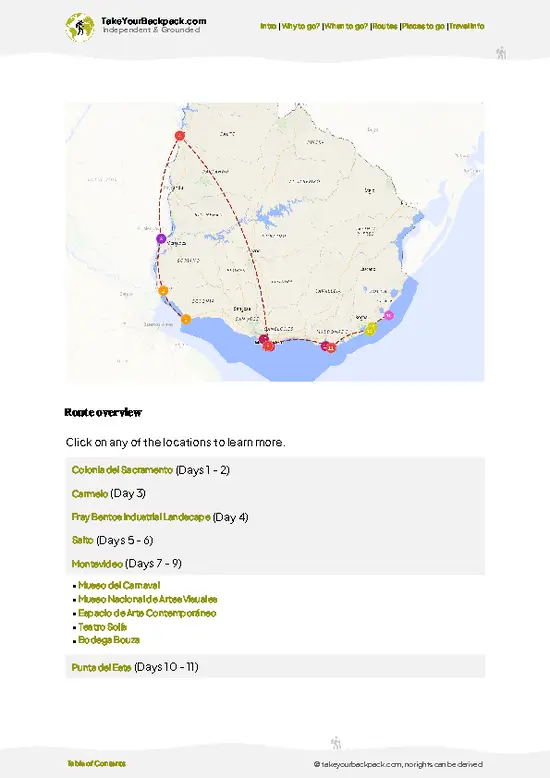
An offline-friendly backpacking guide with optimized travel routes, ranked highlights, transport advice, and the best areas to stay.
example page 0 from our offline Travel Guide for Uruguay
example page 1 from our offline Travel Guide for Uruguay
example page 2 from our offline Travel Guide for Uruguay
example page 3 from our offline Travel Guide for Uruguay
example page 4 from our offline Travel Guide for Uruguay
example page 5 from our offline Travel Guide for Uruguay
example page 6 from our offline Travel Guide for Uruguay
example page 7 from our offline Travel Guide for Uruguay
The digital guide (256 pages) contains:
64 highlights, ranked by travel appeal
Optimized 5, 10 & 15-day travel routes
Cities, national parks, landmarks, beaches
How to get around
Offline-friendly for travel without Wi-Fi
👉 Click to see all 30+ guide features

📅 Plan smarter in minutes, not weeks
Month by month travel advice
Festivals & national holidays
Budget expectations

🗺️ Go to the right places, skip the overrated ones
Honest pros & cons of destinations
Top hikes, parks & viewpoints
Lesser-known places most travelers miss
Clear “worth it vs skip it” guidance

🛏️ Travel smoothly without rookie mistakes
Best areas to stay
Transport systems explained simply
Common scams & safety advice
SIM cards, money & practical tips

🌍 Understand the country, not just visit it
Culture & traditions
52 Essential phrases & customs
Festivals worth planning around
Traveler-friendly historical context
Insights that make places more meaningful

📱 Built for real travel conditions
Fully downloadable PDF
Works completely offline
Optimized for phone use
Useful in remote areas & buses
Everything in one place
Save weeks of stressful planning
Get instant access to your full guide. 30‑day money-back guarantee.


By proceeding you agree to our terms.
Sent to your inbox immediately after payment • 100% Secure Checkout
Best Backpacking Travel Advisor 2025 tourism awardBest Backpacking
Travel Advisor
2025
What others say about Take Your Backpack Guides:
⭐⭐⭐⭐⭐
Fantastic, amazing amount of information!
⭐⭐⭐⭐⭐
My goodness this is amazing, it's what I've been looking for hats off too you!
⭐⭐⭐⭐⭐
I think this is absolutely BRILLIANT
⭐⭐⭐⭐
Very complete and informative. It's still missing places, but I gotta to commend you
⭐⭐⭐⭐⭐
This is truly amazing, thank you, can't wait to explore it with my kids!
⭐⭐⭐⭐⭐
Awesome resource, thank you!
⭐⭐⭐⭐⭐
This is amazing! Can't wait to explore the ones I haven't seen
⭐⭐⭐⭐
I love this! Well done, great idea.
⭐⭐⭐⭐⭐
Thanks for taking the time to make this gem!
⭐⭐⭐⭐⭐
This might be the best website I've ever seen.
⭐⭐⭐⭐⭐
Congratulations, and thank you so much for your work; it's incredibly valuable.
⭐⭐⭐⭐
In all seriousness I think you did a great job pointing out the important spots
⭐⭐⭐⭐⭐
10/10 very good
⭐⭐⭐⭐⭐
As someone who's only just starting to visit regularly this is awesome, thank you.
⭐⭐⭐⭐
Thank you very much! I'm going to visit my dad, it's going to be very useful!
⭐⭐⭐⭐⭐
This is really cool! We'll be travelling for the first time and this definitely come in handy.
⭐⭐⭐⭐⭐
You are now our minister of culture, congratulations 👨‍💼
⭐⭐⭐⭐⭐
Just wanted to tell you that this is a pearl! Going to follow your recommendations.
⭐⭐⭐⭐⭐
This is so cool. I'll definitely be using the resource for my travels soon.
⭐⭐⭐⭐⭐
This is very impressive! Good work.
⭐⭐⭐⭐⭐
This is an amazing and informative site. Very well done!

🛏️ Where to stay?Best Stay Options in Uruguay

Yes — hostels and budget accommodation are widely available across Uruguay, concentrated in Montevideo (Ciudad Vieja, Pocitos, Punta del Carretas), Colonia del Sacramento’s historic quarter, Punta del Este (Peninsula and La Barra) and the Rocha coast (Punta del Diablo, Cabo Polonio, La Paloma).
Montevideo neighborhoods offer the easiest transport links, museums and nightlife but vary from busy/noisy and more backpacker-focused (Ciudad Vieja, Centro) to safer/quieter stretches (Pocitos, Punta del Carretas); Colonia is compact and tranquil with fewer late-night options; Punta del Este has the most nightlife and seasonal price spikes.
Choose Montevideo or Punta del Este for transport and nightlife, … read more 👉
Yes — hostels and budget accommodation are widely available across Uruguay, concentrated in Montevideo (Ciudad Vieja, Pocitos, Punta del Carretas), Colonia del Sacramento’s historic quarter, Punta del Este (Peninsula and La Barra) and the Rocha coast (Punta del Diablo, Cabo Polonio, La Paloma).
Montevideo neighborhoods offer the easiest transport links, museums and nightlife but vary from busy/noisy and more backpacker-focused (Ciudad Vieja, Centro) to safer/quieter stretches (Pocitos, Punta del Carretas); Colonia is compact and tranquil with fewer late-night options; Punta del Este has the most nightlife and seasonal price spikes.
Choose Montevideo or Punta del Este for transport and nightlife, Colonia for historic calm, and Rocha towns for cheap rustic beach vibes while planning ahead for limited services, seasonal crowds and basic safety precautions in isolated areas.

If you enjoy meeting fellow travelers, consider choosing hostels with high ratings for atmosphere. On the other hand, if you prefer having your own space, a hotel might be a better option.

UruguayWhere to Go Next

👋 Meet the founderWho’s Behind Take Your Backpack?

Johan, backpacker and founder of TakeYourBackpackHi, I’m Johan (Netherlands 🇳🇱), the creator of TakeYourBackpack. Over the past decade, I’ve backpacked through 80+ countries across six continents, gaining extensive experience with independent travel, long-term trips, and overland routes.

This site is built on a combination of firsthand travel experience and carefully curated insights from other backpackers. Many guides are based on places I’ve personally visited, while others bring together tips, observations, and practical advice shared by trusted travelers I’ve met along the way.

The goal is to provide realistic, experience-driven guidance — not generic itineraries — so you can explore destinations with better context, clearer expectations, and more confidence.

Get full Uruguay guide •
Instant download • 64 highlights • Full Offline guide