×

Uruguay🇺🇾 | best citiesThe 4 Top cities in Uruguay

Cities in Uruguay are small, low-rise and unhurried, with a population of about 3.4 million and nearly half of it in the capital region. Outside Montevideo, most towns hold fewer than 100,000 people. The Río de la Plata coast has the colonial and seaside towns, with the highest prices and the most visitors in January and February. The interior and the Atlantic coast are quieter and cheaper, though buses run less often. Distances are short and the bus network is dependable, so independent travel is straightforward. Expect grid streets, plazas, riverfront promenades and early closing hours, with mate carried everywhere.

By Johan Kruseman 🇳🇱 | Updated October 20, 2026
Explore the best towns in Uruguay

Why go?Why These city Stand Out

Uruguay is one of the few countries where urban life is shaped by scale and consistency rather than by a single dominant metropolis. The country is about 176,000 square kilometers, mostly rolling grassland, and no point is much more than a day by road from the capital. Cities grew as ports, garrison towns and ranching hubs, first under Spanish and Portuguese rivalry, which explains the mix of fortified walls, grid plans and Portuguese-influenced streets near the Brazilian border. Later European immigration, mainly Spanish and Italian, left cafés, theaters and a strong public-plaza habit.

Several things set it apart from its neighbors. Uruguay has strong secularism, high literacy, reliable public services and one of the lower crime rates in South America, though petty theft exists in the capital. … read more 👉
Uruguay is one of the few countries where urban life is shaped by scale and consistency rather than by a single dominant metropolis. The country is about 176,000 square kilometers, mostly rolling grassland, and no point is much more than a day by road from the capital. Cities grew as ports, garrison towns and ranching hubs, first under Spanish and Portuguese rivalry, which explains the mix of fortified walls, grid plans and Portuguese-influenced streets near the Brazilian border. Later European immigration, mainly Spanish and Italian, left cafés, theaters and a strong public-plaza habit.

Several things set it apart from its neighbors. Uruguay has strong secularism, high literacy, reliable public services and one of the lower crime rates in South America, though petty theft exists in the capital. Its climate is temperate with four seasons and no extreme altitude, so city travel is comfortable most of the year.

Before choosing Uruguay for its cities, know that it is not a high-intensity destination. Monuments are modest, nightlife starts late, and Sundays are very quiet. It is also expensive by regional standards, with prices closer to Chile than to Bolivia or Paraguay. The appeal is atmosphere, walkability and ease, rather than a long list of sights.
Why These Made the Cut
The list of best cities in Uruguay is created based on culture, vibe, attractions, transport ease, and local charm. If you feel a city is missing in this list, please let us know.

When to go?Timing Your Visit for the Best Experience

Best months and weather: The best months for cities in Uruguay are March to May and October to December, when daytime temperatures sit around 17 to 26°C, rain is manageable and the Río de la Plata coast is not yet crowded. Uruguay has no dry season, and rainfall of roughly 80 to 120 mm falls in most months, so a light rain jacket is useful year-round.
Summer peak: December to February brings highs of 28 to 32°C and humidity, and the Atlantic and river coast fills with Uruguayan and Argentine vacationers. Accommodation on the coast can cost 30 to 80 percent more than in the shoulder months, and the best rooms sell out weeks ahead, especially around New Year and Carnival, which runs through January and February. Inland cities are hotter, sometimes above 35°C, and quieter.
Winter: June to August … read more 👉
Best months and weather: The best months for cities in Uruguay are March to May and October to December, when daytime temperatures sit around 17 to 26°C, rain is manageable and the Río de la Plata coast is not yet crowded. Uruguay has no dry season, and rainfall of roughly 80 to 120 mm falls in most months, so a light rain jacket is useful year-round.
Summer peak: December to February brings highs of 28 to 32°C and humidity, and the Atlantic and river coast fills with Uruguayan and Argentine vacationers. Accommodation on the coast can cost 30 to 80 percent more than in the shoulder months, and the best rooms sell out weeks ahead, especially around New Year and Carnival, which runs through January and February. Inland cities are hotter, sometimes above 35°C, and quieter.
Winter: June to August is cool and damp, with highs of 12 to 16°C and nights often near 5°C. Heating in older buildings can be weak. Coastal resort towns are close to empty and many seasonal restaurants and hotels shut, while the capital and larger inland cities operate as normal at lower prices. Winds off the river make it feel colder than the thermometer says. Easter week (Semana de Turismo) is a domestic holiday, and transport and lodging tighten for several days.

city hoppingTips for Visiting Multiple Destinations

How many days to plan: A trip combining several cities in Uruguay needs 7 to 12 days, which allows three to four stops without constant packing. The country is compact, so the limit is energy and bus timetables, not distance.
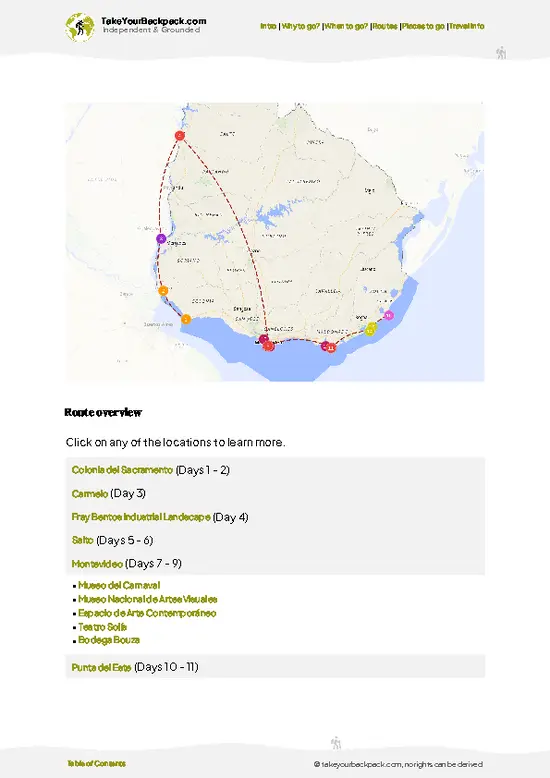
Grouping and direction: The most efficient pattern is a loop out of Montevideo, the main transport hub, along the Río de la Plata to the west, then back across the interior or along the Atlantic coast to the east. Colonia and the western river towns cluster together, and the eastern coastal stops cluster separately. Travel in one direction rather than doubling back, and finish near the capital for onward flights or the ferry to Buenos Aires.
Time per stop and transfers: Allow 2 to 3 nights in the capital and 1 to 2 nights in smaller towns. Typical bus times from Montevideo … read more 👉
How many days to plan: A trip combining several cities in Uruguay needs 7 to 12 days, which allows three to four stops without constant packing. The country is compact, so the limit is energy and bus timetables, not distance.
Grouping and direction: The most efficient pattern is a loop out of Montevideo, the main transport hub, along the Río de la Plata to the west, then back across the interior or along the Atlantic coast to the east. Colonia and the western river towns cluster together, and the eastern coastal stops cluster separately. Travel in one direction rather than doubling back, and finish near the capital for onward flights or the ferry to Buenos Aires.
Time per stop and transfers: Allow 2 to 3 nights in the capital and 1 to 2 nights in smaller towns. Typical bus times from Montevideo are about 2.5 hours to Colonia, 2 hours to the eastern resort belt, 4 to 5 hours to Salto or Paysandú and 5 hours or more to the northern border. Buses are frequent on the coast and sparse inland, so check evening departures.
Common planning mistakes: Travelers often cram in too many stops and spend a third of the trip on buses. Choose fewer places and stay longer. Others visit coastal towns in winter expecting activity, or arrive on Sunday when services thin out. Book long-distance seats a day ahead in January and February.

The ListMust-Visit cities in Uruguay

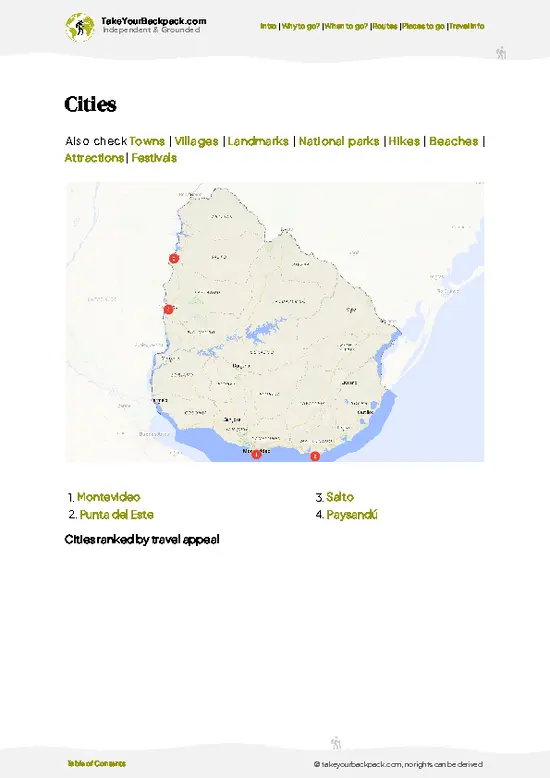
1 Montevideo

Río de la Plata waterfront, Mercado del Puerto parrillas, Rambla sunsets, Ciudad Vieja theaters

Walk the Rambla at dusk, grill beef in the old port market, and trace the old town from Plaza Independencia to Teatro Solís.

uruguay-city-montevideo
© Google |

2 Punta del Este

Peninsula beaches, sea lion port, Playa Brava hand sculpture, Isla de Lobos boats

Cross the peninsula on foot to swap calm bay water for Atlantic surf, then take a boat out to the sea lion island.

3 Salto

Thermal pools, Salto Grande Dam, Costanera, Quiroga house

Soak in mineral hot springs south of town, cross the binational dam toward Argentina, and finish with mate along the Uruguay River.

4 Paysandú

Uruguay River banks, twin-towered basilica, mate on the plaza, quiet river town

Stroll the riverfront promenade, sit under old plaza trees with locals sipping mate, and visit the Monumento a Perpetuidad, the old cemetery turned open-air museum.

Loading the map 🌍

Expert viewPro Tips for Exploring the Best

How many cities to plan for: Three to four cities is the number I advise for a trip of ten days to two weeks. Uruguay is small (about 176,000 square kilometers), but the buses are slow, the best parts of each stop are the unhurried ones, and every extra city costs half a day in terminals and check-ins. Fewer stops also leave room for the rural and coastal stretches between them, which is where much of the country’s character sits.
Choosing between kinds of cities: Uruguay’s urban options split into the capital, the old colonial towns on the Río de la Plata, the Atlantic resort towns and the interior river and farming towns. Each suits a different style. If you want museums, live music, a wide choice of hostels and food at several price levels, the capital is where that exists. If you like quiet … read more 👉
How many cities to plan for: Three to four cities is the number I advise for a trip of ten days to two weeks. Uruguay is small (about 176,000 square kilometers), but the buses are slow, the best parts of each stop are the unhurried ones, and every extra city costs half a day in terminals and check-ins. Fewer stops also leave room for the rural and coastal stretches between them, which is where much of the country’s character sits.
Choosing between kinds of cities: Uruguay’s urban options split into the capital, the old colonial towns on the Río de la Plata, the Atlantic resort towns and the interior river and farming towns. Each suits a different style. If you want museums, live music, a wide choice of hostels and food at several price levels, the capital is where that exists. If you like quiet streets, cobblestones and slow evenings, the colonial towns fit better. The Atlantic resorts are built around beaches and a summer social scene, and they feel half closed outside January and February. Interior towns on the Río Uruguay, with thermal springs and cattle-country culture, suit travelers who want little company and low prices. Most people do well mixing one big city with two small ones, because the pace difference keeps the trip from feeling repetitive.
What things cost: Uruguay is the most expensive country in South America for backpackers, and the reason is a strong currency, high import taxes and a small domestic market. Plan on US$55 to 90 a day if you use dorms (US$18 to 35 a night), eat one restaurant meal and cook or buy bakery food for the rest. Mid-range travelers should expect US$100 to 150. A set lunch (menú del día) at US$8 to 14 is the smarter meal than dinner, when prices climb and portions are huge. Intercity buses cost roughly US$5 to 20 per leg, so book direct with the company counters or online and skip agents who add fees. Museums usually charge US$2 to 8, and many have free days. Walking tours run on tips, typically US$5 to 10. Foreign cards often get a VAT refund on restaurant and hotel bills under tourist-discount schemes, so ask before paying, because the saving is around 10 to 22 percent.
Safety and local habits: Uruguay is among the safest countries in the region, yet petty theft is the real issue in larger cities, mainly phone snatching from hands and bags left on café chairs. Experienced travelers keep phones out of sight near the curb, avoid empty port and downtown streets after dark, and take a licensed taxi or app ride home instead of walking. Beach towns attract opportunistic thefts from parked cars and unattended towels in summer.
Daily rhythm matters too. Shops close for a long midday break in smaller towns, and many places shut on Sundays. Dinner starts after 9 pm. Locals carry a thermos of hot water for mate and share it, so if one is offered, take it, hold the cup until finished, and do not stir the straw. Tipping of about 10 percent is normal, and sunscreen is worth bringing because the sun is strong and local prices are high.

✈️ The backpacker research shortcutUruguay Travel Guide

An offline-friendly backpacking guide with optimized travel routes, ranked highlights, transport advice, and the best areas to stay.
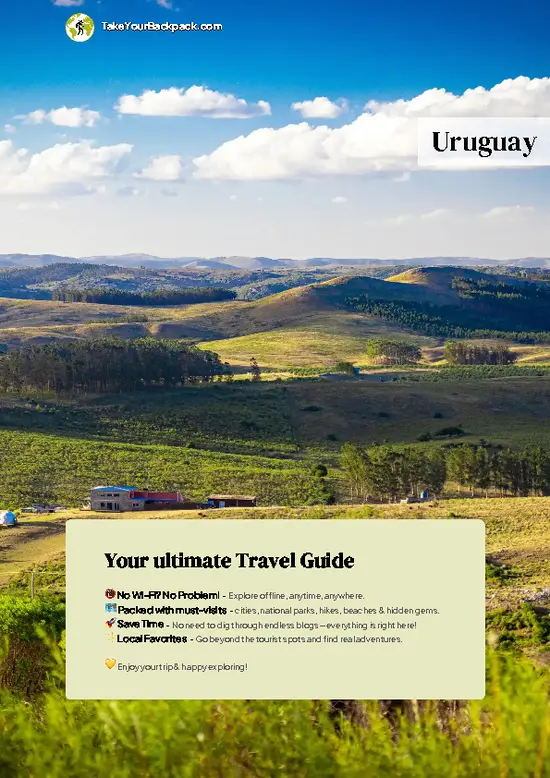
example page 0 from our offline Travel Guide for Uruguay
example page 1 from our offline Travel Guide for Uruguay
example page 2 from our offline Travel Guide for Uruguay
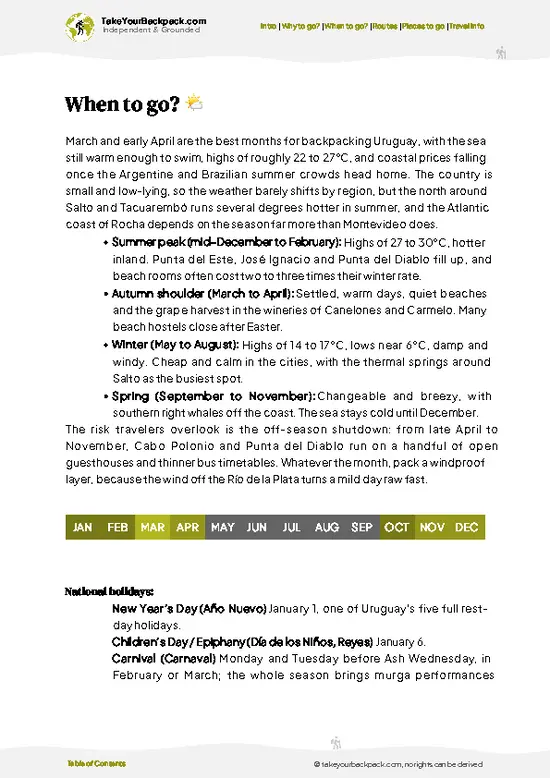
example page 3 from our offline Travel Guide for Uruguay
example page 4 from our offline Travel Guide for Uruguay
example page 5 from our offline Travel Guide for Uruguay
example page 6 from our offline Travel Guide for Uruguay
example page 7 from our offline Travel Guide for Uruguay
The digital guide (198 pages) contains:
✅ 56 highlights, ranked by travel appeal
✅ Optimized 5, 10 & 15-day travel routes
✅ Cities, national parks, landmarks, beaches
✅ How to get around
✅ Offline-friendly for travel without Wi-Fi
👉 Click to see all 30+ guide features

📅 Plan smarter in minutes, not weeks
✅ Month by month travel advice
✅ Festivals & national holidays
✅ Budget expectations

🗺️ Go to the right places, skip the overrated ones
✅ Honest pros & cons of destinations
✅ Top hikes, parks & viewpoints
✅ Lesser-known places most travelers miss
✅ Clear “worth it vs skip it” guidance

🛏️ Travel smoothly without rookie mistakes
✅ Best areas to stay
✅ Transport systems explained simply
✅ Common scams & safety advice
✅ SIM cards, money & practical tips

🌍 Understand the country, not just visit it
✅ Culture & traditions
✅ 52 Essential phrases & customs
✅ Festivals worth planning around
✅ Traveler-friendly historical context
✅ Insights that make places more meaningful

📱 Built for real travel conditions
✅ Fully downloadable PDF
✅ Works completely offline
✅ Optimized for phone use
✅ Useful in remote areas & buses
✅ Everything in one place
Stop searching, start planning
Get instant access to your full guide. 30‑day money-back guarantee.
+ Add another guide for just

By proceeding you agree to our terms.
Sent to your inbox immediately after payment • 100% Secure Checkout
Best Backpacking Travel Advisor 2025 tourism awardBest Backpacking
Travel Advisor
2025
What others say about Take Your Backpack Guides:
⭐⭐⭐⭐⭐
Fantastic, amazing amount of information!
⭐⭐⭐⭐⭐
My goodness this is amazing, it's what I've been looking for hats off too you!
⭐⭐⭐⭐⭐
I think this is absolutely BRILLIANT
⭐⭐⭐⭐
Very complete and informative. It's still missing places, but I gotta to commend you
⭐⭐⭐⭐⭐
This is truly amazing, thank you, can't wait to explore it with my kids!
⭐⭐⭐⭐⭐
Awesome resource, thank you!
⭐⭐⭐⭐⭐
This is amazing! Can't wait to explore the ones I haven't seen
⭐⭐⭐⭐
I love this! Well done, great idea.
⭐⭐⭐⭐⭐
Thanks for taking the time to make this gem!
⭐⭐⭐⭐⭐
This might be the best website I've ever seen.
⭐⭐⭐⭐⭐
Congratulations, and thank you so much for your work; it's incredibly valuable.
⭐⭐⭐⭐
In all seriousness I think you did a great job pointing out the important spots
⭐⭐⭐⭐⭐
10/10 very good
⭐⭐⭐⭐⭐
As someone who's only just starting to visit regularly this is awesome, thank you.
⭐⭐⭐⭐
Thank you very much! I'm going to visit my dad, it's going to be very useful!
⭐⭐⭐⭐⭐
This is really cool! We'll be travelling for the first time and this definitely come in handy.
⭐⭐⭐⭐⭐
You are now our minister of culture, congratulations 👨‍💼
⭐⭐⭐⭐⭐
Just wanted to tell you that this is a pearl! Going to follow your recommendations.
⭐⭐⭐⭐⭐
This is so cool. I'll definitely be using the resource for my travels soon.
⭐⭐⭐⭐⭐
This is very impressive! Good work.
⭐⭐⭐⭐⭐
This is an amazing and informative site. Very well done!

🛏️ Where to stay?Top Areas to Stay

Uruguay has a solid hostel scene, with dorm beds typically running UYU 600 to 1,200 (about US$15 to 30), and the widest choice is in Montevideo, where Ciudad Vieja puts you steps from the old town’s plazas and port market but gets very quiet and a bit sketchy after dark, while Pocitos trades walkable sights for a safe beachfront rambla and plenty of restaurants, and Parque Rodó with neighboring Cordón is cheaper and closest to the bars. Outside the capital, Colonia del Sacramento has calm, compact hostels within walking distance of the cobbled historic quarter, Punta del Este fills with party hostels in January and February when prices jump sharply, and beach villages like Punta del Diablo and … read more 👉
Uruguay has a solid hostel scene, with dorm beds typically running UYU 600 to 1,200 (about US$15 to 30), and the widest choice is in Montevideo, where Ciudad Vieja puts you steps from the old town’s plazas and port market but gets very quiet and a bit sketchy after dark, while Pocitos trades walkable sights for a safe beachfront rambla and plenty of restaurants, and Parque Rodó with neighboring Cordón is cheaper and closest to the bars. Outside the capital, Colonia del Sacramento has calm, compact hostels within walking distance of the cobbled historic quarter, Punta del Este fills with party hostels in January and February when prices jump sharply, and beach villages like Punta del Diablo and Cabo Polonio offer simple, sociable stays that shut down or thin out heavily outside summer.

If you enjoy meeting fellow travelers, consider choosing hostels with high ratings for atmosphere. On the other hand, if you prefer having your own space, a hotel might be a better option.

UruguayDiscover the Country

👋 Meet the founderWho’s Behind Take Your Backpack?

Johan, backpacker and founder of TakeYourBackpackHi, I’m Johan (Netherlands 🇳🇱), the creator of TakeYourBackpack. Over the past 3 decades, I’ve backpacked through 90+ countries across six continents, gaining extensive experience with independent travel, long-term trips, and overland routes.

This site is built on a combination of firsthand travel experience and carefully curated insights from other backpackers. Many guides are based on places I’ve personally visited, while others bring together tips, observations, and practical advice shared by trusted travelers I’ve met along the way.

The goal is to provide realistic, experience-driven guidance — not generic itineraries — so you can explore destinations with better context, clearer expectations, and more confidence.