×

Uzbekistan🇺🇿 | regionsAral SeaUstyurt limestone cliffs, full-day 4x4 drive, salt flotation, tent camping | things to do and best time to go

Explore Sarmishsay GorgeExplore Fergana Valley

Backpacking in Aral Sea
🏆 Top pickregion ranked #2
By Johan Kruseman 🇳🇱 | Updated October 15, 2026

The water sits far from Muynak’s ship cemetery, so reaching the shoreline means four to six hours in a 4x4 across the Ustyurt plateau, usually with a driver you arrange in Muynak or Nukus. The beach lies in Karakalpakstan, northwest of Nukus, on the western basin of the Aral Sea beneath pale limestone cliffs. Out here the track is just tire marks over hard, crusty ground, and the reward is a white-edged shore with nobody on it. The water is so salty you float without trying, and it leaves a crust on your skin, so pack fresh water for rinsing. There are no cafés, no showers and no shade, which keeps the crowds at zero. Time your arrival for late afternoon so you can swim, cook at camp and watch the sky go dark. Muynak shows you rusting ships stranded on sand. Here you can walk into the sea itself.

Discover everything you want to know in the 📖 Uzbekistan Travel Guide.


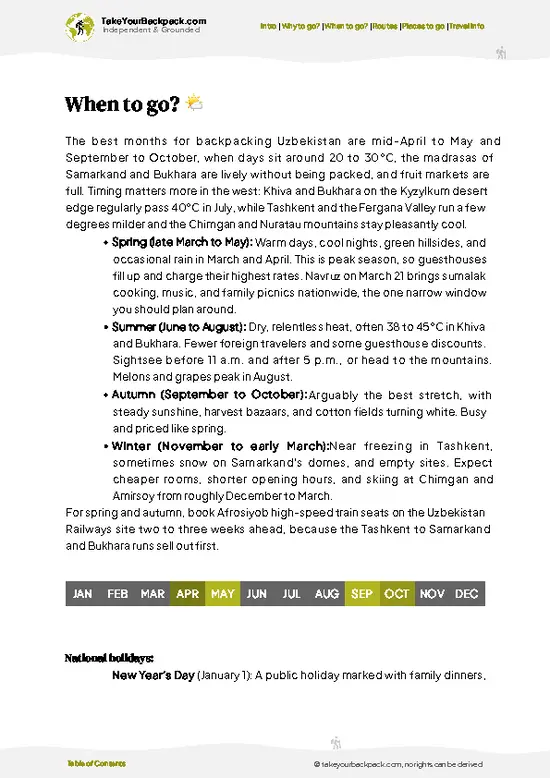
example page 0 from our offline Travel Guide for Uzbekistan
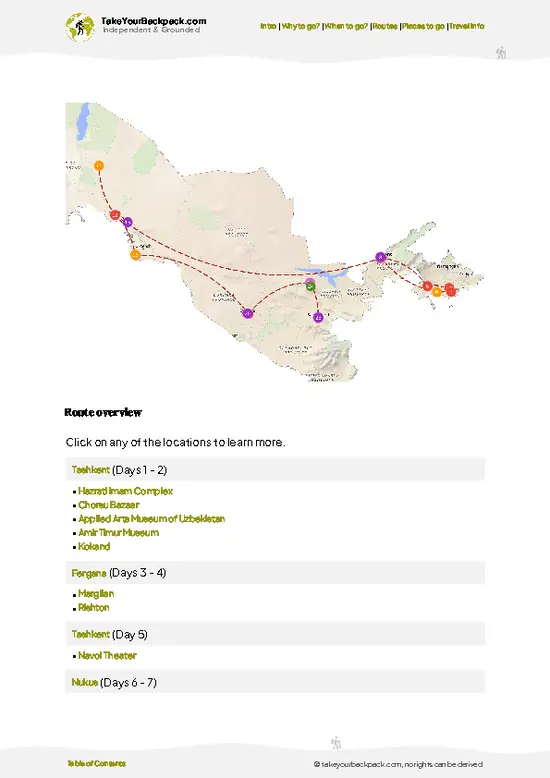
example page 1 from our offline Travel Guide for Uzbekistan
example page 2 from our offline Travel Guide for Uzbekistan
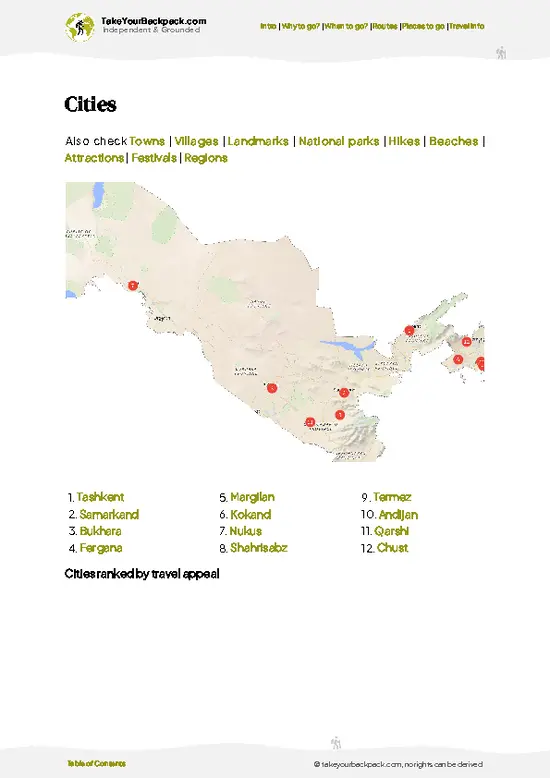
example page 3 from our offline Travel Guide for Uzbekistan
example page 4 from our offline Travel Guide for Uzbekistan
example page 5 from our offline Travel Guide for Uzbekistan
example page 6 from our offline Travel Guide for Uzbekistan
example page 7 from our offline Travel Guide for Uzbekistan
Loading the map 🌍
CLICK TO FILTER
cities
towns
villages
landmarks
national parks
hikes
beaches
attractions
festivals
regions
SHOW COUNTRY’S BESTSHOW ALL

✨ Why go?
Ranked #2 region in Uzbekistan
What makes it a must-see region

Most people come for one reason: this is where the Aral Sea still looks like a sea. The western basin keeps water, and the salinity is high enough that you float like at the Dead Sea, arms behind your head, with nothing around but cliffs and sky. That alone beats staring at the dry seabed from a viewpoint.

The second reason is the journey. The route crosses the Ustyurt plateau, a flat, wind-scoured tableland where you pass the odd camel and little else. Drivers know the tracks, and the long haul is part of the appeal for anyone who likes getting somewhere few others reach. The cliff edges (chinks) drop to the shoreline and give the whole trip its shape.

The third is the camping. Overnight trips are the norm, with a tent or yurt-style setup arranged by your driver or a Muynak guesthouse, … read more 👉
Most people come for one reason: this is where the Aral Sea still looks like a sea. The western basin keeps water, and the salinity is high enough that you float like at the Dead Sea, arms behind your head, with nothing around but cliffs and sky. That alone beats staring at the dry seabed from a viewpoint.

The second reason is the journey. The route crosses the Ustyurt plateau, a flat, wind-scoured tableland where you pass the odd camel and little else. Drivers know the tracks, and the long haul is part of the appeal for anyone who likes getting somewhere few others reach. The cliff edges (chinks) drop to the shoreline and give the whole trip its shape.

The third is the camping. Overnight trips are the norm, with a tent or yurt-style setup arranged by your driver or a Muynak guesthouse, a campfire, and a night sky with no light pollution at all. Backpackers who normally chase beach bars will find the silence strange at first, then hard to leave. It works as a long detour from Muynak, not a pause on a coastal route.

💡 HighlightsWhat this place is best known for

  1. Floating in the Aral Sea: The water is far saltier than the ocean, so your body sits high and your legs bob up. Keep it out of your eyes and cuts, and rinse off afterward, because the salt dries into a white film.
  2. The Ustyurt chink cliffs: Pale, layered limestone walls drop to the shore, and walking to the rim shows you the old sea level and the water far below. Pick a calm moment, because the edge is crumbly and the wind can gust.
  3. Camping on the shore: Most visitors stay overnight in tents set up by their driver, with a fire and a simple dinner. With no town for a long way, the stars come out thick and the quiet is complete, broken only by wind and the odd lapping wave.
  4. Crossing the Ustyurt plateau: The drive is an attraction in itself. It is a flat, cracked, almost colorless steppe where tracks
… read more 👉
  1. Floating in the Aral Sea: The water is far saltier than the ocean, so your body sits high and your legs bob up. Keep it out of your eyes and cuts, and rinse off afterward, because the salt dries into a white film.
  2. The Ustyurt chink cliffs: Pale, layered limestone walls drop to the shore, and walking to the rim shows you the old sea level and the water far below. Pick a calm moment, because the edge is crumbly and the wind can gust.
  3. Camping on the shore: Most visitors stay overnight in tents set up by their driver, with a fire and a simple dinner. With no town for a long way, the stars come out thick and the quiet is complete, broken only by wind and the odd lapping wave.
  4. Crossing the Ustyurt plateau: The drive is an attraction in itself. It is a flat, cracked, almost colorless steppe where tracks braid across the ground and you may pass free-ranging camels along the way. Windows down, dust everywhere, a long horizon in every direction.
  5. Muynak ship cemetery: Most trips start here, and it is worth the stop before you head out. Rusted trawlers sit on what was once the harbor floor, and seeing them first makes the water at the end of the trip land harder.
If time is short, skip aimless wandering on the shell-strewn seabed and put the saved hour into the water and the cliff edge.
Spotted a mistake or missing something? Contact us.

🌤️ When to go?Weather, crowds, and seasonal trade-offs

  • Spring (April to May): Days of 15 to 28°C (59 to 82°F) and about 13 to 14 hours of light make this the most comfortable window for long drives over the dry seabed. Wind can kick up dust, and the shoreline is at its widest after the thaw.
  • Summer (June to August): Highs of 35 to 42°C (95 to 108°F) with almost no shade, and daylight stretching to roughly 15 hours. Salt water feels warm, but midday on the flats is punishing. Jeep drivers get busy, so book ahead.
  • Autumn (September to October): Daytime temperatures fall from 30°C to about 15°C (86 to 59°F), skies are clear, and the light is excellent for photography. Crowds stay thin and prices steady.
  • Winter (November to March): Lows of -10 to -20°C (14 to -4°F), 9 to 10 hours of daylight, and strong cold wind. Few tours run, and some guesthouses
… read more 👉
  • Spring (April to May): Days of 15 to 28°C (59 to 82°F) and about 13 to 14 hours of light make this the most comfortable window for long drives over the dry seabed. Wind can kick up dust, and the shoreline is at its widest after the thaw.
  • Summer (June to August): Highs of 35 to 42°C (95 to 108°F) with almost no shade, and daylight stretching to roughly 15 hours. Salt water feels warm, but midday on the flats is punishing. Jeep drivers get busy, so book ahead.
  • Autumn (September to October): Daytime temperatures fall from 30°C to about 15°C (86 to 59°F), skies are clear, and the light is excellent for photography. Crowds stay thin and prices steady.
  • Winter (November to March): Lows of -10 to -20°C (14 to -4°F), 9 to 10 hours of daylight, and strong cold wind. Few tours run, and some guesthouses close.
Aim for late September, when the heat has broken but the nights are not yet freezing.


source: climatestotravel.comJANJanuary: fair for travelingFEBFebruary: fair for travelingMARMarch: good for travelingAPRApril: highly recommended for travelingMAYMay: excellent for travelingJUNJune: highly recommended for travelingJULJuly: below average for travelingAUGAugust: below average for travelingSEPSeptember: excellent for travelingOCTOctober: highly recommended for travelingNOVNovember: good for travelingDECDecember: fair for traveling
when-to-go

✈️ The backpacker research shortcutUzbekistan Travel Guide

An offline-friendly backpacking guide with optimized travel routes, ranked highlights, transport advice, and the best areas to stay.
example page 0 from our offline Travel Guide for Uzbekistan
example page 1 from our offline Travel Guide for Uzbekistan
example page 2 from our offline Travel Guide for Uzbekistan
example page 3 from our offline Travel Guide for Uzbekistan
example page 4 from our offline Travel Guide for Uzbekistan
example page 5 from our offline Travel Guide for Uzbekistan
example page 6 from our offline Travel Guide for Uzbekistan
example page 7 from our offline Travel Guide for Uzbekistan
The digital guide (246 pages) contains:
✅ 74 highlights, ranked by travel appeal
✅ Optimized 5, 10 & 15-day travel routes
✅ Cities, national parks, landmarks, beaches
✅ How to get around
✅ Offline-friendly for travel without Wi-Fi
👉 Click to see all 30+ guide features

📅 Plan smarter in minutes, not weeks
✅ Month by month travel advice
✅ Festivals & national holidays
✅ Budget expectations

🗺️ Go to the right places, skip the overrated ones
✅ Honest pros & cons of destinations
✅ Top hikes, parks & viewpoints
✅ Lesser-known places most travelers miss
✅ Clear “worth it vs skip it” guidance

🛏️ Travel smoothly without rookie mistakes
✅ Best areas to stay
✅ Transport systems explained simply
✅ Common scams & safety advice
✅ SIM cards, money & practical tips

🌍 Understand the country, not just visit it
✅ Culture & traditions
✅ 52 Essential phrases & customs
✅ Festivals worth planning around
✅ Traveler-friendly historical context
✅ Insights that make places more meaningful

📱 Built for real travel conditions
✅ Fully downloadable PDF
✅ Works completely offline
✅ Optimized for phone use
✅ Useful in remote areas & buses
✅ Everything in one place
Stop searching, start planning
Get instant access to your full guide. 30‑day money-back guarantee.
+ Add another guide for just

By proceeding you agree to our terms.
Sent to your inbox immediately after payment • 100% Secure Checkout
Best Backpacking Travel Advisor 2025 tourism awardBest Backpacking
Travel Advisor
2025
What others say about Take Your Backpack Guides:
⭐⭐⭐⭐⭐
Fantastic, amazing amount of information!
⭐⭐⭐⭐⭐
My goodness this is amazing, it's what I've been looking for hats off too you!
⭐⭐⭐⭐⭐
I think this is absolutely BRILLIANT
⭐⭐⭐⭐
Very complete and informative. It's still missing places, but I gotta to commend you
⭐⭐⭐⭐⭐
This is truly amazing, thank you, can't wait to explore it with my kids!
⭐⭐⭐⭐⭐
Awesome resource, thank you!
⭐⭐⭐⭐⭐
This is amazing! Can't wait to explore the ones I haven't seen
⭐⭐⭐⭐
I love this! Well done, great idea.
⭐⭐⭐⭐⭐
Thanks for taking the time to make this gem!
⭐⭐⭐⭐⭐
This might be the best website I've ever seen.
⭐⭐⭐⭐⭐
Congratulations, and thank you so much for your work; it's incredibly valuable.
⭐⭐⭐⭐
In all seriousness I think you did a great job pointing out the important spots
⭐⭐⭐⭐⭐
10/10 very good
⭐⭐⭐⭐⭐
As someone who's only just starting to visit regularly this is awesome, thank you.
⭐⭐⭐⭐
Thank you very much! I'm going to visit my dad, it's going to be very useful!
⭐⭐⭐⭐⭐
This is really cool! We'll be travelling for the first time and this definitely come in handy.
⭐⭐⭐⭐⭐
You are now our minister of culture, congratulations 👨‍💼
⭐⭐⭐⭐⭐
Just wanted to tell you that this is a pearl! Going to follow your recommendations.
⭐⭐⭐⭐⭐
This is so cool. I'll definitely be using the resource for my travels soon.
⭐⭐⭐⭐⭐
This is very impressive! Good work.
⭐⭐⭐⭐⭐
This is an amazing and informative site. Very well done!

🛏️ Where to stay?How to pick the right area

The practical base for the Aral Sea shore is the town of Muynak (Moynaq), the old fishing port that sits four to six hours by 4x4 from the water as it stands now. Homestays and small guesthouses here are the budget choice, with dorm-style rooms or simple doubles for about US$15 to 30 a night and meals cooked by the family. It is also the best place to meet other travelers and split the cost of a jeep and driver. You are next to the ship graveyard and the small museum, and drivers can pick you up at the door.

Nukus, the regional capital about three hours away by road, is the better option if you … read more 👉
The practical base for the Aral Sea shore is the town of Muynak (Moynaq), the old fishing port that sits four to six hours by 4x4 from the water as it stands now. Homestays and small guesthouses here are the budget choice, with dorm-style rooms or simple doubles for about US$15 to 30 a night and meals cooked by the family. It is also the best place to meet other travelers and split the cost of a jeep and driver. You are next to the ship graveyard and the small museum, and drivers can pick you up at the door.

Nukus, the regional capital about three hours away by road, is the better option if you want more choice. It has the most hostels and guesthouses in Karakalpakstan, reliable food, ATMs and the Savitsky art museum. Many backpackers sleep here, join a one or two day Aral excursion, and come back.

For a night near the shore itself, yurt camps on the Ustyurt plateau and along the dry seabed offer felt-lined tents, shared meals and a very dark sky. These are usually booked as part of a tour. Expect basic toilets, cold nights outside summer, and a chance to share the fire with a small group.

🛡️ SafetyScams, Hazards, and Annoyances

The sea here is calm in the way a very salty lake is, and the main things to know involve the desert around it. The remaining western basin is extremely saline, often several times saltier than the ocean, so you float without effort. Waves are small and there are no rips to speak of. Keep the water out of your eyes, rinse off afterward since the salt dries into a crust, and skip shaving beforehand. Cuts sting. No dangerous marine life lives in water this salty.

Sun and wind are the real hazards. Shade is rare, summer heat is intense and winter cold is serious, so carry more water than seems sensible, a hat and sunscreen. The shoreline shifts from year to year and the seabed can be soft or crusted, so travel only with a local driver in a 4x4 and never wander off alone on the flats. Mobile … read more 👉
The sea here is calm in the way a very salty lake is, and the main things to know involve the desert around it. The remaining western basin is extremely saline, often several times saltier than the ocean, so you float without effort. Waves are small and there are no rips to speak of. Keep the water out of your eyes, rinse off afterward since the salt dries into a crust, and skip shaving beforehand. Cuts sting. No dangerous marine life lives in water this salty.

Sun and wind are the real hazards. Shade is rare, summer heat is intense and winter cold is serious, so carry more water than seems sensible, a hat and sunscreen. The shoreline shifts from year to year and the seabed can be soft or crusted, so travel only with a local driver in a 4x4 and never wander off alone on the flats. Mobile signal fades quickly. Theft is not a concern out here, though leave valuables at your guesthouse in town.

FAQCommon questions from travelers

Most travelers reach the shore by 4x4 from Muynak, which is about 200 km and three hours by road from Nukus. Nukus has daily flights from Tashkent (around two hours) and a long overnight train from Tashkent. From Muynak, a driver takes you across the dry seabed in four to six hours each way, and a shared jeep trip usually costs about US$100 to 200 per vehicle depending on the route.
Swimming is the main draw, and it is unusual: the water is so salty that you float without effort, though it stings eyes and cuts, so bring fresh water to rinse. Surfing is not possible because waves are tiny, and snorkeling is pointless since there is almost no visibility or marine life. Plan for a short dip of 15 to 20 minutes and a picnic on the shore rather than a beach day.
The shore itself is free, with no entrance gate or ticket. Your costs are the transport and a local driver, usually US$100 to 200 per jeep, split among passengers. The ship graveyard near Muynak can be visited without charge, and the small Muynak museum asks a few dollars (roughly 20,000 to 30,000 soum).
⚠️ Things can change over time, so always validate details locally before you go.

Other Uzbek regions near Aral Sea

Explore more nearby:

  • Karakalpakstan—Aral Sea remnants, Nukus museums, steppe horizons| 192 km away
  • Xorazm—fortified cities, mudbrick walls, desert oases| 401 km away
  • Kyzylkum Desert—sand dunes, steppe wildlife, remote caravanserais| 553 km away

💡 Not sure where to go next?
Create a personalized itinerary for Uzbekistan including Aral Sea and the places that fit your trip.

Generate my itinerary

👉 Discover all regions

Or checkout all Uzbekistan has to offer (think cities, towns, villages, national parks, hikes, beaches, festivals)
Country photo of Uzbekistan

We 💚 feedbackIs it worth it?

Come if you like empty places, long dusty drives and sleeping outside with a fire and a tent. It suits curious travelers who care more about the story of the sea than comfort. Bring more water than seems sensible, a headlamp, warm layers for the cold night, and a towel for the salt. Swim once, then sit on the shore and just look.

✍️ Help improve this page!
The information on this page is based on in-depth research, insights shared by experienced travelers, and feedback from the local travel community in Uzbekistan. While every effort is made to keep the information accurate and current, conditions can change — so if you spot anything incorrect or outdated, please get in touch.


🙋‍♂️ Give feedback

👋 Meet the founderWho’s Behind Take Your Backpack?

Johan, backpacker and founder of TakeYourBackpackHi, I’m Johan (Netherlands 🇳🇱), the creator of TakeYourBackpack. Over the past 3 decades, I’ve backpacked through 90+ countries across six continents, gaining extensive experience with independent travel, long-term trips, and overland routes.

This site is built on a combination of firsthand travel experience and carefully curated insights from other backpackers. Many guides are based on places I’ve personally visited, while others bring together tips, observations, and practical advice shared by trusted travelers I’ve met along the way.

The goal is to provide realistic, experience-driven guidance — not generic itineraries — so you can explore destinations with better context, clearer expectations, and more confidence.