×

Uzbekistan🇺🇿 | citiesTashkentChorsu Bazaar, Soviet metro stations, Khast Imam, TV Tower | things to do and best time to go

Explore ShahrisabzExplore Termez

Backpacking in Tashkent
🏆 Top pickcity ranked #1
By Johan Kruseman 🇳🇱 | Updated October 6, 2026

Tashkent was largely rebuilt after the 1966 earthquake, yet its old quarter, tree-lined boulevards and tiled metro stations are a real reason to stay. It sits in the northeast of Uzbekistan, close to the Kazakhstan border, far from the Silk Road showpieces of Samarkand and Bukhara. That position matters when you plan: you can fly in, or take the fast train out, but the city rewards a night or two, not a week. It suits travelers who like markets, big meals and street-level oddities, and it frustrates anyone hunting for medieval skylines. The wide avenues mean long walks between sights, so the metro is the sweet spot between a taxi's price and a bus's patience. Before you go, install Yandex Go for taxis, because hailing a street car costs more time haggling and usually more money.

Discover everything you want to know in the 📖 Uzbekistan Travel Guide.


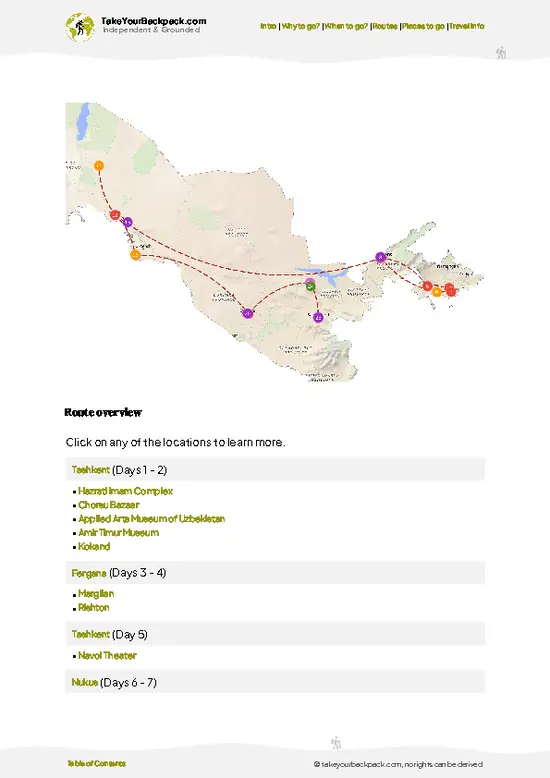
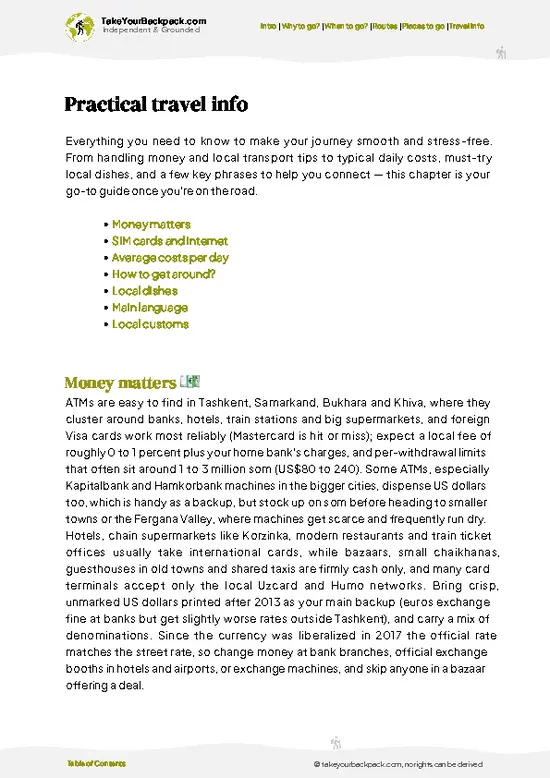
example page 0 from our offline Travel Guide for Uzbekistan
example page 1 from our offline Travel Guide for Uzbekistan
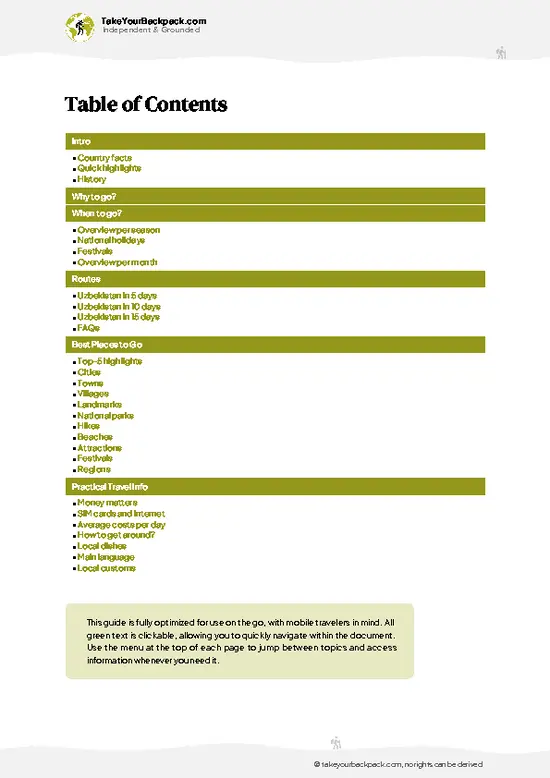
example page 2 from our offline Travel Guide for Uzbekistan
example page 3 from our offline Travel Guide for Uzbekistan
example page 4 from our offline Travel Guide for Uzbekistan
example page 5 from our offline Travel Guide for Uzbekistan
example page 6 from our offline Travel Guide for Uzbekistan
example page 7 from our offline Travel Guide for Uzbekistan
Loading the map 🌍
CLICK TO FILTER
cities
towns
villages
landmarks
national parks
hikes
beaches
attractions
festivals
regions
SHOW COUNTRY’S BESTSHOW ALL

✨ Why go?
Ranked #1 city in Uzbekistan
What makes this city worth visiting

Tashkent earns its place on a route because almost everything in Uzbekistan funnels through it. Most international flights land here, and the high-speed Afrosiyob train departs from the city toward Samarkand, so it works as the logical start or finish of any loop. That makes it a practical place to sort out your SIM card, cash, and registration paperwork before heading to smaller towns where English is thinner.

The second draw is the table. Chorsu Bazaar and the neighborhood eateries around it give you a full education in Uzbek cooking at low prices, and hostels here are social enough that you will find people to share a taxi or a train compartment. Nightlife is modest but real, with rooftop bars and cafes in the Mustaqillik area staying open later than anywhere else in the country.

It is … read more 👉
Tashkent earns its place on a route because almost everything in Uzbekistan funnels through it. Most international flights land here, and the high-speed Afrosiyob train departs from the city toward Samarkand, so it works as the logical start or finish of any loop. That makes it a practical place to sort out your SIM card, cash, and registration paperwork before heading to smaller towns where English is thinner.

The second draw is the table. Chorsu Bazaar and the neighborhood eateries around it give you a full education in Uzbek cooking at low prices, and hostels here are social enough that you will find people to share a taxi or a train compartment. Nightlife is modest but real, with rooftop bars and cafes in the Mustaqillik area staying open later than anywhere else in the country.

It is not a city you tick off in an hour. Distances are large and sights are scattered, so give it two nights and use the Soviet-era metro to cover ground. After that, the old cities pull harder.

💡 HighlightsThe experiences that define the visit

  1. Chorsu Bazaar: The domed blue market hall is the city's best-known sight and its working kitchen. Inside you find mountains of dried fruit, spices, fresh bread and meat stalls. Go in the morning when stocks are full. Entry is free, and 1.5 to 2 hours covers it.
  2. Tashkent Metro: Stations such as Kosmonavtlar, Alisher Navoi and Mustaqillik are decorated with mosaics, chandeliers and carved marble. Rides cost a flat fare of 1,700 UZS by card (about US$0.13). Allow 1 to 2 hours; photography is now generally tolerated, but stay discreet around staff.
  3. Khast Imam Complex: A cluster of madrasas and mosques holding the Uthman Quran, one of the oldest surviving copies. Visit in the morning for soft light and quiet. Entry to the courtyards is free or very cheap, and the museum is a few dollars. Plan 1 to
… read more 👉
  1. Chorsu Bazaar: The domed blue market hall is the city's best-known sight and its working kitchen. Inside you find mountains of dried fruit, spices, fresh bread and meat stalls. Go in the morning when stocks are full. Entry is free, and 1.5 to 2 hours covers it.
  2. Tashkent Metro: Stations such as Kosmonavtlar, Alisher Navoi and Mustaqillik are decorated with mosaics, chandeliers and carved marble. Rides cost a flat fare of 1,700 UZS by card (about US$0.13). Allow 1 to 2 hours; photography is now generally tolerated, but stay discreet around staff.
  3. Khast Imam Complex: A cluster of madrasas and mosques holding the Uthman Quran, one of the oldest surviving copies. Visit in the morning for soft light and quiet. Entry to the courtyards is free or very cheap, and the museum is a few dollars. Plan 1 to 1.5 hours.
  4. Kukeldash Madrasa: A 16th-century brick madrasa near Chorsu with a large entrance portal. The building is photogenic from outside and visiting takes about 30 minutes. Late afternoon light flatters the brick.
  5. Amir Timur Square: Dominated by an equestrian statue of Timur, with fountains and gardens around it. Come in the evening when locals stroll and the lights come on. It is free and needs about 45 minutes.
  6. Museum of Applied Arts: Housed in a former diplomat's house, with carved ceilings, painted walls and collections of suzani embroidery, ceramics and carved wood. Tickets run roughly US$2 to 4. Allow 1 to 1.5 hours.
  7. Independence Square and Mustaqillik Park: Open lawns, fountains and monuments, including the Independence Monument with its globe. It is best in the evening when it cools down. Entry is free, and an hour is plenty.
  8. Tashkent TV Tower: At 375 meters it is among the tallest structures in Central Asia, with an observation deck for a city overview. Go on a clear day around sunset. Tickets cost roughly US$5 to 10 depending on the deck. Plan about 1.5 hours.
For day trips, consider Chimgan and Charvak Reservoir in the Chatkal foothills and the cable car at Beldersay.

Start at Chorsu Bazaar in the morning, because the stalls are best stocked early and it sets your bearings for the old town.
Spotted a mistake or missing something? Contact us.

Things to do in Tashkent

Ratings based on Tripadvisor reviews. When you book through this link, you support our work at no extra cost to you.

🏘️ NeighborhoodsUnderstanding the local layout

Tashkent sprawls, but the parts you will actually use sit along a few metro lines, and knowing which pocket suits your day saves you real hours.
  • Amir Temur Square and Broadway area: This is the leafy center, with the equestrian statue of Amir Temur, the Hotel Uzbekistan landmark and the pedestrian Sayilgoh Street, nicknamed Broadway, full of painters and cafés. It is flat and walkable, and the best value for a first afternoon since almost everything is free to look at. Come around sunset when the fountains and lights switch on.
  • Old Town (Eski Shahar): Home to Chorsu Bazaar, Kukeldash Madrasa and Hazrati Imam complex with the Uthman Quran. Lanes are narrow and best on foot, but get there by metro to Chorsu station rather than a taxi. Go to the bazaar before 10 a.m. for fresh bread and fewer crowds,
… read more 👉
Tashkent sprawls, but the parts you will actually use sit along a few metro lines, and knowing which pocket suits your day saves you real hours.
  • Amir Temur Square and Broadway area: This is the leafy center, with the equestrian statue of Amir Temur, the Hotel Uzbekistan landmark and the pedestrian Sayilgoh Street, nicknamed Broadway, full of painters and cafés. It is flat and walkable, and the best value for a first afternoon since almost everything is free to look at. Come around sunset when the fountains and lights switch on.
  • Old Town (Eski Shahar): Home to Chorsu Bazaar, Kukeldash Madrasa and Hazrati Imam complex with the Uthman Quran. Lanes are narrow and best on foot, but get there by metro to Chorsu station rather than a taxi. Go to the bazaar before 10 a.m. for fresh bread and fewer crowds, then eat plov nearby at lunch.
  • Mirabad and Yunusabad: Residential districts with modern cafés, craft coffee shops and bars. Yunusabad is sprawling, so hop between spots by metro or a cheap ride-hail car. Evenings here are relaxed and locals-heavy, a better night out than the center, which quiets down early.
  • Mustaqillik Square and Independence area: Wide, formal and a bit sterile, but the Ankhor canal park beside it is a pleasant stroll. Worth a short visit, not a half day.
  • Tashkent TV Tower and Minor Mosque area: The white Minor Mosque on the canal is a quick photo stop, and the TV tower viewing deck gives a skyline view for a modest ticket. Take the metro and a short taxi, and pair them in one trip rather than two.
If you only have one full day, stay along the Chorsu to Amir Temur corridor. It costs the least in time and money, and the metro stitches it together beautifully.

⌛️ 1 daySeeing the highlights in 24 hours

8:30 AM: Chorsu Bazaar Start here, before the heat and the crowds build. Wander under the blue dome, try fresh non bread, and sample dried apricots and nuts. Pick up a bowl of breakfast somsa or a small plov from a stall. When you are done, walk ten minutes to the next stop.

10:30 AM: Kukeldash Madrasa and Khast Imam Walk or take a short taxi to Kukeldash, then continue to the Khast Imam complex. Read the old Quran manuscripts in the library museum and sit in the courtyard. The old town is quiet at this hour.

12:30 PM: Lunch in Old Town Find a local oshxona near Chorsu and order lagman or manti. Locals eat early, so you will get a seat without waiting.

2:00 PM: Metro ride Board at Chorsu and ride through Kosmonavtlar, Alisher Navoi and Mustaqillik. Each station has its own look, and the … read more 👉
8:30 AM: Chorsu Bazaar Start here, before the heat and the crowds build. Wander under the blue dome, try fresh non bread, and sample dried apricots and nuts. Pick up a bowl of breakfast somsa or a small plov from a stall. When you are done, walk ten minutes to the next stop.

10:30 AM: Kukeldash Madrasa and Khast Imam Walk or take a short taxi to Kukeldash, then continue to the Khast Imam complex. Read the old Quran manuscripts in the library museum and sit in the courtyard. The old town is quiet at this hour.

12:30 PM: Lunch in Old Town Find a local oshxona near Chorsu and order lagman or manti. Locals eat early, so you will get a seat without waiting.

2:00 PM: Metro ride Board at Chorsu and ride through Kosmonavtlar, Alisher Navoi and Mustaqillik. Each station has its own look, and the ride is cheap and cool. Get off at Amir Timur Square.

3:30 PM: Museum of Applied Arts Spend an hour among carved ceilings and embroidery. It sits away from the main tourist trail and is usually quiet.

5:00 PM: Tashkent Botanical Garden or neighborhood stroll For something off the standard route, walk through the leafy residential streets near the museum, where Soviet-era apartment blocks and courtyard life tell a different story from the monuments.

6:30 PM: Amir Timur Square at dusk Watch the fountains light up and the families gather. Take a taxi or walk to a nearby rooftop or cafe for dinner.

🌤️ When to go?Seasonal considerations and timing

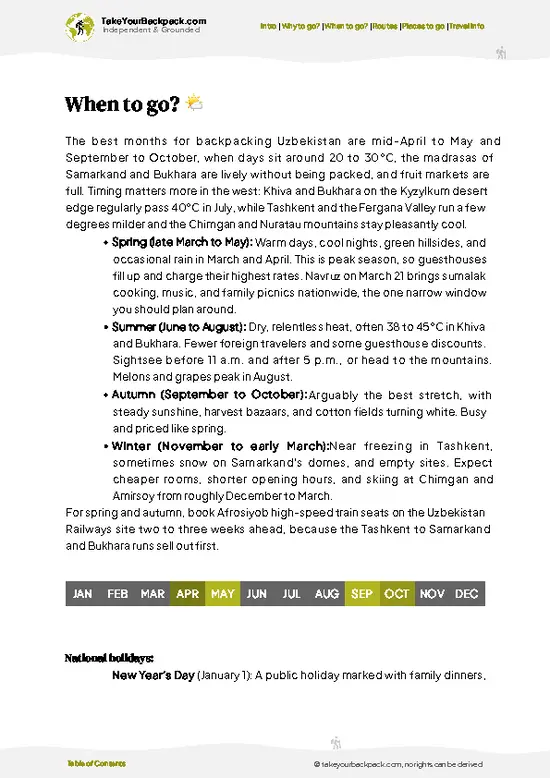
  • Spring (April to May): Highs of 18 to 27°C (64 to 81°F), tulips in the parks and light rain showers. Days run about 13 to 14 hours. Crowds and prices rise, and the Navruz holiday on March 21, just before this window, is busy too.
  • Summer (June to August): Hot and dry, with highs of 35 to 40°C (95 to 104°F) and daylight until about 8:30 p.m. Tour groups thin out and some guesthouses drop rates, but museum hopping becomes the sensible daytime plan.
  • Autumn (September to October): Highs ease from 30°C to about 18°C (86 to 64°F). Fruit is piled high at the bazaars, skies are clear and this is the busiest, priciest stretch for beds and train tickets.
  • Winter (December to February): Cold and gray, with lows around -5 to 0°C (23 to 32°F) and occasional snow. Days are about 9.5 hours long. Rooms are cheapest
… read more 👉
  • Spring (April to May): Highs of 18 to 27°C (64 to 81°F), tulips in the parks and light rain showers. Days run about 13 to 14 hours. Crowds and prices rise, and the Navruz holiday on March 21, just before this window, is busy too.
  • Summer (June to August): Hot and dry, with highs of 35 to 40°C (95 to 104°F) and daylight until about 8:30 p.m. Tour groups thin out and some guesthouses drop rates, but museum hopping becomes the sensible daytime plan.
  • Autumn (September to October): Highs ease from 30°C to about 18°C (86 to 64°F). Fruit is piled high at the bazaars, skies are clear and this is the busiest, priciest stretch for beds and train tickets.
  • Winter (December to February): Cold and gray, with lows around -5 to 0°C (23 to 32°F) and occasional snow. Days are about 9.5 hours long. Rooms are cheapest and attractions nearly empty, though some outdoor sights feel bleak.
Book high-speed trains a week or two ahead for autumn and spring travel.


source: climatestotravel.comJANJanuary: below average for travelingFEBFebruary: below average for travelingMARMarch: good for travelingAPRApril: excellent for travelingMAYMay: excellent for travelingJUNJune: highly recommended for travelingJULJuly: fair for travelingAUGAugust: fair for travelingSEPSeptember: excellent for travelingOCTOctober: excellent for travelingNOVNovember: good for travelingDECDecember: below average for traveling
when-to-go

✈️ The backpacker research shortcutUzbekistan Travel Guide

An offline-friendly backpacking guide with optimized travel routes, ranked highlights, transport advice, and the best areas to stay.
example page 0 from our offline Travel Guide for Uzbekistan
example page 1 from our offline Travel Guide for Uzbekistan
example page 2 from our offline Travel Guide for Uzbekistan
example page 3 from our offline Travel Guide for Uzbekistan
example page 4 from our offline Travel Guide for Uzbekistan
example page 5 from our offline Travel Guide for Uzbekistan
example page 6 from our offline Travel Guide for Uzbekistan
example page 7 from our offline Travel Guide for Uzbekistan
The digital guide (246 pages) contains:
✅ 74 highlights, ranked by travel appeal
✅ Optimized 5, 10 & 15-day travel routes
✅ Cities, national parks, landmarks, beaches
✅ How to get around
✅ Offline-friendly for travel without Wi-Fi
👉 Click to see all 30+ guide features

📅 Plan smarter in minutes, not weeks
✅ Month by month travel advice
✅ Festivals & national holidays
✅ Budget expectations

🗺️ Go to the right places, skip the overrated ones
✅ Honest pros & cons of destinations
✅ Top hikes, parks & viewpoints
✅ Lesser-known places most travelers miss
✅ Clear “worth it vs skip it” guidance

🛏️ Travel smoothly without rookie mistakes
✅ Best areas to stay
✅ Transport systems explained simply
✅ Common scams & safety advice
✅ SIM cards, money & practical tips

🌍 Understand the country, not just visit it
✅ Culture & traditions
✅ 52 Essential phrases & customs
✅ Festivals worth planning around
✅ Traveler-friendly historical context
✅ Insights that make places more meaningful

📱 Built for real travel conditions
✅ Fully downloadable PDF
✅ Works completely offline
✅ Optimized for phone use
✅ Useful in remote areas & buses
✅ Everything in one place
Stop searching, start planning
Get instant access to your full guide. 30‑day money-back guarantee.
+ Add another guide for just

By proceeding you agree to our terms.
Sent to your inbox immediately after payment • 100% Secure Checkout
Best Backpacking Travel Advisor 2025 tourism awardBest Backpacking
Travel Advisor
2025
What others say about Take Your Backpack Guides:
⭐⭐⭐⭐⭐
Fantastic, amazing amount of information!
⭐⭐⭐⭐⭐
My goodness this is amazing, it's what I've been looking for hats off too you!
⭐⭐⭐⭐⭐
I think this is absolutely BRILLIANT
⭐⭐⭐⭐
Very complete and informative. It's still missing places, but I gotta to commend you
⭐⭐⭐⭐⭐
This is truly amazing, thank you, can't wait to explore it with my kids!
⭐⭐⭐⭐⭐
Awesome resource, thank you!
⭐⭐⭐⭐⭐
This is amazing! Can't wait to explore the ones I haven't seen
⭐⭐⭐⭐
I love this! Well done, great idea.
⭐⭐⭐⭐⭐
Thanks for taking the time to make this gem!
⭐⭐⭐⭐⭐
This might be the best website I've ever seen.
⭐⭐⭐⭐⭐
Congratulations, and thank you so much for your work; it's incredibly valuable.
⭐⭐⭐⭐
In all seriousness I think you did a great job pointing out the important spots
⭐⭐⭐⭐⭐
10/10 very good
⭐⭐⭐⭐⭐
As someone who's only just starting to visit regularly this is awesome, thank you.
⭐⭐⭐⭐
Thank you very much! I'm going to visit my dad, it's going to be very useful!
⭐⭐⭐⭐⭐
This is really cool! We'll be travelling for the first time and this definitely come in handy.
⭐⭐⭐⭐⭐
You are now our minister of culture, congratulations 👨‍💼
⭐⭐⭐⭐⭐
Just wanted to tell you that this is a pearl! Going to follow your recommendations.
⭐⭐⭐⭐⭐
This is so cool. I'll definitely be using the resource for my travels soon.
⭐⭐⭐⭐⭐
This is very impressive! Good work.
⭐⭐⭐⭐⭐
This is an amazing and informative site. Very well done!

🛏️ Where to stay?Choosing the right base

The best budget base is the central area around Amir Temur Square, Broadway and the streets toward Mustaqillik, where most hostels and guesthouses cluster and dorm beds are easy to find. It is flat, well lit at night and calm enough to sleep, and the metro stations of Amir Temur Hiyoboni and Alisher Navoi sit within a short walk, so you are never far from the train station or Chorsu.

The second option is the Old Town side near Chorsu Bazaar and the Eski Shahar lanes. Guesthouses here are often family-run and cheaper, with the bazaar on your doorstep for breakfast, and the Chorsu metro station … read more 👉
The best budget base is the central area around Amir Temur Square, Broadway and the streets toward Mustaqillik, where most hostels and guesthouses cluster and dorm beds are easy to find. It is flat, well lit at night and calm enough to sleep, and the metro stations of Amir Temur Hiyoboni and Alisher Navoi sit within a short walk, so you are never far from the train station or Chorsu.

The second option is the Old Town side near Chorsu Bazaar and the Eski Shahar lanes. Guesthouses here are often family-run and cheaper, with the bazaar on your doorstep for breakfast, and the Chorsu metro station is right there. Expect early morning noise from the market and trucks, so light sleepers should bring earplugs. After dark the streets empty out quickly and feel less lively, so you may want a taxi for evening trips.

Yunusabad is good for an evening out, but as a base it is far from Chorsu and the train station. You save very little on beds, and you spend more time and money on transit. Dorm beds in Tashkent generally run about US$10 to 18 in high season, and private rooms in guesthouses start around US$20 to 30. Book ahead for September, October and Navruz in spring, when the best-value beds go first. Many places arrange airport pickups, and the registration slip rules are usually handled by your host.

🚌 Getting aroundMoving around without the hassle

The core around Amir Temur Square and Broadway is easy on foot, with wide, flat, shaded boulevards, but walking stops making sense once you head to Chorsu, the TV tower or the suburbs, where distances stretch to several kilometers. Traffic gets heavy at morning and evening rush, so plan accordingly. Public transport is reliable and cheap, and the metro is the star.
  • Walking: Free and best for the center. A stroll from Amir Temur Square to Mustaqillik Square takes about 15 minutes, and you see far more than from a car window. In summer, walk before noon or after 6 p.m.
  • Metro: A ride costs 1,700 UZS (about US$0.13) using a contactless bank card or the Tashkent transit card, or 3,000 UZS for a paper QR ticket, and trains run roughly 5 a.m. to midnight. Stations like Kosmonavtlar, Alisher Navoi and
… read more 👉
The core around Amir Temur Square and Broadway is easy on foot, with wide, flat, shaded boulevards, but walking stops making sense once you head to Chorsu, the TV tower or the suburbs, where distances stretch to several kilometers. Traffic gets heavy at morning and evening rush, so plan accordingly. Public transport is reliable and cheap, and the metro is the star.
  • Walking: Free and best for the center. A stroll from Amir Temur Square to Mustaqillik Square takes about 15 minutes, and you see far more than from a car window. In summer, walk before noon or after 6 p.m.
  • Metro: A ride costs 1,700 UZS (about US$0.13) using a contactless bank card or the Tashkent transit card, or 3,000 UZS for a paper QR ticket, and trains run roughly 5 a.m. to midnight. Stations like Kosmonavtlar, Alisher Navoi and Pakhtakor have ornate Soviet-era decoration worth a look, and the network handles Chorsu, the center and the train station faster than any road. Photography rules at stations have relaxed, but be discreet. It is the best choice for most backpacker trips: faster than a taxi at rush hour, cheaper than anything else and reasonably comfortable outside the crush at peak times.
  • Buses: Cover places the metro misses, such as the airport and outer districts, for 1,700 UZS per ride with a card. They are slower and more crowded, and route numbers are easy to confuse, so use a maps app that shows live transit before committing.
  • Ride-hailing (Yandex Go and similar): Short city rides typically cost US$1 to 3 (about 12,000 to 40,000 UZS), and the airport to the center is around US$2 to 4. You see the price before you ride, avoiding haggling, and a car is the sensible pick after midnight when the metro stops or with a heavy pack. Use it for the last mile rather than whole days.
  • High-speed train (Afrosiyob): A separate matter from city movement but handy for Samarkand, with tickets of about US$15 to 30. Take the metro to the station.
A friendly shortcut: ride the metro for the main route and use ride-hailing to bridge the gaps, as that blend gives you the most for the least money and sweat.

👛 Costs (as of 6 October 2026)Typical daily expenses

Expect to spend about US$35 to 65 per day backpacking in Tashkent, including a dorm bed and local meals.
CategoryBudget RangeLocal Reality
Dorm accommodation (high season)US$10 to 18Central hostels fill up in September, October and spring.
Dorm accommodation (off-season)US$7 to 12Winter and midsummer bring lower rates.
MealsUS$8 to 18Plov, lagman and somsa are cheap, and a café meal costs more.
Local transportUS$2 to 6Metro rides cost under US$0.20, and a few ride-hail trips add up.
City transport passUS$1 to 3A contactless card or transit card pays per ride, with no daily pass needed.
Basic activities and entry feesUS$3 to 12Museums and madrasas cost about US$1 to 5 each, and the TV tower costs more.
MiscellaneousUS$3 to 8Water, SIM data, coffee and small snacks.
Total Daily BudgetUS$35 to 65Based
… read more 👉
Expect to spend about US$35 to 65 per day backpacking in Tashkent, including a dorm bed and local meals.
CategoryBudget RangeLocal Reality
Dorm accommodation (high season)US$10 to 18Central hostels fill up in September, October and spring.
Dorm accommodation (off-season)US$7 to 12Winter and midsummer bring lower rates.
MealsUS$8 to 18Plov, lagman and somsa are cheap, and a café meal costs more.
Local transportUS$2 to 6Metro rides cost under US$0.20, and a few ride-hail trips add up.
City transport passUS$1 to 3A contactless card or transit card pays per ride, with no daily pass needed.
Basic activities and entry feesUS$3 to 12Museums and madrasas cost about US$1 to 5 each, and the TV tower costs more.
MiscellaneousUS$3 to 8Water, SIM data, coffee and small snacks.
Total Daily BudgetUS$35 to 65Based on one high-season dorm bed plus the rows above.
Save money by eating your main meal at lunch, when set plates and plov are cheapest, and by using the metro instead of cars.
⚠️ Prices can change and everyone travels differently, so take this as a rough guide. Hope it helps you plan your adventure!

🚌 Day tripsEasy escapes and nearby places

Tashkent works well as a base for day trips, because shared taxis and fast trains reach most of the good targets in under three hours and you return to the same bed by evening.
Chimgan and Charvak Lake:
The Western Tien Shan starts about 80 to 90 km northeast of the city, and the road climbs past the turquoise Charvak Reservoir to the villages of Chimgan. Shared taxis leave from near the Ming Urik area for roughly 25,000 to 40,000 UZS per seat, and the trip takes 1.5 to 2 hours. Budget US$12 to 25 with lunch and a chairlift ride up Big Chimgan (about 40,000 to 70,000 UZS). May to June has green slopes and cool air, while winter brings skiing. First-timers often go on a summer Sunday and spend two hours in traffic on the way back, so a weekday is much calmer.

Samarkand by Afrosiyob Train:
The … read more 👉
Tashkent works well as a base for day trips, because shared taxis and fast trains reach most of the good targets in under three hours and you return to the same bed by evening.
Chimgan and Charvak Lake:
The Western Tien Shan starts about 80 to 90 km northeast of the city, and the road climbs past the turquoise Charvak Reservoir to the villages of Chimgan. Shared taxis leave from near the Ming Urik area for roughly 25,000 to 40,000 UZS per seat, and the trip takes 1.5 to 2 hours. Budget US$12 to 25 with lunch and a chairlift ride up Big Chimgan (about 40,000 to 70,000 UZS). May to June has green slopes and cool air, while winter brings skiing. First-timers often go on a summer Sunday and spend two hours in traffic on the way back, so a weekday is much calmer.

Samarkand by Afrosiyob Train:
The Registan, Shah-i-Zinda and Gur-e-Amir are all possible in one long day if you take the fast train, which covers about 340 km in 2 to 2.5 hours. Seats in economy run about 250,000 to 400,000 UZS each way, and the first departures leave around 7 to 8 a.m. Plan US$50 to 80 return including entry fees and food. April, May, September and October are the most comfortable. The usual mistake is buying a ticket on the day. Book a few days ahead, since the morning trains sell out and a late return leaves you only a short window at the monuments.
👉 Explore Samarkand
Kokand Road and the Fergana Valley Edge:
If you want a quieter trip, head for Kokand via the Kamchik Pass, a drive of about 4 to 5 hours each way by shared taxi, so it makes a very long day, and an overnight in Kokand is more relaxed. The Khudayar Khan Palace and the Juma Mosque with its wooden columns are the draw. The fast train through the tunnel is faster, about 3.5 hours, and costs around US$15 to 25 each way. Spring and autumn are best. Many people try to squeeze in Fergana city as well, which turns a good day into a rushed one.
👉 Explore Kokand
Sayram and Turkistan Border Villages:
A short ride south toward the Kazakh border brings you to Ugam-Chatkal National Park trailheads such as Beldersay and the Aksakata area. Taxi hire from Tashkent costs about US$30 to 50 for the day and takes 1.5 to 2 hours each way. Late April to June brings wildflowers and cooler walking weather. Bring your passport, as police checkpoints sometimes ask for it on mountain roads.
👉 Explore Ugam-Chatkal National Park

🍲 FoodLocal Cuisine & Drinks

The city's signature dish is Tashkent plov, with long-grain rice stained dark with carrot and mutton, often topped with quail eggs and horse meat sausage (kazy). It is cooked in enormous cauldrons at the Besh Qozon Plov Center, and locals eat it at midday, often sold out by 2 p.m. Try non, the round flatbread stamped and baked in a tandoor, and somsa from street ovens, which taste best straight from the clay. A bowl of chuchvara dumplings in broth or lagman noodles also fills you up cheaply.

For browsing and grazing, head to Chorsu Bazaar, where dried fruit, nuts, honey and sweet halva are piled in pyramids, and little eateries serve shashlik grilled over charcoal. The chaikhanas (tea houses) are where you sit on raised platforms with endless green tea. Around Mirabad and Yunusabad you find … read more 👉
The city's signature dish is Tashkent plov, with long-grain rice stained dark with carrot and mutton, often topped with quail eggs and horse meat sausage (kazy). It is cooked in enormous cauldrons at the Besh Qozon Plov Center, and locals eat it at midday, often sold out by 2 p.m. Try non, the round flatbread stamped and baked in a tandoor, and somsa from street ovens, which taste best straight from the clay. A bowl of chuchvara dumplings in broth or lagman noodles also fills you up cheaply.

For browsing and grazing, head to Chorsu Bazaar, where dried fruit, nuts, honey and sweet halva are piled in pyramids, and little eateries serve shashlik grilled over charcoal. The chaikhanas (tea houses) are where you sit on raised platforms with endless green tea. Around Mirabad and Yunusabad you find modern cafés with specialty coffee and craft beer, along with small bars. A full meal at a local spot typically costs 40,000 to 80,000 UZS (US$3 to 6).

🛡️ SafetyScams, Hazards, and Annoyances

Tashkent is among the calmer capitals in Central Asia, and daytime wandering in the center, the Old Town and the metro rarely causes trouble. Petty theft exists at Chorsu Bazaar and on crowded buses, so keep your phone and wallet in front pockets and bags zipped when you squeeze through stalls. At night the center is well lit and policed, and solo travelers, including women, usually walk to dinner without issue, though taking a ride-hail car after midnight is smarter than walking dark side streets. Unmarked taxis outside the airport or train station may quote inflated prices, so order a car through an app and check the plate. Police checks of documents occasionally happen, so carry a copy of your passport and your hotel registration slip. Tap water is not recommended for drinking, so buy bottled … read more 👉
Tashkent is among the calmer capitals in Central Asia, and daytime wandering in the center, the Old Town and the metro rarely causes trouble. Petty theft exists at Chorsu Bazaar and on crowded buses, so keep your phone and wallet in front pockets and bags zipped when you squeeze through stalls. At night the center is well lit and policed, and solo travelers, including women, usually walk to dinner without issue, though taking a ride-hail car after midnight is smarter than walking dark side streets. Unmarked taxis outside the airport or train station may quote inflated prices, so order a car through an app and check the plate. Police checks of documents occasionally happen, so carry a copy of your passport and your hotel registration slip. Tap water is not recommended for drinking, so buy bottled water. Photographing government buildings and bridges can draw attention, so ask before pointing your camera at official sites.

FAQTraveler FAQ

Two to three days covers Tashkent well. One day handles the Old Town, Chorsu Bazaar and the metro stations, a second takes in Amir Temur Square, Broadway and the museums, and a third lets you add a day trip to Chimgan, about 1.5 to 2 hours away, or Samarkand by the 2 to 2.5 hour Afrosiyob train.
Yes, Tashkent is comfortable for solo backpackers, including women. The center and metro are well lit and policed, and the main nuisances are pickpockets at Chorsu Bazaar and overpriced unmarked taxis, which you avoid by using a ride-hail app. Keep a copy of your passport and registration slip for occasional police checks, and take a car instead of walking dark side streets after midnight.
Tashkent is known for its Soviet-era metro with ornately decorated stations, a ride costing under US$0.20. It is also famous for Chorsu Bazaar's domed market hall, Tashkent plov cooked in giant cauldrons, and the Hazrati Imam complex that holds the Uthman Quran. As the capital and main transport hub, it is the usual first stop before Samarkand and Bukhara.
⚠️ Things can change over time, so always validate details locally before you go.

Other Uzbek cities near Tashkent

Explore more nearby:

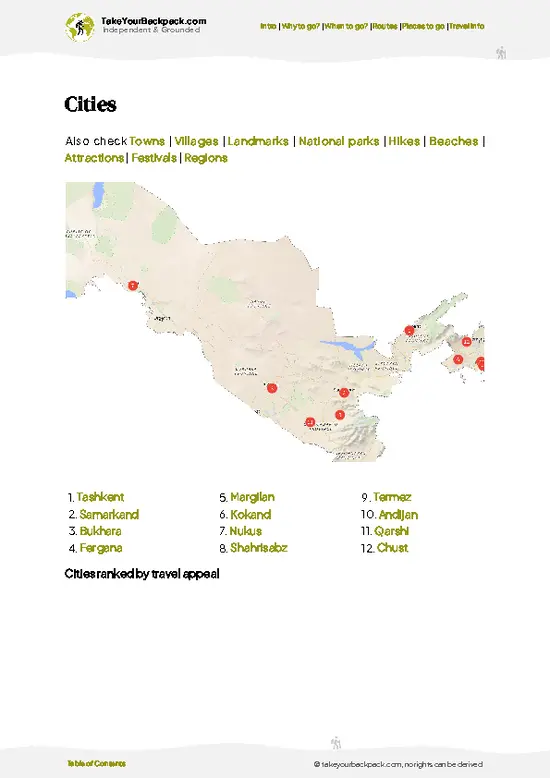
  • Kokand—Khudayar Khan Palace, Dakhma-i Shokhon, wooden-column Jami Mosque, Norbutabey Madrasa| 166 km away
  • Chust—Pichok knife smiths, doppi caps, Bronze Age mound, morning bazaar| 170 km away
  • Margilan—Yodgorlik Silk Factory, ikat looms, Kumtepa Sunday market, Pir Siddiq| 228 km away

💡 Not sure where to go next?
Create a personalized itinerary for Uzbekistan including Tashkent and the places that fit your trip.

Generate my itinerary

👉 Discover all cities

Or checkout all Uzbekistan has to offer (think cities, towns, villages, national parks, hikes, beaches, festivals)
Country photo of Uzbekistan

We 💚 feedbackKey takeaways before you go

Most first-timers rush through the metro like it's just transport, but the platforms themselves are the point. Each station has its own design, and the stations feel like small galleries. Ride a few stops, get off, look up, and then board again. Do it midday when the trains are quieter.

✍️ Help improve this page!
The information on this page is based on in-depth research, insights shared by experienced travelers, and feedback from the local travel community in Uzbekistan. While every effort is made to keep the information accurate and current, conditions can change — so if you spot anything incorrect or outdated, please get in touch.


🙋‍♂️ Give feedback

👋 Meet the founderWho’s Behind Take Your Backpack?

Johan, backpacker and founder of TakeYourBackpackHi, I’m Johan (Netherlands 🇳🇱), the creator of TakeYourBackpack. Over the past 3 decades, I’ve backpacked through 90+ countries across six continents, gaining extensive experience with independent travel, long-term trips, and overland routes.

This site is built on a combination of firsthand travel experience and carefully curated insights from other backpackers. Many guides are based on places I’ve personally visited, while others bring together tips, observations, and practical advice shared by trusted travelers I’ve met along the way.

The goal is to provide realistic, experience-driven guidance — not generic itineraries — so you can explore destinations with better context, clearer expectations, and more confidence.