Short version: Western Sahara is doable to backpack independently, but it’s not a classic “wing it” destination. It’s more like light expedition mode on a bus budget.
The region is politically sensitive and heavily policed, especially outside cities. You’ll hit checkpoints where officers may ask for your passport, hotel details, and route. This isn’t usually dangerous, just slow and bureaucratic. Having printed bookings (or at least screenshots) for your first nights in Laayoune and/or Dakhla makes life easier.
For a budget backpacker, the main challenges are distance, limited public transport, and a lack of classic hostel culture. You’ll find cheap guesthouses and basic hotels rather than dorms and party hostels. Expect simple rooms, sometimes cold showers, and very little English; French and a few words of Moroccan Arabic help a lot.
Spontaneous wild camping near towns or roads can attract police attention. If you camp, do it in obvious, accepted spots (kite camps near Dakhla, beaches locals already use) and avoid wandering off-road in remote desert areas because of old minefields and military zones. Stick to known routes and ask locals or your accommodation staff before heading into the emptier parts of the desert.
If you’re comfortable with long, sparse landscapes, basic French, and some planning, independent backpacking works well. If you need nightlife, constant social hostels, and easy hitchhiking, Western Sahara will feel quiet and logistically stiff.
For a budget backpacker, 5–10 days is the sweet spot, depending on how far south you go and how much bus time you can tolerate.
3–4 days (absolute minimum):
- Focus on Laayoune and nearby coast.
- Day 1–2: Laayoune town, markets, and short trips to the coast.
- Day 3–4: Side trip to Boujdour or a desert excursion arranged locally.
This is enough to get a feel for the place but you’ll spend a big chunk of time in transit if you’re coming from Agadir or Marrakech.
5–7 days (solid, realistic trip):
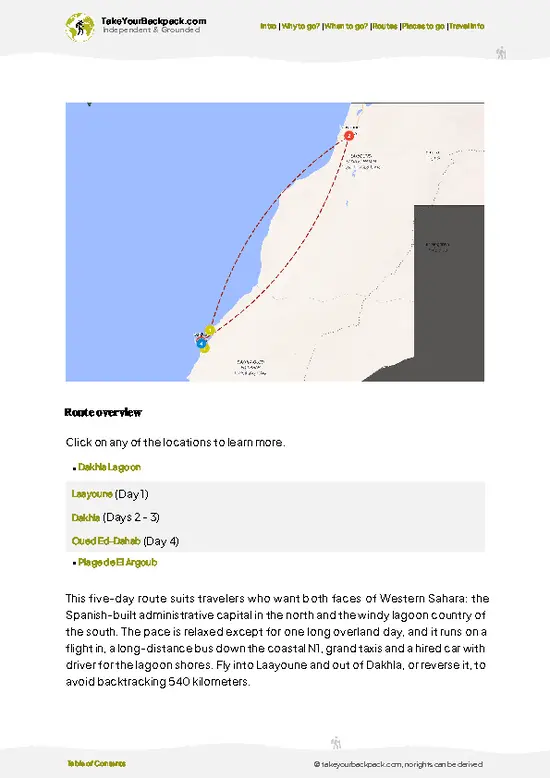
- Day 1–2: Laayoune and surroundings.
- Day 3–4: Bus to Dakhla, explore the peninsula, lagoon, and beaches.
- Day 5–6: Kite-surf vibe watching, cheap seafood, maybe a budget desert camp.
- Day 7: Travel day back north.
This length lets you absorb the slow pace instead of just ticking boxes.
10+ days (if you love slow travel and empty horizons):
- Add extra nights in Dakhla to do day trips along the coast.
- Spend a night or two in smaller towns like Boujdour or Smara for a more local feel.
- Work in a multi-day desert camp or homestay if you find a trustworthy operator.
If you’re on a long overland route through Morocco and Mauritania, Western Sahara works well as a 1–2 week “desert and sea” chapter between busier sections. If you’re flying in just for this region, anything under 5 days feels rushed for the distance involved.
You can get around Western Sahara without a car, but you trade money savings for time and patience.
Intercity travel:
- Long-distance buses (CTM, Supratours, and local companies) connect Agadir–Tantan–Laayoune–Boujdour–Dakhla. They’re the backbone for backpackers. Book ahead in high season and expect night buses on the longer stretches.
- Shared taxis (grand taxis) run between closer towns and can be faster but less comfortable. They leave when full, so timing is flexible rather than fixed.
Within cities:
- Laayoune and Dakhla are walkable in the central areas, with cheap petit taxis for longer hops. Budget-wise, this is easy.
For remote spots:
- Reaching off-the-grid desert areas, remote beaches, or inland routes is hard without a car or organized trip. Hitchhiking is possible but not as casual as in other parts of Morocco because of checkpoints and low traffic. If you hitch, do it on main roads, dress conservatively, and be ready to wait.
- For specific activities (kite-surfing lagoons, desert camps, dune areas), it’s often cheaper and safer to join a local excursion that includes transport rather than trying to DIY with random taxis.
If you’re happy to stick to the main coastal spine and the bigger towns, no car is needed. If your dream is deep desert exploration and remote oases, you either rent a car with solid desert-driving knowledge or pay for guided trips.
For a budget backpacker, the must-visits are less about single monuments and more about a few key zones that show the character of Western Sahara.
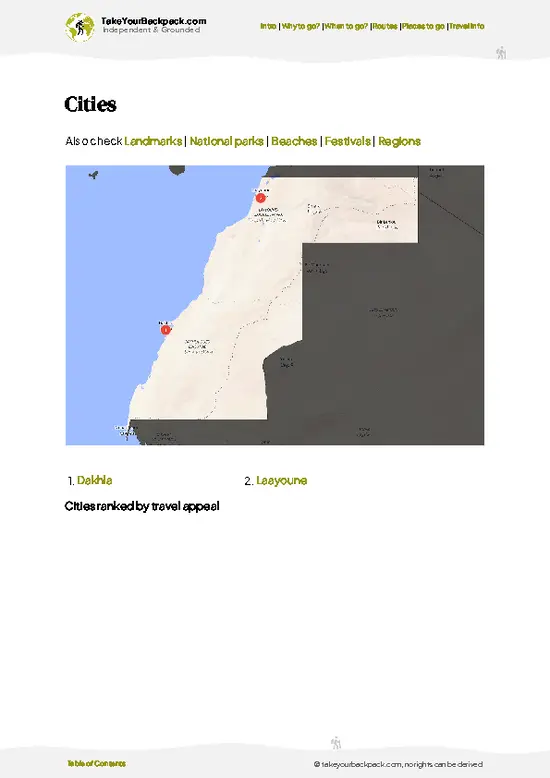
Laayoune (El Aaiún):
- The de facto capital and your most likely entry point.
- Worth it for: street life, markets, tea culture, and the feeling of a frontier town. Walk the main avenues at sunset, grab cheap street food, and watch how slow and social the evenings are.
Laayoune coast (Foum El Oued and nearby beaches):
- Easy day trip from town by taxi.
- Worth it for: Atlantic views, long walks on wide beaches, and a first taste of the desert-meets-ocean vibe without big costs.
Dakhla town and peninsula:
- The main highlight for most travelers.
- Worth it for: the long, narrow peninsula, calm lagoon on one side and wild Atlantic on the other, and a mix of local life and kite-surf culture. Even if you don’t kite, watching the action from shore is free entertainment.
Dakhla lagoon and nearby desert:
- The area around the lagoon is where you feel the scale of the landscape: flat water, sand, and sky.
- Worth it for: sunrise/sunset walks, cheap seafood, and, if your budget allows, a basic camp night under clear desert stars.
A smaller town stop (Boujdour or Smara):
- Not essential, but good if you have time.
- Worth it for: breaking up long bus rides and seeing a more everyday Saharan town with fewer travelers. One night is usually enough.
If you’re short on cash, prioritize Laayoune plus Dakhla and its lagoon. Those give you the best mix of culture, coast, and desert without needing expensive 4x4 expeditions.
If you’re tight on time or money, skip anything that’s mostly about long detours or expensive logistics rather than a clearly different experience.
Deep inland desert expeditions:
- Multi-day 4x4 trips far from the main road are pricey and time-consuming. The landscapes are impressive, but you can get a strong desert feel from shorter, cheaper outings near Laayoune or Dakhla.
Extra nights in smaller towns:
- Boujdour, Smara, and similar towns are interesting for slow travelers, but they’re not essential. If you only have a week, use them as quick bus stops, not overnight destinations.
High-end kite-surf resorts:
- If you’re on a backpacker budget and not a dedicated kite-surfer, the luxury camps and all-inclusive resorts near Dakhla are easy to skip. You can still enjoy the lagoon, watch the action, and stay in town or a simpler camp for far less.
Over-ambitious coastal detours:
- Trying to see every beach and fishing village along the coast eats time and transport money without adding much variety. Pick one or two accessible coastal spots near Laayoune or Dakhla and let the rest go.
Long city time in transit hubs up north:
- If your goal is Western Sahara specifically, don’t burn extra days in mid-route towns like Tantan unless you have a reason. Push through and spend your limited time where the desert and ocean really dominate: Laayoune, its coast, and Dakhla.