×

Zambia🇿🇲 | best regionsTop-Rated regions in Zambia

Zambia rewards the traveler who likes to move. Its regions split into wild safari country in the east and south, waterfall and river towns along the Zambezi, and remote lake and plateau districts in the north. Each runs on a different rhythm. Park areas cost more and need planning, while the Victoria Falls side is easy to reach and busy. The north is quiet, cheap and slow, with long bus days. Independent travel and backpacking work well here if you choose a region that matches your budget, time and appetite for rough roads. Pick your flavor, then start exploring.

By Johan Kruseman 🇳🇱 | Updated October 23, 2026
Explore the best cities in Zambia

Why go?Why These region Stand Out

Zambia is a landlocked plateau sitting mostly at 1,000 to 1,500 meters, and that single fact shapes everything. The Zambezi, Luangwa and Kafue river systems carve the country into distinct landscapes, while the altitude keeps the climate milder than neighbors at similar latitudes. Roughly 20 percent of the land is protected as national park or game management area, so wildlife country is huge, uncrowded and often reached by walking safaris, a style Zambia is known for.

The flip side is infrastructure. Distances are long, paved roads link the main corridors, and many park tracks turn to mud in the rains. Public transport is built for locals, so buses leave when full. Lodges and camps cluster in a few hubs, with prices set in US dollars in many safari areas, while towns use the Zambian kwacha. … read more 👉
Zambia is a landlocked plateau sitting mostly at 1,000 to 1,500 meters, and that single fact shapes everything. The Zambezi, Luangwa and Kafue river systems carve the country into distinct landscapes, while the altitude keeps the climate milder than neighbors at similar latitudes. Roughly 20 percent of the land is protected as national park or game management area, so wildlife country is huge, uncrowded and often reached by walking safaris, a style Zambia is known for.

The flip side is infrastructure. Distances are long, paved roads link the main corridors, and many park tracks turn to mud in the rains. Public transport is built for locals, so buses leave when full. Lodges and camps cluster in a few hubs, with prices set in US dollars in many safari areas, while towns use the Zambian kwacha.

Before choosing Zambia, know that it is not a budget safari country the way some neighbors can be, but it rewards flexibility. English is the working language, the people are famously easygoing, and the country has stayed politically stable since independence in 1964. Expect to trade polish for space, and plan transport early.
Evaluating the Top Choices
The list of best regions in Zambia is created based on landscapes, local culture, attractions, vibes, and overall appeal. If you feel a region is missing in this list, please let us know.

When to go?Optimal Periods for Travel

Best Months and Dry Season: The best months are May to October, when the dry season brings clear skies, easy roads and animals gathering at shrinking water. Days run 24 to 30°C, and nights from June to August can drop to 5 to 10°C, so pack a warm layer. Rain is almost absent, which makes this the window for bush camping and walking trips.

Shoulder Seasons: September and October turn hot, reaching 33 to 38°C in the Luangwa and Zambezi valleys, but wildlife viewing peaks as waterholes shrink. May is green, dust-free and cheaper, with fewer visitors. Late-season heat is the main reason some travelers prefer June and July.

Rainy Season and Prices: From November to April, rain of 700 to 1,400 mm falls depending on the area, with the heaviest in the north. Many bush camps in the Luangwa and Kafue … read more 👉
Best Months and Dry Season: The best months are May to October, when the dry season brings clear skies, easy roads and animals gathering at shrinking water. Days run 24 to 30°C, and nights from June to August can drop to 5 to 10°C, so pack a warm layer. Rain is almost absent, which makes this the window for bush camping and walking trips.

Shoulder Seasons: September and October turn hot, reaching 33 to 38°C in the Luangwa and Zambezi valleys, but wildlife viewing peaks as waterholes shrink. May is green, dust-free and cheaper, with fewer visitors. Late-season heat is the main reason some travelers prefer June and July.

Rainy Season and Prices: From November to April, rain of 700 to 1,400 mm falls depending on the area, with the heaviest in the north. Many bush camps in the Luangwa and Kafue areas close from roughly December to April as roads flood, while northern lake areas stay accessible but muddy. The Victoria Falls area flows hardest from March to May, so mist can hide the views, while low water from September to December opens swimming spots at the lip. Peak-season lodge rates in July and August can run 30 to 50 percent above green-season prices, which makes November and April the cheapest months for those who can handle some mud.

region hoppingOptimizing Your Multi-Stop Itinerary

How Many Days to Link Several Regions: A trip that strings together several regions of Zambia needs 12 to 18 days, and 14 is the comfortable middle. Distances are big, and the roads decide your pace more than the map does.
Direction and Hubs: Work in one long arc instead of zigzagging. Lusaka is the natural gateway and the bus hub, so start there and push toward one far end of the country, then loop back through Livingstone or Lusaka for your flight out. Lusaka to Livingstone runs 6 to 8 hours by coach or about an hour by air. Lusaka to Chipata, the gateway east, takes 7 to 9 hours. Lusaka to Mpika on the Great North Road is 10 to 12 hours, and reaching the far north beyond that adds another 6 to 10 hours on rougher tarmac. Minibuses fill before they leave, so plan on delays of an hour or two. … read more 👉
How Many Days to Link Several Regions: A trip that strings together several regions of Zambia needs 12 to 18 days, and 14 is the comfortable middle. Distances are big, and the roads decide your pace more than the map does.
Direction and Hubs: Work in one long arc instead of zigzagging. Lusaka is the natural gateway and the bus hub, so start there and push toward one far end of the country, then loop back through Livingstone or Lusaka for your flight out. Lusaka to Livingstone runs 6 to 8 hours by coach or about an hour by air. Lusaka to Chipata, the gateway east, takes 7 to 9 hours. Lusaka to Mpika on the Great North Road is 10 to 12 hours, and reaching the far north beyond that adds another 6 to 10 hours on rougher tarmac. Minibuses fill before they leave, so plan on delays of an hour or two.
Time Per Stop: Give park-based stops 3 to 4 nights, since a single night barely covers the drive in. Waterfall and river towns work with 2 to 3 nights, and a lake or remote northern stop deserves 3 to 5 so the long journey pays you back. Big transit days should stand alone, with nothing booked on arrival.
Planning Mistakes: The classic error is cramming too many stops into ten days, which turns the trip into a series of bus seats. Pick two or three clusters and drop the rest. Another is trusting departure times: buses leave when full, so book the morning slot and arrive early. Rainy-season dirt roads can cut off whole areas, so check conditions with your lodge before committing. Finally, many travelers forget that park access often needs a vehicle, so budget for shared transfers or a rented 4x4 rather than assuming a bus will drop you at the gate.

The ListTop regions of Zambia

1 Lake Tanganyika

Cichlid snorkeling, Mpulungu port, 235-meter Kalambo Falls, Nsumbu shoreline

Snorkel over cichlids in rocky shallows, watch fishing boats unload at Mpulungu, then follow the shore to Kalambo Falls and Nsumbu’s hippo-lined beaches.

Loading the map 🌍

Expert viewExpert Commentary on regions

How Many Regions to Visit: Three regions is the number I advise for a trip of two to three weeks. Zambia’s distances are long, and each region usually needs at least three days to feel worthwhile. Trying for four or five means spending most of your time on buses and missing what you came for. A shorter trip of 10 days suits two regions.

Choosing by Travel Style: Wildlife seekers should prioritize a safari region first, since this is where Zambia is strongest and where walking safaris set it apart from neighboring countries. Adrenaline and sightseeing travelers should choose the river and waterfall area, which has the easiest access and the most hostels. Travelers who want solitude and cheap living should choose a northern lake or plateau area, where costs fall and tourists are few. Pair one … read more 👉
How Many Regions to Visit: Three regions is the number I advise for a trip of two to three weeks. Zambia’s distances are long, and each region usually needs at least three days to feel worthwhile. Trying for four or five means spending most of your time on buses and missing what you came for. A shorter trip of 10 days suits two regions.

Choosing by Travel Style: Wildlife seekers should prioritize a safari region first, since this is where Zambia is strongest and where walking safaris set it apart from neighboring countries. Adrenaline and sightseeing travelers should choose the river and waterfall area, which has the easiest access and the most hostels. Travelers who want solitude and cheap living should choose a northern lake or plateau area, where costs fall and tourists are few. Pair one expensive region with one cheap one, so the budget evens out.

What It Costs: Budget about US$35 to 60 a day in towns and lake areas covering dorm beds (US$10 to 20), local meals and buses. Safari regions change the math. Park fees for non-residents run roughly US$25 to 40 a day per person, plus vehicle fees, and camps cost US$40 to 150 per person for basic to midrange options. Guided walks or drives often add US$30 to 80. A three-day park visit realistically costs US$250 to 600 depending on whether you camp or take lodge beds. Self-driving is cheaper per person if you share a rental, but 4x4 hire costs US$80 to 150 a day. Buses between towns cost about US$10 to 25 per long leg.

Safety and Culture: Zambia is generally calm and friendly, but wildlife is the real risk. Never walk at night in park camps, because hippos and elephants pass through. Use an armed ranger on walks, and keep to guide instructions. Take malaria prophylaxis, since the whole country is a risk zone, and drink treated water.

In towns, watch for bag snatching in Lusaka and Livingstone markets, and avoid unlit streets after dark. Greet people before asking for anything, because courtesy matters. Dress modestly in villages, ask before photographing people, and never photograph bridges, airports or government buildings. Carry small kwacha notes, since change is scarce and ATMs fail in remote areas. An experienced traveler withdraws cash in larger towns and keeps US dollars for park fees.

✈️ The backpacker research shortcutZambia Travel Guide

An offline-friendly backpacking guide with optimized travel routes, ranked highlights, transport advice, and the best areas to stay.
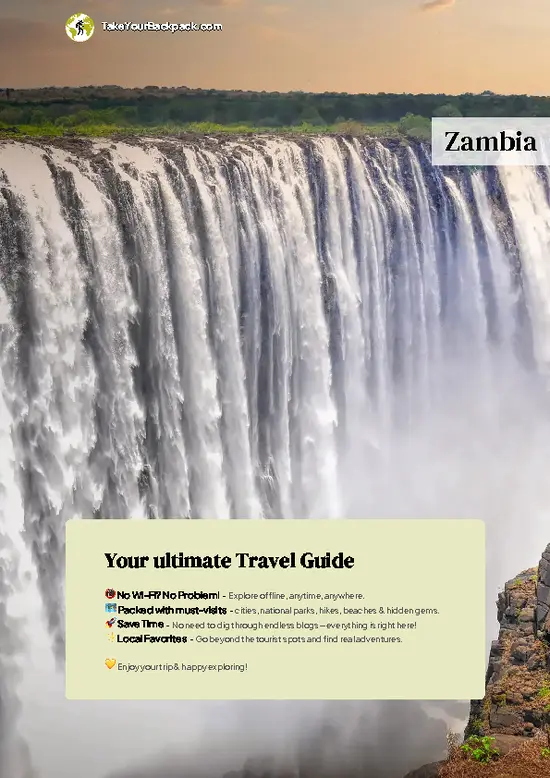
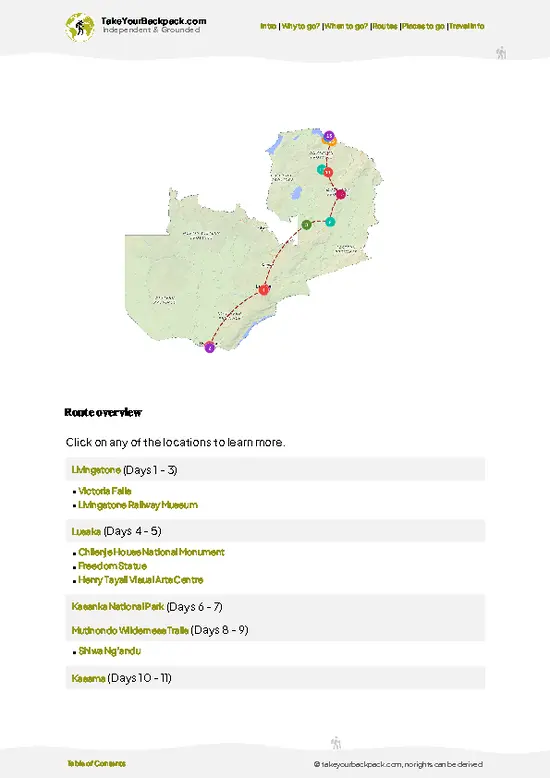
example page 0 from our offline Travel Guide for Zambia
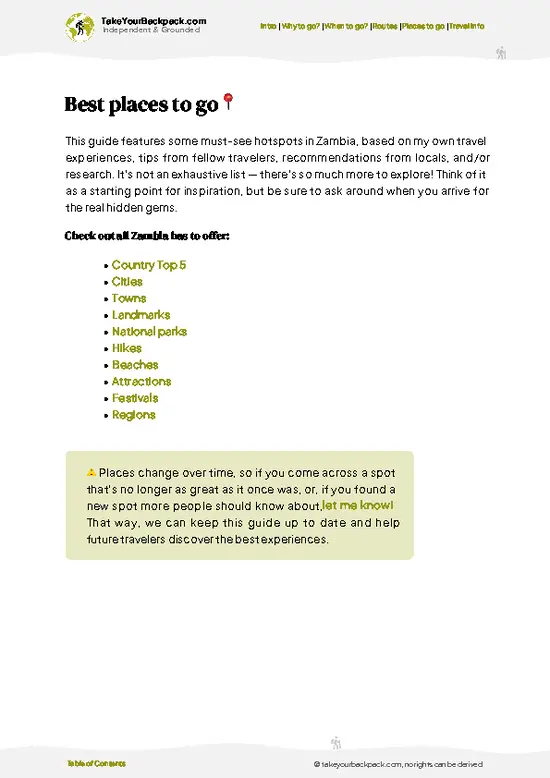
example page 1 from our offline Travel Guide for Zambia
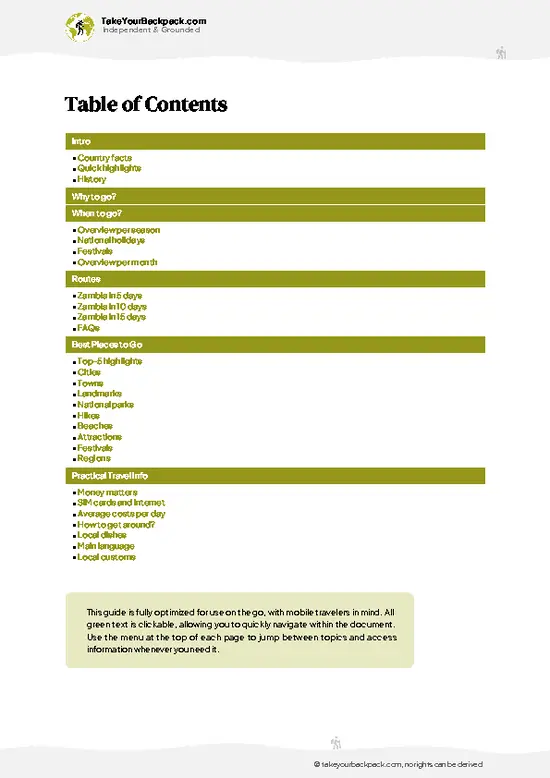
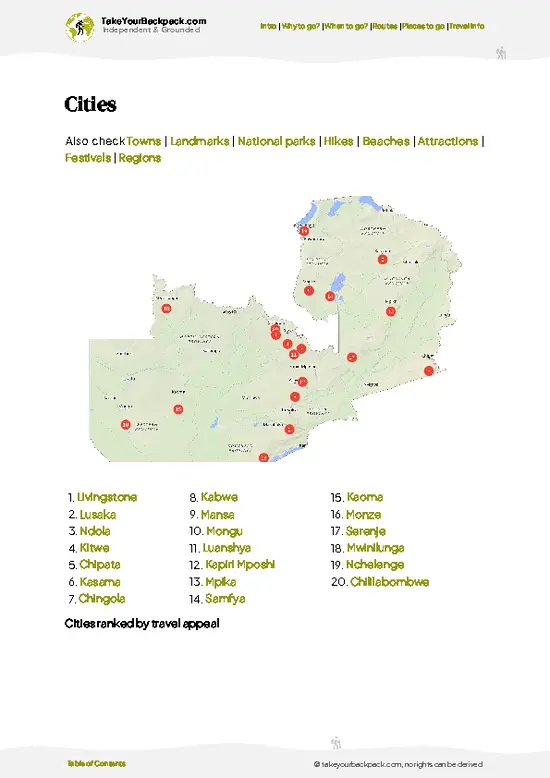
example page 2 from our offline Travel Guide for Zambia
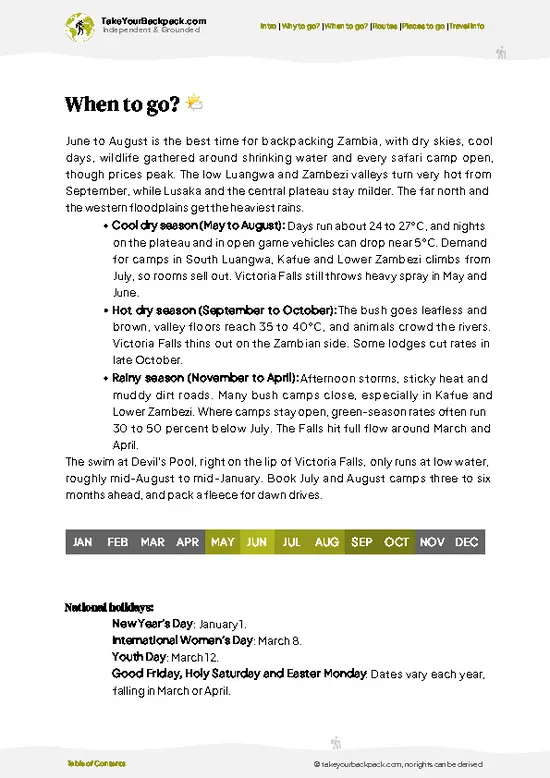
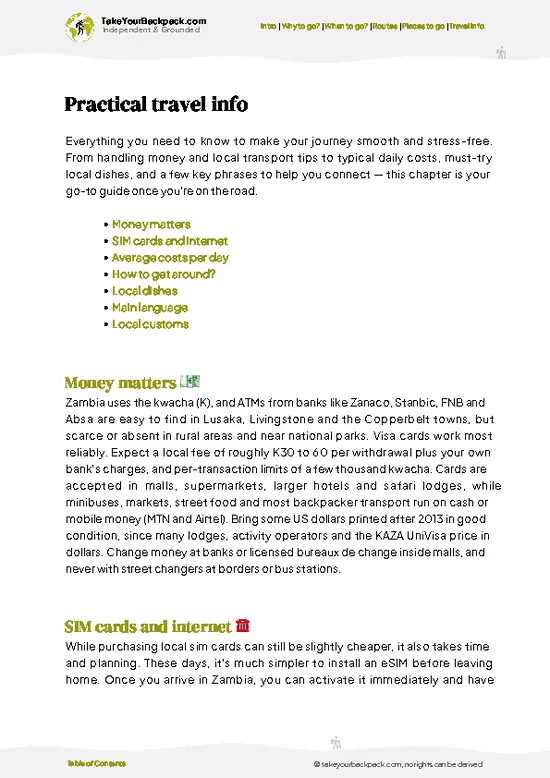
example page 3 from our offline Travel Guide for Zambia
example page 4 from our offline Travel Guide for Zambia
example page 5 from our offline Travel Guide for Zambia
example page 6 from our offline Travel Guide for Zambia
example page 7 from our offline Travel Guide for Zambia
The digital guide (351 pages) contains:
✅ 89 highlights, ranked by travel appeal
✅ Optimized 5, 10 & 15-day travel routes
✅ Cities, national parks, landmarks, beaches
✅ How to get around
✅ Offline-friendly for travel without Wi-Fi
👉 Click to see all 30+ guide features

📅 Plan smarter in minutes, not weeks
✅ Month by month travel advice
✅ Festivals & national holidays
✅ Budget expectations

🗺️ Go to the right places, skip the overrated ones
✅ Honest pros & cons of destinations
✅ Top hikes, parks & viewpoints
✅ Lesser-known places most travelers miss
✅ Clear “worth it vs skip it” guidance

🛏️ Travel smoothly without rookie mistakes
✅ Best areas to stay
✅ Transport systems explained simply
✅ Common scams & safety advice
✅ SIM cards, money & practical tips

🌍 Understand the country, not just visit it
✅ Culture & traditions
✅ 52 Essential phrases & customs
✅ Festivals worth planning around
✅ Traveler-friendly historical context
✅ Insights that make places more meaningful

📱 Built for real travel conditions
✅ Fully downloadable PDF
✅ Works completely offline
✅ Optimized for phone use
✅ Useful in remote areas & buses
✅ Everything in one place
Stop searching, start planning
Get instant access to your full guide. 30‑day money-back guarantee.
+ Add another guide for just

By proceeding you agree to our terms.
Sent to your inbox immediately after payment • 100% Secure Checkout
Best Backpacking Travel Advisor 2025 tourism awardBest Backpacking
Travel Advisor
2025
What others say about Take Your Backpack Guides:
⭐⭐⭐⭐⭐
Fantastic, amazing amount of information!
⭐⭐⭐⭐⭐
My goodness this is amazing, it's what I've been looking for hats off too you!
⭐⭐⭐⭐⭐
I think this is absolutely BRILLIANT
⭐⭐⭐⭐
Very complete and informative. It's still missing places, but I gotta to commend you
⭐⭐⭐⭐⭐
This is truly amazing, thank you, can't wait to explore it with my kids!
⭐⭐⭐⭐⭐
Awesome resource, thank you!
⭐⭐⭐⭐⭐
This is amazing! Can't wait to explore the ones I haven't seen
⭐⭐⭐⭐
I love this! Well done, great idea.
⭐⭐⭐⭐⭐
Thanks for taking the time to make this gem!
⭐⭐⭐⭐⭐
This might be the best website I've ever seen.
⭐⭐⭐⭐⭐
Congratulations, and thank you so much for your work; it's incredibly valuable.
⭐⭐⭐⭐
In all seriousness I think you did a great job pointing out the important spots
⭐⭐⭐⭐⭐
10/10 very good
⭐⭐⭐⭐⭐
As someone who's only just starting to visit regularly this is awesome, thank you.
⭐⭐⭐⭐
Thank you very much! I'm going to visit my dad, it's going to be very useful!
⭐⭐⭐⭐⭐
This is really cool! We'll be travelling for the first time and this definitely come in handy.
⭐⭐⭐⭐⭐
You are now our minister of culture, congratulations 👨‍💼
⭐⭐⭐⭐⭐
Just wanted to tell you that this is a pearl! Going to follow your recommendations.
⭐⭐⭐⭐⭐
This is so cool. I'll definitely be using the resource for my travels soon.
⭐⭐⭐⭐⭐
This is very impressive! Good work.
⭐⭐⭐⭐⭐
This is an amazing and informative site. Very well done!

🛏️ Where to stay?Best Stay Options in Zambia

Backpacking Zambia is easy on a budget: dorm beds run roughly US$12 to 20 a night, and most hostels also offer private rooms and camping on the lawn. In Lusaka, the leafy suburbs east of the center such as Rhodes Park, Longacres and Kabulonga hold the best budget options; they are quiet, gated and close to the malls and restaurant strips, but you need a taxi or ride-hailing app to get anywhere after dark. In Livingstone, the hostels cluster in the town center along Mosi-oa-Tunya Road, which puts you within walking distance of bars, ATMs and adventure-booking desks and about 10 km from Victoria Falls, while the quieter riverside stretch upstream on the Zambezi is mostly pricier lodges and campsites. … read more 👉
Backpacking Zambia is easy on a budget: dorm beds run roughly US$12 to 20 a night, and most hostels also offer private rooms and camping on the lawn. In Lusaka, the leafy suburbs east of the center such as Rhodes Park, Longacres and Kabulonga hold the best budget options; they are quiet, gated and close to the malls and restaurant strips, but you need a taxi or ride-hailing app to get anywhere after dark. In Livingstone, the hostels cluster in the town center along Mosi-oa-Tunya Road, which puts you within walking distance of bars, ATMs and adventure-booking desks and about 10 km from Victoria Falls, while the quieter riverside stretch upstream on the Zambezi is mostly pricier lodges and campsites.

If you enjoy meeting fellow travelers, consider choosing hostels with high ratings for atmosphere. On the other hand, if you prefer having your own space, a hotel might be a better option.

ZambiaWhere to Go Next

👋 Meet the founderWho’s Behind Take Your Backpack?

Johan, backpacker and founder of TakeYourBackpackHi, I’m Johan (Netherlands 🇳🇱), the creator of TakeYourBackpack. Over the past 3 decades, I’ve backpacked through 90+ countries across six continents, gaining extensive experience with independent travel, long-term trips, and overland routes.

This site is built on a combination of firsthand travel experience and carefully curated insights from other backpackers. Many guides are based on places I’ve personally visited, while others bring together tips, observations, and practical advice shared by trusted travelers I’ve met along the way.

The goal is to provide realistic, experience-driven guidance — not generic itineraries — so you can explore destinations with better context, clearer expectations, and more confidence.