×

Zambia🇿🇲 | best attractionsTop-Rated 10 attractions in Zambia

Zambia’s attractions come in three distinct flavors, and the one you pick shapes your whole trip. In the south, Victoria Falls and Livingstone deliver roaring water, adrenaline and the easiest logistics, with a crowd to match. In the east and center, South Luangwa and Lower Zambezi parks offer walking safaris and wild riverbanks at higher prices. Up north, Kasanka, Lake Tanganyika and Kalambo reward travelers willing to endure long, bumpy road days for empty shorelines and almost no other visitors. Independent travel works best when you match your patience and budget to the region. Go bold, go early, and start exploring.

By Johan Kruseman 🇳🇱 | Updated October 23, 2026
Explore the best festivals in Zambia

Why go?Why These attraction Stand Out

Zambia rewards explorers because it pairs raw geography with a very light tourist footprint. The country sits on a high plateau, cut by the Zambezi, Luangwa and Kafue river systems, so water shapes almost everything you will see. Roughly a third of the land is protected as national parks and game management areas, which keeps big wildlife corridors intact and lets you do things most countries banned decades ago, such as walking safaris, a tradition born in the Luangwa Valley.

That wildness has a price. Infrastructure is uneven: paved roads link Lusaka, Livingstone and the Copperbelt, but distances are huge and many park roads turn to mud in the rainy season. Safari lodges lean toward the premium end, so a budget traveler must plan around public land, campsites and shared transfers.

Before … read more 👉
Zambia rewards explorers because it pairs raw geography with a very light tourist footprint. The country sits on a high plateau, cut by the Zambezi, Luangwa and Kafue river systems, so water shapes almost everything you will see. Roughly a third of the land is protected as national parks and game management areas, which keeps big wildlife corridors intact and lets you do things most countries banned decades ago, such as walking safaris, a tradition born in the Luangwa Valley.

That wildness has a price. Infrastructure is uneven: paved roads link Lusaka, Livingstone and the Copperbelt, but distances are huge and many park roads turn to mud in the rainy season. Safari lodges lean toward the premium end, so a budget traveler must plan around public land, campsites and shared transfers.

Before choosing Zambia, know that it is English-speaking, politically stable and welcoming, with a strong tradition of local guiding standards. Know too that spontaneity has limits: top lodges and camps fill in the dry season, and many remote parks close or become unreachable in the wet months. Book key stays ahead, carry cash in kwacha for rural fees, and treat the country as a place where effort buys solitude. Visitors who accept that find a quieter, more hands-on Africa.
Behind the Scenes of Selection
The list of best attractions in Zambia is created based on cultural significance or entertainment value. If you feel a attraction is missing in this list, please let us know.

When to go?Optimal Periods for Travel

Best months for Zambia’s attractions: May to October is the best window, because the dry season concentrates wildlife along rivers and keeps roads passable across most of the country. Days run about 24 to 30°C (75 to 86°F), while nights in June and July in the Luangwa Valley and on the plateau can fall to 5 to 10°C (41 to 50°F), so pack a warm layer for dawn drives.

Shoulder seasons and the green months: September to October is the hottest stretch, with highs of 35 to 40°C (95 to 104°F) in the valleys, but wildlife viewing peaks as water sources shrink. April and early May bring lush landscapes and falling rain at lower prices. November to March is the rainy season, with roughly 700 to 1,400 mm (28 to 55 in) falling, heaviest in the north. Many bush camps in South Luangwa and Kafue shut from … read more 👉
Best months for Zambia’s attractions: May to October is the best window, because the dry season concentrates wildlife along rivers and keeps roads passable across most of the country. Days run about 24 to 30°C (75 to 86°F), while nights in June and July in the Luangwa Valley and on the plateau can fall to 5 to 10°C (41 to 50°F), so pack a warm layer for dawn drives.

Shoulder seasons and the green months: September to October is the hottest stretch, with highs of 35 to 40°C (95 to 104°F) in the valleys, but wildlife viewing peaks as water sources shrink. April and early May bring lush landscapes and falling rain at lower prices. November to March is the rainy season, with roughly 700 to 1,400 mm (28 to 55 in) falling, heaviest in the north. Many bush camps in South Luangwa and Kafue shut from about November to April, and unpaved roads can become impassable.

Crowds and prices: Peak rates apply from July to October, when lodges can cost 30 to 50 percent more than in the green season. Victoria Falls works differently: water volume peaks around March to May, producing heavy spray, while lower flows from September to December open up swimming spots and clearer views. Book dry-season beds three to six months ahead.

attraction hoppingOptimizing Your Multi-Stop Itinerary

How many days a multi-stop trip needs: A trip linking several attractions in Zambia needs 10 to 16 days, because distances are long and roads slow. Most travelers connect the south, east and Lusaka in a loop, with the north saved for a separate, longer adventure.

Direction and regions that cluster: Start in Livingstone, which has an international airport and the best backpacker infrastructure. Then head to Lusaka, about 7 to 8 hours by bus (or a short flight), and onward to Chipata and the Luangwa Valley, another 8 to 10 hours by road, followed by a 1.5 to 2 hour transfer to Mfuwe or Mambwe. Finishing in the east lets you fly or bus back from Lusaka. The Kafue region sits between Lusaka and Livingstone and suits travelers with a vehicle. Northern stops, such as the Lake Tanganyika shoreline, … read more 👉
How many days a multi-stop trip needs: A trip linking several attractions in Zambia needs 10 to 16 days, because distances are long and roads slow. Most travelers connect the south, east and Lusaka in a loop, with the north saved for a separate, longer adventure.

Direction and regions that cluster: Start in Livingstone, which has an international airport and the best backpacker infrastructure. Then head to Lusaka, about 7 to 8 hours by bus (or a short flight), and onward to Chipata and the Luangwa Valley, another 8 to 10 hours by road, followed by a 1.5 to 2 hour transfer to Mfuwe or Mambwe. Finishing in the east lets you fly or bus back from Lusaka. The Kafue region sits between Lusaka and Livingstone and suits travelers with a vehicle. Northern stops, such as the Lake Tanganyika shoreline, are 14 to 20 hours or more from Lusaka, so add four extra days.

Time per stop and planning mistakes: Allow two to three nights in Livingstone and three to four in a park such as South Luangwa. The biggest mistake is cramming everything into a week, which turns the trip into bus windows. Another is trusting map distances: a 400 km leg can take 8 hours. Instead, cut a region, book transfers a day ahead, and add a buffer night before any flight.

The ListTop attractions of Zambia

1 Victoria Falls Bridge

Steel arch, midspan border line, 111-meter bungee, Boiling Pot trail

Walk to the center of the arch above the gorge, watch bungee jumpers drop, then descend the steep trail to the churning river below.

2 Livingstone Museum

Livingstone letters, ethnography, archaeology, old taxidermy

Spend a midday indoors with the explorer’s journals and personal items, plus galleries of masks, Stone Age tools and independence-era history.

3 Lusaka National Museum

Independence story, ceremonial masks, village dioramas, contemporary art

Trace Zambia’s path to 1964 through photographs and documents, then move on to ethnography rooms, reconstructed village scenes and local painters.

4 Choma Museum and Crafts Centre

Tonga homesteads, cattle culture, headrests, craft shop

Walk through thatched homestead buildings and ethnographic halls that explain Tonga farming and herding, then buy baskets and carvings at the on-site crafts centre.

5 Moto Moto Museum

Bemba artifacts, thumb pianos, ironwork, mounted elephant

Study Bemba ritual objects, instruments and iron tools in dim old halls, then rest in the quiet green grounds.

6 Shiwa Ng’andu

Tudor-style manor, Lake Ishiba Ng’andu, Gore-Browne grave, estate village

Tour an English-style manor deep in northern bush, then walk the lakeshore, visit the founder’s hilltop grave and soak at Kapishya Hot Springs.

7 Kabwata Cultural Village

Artisan cottages, malachite, wood carvers, batik

Browse workshop cottages where carvers and painters sell their own pieces, from malachite bowls to woven baskets, with room to bargain.

8 Kalimba Reptile Park

Nile crocodiles, guided snake walk, mamba displays, pythons

Watch crocodiles feed, meet handlers who explain local snakes, and get close to pythons, tortoises and chameleons on a working farm.

9 Mukuni Big 5

Habituated elephants, hand feeding, cheetah viewing, bush drive

Walk beside calm elephants with handlers, feed them by hand, and add a game drive through the bush near Mukuni Village.

10 Chilenje House National Monument

Kaunda’s township home, independence meetings, Chilenje streets

Step into the modest house where Kenneth Kaunda planned the independence campaign, then walk the surrounding township lanes of everyday Lusaka.

11 Livingstone Railway Museum

Steam engines, climbable cabs, signal gear, colonial coaches

Climb into locomotive cabs on original track, inspect telegraph equipment and old carriages, and trace the line that carried copper.

12 Freedom Statue

Bronze monument, broken shackles, Independence Avenue

Pause at the bronze figure bursting from its chains, then pair a short photo stop with the nearby memorial sites and avenues.

13 Henry Tayali Visual Arts Centre

Artist studios, Zambian canvases, batik, stone carving

Meet painters and sculptors at work, compare canvases and batiks, and haggle gently for rollable art that packs easily.

14 Mosi-oa-Tunya Cultural Village

Guided homesteads, drum circles, chief’s court, healer’s hut

Follow a guide through thatched homesteads, join the drumming and dance, and learn how nshima is cooked the old way.

15 Leopards Hill Memorial Park

Manicured memorial lawns, epitaphs, ridge views

Wander clipped lawns and hillside paths, read headstones in several languages, and look out over bush and southeastern rooftops.

Think you know Zambia?

Prove you’re a true local — uncover 5 lesser-known attractions in Zambia that locals tend to keep to themselves.
Loading the map 🌍

Expert viewExpert Commentary on attractions

How many attractions to aim for: Plan on three to five major attractions in a two-week trip. Zambia’s distances are large, and every long transfer costs a half or full day, so more than five turns the trip into transit. Experienced travelers pick one headline spot, one wildlife park and one quiet place, then leave slack for weather and delays.

Prioritizing by travel style: Adrenaline seekers should anchor the trip in Livingstone, where activities cluster in a small area and can be booked locally. Wildlife lovers should put their money into a park stay, since a good guide transforms a drive or walk, and the experience is hard to replace with a cheaper alternative. Slow travelers and the budget-minded should lean toward lakeshores and community-run areas, where you pay less and meet more locals. … read more 👉
How many attractions to aim for: Plan on three to five major attractions in a two-week trip. Zambia’s distances are large, and every long transfer costs a half or full day, so more than five turns the trip into transit. Experienced travelers pick one headline spot, one wildlife park and one quiet place, then leave slack for weather and delays.

Prioritizing by travel style: Adrenaline seekers should anchor the trip in Livingstone, where activities cluster in a small area and can be booked locally. Wildlife lovers should put their money into a park stay, since a good guide transforms a drive or walk, and the experience is hard to replace with a cheaper alternative. Slow travelers and the budget-minded should lean toward lakeshores and community-run areas, where you pay less and meet more locals. Skip the idea of doing everything: a rushed park visit wastes the highest cost in the country.

What it costs: Budget travelers can manage on US$40 to 70 a day using hostels, campsites, local buses and self-catering. Midrange travelers spend US$100 to 200 a day. Safari lodges commonly run US$250 to 600 or more per person per night in peak season, so many backpackers stay in campsites or lodges just outside park boundaries (US$10 to 25 a night for camping or dorms).

Per-visit costs add up. National park entry for foreign visitors is usually in the US$20 to 40 range per day, plus vehicle fees of about US$15 to 30. Guided game drives or walks outside lodge packages cost around US$40 to 100 a person, and Victoria Falls entry from the Zambian side is about US$20 to 25. Foreign visitors are often charged in dollars, but carry some kwacha for small fees, snacks and local transport. Cards fail often outside major towns, and ATMs can run dry, so withdraw cash when you see a working machine.

Safety and cultural considerations: Wildlife is the real hazard. Stay in your vehicle on self-drive routes unless a sign says otherwise, and never walk between tents at night in a park, because hippos and elephants pass through camps. Hire licensed guides for walks. Swimming in rivers carries crocodile and hippo risk, so use only spots that guides approve.

In towns, petty theft is the main concern, so keep phones out of sight at bus stations and avoid walking after dark. Police checkpoints are common on roads; stay calm, carry your passport copy and be polite.

Zambians value greetings, so begin any exchange with a handshake and a hello. Ask before photographing people, and never photograph government buildings, airports or military sites. Dress modestly in villages, and pay community fees directly to the official collectors, not to individuals offering informal tours.

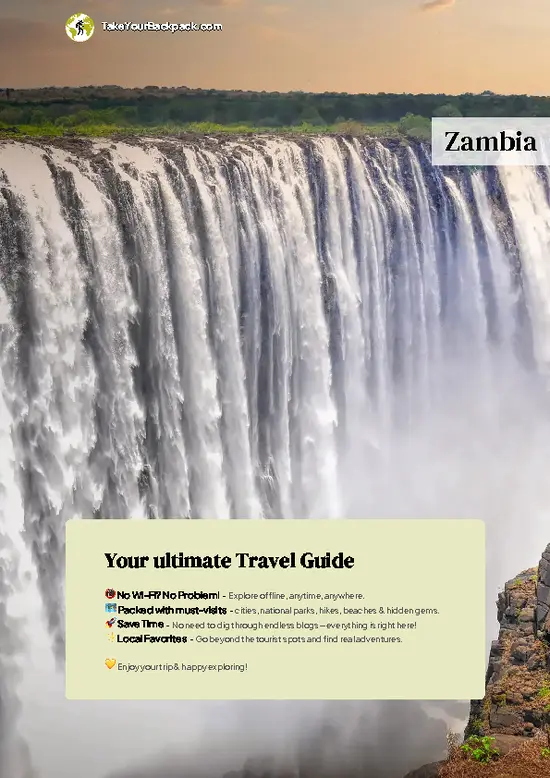
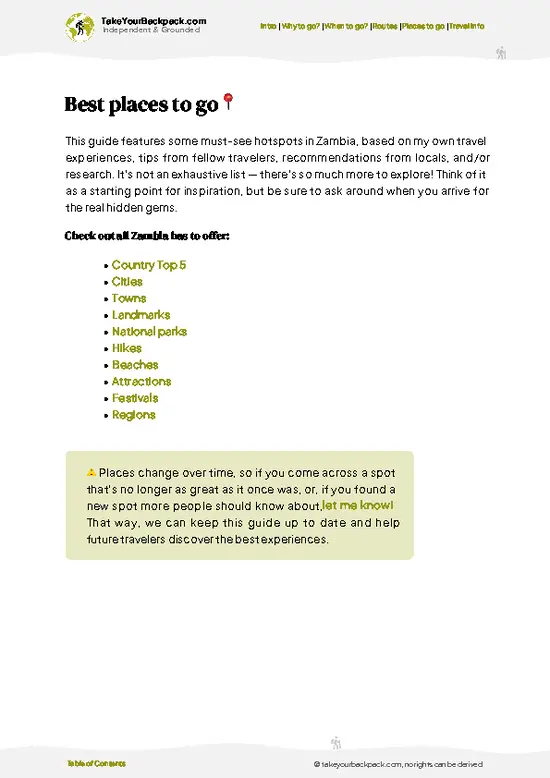
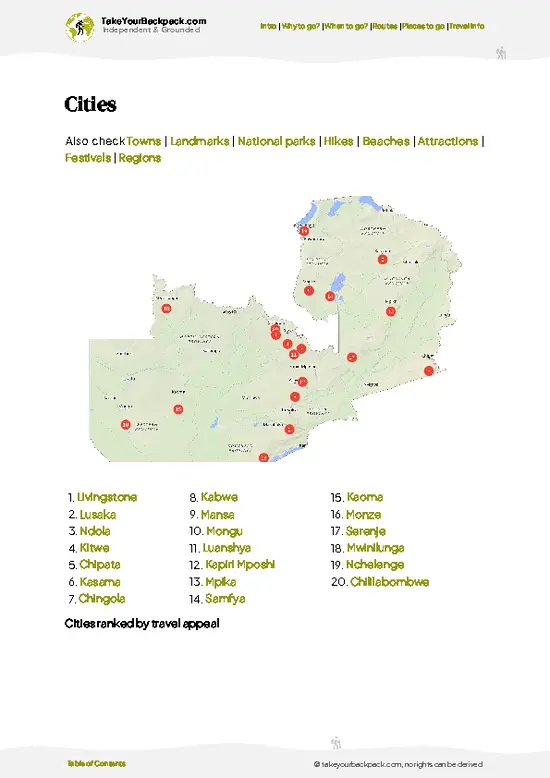
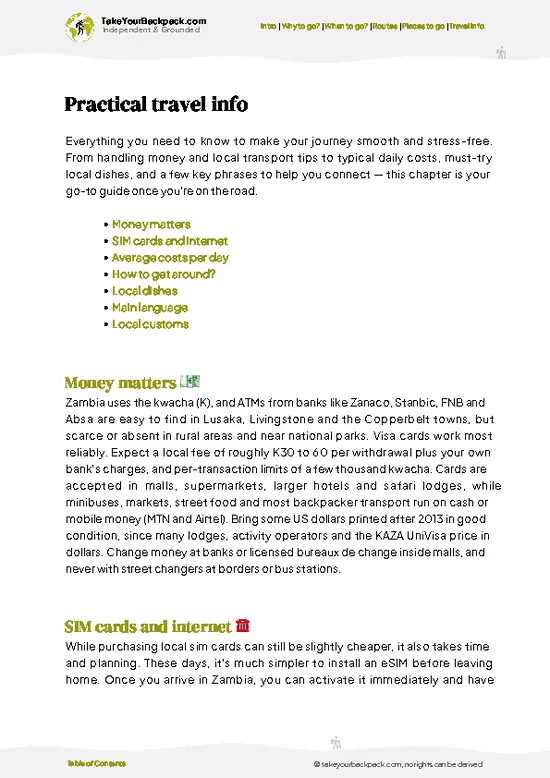
✈️ The backpacker research shortcutZambia Travel Guide

An offline-friendly backpacking guide with optimized travel routes, ranked highlights, transport advice, and the best areas to stay.
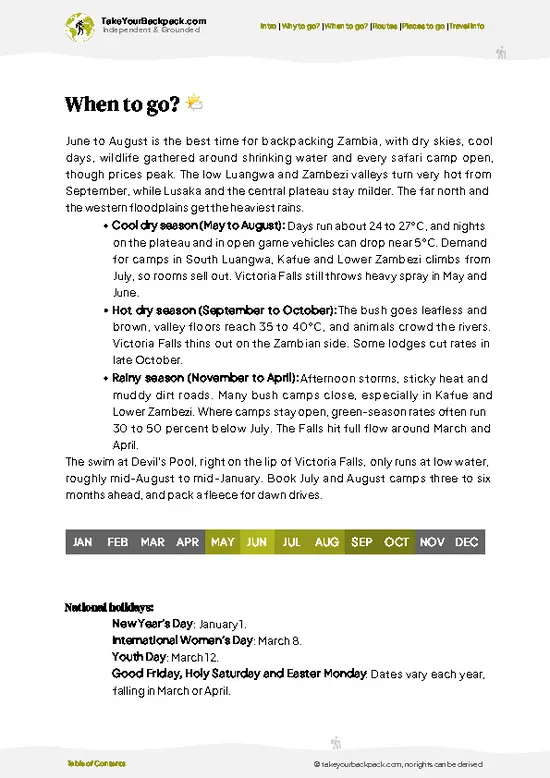
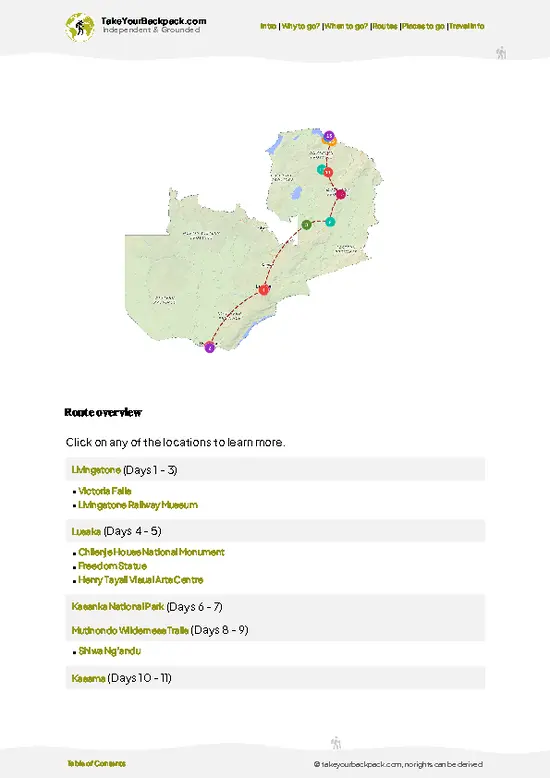
example page 0 from our offline Travel Guide for Zambia
example page 1 from our offline Travel Guide for Zambia
example page 2 from our offline Travel Guide for Zambia
example page 3 from our offline Travel Guide for Zambia
example page 4 from our offline Travel Guide for Zambia
example page 5 from our offline Travel Guide for Zambia
example page 6 from our offline Travel Guide for Zambia
example page 7 from our offline Travel Guide for Zambia
The digital guide (351 pages) contains:
✅ 89 highlights, ranked by travel appeal
✅ Optimized 5, 10 & 15-day travel routes
✅ Cities, national parks, landmarks, beaches
✅ How to get around
✅ Offline-friendly for travel without Wi-Fi
👉 Click to see all 30+ guide features

📅 Plan smarter in minutes, not weeks
✅ Month by month travel advice
✅ Festivals & national holidays
✅ Budget expectations

🗺️ Go to the right places, skip the overrated ones
✅ Honest pros & cons of destinations
✅ Top hikes, parks & viewpoints
✅ Lesser-known places most travelers miss
✅ Clear “worth it vs skip it” guidance

🛏️ Travel smoothly without rookie mistakes
✅ Best areas to stay
✅ Transport systems explained simply
✅ Common scams & safety advice
✅ SIM cards, money & practical tips

🌍 Understand the country, not just visit it
✅ Culture & traditions
✅ 52 Essential phrases & customs
✅ Festivals worth planning around
✅ Traveler-friendly historical context
✅ Insights that make places more meaningful

📱 Built for real travel conditions
✅ Fully downloadable PDF
✅ Works completely offline
✅ Optimized for phone use
✅ Useful in remote areas & buses
✅ Everything in one place
Stop searching, start planning
Get instant access to your full guide. 30‑day money-back guarantee.
+ Add another guide for just

By proceeding you agree to our terms.
Sent to your inbox immediately after payment • 100% Secure Checkout
Best Backpacking Travel Advisor 2025 tourism awardBest Backpacking
Travel Advisor
2025
What others say about Take Your Backpack Guides:
⭐⭐⭐⭐⭐
Fantastic, amazing amount of information!
⭐⭐⭐⭐⭐
My goodness this is amazing, it's what I've been looking for hats off too you!
⭐⭐⭐⭐⭐
I think this is absolutely BRILLIANT
⭐⭐⭐⭐
Very complete and informative. It's still missing places, but I gotta to commend you
⭐⭐⭐⭐⭐
This is truly amazing, thank you, can't wait to explore it with my kids!
⭐⭐⭐⭐⭐
Awesome resource, thank you!
⭐⭐⭐⭐⭐
This is amazing! Can't wait to explore the ones I haven't seen
⭐⭐⭐⭐
I love this! Well done, great idea.
⭐⭐⭐⭐⭐
Thanks for taking the time to make this gem!
⭐⭐⭐⭐⭐
This might be the best website I've ever seen.
⭐⭐⭐⭐⭐
Congratulations, and thank you so much for your work; it's incredibly valuable.
⭐⭐⭐⭐
In all seriousness I think you did a great job pointing out the important spots
⭐⭐⭐⭐⭐
10/10 very good
⭐⭐⭐⭐⭐
As someone who's only just starting to visit regularly this is awesome, thank you.
⭐⭐⭐⭐
Thank you very much! I'm going to visit my dad, it's going to be very useful!
⭐⭐⭐⭐⭐
This is really cool! We'll be travelling for the first time and this definitely come in handy.
⭐⭐⭐⭐⭐
You are now our minister of culture, congratulations 👨‍💼
⭐⭐⭐⭐⭐
Just wanted to tell you that this is a pearl! Going to follow your recommendations.
⭐⭐⭐⭐⭐
This is so cool. I'll definitely be using the resource for my travels soon.
⭐⭐⭐⭐⭐
This is very impressive! Good work.
⭐⭐⭐⭐⭐
This is an amazing and informative site. Very well done!

🛏️ Where to stay?Top Places to Consider Staying

Backpacking Zambia is easy on a budget: dorm beds run roughly US$12 to 20 a night, and most hostels also offer private rooms and camping on the lawn. In Lusaka, the leafy suburbs east of the center such as Rhodes Park, Longacres and Kabulonga hold the best budget options; they are quiet, gated and close to the malls and restaurant strips, but you need a taxi or ride-hailing app to get anywhere after dark. In Livingstone, the hostels cluster in the town center along Mosi-oa-Tunya Road, which puts you within walking distance of bars, ATMs and adventure-booking desks and about 10 km from Victoria Falls, while the quieter riverside stretch upstream on the Zambezi is mostly pricier lodges and campsites. … read more 👉
Backpacking Zambia is easy on a budget: dorm beds run roughly US$12 to 20 a night, and most hostels also offer private rooms and camping on the lawn. In Lusaka, the leafy suburbs east of the center such as Rhodes Park, Longacres and Kabulonga hold the best budget options; they are quiet, gated and close to the malls and restaurant strips, but you need a taxi or ride-hailing app to get anywhere after dark. In Livingstone, the hostels cluster in the town center along Mosi-oa-Tunya Road, which puts you within walking distance of bars, ATMs and adventure-booking desks and about 10 km from Victoria Falls, while the quieter riverside stretch upstream on the Zambezi is mostly pricier lodges and campsites.

If you enjoy meeting fellow travelers, consider choosing hostels with high ratings for atmosphere. On the other hand, if you prefer having your own space, a hotel might be a better option.

ZambiaMore Places Across Zambia

👋 Meet the founderWho’s Behind Take Your Backpack?

Johan, backpacker and founder of TakeYourBackpackHi, I’m Johan (Netherlands 🇳🇱), the creator of TakeYourBackpack. Over the past 3 decades, I’ve backpacked through 90+ countries across six continents, gaining extensive experience with independent travel, long-term trips, and overland routes.

This site is built on a combination of firsthand travel experience and carefully curated insights from other backpackers. Many guides are based on places I’ve personally visited, while others bring together tips, observations, and practical advice shared by trusted travelers I’ve met along the way.

The goal is to provide realistic, experience-driven guidance — not generic itineraries — so you can explore destinations with better context, clearer expectations, and more confidence.