
×

Zimbabwe🇿🇼 | townsChipingeHighland forest edge, tea and coffee supplies, minibus wait | things to do and best time to go

Explore Honde ValleyExplore Victoria Falls town

Backpacking in Chipinge
🏆 Top picktown ranked #3
By Johan Kruseman 🇳🇱 | Updated October 22, 2026

Chipinge is the easiest place to buy supplies and sort out a ride before heading into the forests and tea country of the Eastern Highlands. It sits in the southeast of Zimbabwe, in Manicaland, southeast of Mutare and close to the Mozambique border. Don’t expect polish. The town is a working hub for tea, coffee and timber, with few sights and a short list of guesthouses, so most travelers pass through quickly. I came in by kombi from Mutare, and we idled until the roof was stacked with sacks of macadamia nuts before we rolled out. Minibuses leave only when full, because fuel is dear and margins are thin, so arrive early and treat the wait as part of the trip. Evenings are quiet and you’ll meet few other backpackers. Cash drives everything here and card machines fail often, so load up on small US dollar notes before you arrive.

Discover everything you want to know in the 📖 Zimbabwe Travel Guide.


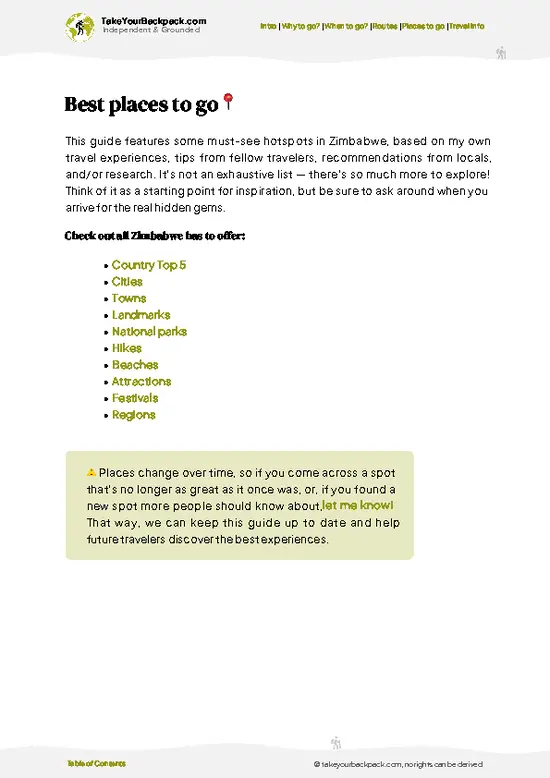
example page 0 from our offline Travel Guide for Zimbabwe
example page 1 from our offline Travel Guide for Zimbabwe
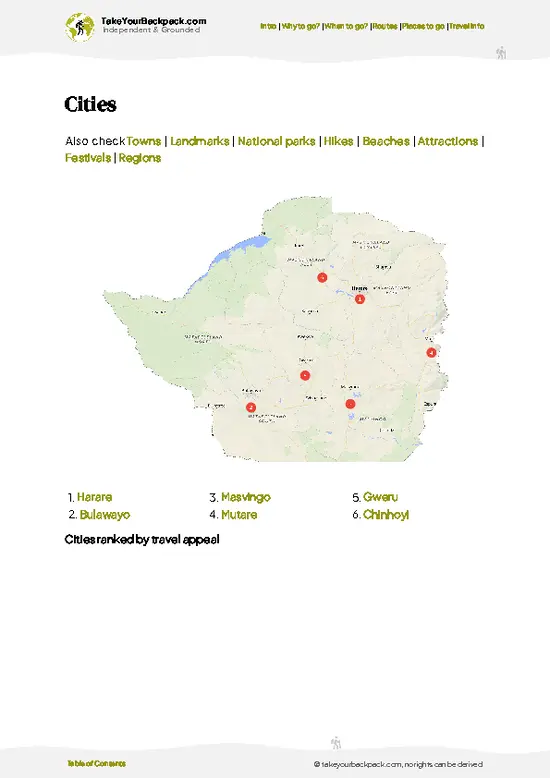
example page 2 from our offline Travel Guide for Zimbabwe
example page 3 from our offline Travel Guide for Zimbabwe
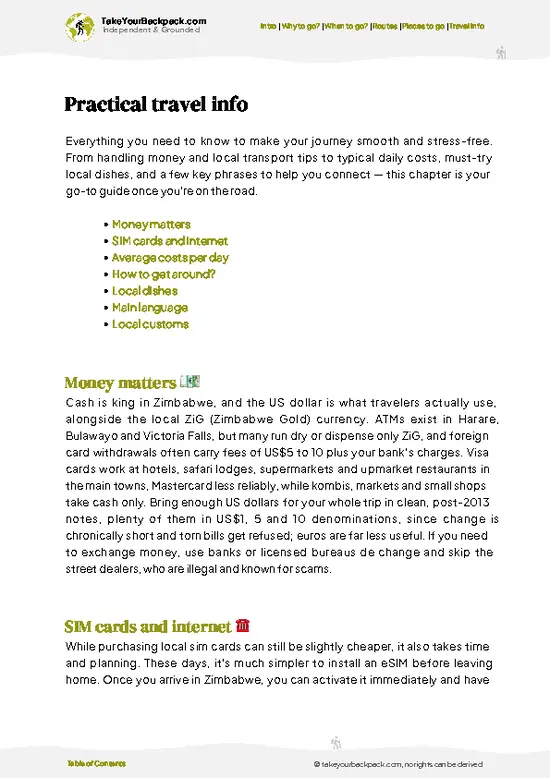
example page 4 from our offline Travel Guide for Zimbabwe
example page 5 from our offline Travel Guide for Zimbabwe
example page 6 from our offline Travel Guide for Zimbabwe
example page 7 from our offline Travel Guide for Zimbabwe
Loading the map 🌍
CLICK TO FILTER
cities
towns
landmarks
national parks
hikes
beaches
attractions
festivals
regions
SHOW COUNTRY’S BESTSHOW ALL

✨ Why go?
Ranked #3 town in Zimbabwe
What makes it a must-see town

Chipinge earns a stop because it is the practical doorway to forest and mountain country that most itineraries skip. From here you can strike out toward the ancient Chirinda Forest at Mount Selinda, the lowland rainforest of the Haroni-Rusitu area, and the southern flanks of the Chimanimani range. Few buses go those ways, so having a base with shops, fuel and a market makes the difference between a plan and a hitchhiking gamble. Stays are short, usually one night, or two or three if you use the town for day hikes and walks between tea estates. It suits hikers, solo travelers comfortable with a slow pace, and anyone who likes talking with farmers and traders rather than other backpackers. The Gungunyana Forest on the edge of town gives you green shade without a transport headache. Nightlife … read more 👉
Chipinge earns a stop because it is the practical doorway to forest and mountain country that most itineraries skip. From here you can strike out toward the ancient Chirinda Forest at Mount Selinda, the lowland rainforest of the Haroni-Rusitu area, and the southern flanks of the Chimanimani range. Few buses go those ways, so having a base with shops, fuel and a market makes the difference between a plan and a hitchhiking gamble. Stays are short, usually one night, or two or three if you use the town for day hikes and walks between tea estates. It suits hikers, solo travelers comfortable with a slow pace, and anyone who likes talking with farmers and traders rather than other backpackers. The Gungunyana Forest on the edge of town gives you green shade without a transport headache. Nightlife is a beer on a veranda and an early bed. If you want hostel dorms and travel buddies, push on to Mutare or Chimanimani village instead.

💡 HighlightsMust-see experiences and standout moments

  1. Gungunyana Forest Reserve: A patch of highland forest at the edge of town, named for the Gaza king, with shaded tracks and birdsong that make a gentle first walk. Go in the morning when birds are most active. Entry is free or a small donation of about US$1 to 2 where someone is on duty, and a walk takes 1 to 2 hours. Wear sturdy shoes, as paths get slippery after rain.
  2. Chipinge Central Market: The place to see what the district grows: bananas, avocados, macadamia nuts, tomatoes and greens, plus roasted maize and dried fish brought in by traders. Mornings are liveliest, before stock sells down by midday. Browsing is free, snacks and fruit run US$0.50 to 3, and an hour is plenty. Bargain politely and carry small notes.
  3. Chipinge Hotel: One of the few spots for a sit-down drink and a plate of sadza
… read more 👉
  1. Gungunyana Forest Reserve: A patch of highland forest at the edge of town, named for the Gaza king, with shaded tracks and birdsong that make a gentle first walk. Go in the morning when birds are most active. Entry is free or a small donation of about US$1 to 2 where someone is on duty, and a walk takes 1 to 2 hours. Wear sturdy shoes, as paths get slippery after rain.
  2. Chipinge Central Market: The place to see what the district grows: bananas, avocados, macadamia nuts, tomatoes and greens, plus roasted maize and dried fish brought in by traders. Mornings are liveliest, before stock sells down by midday. Browsing is free, snacks and fruit run US$0.50 to 3, and an hour is plenty. Bargain politely and carry small notes.
  3. Chipinge Hotel: One of the few spots for a sit-down drink and a plate of sadza with stew, and the best place to hear local news from farmers and estate workers. Go late afternoon, when the day’s traffic has quieted. A meal and a drink come to roughly US$4 to 8, and it takes 1 to 2 hours. It is a plain place, so visit for the talk.
Chipinge also works as a launch point for several day trips: the giant trees of Chirinda Forest at Mount Selinda, the rainforest around Haroni-Rusitu, the southern Chimanimani foothills and the long span of Birchenough Bridge over the Sabi River. All of the sights in town together need only half a day.
Spotted a mistake or missing something? Contact us.

🏘️ NeighborhoodsWhere things are and how it's laid out

Chipinge is small enough to cover on foot in an afternoon, and each pocket has a different job, so match the area to what you need and keep moving.
  • Town Center (Main Street and Chipinge Market): This is the commercial core, where shops, banks with ATMs, mobile money kiosks and grocery stores sit within a few blocks. Walk it in 20 minutes. Stalls sell fresh produce, bananas, avocados and macadamia nuts from the surrounding farms, and cash in small US dollar notes moves faster than big bills because change is scarce. Go in the morning, when stock is fresh.
  • Rank and Bus Terminus Area: The minibus and bus rank is loud, crowded and the best place to read how the district really moves. Vehicles leave when full, not on a timetable, so arrive early and ask drivers directly. Grab fried snacks and roadside
… read more 👉
Chipinge is small enough to cover on foot in an afternoon, and each pocket has a different job, so match the area to what you need and keep moving.
  • Town Center (Main Street and Chipinge Market): This is the commercial core, where shops, banks with ATMs, mobile money kiosks and grocery stores sit within a few blocks. Walk it in 20 minutes. Stalls sell fresh produce, bananas, avocados and macadamia nuts from the surrounding farms, and cash in small US dollar notes moves faster than big bills because change is scarce. Go in the morning, when stock is fresh.
  • Rank and Bus Terminus Area: The minibus and bus rank is loud, crowded and the best place to read how the district really moves. Vehicles leave when full, not on a timetable, so arrive early and ask drivers directly. Grab fried snacks and roadside sadza from vendors here. Keep it to daylight.
  • Chipinge Suburbs and Farm Roads: Residential streets spread out on the hills, quiet and green, with views over tea and coffee country. Distances stretch, so hop a shared taxi rather than trudging uphill in the midday sun. Nightlife is nearly absent here.
  • Pubs and Local Bars Strip: A handful of beer halls around the center keep the evenings lively with music and cold local lager. It is walkable from the center, though taking a short taxi back after dark is smarter than wandering unlit stretches.

⌛️ 1 dayHow to make the most of one day

7:30 AM: Chipinge town center
Start on foot along the main street, where shopfronts, farm suppliers and bakeries open early. Grab a hot tea and a bread roll and watch pickup trucks from the surrounding estates roll in. The town is compact, so everything you need for the day is within a ten-minute stroll.

9:00 AM: Chipinge central market
Wander the stalls for fresh bananas, avocados, macadamia nuts and local honey, all grown on the surrounding highlands. Buy a bag of fruit for the road, then flag down a shared taxi or arrange a driver heading south toward the forest. Settle the fare before you climb in.

10:30 AM: Chirinda Forest, Mount Selinda
This is the one stop that sits outside the standard tourist circuit, and it deserves your whole morning. Chirinda is one of the last patches of dense … read more 👉
7:30 AM: Chipinge town center
Start on foot along the main street, where shopfronts, farm suppliers and bakeries open early. Grab a hot tea and a bread roll and watch pickup trucks from the surrounding estates roll in. The town is compact, so everything you need for the day is within a ten-minute stroll.

9:00 AM: Chipinge central market
Wander the stalls for fresh bananas, avocados, macadamia nuts and local honey, all grown on the surrounding highlands. Buy a bag of fruit for the road, then flag down a shared taxi or arrange a driver heading south toward the forest. Settle the fare before you climb in.

10:30 AM: Chirinda Forest, Mount Selinda
This is the one stop that sits outside the standard tourist circuit, and it deserves your whole morning. Chirinda is one of the last patches of dense evergreen rainforest in Zimbabwe, a cool green pocket with giant mahogany and strangler figs. Follow the trail to the Big Tree, a red mahogany that soars far above the canopy. Listen for the loud calls of turacos and the rustle of forest birds, and keep your eyes open for blue duikers and colorful butterflies. Bring a rain jacket, since the canopy drips even on dry days.

1:30 PM: Lunch back in Chipinge
Return to town hungry. Order sadza with stewed beef or chicken and greens at a local eatery, and finish with a cup of coffee grown in these hills. Eating where the farm workers eat gets you big portions and plenty of conversation.

3:00 PM: Tea and coffee country drive
Hire a driver for an easy loop through the estates around town. Rows of tea bushes and coffee plantations roll across the hillsides, and the road is quiet enough to stop wherever the view opens up. Photograph the ridges and chat with workers if they wave you over.

5:30 PM: Sundowner in town
End at a relaxed bar or hotel terrace for a cold Zambezi lager as the hills turn dark. Evenings here are slow and friendly, which suits an early night and a rested start tomorrow.

🌤️ When to go?Seasonal considerations and timing

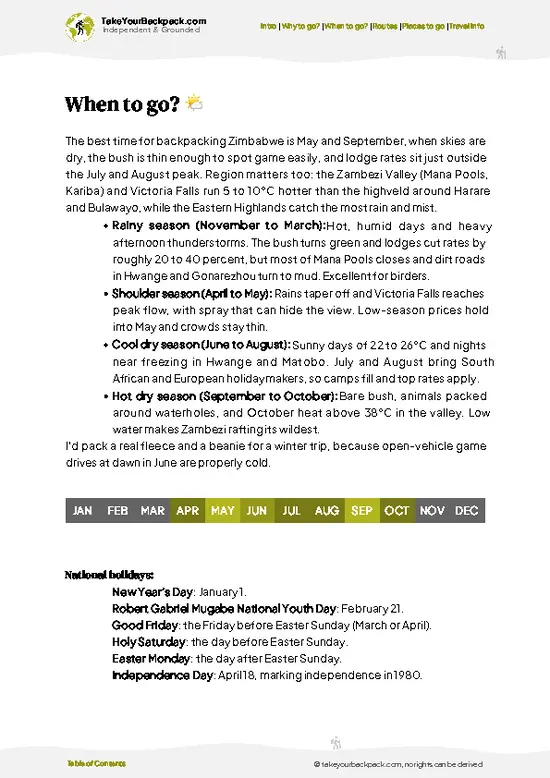
May to August is the most comfortable window for Chipinge, with sunny, dry days and a crisp edge to the air at this altitude of roughly 1,100 meters.
  • Cool Dry Season (May to August): Days reach 20 to 25°C (68 to 77°F) and nights fall to 5 to 10°C (41 to 50°F), with frost possible in the highlands. Daylight runs about 10.5 to 11 hours. Roads are in their best shape and prices stay steady.
  • Hot Late Dry Season (September to November): Temperatures climb to 28 to 33°C (82 to 91°F). Mornings are clear and the first storms build in November. Hiking is best at dawn.
  • Rainy Season (December to March): Expect 22 to 28°C (72 to 82°F), afternoon downpours and mist over the mountains. Everything turns lush, but dirt roads get slick and some routes slow down. Daylight stretches to about 13.5 hours.
  • Shoulder
… read more 👉
May to August is the most comfortable window for Chipinge, with sunny, dry days and a crisp edge to the air at this altitude of roughly 1,100 meters.
  • Cool Dry Season (May to August): Days reach 20 to 25°C (68 to 77°F) and nights fall to 5 to 10°C (41 to 50°F), with frost possible in the highlands. Daylight runs about 10.5 to 11 hours. Roads are in their best shape and prices stay steady.
  • Hot Late Dry Season (September to November): Temperatures climb to 28 to 33°C (82 to 91°F). Mornings are clear and the first storms build in November. Hiking is best at dawn.
  • Rainy Season (December to March): Expect 22 to 28°C (72 to 82°F), afternoon downpours and mist over the mountains. Everything turns lush, but dirt roads get slick and some routes slow down. Daylight stretches to about 13.5 hours.
  • Shoulder Weeks (April): Rain tapers off, hills stay green and the air is clear.
Book mountain activities for April to June, when views are sharp and the ground has dried.


source: climatestotravel.comJANJanuary: fair for travelingFEBFebruary: fair for travelingMARMarch: fair for travelingAPRApril: good for travelingMAYMay: highly recommended for travelingJUNJune: excellent for travelingJULJuly: excellent for travelingAUGAugust: excellent for travelingSEPSeptember: highly recommended for travelingOCTOctober: highly recommended for travelingNOVNovember: fair for travelingDECDecember: fair for traveling
when-to-go

✈️ The backpacker research shortcutZimbabwe Travel Guide

An offline-friendly backpacking guide with optimized travel routes, ranked highlights, transport advice, and the best areas to stay.
example page 0 from our offline Travel Guide for Zimbabwe
example page 1 from our offline Travel Guide for Zimbabwe
example page 2 from our offline Travel Guide for Zimbabwe
example page 3 from our offline Travel Guide for Zimbabwe
example page 4 from our offline Travel Guide for Zimbabwe
example page 5 from our offline Travel Guide for Zimbabwe
example page 6 from our offline Travel Guide for Zimbabwe
example page 7 from our offline Travel Guide for Zimbabwe
The digital guide (265 pages) contains:
✅ 67 highlights, ranked by travel appeal
✅ Optimized 5, 10 & 15-day travel routes
✅ Cities, national parks, landmarks, beaches
✅ How to get around
✅ Offline-friendly for travel without Wi-Fi
👉 Click to see all 30+ guide features

📅 Plan smarter in minutes, not weeks
✅ Month by month travel advice
✅ Festivals & national holidays
✅ Budget expectations

🗺️ Go to the right places, skip the overrated ones
✅ Honest pros & cons of destinations
✅ Top hikes, parks & viewpoints
✅ Lesser-known places most travelers miss
✅ Clear “worth it vs skip it” guidance

🛏️ Travel smoothly without rookie mistakes
✅ Best areas to stay
✅ Transport systems explained simply
✅ Common scams & safety advice
✅ SIM cards, money & practical tips

🌍 Understand the country, not just visit it
✅ Culture & traditions
✅ 52 Essential phrases & customs
✅ Festivals worth planning around
✅ Traveler-friendly historical context
✅ Insights that make places more meaningful

📱 Built for real travel conditions
✅ Fully downloadable PDF
✅ Works completely offline
✅ Optimized for phone use
✅ Useful in remote areas & buses
✅ Everything in one place
Stop searching, start planning
Get instant access to your full guide. 30‑day money-back guarantee.
+ Add another guide for just

By proceeding you agree to our terms.
Sent to your inbox immediately after payment • 100% Secure Checkout
Best Backpacking Travel Advisor 2025 tourism awardBest Backpacking
Travel Advisor
2025
What others say about Take Your Backpack Guides:
⭐⭐⭐⭐⭐
Fantastic, amazing amount of information!
⭐⭐⭐⭐⭐
My goodness this is amazing, it's what I've been looking for hats off too you!
⭐⭐⭐⭐⭐
I think this is absolutely BRILLIANT
⭐⭐⭐⭐
Very complete and informative. It's still missing places, but I gotta to commend you
⭐⭐⭐⭐⭐
This is truly amazing, thank you, can't wait to explore it with my kids!
⭐⭐⭐⭐⭐
Awesome resource, thank you!
⭐⭐⭐⭐⭐
This is amazing! Can't wait to explore the ones I haven't seen
⭐⭐⭐⭐
I love this! Well done, great idea.
⭐⭐⭐⭐⭐
Thanks for taking the time to make this gem!
⭐⭐⭐⭐⭐
This might be the best website I've ever seen.
⭐⭐⭐⭐⭐
Congratulations, and thank you so much for your work; it's incredibly valuable.
⭐⭐⭐⭐
In all seriousness I think you did a great job pointing out the important spots
⭐⭐⭐⭐⭐
10/10 very good
⭐⭐⭐⭐⭐
As someone who's only just starting to visit regularly this is awesome, thank you.
⭐⭐⭐⭐
Thank you very much! I'm going to visit my dad, it's going to be very useful!
⭐⭐⭐⭐⭐
This is really cool! We'll be travelling for the first time and this definitely come in handy.
⭐⭐⭐⭐⭐
You are now our minister of culture, congratulations 👨‍💼
⭐⭐⭐⭐⭐
Just wanted to tell you that this is a pearl! Going to follow your recommendations.
⭐⭐⭐⭐⭐
This is so cool. I'll definitely be using the resource for my travels soon.
⭐⭐⭐⭐⭐
This is very impressive! Good work.
⭐⭐⭐⭐⭐
This is an amazing and informative site. Very well done!

🛏️ Where to stay?Where staying makes the most sense

The center of Chipinge is the best base for a budget stay, because everything you need sits within a short walk and the rank for onward transport is only a few minutes away. Budget beds are limited in this small farming town, with a handful of guesthouses and lodges rather than dedicated hostels, so you will usually book a simple private room and share the savings only if you travel with a partner. Reserve ahead by phone or message in the busy farming and holiday periods, since rooms can fill when visiting businesspeople and tour groups arrive.

Staying in the center makes evenings easy. Street … read more 👉
The center of Chipinge is the best base for a budget stay, because everything you need sits within a short walk and the rank for onward transport is only a few minutes away. Budget beds are limited in this small farming town, with a handful of guesthouses and lodges rather than dedicated hostels, so you will usually book a simple private room and share the savings only if you travel with a partner. Reserve ahead by phone or message in the busy farming and holiday periods, since rooms can fill when visiting businesspeople and tour groups arrive.

Staying in the center makes evenings easy. Street lighting is better than on the outskirts, shops and eateries stay open later, and you can walk to dinner instead of arranging a ride. Noise comes mostly from the rank and weekend bars, so ask for a room away from the main road if you sleep lightly.

The quieter residential edges, a short taxi ride out, suit travelers who prefer peace and mountain air to convenience. Rooms there tend to feel calmer and often include garden space or a view. The trade-off is that you depend on taxis after dark and on a host for food. Choose the center if you want independence, and the outskirts if you want quiet and have transport sorted.

🚌 Getting aroundTransportation options and practical tips

Waiting in town for a minibus to the next district at midday is the habit that eats the most time, because vehicles in this part of Zimbabwe leave only once they are full and the fullest ones depart early. Get to the rank by 7 or 8 a.m., ask the conductor (the “hwindi”) which vehicle is nearly packed, and you will be rolling within the hour. Chipinge itself is compact, the roads are mostly tarred, and traffic is light, so a day here rarely needs more than your own feet and an occasional short ride.
  • Walking: The center spans only a few blocks, so you can cover shops, market and ATMs in 15 to 20 minutes. Sidewalks are patchy and hills tire you out by midday, so start early and carry water.
  • Minibuses (kombis): These are the backbone of local travel, costing roughly US$1 to 3 for in-district runs
… read more 👉
Waiting in town for a minibus to the next district at midday is the habit that eats the most time, because vehicles in this part of Zimbabwe leave only once they are full and the fullest ones depart early. Get to the rank by 7 or 8 a.m., ask the conductor (the “hwindi”) which vehicle is nearly packed, and you will be rolling within the hour. Chipinge itself is compact, the roads are mostly tarred, and traffic is light, so a day here rarely needs more than your own feet and an occasional short ride.
  • Walking: The center spans only a few blocks, so you can cover shops, market and ATMs in 15 to 20 minutes. Sidewalks are patchy and hills tire you out by midday, so start early and carry water.
  • Minibuses (kombis): These are the backbone of local travel, costing roughly US$1 to 3 for in-district runs and US$5 to 10 for longer hauls toward Mutare or Masvingo. Departure depends on filling every seat, which is why early arrival matters. Carry small dollar bills because change is hard to find. Services thin out by late afternoon, and you should not count on anything after about 5 or 6 p.m.
  • Shared Taxis: Short hops around town and to the suburbs run about US$1 to 3 per person. Drivers often take several passengers on the same route, so you can pay less than the quoted solo fare by asking if others are going your way. Agree on the price before you climb in.
  • Long-Distance Coaches: Larger buses connect the town with Mutare and Harare, and the Mutare leg takes about 2.5 to 3 hours for roughly US$6 to 10. Harare takes 7 to 8 hours. Book a day ahead if you can and board before mid-morning.
  • Hitchhiking and Lift Sharing: Locals regularly flag down pickup trucks and farm vehicles, offering a small contribution toward fuel, often US$2 to 5. Go only in daylight, ride with several people aboard and check the driver’s plan before committing.

👛 Costs (as of 22 October 2026)What things cost and how to budget

Chipinge costs a backpacker about US$31 to 58 a day, and the final figure depends mostly on whether you pick a private guesthouse room or share one.
CategoryBudget RangeLocal Reality
Dorm accommodationUS$15 to 25Few true dorms exist, so you will often pay for a basic guesthouse room, with lower rates in the off-season.
MealsUS$8 to 14Sadza with relish at a local eatery runs US$2 to 4, and a sit-down meal runs US$5 to 8.
Local transportUS$2 to 5Minibus and shared taxi hops cost US$1 to 3 each, and cash in small bills is preferred.
Basic activities/entry feesUS$3 to 8Forest or park entry costs a few dollars, and most walking is free.
Miscellaneous expensesUS$3 to 6Water, data, snacks and the odd cold beer at US$1 to 2.
Total Daily BudgetUS$31 to 58About US$45 a day
Buy fruit and vegetables at the main … read more 👉
Chipinge costs a backpacker about US$31 to 58 a day, and the final figure depends mostly on whether you pick a private guesthouse room or share one.
CategoryBudget RangeLocal Reality
Dorm accommodationUS$15 to 25Few true dorms exist, so you will often pay for a basic guesthouse room, with lower rates in the off-season.
MealsUS$8 to 14Sadza with relish at a local eatery runs US$2 to 4, and a sit-down meal runs US$5 to 8.
Local transportUS$2 to 5Minibus and shared taxi hops cost US$1 to 3 each, and cash in small bills is preferred.
Basic activities/entry feesUS$3 to 8Forest or park entry costs a few dollars, and most walking is free.
Miscellaneous expensesUS$3 to 6Water, data, snacks and the odd cold beer at US$1 to 2.
Total Daily BudgetUS$31 to 58About US$45 a day
Buy fruit and vegetables at the main market rather than in shops, since local produce such as bananas and avocados is far cheaper and fresher there.
⚠️ Prices can change and everyone travels differently, so take this as a rough guide. Hope it helps you plan your adventure!

🚌 Day tripsBest day trips from Chipinge

Chipinge works well as a base for day trips into the eastern highlands, though public transport is thin and an early start is the difference between a full day and a stranded one.
Chirinda Forest:
This patch of ancient forest near Mount Selinda holds some of the tallest trees in Zimbabwe, including a giant red mahogany, and the cool, dripping air feels nothing like the farmland around it. The trip takes about 45 minutes to an hour each way by shared taxi or minibus toward Mount Selinda, and costs US$3 to 8 including a small entrance fee. Go between May and October when trails are drier, and do not wait until afternoon for the ride back.

Mount Selinda:
A scenic mission and farming settlement that gives you a taste of the highlands without hard hiking, with old buildings and views across the … read more 👉
Chipinge works well as a base for day trips into the eastern highlands, though public transport is thin and an early start is the difference between a full day and a stranded one.
Chirinda Forest:
This patch of ancient forest near Mount Selinda holds some of the tallest trees in Zimbabwe, including a giant red mahogany, and the cool, dripping air feels nothing like the farmland around it. The trip takes about 45 minutes to an hour each way by shared taxi or minibus toward Mount Selinda, and costs US$3 to 8 including a small entrance fee. Go between May and October when trails are drier, and do not wait until afternoon for the ride back.

Mount Selinda:
A scenic mission and farming settlement that gives you a taste of the highlands without hard hiking, with old buildings and views across the valley. Count on 45 to 60 minutes each way by minibus and US$3 to 6 return. First-timers often leave too late and catch the last vehicle with no margin. Aim to be back at the road by mid-afternoon.

Chimanimani Mountains:
Jagged quartzite peaks and clear streams make this a top hiking area, and the lower trails fit into a long day if you start early. Allow roughly 1.5 to 2.5 hours each way by road and budget US$10 to 20 for transport and park fees. The dry months from May to October are safest, and the common error is underestimating how slowly rides connect on the return.

Vumba Mountains:
Mist-draped forest, gardens and viewpoints make this a refreshing contrast to Chipinge’s farm country. Public coaches via Mutare make it a long day, about 3 hours each way, so only attempt it if you leave very early. Expect US$10 to 18 return.

🛡️ SafetyTraveler Safety Guide

Chipinge is a small, generally calm farming town, and most problems are petty ones that sensible habits prevent. Pickpocketing and phone snatching can occur around the rank and the market in the crowds, so keep your valuables in a front pocket or zipped daypack and avoid pulling out expensive gear while you wait for a minibus. After dark, street lighting thins out away from the center, so take a short taxi rather than walking unlit roads, especially if you are traveling alone. Solo travelers, including women, generally find locals friendly and helpful, though dressing modestly and staying confident keeps unwanted attention low. Overcharging of newcomers happens with some drivers and vendors, so confirm fares before you set off and carry small bills. Police roadblocks on main roads are routine, … read more 👉
Chipinge is a small, generally calm farming town, and most problems are petty ones that sensible habits prevent. Pickpocketing and phone snatching can occur around the rank and the market in the crowds, so keep your valuables in a front pocket or zipped daypack and avoid pulling out expensive gear while you wait for a minibus. After dark, street lighting thins out away from the center, so take a short taxi rather than walking unlit roads, especially if you are traveling alone. Solo travelers, including women, generally find locals friendly and helpful, though dressing modestly and staying confident keeps unwanted attention low. Overcharging of newcomers happens with some drivers and vendors, so confirm fares before you set off and carry small bills. Police roadblocks on main roads are routine, so keep your passport copy handy, stay polite and expect to be waved through. Avoid photographing officials or government buildings.

FAQCommon questions from travelers

Chipinge is worth a visit if you like mountain scenery, forest and farm country rather than big sights, and it works best as a base for the eastern highlands. Chirinda Forest and Mount Selinda sit under an hour away, and the Chimanimani Mountains are about 1.5 to 2.5 hours by road. Treat it as a stopover only if your plan is to reach Mutare or Masvingo quickly.
Two to three days suit Chipinge well. One day covers the town, market and a walk in the hills, and a second day can go to Chirinda Forest or Mount Selinda for about US$3 to 8 in transport. Add a third day if you want a long hike toward Chimanimani.
Chipinge can be a day trip from Mutare, but it is a long one. The ride takes about 2.5 to 3 hours each way and costs roughly US$6 to 10 by coach or minibus, which leaves little time on the ground. Overnighting in Chipinge makes the journey far more worthwhile.
⚠️ Things can change over time, so always validate details locally before you go.

Other Zimbabwean towns near Chipinge

Explore more nearby:

  • Chivhu—Highway tomato stalls, Enkeldoorn streets, stretch-your-legs stop| 223 km away
  • Mutoko—Granite kopjes, San-era paintings, dry-stone hilltop ruins| 313 km away
  • Shamva—Gold belt, mine compound, kopje lookouts, tobacco farm roads| 339 km away

💡 Not sure where to go next?
Create a personalized itinerary for Zimbabwe including Chipinge and the places that fit your trip.

Generate my itinerary

👉 Discover all towns

Or checkout all Zimbabwe has to offer (think cities, towns, villages, national parks, hikes, beaches, festivals)
Country photo of Zimbabwe

We 💚 feedbackFinal thoughts on visiting Chipinge

Chipinge makes sense as a one or two night pause between Mutare and the Chimanimani mountains, with Chirinda Forest or Haroni-Rusitu as a side loop on the way. Alone it won’t fill a long stay. I would arrive with cash, buy supplies here, and be at the minibus rank early, since onward rides leave when full and rarely run late in the day.

✈️ When did I visit Zimbabwe?
I have backpacked Zimbabwe all the way back in 2001.

✍️ Help improve this page!
The information on this page is based on my own backpacking experience in Zimbabwe, supplemented with up-to-date research and feedback from other travelers. Travel details can change, so if you notice anything outdated or incomplete, feel free to let me know.


🙋‍♂️ Give feedback

👋 Meet the founderWho’s Behind Take Your Backpack?

Johan, backpacker and founder of TakeYourBackpackHi, I’m Johan (Netherlands 🇳🇱), the creator of TakeYourBackpack. Over the past 3 decades, I’ve backpacked through 90+ countries across six continents, gaining extensive experience with independent travel, long-term trips, and overland routes.

This site is built on a combination of firsthand travel experience and carefully curated insights from other backpackers. Many guides are based on places I’ve personally visited, while others bring together tips, observations, and practical advice shared by trusted travelers I’ve met along the way.

The goal is to provide realistic, experience-driven guidance — not generic itineraries — so you can explore destinations with better context, clearer expectations, and more confidence.