×

Afghanistan🇦🇫 | best landmarksBest 2 landmarks in Afghanistan

Landmarks in Afghanistan are mostly Islamic-era monuments, Buddhist-era sites and natural wonders, and they sit hundreds of kilometers apart. The central highlands around Bamiyan are the easiest to reach and the quietest, with a few visitors a day and low entry fees. Herat in the west has the finest Timurid-era architecture, a walkable old city and the best guesthouses outside Kabul. Mazar-i-Sharif and Balkh in the north are pilgrimage centers, so you share them with Afghan families instead of tourists. Kabul is the logistical hub, but its monuments are modest and deserve a day at most.

The far Wakhan and the remote Jam valley cost the most in time and money, and I would skip them on a first trip. Independent travel and backpacking are possible, but a visa, local permits and a hired driver are the norm, so pick two or three regions rather than chasing every name.

By Johan Kruseman 🇳🇱 | Updated October 19, 2026
Explore the best national parks in Afghanistan

Why go?Why Travelers Love These Spots

Afghanistan sits on the old Silk Road crossroads between Persia, Central Asia and India, and that is why it holds Buddhist cave monasteries, Timurid mosques and Ghurid towers within one country. Few places layer so many eras in one landscape. Dry mountain air and thin populations also kept some remains standing in the open, with no ticket gates or railings.

The weakness is infrastructure. There are almost no visitor centers, signs, printed guides or site staff who speak English. Decades of war damaged or destroyed a lot, and restoration is partial, so some famous sites are better as empty niches or ruins than as finished monuments. Do not come expecting the polish of Uzbekistan or Iran. Plan around the experience of seeing a site almost alone, which is the real advantage here.

Before choosing … read more 👉
Afghanistan sits on the old Silk Road crossroads between Persia, Central Asia and India, and that is why it holds Buddhist cave monasteries, Timurid mosques and Ghurid towers within one country. Few places layer so many eras in one landscape. Dry mountain air and thin populations also kept some remains standing in the open, with no ticket gates or railings.

The weakness is infrastructure. There are almost no visitor centers, signs, printed guides or site staff who speak English. Decades of war damaged or destroyed a lot, and restoration is partial, so some famous sites are better as empty niches or ruins than as finished monuments. Do not come expecting the polish of Uzbekistan or Iran. Plan around the experience of seeing a site almost alone, which is the real advantage here.

Before choosing Afghanistan for landmarks, understand the conditions of access. The country is governed by the Taliban, most nationalities need a visa obtained in advance, and travel is usually arranged with a local agency or at least a guide who handles checkpoints and permits. Security varies by province and changes quickly, and some regions are effectively closed to foreigners. Women can travel, but rules on dress, movement and local contact are stricter than in neighboring countries, and a female traveler should plan with an experienced agency.

Distance is the other factor. Roads are slow, mountain passes close in winter, and the best sites are rarely near each other. A landmark here costs a full day of travel as often as an hour of looking. For anyone who accepts that, the quiet and the depth of history are hard to match. For anyone short on time, it is not the place for a quick landmark tour.
Why These Made the Cut
The list of best unique sites in Afghanistan is created based on history or culture, wow factor, atmosphere, quirks, and memorability. If you feel a unique site is missing in this list, please let us know.

When to go?When to Plan Your Trip

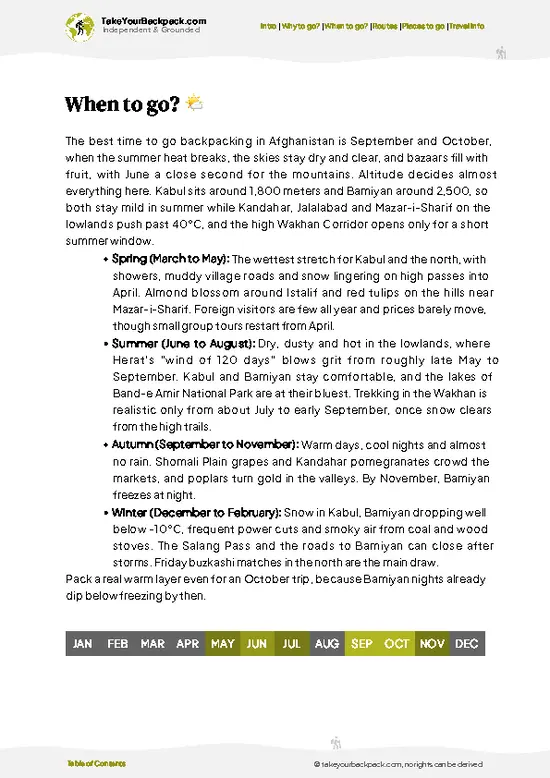
Best months for landmarks: The best months are April to June and September to October, when roads are open, daytime highs run roughly 15 to 30°C in most visited regions and the light is clear for photography. Rain falls mostly from March to May and snow in winter, so spring brings muddy tracks in some valleys but green hillsides, and autumn is the driest and most dependable window.

Summer and winter: July and August are hot in the lowlands. Herat and the northern plains around Mazar-i-Sharif regularly pass 38 to 42°C, which makes midday visits to open-air monuments miserable. Start at dawn and finish by noon. The central highlands near Bamiyan stay cooler, with highs of about 25 to 30°C, so summer is actually their best season. The lakes in that region are at their most accessible then, and … read more 👉
Best months for landmarks: The best months are April to June and September to October, when roads are open, daytime highs run roughly 15 to 30°C in most visited regions and the light is clear for photography. Rain falls mostly from March to May and snow in winter, so spring brings muddy tracks in some valleys but green hillsides, and autumn is the driest and most dependable window.

Summer and winter: July and August are hot in the lowlands. Herat and the northern plains around Mazar-i-Sharif regularly pass 38 to 42°C, which makes midday visits to open-air monuments miserable. Start at dawn and finish by noon. The central highlands near Bamiyan stay cooler, with highs of about 25 to 30°C, so summer is actually their best season. The lakes in that region are at their most accessible then, and high passes toward the Wakhan generally open only from about June to September.

Winter, from December to February, is a poor time for landmarks. Kabul sees lows around -5 to -10°C and snow, and Bamiyan can fall below -20°C. Snow closes the Salang Pass at times and cuts off remote valleys such as the one holding the Minaret of Jam, so a trip then risks getting stuck. Herat is milder but gray and cold, about 0 to 10°C.

Crowds and prices: Afghanistan has no real tourist crowds, so seasons barely change prices. Expect small rises in guide and vehicle rates in summer, when demand from the few tour groups peaks. The one event that changes plans is Nowruz around March 21, when Mazar-i-Sharif fills with local visitors and rooms are scarce. Ramadan moves each year and matters more: restaurants close in daylight, drivers tire, and sites may keep shorter hours. Check the dates before booking.

unique site hoppingSuggested Travel Strategies

How many days to allow: A trip combining several landmarks in Afghanistan needs 10 to 14 days, because every move between regions eats most of a day. Shorter plans work only if limited to one region and a flight.

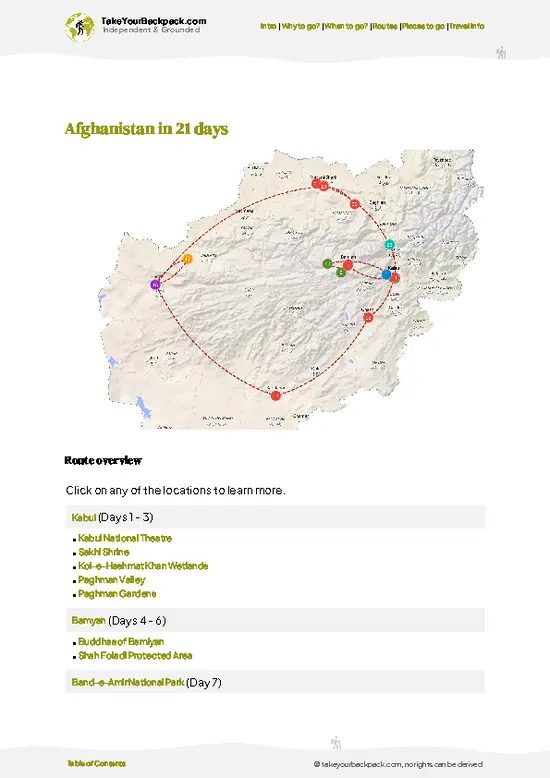
Which regions group together: Kabul is the entry point, and the central highlands are the natural first leg, roughly 4 to 6 hours by road from the capital depending on the pass and conditions. Allow 2 to 3 days there. Next, go north over the Salang route to Mazar-i-Sharif and Balkh, which takes about 8 to 10 hours by road and is the longest stretch worth driving. Allow 1 to 2 days. Finish in the west at Herat, where 2 days covers the old city and surroundings. Fly Mazar or Kabul to Herat (about 1 to 1.5 hours) instead of the 12 to 14 hour road. This sequence runs from east to west … read more 👉
How many days to allow: A trip combining several landmarks in Afghanistan needs 10 to 14 days, because every move between regions eats most of a day. Shorter plans work only if limited to one region and a flight.

Which regions group together: Kabul is the entry point, and the central highlands are the natural first leg, roughly 4 to 6 hours by road from the capital depending on the pass and conditions. Allow 2 to 3 days there. Next, go north over the Salang route to Mazar-i-Sharif and Balkh, which takes about 8 to 10 hours by road and is the longest stretch worth driving. Allow 1 to 2 days. Finish in the west at Herat, where 2 days covers the old city and surroundings. Fly Mazar or Kabul to Herat (about 1 to 1.5 hours) instead of the 12 to 14 hour road. This sequence runs from east to west and ends at the best-equipped city for rest and onward travel to Iran.

Time per stop is simple: half a day suffices for most urban monuments and a full day for sites in the countryside. Kabul needs one day at most.

Planning mistakes to avoid: The first mistake is trusting map distances. Roads that look short take double the time because of checkpoints, potholes and mountain grades. Add a buffer of 25 to 30 percent to every drive. The second is scheduling back-to-back long drives. Alternate a hard travel day with a lighter sightseeing day. The third is adding remote sites such as the Wakhan or Jam valley to a short trip; each needs 3 to 5 extra days and separate permits, so they belong on a second visit. The fourth is booking flights without slack, since domestic services are limited and can be canceled, so leave a spare day before an international departure.

The ListTop landmarks of Afghanistan

1 Herat Citadel

mud-brick ramparts, blue-tiled towers, panoramic city views

Climb ancient walls to trace centuries of conquest and restoration, then watch daily life unfold across Herat from the highest battlements.

afghanistan-unique-site-herat-citadel
© Google |

2 Shahr-e Zohak

red cliffs, ruined fortresses, Bamiyan Valley gateway

Walk among wind-carved ruins perched above a valley, where the remains of watchtowers and walls evoke centuries of Silk Road defense.

afghanistan-unique-site-shahr-e-zohak
© Google |
Loading the map 🌍

Expert viewInsights from Locals and Experts

How many landmarks to visit: I advise four to six landmarks on a first trip, spread across two or three regions. Drives are long, checkpoints add delays, and daylight in winter is short. At that pace, you have time to see each place properly and still absorb a day of local life. Packing in ten sites means most of your trip happens in the back of a car.

Choosing between kinds of landmarks: For history-focused travelers, prioritize Islamic-era architecture and Buddhist-era remains. Both are accessible and rich in detail. For photographers, spring and autumn light in the highlands and the west gives the best results. For nature seekers, the lakes and valleys of the highlands suit summer. For tight budgets, stay in the highlands and Herat, where sites are close to lodging, and skip the remote … read more 👉
How many landmarks to visit: I advise four to six landmarks on a first trip, spread across two or three regions. Drives are long, checkpoints add delays, and daylight in winter is short. At that pace, you have time to see each place properly and still absorb a day of local life. Packing in ten sites means most of your trip happens in the back of a car.

Choosing between kinds of landmarks: For history-focused travelers, prioritize Islamic-era architecture and Buddhist-era remains. Both are accessible and rich in detail. For photographers, spring and autumn light in the highlands and the west gives the best results. For nature seekers, the lakes and valleys of the highlands suit summer. For tight budgets, stay in the highlands and Herat, where sites are close to lodging, and skip the remote ones. Not worth the time for most travelers: Kabul’s secondary monuments and anything needing more than two days of driving each way.

What it costs: Budget US$50 to 90 a day if you share a driver and guide, which is the main expense. A private driver with car typically runs US$60 to 120 a day, and a guide US$30 to 60. Guesthouses cost US$10 to 30 a night outside Kabul and US$30 to 60 in Kabul, and meals run US$3 to 8. Site entry fees for foreigners are usually small, around US$2 to 10 a visit, paid in afghanis (roughly 65 to 75 AFN to US$1). Carry clean US dollars, since cards rarely work and ATMs are unreliable. The costs that catch people out are unplanned detour fees and one-way drivers asking for return fare. Agree a total in writing before departure, and confirm what covers fuel, tolls and the driver’s lodging.

Delays and mistakes that cost time: The biggest delay is permits. Some provinces and sites need a letter from the authorities, and processing takes from a day to a week. Arrange them through your agency before arriving and carry several printed copies, because checkpoints ask repeatedly. A second delay is weather and road closures, so keep one spare day in any itinerary. A third is arriving late. Sites are best seen in morning light, and travel after dark is both unsafe and slow, so be at your destination by mid-afternoon.

Safety and cultural rules: Check the current security situation in every province a few days before moving, and rely on a local guide’s judgment over any fixed plan. Avoid crowds, demonstrations and any area your guide calls unstable. Do not fly drones, which are banned without permission and will get you detained. Ask before photographing people, especially women, and avoid pictures of checkpoints, officials and military sites. Many Afghans object to images of living beings in religious spaces, so ask at mosques and shrines first.

Dress conservatively. Men should wear long trousers and sleeves. Women should cover hair, arms and legs with loose clothing, and should travel with an experienced agency, since restrictions on women’s movement can change. Remove shoes at religious sites, and avoid visiting them during prayer times. Alcohol is illegal. Public displays of affection are unwise.

Carry a printed copy of your visa, passport and travel insurance that explicitly covers Afghanistan, which many policies exclude. Buy it before you leave, since it is difficult to obtain once there. Spend your money and time on a good guide, a reliable driver and a margin of spare days. Those things save a trip, and extra sites do not.

✈️ The backpacker research shortcutAfghanistan Travel Guide

An offline-friendly backpacking guide with optimized travel routes, ranked highlights, transport advice, and the best areas to stay.
example page 0 from our offline Travel Guide for Afghanistan
example page 1 from our offline Travel Guide for Afghanistan
example page 2 from our offline Travel Guide for Afghanistan
example page 3 from our offline Travel Guide for Afghanistan
example page 4 from our offline Travel Guide for Afghanistan
example page 5 from our offline Travel Guide for Afghanistan
example page 6 from our offline Travel Guide for Afghanistan
example page 7 from our offline Travel Guide for Afghanistan
The digital guide (204 pages) contains:
✅ 46 highlights, ranked by travel appeal
✅ Optimized 7, 14 & 21-day travel routes
✅ Cities, national parks, landmarks, beaches
✅ How to get around
✅ Offline-friendly for travel without Wi-Fi
👉 Click to see all 30+ guide features

📅 Plan smarter in minutes, not weeks
✅ Month by month travel advice
✅ Festivals & national holidays
✅ Budget expectations

🗺️ Go to the right places, skip the overrated ones
✅ Honest pros & cons of destinations
✅ Top hikes, parks & viewpoints
✅ Lesser-known places most travelers miss
✅ Clear “worth it vs skip it” guidance

🛏️ Travel smoothly without rookie mistakes
✅ Best areas to stay
✅ Transport systems explained simply
✅ Common scams & safety advice
✅ SIM cards, money & practical tips

🌍 Understand the country, not just visit it
✅ Culture & traditions
✅ 52 Essential phrases & customs
✅ Festivals worth planning around
✅ Traveler-friendly historical context
✅ Insights that make places more meaningful

📱 Built for real travel conditions
✅ Fully downloadable PDF
✅ Works completely offline
✅ Optimized for phone use
✅ Useful in remote areas & buses
✅ Everything in one place
Stop searching, start planning
Get instant access to your full guide. 30‑day money-back guarantee.
+ Add another guide for just

By proceeding you agree to our terms.
Sent to your inbox immediately after payment • 100% Secure Checkout
Best Backpacking Travel Advisor 2025 tourism awardBest Backpacking
Travel Advisor
2025
What others say about Take Your Backpack Guides:
⭐⭐⭐⭐⭐
Fantastic, amazing amount of information!
⭐⭐⭐⭐⭐
My goodness this is amazing, it's what I've been looking for hats off too you!
⭐⭐⭐⭐⭐
I think this is absolutely BRILLIANT
⭐⭐⭐⭐
Very complete and informative. It's still missing places, but I gotta to commend you
⭐⭐⭐⭐⭐
This is truly amazing, thank you, can't wait to explore it with my kids!
⭐⭐⭐⭐⭐
Awesome resource, thank you!
⭐⭐⭐⭐⭐
This is amazing! Can't wait to explore the ones I haven't seen
⭐⭐⭐⭐
I love this! Well done, great idea.
⭐⭐⭐⭐⭐
Thanks for taking the time to make this gem!
⭐⭐⭐⭐⭐
This might be the best website I've ever seen.
⭐⭐⭐⭐⭐
Congratulations, and thank you so much for your work; it's incredibly valuable.
⭐⭐⭐⭐
In all seriousness I think you did a great job pointing out the important spots
⭐⭐⭐⭐⭐
10/10 very good
⭐⭐⭐⭐⭐
As someone who's only just starting to visit regularly this is awesome, thank you.
⭐⭐⭐⭐
Thank you very much! I'm going to visit my dad, it's going to be very useful!
⭐⭐⭐⭐⭐
This is really cool! We'll be travelling for the first time and this definitely come in handy.
⭐⭐⭐⭐⭐
You are now our minister of culture, congratulations 👨‍💼
⭐⭐⭐⭐⭐
Just wanted to tell you that this is a pearl! Going to follow your recommendations.
⭐⭐⭐⭐⭐
This is so cool. I'll definitely be using the resource for my travels soon.
⭐⭐⭐⭐⭐
This is very impressive! Good work.
⭐⭐⭐⭐⭐
This is an amazing and informative site. Very well done!

🛏️ Where to stay?Accommodation Highlights

Backpacker hostels with dorms barely exist in Afghanistan, so budget travelers stay in small guesthouses and local hotels, with simple private rooms typically running 1,000 to 2,800 AFN (about US$15 to 40) a night. In Kabul, Shahr-e Naw has the densest cluster of cheap hotels, restaurants and money changers within walking distance, though traffic noise and crowds are constant. Leafier Wazir Akbar Khan is quieter but pricier and farther from the markets. In Herat, rooms near the Old City and the Friday Mosque put the citadel and bazaars on foot. In Mazar-i-Sharif, hotels around the Blue Mosque are the most convenient choice, while the outer districts are calmer but need a taxi everywhere. Nightlife … read more 👉
Backpacker hostels with dorms barely exist in Afghanistan, so budget travelers stay in small guesthouses and local hotels, with simple private rooms typically running 1,000 to 2,800 AFN (about US$15 to 40) a night. In Kabul, Shahr-e Naw has the densest cluster of cheap hotels, restaurants and money changers within walking distance, though traffic noise and crowds are constant. Leafier Wazir Akbar Khan is quieter but pricier and farther from the markets. In Herat, rooms near the Old City and the Friday Mosque put the citadel and bazaars on foot. In Mazar-i-Sharif, hotels around the Blue Mosque are the most convenient choice, while the outer districts are calmer but need a taxi everywhere. Nightlife does not exist anywhere in the country, so choose by access to sights and food.

If you enjoy meeting fellow travelers, consider choosing hostels with high ratings for atmosphere. On the other hand, if you prefer having your own space, a hotel might be a better option.

AfghanistanSee More of Afghanistan

👋 Meet the founderWho’s Behind Take Your Backpack?

Johan, backpacker and founder of TakeYourBackpackHi, I’m Johan (Netherlands 🇳🇱), the creator of TakeYourBackpack. Over the past 3 decades, I’ve backpacked through 90+ countries across six continents, gaining extensive experience with independent travel, long-term trips, and overland routes.

This site is built on a combination of firsthand travel experience and carefully curated insights from other backpackers. Many guides are based on places I’ve personally visited, while others bring together tips, observations, and practical advice shared by trusted travelers I’ve met along the way.

The goal is to provide realistic, experience-driven guidance — not generic itineraries — so you can explore destinations with better context, clearer expectations, and more confidence.