×

Algeria🇩🇿 | best beachesWhere to Find the 3 Best beaches in Algeria

Beaches in Algeria are working Mediterranean coastline, not resort strips: 1,200 kilometers of rock, pine and pale sand, with the smell of grilled sardines, diesel and wild fennel drifting across the parking lots. The east, around Annaba, Skikda and Jijel, has green cliffs and cork-oak hills dropping into coves, and it is the most scenic. The center, near Algiers and Tipaza, gives easy access by suburban train and shared taxi, but the sand fills with families by 10 a.m. in summer. The west, around Oran and Mostaganem, runs wide and breezy, with more beach-club energy. Costs stay low (a plastic chair and umbrella run roughly 500 to 1,500 DZD), though you will rarely find hostels at the water. For independent travel, expect to improvise, pay cash and share the shore with locals who are curious and quick to offer tea.

By Johan Kruseman 🇳🇱 | Updated October 23, 2026
Explore the best attractions in Algeria

Why go?What Makes Them Special

Algeria is the largest country in Africa, and its Mediterranean face is a thin, steep strip pressed between the sea and the Tell Atlas mountains. That geography explains the beaches: small coves under cliffs, long pine-backed bays and rocky headlands rather than endless dunes. The water is clear and often a deep green-blue, cool in early June and warm and salty by August. Because the mountains run so close to the shore, the coast road bends constantly, and a short distance on the map can take hours.

The country never built a mass beach-tourism industry. After independence the state focused on housing and industry, and a long period of insecurity in the 1990s kept foreign visitors away. The result is almost no international resort infrastructure: few foreign-run hotels at the sea, little English … read more 👉
Algeria is the largest country in Africa, and its Mediterranean face is a thin, steep strip pressed between the sea and the Tell Atlas mountains. That geography explains the beaches: small coves under cliffs, long pine-backed bays and rocky headlands rather than endless dunes. The water is clear and often a deep green-blue, cool in early June and warm and salty by August. Because the mountains run so close to the shore, the coast road bends constantly, and a short distance on the map can take hours.

The country never built a mass beach-tourism industry. After independence the state focused on housing and industry, and a long period of insecurity in the 1990s kept foreign visitors away. The result is almost no international resort infrastructure: few foreign-run hotels at the sea, little English signage and limited card payment. What you get instead is a beach culture that belongs to Algerians. Families arrive with coolers, rugs and loud speakers, and from July to August the best-known sands are packed. Many local people go to the beach in the evening as well, and the cafés along the corniche stay busy until late.

There is also a seasonal system of beach access. Some of the most popular bays have parking attendants who charge in summer, and a number of beaches are officially declared open for bathing only for the season, with lifeguards present from roughly June to September. Elsewhere the shore is unsupervised.

Before choosing Algeria, a traveler should know that the visa is required for most nationalities and takes planning, that beach dress is more modest than in Spain or Greece, and that women traveling alone often prefer family-oriented or less crowded stretches. In return you get cheap seafood, warm hospitality and coastline that remains largely uncommercialized.
Evaluating the Top Choices
The list of best beaches in Algeria is created based on beauty, vibe, water quality, activities, and surrounding scenery. If you feel a beach is missing in this list, please let us know.

When to go?When to Plan Your Trip

Best months: The best months for Algeria’s beaches are June and September, when the sea reaches roughly 22 to 26°C, air temperatures sit around 28 to 32°C, and the coast is far less packed than in midsummer. In those weeks the light is clear and gold by late afternoon, the pine resin smell is strong in the heat, and a plastic chair on the sand costs less than in peak weeks.
Peak season: July and August are the hottest and busiest months. Coastal temperatures climb to 30 to 35°C and the humidity makes midday sun heavy, especially around Algiers, Annaba and Oran. Domestic holidaymakers, plus emigrants returning from France for the summer, fill beaches, roads and rented apartments. Expect parking queues, loud music and accommodation prices that can rise by 30 to 100 percent compared with shoulder … read more 👉
Best months: The best months for Algeria’s beaches are June and September, when the sea reaches roughly 22 to 26°C, air temperatures sit around 28 to 32°C, and the coast is far less packed than in midsummer. In those weeks the light is clear and gold by late afternoon, the pine resin smell is strong in the heat, and a plastic chair on the sand costs less than in peak weeks.
Peak season: July and August are the hottest and busiest months. Coastal temperatures climb to 30 to 35°C and the humidity makes midday sun heavy, especially around Algiers, Annaba and Oran. Domestic holidaymakers, plus emigrants returning from France for the summer, fill beaches, roads and rented apartments. Expect parking queues, loud music and accommodation prices that can rise by 30 to 100 percent compared with shoulder months. A sirocco wind from the Sahara occasionally pushes temperatures above 40°C for a day or two, and the sea turns warm and slightly hazy. Book rooms near the coast well ahead if you must travel then.
Shoulder seasons: May and October are usable but cooler. The sea is around 17 to 21°C, air temperatures range from 22 to 27°C, and the beaches are quiet. Some seasonal cafés, kiosks and lifeguard posts open only from about June, so services can be thin. Water in May still feels sharp on the skin, though the green hills behind the eastern coast are at their lushest.
Winter and regional differences: From November to March the coast is wet and cool. Rainfall is heaviest in the east, around Jijel, Skikda and Annaba, where annual totals can reach 700 to 1,000 mm, while Oran and the west are noticeably drier. Swimming is unrealistic, with sea temperatures near 14 to 16°C and rough surf, but empty sand and stormy skies suit walkers. The south has its own Saharan seasons and is not part of the Mediterranean beach calendar.

beach hoppingPlanning Your Route Efficiently

How many days: A trip combining several beaches in Algeria needs 10 to 14 days, because distances are long, roads are slow and each region deserves a proper stop. The coast splits naturally into three clusters: the east (Annaba, Skikda, Jijel), the center (Algiers, Tipaza, Béjaïa side) and the west (Oran, Mostaganem, Tlemcen side). Moving from east to west or the reverse keeps you on one line and avoids backtracking.
Direction and transport: Starting in Algiers works best, since the international airport has the widest flight choice. From there, head either east or west, and fly or take the train home from the far end. Trains connect Algiers with Oran (about 4 to 5 hours) and Algiers with Constantine and Annaba on the eastern side by longer routes. Intercity buses and shared taxis fill the … read more 👉
How many days: A trip combining several beaches in Algeria needs 10 to 14 days, because distances are long, roads are slow and each region deserves a proper stop. The coast splits naturally into three clusters: the east (Annaba, Skikda, Jijel), the center (Algiers, Tipaza, Béjaïa side) and the west (Oran, Mostaganem, Tlemcen side). Moving from east to west or the reverse keeps you on one line and avoids backtracking.
Direction and transport: Starting in Algiers works best, since the international airport has the widest flight choice. From there, head either east or west, and fly or take the train home from the far end. Trains connect Algiers with Oran (about 4 to 5 hours) and Algiers with Constantine and Annaba on the eastern side by longer routes. Intercity buses and shared taxis fill the gaps and are cheap, though they leave when full and slow down in summer traffic. Between regions, budget 4 to 8 hours on the road, and more on mountain stretches where the coast road twists through pine, fig and olive slopes with dust and horn noise at every bend.
Time per stop: Give each cluster 3 to 5 days, with at least 2 nights in a base town and one or two beach days on either side of it. That leaves time for the drive, a slow lunch of grilled fish and a swim when the afternoon light softens.
Common planning mistakes: Travelers often try to cover the whole coast in a week and spend most of it in seats. Pick two regions and do them properly. Another mistake is arriving in July or August without bookings, then paying inflated prices for poor rooms. Reserve ahead and travel between regions in the morning, when roads are quieter and the sun is not yet punishing. Finally, do not count on night transport: many intercity services stop by late afternoon, so plan arrivals while there is daylight and cash in your pocket, since cards are rarely accepted.

The ListMust-Visit beaches in Algeria

1 Plage de Tipaza

Roman ruins, rock-shelf snorkeling, port grills, Chenoua slopes

Combine a morning among Roman streets and basilicas with charcoal-grilled fish at the port and an afternoon swim off the rocks.

algeria-beach-plage-de-tipaza
© Google |

2 Plage de Sidi Fredj

1830 landing point, pale sand, marina promenade, pine coves

Walk the historic peninsula and its small white shrine, swim from fine pale sand, then stroll the marina as the evening cools.

3 Plage Clovis

Calm morning swims, low cliffs, family picnics, pickup football

Swim in calm morning water, then spread a mat among local families and watch the afternoon football games as the cliffs turn gold.

algeria-beach-plage-clovis
© Google |
Loading the map 🌍

Expert viewWhat You Should Know

How many beaches: I advise visiting 4 to 6 beaches in a single trip, spread across two regions. Algeria’s roads are slow, and each day at the sea deserves a proper morning and evening, not a dash between car parks. More than six turns the trip into logistics. Fewer than four leaves you without comparison between the rugged east and the wider, breezier west. You get time to learn how locals use the shore: late arrivals, long lunches, a swim at dusk with the call to prayer carrying over the water.
Which kind for which traveler: Independent travelers who want quiet should prioritize small cliff-backed coves, where you hear cicadas, wind in the pines and not much else. The payoff is clear water and almost no crowds in shoulder months, though facilities may be missing, so carry water and food. Travelers … read more 👉
How many beaches: I advise visiting 4 to 6 beaches in a single trip, spread across two regions. Algeria’s roads are slow, and each day at the sea deserves a proper morning and evening, not a dash between car parks. More than six turns the trip into logistics. Fewer than four leaves you without comparison between the rugged east and the wider, breezier west. You get time to learn how locals use the shore: late arrivals, long lunches, a swim at dusk with the call to prayer carrying over the water.
Which kind for which traveler: Independent travelers who want quiet should prioritize small cliff-backed coves, where you hear cicadas, wind in the pines and not much else. The payoff is clear water and almost no crowds in shoulder months, though facilities may be missing, so carry water and food. Travelers who want company and easy logistics should choose the big family beaches near cities, where cafés, showers and transport are close. You get warm hospitality, grilled sardines and plenty of people-watching. Solo women are generally more comfortable at supervised, family-oriented stretches or in a group, where staring is reduced and help is nearby. Culture-minded travelers can pick beaches near Roman ruins and old fishing towns, which reward a morning of walking before the swim.
What it costs: Budget US$25 to 45 a day (roughly 3,500 to 6,000 DZD) including a simple room, local meals and shared transport. Midrange comfort runs US$50 to 90. Typical beach costs: a chair and umbrella 500 to 1,500 DZD (US$4 to 11), parking 100 to 300 DZD, a shared taxi or local bus to the shore 100 to 500 DZD, and a grilled fish lunch 1,200 to 2,500 DZD. Guides are rarely needed for beaches, though a local boatman to a hidden cove may charge 2,000 to 6,000 DZD. Carry cash, because ATMs can be unreliable and cards are often refused. A meal of fresh seafood at a roadside grill is a better use of money than a hotel buffet.
Safety and culture: Swim only where lifeguards are posted and the flag system is in use, since rip currents and sudden swells occur and many unsupervised beaches have no rescue service. Avoid swimming alone, and avoid beaches with sewage outfalls near large towns: check the water color and smell before you enter. Sun is strong, so bring a hat, reef-safe sunscreen and a liter or two of water.

Dress modestly when walking to and from the beach. Swimwear is normal on the sand, but cover up in town and in cafés. Ask before taking photos of families or women, and keep alcohol out of sight, since public drinking is frowned on. During Ramadan, eating and drinking openly in daylight is discouraged, so many cafés close until sunset. Keep valuables out of parked cars and watch bags on crowded summer sands. Do check current government travel advice before heading to remote areas, and stay on well-used coastal routes.

Accept offers of tea, sit in the shade and swim at dusk. That is the version of Algeria’s coast that stays with you.

✈️ The backpacker research shortcutAlgeria Travel Guide

An offline-friendly backpacking guide with optimized travel routes, ranked highlights, transport advice, and the best areas to stay.
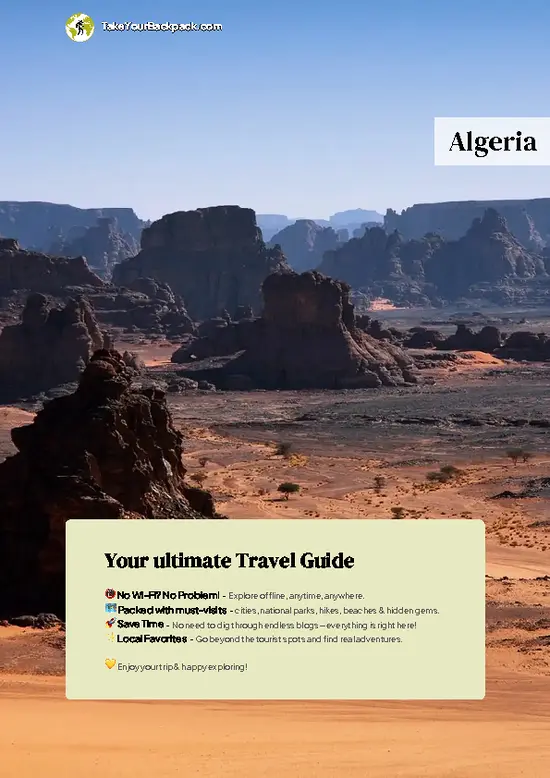
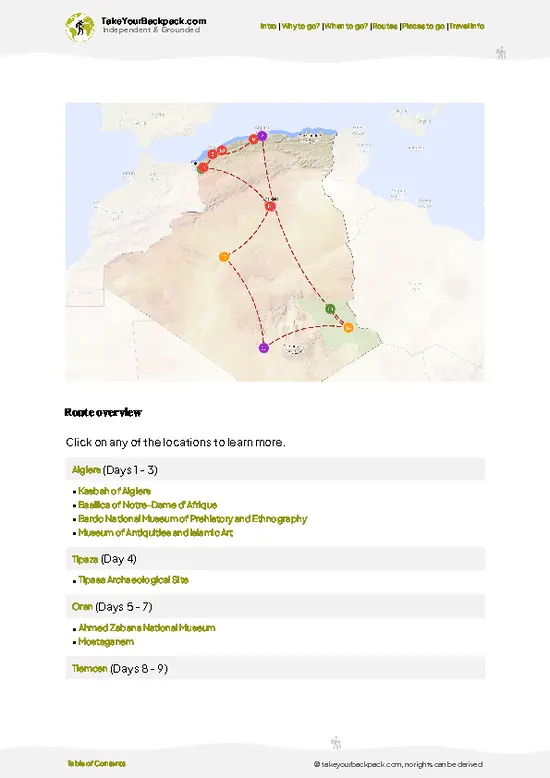
example page 0 from our offline Travel Guide for Algeria
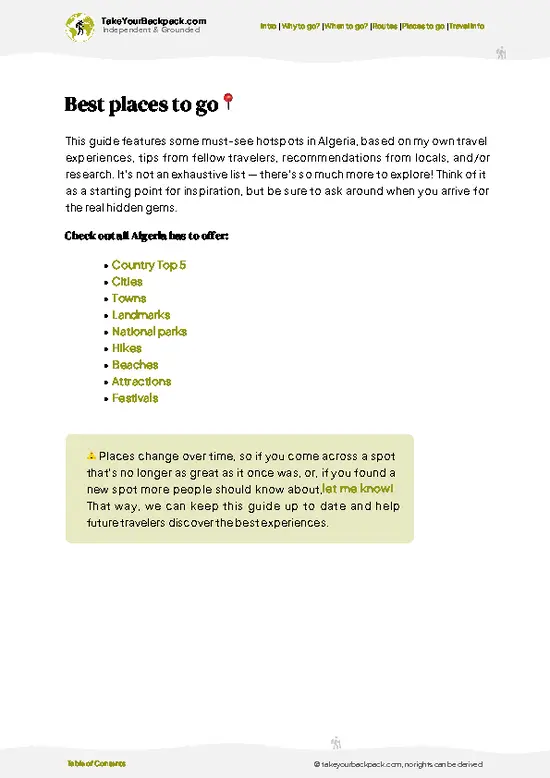
example page 1 from our offline Travel Guide for Algeria
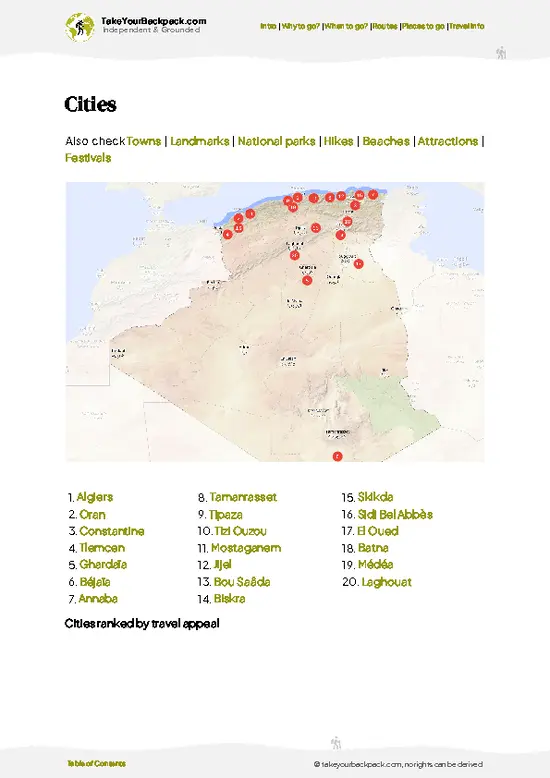
example page 2 from our offline Travel Guide for Algeria
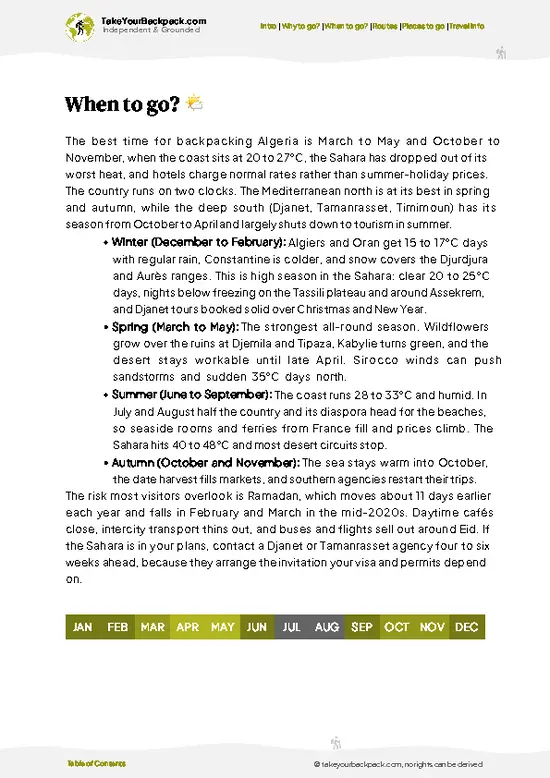
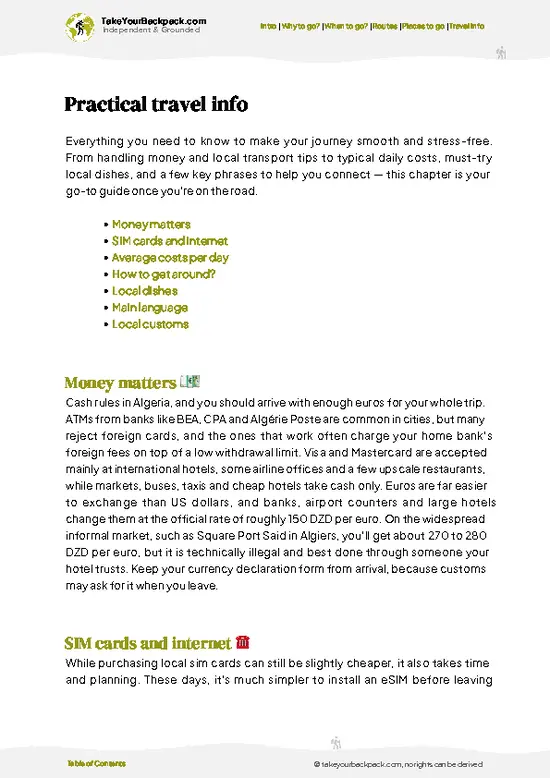
example page 3 from our offline Travel Guide for Algeria
example page 4 from our offline Travel Guide for Algeria
example page 5 from our offline Travel Guide for Algeria
example page 6 from our offline Travel Guide for Algeria
example page 7 from our offline Travel Guide for Algeria
The digital guide (314 pages) contains:
✅ 79 highlights, ranked by travel appeal
✅ Optimized 7, 14 & 21-day travel routes
✅ Cities, national parks, landmarks, beaches
✅ How to get around
✅ Offline-friendly for travel without Wi-Fi
👉 Click to see all 30+ guide features

📅 Plan smarter in minutes, not weeks
✅ Month by month travel advice
✅ Festivals & national holidays
✅ Budget expectations

🗺️ Go to the right places, skip the overrated ones
✅ Honest pros & cons of destinations
✅ Top hikes, parks & viewpoints
✅ Lesser-known places most travelers miss
✅ Clear “worth it vs skip it” guidance

🛏️ Travel smoothly without rookie mistakes
✅ Best areas to stay
✅ Transport systems explained simply
✅ Common scams & safety advice
✅ SIM cards, money & practical tips

🌍 Understand the country, not just visit it
✅ Culture & traditions
✅ 52 Essential phrases & customs
✅ Festivals worth planning around
✅ Traveler-friendly historical context
✅ Insights that make places more meaningful

📱 Built for real travel conditions
✅ Fully downloadable PDF
✅ Works completely offline
✅ Optimized for phone use
✅ Useful in remote areas & buses
✅ Everything in one place
Stop searching, start planning
Get instant access to your full guide. 30‑day money-back guarantee.
+ Add another guide for just

By proceeding you agree to our terms.
Sent to your inbox immediately after payment • 100% Secure Checkout
Best Backpacking Travel Advisor 2025 tourism awardBest Backpacking
Travel Advisor
2025
What others say about Take Your Backpack Guides:
⭐⭐⭐⭐⭐
Fantastic, amazing amount of information!
⭐⭐⭐⭐⭐
My goodness this is amazing, it's what I've been looking for hats off too you!
⭐⭐⭐⭐⭐
I think this is absolutely BRILLIANT
⭐⭐⭐⭐
Very complete and informative. It's still missing places, but I gotta to commend you
⭐⭐⭐⭐⭐
This is truly amazing, thank you, can't wait to explore it with my kids!
⭐⭐⭐⭐⭐
Awesome resource, thank you!
⭐⭐⭐⭐⭐
This is amazing! Can't wait to explore the ones I haven't seen
⭐⭐⭐⭐
I love this! Well done, great idea.
⭐⭐⭐⭐⭐
Thanks for taking the time to make this gem!
⭐⭐⭐⭐⭐
This might be the best website I've ever seen.
⭐⭐⭐⭐⭐
Congratulations, and thank you so much for your work; it's incredibly valuable.
⭐⭐⭐⭐
In all seriousness I think you did a great job pointing out the important spots
⭐⭐⭐⭐⭐
10/10 very good
⭐⭐⭐⭐⭐
As someone who's only just starting to visit regularly this is awesome, thank you.
⭐⭐⭐⭐
Thank you very much! I'm going to visit my dad, it's going to be very useful!
⭐⭐⭐⭐⭐
This is really cool! We'll be travelling for the first time and this definitely come in handy.
⭐⭐⭐⭐⭐
You are now our minister of culture, congratulations 👨‍💼
⭐⭐⭐⭐⭐
Just wanted to tell you that this is a pearl! Going to follow your recommendations.
⭐⭐⭐⭐⭐
This is so cool. I'll definitely be using the resource for my travels soon.
⭐⭐⭐⭐⭐
This is very impressive! Good work.
⭐⭐⭐⭐⭐
This is an amazing and informative site. Very well done!

🛏️ Where to stay?Best Stay Options in Algeria

Backpacker-style hostels are rare in Algeria, so budget travelers mostly stay in state-run youth hostels (auberges de jeunesse), simple family hotels and private rooms or apartments, with doubles typically running about 3,000 to 6,000 DZD (US$22 to 45). In Algiers, the streets around Grande Poste and Didouche Mourad put you within walking distance of the Casbah and the best cafés, though they are noisy and quiet down early at night, while Hydra is calm and safe but pricier and a taxi ride from the sights. In Oran, the city center near Place du 1er Novembre and the Front de Mer gives you the liveliest evenings in the country, and in Constantine the old center near the bridges is the most practical … read more 👉
Backpacker-style hostels are rare in Algeria, so budget travelers mostly stay in state-run youth hostels (auberges de jeunesse), simple family hotels and private rooms or apartments, with doubles typically running about 3,000 to 6,000 DZD (US$22 to 45). In Algiers, the streets around Grande Poste and Didouche Mourad put you within walking distance of the Casbah and the best cafés, though they are noisy and quiet down early at night, while Hydra is calm and safe but pricier and a taxi ride from the sights. In Oran, the city center near Place du 1er Novembre and the Front de Mer gives you the liveliest evenings in the country, and in Constantine the old center near the bridges is the most practical base, just very hilly and short on budget choices.

If you enjoy meeting fellow travelers, consider choosing hostels with high ratings for atmosphere. On the other hand, if you prefer having your own space, a hotel might be a better option.

AlgeriaWhere to Go Next

👋 Meet the founderWho’s Behind Take Your Backpack?

Johan, backpacker and founder of TakeYourBackpackHi, I’m Johan (Netherlands 🇳🇱), the creator of TakeYourBackpack. Over the past 3 decades, I’ve backpacked through 90+ countries across six continents, gaining extensive experience with independent travel, long-term trips, and overland routes.

This site is built on a combination of firsthand travel experience and carefully curated insights from other backpackers. Many guides are based on places I’ve personally visited, while others bring together tips, observations, and practical advice shared by trusted travelers I’ve met along the way.

The goal is to provide realistic, experience-driven guidance — not generic itineraries — so you can explore destinations with better context, clearer expectations, and more confidence.