×

Algeria🇩🇿 | best landmarksWhere to Find the 7 Best landmarks in Algeria

Algeria is Africa’s largest country, and its landmarks are spread across a territory that runs from Mediterranean cliffs to Saharan dunes. On the coast, you move through white-washed hillside districts, salt-sprayed harbors and the smell of grilled sardines, with Roman, Ottoman and French colonial layers stacked within a few blocks. Inland, the high plateaus turn dry and windy, and stone ruins sit in open fields where you may be the only visitor. Deep south, desert sites mean red rock, cold nights, fine sand in your teeth and long 4x4 rides. Costs split the same way: northern sites usually charge small entry fees, while Sahara access needs a permit-aware guide and a vehicle. Independent travelers will find the north easy by train, bus and shared taxi, and the south slow and costly. Crowds are thin nearly everywhere, so expect quiet, heat and the occasional curious stare.

By Johan Kruseman 🇳🇱 | Updated October 23, 2026
Explore the best national parks in Algeria

Why go?What Makes Them Special

Algeria holds an unusual density of history because nearly every Mediterranean power left a mark here, and the country is big enough that the traces range from rock art in the Sahara to colonial boulevards by the sea. Berber, Phoenician, Roman, Ottoman and French eras all survive in stone, tile and street layout, so a single region can feel like several centuries at once. The scale matters. Distances are huge, and light changes sharply from the damp, gray-green north in winter to the hard white glare of the interior.

The other defining fact is low tourist traffic. For decades visitors were few, so many sites have no crowds, no souvenir wall, and often no English signage. You can stand in an empty Roman forum with only wind and the sound of goat bells for company. The flip side is thin infrastructure: … read more 👉
Algeria holds an unusual density of history because nearly every Mediterranean power left a mark here, and the country is big enough that the traces range from rock art in the Sahara to colonial boulevards by the sea. Berber, Phoenician, Roman, Ottoman and French eras all survive in stone, tile and street layout, so a single region can feel like several centuries at once. The scale matters. Distances are huge, and light changes sharply from the damp, gray-green north in winter to the hard white glare of the interior.

The other defining fact is low tourist traffic. For decades visitors were few, so many sites have no crowds, no souvenir wall, and often no English signage. You can stand in an empty Roman forum with only wind and the sound of goat bells for company. The flip side is thin infrastructure: limited signposting, irregular opening hours, and few cafes at remote sites. Bring water, cash and patience.

Before choosing Algeria for landmarks, know that most travelers need a visa arranged in advance, and that Sahara regions often require a licensed local guide or agency and sometimes permits. Card payments are unreliable, so carry Algerian dinars. Photography near government or military buildings is restricted, and asking before photographing people is basic courtesy. The north rewards independent travel with cheap, frequent transport. The south rewards planning, since flights and 4x4 transfers drive the cost. Arabic and French dominate, and a few French phrases go a long way. If you want polished, well-staffed attractions, other countries do that better. If you want raw, uncrowded places with real texture, Algeria delivers that.
Our Approach to Ranking
The list of best unique sites in Algeria is created based on history or culture, wow factor, atmosphere, quirks, and memorability. If you feel a unique site is missing in this list, please let us know.

When to go?When to Plan Your Trip

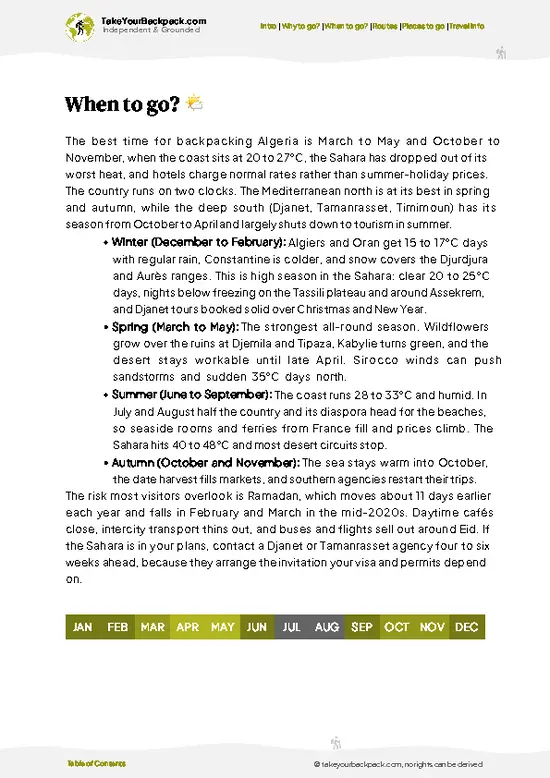
Best months for landmark visits: The best months are March to May and October to November, when northern daytime temperatures sit around 18 to 27°C and the Sahara is warm instead of punishing. In spring the hills smell of wild herbs and the air is clear, which helps for photographs of ruins on open plateaus. Autumn brings softer light and fewer flies.
Summer heat: From June to August, the coast runs 28 to 35°C with sticky humidity, and inland plateaus and the Sahara can top 40°C, sometimes reaching 45 to 50°C in the far south. Midday stone is too hot to touch and shade is scarce at open ruins. Plan outdoor visits for early morning or late afternoon. Coastal cities fill with Algerian holidaymakers in July and August, so beach-town rooms get pricier and more crowded, often rising 20 to 50 percent. … read more 👉
Best months for landmark visits: The best months are March to May and October to November, when northern daytime temperatures sit around 18 to 27°C and the Sahara is warm instead of punishing. In spring the hills smell of wild herbs and the air is clear, which helps for photographs of ruins on open plateaus. Autumn brings softer light and fewer flies.
Summer heat: From June to August, the coast runs 28 to 35°C with sticky humidity, and inland plateaus and the Sahara can top 40°C, sometimes reaching 45 to 50°C in the far south. Midday stone is too hot to touch and shade is scarce at open ruins. Plan outdoor visits for early morning or late afternoon. Coastal cities fill with Algerian holidaymakers in July and August, so beach-town rooms get pricier and more crowded, often rising 20 to 50 percent.
Winter: December to February is mild on the coast, roughly 10 to 17°C, but it is the wet season, with most rainfall of about 500 to 800 mm in the north falling between November and March. Expect gray skies, muddy paths and wet marble. The high plateaus can be properly cold, dipping to around 0°C at night with occasional snow. In the Sahara, winter is actually pleasant by day at 18 to 25°C, but nights can fall close to freezing, so desert trips work well then if you pack a warm layer.
Ramadan and holidays: During Ramadan, which shifts about 11 days earlier each year, opening hours shorten, restaurants close by day and the pace slows. Evenings, though, become lively and food-scented. Friday mornings are quiet for many sites, and some close that day or reduce hours. Shoulder seasons keep prices lowest and access easiest.

unique site hoppingPlanning Your Route Efficiently

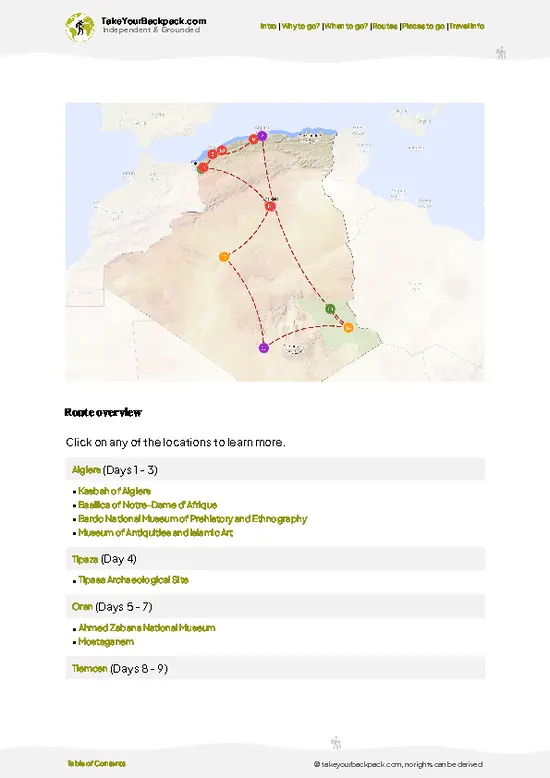
How many days to allow: A trip linking several landmarks in Algeria needs 10 to 14 days, and 7 days works only if you stay in the north. The country is large, and distances eat time more than the sites themselves do.
Grouping regions: The north coast and Tell Atlas cluster well, with Algiers as the hub and Constantine, Annaba, Tipasa and Oran along an east-west corridor. Trains and buses link the main cities, and shared taxis fill gaps. Travel between Algiers and Constantine takes roughly 5 to 6 hours by road, and Algiers to Oran 4 to 5 hours by train or road. The Sahara is a separate trip, reached by domestic flight from Algiers, for example to Djanet or Tamanrasset, in about 2 to 3 hours. Overland to the deep south takes a day or more each way.
Direction and pacing: Moving east to west or … read more 👉
How many days to allow: A trip linking several landmarks in Algeria needs 10 to 14 days, and 7 days works only if you stay in the north. The country is large, and distances eat time more than the sites themselves do.
Grouping regions: The north coast and Tell Atlas cluster well, with Algiers as the hub and Constantine, Annaba, Tipasa and Oran along an east-west corridor. Trains and buses link the main cities, and shared taxis fill gaps. Travel between Algiers and Constantine takes roughly 5 to 6 hours by road, and Algiers to Oran 4 to 5 hours by train or road. The Sahara is a separate trip, reached by domestic flight from Algiers, for example to Djanet or Tamanrasset, in about 2 to 3 hours. Overland to the deep south takes a day or more each way.
Direction and pacing: Moving east to west or the reverse along the coast avoids backtracking, and a flight south at the end of the trip saves energy. Allow 1 to 2 days at most northern stops, a half day for a small ruin, and 3 to 5 days for desert excursions, since sites there sit hours apart by 4x4 over sand and rock.
Common planning mistakes: The biggest is trying to cram north and south into one week, which leaves you in vans watching dust roll past. Allow buffer days instead. Another is assuming transport runs on a fixed schedule. Intercity buses and shared taxis often depart when full, so go early in the morning. Travelers also underestimate summer heat on long drives, so travel by night or morning in warm months. Finally, book Saharan guides and flights ahead, since seats are limited and agencies need lead time.

The ListMust-Visit landmarks in Algeria

1 Sahara Desert

Erg dunes, Tassili rock art, Hoggar peaks, oasis towns

Cross stony plains and dune seas by 4x4 to reach painted sandstone plateaus, Tuareg markets, palm oases and the volcanic heights of Assekrem.

2 Kasbah of Algiers

Stairway alleys, Ottoman citadel, blue doors, harbor views

Wander steep lanes with no fixed route, pausing at old mosques and palace courtyards, and finish at the citadel ramparts above the bay.

3 Timgad

Trajan’s arch, gridded streets, plateau ruins, Roman library

Pace the paved decumanus past the arch, forum and theater, then stop at the museum mosaics, bringing water and a hat for the shadeless site.

algeria-unique-site-timgad
© Google |

4 Djémila

Cuicul forum, mountain-spur ruins, mosaic museum, limestone ridge

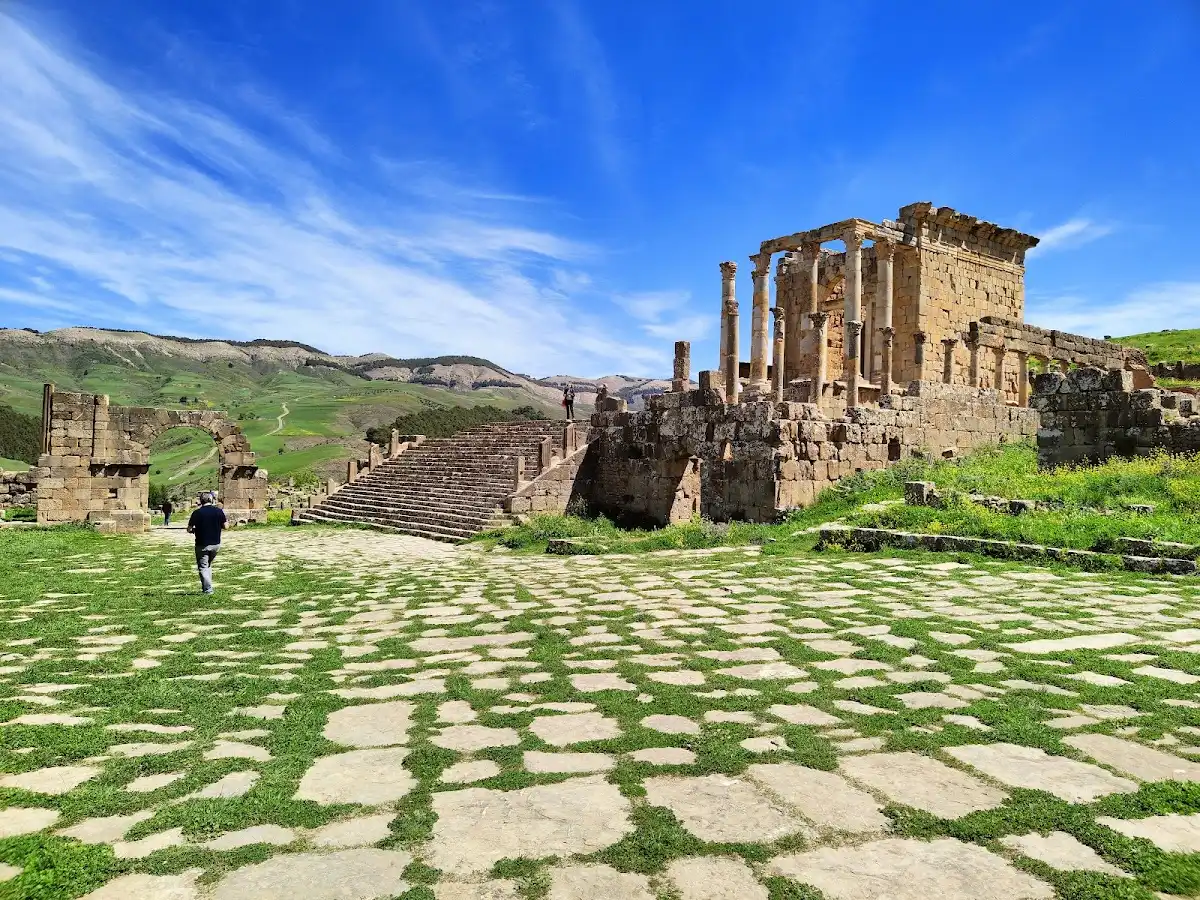
Walk rutted Roman streets across a hillside town, from the paved forum to the Severan temple, then see fresh-colored hunt mosaics in the small museum.

algeria-unique-site-djemila
© Google |

5 Ghoufi Balconies

Canyon rim, cliff houses, palm floor, Chaoui villages

Follow the rim above the Oued Abiod gorge, then descend toward date palms and abandoned mud-and-stone dwellings, with a chance of tea from local villagers.

algeria-unique-site-ghoufi-balconies
© Google |

6 Hammam Debagh

Steaming travertine, boiling spring, sulfur air, thermal pools

Watch near-boiling water spill over white and orange calcite terraces, then soak in the spring-fed pools where Algerian families come for their health.

algeria-unique-site-hammam-debagh
© Google |

7 Calama

Roman theater, town-center ruins, Byzantine walls, Seybouse views

Climb the semicircular tiers of a Roman theater set among apartment blocks, then trace bath remains and sixth-century walls before heading up Mount Maouna.

Loading the map 🌍

Expert viewWhat You Should Know

How many landmarks to aim for: Plan on four to six landmarks in a trip of two to three weeks, and treat that as a ceiling. Distances in Algeria are continental (the country is the largest in Africa), buses leave when full, and a single site can swallow a half day once you add the taxi haggle, the wait for a caretaker with the key, and the midday hours when stone is too hot to touch. Fewer stops also leave room for what makes Algeria worth the trouble: a tea poured by a site guardian, an hour on a café terrace with the call to prayer rolling over whitewashed roofs.

Choosing between kinds of landmarks: Algeria splits into three experiences. Roman and Numidian ruins along the coast and the high plateaus are the easy, cheap option. You walk through them on your own, boots crunching on limestone … read more 👉
How many landmarks to aim for: Plan on four to six landmarks in a trip of two to three weeks, and treat that as a ceiling. Distances in Algeria are continental (the country is the largest in Africa), buses leave when full, and a single site can swallow a half day once you add the taxi haggle, the wait for a caretaker with the key, and the midday hours when stone is too hot to touch. Fewer stops also leave room for what makes Algeria worth the trouble: a tea poured by a site guardian, an hour on a café terrace with the call to prayer rolling over whitewashed roofs.

Choosing between kinds of landmarks: Algeria splits into three experiences. Roman and Numidian ruins along the coast and the high plateaus are the easy, cheap option. You walk through them on your own, boots crunching on limestone paving, with cicadas loud in the pines and often no other visitors at all. Pick these if you travel on a tight budget and want independence. Old medina quarters, casbahs and Ottoman-era mosques suit travelers who like to wander. Expect stairways worn smooth, the smell of grilled meat and orange blossom, and the odd gentle hand pointing you the right way. Wear shoes with grip, because wet stone is slick. The Saharan rock art and desert fortified towns sit in a different category. They demand time, money and a licensed guide, and the payoff is silence, ochre light and engravings that feel impossibly old. Choose these only if you can spare the extra days and cash. Most people are better served by building a trip on coastal and highland sites and adding one desert stop at most.

What it costs: A realistic budget in the north is US$30 to 50 a day: a simple room in a family-run hotel at DZD 4,000 to 7,000 (US$30 to 52), a plate of grilled chicken or couscous for DZD 600 to 1,200 (US$4.50 to 9), and shared taxis or buses for a few hundred dinars per hop. Entry fees to archaeological sites and museums are low, usually DZD 200 to 600 (US$1.50 to 4.50) for foreigners, sometimes less. A local guide at a major ruin runs roughly DZD 1,500 to 4,000 (US$11 to 30) for a couple of hours and is worth hiring where inscriptions and ground plans are otherwise silent stone. The Sahara changes the math. Agency-organized trips, which are required in much of the deep south, run about US$80 to 150 a day per person including guide, vehicle, camping and meals, dropping toward the low end in a group of four or more. Cash is the rule almost everywhere, since foreign cards rarely work, so carry euros and exchange them at a good rate rather than relying on ATMs.

Safety and conduct at sites: The north is calm for travelers who use ordinary sense, and heritage sites are generally quiet and watched by caretakers. The far south and border zones are another matter. Permits and an approved agency are needed, and traveling there independently is neither legal nor wise. Check your government’s current advice before booking anything remote. Photography near military posts, police stations and government buildings is forbidden, and a camera raised the wrong way can mean a long conversation at a roadside checkpoint. Keep your passport and a few photocopies on you, because checkpoints on intercity roads are routine and polite. Drones are effectively banned, so leave yours at home.

Cultural manners that open doors: Dress modestly at mosques and in old quarters: covered shoulders and knees for everyone, and a scarf in your bag for women. Ask before photographing people, and expect a smile or a firm no. Friday is the main prayer day, and many sites open late or close, so do not set your heart on a Friday morning visit. During Ramadan, opening hours shrink, cafés shutter until sunset, and eating or drinking in the street is considered rude. In exchange, the evening meal at sunset is a joyful, crowded affair that is worth joining. Learn a few words of French or Arabic. A simple greeting often turns a stiff ticket-booth moment into an invitation to tea, and that warmth is the real draw of traveling here.

✈️ The backpacker research shortcutAlgeria Travel Guide

An offline-friendly backpacking guide with optimized travel routes, ranked highlights, transport advice, and the best areas to stay.
example page 0 from our offline Travel Guide for Algeria
example page 1 from our offline Travel Guide for Algeria
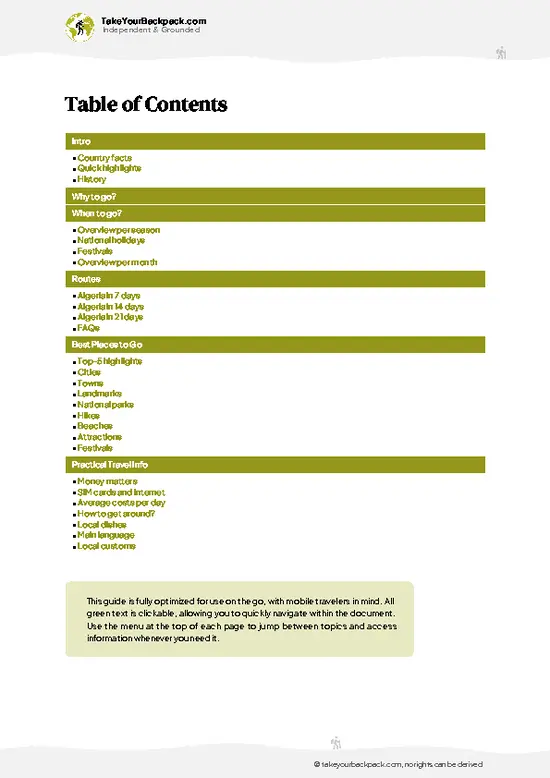
example page 2 from our offline Travel Guide for Algeria
example page 3 from our offline Travel Guide for Algeria
example page 4 from our offline Travel Guide for Algeria
example page 5 from our offline Travel Guide for Algeria
example page 6 from our offline Travel Guide for Algeria
example page 7 from our offline Travel Guide for Algeria
The digital guide (314 pages) contains:
✅ 79 highlights, ranked by travel appeal
✅ Optimized 7, 14 & 21-day travel routes
✅ Cities, national parks, landmarks, beaches
✅ How to get around
✅ Offline-friendly for travel without Wi-Fi
👉 Click to see all 30+ guide features

📅 Plan smarter in minutes, not weeks
✅ Month by month travel advice
✅ Festivals & national holidays
✅ Budget expectations

🗺️ Go to the right places, skip the overrated ones
✅ Honest pros & cons of destinations
✅ Top hikes, parks & viewpoints
✅ Lesser-known places most travelers miss
✅ Clear “worth it vs skip it” guidance

🛏️ Travel smoothly without rookie mistakes
✅ Best areas to stay
✅ Transport systems explained simply
✅ Common scams & safety advice
✅ SIM cards, money & practical tips

🌍 Understand the country, not just visit it
✅ Culture & traditions
✅ 52 Essential phrases & customs
✅ Festivals worth planning around
✅ Traveler-friendly historical context
✅ Insights that make places more meaningful

📱 Built for real travel conditions
✅ Fully downloadable PDF
✅ Works completely offline
✅ Optimized for phone use
✅ Useful in remote areas & buses
✅ Everything in one place
Stop searching, start planning
Get instant access to your full guide. 30‑day money-back guarantee.
+ Add another guide for just

By proceeding you agree to our terms.
Sent to your inbox immediately after payment • 100% Secure Checkout
Best Backpacking Travel Advisor 2025 tourism awardBest Backpacking
Travel Advisor
2025
What others say about Take Your Backpack Guides:
⭐⭐⭐⭐⭐
Fantastic, amazing amount of information!
⭐⭐⭐⭐⭐
My goodness this is amazing, it's what I've been looking for hats off too you!
⭐⭐⭐⭐⭐
I think this is absolutely BRILLIANT
⭐⭐⭐⭐
Very complete and informative. It's still missing places, but I gotta to commend you
⭐⭐⭐⭐⭐
This is truly amazing, thank you, can't wait to explore it with my kids!
⭐⭐⭐⭐⭐
Awesome resource, thank you!
⭐⭐⭐⭐⭐
This is amazing! Can't wait to explore the ones I haven't seen
⭐⭐⭐⭐
I love this! Well done, great idea.
⭐⭐⭐⭐⭐
Thanks for taking the time to make this gem!
⭐⭐⭐⭐⭐
This might be the best website I've ever seen.
⭐⭐⭐⭐⭐
Congratulations, and thank you so much for your work; it's incredibly valuable.
⭐⭐⭐⭐
In all seriousness I think you did a great job pointing out the important spots
⭐⭐⭐⭐⭐
10/10 very good
⭐⭐⭐⭐⭐
As someone who's only just starting to visit regularly this is awesome, thank you.
⭐⭐⭐⭐
Thank you very much! I'm going to visit my dad, it's going to be very useful!
⭐⭐⭐⭐⭐
This is really cool! We'll be travelling for the first time and this definitely come in handy.
⭐⭐⭐⭐⭐
You are now our minister of culture, congratulations 👨‍💼
⭐⭐⭐⭐⭐
Just wanted to tell you that this is a pearl! Going to follow your recommendations.
⭐⭐⭐⭐⭐
This is so cool. I'll definitely be using the resource for my travels soon.
⭐⭐⭐⭐⭐
This is very impressive! Good work.
⭐⭐⭐⭐⭐
This is an amazing and informative site. Very well done!

🛏️ Where to stay?Top Areas to Stay

Backpacker-style hostels are rare in Algeria, so budget travelers mostly stay in state-run youth hostels (auberges de jeunesse), simple family hotels and private rooms or apartments, with doubles typically running about 3,000 to 6,000 DZD (US$22 to 45). In Algiers, the streets around Grande Poste and Didouche Mourad put you within walking distance of the Casbah and the best cafés, though they are noisy and quiet down early at night, while Hydra is calm and safe but pricier and a taxi ride from the sights. In Oran, the city center near Place du 1er Novembre and the Front de Mer gives you the liveliest evenings in the country, and in Constantine the old center near the bridges is the most practical … read more 👉
Backpacker-style hostels are rare in Algeria, so budget travelers mostly stay in state-run youth hostels (auberges de jeunesse), simple family hotels and private rooms or apartments, with doubles typically running about 3,000 to 6,000 DZD (US$22 to 45). In Algiers, the streets around Grande Poste and Didouche Mourad put you within walking distance of the Casbah and the best cafés, though they are noisy and quiet down early at night, while Hydra is calm and safe but pricier and a taxi ride from the sights. In Oran, the city center near Place du 1er Novembre and the Front de Mer gives you the liveliest evenings in the country, and in Constantine the old center near the bridges is the most practical base, just very hilly and short on budget choices.

If you enjoy meeting fellow travelers, consider choosing hostels with high ratings for atmosphere. On the other hand, if you prefer having your own space, a hotel might be a better option.

AlgeriaDiscover the Country

👋 Meet the founderWho’s Behind Take Your Backpack?

Johan, backpacker and founder of TakeYourBackpackHi, I’m Johan (Netherlands 🇳🇱), the creator of TakeYourBackpack. Over the past 3 decades, I’ve backpacked through 90+ countries across six continents, gaining extensive experience with independent travel, long-term trips, and overland routes.

This site is built on a combination of firsthand travel experience and carefully curated insights from other backpackers. Many guides are based on places I’ve personally visited, while others bring together tips, observations, and practical advice shared by trusted travelers I’ve met along the way.

The goal is to provide realistic, experience-driven guidance — not generic itineraries — so you can explore destinations with better context, clearer expectations, and more confidence.