×

Angola🇦🇴 | best hikesYour Guide to the 7 Best hikes in Angola

Angola’s hiking trails offer a raw, unfiltered experience that reflects the country’s diverse landscapes and rich culture. From the rugged mountains of the Serra da Leba to the lush wetlands of the Okavango, each region presents unique challenges and rewards. The altitude varies significantly, affecting both trail difficulty and recovery needs.

In the dry season, trails are more accessible, but the heat can be intense, demanding careful planning for hydration and timing. Conversely, the rainy season transforms the scenery but can make trails treacherous. Choosing the right hike shapes your entire trip—impacting your budget, safety, and cultural immersion.

Independent travelers will find that some trails are well-marked and frequented, while others require a local guide to navigate. This choice not only influences the vibe of your hike but also deepens your connection to Angola’s vibrant communities.

By Johan Kruseman 🇳🇱 | Updated September 4, 2026
Explore the best beaches in Angola

Why go?Understanding Their Importance

Angola’s hiking landscape is a tapestry of diverse terrains that beckon adventurers. From the rugged mountains of the Serra da Leba to the expansive savannas, each trail offers a unique experience. The altitude varies significantly, with some hikes reaching over 2,600 meters, presenting both a challenge and a reward. The higher you climb, the more breathtaking the views become, revealing the vastness of the Angolan wilderness.

However, this diversity comes with trade-offs. Many trails are less developed than those in more popular hiking destinations, which can mean navigating rough paths and limited infrastructure. This lack of established routes may deter some, but for those willing to embrace the grit, it leads to a more immersive experience. The sense of solitude in the wild is palpable, … read more 👉
Angola’s hiking landscape is a tapestry of diverse terrains that beckon adventurers. From the rugged mountains of the Serra da Leba to the expansive savannas, each trail offers a unique experience. The altitude varies significantly, with some hikes reaching over 2,600 meters, presenting both a challenge and a reward. The higher you climb, the more breathtaking the views become, revealing the vastness of the Angolan wilderness.

However, this diversity comes with trade-offs. Many trails are less developed than those in more popular hiking destinations, which can mean navigating rough paths and limited infrastructure. This lack of established routes may deter some, but for those willing to embrace the grit, it leads to a more immersive experience. The sense of solitude in the wild is palpable, allowing hikers to connect deeply with the landscape.

Logistics play a crucial role in planning hikes in Angola. Travel times can be lengthy due to the country’s vastness and sometimes poor road conditions. This can limit the number of hikes you can tackle in a single trip, but it also means that each hike can feel like a journey into the heart of Angola’s rich cultural and historical tapestry. The climate varies widely, with the dry season offering the best conditions for hiking, while the rainy season can transform trails into slippery challenges.

Ultimately, the reward for those who venture into Angola’s trails is profound. The combination of stunning vistas, the thrill of exploration, and the chance to experience a country still relatively untouched by mass tourism makes these hikes not just a physical challenge, but a journey into the soul of Angola itself.
Behind the Scenes of Selection
The list of best hikes in Angola is created based on scenery, challenge, trail quality, landmarks, and overall enjoyment. If you feel a hike is missing in this list, please let us know.

When to go?Timing Your Visit for the Best Experience

Weather Patterns

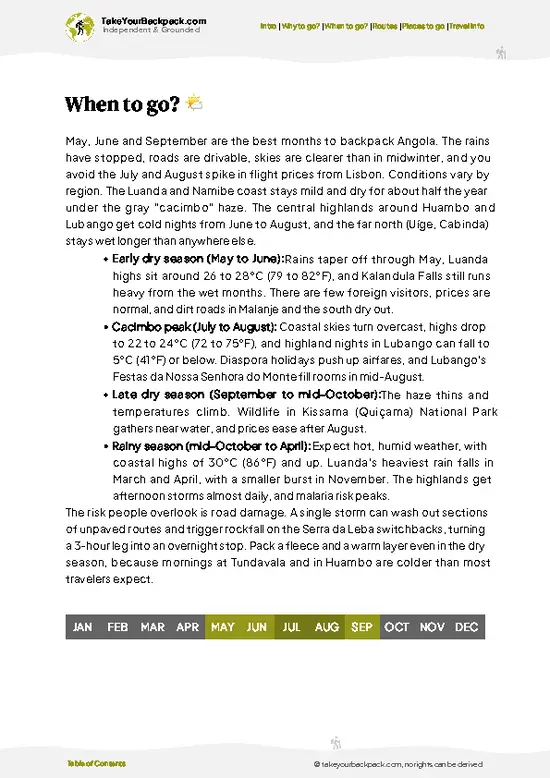
Angola’s climate varies significantly across its regions, impacting hiking conditions. The dry season, typically from May to September, offers the most reliable weather. Expect clear skies and cooler temperatures, especially in the highlands. Daylight hours are longer, providing ample time to explore trails without the rush.

Rainfall and Trail Access

The rainy season, from October to April, brings heavy downpours, particularly in the northern regions. Trails can become muddy and challenging, limiting access to certain areas. Rivers swell, and some paths may wash out, making navigation tricky. However, the lush landscapes during this time can be breathtaking, rewarding those who venture out despite the conditions.

Optimal Months

The best months for hiking generally fall … read more 👉

Weather Patterns

Angola’s climate varies significantly across its regions, impacting hiking conditions. The dry season, typically from May to September, offers the most reliable weather. Expect clear skies and cooler temperatures, especially in the highlands. Daylight hours are longer, providing ample time to explore trails without the rush.

Rainfall and Trail Access

The rainy season, from October to April, brings heavy downpours, particularly in the northern regions. Trails can become muddy and challenging, limiting access to certain areas. Rivers swell, and some paths may wash out, making navigation tricky. However, the lush landscapes during this time can be breathtaking, rewarding those who venture out despite the conditions.

Optimal Months

The best months for hiking generally fall within the dry season. This period not only ensures better trail conditions but also enhances visibility for scenic views. Wildlife is more active, and the vibrant flora adds to the experience.

Shoulder Seasons

Visiting during the shoulder months—just before or after the peak season—can offer a balance of fewer crowds and lower costs. However, weather can be unpredictable. Early rains may still linger, and late dry season heat can be intense, requiring careful planning for hydration and recovery.

Peak Periods

While the dry season is ideal, the peak tourist months can lead to crowded trails. For those seeking solitude, timing visits just outside these busy periods can enhance the experience.

Seasonal Constraints

Travelers should consider altitude when planning hikes. Higher elevations can lead to cooler temperatures and require acclimatization. Balancing safety with the desire for scenic rewards is crucial, as conditions can shift quickly.

hike hoppingHow to Combine hikes Into One Trip

General Routing Logic

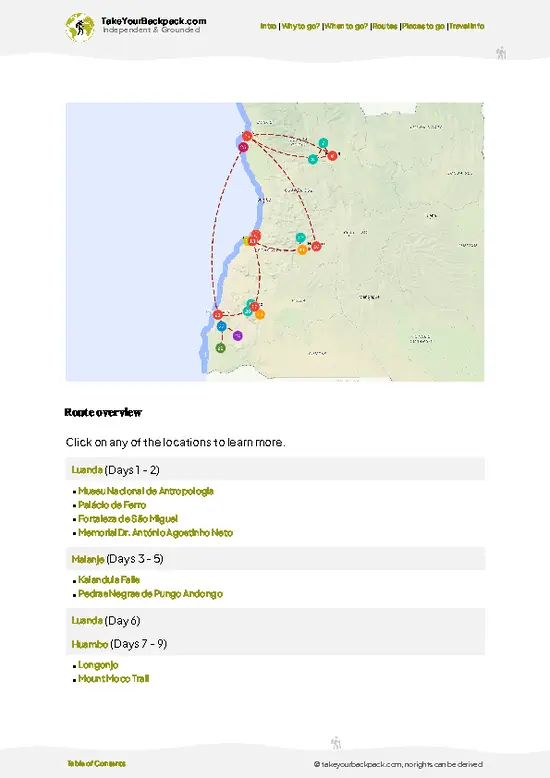
Angola’s diverse landscapes demand a thoughtful approach to hiking. Start in the north, where the lush highlands of the Serra da Leba offer stunning vistas. From there, head south toward the arid expanses of Namibe Desert. This route not only showcases the country’s varied topography but also allows for a natural progression in altitude and climate.

Typical Time Needed

Plan for at least two to three days at each major stop. This allows for acclimatization and recovery, especially after tackling the more strenuous hikes. The trails can be demanding, and rushing through them can lead to fatigue or injury. A well-paced itinerary lets you absorb the surroundings, from the scent of wildflowers to the sound of rustling leaves.

Common Planning Mistakes

One frequent pitfall … read more 👉

General Routing Logic

Angola’s diverse landscapes demand a thoughtful approach to hiking. Start in the north, where the lush highlands of the Serra da Leba offer stunning vistas. From there, head south toward the arid expanses of Namibe Desert. This route not only showcases the country’s varied topography but also allows for a natural progression in altitude and climate.

Typical Time Needed

Plan for at least two to three days at each major stop. This allows for acclimatization and recovery, especially after tackling the more strenuous hikes. The trails can be demanding, and rushing through them can lead to fatigue or injury. A well-paced itinerary lets you absorb the surroundings, from the scent of wildflowers to the sound of rustling leaves.

Common Planning Mistakes

One frequent pitfall is underestimating travel times between hikes. Roads can be rough, and conditions may vary. Always factor in extra time for unexpected delays. Another mistake is overloading the schedule. Prioritize quality over quantity; a single rewarding hike can be more fulfilling than several rushed ones.

Trade-offs and Constraints

Balancing speed with depth of experience is crucial. While it might be tempting to cover more ground quickly, the real beauty lies in savoring each moment. Budget considerations also play a role; some areas may require more investment in terms of guides or accommodations. Ultimately, the effort put into planning will yield richer rewards, whether it’s a breathtaking view or a well-deserved cold drink at the end of a long day.

Pacing Strategies

Flexibility is key. Be prepared to adjust plans based on energy levels or weather conditions. Incorporate rest days to recharge. This approach not only enhances enjoyment but also ensures that each hike feels like a meaningful part of the journey, rather than just another checkbox on a list.

The ListThe Best hikes of Angola

1 Mount Moco Trail

Angola’s highest peak, montane forest, endemic birdlife

Climb through cool upland forest to the country’s highest summit, passing rare plants and birds found nowhere else in Angola.

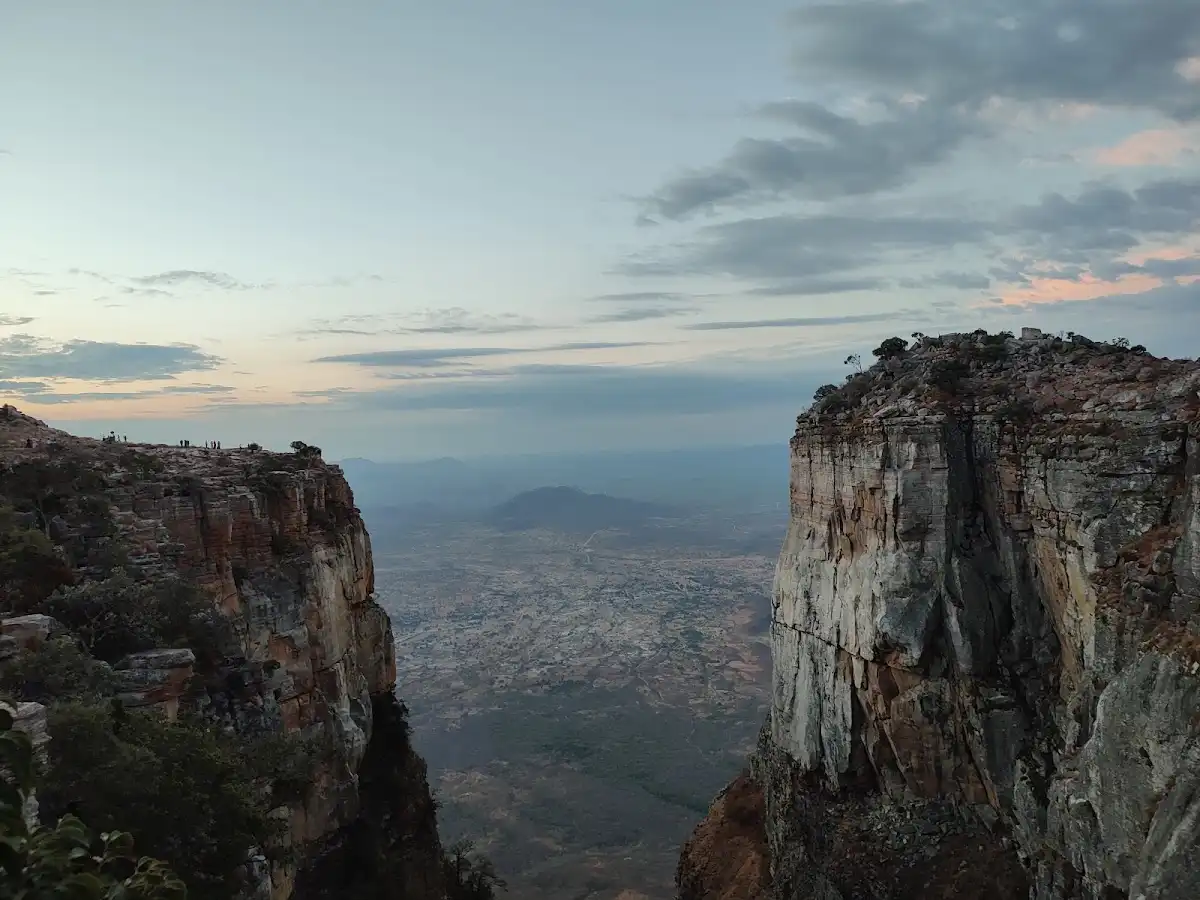
2 Tundavala Gap

sheer cliff drop, plateau rim, expansive valley floor

Stand at the edge of a dramatic escarpment, gazing down from the plateau to the vast plains stretching out far below.

angola-hike-tundavala-gap
© Google |

3 Kalandula Falls

broad waterfall curtain, rainforest edge, spray-filled basin

Approach the thunderous drop of one of Africa’s widest waterfalls, where constant mist nourishes dense greenery and vibrant birdlife.

4 Serra da Leba Pass

hairpin mountain road, panoramic escarpment, misty viewpoints

Ascend a winding route where sharp turns reveal shifting cloud banks, dramatic elevation changes, and sweeping views across southern Angola’s highlands.

angola-hike-serra-da-leba-pass
© Google |

5 Pedras Negras de Pungo Andongo

towering rock monoliths, savanna plateau, ancient petroglyphs

Walk among massive stone formations rising from open grassland, tracing the contours of a landscape marked by centuries-old carvings and local legend.

angola-hike-pedras-negras-de-pungo-andongo
© Google |

6 Serra da Chela Trail

steep escarpment, arid plateau, distant ocean views

Traverse a rugged ridge where dry grasslands meet sheer cliffs, with the Atlantic horizon visible on clear days far below.

7 Binga Waterfall Trail

multi-tiered cascades, lush river valley, slippery rock paths

Follow a forested trail along a river, navigating wet stones and dense foliage to reach a series of cool, secluded waterfalls.

Loading the map 🌍

Expert viewPro Tips for Exploring the Best

Trail Logistics

Angola’s hiking scene is as diverse as its landscapes, offering everything from coastal treks to mountainous climbs. You’ll want to tackle at least three to five hikes to get a real sense of the country’s natural beauty. Each hike presents its own challenges and rewards, so pacing yourself is key. Expect to spend anywhere from a few hours to a couple of days on the trails. The effort you put in will be rewarded with breathtaking views, but don’t underestimate the terrain.

Altitude and Terrain

The altitude varies significantly across Angola, especially if you venture into the highlands. Some trails can take you above 2,000 meters, where the air is thinner and the climbs steeper. This can be a game-changer for your stamina. If you’re not acclimatized, you might find yourself … read more 👉

Trail Logistics

Angola’s hiking scene is as diverse as its landscapes, offering everything from coastal treks to mountainous climbs. You’ll want to tackle at least three to five hikes to get a real sense of the country’s natural beauty. Each hike presents its own challenges and rewards, so pacing yourself is key. Expect to spend anywhere from a few hours to a couple of days on the trails. The effort you put in will be rewarded with breathtaking views, but don’t underestimate the terrain.

Altitude and Terrain

The altitude varies significantly across Angola, especially if you venture into the highlands. Some trails can take you above 2,000 meters, where the air is thinner and the climbs steeper. This can be a game-changer for your stamina. If you’re not acclimatized, you might find yourself gasping for breath on the ascent. The rocky paths can be unforgiving, so sturdy footwear is non-negotiable. Consider your fitness level and choose hikes that match it. If you’re a beginner, opt for lower-altitude trails to build your confidence and endurance.

Recovery and Preparation

Recovery is as crucial as the hike itself. After a long day on the trails, your body will need time to bounce back. Hydration is vital; the heat can be relentless, especially in the lower regions. Bring electrolyte tablets to replenish what you lose through sweat. Stretching and a good meal will help, too. Local cuisine often features hearty stews and grilled meats, which can be a satisfying reward after a day of exertion. Just be cautious with street food; while it can be tempting, it’s best to stick to established eateries to avoid any gastrointestinal surprises.

Difficulty and Pacing

Difficulty levels can range widely. Some trails are well-marked and manageable, while others demand serious grit and navigation skills. If you’re unsure, consult local guides who know the terrain intimately. They can provide insights that maps simply can’t. Pacing yourself is essential. Don’t rush; take the time to soak in the surroundings. The rhythm of your breath, the crunch of gravel underfoot, and the rustle of leaves all contribute to the experience.

Planning and Prioritizing

When planning your hikes, consider the regional variations. The coastal trails offer a different vibe compared to the inland routes. If you’re short on time, prioritize hikes that showcase the country’s unique ecosystems. A mix of coastal and mountainous hikes will give you a well-rounded experience. Factor in travel time between hikes, as roads can be rough and slow.

Safety and Cultural Considerations

Safety is paramount. Always hike with a buddy or a group, especially in remote areas. Wildlife encounters can be thrilling but also risky. Be aware of your surroundings and respect local wildlife. Cultural sensitivity is equally important. Angola has a rich tapestry of cultures, and understanding local customs can enhance your experience. Engage with local communities, but do so respectfully.

Trade-offs and Constraints

One significant trade-off is the balance between adventure and comfort. Some trails may lead you to stunning vistas but come with limited infrastructure. Be prepared for basic accommodations or even camping. If you prefer a more comfortable experience, you might have to sacrifice some of the more remote hikes. It’s about finding what resonates with you.

Final Thoughts

Angola’s hiking trails are not just paths through nature; they are gateways to understanding the country’s heart and soul. The grit of the streets and the burn of the trails lead to moments that linger long after the hike is over. Whether it’s the first cold beer shared with fellow hikers or the quiet satisfaction of reaching a summit, each step is a part of a larger journey. Embrace the challenges, and you’ll find that the rewards are well worth the effort.

✈️ The backpacker research shortcutAngola Travel Guide

An offline-friendly backpacking guide with optimized travel routes, ranked highlights, transport advice, and the best areas to stay.
example page 0 from our offline Travel Guide for Angola
example page 1 from our offline Travel Guide for Angola
example page 2 from our offline Travel Guide for Angola
example page 3 from our offline Travel Guide for Angola
example page 4 from our offline Travel Guide for Angola
example page 5 from our offline Travel Guide for Angola
example page 6 from our offline Travel Guide for Angola
example page 7 from our offline Travel Guide for Angola
The digital guide (341 pages) contains:
90 highlights, ranked by travel appeal
Optimized 7, 14 & 21-day travel routes
Cities, national parks, landmarks, beaches
How to get around
Offline-friendly for travel without Wi-Fi
👉 Click to see all 30+ guide features

📅 Plan smarter in minutes, not weeks
Month by month travel advice
Festivals & national holidays
Budget expectations

🗺️ Go to the right places, skip the overrated ones
Honest pros & cons of destinations
Top hikes, parks & viewpoints
Lesser-known places most travelers miss
Clear “worth it vs skip it” guidance

🛏️ Travel smoothly without rookie mistakes
Best areas to stay
Transport systems explained simply
Common scams & safety advice
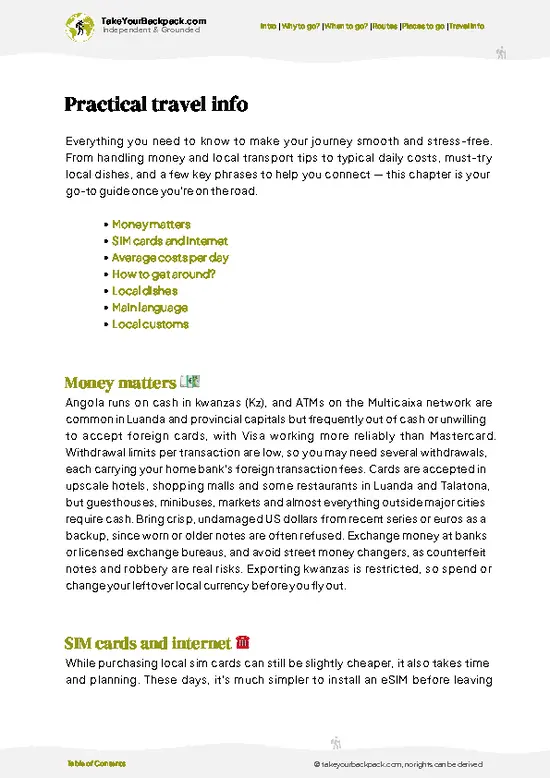
SIM cards, money & practical tips

🌍 Understand the country, not just visit it
Culture & traditions
52 Essential phrases & customs
Festivals worth planning around
Traveler-friendly historical context
Insights that make places more meaningful

📱 Built for real travel conditions
Fully downloadable PDF
Works completely offline
Optimized for phone use
Useful in remote areas & buses
Everything in one place
Save weeks of stressful planning
Get instant access to your full guide. 30‑day money-back guarantee.
+ Add another guide for just US$7.80

By proceeding you agree to our terms.
Sent to your inbox immediately after payment • 100% Secure Checkout
Best Backpacking Travel Advisor 2025 tourism awardBest Backpacking
Travel Advisor
2025
What others say about Take Your Backpack Guides:
⭐⭐⭐⭐⭐
Fantastic, amazing amount of information!
⭐⭐⭐⭐⭐
My goodness this is amazing, it's what I've been looking for hats off too you!
⭐⭐⭐⭐⭐
I think this is absolutely BRILLIANT
⭐⭐⭐⭐
Very complete and informative. It's still missing places, but I gotta to commend you
⭐⭐⭐⭐⭐
This is truly amazing, thank you, can't wait to explore it with my kids!
⭐⭐⭐⭐⭐
Awesome resource, thank you!
⭐⭐⭐⭐⭐
This is amazing! Can't wait to explore the ones I haven't seen
⭐⭐⭐⭐
I love this! Well done, great idea.
⭐⭐⭐⭐⭐
Thanks for taking the time to make this gem!
⭐⭐⭐⭐⭐
This might be the best website I've ever seen.
⭐⭐⭐⭐⭐
Congratulations, and thank you so much for your work; it's incredibly valuable.
⭐⭐⭐⭐
In all seriousness I think you did a great job pointing out the important spots
⭐⭐⭐⭐⭐
10/10 very good
⭐⭐⭐⭐⭐
As someone who's only just starting to visit regularly this is awesome, thank you.
⭐⭐⭐⭐
Thank you very much! I'm going to visit my dad, it's going to be very useful!
⭐⭐⭐⭐⭐
This is really cool! We'll be travelling for the first time and this definitely come in handy.
⭐⭐⭐⭐⭐
You are now our minister of culture, congratulations 👨‍💼
⭐⭐⭐⭐⭐
Just wanted to tell you that this is a pearl! Going to follow your recommendations.
⭐⭐⭐⭐⭐
This is so cool. I'll definitely be using the resource for my travels soon.
⭐⭐⭐⭐⭐
This is very impressive! Good work.
⭐⭐⭐⭐⭐
This is an amazing and informative site. Very well done!

🛏️ Where to stay?Best Stay Options in Angola

Yes — Angola has some hostels and budget accommodation but options are limited and concentrated in a few cities; expect more guesthouse-style budget hotels than classic dorm hostels, higher prices in major centers, and variable service standards.

Most choices cluster in Luanda (central districts and business suburbs), and coastal towns such as Benguela/Lobito and Namibe (Moçâmedes); central Luanda gives easy access to sights and nightlife but brings heavy traffic and higher rates, business suburbs are quieter and safer but farther from attractions, and coastal towns are cheaper and better for beaches but have fewer evening services and limited transport links.

Carry cash, book ahead because … read more 👉
Yes — Angola has some hostels and budget accommodation but options are limited and concentrated in a few cities; expect more guesthouse-style budget hotels than classic dorm hostels, higher prices in major centers, and variable service standards.

Most choices cluster in Luanda (central districts and business suburbs), and coastal towns such as Benguela/Lobito and Namibe (Moçâmedes); central Luanda gives easy access to sights and nightlife but brings heavy traffic and higher rates, business suburbs are quieter and safer but farther from attractions, and coastal towns are cheaper and better for beaches but have fewer evening services and limited transport links.

Carry cash, book ahead because availability is sparse, and expect occasional basic-utility interruptions and tighter safety awareness in budget areas.

If you enjoy meeting fellow travelers, consider choosing hostels with high ratings for atmosphere. On the other hand, if you prefer having your own space, a hotel might be a better option.

AngolaWhere to Go Next

👋 Meet the founderWho’s Behind Take Your Backpack?

Johan, backpacker and founder of TakeYourBackpackHi, I’m Johan (Netherlands 🇳🇱), the creator of TakeYourBackpack. Over the past decade, I’ve backpacked through 80+ countries across six continents, gaining extensive experience with independent travel, long-term trips, and overland routes.

This site is built on a combination of firsthand travel experience and carefully curated insights from other backpackers. Many guides are based on places I’ve personally visited, while others bring together tips, observations, and practical advice shared by trusted travelers I’ve met along the way.

The goal is to provide realistic, experience-driven guidance — not generic itineraries — so you can explore destinations with better context, clearer expectations, and more confidence.

Get full Angola guide •
Instant download • 90 highlights • Full Offline guide