
×

Argentina🇦🇷 | national parksLihué Calel National Park
granite outcrops, low hills, native shrubland, archaeological sites | things to do and best time to go

Explore El Leoncito National ParkExplore Monte León National Park

Backpacking in Lihué Calel
👌 Worth visitingnational park ranked #20
By Johan Kruseman 🇳🇱 | Updated April 27, 2026

Most people assume Lihué Calel is just a flat, empty stretch of pampa you blast past on Ruta 152; it isn’t. This small national park in southern La Pampa province, roughly between Buenos Aires and Bariloche, is a low, rocky range rising out of scrubby steppe, with short but satisfying hikes, guanacos, and big-sky sunsets. Trails are limited yet peaceful, camping is basic but cheap, access is easiest with your own wheels, and crowds are almost nonexistent. Compared with headline parks like Lanín or Nahuel Huapi, Lihué Calel is quieter, drier, and far less dramatic, but also far less hassle and cost—worth a night if you’re crossing Patagonia and want real ground under your boots instead of another roadside motel.

Discover everything you want to know in the 📖 Argentina Travel Guide.
Loading the map 🌍
CLICK TO FILTER
city
town
village
unique site
national park
hike
beach
attraction
festival
region
SHOW COUNTRY‘S BESTSHOW ALL

✨ Why go?
Ranked #20 national park in Argentina
The unique appeal for travelers

Backpackers flock to Lihué Calel National Park for its blend of independent exploration and budget-friendly options. With campsites and hostels nearby, you can stretch your funds while enjoying the park’s diverse trails. Whether you crave a leisurely stroll or a challenging hike, the variety here caters to all levels. This park is particularly suited for self-guided travelers; marked paths and clear signage make it easy to navigate without a tour. Avoid the crowds and embrace the freedom to explore at your own pace, preserving your energy and budget for the moments that truly matter.
Get the complete Travel Guide for Argentina
Everything organized for offline planning — routes, highlights, costs & tips

See what’s inside 👉

Get the Travel Guide -

💡 HighlightsMust-see experiences and standout moments

  • The Lihué Calel ridges and summits — Dramatic rocky hills that rise out of the flat Pampean plain, giving wide panoramas over the park; great for short climbs, dramatic light at sunrise/sunset, and that satisfying feeling of actually getting above the pampas. (Personal favorite — the view from the main ridge at dusk is unbeatable.)
  • Caldén woodlands — Patches of the iconic caldén tree (Prosopis caldenia) create a strangely sculpted, wind-carved forest unique to La Pampa; nice shade, interesting bark and a different plant community from the surrounding scrub.
  • Steppe wildlife watching — Keep an eye out for guanacos, small mammals and foxes that use the scrub and rock edges; animals here are adapted to open, dry country, so sightings are quiet and often rewarding if you move slowly.
  • Distinctive
read more 👉
  • The Lihué Calel ridges and summits — Dramatic rocky hills that rise out of the flat Pampean plain, giving wide panoramas over the park; great for short climbs, dramatic light at sunrise/sunset, and that satisfying feeling of actually getting above the pampas. (Personal favorite — the view from the main ridge at dusk is unbeatable.)
  • Caldén woodlands — Patches of the iconic caldén tree (Prosopis caldenia) create a strangely sculpted, wind-carved forest unique to La Pampa; nice shade, interesting bark and a different plant community from the surrounding scrub.
  • Steppe wildlife watching — Keep an eye out for guanacos, small mammals and foxes that use the scrub and rock edges; animals here are adapted to open, dry country, so sightings are quiet and often rewarding if you move slowly.
  • Distinctive rock formations and cavities — Weathered volcanic rock and cliffs with nooks, ledges and small caves that make interesting terrain for exploration and are often used by birds and other animals.
  • Short hiking circuits and ridge trails — A handful of well-marked, mostly day-hike routes that mix easy walking with steeper sections on the ridgeline; you get variety without needing a full wilderness expedition.
  • Birdwatching and raptors — Open-country and woodland birds plus birds of prey hunting the plains; binoculars worth bringing — you’ll often spot perched raptors scanning the valleys.
  • Night skies and solitude — Low light pollution and wide horizons mean great stargazing and an actual sense of space; camping or an evening on the ridge is peaceful and uncrowded compared to Argentina’s bigger parks.
Spotted a mistake or missing something? Contact us.

🌤️ When to go?Choosing the right time of year


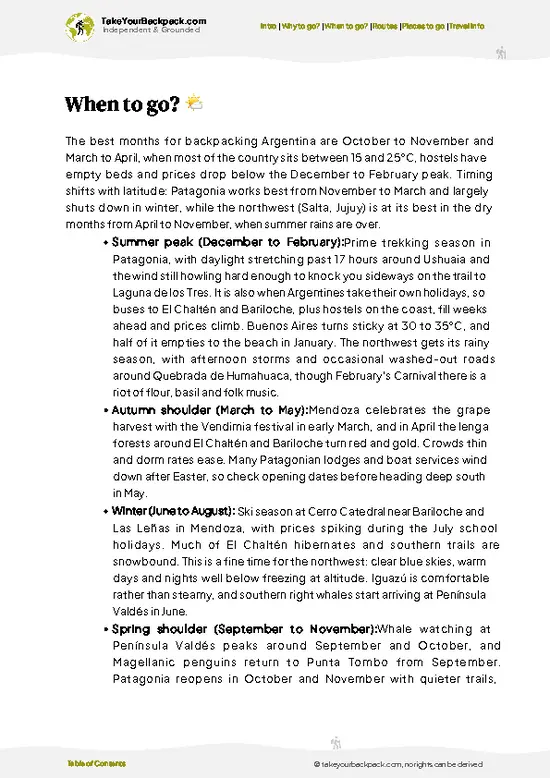
  • Weather: Spring (September to November) and fall (March to May) offer mild, dry conditions, avoiding the scorching summer heat and winter chills.

  • Temperature: Expect 15-25°C (59-77°F) in spring and fall, perfect for hiking without overheating or freezing.

  • Daylight Hours: Longer days in spring and fall provide 10-12 hours of light, enough for full-day treks without rushing.

  • Crowds: Avoid summer (December to February) when local visitors peak, making trails busier and campsites crowded.

  • Seasonal Activities: Spring brings wildflowers and birdwatching; fall offers crisp air and quieter trails, ideal for solitude seekers.

  • Price Fluctuations: Off-peak seasons (fall and spring) generally mean lower accommodation and transport costs, stretching your budget further.


Pro-tip: Aim for early … read more 👉

  • Weather: Spring (September to November) and fall (March to May) offer mild, dry conditions, avoiding the scorching summer heat and winter chills.

  • Temperature: Expect 15-25°C (59-77°F) in spring and fall, perfect for hiking without overheating or freezing.

  • Daylight Hours: Longer days in spring and fall provide 10-12 hours of light, enough for full-day treks without rushing.

  • Crowds: Avoid summer (December to February) when local visitors peak, making trails busier and campsites crowded.

  • Seasonal Activities: Spring brings wildflowers and birdwatching; fall offers crisp air and quieter trails, ideal for solitude seekers.

  • Price Fluctuations: Off-peak seasons (fall and spring) generally mean lower accommodation and transport costs, stretching your budget further.


Pro-tip: Aim for early spring to catch blooming landscapes with fewer people and better prices—your energy and wallet will thank you.


source: climatestotravel.comJANJanuary: fair for travelingFEBFebruary: fair for travelingMARMarch: highly recommended for travelingAPRApril: excellent for travelingMAYMay: highly recommended for travelingJUNJune: below average for travelingJULJuly: below average for travelingAUGAugust: below average for travelingSEPSeptember: excellent for travelingOCTOctober: excellent for travelingNOVNovember: highly recommended for travelingDECDecember: fair for traveling
when-to-go

✈️ The backpacker research shortcutArgentina Travel Guide

An offline-friendly backpacking guide with optimized travel routes, ranked highlights, transport advice, and the best areas to stay.
example page 0 from our offline Travel Guide for Argentinaexample page 1 from our offline Travel Guide for Argentinaexample page 2 from our offline Travel Guide for Argentinaexample page 3 from our offline Travel Guide for Argentinaexample page 4 from our offline Travel Guide for Argentinaexample page 5 from our offline Travel Guide for Argentinaexample page 6 from our offline Travel Guide for Argentinaexample page 7 from our offline Travel Guide for Argentina
The digital guide (542 pages) contains:
143 highlights, ranked by travel appeal
Optimized 14, 21 & 30-day travel routes
Best neighborhoods to stay
How to get around
Offline-friendly for travel without Wi-Fi
👉 See all 30+ guide features

📅 Plan smarter in minutes, not weeks
Month by month travel advice
Festivals & national holidays
Budget expectations

🗺️ Go to the right places, skip the overrated ones
Honest pros & cons of destinations
Top hikes, parks & viewpoints
Lesser-known places most travelers miss
Clear “worth it vs skip it” guidance

🛏️ Travel smoothly without rookie mistakes
Best areas to stay
Transport systems explained simply
Common scams & safety advice
SIM cards, money & practical tips

🌍 Understand the country, not just visit it
Culture & traditions
52 Essential phrases & customs
Festivals worth planning around
Traveler-friendly historical context
Insights that make places more meaningful

📱 Built for real travel conditions
Fully downloadable PDF
Works completely offline
Optimized for phone use
Useful in remote areas & buses
Everything in one place
Save weeks of stressful planning
Get instant access to the full guide directly. 30-day money-back guarantee.


Sent to your inbox immediately after payment • 100% Secure Checkout
Best Backpacking Travel Advisor 2025 tourism awardBest Backpacking
Travel Advisor
2025
What others say about Take Your Backpack Guides:
⭐⭐⭐⭐⭐
Fantastic, amazing amount of information!
⭐⭐⭐⭐⭐
My goodness this is amazing, it's what I've been looking for hats off too you!
⭐⭐⭐⭐⭐
I think this is absolutely BRILLIANT
⭐⭐⭐⭐
Very complete and informative. It's still missing places, but I gotta to commend you
⭐⭐⭐⭐⭐
This is truly amazing, thank you, can't wait to explore it with my kids!
⭐⭐⭐⭐⭐
Awesome resource, thank you!
⭐⭐⭐⭐⭐
This is amazing! Can't wait to explore the ones I haven't seen
⭐⭐⭐⭐
I love this! Well done, great idea.
⭐⭐⭐⭐⭐
Thanks for taking the time to make this gem!
⭐⭐⭐⭐⭐
This might be the best website I've ever seen.
⭐⭐⭐⭐⭐
Congratulations, and thank you so much for your work; it's incredibly valuable.
⭐⭐⭐⭐
In all seriousness I think you did a great job pointing out the important spots
⭐⭐⭐⭐⭐
10/10 very good
⭐⭐⭐⭐⭐
As someone who's only just starting to visit regularly this is awesome, thank you.
⭐⭐⭐⭐
Thank you very much! I'm going to visit my dad, it's going to be very useful!
⭐⭐⭐⭐⭐
This is really cool! We'll be travelling for the first time and this definitely come in handy.
⭐⭐⭐⭐⭐
You are now our minister of culture, congratulations 👨‍💼
⭐⭐⭐⭐⭐
Just wanted to tell you that this is a pearl! Going to follow your recommendations.
⭐⭐⭐⭐⭐
This is so cool. I'll definitely be using the resource for my travels soon.
⭐⭐⭐⭐⭐
This is very impressive! Good work.
⭐⭐⭐⭐⭐
This is an amazing and informative site. Very well done!

🛏️ Where to stay?Best areas to stay in Argentina

Lihué Calel National Park doesn’t have accommodations within its boundaries, but don’t worry; nearby options are solid. The closest town is General Acha, about 60 kilometers away. Here, you’ll find budget-friendly hostels and small hotels that cater to backpackers.

Consider staying at Hotel El Cazador or Hostal La Casona for a cozy vibe. Both offer basic amenities and a chance to mingle with fellow travelers.

If you’re up for a bit of a drive, the city of Santa Rosa is about 120 kilometers away and has more options, including campsites. Just remember to stock up on supplies before heading … read more 👉
Lihué Calel National Park doesn’t have accommodations within its boundaries, but don’t worry; nearby options are solid. The closest town is General Acha, about 60 kilometers away. Here, you’ll find budget-friendly hostels and small hotels that cater to backpackers.

Consider staying at Hotel El Cazador or Hostal La Casona for a cozy vibe. Both offer basic amenities and a chance to mingle with fellow travelers.

If you’re up for a bit of a drive, the city of Santa Rosa is about 120 kilometers away and has more options, including campsites. Just remember to stock up on supplies before heading into the park; amenities are sparse once you’re in.

👛 Costs (as of 24 April 2025)Travel costs and budget guide for Lihué Calel

Lihué Calel National Park in Argentina offers a unique experience, but it’s essential to be aware of the costs involved to avoid any surprises.

Entry fees typically range from $5 to $10 USD per person. This fee grants you access to the park’s trails and facilities. If you’re planning to camp, expect to pay around $10 to $15 USD per night for a campsite.

Guided tours can enhance your visit, especially if you want to explore the park’s biodiversity. These tours usually cost between $30 and $60 USD, depending on the length and inclusivity.

Food options are limited within the park. Bring your own supplies to save money. If you do buy food, budget around $5 to $15 USD for basic meals at nearby facilities.

Gas prices in Argentina can fluctuate, so if you’re driving, keep an eye on local rates. … read more 👉
Lihué Calel National Park in Argentina offers a unique experience, but it’s essential to be aware of the costs involved to avoid any surprises.

Entry fees typically range from $5 to $10 USD per person. This fee grants you access to the park’s trails and facilities. If you’re planning to camp, expect to pay around $10 to $15 USD per night for a campsite.

Guided tours can enhance your visit, especially if you want to explore the park’s biodiversity. These tours usually cost between $30 and $60 USD, depending on the length and inclusivity.

Food options are limited within the park. Bring your own supplies to save money. If you do buy food, budget around $5 to $15 USD for basic meals at nearby facilities.

Gas prices in Argentina can fluctuate, so if you’re driving, keep an eye on local rates. It’s wise to fill up before heading into the park, as options are sparse.

Plan for additional costs like parking fees, which can be around $2 to $5 USD per day.

By being aware of these costs, you can allocate your budget wisely and focus on enjoying the park’s natural beauty without financial stress.


source: argentina.gob.ar
⚠️ Prices can change and everyone travels differently, so take this as a rough guide. Hope it helps you plan your adventure!

🥾 TrailsDiscover Lihué Calel's top trails and natural wonders

Lihué Calel National Park offers a unique blend of rugged landscapes, fascinating geological formations, and diverse wildlife, making it a hidden gem for hikers. The park’s terrain is mostly characterized by rolling hills, rocky outcrops, and vast expanses of grasslands. As you wander through, you might spot guanacos and various bird species, adding to the park’s charm.

One of the standout trails is Sendero de los Valles, which is about 8 km long and takes roughly 3-4 hours to complete. Here are the details:
  • Length: 8 km
  • Estimated Duration: 3-4 hours
  • Difficulty Level: Moderate
  • Key Features: Stunning
read more 👉
Lihué Calel National Park offers a unique blend of rugged landscapes, fascinating geological formations, and diverse wildlife, making it a hidden gem for hikers. The park’s terrain is mostly characterized by rolling hills, rocky outcrops, and vast expanses of grasslands. As you wander through, you might spot guanacos and various bird species, adding to the park’s charm.

One of the standout trails is Sendero de los Valles, which is about 8 km long and takes roughly 3-4 hours to complete. Here are the details:
  • Length: 8 km
  • Estimated Duration: 3-4 hours
  • Difficulty Level: Moderate
  • Key Features: Stunning valley views, unique rock formations
  • Terrain: Mix of dirt paths and rocky sections

Another option is the Sendero de la Lluvia, a shorter but equally rewarding trail that spans 4 km and takes about 1-2 hours. Here’s what you need to know:
  • Length: 4 km
  • Estimated Duration: 1-2 hours
  • Difficulty Level: Easy
  • Key Features: Scenic overlooks, diverse flora
  • Terrain: Well-marked paths, mostly flat

Getting to Lihué Calel isn’t too tricky; you can catch a bus from nearby towns like General Acha or Santa Rosa. Just keep in mind that it’s not a major tourist hotspot, so crowds are usually minimal, allowing for a peaceful hike. As for entrance fees, they’re pretty reasonable, so it won’t break the bank. Just pack plenty of water and snacks, and you’re all set for a memorable adventure!
⚠️ Hiking info can sometimes be outdated or inaccurate. Before you hit the trail, check the latest conditions with locals. If you do spot anything that's off, I'd love to hear from you, so I can update it for fellow travelers.

🛡️ SafetyScams, Hazards, and Annoyances

Lihué Calel National Park offers a generally straightforward hiking experience, but a few practical considerations can enhance your adventure. Weather can shift quickly, so pack layers and be ready for sun or sudden rain. The terrain is mostly manageable, but some trails have steep sections; good footwear is essential for grip and comfort. Wildlife is present, including guanacos and various birds; keep a respectful distance and avoid feeding them. Stay on marked paths to minimize your impact and ensure you don’t get lost. With thoughtful preparation, you’ll preserve your energy for the park’s true highlights.

Other Argentinian national parks near Lihué Calel

Explore more nearby:


👉 Discover all national parks

Or checkout all Argentina has to offer (think cities, towns, villages, national parks, hikes, beaches, festivals)
Country photo of Argentina
film
0
0
0a
Iguazu
Pixabay
film
1
1
1a
Los Glaciares
Pixabay
film
2
2
2a
Nahuel Huapi
Juan Luis Gronek
film
3
3
3a
Talampaya
Marcelo Ceballos
film
4
4
4a
Los Alerces
Robert Quinn
film
5
5
5a
Patagonia
Pixabay
film
6
6
6a
Provincial Reserve La Payunia
Facundo De Martino
film
7
7
7a
El Palmar
film
8
8
8a
Copahue Provincial Park
Silvina G.

We 💚 feedbackParting advice and final tips

Lihué Calel National Park is a treasure for those who crave solitude and stunning landscapes. The vast, open spaces let you breathe and reflect. Just be prepared for limited amenities—bring your own supplies and plan ahead. It’s about the experience, not the comforts.

✈️ When did I visit Argentina?
I have visited Argentina, together with Chile, in September 2012.

✍️ Help improve this page!
The information on this page is based on my own backpacking experience in Argentina, supplemented with up-to-date research and feedback from other travelers. Travel details can change, so if you notice anything outdated or incomplete, feel free to let me know.


🙋‍♂️ Give feedback

👋 Meet the founderWho’s Behind Take Your Backpack?

Johan, backpacker and founder of TakeYourBackpackHi, I’m Johan (Netherlands 🇳🇱), the creator of TakeYourBackpack. Over the past decade, I’ve backpacked through 80+ countries across six continents, gaining extensive experience with independent travel, long-term trips, and overland routes.

This site is built on a combination of firsthand travel experience and carefully curated insights from other backpackers. Many guides are based on places I’ve personally visited, while others bring together tips, observations, and practical advice shared by trusted travelers I’ve met along the way.

The goal is to provide realistic, experience-driven guidance — not generic itineraries — so you can explore destinations with better context, clearer expectations, and more confidence.

Get Full Country Guide |
Instant download • 143 highlights • Full Offline guide