×

Argentina🇦🇷 | landmarksSalinas GrandesHexagonal crust, brine pools, salt cooperatives, Lipan Pass | things to do and best time to go

Explore Lagunas de EstromatolitosExplore Punta Tombo

Backpacking in Salinas Grandes
🌟 Highlightunique site ranked #5
By Johan Kruseman 🇳🇱 | Updated October 19, 2026

Here's what nobody tells you: the puddle depth changes everything, and it's weather-dependent, not schedule-dependent. Show up after rain and you get the mirror effect everyone's chasing. Show up in dry season and you get cracked white hexagons instead, which is its own kind of stark beauty. Salinas Grandes sits on the border of Jujuy and Salta provinces, up around 3,450 meters, reachable via the switchback road from Purmamarca. The wow-factor is real once you're standing on it. On the downside, it's a long way from anywhere, the altitude hits harder than you expect, and the tourist-trap forced-perspective photo shoots feel silly after the fifth group does the same 'tiny person in a giant boot' pose. I remember crouching down, tasting salt dust on my lips, and hearing absolutely nothing except wind. That silence is the real magic, not the photos.

Discover everything you want to know in the 📖 Argentina Travel Guide.


example page 0 from our offline Travel Guide for Argentina
example page 1 from our offline Travel Guide for Argentina
example page 2 from our offline Travel Guide for Argentina
example page 3 from our offline Travel Guide for Argentina
example page 4 from our offline Travel Guide for Argentina
example page 5 from our offline Travel Guide for Argentina
example page 6 from our offline Travel Guide for Argentina
example page 7 from our offline Travel Guide for Argentina
Loading the map 🌍
CLICK TO FILTER
cities
towns
villages
landmarks
national parks
hikes
beaches
attractions
festivals
regions
SHOW COUNTRY’S BESTSHOW ALL

✨ Why go?
Ranked #5 unique site in Argentina
What makes this unique site worth visiting

Backpackers build routes through the Jujuy-Salta loop, and Salinas Grandes earns its stop because the effort-to-reward ratio is lopsided in your favor. It's a half-day detour from Purmamarca or Tilcara, costs almost nothing beyond transport (shared minivans run cheap), and delivers a landscape you won't see replicated anywhere else on the continent outside Bolivia's Salar de Uyuni. Unlike Uyuni, you don't need a multi-day tour operation, a 4x4 convoy, or a big budget. You show up, walk out onto the crust, and you're there. It also slots naturally into the broader Quebrada de Humahuaca circuit, meaning you're not making a special pilgrimage, just adding a striking stop to a route you're already doing. For photographers, the flat white horizon and mountain backdrop deliver shots that genuinely … read more 👉
Backpackers build routes through the Jujuy-Salta loop, and Salinas Grandes earns its stop because the effort-to-reward ratio is lopsided in your favor. It's a half-day detour from Purmamarca or Tilcara, costs almost nothing beyond transport (shared minivans run cheap), and delivers a landscape you won't see replicated anywhere else on the continent outside Bolivia's Salar de Uyuni. Unlike Uyuni, you don't need a multi-day tour operation, a 4x4 convoy, or a big budget. You show up, walk out onto the crust, and you're there. It also slots naturally into the broader Quebrada de Humahuaca circuit, meaning you're not making a special pilgrimage, just adding a striking stop to a route you're already doing. For photographers, the flat white horizon and mountain backdrop deliver shots that genuinely stand apart from typical Andean scenery. Low cost, low logistics, high payoff: that's the formula.

💡 HighlightsWhat this place is best known for

  1. The Salt Crust Walk: Walking directly onto the flat, hearing it crunch faintly underfoot, is the core experience. The hexagonal patterns underfoot are formed naturally by evaporation cycles and vary in size depending on where you stand.
  2. Forced-Perspective Photos: The flat white background with zero depth cues makes optical illusion shots (tiny people, giant bottles) genuinely work here, not just as a gimmick.
  3. Salt Pools: Small pockets of shallow brine near the extraction areas show off intense turquoise and rust coloring caused by mineral concentration, a sharp visual contrast against the white.
  4. Working Salt Extraction Sites: Local cooperatives still cut and pile salt blocks by hand in sections of the flat. Watching this in person makes clear this isn't just a scenic backdrop, it's an active
… read more 👉
  1. The Salt Crust Walk: Walking directly onto the flat, hearing it crunch faintly underfoot, is the core experience. The hexagonal patterns underfoot are formed naturally by evaporation cycles and vary in size depending on where you stand.
  2. Forced-Perspective Photos: The flat white background with zero depth cues makes optical illusion shots (tiny people, giant bottles) genuinely work here, not just as a gimmick.
  3. Salt Pools: Small pockets of shallow brine near the extraction areas show off intense turquoise and rust coloring caused by mineral concentration, a sharp visual contrast against the white.
  4. Working Salt Extraction Sites: Local cooperatives still cut and pile salt blocks by hand in sections of the flat. Watching this in person makes clear this isn't just a scenic backdrop, it's an active livelihood.
  5. The Andean Backdrop: Surrounding peaks, including views toward the Chañi range, frame the flat on clear days and give scale to what otherwise feels like an endless white void.
  6. Sunrise Light: My personal favorite. The low sun turns the crust pale gold for maybe twenty minutes before flattening into blinding white, and the temperature swing from freezing to comfortable happens fast enough that you feel it on your skin.
  7. Roadside Salt Vendors: Small stalls near the entrance sell hand-carved salt figurines and llama-shaped souvenirs, made by families connected to the extraction cooperatives, a direct link to the local economy.
  8. The Drive from Purmamarca: The switchback ascent over the Lipan Pass (around 4,170 meters) leading in is dramatic on its own, with abrupt color changes in the rock layers.
Spotted a mistake or missing something? Contact us.

Things to do near Salinas Grandes

Ratings based on Tripadvisor reviews. When you book through this link, you support our work at no extra cost to you.

🌤️ When to go?Best time to visit Salinas Grandes

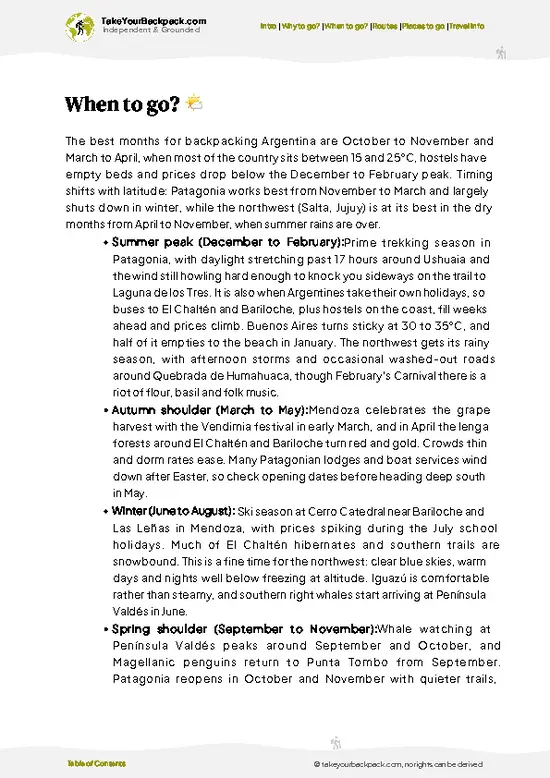
  • Dry Season (May to October): Clear skies, cold nights (down to -10°C/14°F), daytime highs around 15-20°C (59-68°F). Salt flat is cracked and white, best for classic photos, fewer logistical headaches.
  • Wet Season (December to February): Occasional rain creates thin water layers that produce the mirror effect. Daytime temps reach 20-25°C (68-77°F), but roads can turn muddy and access gets trickier.
  • Shoulder Months (November, March): Decent balance of mild weather and lower crowd numbers, good compromise if you want some mirror chance without full wet-season risk.
  • Crowds: Midday tour buses from Purmamarca peak between 11am and 2pm.
Go right at sunrise before the tour vans arrive, the light is softer and you'll have long stretches of crust entirely to yourself.

source: climatestotravel.comJANJanuary: fair for travelingFEBFebruary: fair for travelingMARMarch: fair for travelingAPRApril: highly recommended for travelingMAYMay: excellent for travelingJUNJune: excellent for travelingJULJuly: excellent for travelingAUGAugust: excellent for travelingSEPSeptember: highly recommended for travelingOCTOctober: highly recommended for travelingNOVNovember: fair for travelingDECDecember: fair for traveling
argentina-unique-site-salinas-grandes
© Google | Charles Mac

✈️ The backpacker research shortcutArgentina Travel Guide

An offline-friendly backpacking guide with optimized travel routes, ranked highlights, transport advice, and the best areas to stay.
example page 0 from our offline Travel Guide for Argentina
example page 1 from our offline Travel Guide for Argentina
example page 2 from our offline Travel Guide for Argentina
example page 3 from our offline Travel Guide for Argentina
example page 4 from our offline Travel Guide for Argentina
example page 5 from our offline Travel Guide for Argentina
example page 6 from our offline Travel Guide for Argentina
example page 7 from our offline Travel Guide for Argentina
The digital guide (393 pages) contains:
✅ 131 highlights, ranked by travel appeal
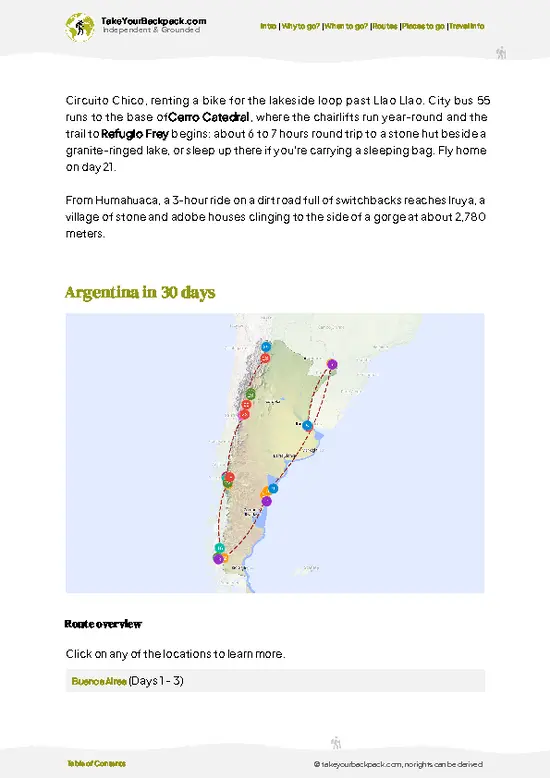
✅ Optimized 14, 21 & 30-day travel routes
✅ Cities, national parks, landmarks, beaches
✅ How to get around
✅ Offline-friendly for travel without Wi-Fi
👉 Click to see all 30+ guide features

📅 Plan smarter in minutes, not weeks
✅ Month by month travel advice
✅ Festivals & national holidays
✅ Budget expectations

🗺️ Go to the right places, skip the overrated ones
✅ Honest pros & cons of destinations
✅ Top hikes, parks & viewpoints
✅ Lesser-known places most travelers miss
✅ Clear “worth it vs skip it” guidance

🛏️ Travel smoothly without rookie mistakes
✅ Best areas to stay
✅ Transport systems explained simply
✅ Common scams & safety advice
✅ SIM cards, money & practical tips

🌍 Understand the country, not just visit it
✅ Culture & traditions
✅ 52 Essential phrases & customs
✅ Festivals worth planning around
✅ Traveler-friendly historical context
✅ Insights that make places more meaningful

📱 Built for real travel conditions
✅ Fully downloadable PDF
✅ Works completely offline
✅ Optimized for phone use
✅ Useful in remote areas & buses
✅ Everything in one place
Stop searching, start planning
Get instant access to your full guide. 30‑day money-back guarantee.
+ Add another guide for just

By proceeding you agree to our terms.
Sent to your inbox immediately after payment • 100% Secure Checkout
Best Backpacking Travel Advisor 2025 tourism awardBest Backpacking
Travel Advisor
2025
What others say about Take Your Backpack Guides:
⭐⭐⭐⭐⭐
Fantastic, amazing amount of information!
⭐⭐⭐⭐⭐
My goodness this is amazing, it's what I've been looking for hats off too you!
⭐⭐⭐⭐⭐
I think this is absolutely BRILLIANT
⭐⭐⭐⭐
Very complete and informative. It's still missing places, but I gotta to commend you
⭐⭐⭐⭐⭐
This is truly amazing, thank you, can't wait to explore it with my kids!
⭐⭐⭐⭐⭐
Awesome resource, thank you!
⭐⭐⭐⭐⭐
This is amazing! Can't wait to explore the ones I haven't seen
⭐⭐⭐⭐
I love this! Well done, great idea.
⭐⭐⭐⭐⭐
Thanks for taking the time to make this gem!
⭐⭐⭐⭐⭐
This might be the best website I've ever seen.
⭐⭐⭐⭐⭐
Congratulations, and thank you so much for your work; it's incredibly valuable.
⭐⭐⭐⭐
In all seriousness I think you did a great job pointing out the important spots
⭐⭐⭐⭐⭐
10/10 very good
⭐⭐⭐⭐⭐
As someone who's only just starting to visit regularly this is awesome, thank you.
⭐⭐⭐⭐
Thank you very much! I'm going to visit my dad, it's going to be very useful!
⭐⭐⭐⭐⭐
This is really cool! We'll be travelling for the first time and this definitely come in handy.
⭐⭐⭐⭐⭐
You are now our minister of culture, congratulations 👨‍💼
⭐⭐⭐⭐⭐
Just wanted to tell you that this is a pearl! Going to follow your recommendations.
⭐⭐⭐⭐⭐
This is so cool. I'll definitely be using the resource for my travels soon.
⭐⭐⭐⭐⭐
This is very impressive! Good work.
⭐⭐⭐⭐⭐
This is an amazing and informative site. Very well done!

🛏️ Where to stay?Choosing the right base

Purmamarca is the standard base, a small town about an hour's drive from the salt flat with a real backpacker circuit: budget guesthouses, communal kitchens, and enough foot traffic that solo travelers link up easily for shared transport out to the flat. It's compact enough to walk everywhere and quiet at night, good if you want altitude acclimatization without noise. Tilcara, a bit further away but well connected via the Quebrada de Humahuaca route, has a livelier backpacker scene with more hostels geared toward younger travelers and a stronger nightlife pulse. Salta city itself, though several … read more 👉
Purmamarca is the standard base, a small town about an hour's drive from the salt flat with a real backpacker circuit: budget guesthouses, communal kitchens, and enough foot traffic that solo travelers link up easily for shared transport out to the flat. It's compact enough to walk everywhere and quiet at night, good if you want altitude acclimatization without noise. Tilcara, a bit further away but well connected via the Quebrada de Humahuaca route, has a livelier backpacker scene with more hostels geared toward younger travelers and a stronger nightlife pulse. Salta city itself, though several hours out, works if you're organizing a multi-stop tour and want access to bigger hostels, tour agencies, and better transport connections before heading up into the Puna. Whichever base you pick, altitude matters more than convenience, so spend a night acclimatizing before the salt flat trip rather than pushing straight through from lower elevations.

👛 Costs (as of 19 October 2026)Typical daily expenses

Visiting Salinas Grandes is inexpensive by regional backpacking standards, with transport being the main cost variable rather than entry itself.
CategoryBudget RangeLocal Reality
Entry/Access FeeUSD 1 to 3Small community-managed fee collected at the site, sometimes informal
Shared Van from PurmamarcaUSD 10 to 20 round tripShared minivans depart mid-morning, return early afternoon
Private Tour/TaxiUSD 40 to 70Useful for sunrise trips or flexible timing, split cost with others if possible
Food (day trip)USD 3 to 8Pack snacks or grab empanadas in Purmamarca before departure
Salt SouvenirsUSD 2 to 10Hand-carved figurines sold roadside by local cooperatives
Accommodation (Purmamarca)USD 10 to 25/nightBasic hostel dorm or budget guesthouse room
⚠️ Prices can change and everyone travels differently, so take this as a rough guide. Hope it helps you plan your adventure!

FAQTraveler FAQ

Salinas Grandes is a high-altitude salt flat spanning about 212 square kilometers along the border of Jujuy and Salta provinces in northern Argentina, sitting at about 3,450 meters elevation. It formed from an ancient evaporated lake and remains an active salt extraction site worked by local cooperatives using traditional hand-cutting methods.
Most backpackers spend two to three hours at the site, enough time to walk out onto the crust, take photos, and watch the extraction work if it's happening. Combined with the drive from Purmamarca (about an hour each way) or Tilcara, plan for a half-day trip total, though sunrise visits require leaving before dawn.
The most common route is a shared minivan or private taxi from Purmamarca, crossing the Lipan Pass at around 4,170 meters before descending to the flat. Some travelers arrange transport from Tilcara or Salta as part of a longer Quebrada de Humahuaca tour, and self-driving is possible if you're comfortable with high-altitude mountain roads.
⚠️ Things can change over time, so always validate details locally before you go.

Other Argentine landmarks near Salinas Grandes

Explore more nearby:

  • Serranía de Hornocal—Fourteen colored ridges, 4,350 m mirador, gravel switchbacks, condor mornings| 103 km away
  • Salar de Arizaro—Ojos de Mar, cracked salt polygons, Arizaro volcano, night sky| 206 km away
  • Cono de Arita—Symmetrical cone, salt crust, shadow line, Tolar Grande| 225 km away

💡 Not sure where to go next?
Create a personalized itinerary for Argentina including Salinas Grandes and the places that fit your trip.

Generate my itinerary

👉 Discover all landmarks

Or checkout all Argentina has to offer (think cities, towns, villages, national parks, hikes, beaches, festivals)
Country photo of Argentina

We 💚 feedbackKey takeaways before you go

Worth it for that first ten minutes standing on the crust with no sound except wind, genuinely nowhere else feels like that. The drawback: altitude sickness hits some travelers hard, and there's no real infrastructure out there if it does. Acclimatize first, then go.

✈️ When did I visit Argentina?
I have visited Argentina, together with Chile, in September 2012.

✍️ Help improve this page!
The information on this page is based on my own backpacking experience in Argentina, supplemented with up-to-date research and feedback from other travelers. Travel details can change, so if you notice anything outdated or incomplete, feel free to let me know.


🙋‍♂️ Give feedback

👋 Meet the founderWho’s Behind Take Your Backpack?

Johan, backpacker and founder of TakeYourBackpackHi, I’m Johan (Netherlands 🇳🇱), the creator of TakeYourBackpack. Over the past 3 decades, I’ve backpacked through 90+ countries across six continents, gaining extensive experience with independent travel, long-term trips, and overland routes.

This site is built on a combination of firsthand travel experience and carefully curated insights from other backpackers. Many guides are based on places I’ve personally visited, while others bring together tips, observations, and practical advice shared by trusted travelers I’ve met along the way.

The goal is to provide realistic, experience-driven guidance — not generic itineraries — so you can explore destinations with better context, clearer expectations, and more confidence.