×

Armenia🇦🇲 | best festivalsTop-Rated 9 festivals in Armenia

Festivals in Armenia run on village squares, monastery courtyards and Soviet-era concert halls, not on ticketed fairgrounds. Expect smoke from grilling pork and lamb skewers, the nasal drone of the duduk, and apricot brandy poured into small glasses before noon. Yerevan has the most polished programs and the easiest buses and taxis, but also the biggest crowds. In Gyumri, Dilijan and Syunik, events are smaller, cheaper and more personal, and reaching them can mean a marshrutka that leaves when full. For backpacking or independent travel, that gap decides whether you want comfort or contact.

By Johan Kruseman 🇳🇱 | Updated October 18, 2026
Explore the best regions in Armenia

Why go?Why Travelers Love These Spots

Armenia packs an unusual amount of festival life into a country about the size of Maryland. The reason is continuity: it was the first state to adopt Christianity, in the early 300s, so church feasts, blessing of grapes and water-splashing rites still sit on the calendar and draw whole villages. Add a wine tradition stretching back some 6,000 years, apricot orchards, and a music culture built around the duduk, the dhol and choral chant, and you get celebrations tied to harvests and saints rather than to tourism marketing.

Geography shapes the experience. The country is mountainous and landlocked, with most of it above 1,000 meters, so evenings turn cold quickly even in summer, and rural roads wind slowly through basalt gorges and bare volcanic slopes. Distances are short, yet travel times … read more 👉
Armenia packs an unusual amount of festival life into a country about the size of Maryland. The reason is continuity: it was the first state to adopt Christianity, in the early 300s, so church feasts, blessing of grapes and water-splashing rites still sit on the calendar and draw whole villages. Add a wine tradition stretching back some 6,000 years, apricot orchards, and a music culture built around the duduk, the dhol and choral chant, and you get celebrations tied to harvests and saints rather than to tourism marketing.

Geography shapes the experience. The country is mountainous and landlocked, with most of it above 1,000 meters, so evenings turn cold quickly even in summer, and rural roads wind slowly through basalt gorges and bare volcanic slopes. Distances are short, yet travel times are long.

Before choosing Armenia for festivals, know that information is patchy. Dates for village events are often confirmed only weeks ahead, through Facebook pages and Telegram groups, and printed English schedules are rare. Public transport thins out after dark, so plan a return ride or a bed nearby. Lodging in small towns fills fast during major events, and cash in Armenian dram (AMD) is still useful for food stalls and guesthouses. Tourist infrastructure is improving, but flexibility is the best preparation.
Why These Made the Cut
The list of best festivals in Armenia is created based on energy, traditions, crowd experience, activities, and overall excitement. If you feel a festival is missing in this list, please let us know.

When to go?Seasonal Guide to Visiting

Best months and weather: The best months for festivals in Armenia are May to October, when days run roughly 20 to 32°C in Yerevan and open-air stages, vineyards and monastery courtyards all function. June and September are the most comfortable, with dry light, warm evenings and fewer crowds than midsummer. In July and August the Ararat plain can reach 35 to 40°C, so the capital feels like a hot stone oven by afternoon, while highland towns such as Dilijan, Sevan and Goris stay cooler, often 22 to 28°C.
Shoulder seasons: Late April and early May bring blossoming apricot trees, fresh green slopes and chilly nights near 5 to 8°C, with rain showers more likely than later in summer. October brings the harvest, golden vineyards and smoke from village kitchens, though nights in the highlands drop … read more 👉
Best months and weather: The best months for festivals in Armenia are May to October, when days run roughly 20 to 32°C in Yerevan and open-air stages, vineyards and monastery courtyards all function. June and September are the most comfortable, with dry light, warm evenings and fewer crowds than midsummer. In July and August the Ararat plain can reach 35 to 40°C, so the capital feels like a hot stone oven by afternoon, while highland towns such as Dilijan, Sevan and Goris stay cooler, often 22 to 28°C.
Shoulder seasons: Late April and early May bring blossoming apricot trees, fresh green slopes and chilly nights near 5 to 8°C, with rain showers more likely than later in summer. October brings the harvest, golden vineyards and smoke from village kitchens, though nights in the highlands drop toward freezing by month's end. Winter runs November to March, with snow common in Gyumri, Vanadzor and Sevan, temperatures often below 0°C and many mountain roads icy. Indoor events continue in Yerevan, but outdoor celebrations are rare.
Crowds and prices: Peak pressure comes in July, August and around major holidays, when guesthouse prices in popular towns can rise by 20 to 40 percent and rooms in smaller places can vanish. Dorm beds in Yerevan typically cost about 6,000 to 10,000 AMD (US$15 to 25), more in peak weeks.

festival hoppingTips for Visiting Multiple Destinations

How long to allow: A trip combining several festivals in Armenia needs 7 to 12 days, because roads are slow even when distances look small. Most of the country sits within a loop out of Yerevan, so use the capital as your hub and move in one direction rather than backtracking.
Which regions group well: The central cluster of Yerevan, Echmiadzin, Aragatsotn and Lake Sevan works as a first leg, with 1 to 2 nights per stop and transfers of 1 to 2.5 hours. From there, Dilijan and the northern forests are about 2 hours away by marshrutka or bus, and Gyumri is 2 to 2.5 hours from the capital, with its black-stone streets and the smell of coal and baking bread on cold mornings. Heading south to Vayots Dzor and Syunik (Areni, Yeghegnadzor, Goris) takes 2 to 3.5 hours to Areni and about 5 hours to Goris, … read more 👉
How long to allow: A trip combining several festivals in Armenia needs 7 to 12 days, because roads are slow even when distances look small. Most of the country sits within a loop out of Yerevan, so use the capital as your hub and move in one direction rather than backtracking.
Which regions group well: The central cluster of Yerevan, Echmiadzin, Aragatsotn and Lake Sevan works as a first leg, with 1 to 2 nights per stop and transfers of 1 to 2.5 hours. From there, Dilijan and the northern forests are about 2 hours away by marshrutka or bus, and Gyumri is 2 to 2.5 hours from the capital, with its black-stone streets and the smell of coal and baking bread on cold mornings. Heading south to Vayots Dzor and Syunik (Areni, Yeghegnadzor, Goris) takes 2 to 3.5 hours to Areni and about 5 hours to Goris, so give them 2 to 3 nights and treat them as the far end of the loop. A sensible direction is north first, back through Yerevan, then south, or the reverse if your dates demand it.
Planning mistakes: The classic error is stacking events on consecutive days in opposite corners. Leave one buffer day between distant regions. A second is relying on the last marshrutka, since many leave only when full and stop by late afternoon. Book a bed in smaller towns early, and arrange a shared taxi back from evening events instead of hoping.

The ListTop festivals of Armenia

1 Areni Wine Festival

village harvest, grape stomping, rural tastings

Visit Armenia’s wine heartland during harvest, where you can taste local vintages, watch traditional dances, and join grape-stomping contests.

2 Vardavar

water splashing, public squares, summer ritual

Celebrate an ancient festival by joining locals in citywide water fights, where everyone—regardless of age—gets drenched in good humor.

3 Yerevan Wine Days

wine stalls, central boulevards, tasting glasses

Stroll through closed-off city streets lined with regional wineries, sampling varietals and local snacks in a festive urban atmosphere.

4 Golden Apricot International Film Festival

arthouse cinema, filmmaker gatherings, Yerevan screenings

Join film enthusiasts and directors for a week of premieres, discussions, and cross-cultural encounters in Armenia’s capital’s independent cinemas.

5 Yerevan Beer Fest

craft breweries, tasting tents, city park venue

Sample a wide range of Armenian and international brews, mingle with locals, and enjoy live music in a relaxed outdoor setting.

6 Dolma Festival

culinary contest, stuffed grape leaves, rural setting

Watch teams compete to make the best dolma, sample dozens of recipes, and learn about Armenian food traditions in a countryside environment.

7 Yerevan Jazz Fest

improvised sets, international artists, concert halls

Hear jazz legends and emerging talent perform in intimate venues, with a focus on collaboration and spontaneous musical moments.

8 Sheep Shearing Festival

mountain village, shepherd skills, wool crafts

Observe skilled shepherds shear sheep by hand, try rustic foods, and see how wool is spun and woven in a highland community.

9 Taraz Festival

traditional dress, textile displays, folk pageantry

See vibrant Armenian costumes on parade, browse handmade fabrics, and witness demonstrations of centuries-old weaving and embroidery techniques.

Loading the map 🌍

Expert viewExpert Commentary on festivals

How many to attend: I advise two to three festivals on a single trip. Armenian events tend to spread across long days of eating, toasting and watching, and roads between regions are slow, so a fourth stop usually means you are watching the clock rather than the music. Three gives you contrast, you get a full day at each, and you still have time to wander a monastery or a market without a deadline.
Choosing by travel style: If you want comfort and variety, favor Yerevan events: you can walk to the venue, eat well afterward and catch a metro or taxi home. If you are drawn to tradition and food, pick a village or wine-region celebration, where you get a plate of khorovats, home-pressed wine and a seat at someone’s table. If you love music and arts, prioritize city and mountain-town programs with … read more 👉
How many to attend: I advise two to three festivals on a single trip. Armenian events tend to spread across long days of eating, toasting and watching, and roads between regions are slow, so a fourth stop usually means you are watching the clock rather than the music. Three gives you contrast, you get a full day at each, and you still have time to wander a monastery or a market without a deadline.
Choosing by travel style: If you want comfort and variety, favor Yerevan events: you can walk to the venue, eat well afterward and catch a metro or taxi home. If you are drawn to tradition and food, pick a village or wine-region celebration, where you get a plate of khorovats, home-pressed wine and a seat at someone’s table. If you love music and arts, prioritize city and mountain-town programs with stages and concert halls. Travelers on a tight timeline should pick one capital event and one rural event, which shows both sides of the country without crossing it twice.
What it costs: Budget US$30 to 55 a day for a backpacker moving between festivals, covering a dorm bed or guesthouse (US$15 to 30), meals (US$8 to 15) and local transport. Entry is often free at outdoor and village events, while concerts and larger cultural programs typically run about 3,000 to 15,000 AMD (US$8 to 40). Marshrutka rides between towns cost roughly 500 to 3,000 AMD (US$1.30 to 8), and a shared or private taxi home at night can add 3,000 to 10,000 AMD. Carry cash, because small vendors and village hosts rarely take cards, and you get a hot lavash sandwich or a glass of local wine out of it.
Safety and etiquette: Armenia is generally safe for travelers, and festival crowds are friendly and curious. Avoid areas near the borders with Azerbaijan and check current government travel advice before heading to Syunik, Tavush and other border regions. Toasts are a ritual: wait for the host to lead, hold eye contact, and do not rush the drinking, because refusing a glass can feel rude but a polite sip is accepted. Dress modestly in church grounds, with shoulders covered, and ask before photographing people at religious rites. Mountain evenings get cold, so pack a warm layer, and on hot days carry water and a hat because shade at open-air events is scarce and the sun on the plateau is strong. Keep an eye on your bag in dense city crowds, as you would anywhere.

✈️ The backpacker research shortcutArmenia Travel Guide

An offline-friendly backpacking guide with optimized travel routes, ranked highlights, transport advice, and the best areas to stay.
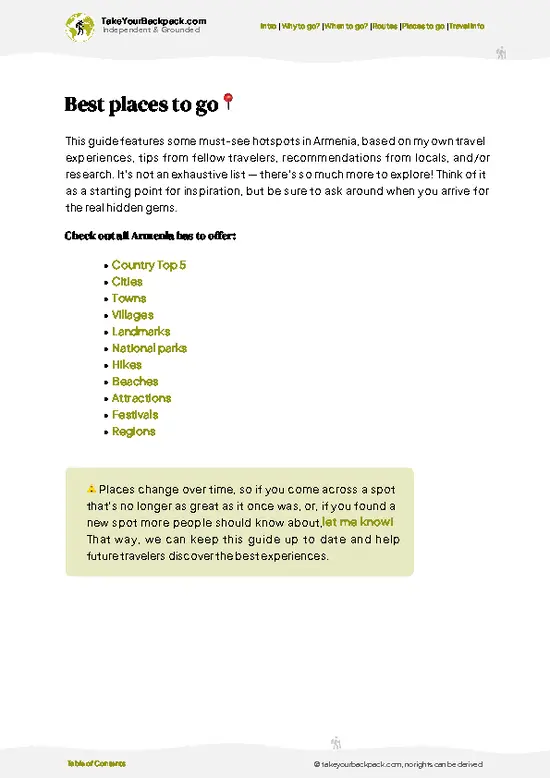
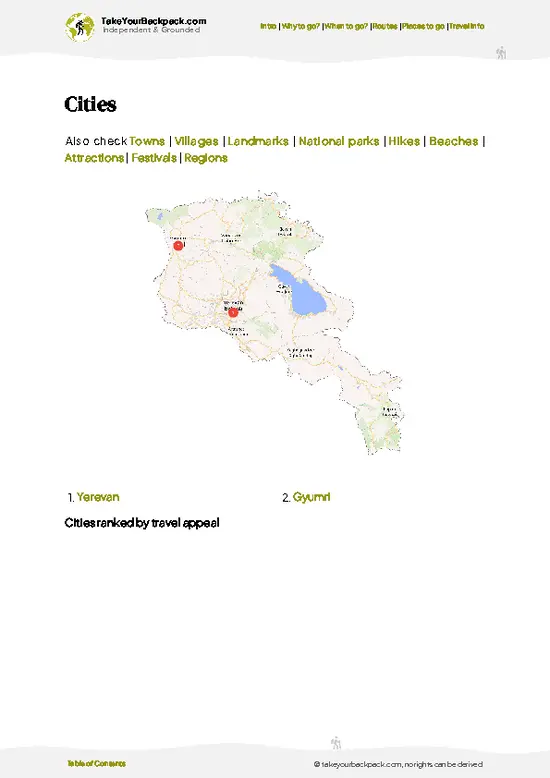
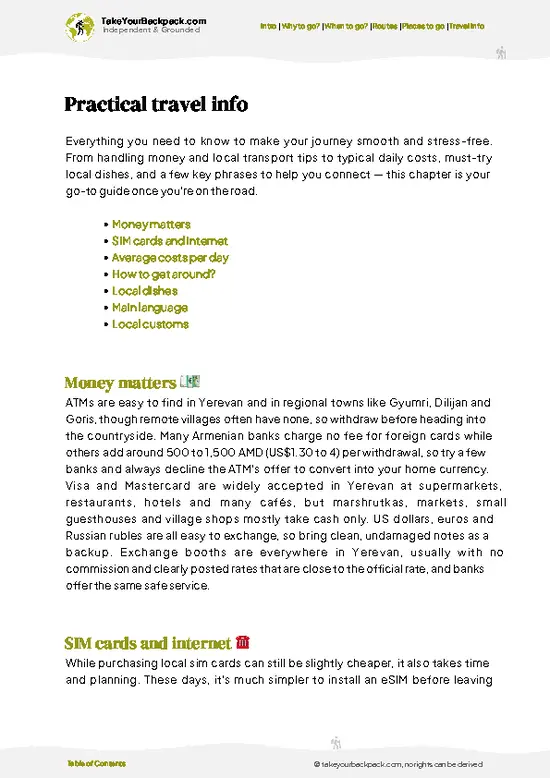
example page 0 from our offline Travel Guide for Armenia
example page 1 from our offline Travel Guide for Armenia
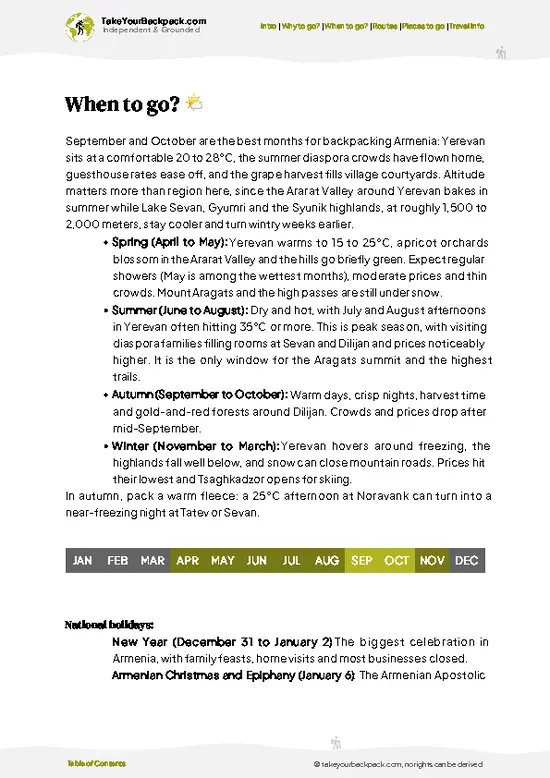
example page 2 from our offline Travel Guide for Armenia
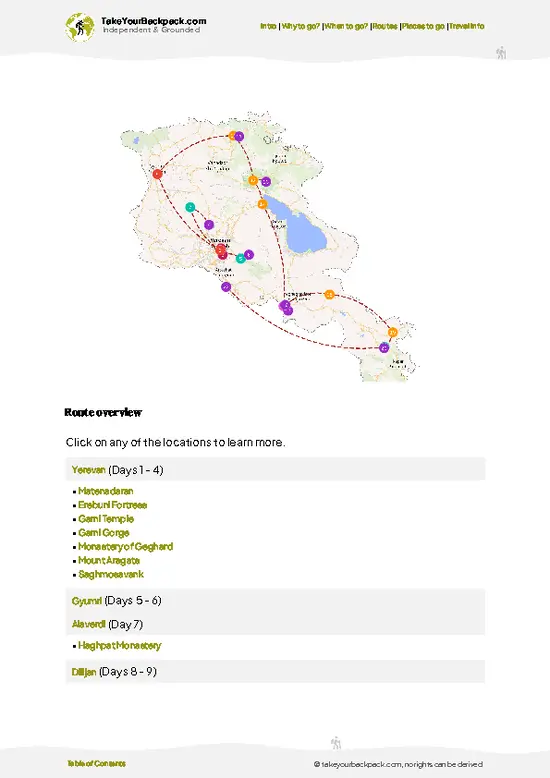
example page 3 from our offline Travel Guide for Armenia
example page 4 from our offline Travel Guide for Armenia
example page 5 from our offline Travel Guide for Armenia
example page 6 from our offline Travel Guide for Armenia
example page 7 from our offline Travel Guide for Armenia
The digital guide (257 pages) contains:
✅ 65 highlights, ranked by travel appeal
✅ Optimized 5, 10 & 15-day travel routes
✅ Cities, national parks, landmarks, beaches
✅ How to get around
✅ Offline-friendly for travel without Wi-Fi
👉 Click to see all 30+ guide features

📅 Plan smarter in minutes, not weeks
✅ Month by month travel advice
✅ Festivals & national holidays
✅ Budget expectations

🗺️ Go to the right places, skip the overrated ones
✅ Honest pros & cons of destinations
✅ Top hikes, parks & viewpoints
✅ Lesser-known places most travelers miss
✅ Clear “worth it vs skip it” guidance

🛏️ Travel smoothly without rookie mistakes
✅ Best areas to stay
✅ Transport systems explained simply
✅ Common scams & safety advice
✅ SIM cards, money & practical tips

🌍 Understand the country, not just visit it
✅ Culture & traditions
✅ 52 Essential phrases & customs
✅ Festivals worth planning around
✅ Traveler-friendly historical context
✅ Insights that make places more meaningful

📱 Built for real travel conditions
✅ Fully downloadable PDF
✅ Works completely offline
✅ Optimized for phone use
✅ Useful in remote areas & buses
✅ Everything in one place
Stop searching, start planning
Get instant access to your full guide. 30‑day money-back guarantee.
+ Add another guide for just

By proceeding you agree to our terms.
Sent to your inbox immediately after payment • 100% Secure Checkout
Best Backpacking Travel Advisor 2025 tourism awardBest Backpacking
Travel Advisor
2025
What others say about Take Your Backpack Guides:
⭐⭐⭐⭐⭐
Fantastic, amazing amount of information!
⭐⭐⭐⭐⭐
My goodness this is amazing, it's what I've been looking for hats off too you!
⭐⭐⭐⭐⭐
I think this is absolutely BRILLIANT
⭐⭐⭐⭐
Very complete and informative. It's still missing places, but I gotta to commend you
⭐⭐⭐⭐⭐
This is truly amazing, thank you, can't wait to explore it with my kids!
⭐⭐⭐⭐⭐
Awesome resource, thank you!
⭐⭐⭐⭐⭐
This is amazing! Can't wait to explore the ones I haven't seen
⭐⭐⭐⭐
I love this! Well done, great idea.
⭐⭐⭐⭐⭐
Thanks for taking the time to make this gem!
⭐⭐⭐⭐⭐
This might be the best website I've ever seen.
⭐⭐⭐⭐⭐
Congratulations, and thank you so much for your work; it's incredibly valuable.
⭐⭐⭐⭐
In all seriousness I think you did a great job pointing out the important spots
⭐⭐⭐⭐⭐
10/10 very good
⭐⭐⭐⭐⭐
As someone who's only just starting to visit regularly this is awesome, thank you.
⭐⭐⭐⭐
Thank you very much! I'm going to visit my dad, it's going to be very useful!
⭐⭐⭐⭐⭐
This is really cool! We'll be travelling for the first time and this definitely come in handy.
⭐⭐⭐⭐⭐
You are now our minister of culture, congratulations 👨‍💼
⭐⭐⭐⭐⭐
Just wanted to tell you that this is a pearl! Going to follow your recommendations.
⭐⭐⭐⭐⭐
This is so cool. I'll definitely be using the resource for my travels soon.
⭐⭐⭐⭐⭐
This is very impressive! Good work.
⭐⭐⭐⭐⭐
This is an amazing and informative site. Very well done!

🛏️ Where to stay?Where to Stay in Armenia

Armenia has plenty of hostels and family-run guesthouses, with dorm beds in Yerevan typically running 4,000 to 8,000 AMD (US$10 to 20) a night. The densest cluster sits in central Kentron, around Republic Square, Northern Avenue and the Cascade, where you can walk to most sights and the wine bars but should expect street noise late into the night, while neighboring Arabkir is quieter, residential and still only a 15 to 20 minute walk from the center. Outside the capital, Gyumri and Dilijan lean toward homestays and small guesthouses with breakfast included, which suits slower travel but gives you little nightlife after dark.

If you enjoy meeting fellow travelers, consider choosing hostels with … read more 👉
Armenia has plenty of hostels and family-run guesthouses, with dorm beds in Yerevan typically running 4,000 to 8,000 AMD (US$10 to 20) a night. The densest cluster sits in central Kentron, around Republic Square, Northern Avenue and the Cascade, where you can walk to most sights and the wine bars but should expect street noise late into the night, while neighboring Arabkir is quieter, residential and still only a 15 to 20 minute walk from the center. Outside the capital, Gyumri and Dilijan lean toward homestays and small guesthouses with breakfast included, which suits slower travel but gives you little nightlife after dark.

If you enjoy meeting fellow travelers, consider choosing hostels with high ratings for atmosphere. On the other hand, if you prefer having your own space, a hotel might be a better option.

ArmeniaMore of Armenia

👋 Meet the founderWho’s Behind Take Your Backpack?

Johan, backpacker and founder of TakeYourBackpackHi, I’m Johan (Netherlands 🇳🇱), the creator of TakeYourBackpack. Over the past 3 decades, I’ve backpacked through 90+ countries across six continents, gaining extensive experience with independent travel, long-term trips, and overland routes.

This site is built on a combination of firsthand travel experience and carefully curated insights from other backpackers. Many guides are based on places I’ve personally visited, while others bring together tips, observations, and practical advice shared by trusted travelers I’ve met along the way.

The goal is to provide realistic, experience-driven guidance — not generic itineraries — so you can explore destinations with better context, clearer expectations, and more confidence.