×

Armenia🇦🇲 | best citiesTop-Rated 2 cities in Armenia

Cities in Armenia are small, compact and built from stone the color of dried apricots: pink tuff in the capital, black basalt in the north, with Soviet-era blocks and mountain ridges never far behind. Armenia has only a handful of real urban centers, so the differences between them are sharp. The capital has cafés, loud marshrutkas and a late-night pulse, with beds from about US$10 to 20. Provincial towns are quieter, smell of woodsmoke and fresh lavash in the morning, and have sparse transport. Independent travelers get the best deal by mixing big-city comfort with slower regional towns, where crowds are thin and the roads can be rough.

By Johan Kruseman 🇳🇱 | Updated October 18, 2026
Explore the best towns in Armenia

Why go?Why Travelers Love These Spots

Armenia is a country where cities grew in tight pockets of fertile valley and high plateau, squeezed between volcanic ridges at 1,000 to 2,000 meters. The result is small, walkable centers rather than sprawl, and almost every urban area sits within sight of a mountain. Stone is the common material. Tuff and basalt hold the heat of the day and glow orange or charcoal at dusk, which gives streets a texture you will not find in glass-and-concrete capitals.

History shapes everything. As one of the world’s earliest Christian states, Armenia placed monasteries and old trade towns on the edges of its cities, and Soviet planning later added wide avenues, grey apartment blocks and big public squares. Expect that contrast: ancient khachkars (carved stone crosses) beside mosaic-covered bus stops.

Before … read more 👉
Armenia is a country where cities grew in tight pockets of fertile valley and high plateau, squeezed between volcanic ridges at 1,000 to 2,000 meters. The result is small, walkable centers rather than sprawl, and almost every urban area sits within sight of a mountain. Stone is the common material. Tuff and basalt hold the heat of the day and glow orange or charcoal at dusk, which gives streets a texture you will not find in glass-and-concrete capitals.

History shapes everything. As one of the world’s earliest Christian states, Armenia placed monasteries and old trade towns on the edges of its cities, and Soviet planning later added wide avenues, grey apartment blocks and big public squares. Expect that contrast: ancient khachkars (carved stone crosses) beside mosaic-covered bus stops.

Before choosing Armenia for its cities, know the limits. The country is landlocked, borders with Turkey and Azerbaijan are closed, and public transport is mostly minibuses with no fixed timetable. Winters are cold and summers can be dry and dusty. The reward is low prices, strong coffee, apricots in season, and locals who will often press food on you. Cities here suit travelers who like atmosphere and conversation over polished sights.
Our Approach to Ranking
The list of best cities in Armenia is created based on culture, vibe, attractions, transport ease, and local charm. If you feel a city is missing in this list, please let us know.

When to go?Seasonal Guide to Visiting

Best months for city travel: The best months are May to June and September to October, when daytime temperatures sit around 18 to 28°C and the light is clear and soft on stone buildings. Spring brings blossoming apricot and cherry trees and occasional showers, with Yerevan getting roughly 30 to 50 mm of rain a month in April and May.

Summer and winter: July and August are hot in the lowlands, with Yerevan often reaching 35 to 40°C. Pavements radiate heat, shops close at midday, and evenings fill with people on terraces. Higher northern and central towns stay cooler, usually 24 to 30°C, so they make more comfortable summer stops. Prices for beds rise slightly in peak summer, perhaps 10 to 30 percent in popular spots, and diaspora visitors crowd flights and guesthouses in July and August.

… read more 👉
Best months for city travel: The best months are May to June and September to October, when daytime temperatures sit around 18 to 28°C and the light is clear and soft on stone buildings. Spring brings blossoming apricot and cherry trees and occasional showers, with Yerevan getting roughly 30 to 50 mm of rain a month in April and May.

Summer and winter: July and August are hot in the lowlands, with Yerevan often reaching 35 to 40°C. Pavements radiate heat, shops close at midday, and evenings fill with people on terraces. Higher northern and central towns stay cooler, usually 24 to 30°C, so they make more comfortable summer stops. Prices for beds rise slightly in peak summer, perhaps 10 to 30 percent in popular spots, and diaspora visitors crowd flights and guesthouses in July and August.

Winter, from December to February, is cold and quiet. Lowland cities hover around -5 to 3°C, while upland towns can drop well below -10°C with snow. Roads and minibus routes slow down or stop on mountain passes. The upside is empty streets, steaming bowls of khash and the lowest accommodation prices, often 20 to 30 percent below summer. New Year is the exception, with busy markets and higher rates.

city hoppingTips for Visiting Multiple Destinations

How many days to plan: A trip combining several cities in Armenia needs 7 to 10 days. The country is small, but mountain roads slow everything, and distances of 100 to 200 km often take 2 to 4 hours.

Grouping and direction: Most travelers start in Yerevan, the transport hub, where minibuses leave from several stations and shared taxis fill up near them. The center and north cluster well together, with trips of about 2 to 3 hours. The south is a separate leg, with longer drives of 3 to 5 hours over passes. A loop out of the capital to the north, then back through the central highlands and south, avoids retracing the same roads. Allow 2 to 3 nights in the capital and 1 to 2 nights in each regional town, which gives time to wander markets and still catch evening light.

Planning mistakes: The … read more 👉
How many days to plan: A trip combining several cities in Armenia needs 7 to 10 days. The country is small, but mountain roads slow everything, and distances of 100 to 200 km often take 2 to 4 hours.

Grouping and direction: Most travelers start in Yerevan, the transport hub, where minibuses leave from several stations and shared taxis fill up near them. The center and north cluster well together, with trips of about 2 to 3 hours. The south is a separate leg, with longer drives of 3 to 5 hours over passes. A loop out of the capital to the north, then back through the central highlands and south, avoids retracing the same roads. Allow 2 to 3 nights in the capital and 1 to 2 nights in each regional town, which gives time to wander markets and still catch evening light.

Planning mistakes: The most common error is cramming too many stops in, then spending hours in a hot minibus with luggage on your knees. Choose fewer places and stay longer. Another is relying on afternoon departures: many minibuses leave when full and stop running by early evening, so travel in the morning. Winter travelers should check pass conditions before setting out, and everyone should carry cash in drams for smaller stations.

The ListTop cities of Armenia

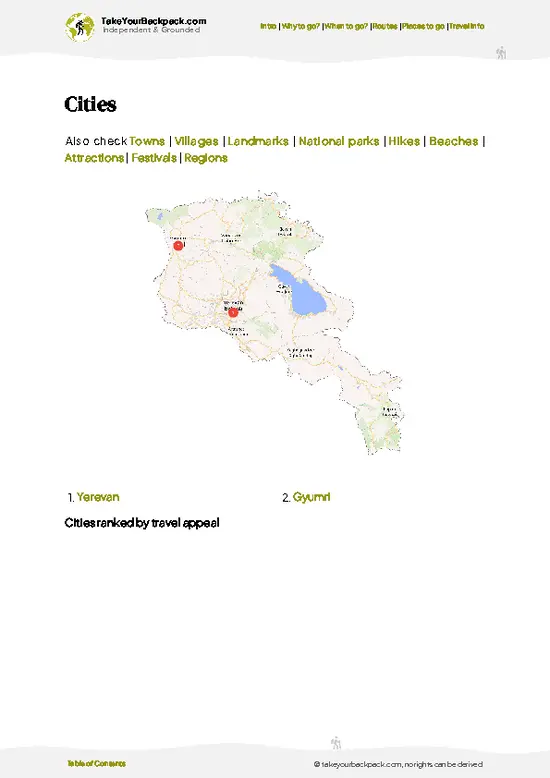
1 Yerevan

Republic Square, open-air sculpture, bustling markets

Start your day amid monumental plazas and end it in lively courtyards, with contemporary art and street food shaping each neighborhood’s rhythm.

armenia-city-yerevan
© Google |

2 Gyumri

earthquake scars, black tuff architecture, artisan workshops

Wander streets marked by Soviet-era resilience and discover a creative spirit in local studios, where daily life unfolds at a measured pace.

armenia-city-gyumri
© Google |
Loading the map 🌍

Expert viewExpert Commentary on cities

How many cities to visit: I advise three to four cities on a first trip. Distances are short on a map but slow on the road, and a city here repays a second evening more than another ticked box. Fewer stops mean time for a long lunch of grilled meat and herbs, a market wander and a slow coffee that costs under US$2.

Choosing the kind of city: Culture and nightlife seekers should favor the capital: wide boulevards, wine bars, galleries and music spilling from basement venues until late. Travelers who want quiet, stone alleys and mountain air do better in smaller provincial towns, where the soundtrack is roosters, church bells and the clatter of old Lada engines. Pick one big and the rest small to get both energy and calm. Hikers should favor towns close to trailheads, since the payoff is waking … read more 👉
How many cities to visit: I advise three to four cities on a first trip. Distances are short on a map but slow on the road, and a city here repays a second evening more than another ticked box. Fewer stops mean time for a long lunch of grilled meat and herbs, a market wander and a slow coffee that costs under US$2.

Choosing the kind of city: Culture and nightlife seekers should favor the capital: wide boulevards, wine bars, galleries and music spilling from basement venues until late. Travelers who want quiet, stone alleys and mountain air do better in smaller provincial towns, where the soundtrack is roosters, church bells and the clatter of old Lada engines. Pick one big and the rest small to get both energy and calm. Hikers should favor towns close to trailheads, since the payoff is waking up to trails instead of traffic.

What it costs: Budget US$25 to 45 a day for a comfortable independent trip, or US$18 to 25 if you stick to dorms and street food. Dorm beds run roughly US$8 to 15, private guesthouse rooms US$25 to 50. City minibuses cost around 100 to 150 dram (under US$0.50), and intercity rides typically US$3 to 10 depending on distance. Museum and monastery entry usually falls between 1,000 and 3,000 dram (US$2.50 to 8), and a private guide for a half day is about US$30 to 60. A hearty meal at a local restaurant is US$6 to 12, and the fruit, cheese and fresh bread bought from market stalls make a cheap, fragrant picnic.

Safety and culture: Cities are generally safe, with low violent crime. Petty theft is rare but possible in crowded markets and on packed minibuses, so keep valuables in a front pocket. Taxi drivers sometimes overcharge, so use a ride-hailing app or agree on the fare first. Crossing roads takes confidence, as drivers rarely yield at crossings.

Cultural habits matter. Hospitality is strong: accept a coffee or a toast, and expect long dinners with brandy and many toasts. Dress modestly in churches, covering shoulders and knees, and women may be asked to cover their heads in some. Avoid casual political talk about the neighboring conflict unless a local raises it, and never photograph military sites or border areas. Learn a few words of Armenian, like “barev” for hello, and the smiles will follow.

✈️ The backpacker research shortcutArmenia Travel Guide

An offline-friendly backpacking guide with optimized travel routes, ranked highlights, transport advice, and the best areas to stay.
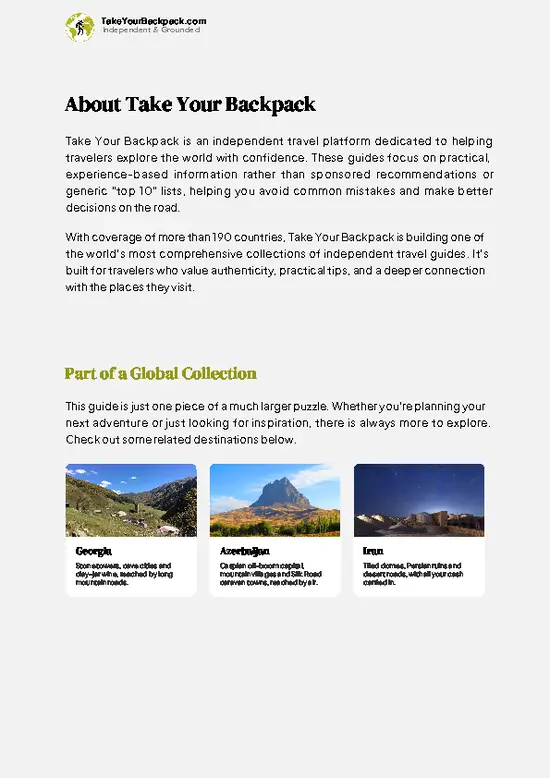
example page 0 from our offline Travel Guide for Armenia
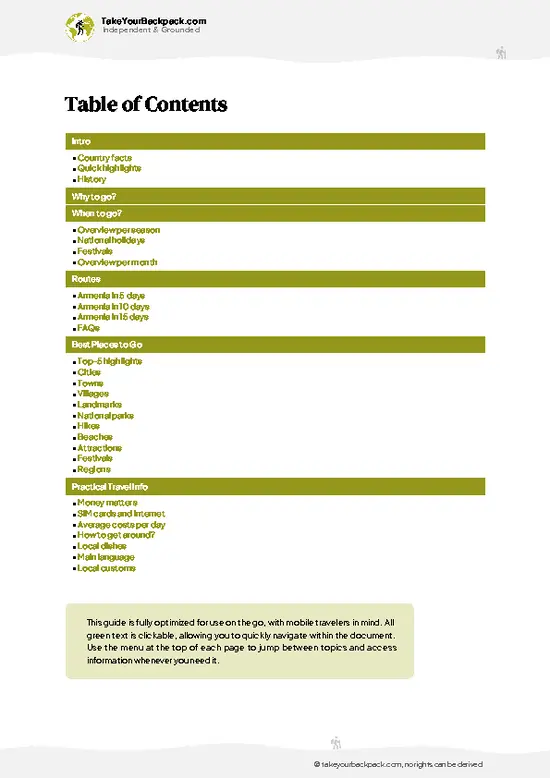
example page 1 from our offline Travel Guide for Armenia
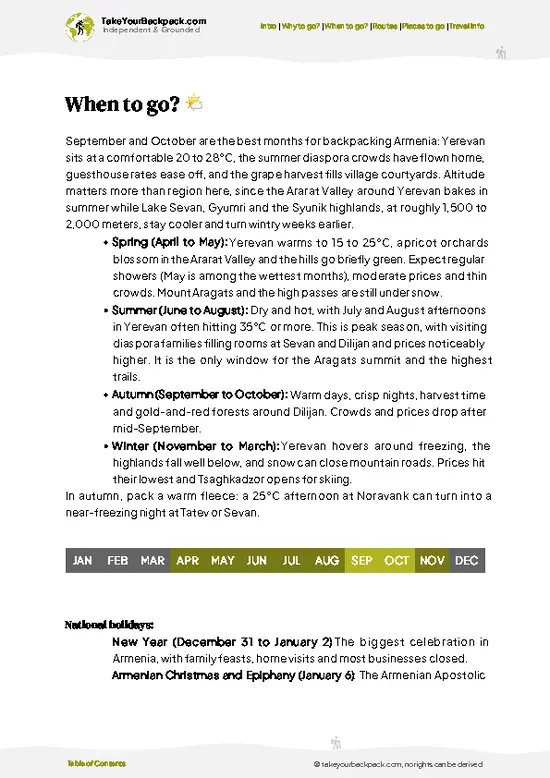
example page 2 from our offline Travel Guide for Armenia
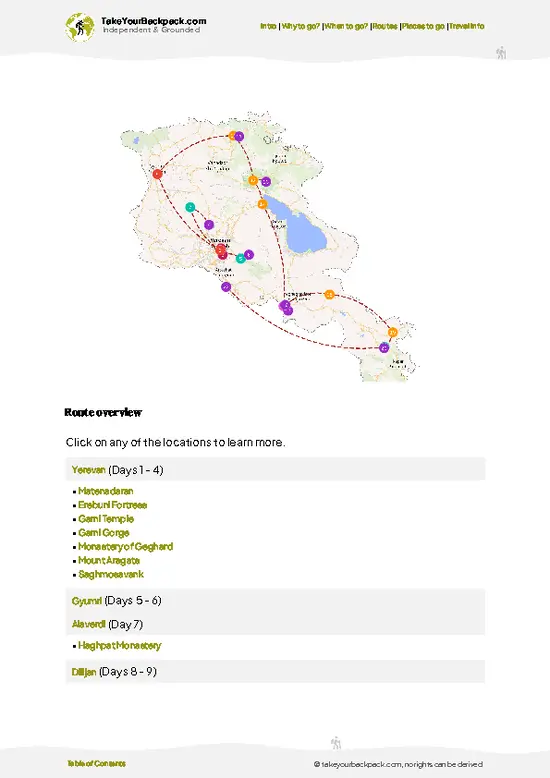
example page 3 from our offline Travel Guide for Armenia
example page 4 from our offline Travel Guide for Armenia
example page 5 from our offline Travel Guide for Armenia
example page 6 from our offline Travel Guide for Armenia
example page 7 from our offline Travel Guide for Armenia
The digital guide (257 pages) contains:
✅ 65 highlights, ranked by travel appeal
✅ Optimized 5, 10 & 15-day travel routes
✅ Cities, national parks, landmarks, beaches
✅ How to get around
✅ Offline-friendly for travel without Wi-Fi
👉 Click to see all 30+ guide features

📅 Plan smarter in minutes, not weeks
✅ Month by month travel advice
✅ Festivals & national holidays
✅ Budget expectations

🗺️ Go to the right places, skip the overrated ones
✅ Honest pros & cons of destinations
✅ Top hikes, parks & viewpoints
✅ Lesser-known places most travelers miss
✅ Clear “worth it vs skip it” guidance

🛏️ Travel smoothly without rookie mistakes
✅ Best areas to stay
✅ Transport systems explained simply
✅ Common scams & safety advice
✅ SIM cards, money & practical tips

🌍 Understand the country, not just visit it
✅ Culture & traditions
✅ 52 Essential phrases & customs
✅ Festivals worth planning around
✅ Traveler-friendly historical context
✅ Insights that make places more meaningful

📱 Built for real travel conditions
✅ Fully downloadable PDF
✅ Works completely offline
✅ Optimized for phone use
✅ Useful in remote areas & buses
✅ Everything in one place
Stop searching, start planning
Get instant access to your full guide. 30‑day money-back guarantee.
+ Add another guide for just

By proceeding you agree to our terms.
Sent to your inbox immediately after payment • 100% Secure Checkout
Best Backpacking Travel Advisor 2025 tourism awardBest Backpacking
Travel Advisor
2025
What others say about Take Your Backpack Guides:
⭐⭐⭐⭐⭐
Fantastic, amazing amount of information!
⭐⭐⭐⭐⭐
My goodness this is amazing, it's what I've been looking for hats off too you!
⭐⭐⭐⭐⭐
I think this is absolutely BRILLIANT
⭐⭐⭐⭐
Very complete and informative. It's still missing places, but I gotta to commend you
⭐⭐⭐⭐⭐
This is truly amazing, thank you, can't wait to explore it with my kids!
⭐⭐⭐⭐⭐
Awesome resource, thank you!
⭐⭐⭐⭐⭐
This is amazing! Can't wait to explore the ones I haven't seen
⭐⭐⭐⭐
I love this! Well done, great idea.
⭐⭐⭐⭐⭐
Thanks for taking the time to make this gem!
⭐⭐⭐⭐⭐
This might be the best website I've ever seen.
⭐⭐⭐⭐⭐
Congratulations, and thank you so much for your work; it's incredibly valuable.
⭐⭐⭐⭐
In all seriousness I think you did a great job pointing out the important spots
⭐⭐⭐⭐⭐
10/10 very good
⭐⭐⭐⭐⭐
As someone who's only just starting to visit regularly this is awesome, thank you.
⭐⭐⭐⭐
Thank you very much! I'm going to visit my dad, it's going to be very useful!
⭐⭐⭐⭐⭐
This is really cool! We'll be travelling for the first time and this definitely come in handy.
⭐⭐⭐⭐⭐
You are now our minister of culture, congratulations 👨‍💼
⭐⭐⭐⭐⭐
Just wanted to tell you that this is a pearl! Going to follow your recommendations.
⭐⭐⭐⭐⭐
This is so cool. I'll definitely be using the resource for my travels soon.
⭐⭐⭐⭐⭐
This is very impressive! Good work.
⭐⭐⭐⭐⭐
This is an amazing and informative site. Very well done!

🛏️ Where to stay?Where to Base Yourself

Armenia has plenty of hostels and family-run guesthouses, with dorm beds in Yerevan typically running 4,000 to 8,000 AMD (US$10 to 20) a night. The densest cluster sits in central Kentron, around Republic Square, Northern Avenue and the Cascade, where you can walk to most sights and the wine bars but should expect street noise late into the night, while neighboring Arabkir is quieter, residential and still only a 15 to 20 minute walk from the center. Outside the capital, Gyumri and Dilijan lean toward homestays and small guesthouses with breakfast included, which suits slower travel but gives you little nightlife after dark.

If you enjoy meeting fellow travelers, consider choosing hostels with … read more 👉
Armenia has plenty of hostels and family-run guesthouses, with dorm beds in Yerevan typically running 4,000 to 8,000 AMD (US$10 to 20) a night. The densest cluster sits in central Kentron, around Republic Square, Northern Avenue and the Cascade, where you can walk to most sights and the wine bars but should expect street noise late into the night, while neighboring Arabkir is quieter, residential and still only a 15 to 20 minute walk from the center. Outside the capital, Gyumri and Dilijan lean toward homestays and small guesthouses with breakfast included, which suits slower travel but gives you little nightlife after dark.

If you enjoy meeting fellow travelers, consider choosing hostels with high ratings for atmosphere. On the other hand, if you prefer having your own space, a hotel might be a better option.

ArmeniaExpand Your Journey

👋 Meet the founderWho’s Behind Take Your Backpack?

Johan, backpacker and founder of TakeYourBackpackHi, I’m Johan (Netherlands 🇳🇱), the creator of TakeYourBackpack. Over the past 3 decades, I’ve backpacked through 90+ countries across six continents, gaining extensive experience with independent travel, long-term trips, and overland routes.

This site is built on a combination of firsthand travel experience and carefully curated insights from other backpackers. Many guides are based on places I’ve personally visited, while others bring together tips, observations, and practical advice shared by trusted travelers I’ve met along the way.

The goal is to provide realistic, experience-driven guidance — not generic itineraries — so you can explore destinations with better context, clearer expectations, and more confidence.