×

Armenia🇦🇲 | best landmarksTop-Rated 10 landmarks in Armenia

Armenia packs its landmarks into a country the size of Maryland, and the character shifts fast. Around Yerevan, pink tuff stone glows at dusk and monasteries sit a short marshrutka ride away. In the south, Syunik means basalt gorges, switchback roads and dusty hours between stops. Up north, Lori and Tavush bring damp forest, moss on carved crosses and almost no one else. Entry is often free or costs only US$2 to 5, and independent travel works well, though the best sites need a taxi or a long walk. Crowds thin quickly beyond the day-trip circuit.

By Johan Kruseman 🇳🇱 | Updated October 18, 2026
Explore the best national parks in Armenia

Why go?Why Travelers Love These Spots

Armenia was the first state to adopt Christianity as its official religion, in the early 4th century, and the stone it left behind is the reason to come. Churches here are built of local basalt, tuff and limestone, so they look like part of the hillside, cold and damp inside, with the smell of wax and old rock. Because the country sits on a volcanic plateau, carved stone is everywhere: khachkars (cross-stones) lean in cemeteries, lichen-stained and worn smooth by centuries of wind.

The compact size is a real advantage. Most major sites lie within four hours of Yerevan, and you can sleep in the same guesthouse for several nights. The trade-off is infrastructure. Rural roads are patchy, buses run on irregular schedules, and many sites are reached by a rutted track or a steep climb on loose … read more 👉
Armenia was the first state to adopt Christianity as its official religion, in the early 4th century, and the stone it left behind is the reason to come. Churches here are built of local basalt, tuff and limestone, so they look like part of the hillside, cold and damp inside, with the smell of wax and old rock. Because the country sits on a volcanic plateau, carved stone is everywhere: khachkars (cross-stones) lean in cemeteries, lichen-stained and worn smooth by centuries of wind.

The compact size is a real advantage. Most major sites lie within four hours of Yerevan, and you can sleep in the same guesthouse for several nights. The trade-off is infrastructure. Rural roads are patchy, buses run on irregular schedules, and many sites are reached by a rutted track or a steep climb on loose gravel. Signage is thin and opening hours are loose.

Travelers should also know that these are mostly working places of worship, not museums. Expect incense, candles and the occasional service. The borders with Azerbaijan and Turkey are closed, which shapes routes and keeps the country feeling like a loop rather than a through-road. Come for medieval stone and mountain light, not polished visitor centers.
Behind the Scenes of Selection
The list of best unique sites in Armenia is created based on history or culture, wow factor, atmosphere, quirks, and memorability. If you feel a unique site is missing in this list, please let us know.

When to go?Seasonal Guide to Visiting

Best months: The best months for landmarks in Armenia are May to June and September to October, when daytime temperatures sit around 15 to 27°C and the roads and hillside paths are dry. Spring brings green slopes and the smell of wet earth, with afternoon showers most likely in May. Autumn turns the gorges copper and gold, and the light is low and sharp by late afternoon.
Summer: July and August push Yerevan and the Ararat plain to 35 to 40°C, with stone courtyards radiating heat by noon. Higher sites near Lake Sevan and in Syunik stay 8 to 12 degrees cooler, so mornings there are comfortable. Crowds peak in these months only at the best-known monasteries, and guesthouse prices rise about 10 to 25 percent.
Winter and shoulder risks: From December to March, snow closes or slows mountain passes, … read more 👉
Best months: The best months for landmarks in Armenia are May to June and September to October, when daytime temperatures sit around 15 to 27°C and the roads and hillside paths are dry. Spring brings green slopes and the smell of wet earth, with afternoon showers most likely in May. Autumn turns the gorges copper and gold, and the light is low and sharp by late afternoon.
Summer: July and August push Yerevan and the Ararat plain to 35 to 40°C, with stone courtyards radiating heat by noon. Higher sites near Lake Sevan and in Syunik stay 8 to 12 degrees cooler, so mornings there are comfortable. Crowds peak in these months only at the best-known monasteries, and guesthouse prices rise about 10 to 25 percent.
Winter and shoulder risks: From December to March, snow closes or slows mountain passes, including those on routes to the south and around Sevan, and temperatures fall to between -5 and -15°C at altitude. Some rural sites become reachable only by 4x4 or on foot through ice. Prices drop by 20 to 30 percent, and you will often be alone with the echo of your own footsteps. In November and early April, expect mud and short days, with light fading by 5 pm.

unique site hoppingTips for Visiting Multiple Destinations

How many days: A trip combining several landmarks in Armenia needs 7 to 10 days, since the roads are slow even when the distances look short. Plan 2 to 3 hours per major site, or half a day for the larger monastery complexes and any walk to reach them.
Grouping and direction: Start in Yerevan, where the main bus station and metro connect to marshrutkas. Cluster the sites near the capital first (Ararat plain and Aragatsotn, 1 to 1.5 hours out), then loop through Lake Sevan and Dilijan in the northeast, around 1.5 to 2 hours from the city. From there, the highway south to Vayots Dzor and Syunik runs 3 to 5 hours, climbing through passes with thin air and wind rattling the van windows. Return via Goris and Sisian, or reverse the loop if the weather favors it. The north (Lori and Tavush) fits as … read more 👉
How many days: A trip combining several landmarks in Armenia needs 7 to 10 days, since the roads are slow even when the distances look short. Plan 2 to 3 hours per major site, or half a day for the larger monastery complexes and any walk to reach them.
Grouping and direction: Start in Yerevan, where the main bus station and metro connect to marshrutkas. Cluster the sites near the capital first (Ararat plain and Aragatsotn, 1 to 1.5 hours out), then loop through Lake Sevan and Dilijan in the northeast, around 1.5 to 2 hours from the city. From there, the highway south to Vayots Dzor and Syunik runs 3 to 5 hours, climbing through passes with thin air and wind rattling the van windows. Return via Goris and Sisian, or reverse the loop if the weather favors it. The north (Lori and Tavush) fits as a separate 2-day detour from Dilijan or Gyumri.
Common planning mistakes: Travelers often squeeze too many sites into a day, forgetting that mountain roads average 40 to 50 km/h. Pick two stops per day at most. Others rely on marshrutkas to remote monasteries, which may run once a day or not at all. Hire a taxi for the final stretch (US$15 to 30 for a half-day) or base yourself in the nearest town. Leave a spare day for weather.

The ListTop landmarks of Armenia

1 Tatev Monastery

Mountain plateau, swinging bridge, remote stronghold

Ride above deep valleys to a secluded monastery, where isolation and sweeping views define the journey as much as the site.

armenia-unique-site-tatev-monastery
© Google |

2 Khor Virap

Ararat views, pilgrimage site, walled monastery

Stand at the edge of Armenia’s plains and look across to Mount Ararat, where religious history and stark landscapes converge.

3 Monastery of Geghard

Rock-cut chapels, mountain gorge, spring sanctuary

Step into chambers carved from living rock, where mountain springs and ancient rituals shape a unique spiritual atmosphere.

armenia-unique-site-monastery-of-geghard
© Google |

4 Etchmiadzin Cathedral

Spiritual center, early Christian architecture, sacred relics

Experience the heart of Armenian faith in a cathedral that preserves relics and rituals from the dawn of Christianity.

armenia-unique-site-etchmiadzin-cathedral
© Google |

5 Noravank

Red cliffs, narrow gorge, tiered church

Climb through a dramatic canyon to reach a monastery perched among vivid stone walls and layered architectural details.

armenia-unique-site-noravank
© Google |

6 Areni Cave

Ancient winery, archaeological site, cave chambers

Descend into cool caverns where early winemaking and prehistoric artifacts reveal daily life from millennia past.

armenia-unique-site-areni-cave
© Google |

7 Haghpat Monastery

Canyon rim, cross-stone gallery, UNESCO site

Trace the contours of a high plateau where stone halls and cross-stones overlook deep valleys and distant villages.

armenia-unique-site-haghpat-monastery
© Google |

8 Goshavank

Forest valley, medieval carvings, khachkars

Wander through a wooded valley to discover intricate stonework and centuries-old monastic life surrounded by quiet hills.

armenia-unique-site-goshavank
© Google |

9 Saghmosavank

Clifftop setting, canyon panorama, manuscript heritage

Pause above a vast gorge where monastic towers and ancient texts echo the region’s literary and spiritual traditions.

armenia-unique-site-saghmosavank
© Google |

10 Hrazdan Gorge

Urban canyon, basalt cliffs, riverside trails

Follow winding paths beneath city bridges, where natural rock formations and riverbanks offer a retreat from urban bustle.

Loading the map 🌍

Expert viewExpert Commentary on landmarks

How many to visit: I advise 8 to 12 landmarks over a one- to two-week trip. Fewer leaves the country half seen, and more blurs into a haze of identical cool stone rooms and smoky candle racks. After the fifth monastery, your attention drifts, so mix in hillside ruins, caves or a fortress to keep the senses sharp. The reward is a trip where each stop still has its own smell, light and silence.
Choosing by travel style: If you travel on a tight budget, focus on the monasteries and fortresses around Yerevan and Dilijan, which are cheap and easy by marshrutka. For hikers, choose sites in Syunik, Tavush and Vayots Dzor where a trail leads through gorges and over meadows to a cold stone doorway. If you like history and archaeology, prioritize the ancient temples, cave settlements and stone observatories … read more 👉
How many to visit: I advise 8 to 12 landmarks over a one- to two-week trip. Fewer leaves the country half seen, and more blurs into a haze of identical cool stone rooms and smoky candle racks. After the fifth monastery, your attention drifts, so mix in hillside ruins, caves or a fortress to keep the senses sharp. The reward is a trip where each stop still has its own smell, light and silence.
Choosing by travel style: If you travel on a tight budget, focus on the monasteries and fortresses around Yerevan and Dilijan, which are cheap and easy by marshrutka. For hikers, choose sites in Syunik, Tavush and Vayots Dzor where a trail leads through gorges and over meadows to a cold stone doorway. If you like history and archaeology, prioritize the ancient temples, cave settlements and stone observatories scattered over the plateau, where wind is the only soundtrack. Photographers should favor early morning, when low light turns the stone gold.
What it costs: A realistic budget is US$30 to 55 a day including a dorm or guesthouse bed (US$10 to 20), meals (US$8 to 15) and local transport. Entry fees at most sites run free to about US$5, and a few larger complexes charge up to 2,000 AMD (roughly US$5). Marshrutkas cost US$1 to 4 per leg. A private driver for a full day runs US$50 to 90 and pays off for remote sites, since you stop where the light is good and skip the long wait at a dusty roadside. A local guide is US$25 to 60 per site and is useful where plaques are scarce.
Safety and etiquette: Sites are safe and low in petty crime, but the real hazards are physical: slick steps, loose scree, unfenced drops and sudden mountain weather. Wear shoes with grip and carry water, since there are rarely shops nearby. At active churches, dress modestly (covered shoulders and knees), speak quietly and ask before photographing services or people lighting candles. Women often cover their heads inside, though it is not always enforced. Avoid walking near the border zones with Azerbaijan, especially in the southeast and northeast, and keep to marked roads. Carry cash in drams, because cards are rare outside Yerevan.

✈️ The backpacker research shortcutArmenia Travel Guide

An offline-friendly backpacking guide with optimized travel routes, ranked highlights, transport advice, and the best areas to stay.
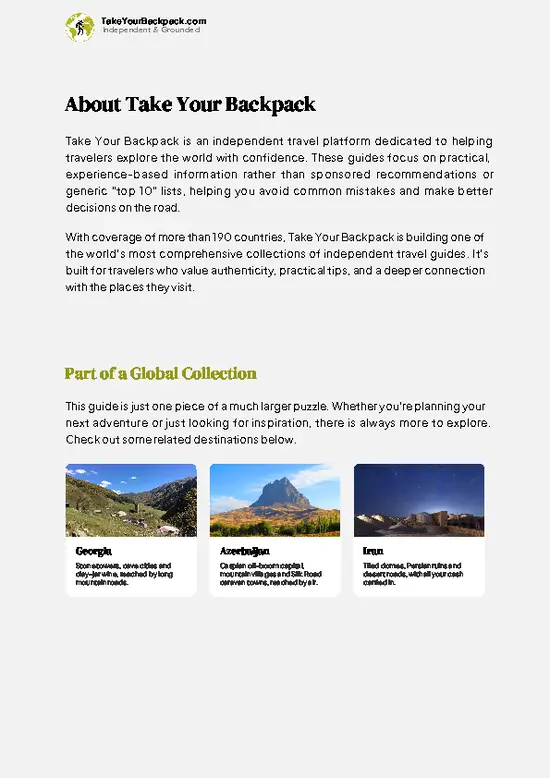
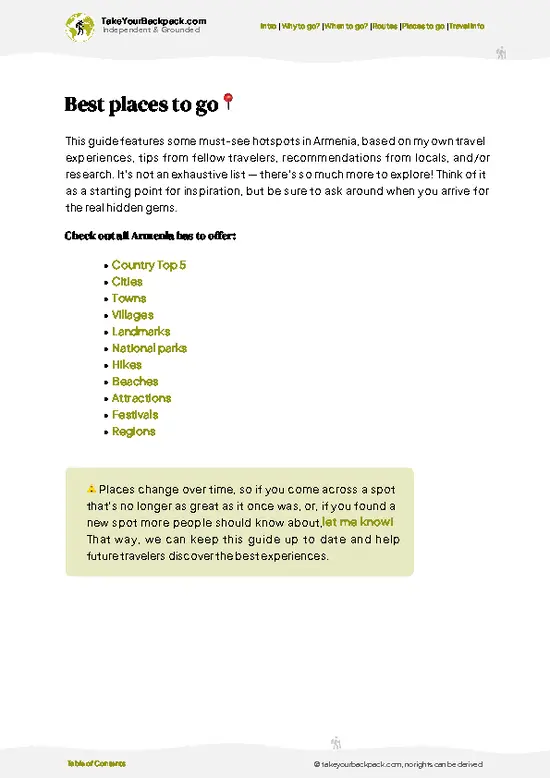
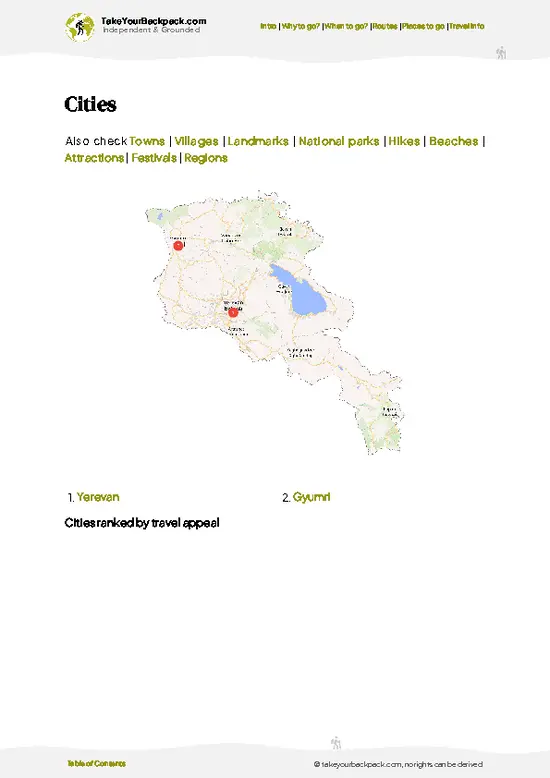
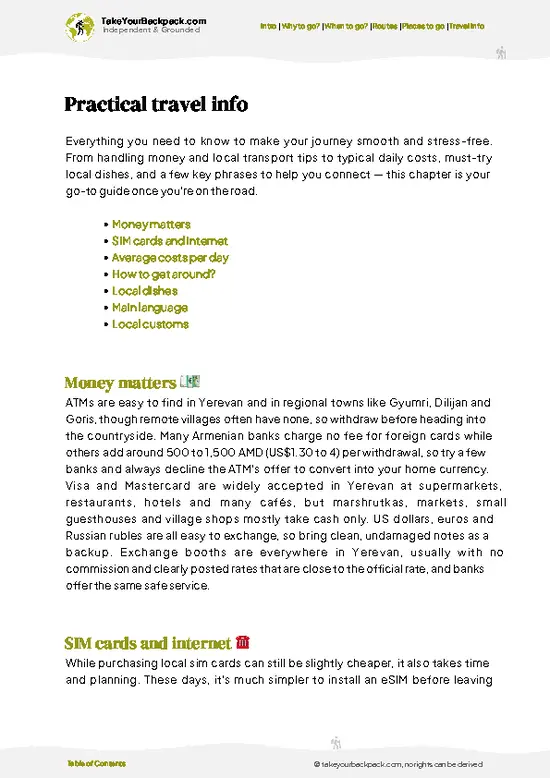
example page 0 from our offline Travel Guide for Armenia
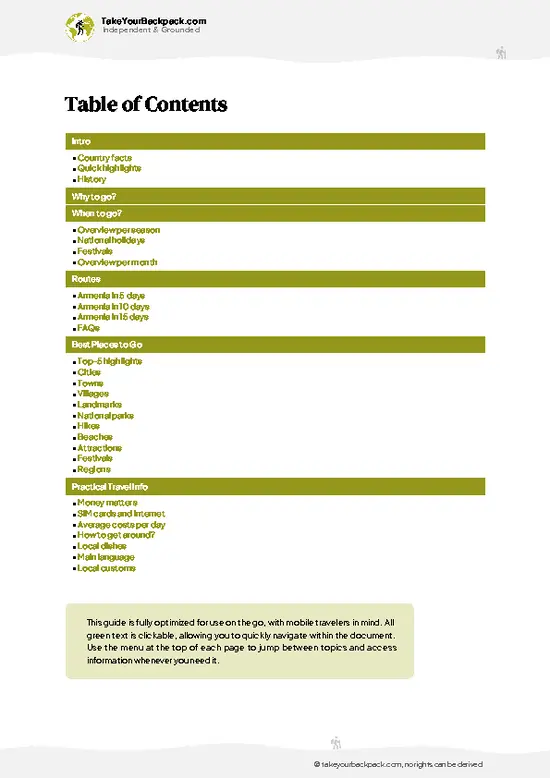
example page 1 from our offline Travel Guide for Armenia
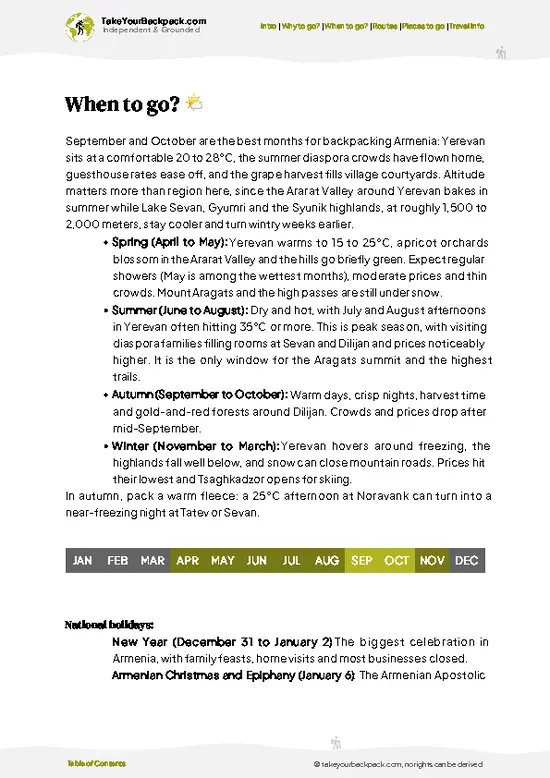
example page 2 from our offline Travel Guide for Armenia
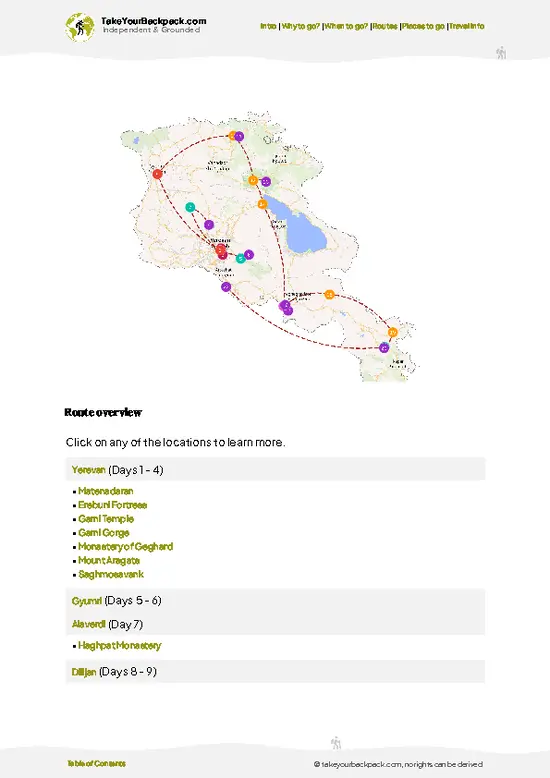
example page 3 from our offline Travel Guide for Armenia
example page 4 from our offline Travel Guide for Armenia
example page 5 from our offline Travel Guide for Armenia
example page 6 from our offline Travel Guide for Armenia
example page 7 from our offline Travel Guide for Armenia
The digital guide (257 pages) contains:
✅ 65 highlights, ranked by travel appeal
✅ Optimized 5, 10 & 15-day travel routes
✅ Cities, national parks, landmarks, beaches
✅ How to get around
✅ Offline-friendly for travel without Wi-Fi
👉 Click to see all 30+ guide features

📅 Plan smarter in minutes, not weeks
✅ Month by month travel advice
✅ Festivals & national holidays
✅ Budget expectations

🗺️ Go to the right places, skip the overrated ones
✅ Honest pros & cons of destinations
✅ Top hikes, parks & viewpoints
✅ Lesser-known places most travelers miss
✅ Clear “worth it vs skip it” guidance

🛏️ Travel smoothly without rookie mistakes
✅ Best areas to stay
✅ Transport systems explained simply
✅ Common scams & safety advice
✅ SIM cards, money & practical tips

🌍 Understand the country, not just visit it
✅ Culture & traditions
✅ 52 Essential phrases & customs
✅ Festivals worth planning around
✅ Traveler-friendly historical context
✅ Insights that make places more meaningful

📱 Built for real travel conditions
✅ Fully downloadable PDF
✅ Works completely offline
✅ Optimized for phone use
✅ Useful in remote areas & buses
✅ Everything in one place
Stop searching, start planning
Get instant access to your full guide. 30‑day money-back guarantee.
+ Add another guide for just

By proceeding you agree to our terms.
Sent to your inbox immediately after payment • 100% Secure Checkout
Best Backpacking Travel Advisor 2025 tourism awardBest Backpacking
Travel Advisor
2025
What others say about Take Your Backpack Guides:
⭐⭐⭐⭐⭐
Fantastic, amazing amount of information!
⭐⭐⭐⭐⭐
My goodness this is amazing, it's what I've been looking for hats off too you!
⭐⭐⭐⭐⭐
I think this is absolutely BRILLIANT
⭐⭐⭐⭐
Very complete and informative. It's still missing places, but I gotta to commend you
⭐⭐⭐⭐⭐
This is truly amazing, thank you, can't wait to explore it with my kids!
⭐⭐⭐⭐⭐
Awesome resource, thank you!
⭐⭐⭐⭐⭐
This is amazing! Can't wait to explore the ones I haven't seen
⭐⭐⭐⭐
I love this! Well done, great idea.
⭐⭐⭐⭐⭐
Thanks for taking the time to make this gem!
⭐⭐⭐⭐⭐
This might be the best website I've ever seen.
⭐⭐⭐⭐⭐
Congratulations, and thank you so much for your work; it's incredibly valuable.
⭐⭐⭐⭐
In all seriousness I think you did a great job pointing out the important spots
⭐⭐⭐⭐⭐
10/10 very good
⭐⭐⭐⭐⭐
As someone who's only just starting to visit regularly this is awesome, thank you.
⭐⭐⭐⭐
Thank you very much! I'm going to visit my dad, it's going to be very useful!
⭐⭐⭐⭐⭐
This is really cool! We'll be travelling for the first time and this definitely come in handy.
⭐⭐⭐⭐⭐
You are now our minister of culture, congratulations 👨‍💼
⭐⭐⭐⭐⭐
Just wanted to tell you that this is a pearl! Going to follow your recommendations.
⭐⭐⭐⭐⭐
This is so cool. I'll definitely be using the resource for my travels soon.
⭐⭐⭐⭐⭐
This is very impressive! Good work.
⭐⭐⭐⭐⭐
This is an amazing and informative site. Very well done!

🛏️ Where to stay?Best Stay Options in Armenia

Armenia has plenty of hostels and family-run guesthouses, with dorm beds in Yerevan typically running 4,000 to 8,000 AMD (US$10 to 20) a night. The densest cluster sits in central Kentron, around Republic Square, Northern Avenue and the Cascade, where you can walk to most sights and the wine bars but should expect street noise late into the night, while neighboring Arabkir is quieter, residential and still only a 15 to 20 minute walk from the center. Outside the capital, Gyumri and Dilijan lean toward homestays and small guesthouses with breakfast included, which suits slower travel but gives you little nightlife after dark.

If you enjoy meeting fellow travelers, consider choosing hostels with … read more 👉
Armenia has plenty of hostels and family-run guesthouses, with dorm beds in Yerevan typically running 4,000 to 8,000 AMD (US$10 to 20) a night. The densest cluster sits in central Kentron, around Republic Square, Northern Avenue and the Cascade, where you can walk to most sights and the wine bars but should expect street noise late into the night, while neighboring Arabkir is quieter, residential and still only a 15 to 20 minute walk from the center. Outside the capital, Gyumri and Dilijan lean toward homestays and small guesthouses with breakfast included, which suits slower travel but gives you little nightlife after dark.

If you enjoy meeting fellow travelers, consider choosing hostels with high ratings for atmosphere. On the other hand, if you prefer having your own space, a hotel might be a better option.

ArmeniaWhere to Go Next

👋 Meet the founderWho’s Behind Take Your Backpack?

Johan, backpacker and founder of TakeYourBackpackHi, I’m Johan (Netherlands 🇳🇱), the creator of TakeYourBackpack. Over the past 3 decades, I’ve backpacked through 90+ countries across six continents, gaining extensive experience with independent travel, long-term trips, and overland routes.

This site is built on a combination of firsthand travel experience and carefully curated insights from other backpackers. Many guides are based on places I’ve personally visited, while others bring together tips, observations, and practical advice shared by trusted travelers I’ve met along the way.

The goal is to provide realistic, experience-driven guidance — not generic itineraries — so you can explore destinations with better context, clearer expectations, and more confidence.