×

Armenia🇦🇲 | best national parksTop-Rated 4 national parks in Armenia

National parks in Armenia are small, high and close together, and almost none feel like fenced-off attractions. Dilijan, in the forested north, smells of wet beech leaves and moss, with muddy paths and mist between trunks. Further south, the dry volcanic uplands around Sevan and the Syunik gorges offer open slopes, basalt cliffs and thin mountain air. Entry costs little (often a few hundred to 2,000 AMD, roughly US$1 to 5), but public transport is thin and trailheads are often a marshrutka plus a taxi away. For backpacking or independent travel, forest parks suit hikers, while alpine ones suit people with a car and a tent.

By Johan Kruseman 🇳🇱 | Updated October 18, 2026
Explore the best hikes in Armenia

Why go?Why Travelers Love These Spots

Armenia packs forest, semi-desert, alpine meadow and volcanic plateau into a country smaller than Maryland, and most of it sits above 1,000 meters. Within one day you can drop from cool beech woods into hot, dusty gorges where the air smells of thyme and warm stone. That compression is the main reason the parks here are so varied, and so accessible to anyone with a few days.

History sits on top of the landscape. Monasteries, khachkar crosses and old caravan bridges stand inside or beside protected land, so a walk often ends at a 10th to 13th century stone church rather than a summit sign. Shepherds, beekeepers and village families still use the surrounding slopes.

The infrastructure is modest. Marked trails exist but are patchy, signage is often only in Armenian, visitor centers are few, … read more 👉
Armenia packs forest, semi-desert, alpine meadow and volcanic plateau into a country smaller than Maryland, and most of it sits above 1,000 meters. Within one day you can drop from cool beech woods into hot, dusty gorges where the air smells of thyme and warm stone. That compression is the main reason the parks here are so varied, and so accessible to anyone with a few days.

History sits on top of the landscape. Monasteries, khachkar crosses and old caravan bridges stand inside or beside protected land, so a walk often ends at a 10th to 13th century stone church rather than a summit sign. Shepherds, beekeepers and village families still use the surrounding slopes.

The infrastructure is modest. Marked trails exist but are patchy, signage is often only in Armenian, visitor centers are few, and many roads are rough gravel with potholes. Mobile coverage fades in the gorges. Guesthouses in nearby villages usually serve homemade bread, cheese and herbal tea, which is part of the appeal. Expect few crowds, a mild language barrier and a need to plan your own transport. Come for quiet, not polish.
Our Approach to Ranking
The list of best national parks in Armenia is created based on landscapes, wildlife, adventure opportunities, facilities, and overall experience. If you feel a national park is missing in this list, please let us know.

When to go?Seasonal Guide to Visiting

Best months and the seasons around them: The best months for national parks in Armenia are May to June and September to early October, when daytime temperatures sit around 15 to 25°C and trails are dry enough to walk without sinking into mud. In late spring the meadows turn green and wet, and the air smells of crushed grass and wild herbs. In September the beech forests in the north start to turn copper and gold, with clear light and cool mornings.
Summer, winter and regional differences: July and August bring heat of 30 to 40°C in the low southern gorges and Ararat plain, so hike early and rest by midday. Higher alpine areas stay cooler at 15 to 25°C but see afternoon thunderstorms. Guesthouse prices rise modestly, perhaps 10 to 25 percent, near Lake Sevan in July and August, when domestic … read more 👉
Best months and the seasons around them: The best months for national parks in Armenia are May to June and September to early October, when daytime temperatures sit around 15 to 25°C and trails are dry enough to walk without sinking into mud. In late spring the meadows turn green and wet, and the air smells of crushed grass and wild herbs. In September the beech forests in the north start to turn copper and gold, with clear light and cool mornings.
Summer, winter and regional differences: July and August bring heat of 30 to 40°C in the low southern gorges and Ararat plain, so hike early and rest by midday. Higher alpine areas stay cooler at 15 to 25°C but see afternoon thunderstorms. Guesthouse prices rise modestly, perhaps 10 to 25 percent, near Lake Sevan in July and August, when domestic visitors fill the shore.
November to March is cold. Snow settles above 1,800 meters from about November, passes can close, and the highest trails are not safely walkable until May or even June. Forest parks at lower elevation, such as those in Tavush and Lori, remain walkable on clear winter days, though the paths are icy and muddy. Facilities and some guesthouses may be shut out of season.

national park hoppingTips for Visiting Multiple Destinations

How long and in what order: A trip linking several national parks in Armenia needs 7 to 10 days, since distances are short but roads are slow and winding. Yerevan is the practical hub. Most travelers loop north toward the forested Tavush and Lori regions, cross to the Lake Sevan basin, then head south through Vayots Dzor into Syunik, or run the same line in reverse.
Pacing and transfers: Allow one to two days per stop. A half day is only enough for a short loop trail, while a full day suits a gorge walk or ridge hike. Typical transfers from Yerevan run about 1.5 to 2 hours to Sevan, 2 to 2.5 hours to Dilijan, 2 to 3 hours to Vayots Dzor and 5 to 6 hours to Syunik’s far south. Mountain roads twist, so the kilometers mislead. Marshrutkas run mostly to larger towns, so a final leg to a trailhead … read more 👉
How long and in what order: A trip linking several national parks in Armenia needs 7 to 10 days, since distances are short but roads are slow and winding. Yerevan is the practical hub. Most travelers loop north toward the forested Tavush and Lori regions, cross to the Lake Sevan basin, then head south through Vayots Dzor into Syunik, or run the same line in reverse.
Pacing and transfers: Allow one to two days per stop. A half day is only enough for a short loop trail, while a full day suits a gorge walk or ridge hike. Typical transfers from Yerevan run about 1.5 to 2 hours to Sevan, 2 to 2.5 hours to Dilijan, 2 to 3 hours to Vayots Dzor and 5 to 6 hours to Syunik’s far south. Mountain roads twist, so the kilometers mislead. Marshrutkas run mostly to larger towns, so a final leg to a trailhead usually means a taxi (roughly 3,000 to 10,000 AMD, about US$8 to 26) or a shared car.
Common planning mistakes: Travelers often cram three regions into three days and spend most of it in a minibus. Choose two or three bases and radiate out. Many also underestimate how early the last marshrutka leaves, often mid-afternoon, so confirm the return before setting off. Skipping a day of buffer for weather in the highlands is another trap, since fog and storms can cancel a ridge walk.

The ListTop national parks of Armenia

1 Dilijan National Park

wooded hills, mineral springs, monasteries, hiking trails

Follow winding forest paths past ancient monasteries and cold springs, where changing light and dense woodland create a shifting sense of solitude.

armenia-national-park-dilijan-national-park
© Google |

2 Khosrov Forest State Reserve

semi-desert slopes, rare wildlife, ancient ruins, endemic plants

Trace rugged canyons and dry hillsides where elusive animals roam, and discover centuries-old ruins hidden among Armenia’s oldest protected landscapes.

armenia-national-park-khosrov-forest-state-reserve
© Google |

3 Arevik National Park

subalpine forests, deep gorges, rare butterflies, mountain passes

Traverse remote mountain passes and forested slopes, where deep gorges and rare butterflies mark a landscape shaped by elevation and climate.

armenia-national-park-arevik-national-park
© Google |

4 Shikahogh State Reserve

dense forests, mountain streams, rare flora, remote valleys

Venture into thick southern forests where mountain streams cut through deep valleys, sheltering unique plants and a sense of isolation.

armenia-national-park-shikahogh-state-reserve
© Google |
Loading the map 🌍

Expert viewExpert Commentary on national parks

How many parks to visit: I would advise three national parks on a trip of a week to ten days, four at most with a car. Armenian roads are slow, trailheads sit at the end of gravel tracks, and the best moments come when you have time to sit by a stream or a stone chapel and let the quiet settle. Rushing through five parks leaves you with window views and little else.
Choosing between kinds: Pick one forest park, one gorge or volcanic landscape and one high alpine or lake area. First-timers and anyone without a car do best with forest parks, where marked paths start close to a town and guesthouses are easy to find. The reward is cool shade, birdsong and the smell of damp earth after rain. Experienced hikers with their own transport or a hired driver should add the highlands, where thin air, open … read more 👉
How many parks to visit: I would advise three national parks on a trip of a week to ten days, four at most with a car. Armenian roads are slow, trailheads sit at the end of gravel tracks, and the best moments come when you have time to sit by a stream or a stone chapel and let the quiet settle. Rushing through five parks leaves you with window views and little else.
Choosing between kinds: Pick one forest park, one gorge or volcanic landscape and one high alpine or lake area. First-timers and anyone without a car do best with forest parks, where marked paths start close to a town and guesthouses are easy to find. The reward is cool shade, birdsong and the smell of damp earth after rain. Experienced hikers with their own transport or a hired driver should add the highlands, where thin air, open ridgelines and grazing flocks replace trees and the views stretch to snow.
What it costs: Budget about US$30 to 55 a day (roughly 12,000 to 21,000 AMD) for a guesthouse bed, home-cooked meals and local transport. Park entry is usually 500 to 2,000 AMD (US$1 to 5). A local guide for a day hike runs about 15,000 to 40,000 AMD (US$40 to 100), worth paying on unmarked routes. Taxis to remote trailheads cost 3,000 to 10,000 AMD each way. A rental car is about US$35 to 70 a day plus fuel, and it saves hours of waiting. Carry cash, since village shops and many guesthouses do not take cards and ATMs vanish outside towns.
Safety and etiquette: The main hazards are weather and navigation. Afternoon storms build fast above 2,000 meters, and fog can erase a faint trail, so download offline maps and start early. Tell your host your route. Shepherd dogs guard flocks and can be aggressive. Stop, avoid eye contact and walk wide around them, and a trekking pole helps. Near the southern and eastern borders, some areas are militarily sensitive, so avoid photographing installations and stick to open trails. Mines and unexploded ordnance are a concern in certain border zones, so ask locally before leaving the path.
Culturally, dress modestly and cover shoulders at monasteries. Hosts will often offer coffee, brandy or fruit, and accepting a small portion goes a long way. Pack out every scrap of trash, since bins are scarce, and the quiet meadow you leave behind stays clean.

✈️ The backpacker research shortcutArmenia Travel Guide

An offline-friendly backpacking guide with optimized travel routes, ranked highlights, transport advice, and the best areas to stay.
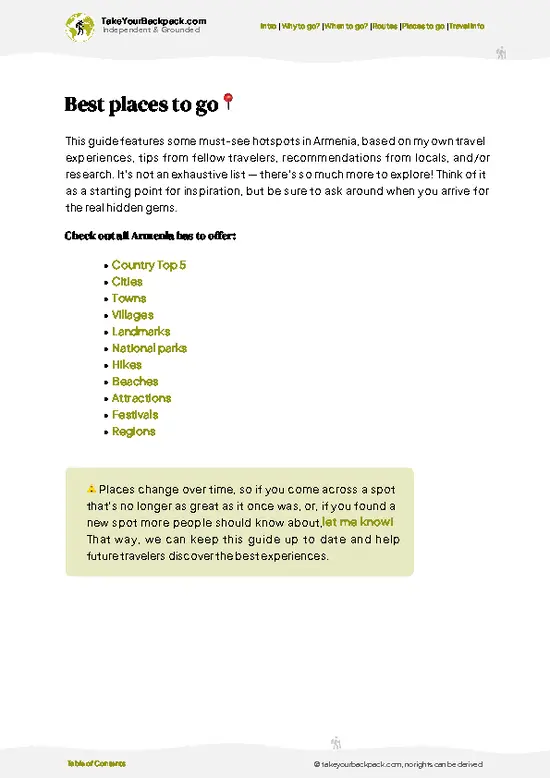
example page 0 from our offline Travel Guide for Armenia
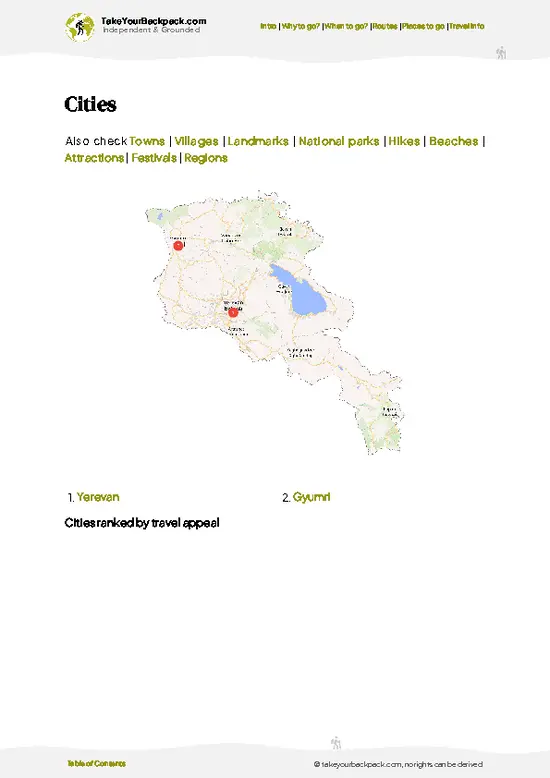
example page 1 from our offline Travel Guide for Armenia
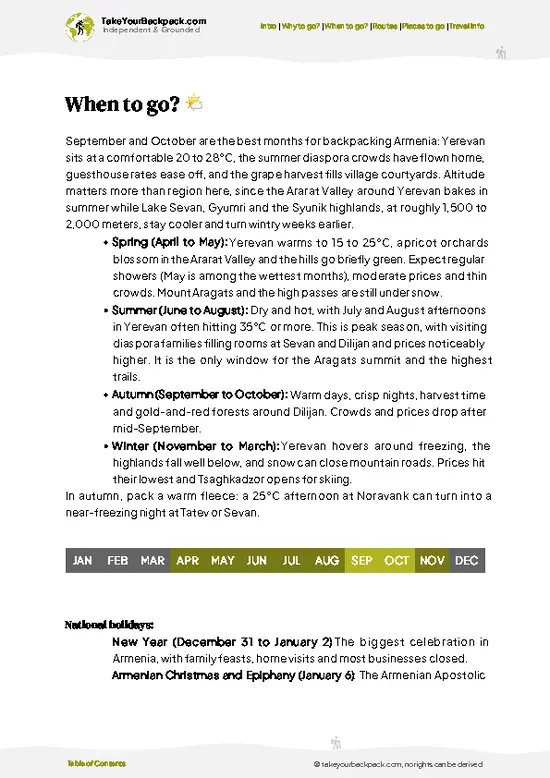
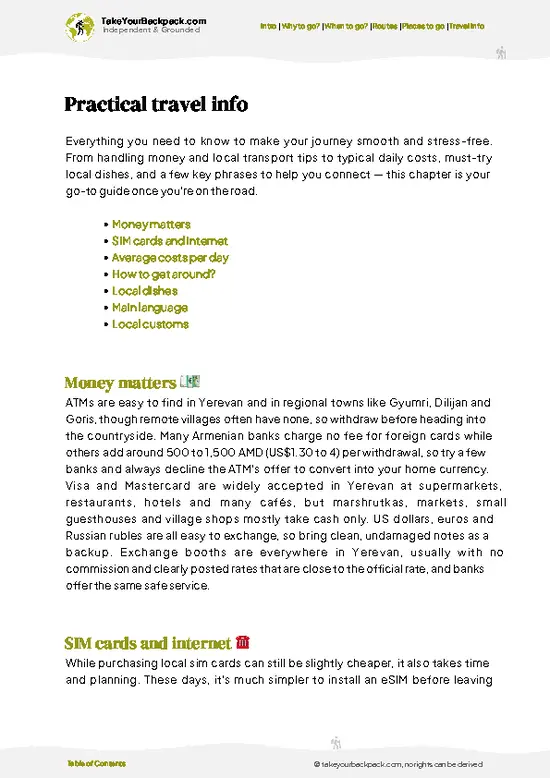
example page 2 from our offline Travel Guide for Armenia
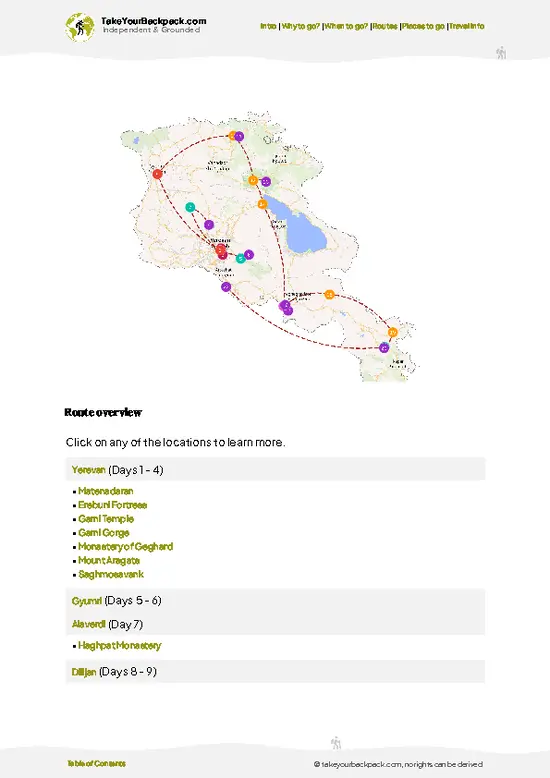
example page 3 from our offline Travel Guide for Armenia
example page 4 from our offline Travel Guide for Armenia
example page 5 from our offline Travel Guide for Armenia
example page 6 from our offline Travel Guide for Armenia
example page 7 from our offline Travel Guide for Armenia
The digital guide (257 pages) contains:
✅ 65 highlights, ranked by travel appeal
✅ Optimized 5, 10 & 15-day travel routes
✅ Cities, national parks, landmarks, beaches
✅ How to get around
✅ Offline-friendly for travel without Wi-Fi
👉 Click to see all 30+ guide features

📅 Plan smarter in minutes, not weeks
✅ Month by month travel advice
✅ Festivals & national holidays
✅ Budget expectations

🗺️ Go to the right places, skip the overrated ones
✅ Honest pros & cons of destinations
✅ Top hikes, parks & viewpoints
✅ Lesser-known places most travelers miss
✅ Clear “worth it vs skip it” guidance

🛏️ Travel smoothly without rookie mistakes
✅ Best areas to stay
✅ Transport systems explained simply
✅ Common scams & safety advice
✅ SIM cards, money & practical tips

🌍 Understand the country, not just visit it
✅ Culture & traditions
✅ 52 Essential phrases & customs
✅ Festivals worth planning around
✅ Traveler-friendly historical context
✅ Insights that make places more meaningful

📱 Built for real travel conditions
✅ Fully downloadable PDF
✅ Works completely offline
✅ Optimized for phone use
✅ Useful in remote areas & buses
✅ Everything in one place
Stop searching, start planning
Get instant access to your full guide. 30‑day money-back guarantee.
+ Add another guide for just

By proceeding you agree to our terms.
Sent to your inbox immediately after payment • 100% Secure Checkout
Best Backpacking Travel Advisor 2025 tourism awardBest Backpacking
Travel Advisor
2025
What others say about Take Your Backpack Guides:
⭐⭐⭐⭐⭐
Fantastic, amazing amount of information!
⭐⭐⭐⭐⭐
My goodness this is amazing, it's what I've been looking for hats off too you!
⭐⭐⭐⭐⭐
I think this is absolutely BRILLIANT
⭐⭐⭐⭐
Very complete and informative. It's still missing places, but I gotta to commend you
⭐⭐⭐⭐⭐
This is truly amazing, thank you, can't wait to explore it with my kids!
⭐⭐⭐⭐⭐
Awesome resource, thank you!
⭐⭐⭐⭐⭐
This is amazing! Can't wait to explore the ones I haven't seen
⭐⭐⭐⭐
I love this! Well done, great idea.
⭐⭐⭐⭐⭐
Thanks for taking the time to make this gem!
⭐⭐⭐⭐⭐
This might be the best website I've ever seen.
⭐⭐⭐⭐⭐
Congratulations, and thank you so much for your work; it's incredibly valuable.
⭐⭐⭐⭐
In all seriousness I think you did a great job pointing out the important spots
⭐⭐⭐⭐⭐
10/10 very good
⭐⭐⭐⭐⭐
As someone who's only just starting to visit regularly this is awesome, thank you.
⭐⭐⭐⭐
Thank you very much! I'm going to visit my dad, it's going to be very useful!
⭐⭐⭐⭐⭐
This is really cool! We'll be travelling for the first time and this definitely come in handy.
⭐⭐⭐⭐⭐
You are now our minister of culture, congratulations 👨‍💼
⭐⭐⭐⭐⭐
Just wanted to tell you that this is a pearl! Going to follow your recommendations.
⭐⭐⭐⭐⭐
This is so cool. I'll definitely be using the resource for my travels soon.
⭐⭐⭐⭐⭐
This is very impressive! Good work.
⭐⭐⭐⭐⭐
This is an amazing and informative site. Very well done!

🛏️ Where to stay?Where to Stay in Armenia

Armenia has plenty of hostels and family-run guesthouses, with dorm beds in Yerevan typically running 4,000 to 8,000 AMD (US$10 to 20) a night. The densest cluster sits in central Kentron, around Republic Square, Northern Avenue and the Cascade, where you can walk to most sights and the wine bars but should expect street noise late into the night, while neighboring Arabkir is quieter, residential and still only a 15 to 20 minute walk from the center. Outside the capital, Gyumri and Dilijan lean toward homestays and small guesthouses with breakfast included, which suits slower travel but gives you little nightlife after dark.

If you enjoy meeting fellow travelers, consider choosing hostels with … read more 👉
Armenia has plenty of hostels and family-run guesthouses, with dorm beds in Yerevan typically running 4,000 to 8,000 AMD (US$10 to 20) a night. The densest cluster sits in central Kentron, around Republic Square, Northern Avenue and the Cascade, where you can walk to most sights and the wine bars but should expect street noise late into the night, while neighboring Arabkir is quieter, residential and still only a 15 to 20 minute walk from the center. Outside the capital, Gyumri and Dilijan lean toward homestays and small guesthouses with breakfast included, which suits slower travel but gives you little nightlife after dark.

If you enjoy meeting fellow travelers, consider choosing hostels with high ratings for atmosphere. On the other hand, if you prefer having your own space, a hotel might be a better option.

ArmeniaMore of Armenia

👋 Meet the founderWho’s Behind Take Your Backpack?

Johan, backpacker and founder of TakeYourBackpackHi, I’m Johan (Netherlands 🇳🇱), the creator of TakeYourBackpack. Over the past 3 decades, I’ve backpacked through 90+ countries across six continents, gaining extensive experience with independent travel, long-term trips, and overland routes.

This site is built on a combination of firsthand travel experience and carefully curated insights from other backpackers. Many guides are based on places I’ve personally visited, while others bring together tips, observations, and practical advice shared by trusted travelers I’ve met along the way.

The goal is to provide realistic, experience-driven guidance — not generic itineraries — so you can explore destinations with better context, clearer expectations, and more confidence.