×

Armenia🇦🇲 | best regionsTop-Rated 3 regions in Armenia

Armenia’s regions are separated by altitude more than distance. The country is small, roughly 29,800 square kilometers, yet you drop from apricot orchards and dry canyons near 400 meters to basalt plateaus above 2,000 meters within a few hours. Ararat-valley heat smells of dust and ripe fruit, while the northern forests hold damp moss and woodsmoke. The south is wilder and slower, with long gaps between villages and rougher roads. Yerevan-adjacent areas are easy and crowded, remote provinces are cheap and quiet. For independent travel, that means marshrutkas (minibuses) run often on main corridors and thin out fast beyond them.

By Johan Kruseman 🇳🇱 | Updated October 18, 2026
Explore the best cities in Armenia

Why go?Why Travelers Love These Spots

Armenia suits regional travel because history is stacked into the landscape. Volcanic highlands, deep river gorges and high mountain passes kept communities apart, so each province developed its own dialect, food habits and monastery tradition. The Armenian Apostolic Church, which the country adopted as a state religion in 301 AD, left stone monasteries and khachkars (carved cross-stones) in valleys that otherwise see few visitors. Basalt, tuff and limestone give the buildings their dark gray, pink or honey color, and the light at altitude is sharp and clear.

The country is compact, so nothing is truly far, but the terrain makes distances deceptive. Mountain roads twist, winter closes high passes, and some rural surfaces are potholed. Public transport is cheap but runs on fixed morning schedules … read more 👉
Armenia suits regional travel because history is stacked into the landscape. Volcanic highlands, deep river gorges and high mountain passes kept communities apart, so each province developed its own dialect, food habits and monastery tradition. The Armenian Apostolic Church, which the country adopted as a state religion in 301 AD, left stone monasteries and khachkars (carved cross-stones) in valleys that otherwise see few visitors. Basalt, tuff and limestone give the buildings their dark gray, pink or honey color, and the light at altitude is sharp and clear.

The country is compact, so nothing is truly far, but the terrain makes distances deceptive. Mountain roads twist, winter closes high passes, and some rural surfaces are potholed. Public transport is cheap but runs on fixed morning schedules from regional bus stations, and drivers rarely speak English. Borders with Turkey and Azerbaijan are closed, which shapes entry and exit options, so most travelers arrive via Yerevan or cross from Georgia or Iran. Travelers should also expect hospitality that is hard to refuse: coffee, brandy and a full table appear without warning. Armenia rewards those who arrive with time, a few phrases of Armenian or Russian, and cash for small villages.
How the List Was Created
The list of best regions in Armenia is created based on landscapes, local culture, attractions, vibes, and overall appeal. If you feel a region is missing in this list, please let us know.

When to go?Seasonal Guide to Visiting

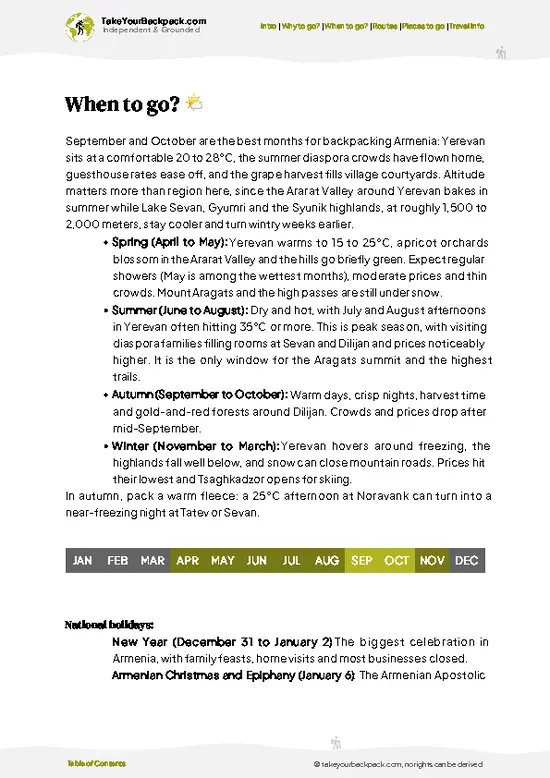
Best Months and Why: Late May to June and September to mid-October are the best months, because daytime temperatures sit around 18 to 28°C in most of the country and the high roads are open and clear. In spring the hills turn green and snowmelt fills the rivers. Early autumn brings the grape and pomegranate harvest, dry air and long golden evenings.

Summer and Winter: July and August are hot in the lowlands. The Ararat Valley, including Yerevan, often passes 35°C, and dust hangs in the afternoon air. Higher areas around Lake Sevan and Syunik stay cooler, around 20 to 26°C by day with cold nights. Rain is low across most of the country, roughly 250 to 600 mm a year depending on altitude, with spring thunderstorms common in the mountains.

Winter, December to February, is cold and snowy at … read more 👉
Best Months and Why: Late May to June and September to mid-October are the best months, because daytime temperatures sit around 18 to 28°C in most of the country and the high roads are open and clear. In spring the hills turn green and snowmelt fills the rivers. Early autumn brings the grape and pomegranate harvest, dry air and long golden evenings.

Summer and Winter: July and August are hot in the lowlands. The Ararat Valley, including Yerevan, often passes 35°C, and dust hangs in the afternoon air. Higher areas around Lake Sevan and Syunik stay cooler, around 20 to 26°C by day with cold nights. Rain is low across most of the country, roughly 250 to 600 mm a year depending on altitude, with spring thunderstorms common in the mountains.

Winter, December to February, is cold and snowy at altitude. Temperatures drop below -10°C in the highlands, snow can close high passes for days, and some guesthouses and rural sights shut. Lowland and city travel stays possible, and prices dip, often 20 to 30 percent for rooms outside Yerevan. Peak pressure comes in July and August and around holidays such as Easter and New Year, when domestic travel and diaspora visits fill guesthouses and minibuses on popular corridors. Book ahead then, particularly for lake-side and spa towns.

region hoppingTips for Visiting Multiple Destinations

How Many Days You Need: A trip combining several regions in Armenia needs 8 to 14 days, with 10 being a comfortable middle. Anything under a week turns into a blur of road time, because mountain driving is slow even over short distances.

Direction and Pacing: Most travelers start in Yerevan, the main transport hub, and loop out through the north or the south rather than doubling back. A clockwise or counterclockwise circuit works well, with the Sevan basin as the natural link between north and south. Plan 2 to 3 nights per base, with day trips from each, rather than a new bed every night. Travel between regions typically takes 2 to 5 hours by marshrutka or shared taxi, and the longest southern legs can reach 5 to 6 hours on winding roads.

Planning Mistakes: The most common error is judging … read more 👉
How Many Days You Need: A trip combining several regions in Armenia needs 8 to 14 days, with 10 being a comfortable middle. Anything under a week turns into a blur of road time, because mountain driving is slow even over short distances.

Direction and Pacing: Most travelers start in Yerevan, the main transport hub, and loop out through the north or the south rather than doubling back. A clockwise or counterclockwise circuit works well, with the Sevan basin as the natural link between north and south. Plan 2 to 3 nights per base, with day trips from each, rather than a new bed every night. Travel between regions typically takes 2 to 5 hours by marshrutka or shared taxi, and the longest southern legs can reach 5 to 6 hours on winding roads.

Planning Mistakes: The most common error is judging by kilometers. A 120 km stretch can take three hours behind trucks on a switchbacking mountain road, so budget by hours instead. Another is arriving at a regional bus station after midday, when departures thin out and fewer vehicles fill; leave in the morning. Travelers also cram too many monasteries into a day and end up numb to them. Choose one or two per day and leave time for a long lunch of lavash, grilled meat and herbs. Finally, check pass conditions from November to April, and keep a buffer day before any flight out of Yerevan.

The ListTop regions of Armenia

1 Lori Region

deep gorges, forested plateaus, medieval monasteries

Hike through misty valleys and wooded uplands, passing remote villages and centuries-old stone churches tucked into dramatic natural settings.

armenia-region-lori-region
© Google |

2 Tavush

rolling hills, dense forests, border villages

Travel winding roads through green woodlands, discover quiet settlements near the frontier, and enjoy a cooler, rainier climate than much of Armenia.

armenia-region-tavush
© Google |

3 Aragatsotn

Mount Aragats, volcanic landscapes, ancient fortresses

Ascend rugged slopes for panoramic views, encounter fortress ruins on windswept ridges, and experience the stark contrasts of Armenia’s highest peak.

armenia-region-aragatsotn
© Google |
Loading the map 🌍

Expert viewExpert Commentary on regions

How Many Regions to Visit: Three or four regions in one trip is the number I would advise. Roads are slow, and each area rewards at least two nights, so more than that becomes transit. With three you get time for a long walk, a village meal, and one lazy morning, and you leave with the sound of cowbells and church bells rather than just bus engines.

Choosing by Travel Style: Hikers should prioritize the highland and forested provinces, where trails run through meadows and gorges and you can go hours without seeing a person. Culture-focused travelers should favor the areas with dense clusters of medieval monasteries, where cool stone interiors smell of candle wax and incense. If you want easy logistics and good food, stay close to Yerevan and use day trips. Those wanting remoteness should … read more 👉
How Many Regions to Visit: Three or four regions in one trip is the number I would advise. Roads are slow, and each area rewards at least two nights, so more than that becomes transit. With three you get time for a long walk, a village meal, and one lazy morning, and you leave with the sound of cowbells and church bells rather than just bus engines.

Choosing by Travel Style: Hikers should prioritize the highland and forested provinces, where trails run through meadows and gorges and you can go hours without seeing a person. Culture-focused travelers should favor the areas with dense clusters of medieval monasteries, where cool stone interiors smell of candle wax and incense. If you want easy logistics and good food, stay close to Yerevan and use day trips. Those wanting remoteness should accept rougher roads, fewer English speakers and basic guesthouses in exchange for silence and open sky.

What It Costs: Budget travelers can manage on US$25 to 40 a day: dorm beds or guesthouse rooms around US$10 to 20, a home-style dinner US$5 to 10, and marshrutka rides usually under US$1 to 5 per leg. Mid-range travel runs US$50 to 90 a day. Monastery entry is mostly free, with a few sites charging around 1,000 to 2,000 AMD (roughly US$2.50 to 5). A private driver for a day costs about US$60 to 120, worth it for remote areas with no scheduled transport, and a local hiking guide runs roughly US$40 to 80 a day. Over a ten-day trip, plan US$350 to 600 including transport.

Safety and Etiquette: Armenia is generally safe, with low violent crime and friendly strangers. The real hazards are practical: mountain driving, sudden weather above 2,000 meters, and stray dogs near rural settlements. Stay away from the closed border zones with Azerbaijan and check current government travel advice before heading to areas near them. Carry cash in drams, since village shops and guesthouses seldom take cards.

Cover shoulders and knees in churches, and women often wear a scarf in more traditional sites. Accepting a toast and a shot of homemade fruit brandy is part of the welcome, and refusing politely with a hand on the heart is fine. Ask before photographing people, and never step on a khachkar base or graves. The payoff is a table crowded with cheese, herbs, and warm bread, offered by hosts who rarely let a guest leave hungry.

✈️ The backpacker research shortcutArmenia Travel Guide

An offline-friendly backpacking guide with optimized travel routes, ranked highlights, transport advice, and the best areas to stay.
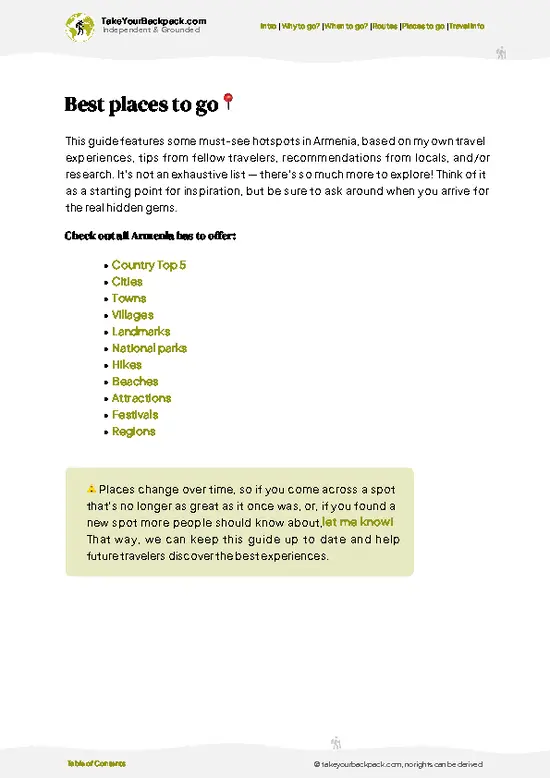
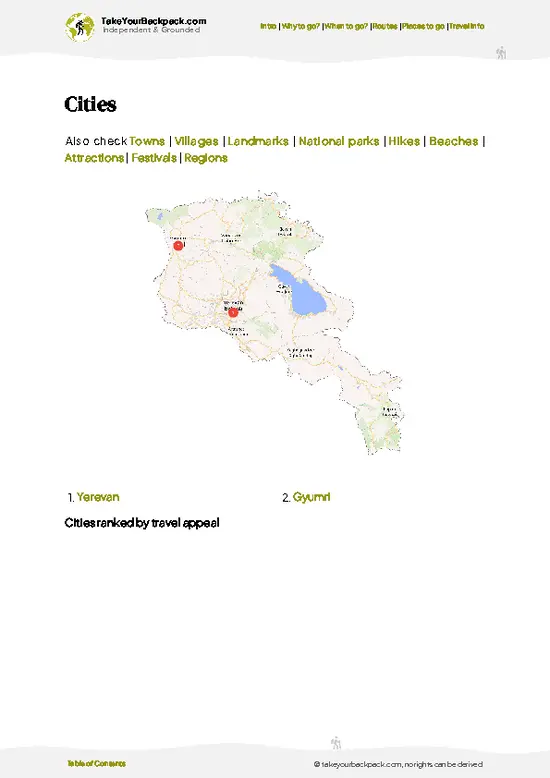
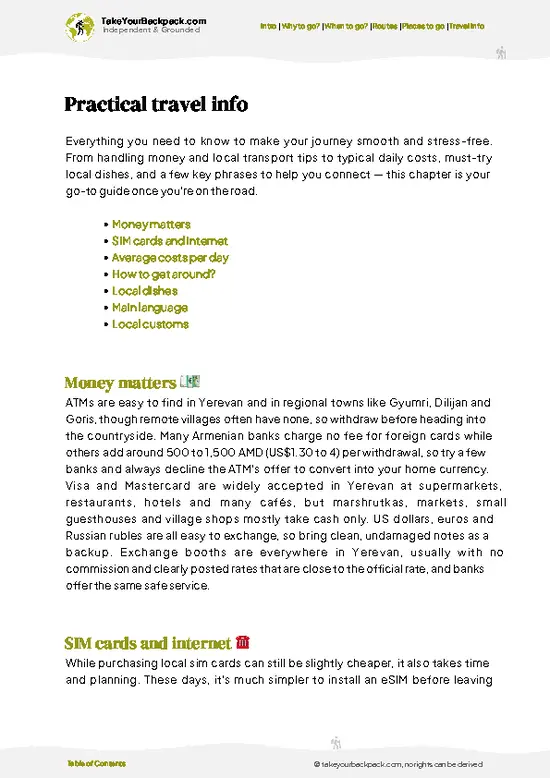
example page 0 from our offline Travel Guide for Armenia
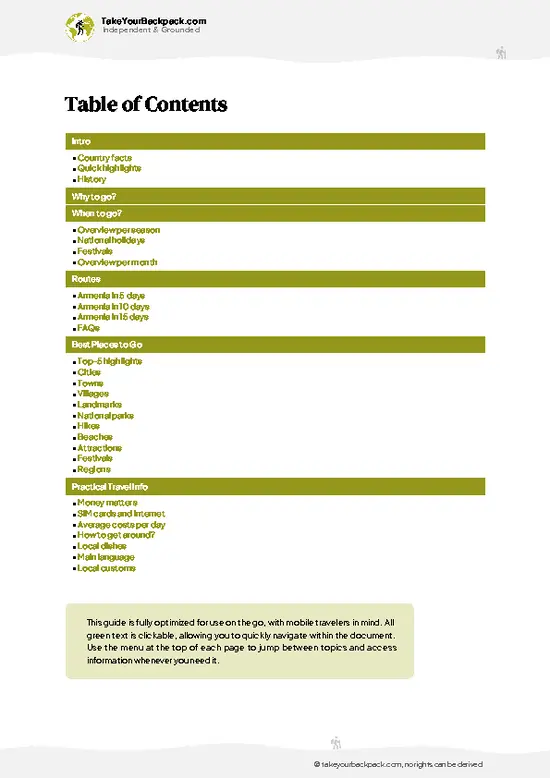
example page 1 from our offline Travel Guide for Armenia
example page 2 from our offline Travel Guide for Armenia
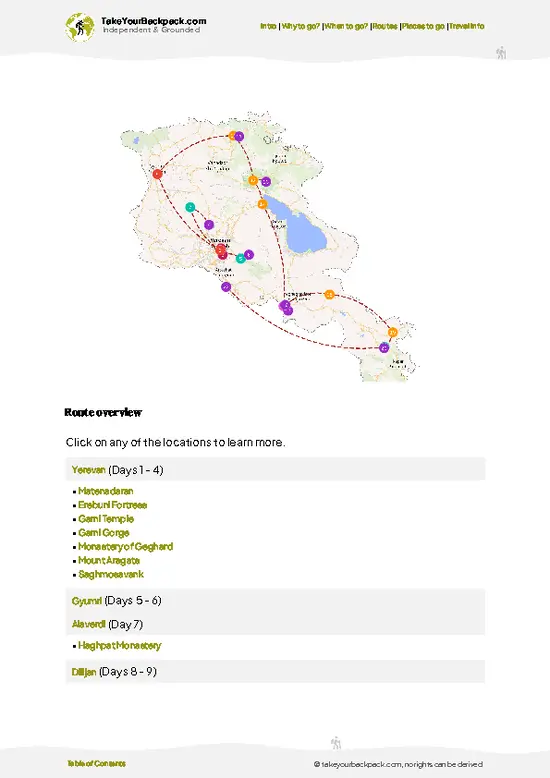
example page 3 from our offline Travel Guide for Armenia
example page 4 from our offline Travel Guide for Armenia
example page 5 from our offline Travel Guide for Armenia
example page 6 from our offline Travel Guide for Armenia
example page 7 from our offline Travel Guide for Armenia
The digital guide (257 pages) contains:
✅ 65 highlights, ranked by travel appeal
✅ Optimized 5, 10 & 15-day travel routes
✅ Cities, national parks, landmarks, beaches
✅ How to get around
✅ Offline-friendly for travel without Wi-Fi
👉 Click to see all 30+ guide features

📅 Plan smarter in minutes, not weeks
✅ Month by month travel advice
✅ Festivals & national holidays
✅ Budget expectations

🗺️ Go to the right places, skip the overrated ones
✅ Honest pros & cons of destinations
✅ Top hikes, parks & viewpoints
✅ Lesser-known places most travelers miss
✅ Clear “worth it vs skip it” guidance

🛏️ Travel smoothly without rookie mistakes
✅ Best areas to stay
✅ Transport systems explained simply
✅ Common scams & safety advice
✅ SIM cards, money & practical tips

🌍 Understand the country, not just visit it
✅ Culture & traditions
✅ 52 Essential phrases & customs
✅ Festivals worth planning around
✅ Traveler-friendly historical context
✅ Insights that make places more meaningful

📱 Built for real travel conditions
✅ Fully downloadable PDF
✅ Works completely offline
✅ Optimized for phone use
✅ Useful in remote areas & buses
✅ Everything in one place
Stop searching, start planning
Get instant access to your full guide. 30‑day money-back guarantee.
+ Add another guide for just

By proceeding you agree to our terms.
Sent to your inbox immediately after payment • 100% Secure Checkout
Best Backpacking Travel Advisor 2025 tourism awardBest Backpacking
Travel Advisor
2025
What others say about Take Your Backpack Guides:
⭐⭐⭐⭐⭐
Fantastic, amazing amount of information!
⭐⭐⭐⭐⭐
My goodness this is amazing, it's what I've been looking for hats off too you!
⭐⭐⭐⭐⭐
I think this is absolutely BRILLIANT
⭐⭐⭐⭐
Very complete and informative. It's still missing places, but I gotta to commend you
⭐⭐⭐⭐⭐
This is truly amazing, thank you, can't wait to explore it with my kids!
⭐⭐⭐⭐⭐
Awesome resource, thank you!
⭐⭐⭐⭐⭐
This is amazing! Can't wait to explore the ones I haven't seen
⭐⭐⭐⭐
I love this! Well done, great idea.
⭐⭐⭐⭐⭐
Thanks for taking the time to make this gem!
⭐⭐⭐⭐⭐
This might be the best website I've ever seen.
⭐⭐⭐⭐⭐
Congratulations, and thank you so much for your work; it's incredibly valuable.
⭐⭐⭐⭐
In all seriousness I think you did a great job pointing out the important spots
⭐⭐⭐⭐⭐
10/10 very good
⭐⭐⭐⭐⭐
As someone who's only just starting to visit regularly this is awesome, thank you.
⭐⭐⭐⭐
Thank you very much! I'm going to visit my dad, it's going to be very useful!
⭐⭐⭐⭐⭐
This is really cool! We'll be travelling for the first time and this definitely come in handy.
⭐⭐⭐⭐⭐
You are now our minister of culture, congratulations 👨‍💼
⭐⭐⭐⭐⭐
Just wanted to tell you that this is a pearl! Going to follow your recommendations.
⭐⭐⭐⭐⭐
This is so cool. I'll definitely be using the resource for my travels soon.
⭐⭐⭐⭐⭐
This is very impressive! Good work.
⭐⭐⭐⭐⭐
This is an amazing and informative site. Very well done!

🛏️ Where to stay?Top Places to Consider Staying

Armenia has plenty of hostels and family-run guesthouses, with dorm beds in Yerevan typically running 4,000 to 8,000 AMD (US$10 to 20) a night. The densest cluster sits in central Kentron, around Republic Square, Northern Avenue and the Cascade, where you can walk to most sights and the wine bars but should expect street noise late into the night, while neighboring Arabkir is quieter, residential and still only a 15 to 20 minute walk from the center. Outside the capital, Gyumri and Dilijan lean toward homestays and small guesthouses with breakfast included, which suits slower travel but gives you little nightlife after dark.

If you enjoy meeting fellow travelers, consider choosing hostels with … read more 👉
Armenia has plenty of hostels and family-run guesthouses, with dorm beds in Yerevan typically running 4,000 to 8,000 AMD (US$10 to 20) a night. The densest cluster sits in central Kentron, around Republic Square, Northern Avenue and the Cascade, where you can walk to most sights and the wine bars but should expect street noise late into the night, while neighboring Arabkir is quieter, residential and still only a 15 to 20 minute walk from the center. Outside the capital, Gyumri and Dilijan lean toward homestays and small guesthouses with breakfast included, which suits slower travel but gives you little nightlife after dark.

If you enjoy meeting fellow travelers, consider choosing hostels with high ratings for atmosphere. On the other hand, if you prefer having your own space, a hotel might be a better option.

ArmeniaMore Places Across Armenia

👋 Meet the founderWho’s Behind Take Your Backpack?

Johan, backpacker and founder of TakeYourBackpackHi, I’m Johan (Netherlands 🇳🇱), the creator of TakeYourBackpack. Over the past 3 decades, I’ve backpacked through 90+ countries across six continents, gaining extensive experience with independent travel, long-term trips, and overland routes.

This site is built on a combination of firsthand travel experience and carefully curated insights from other backpackers. Many guides are based on places I’ve personally visited, while others bring together tips, observations, and practical advice shared by trusted travelers I’ve met along the way.

The goal is to provide realistic, experience-driven guidance — not generic itineraries — so you can explore destinations with better context, clearer expectations, and more confidence.