×

Bolivia🇧🇴 | landmarksTiwanakustone monoliths, ancient temples, archaeological site | things to do and best time to go

Explore Salar de UyuniExplore Valle de la Luna

Backpacking in Tiwanaku
UNESCO World Heritage site
🌟 Highlightunique site ranked #4
By Johan Kruseman 🇳🇱 | Updated June 7, 2026

You know the best thing about Tiwanaku that no one tells you? It’s an easy half-day escape from La Paz that doesn’t wreck your altitude or your budget, and you can be back in the city by dinner instead of losing a full day to transport chaos. Tiwanaku sits on the Altiplano west of La Paz, on the road toward Lake Titicaca, in a dry, wide-open landscape that feels almost lunar. As a backpacker destination, it’s not Machu Picchu-level drama, and the ruins are more about quiet brain-melt than jaw-drop photos. The wow-factor is in the age, the stonework, and the “how on earth did they do this?” engineering, not in lush scenery. Crowds are manageable but tour groups do roll through, the entry fee is a bit steep for Bolivia, and the wind cuts through every layer—but if you like deep-time history, it hits hard.

Discover everything you want to know in the 📖 Bolivia Travel Guide.


Get your Bolivia guide
82 ranked highlights, routes & tips, works offline (350 pages)
Loading the map 🌍
CLICK TO FILTER
cities
towns
landmarks
national parks
hikes
beaches
attractions
festivals
regions
SHOW COUNTRY’S BESTSHOW ALL

✨ Why go?
Ranked #4 unique site in Bolivia
The unique appeal for travelers

Tiwanaku is not just another stop on your Bolivia itinerary; it’s a gateway to understanding ancient Andean civilization. Sure, it can get crowded, especially during peak tourist season, but that’s part of the experience. You’re walking among the remnants of a culture that thrived over a thousand years ago. The cost is a steal—entry fees are low, and you can easily spend a day exploring without breaking the bank.

What sets Tiwanaku apart is its uniqueness. The Akapana Pyramid and the Gateway of the Sun are awe-inspiring, but it’s the energy of the site that hits you. You can almost feel the weight of history in the air. Plus, it fits perfectly into a broader route; many backpackers swing through on their way to Lake Titicaca or La Paz.

Don’t just snap a photo and move on. Take the time … read more 👉
Tiwanaku is not just another stop on your Bolivia itinerary; it’s a gateway to understanding ancient Andean civilization. Sure, it can get crowded, especially during peak tourist season, but that’s part of the experience. You’re walking among the remnants of a culture that thrived over a thousand years ago. The cost is a steal—entry fees are low, and you can easily spend a day exploring without breaking the bank.

What sets Tiwanaku apart is its uniqueness. The Akapana Pyramid and the Gateway of the Sun are awe-inspiring, but it’s the energy of the site that hits you. You can almost feel the weight of history in the air. Plus, it fits perfectly into a broader route; many backpackers swing through on their way to Lake Titicaca or La Paz.

Don’t just snap a photo and move on. Take the time to connect with the local guides, who often share stories that aren’t in any guidebook. That’s where the real magic lies—beyond the Instagram filters and into the heart of a civilization that still resonates today.
Want to include Tiwanaku in your Bolivia route?
Create a personalized Bolivia itinerary that includes Tiwanaku and the places that fit your trip — based on your travel style, budget, and available time. Get your route in seconds.

Generate my trip

💡 HighlightsWhat this place is best known for

  • Gate of the Sun — The iconic megalithic arch carved with a central deity (often linked to Viracocha or the Staff God) surrounded by rows of attendants; it’s the single image most people picture and gives a real sense of Tiwanaku’s symbolic power. (Personal favorite — it’s haunting in the high-altitude light.)
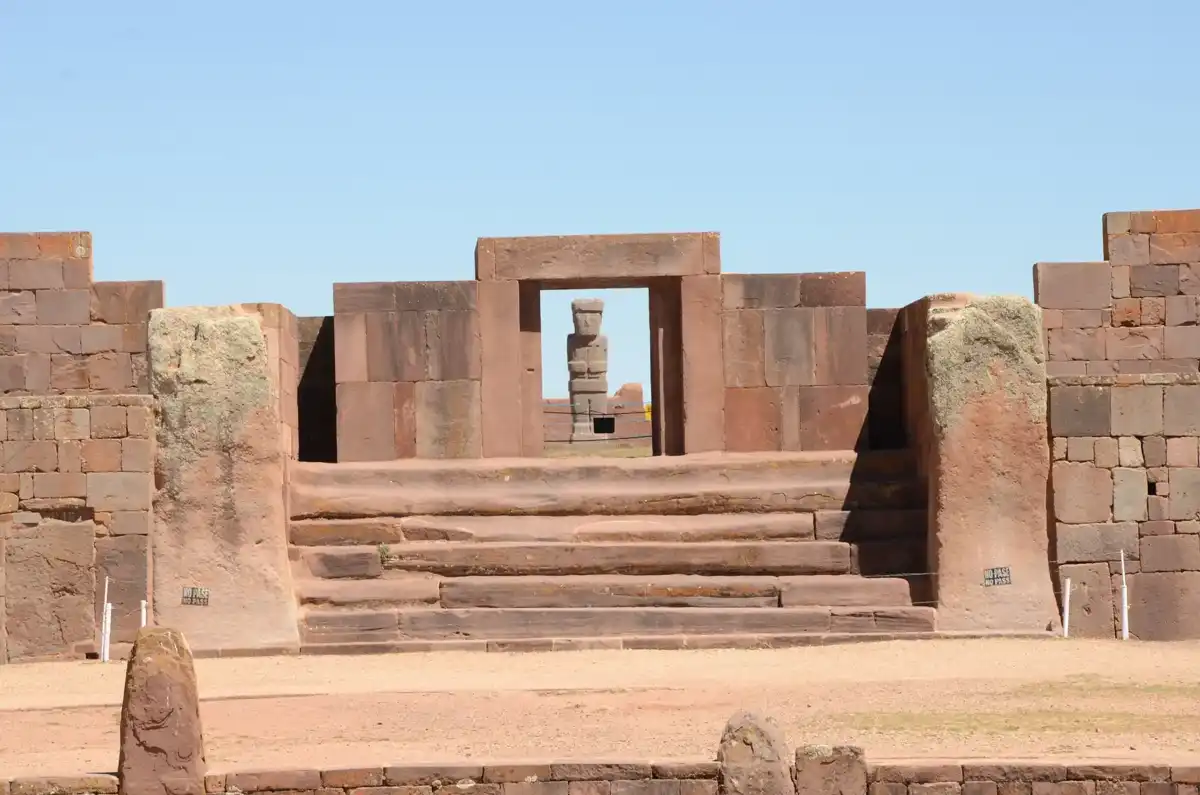
  • Kalasasaya Temple — A rectangular, walled courtyard built with huge dressed stones and precisely placed doorways; its alignments suggest astronomical or ceremonial uses, so you feel the site was designed with both ritual and sky in mind.
  • Akapana Pyramid — A massive, stepped artificial mound that’s less a smooth pyramid and more a layered ceremonial platform; climb around its terraces to see how Tiwanaku organized space for gatherings and rituals.
  • Semi-Subterranean Temple — A sunken,
read more 👉
  • Gate of the Sun — The iconic megalithic arch carved with a central deity (often linked to Viracocha or the Staff God) surrounded by rows of attendants; it’s the single image most people picture and gives a real sense of Tiwanaku’s symbolic power. (Personal favorite — it’s haunting in the high-altitude light.)
  • Kalasasaya Temple — A rectangular, walled courtyard built with huge dressed stones and precisely placed doorways; its alignments suggest astronomical or ceremonial uses, so you feel the site was designed with both ritual and sky in mind.
  • Akapana Pyramid — A massive, stepped artificial mound that’s less a smooth pyramid and more a layered ceremonial platform; climb around its terraces to see how Tiwanaku organized space for gatherings and rituals.
  • Semi-Subterranean Temple — A sunken, circular courtyard lined with dozens of sculpted stone heads set into low walls; intimate and eerie, it gives a glimpse of religious life and portraiture in stone.
  • Ponce (and Bennett) Monoliths — Tall carved figures in the open plaza, each with detailed headdresses and iconography; they’re great for studying Tiwanaku costume, authority imagery, and how scale was used to impress visitors.
  • Putuni (Palace of the Virgins) and carved masonry — Fine-cut door jambs and lintels, some reused across structures, show advanced stoneworking and a modular approach to building; small details here reward close-up inspection.
  • On-site museum and the high plain panorama — The compact museum displays ceramics, textiles, and small finds that explain the daily and ritual life behind the stones, while the surrounding Altiplano and distant Lake Titicaca views put the whole complex in beautiful geographical context.
Spotted a mistake or missing something? Contact us.

Things to do around Tiwanaku

Ratings based on Tripadvisor reviews. When you book through this link, you support our work at no extra cost to you.

🌤️ When to go?Best time to visit Tiwanaku


  • Weather: Tiwanaku sits high at 3,850 meters (12,630 feet), so expect a dry season from May to October with crisp, clear skies—perfect for exploring ruins without mud or rain. The wet season, November to March, brings unpredictable showers that can turn paths slippery and obscure views.

  • Temperature: Days in the dry season hover around 15-20°C (59-68°F), but nights plunge below freezing, sometimes down to -5°C (23°F). Dress in layers; the sun feels strong, but the cold bites once it sets.

  • Daylight Hours: Around 11 to 12 hours year-round, with slightly longer days in the southern hemisphere summer (December-February). Early starts are key to beating the heat and crowds.

  • Crowds: Peak tourist season aligns with the dry months, especially June to August. Expect busloads mid-morning. Off-season
read more 👉

  • Weather: Tiwanaku sits high at 3,850 meters (12,630 feet), so expect a dry season from May to October with crisp, clear skies—perfect for exploring ruins without mud or rain. The wet season, November to March, brings unpredictable showers that can turn paths slippery and obscure views.

  • Temperature: Days in the dry season hover around 15-20°C (59-68°F), but nights plunge below freezing, sometimes down to -5°C (23°F). Dress in layers; the sun feels strong, but the cold bites once it sets.

  • Daylight Hours: Around 11 to 12 hours year-round, with slightly longer days in the southern hemisphere summer (December-February). Early starts are key to beating the heat and crowds.

  • Crowds: Peak tourist season aligns with the dry months, especially June to August. Expect busloads mid-morning. Off-season means fewer people but riskier weather.

  • Seasonal Activities: The winter solstice (June 21) is a magnet for locals and spiritual seekers, offering a raw cultural experience but also intense crowds and higher prices.

  • Price Fluctuations: Accommodation and tours spike during dry season and festivals. Booking ahead saves money; off-season offers bargains but fewer services.


Pro-tip: Visit in late April or early May—dry enough for clear skies, fewer tourists, and cooler nights that keep the ruins feeling alive rather than baked or deserted.


source: climatestotravel.comJANJanuary: fair for travelingFEBFebruary: fair for travelingMARMarch: fair for travelingAPRApril: highly recommended for travelingMAYMay: highly recommended for travelingJUNJune: excellent for travelingJULJuly: excellent for travelingAUGAugust: excellent for travelingSEPSeptember: highly recommended for travelingOCTOctober: highly recommended for travelingNOVNovember: fair for travelingDECDecember: fair for traveling
bolivia-unique-site-tiwanaku
© Google | Familia Nómade

✈️ The backpacker research shortcutBolivia Travel Guide

An offline-friendly backpacking guide with optimized travel routes, ranked highlights, transport advice, and the best areas to stay.
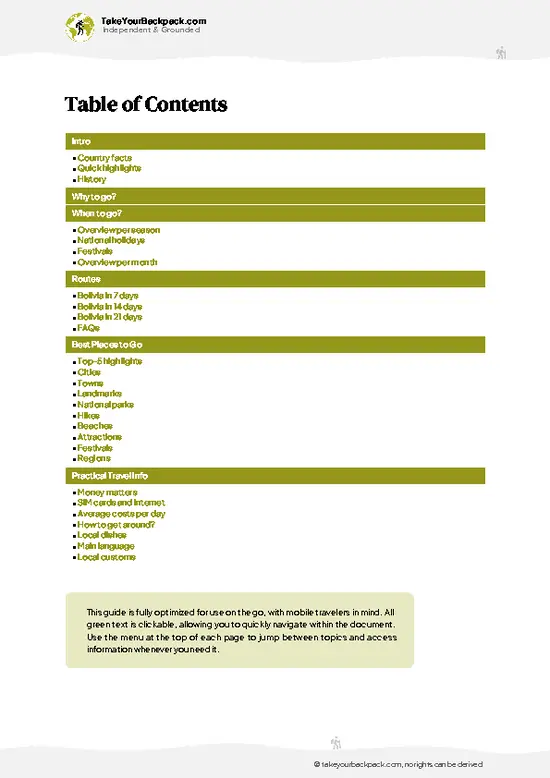
example page 0 from our offline Travel Guide for Bolivia
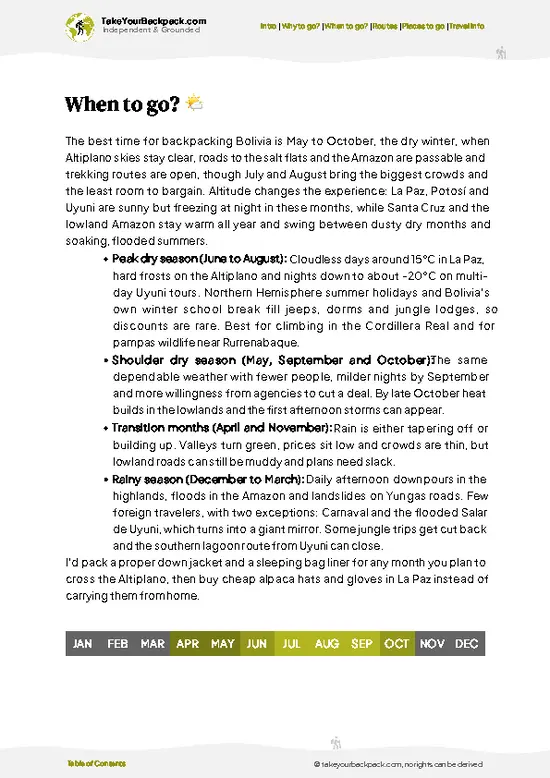
example page 1 from our offline Travel Guide for Bolivia
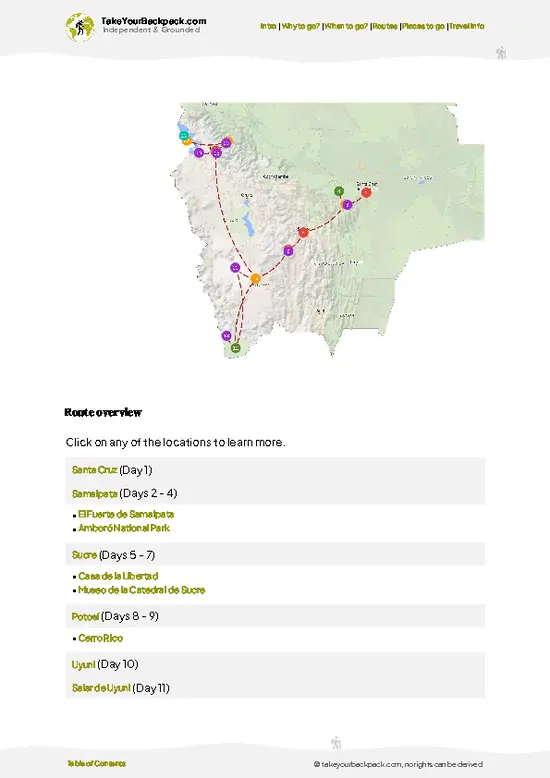
example page 2 from our offline Travel Guide for Bolivia
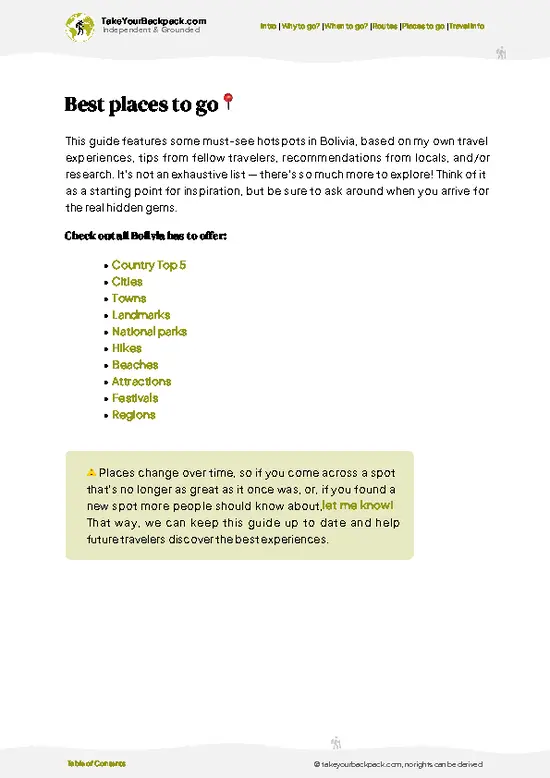
example page 3 from our offline Travel Guide for Bolivia
example page 4 from our offline Travel Guide for Bolivia
example page 5 from our offline Travel Guide for Bolivia
example page 6 from our offline Travel Guide for Bolivia
example page 7 from our offline Travel Guide for Bolivia
The digital guide (350 pages) contains:
82 highlights, ranked by travel appeal
Optimized 7, 14 & 21-day travel routes
Cities, national parks, landmarks, beaches
How to get around
Offline-friendly for travel without Wi-Fi
👉 Click to see all 30+ guide features

📅 Plan smarter in minutes, not weeks
Month by month travel advice
Festivals & national holidays
Budget expectations

🗺️ Go to the right places, skip the overrated ones
Honest pros & cons of destinations
Top hikes, parks & viewpoints
Lesser-known places most travelers miss
Clear “worth it vs skip it” guidance

🛏️ Travel smoothly without rookie mistakes
Best areas to stay
Transport systems explained simply
Common scams & safety advice
SIM cards, money & practical tips

🌍 Understand the country, not just visit it
Culture & traditions
52 Essential phrases & customs
Festivals worth planning around
Traveler-friendly historical context
Insights that make places more meaningful

📱 Built for real travel conditions
Fully downloadable PDF
Works completely offline
Optimized for phone use
Useful in remote areas & buses
Everything in one place
Save weeks of stressful planning
Get instant access to your full guide. 30‑day money-back guarantee.


By proceeding you agree to our terms.
Sent to your inbox immediately after payment • 100% Secure Checkout
Best Backpacking Travel Advisor 2025 tourism awardBest Backpacking
Travel Advisor
2025
What others say about Take Your Backpack Guides:
⭐⭐⭐⭐⭐
Fantastic, amazing amount of information!
⭐⭐⭐⭐⭐
My goodness this is amazing, it's what I've been looking for hats off too you!
⭐⭐⭐⭐⭐
I think this is absolutely BRILLIANT
⭐⭐⭐⭐
Very complete and informative. It's still missing places, but I gotta to commend you
⭐⭐⭐⭐⭐
This is truly amazing, thank you, can't wait to explore it with my kids!
⭐⭐⭐⭐⭐
Awesome resource, thank you!
⭐⭐⭐⭐⭐
This is amazing! Can't wait to explore the ones I haven't seen
⭐⭐⭐⭐
I love this! Well done, great idea.
⭐⭐⭐⭐⭐
Thanks for taking the time to make this gem!
⭐⭐⭐⭐⭐
This might be the best website I've ever seen.
⭐⭐⭐⭐⭐
Congratulations, and thank you so much for your work; it's incredibly valuable.
⭐⭐⭐⭐
In all seriousness I think you did a great job pointing out the important spots
⭐⭐⭐⭐⭐
10/10 very good
⭐⭐⭐⭐⭐
As someone who's only just starting to visit regularly this is awesome, thank you.
⭐⭐⭐⭐
Thank you very much! I'm going to visit my dad, it's going to be very useful!
⭐⭐⭐⭐⭐
This is really cool! We'll be travelling for the first time and this definitely come in handy.
⭐⭐⭐⭐⭐
You are now our minister of culture, congratulations 👨‍💼
⭐⭐⭐⭐⭐
Just wanted to tell you that this is a pearl! Going to follow your recommendations.
⭐⭐⭐⭐⭐
This is so cool. I'll definitely be using the resource for my travels soon.
⭐⭐⭐⭐⭐
This is very impressive! Good work.
⭐⭐⭐⭐⭐
This is an amazing and informative site. Very well done!

🛏️ Where to stay?Choosing the right base

When you’re heading to Tiwanaku, the ancient site that’s a must-see in Bolivia, you’ll want to find a place that balances safety, social vibes, and budget-friendliness.

Start with the town of Tiwanaku itself. It’s small but packed with character. Staying here means you’re just a stone’s throw from the ruins. You’ll find local eateries serving hearty meals at prices that won’t break the bank. Plus, the community is welcoming, making it easy to strike up conversations with fellow travelers and locals alike.

If you’re looking for a bit more action, consider staying in nearby El Alto. It’s a bustling … read more 👉
When you’re heading to Tiwanaku, the ancient site that’s a must-see in Bolivia, you’ll want to find a place that balances safety, social vibes, and budget-friendliness.

Start with the town of Tiwanaku itself. It’s small but packed with character. Staying here means you’re just a stone’s throw from the ruins. You’ll find local eateries serving hearty meals at prices that won’t break the bank. Plus, the community is welcoming, making it easy to strike up conversations with fellow travelers and locals alike.

If you’re looking for a bit more action, consider staying in nearby El Alto. It’s a bustling area with a lively market scene. The views of La Paz from here are a bonus. It’s a bit further from Tiwanaku, but the public transport is reliable and cheap. You’ll meet a mix of backpackers and locals, which adds to the experience.

Avoid the tourist traps in La Paz itself. They can be pricey and lack the authentic Bolivian charm. Instead, embrace the local culture and the genuine connections you’ll make in Tiwanaku or El Alto. That’s where the real magic happens.

👛 Costs (as of 27 February 2026)How expensive it really is

Visiting Tiwanaku, Bolivia, can be a rewarding experience, but it’s essential to know what you’re getting into financially. Here’s a breakdown of typical costs to help you plan your adventure.
  • Entrance Fee: Expect to pay around $10 USD for the entrance ticket. This fee grants you access to the archaeological site and its museum. It’s a small price for a glimpse into a civilization that thrived over a thousand years ago.
  • Transportation: Getting to Tiwanaku from La Paz will set you back about $5 to $10 USD for a bus ticket. The journey takes about 1.5 to 2 hours. If you prefer a private taxi, be prepared to pay around $50 USD, but that’s a splurge for convenience.
  • Guided Tours: If you want to dive deeper into the history, consider a guided tour. Prices range from $20 to $50 USD, depending on the
read more 👉
Visiting Tiwanaku, Bolivia, can be a rewarding experience, but it’s essential to know what you’re getting into financially. Here’s a breakdown of typical costs to help you plan your adventure.
  • Entrance Fee: Expect to pay around $10 USD for the entrance ticket. This fee grants you access to the archaeological site and its museum. It’s a small price for a glimpse into a civilization that thrived over a thousand years ago.
  • Transportation: Getting to Tiwanaku from La Paz will set you back about $5 to $10 USD for a bus ticket. The journey takes about 1.5 to 2 hours. If you prefer a private taxi, be prepared to pay around $50 USD, but that’s a splurge for convenience.
  • Guided Tours: If you want to dive deeper into the history, consider a guided tour. Prices range from $20 to $50 USD, depending on the length and depth of the tour. A knowledgeable guide can enhance your experience significantly, helping you understand the significance of the ruins.
  • Food and Drink: Local eateries offer meals for as little as $3 to $10 USD. Try the traditional Bolivian dishes; they’re hearty and affordable. If you’re looking for something more upscale, budget around $15 to $25 USD for a nicer restaurant.
  • Souvenirs: Local crafts can range from $5 to $30 USD. Handcrafted items like textiles or pottery make for unique keepsakes. Just remember to haggle a bit; it’s part of the experience.

Understanding these costs will help you navigate your visit to Tiwanaku without any surprises. It’s a place that deserves your attention, not just for its ruins but for the stories they tell.
⚠️ Prices can change and everyone travels differently, so take this as a rough guide. Hope it helps you plan your adventure!

Other Bolivian landmarks near Tiwanaku

Explore more nearby:

  • Valle de la Luna—eroded clay spires, lunar landscape, arid terrain| 62 km away
  • Yungas Road—steep cliffs, cloud forest, narrow track| 101 km away
  • Lago Poopó—shallow lake, migratory birds, salt flats| 303 km away

💡 Not sure where to go next?
Create a personalized itinerary for Bolivia including Tiwanaku and the places that fit your trip.

Generate my itinerary

👉 Discover all landmarks

Or checkout all Bolivia has to offer (think cities, towns, villages, national parks, hikes, beaches, festivals)
Country photo of Bolivia

We 💚 feedbackSumming up the experience

Tiwanaku is a mind-bending experience. Standing among those ancient stone structures, you can almost hear the whispers of a civilization long gone. But let’s be real: the crowds can be overwhelming, especially during peak season. You’ll share the space with selfie sticks and tour groups. Still, if you can tune out the noise, the energy of this place is electric. It’s a chance to connect with history in a way that’s rare and profound.

✈️ When did I visit Bolivia?
Bolivia I visited during my half year trip through South and Central America back in 2003

✍️ Help improve this page!
The information on this page is based on my own backpacking experience in Bolivia, supplemented with up-to-date research and feedback from other travelers. Travel details can change, so if you notice anything outdated or incomplete, feel free to let me know.


🙋‍♂️ Give feedback

👋 Meet the founderWho’s Behind Take Your Backpack?

Johan, backpacker and founder of TakeYourBackpackHi, I’m Johan (Netherlands 🇳🇱), the creator of TakeYourBackpack. Over the past decade, I’ve backpacked through 80+ countries across six continents, gaining extensive experience with independent travel, long-term trips, and overland routes.

This site is built on a combination of firsthand travel experience and carefully curated insights from other backpackers. Many guides are based on places I’ve personally visited, while others bring together tips, observations, and practical advice shared by trusted travelers I’ve met along the way.

The goal is to provide realistic, experience-driven guidance — not generic itineraries — so you can explore destinations with better context, clearer expectations, and more confidence.

Get full Bolivia guide •
Instant download • 82 highlights • Full Offline guide