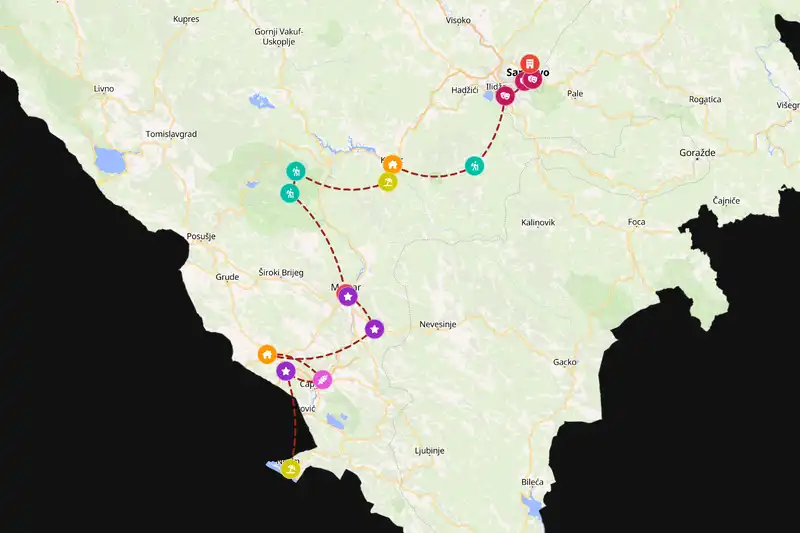
Yes, Bosnia and Herzegovina is very doable as an independent backpacker, especially if you already have a trip or two under your belt. The country is compact, people are helpful, and the main backpacker trail (Sarajevo–Mostar–Blagaj/Kravica–Tuzla/Banja Luka) is straightforward. English is common with younger people and in tourism, and prices are friendly for a tight budget.
The main thing that makes Bosnia feel “hard” is not danger, it is logistics and history. You need to respect that the 1990s war is recent: avoid wandering off marked paths in rural or mountainous areas because of remaining landmines, and do not treat war stories like entertainment. In cities and on signed trails you are fine; just do not freestyle random forest shortcuts.
Hostel culture is strong in Sarajevo and Mostar, with social, traveler-focused hostels that run day trips to places that are awkward by public transport (Srebrenica, Lukomir village, Kravica waterfalls, etc.). This makes it easy to meet people and outsource the trickiest logistics while still traveling independently.
You do need to be comfortable with slightly chaotic bus stations, handwritten timetables, and occasional delays. Things work, but not always on the dot. If you can handle Balkan-style transport and keep some buffer time, Bosnia is one of the most rewarding “next step” countries after Western Europe.
For a first-time backpacking trip, 7–10 days is the sweet spot; 14 days lets you slow down and add mountains and smaller towns.
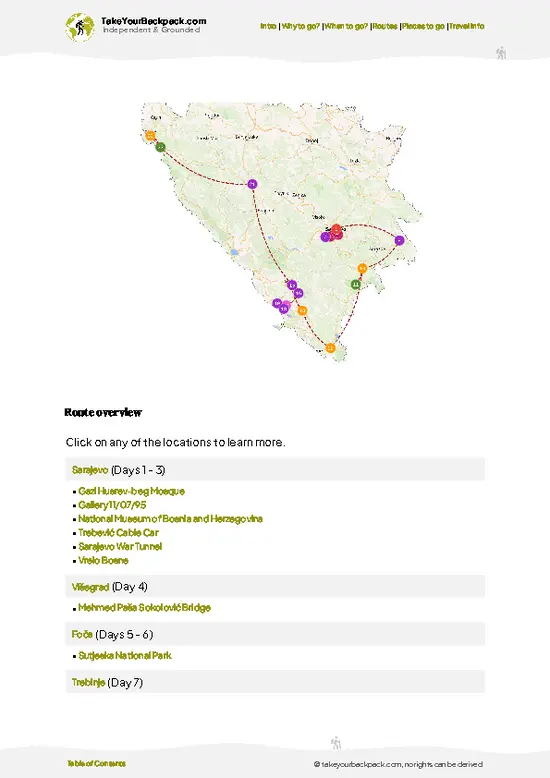
With about 7 days, you can do a tight but satisfying loop:
- Day 1–3: Sarajevo (old town, war history tours, cable car to Trebević, day trip to Tunnel of Hope)
- Day 4–5: Mostar (Old Bridge, war ruins, sunset viewpoints) with a day trip to Blagaj and Kravica waterfalls
- Day 6–7: One extra stop like Konjic (rafting, Tito’s bunker) or Travnik/Jajce on the way back toward Sarajevo or onward to Croatia.
With 10–14 days, you can breathe:
- 3–4 days in Sarajevo
- 2–3 days in Mostar with side trips
- 2–3 days in the mountains (Sutjeska National Park for Maglić and Trnovačko Lake, or Bjelašnica/Lukomir for village life and day hikes)
- 2–3 days in the north or northwest (Jajce, Banja Luka, Una National Park) if you like rivers and waterfalls.
If you only have 3–4 days, focus on Sarajevo with one day trip (Mostar or a war-focused tour). Trying to cram the whole country into a long weekend just turns bus rides into your main activity. Bosnia rewards slow mornings, long coffees, and actually talking to people, so it is better to see less and stay longer in each place.
You can absolutely get around Bosnia and Herzegovina without a car, but you need to plan around bus and train schedules instead of assuming you can just show up and go. For a classic backpacker route (Sarajevo–Mostar–Konjic–Mostar day trips–Tuzla/Banja Luka/Jajce), public transport plus the occasional tour or taxi works fine.
Buses are your main tool. They connect almost every town, they are cheap, and they are reasonably reliable, just not always frequent. Buy tickets at the station, bring small cash, and arrive 20–30 minutes early because platforms can change and announcements are not always clear in English.
Trains exist on a few key routes, especially Sarajevo–Mostar–Čapljina. That line is worth doing at least once for the scenery alone, and tickets are usually cheap. Outside those main routes, trains are limited, so do not build your whole itinerary around them.
For more remote spots (Lukomir village, Sutjeska National Park, some waterfalls and viewpoints), public transport is either awkward or nonexistent. The budget-friendly workaround is to use hostel-organized day trips, shared taxis with other travelers, or hitchhiking if you are experienced and comfortable with it. Hitchhiking is fairly common in rural Bosnia, but you still need normal safety judgment and daylight.
If you are willing to be flexible with departure times, accept that some days are “travel days,” and use hostels as logistics hubs, you do not need a car at all.
For a budget traveler, the must-visits are the places that give you the most culture, history, and nature per euro and are reachable without a private car.
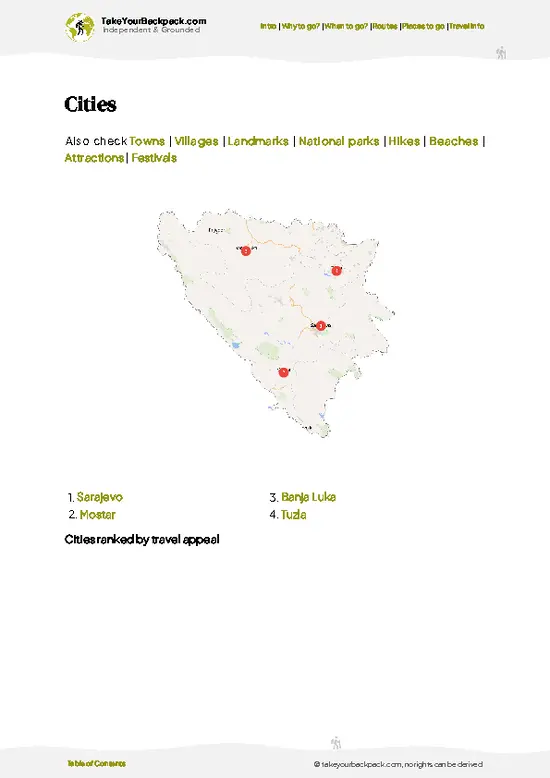
Sarajevo: Non-negotiable. It is one of the most layered cities in Europe. You get Ottoman alleys, Austro-Hungarian streets, Yugoslav blocks, and fresh war scars all in one walk. Do a war history tour with a local guide, ride the cable car up to Trebević for city views and abandoned bobsled track graffiti, and spend time in Baščaršija drinking coffee and people-watching.
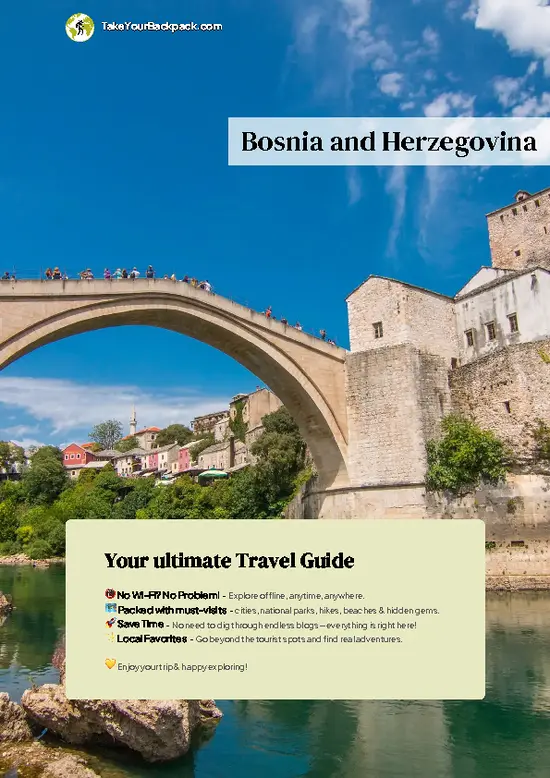
Mostar: Yes, it is touristy around the Old Bridge, but it is still worth it. Watch locals dive from Stari Most, walk the backstreets to see bullet-riddled buildings, and cross the river to escape the crowds. Stay at least one night so you see the bridge at dawn or late evening when day-trippers are gone.
Blagaj and Kravica (as day trips from Mostar): Blagaj has the Dervish house under a cliff with turquoise water; Kravica has a wide curtain of waterfalls where you can swim in summer. Both are easy on a hostel tour or by a mix of bus and short taxi rides, and they deliver a lot of scenery for not much money.
Jajce: A small town with a big waterfall right in the center, plus old fortifications and lakes nearby. It is a great stop if you are moving between Sarajevo and Banja Luka or Croatia.
At least one mountain area: Either:
-
Sutjeska National Park (for serious hiking, Maglić peak, and Trnovačko Lake), or
-
Bjelašnica and Lukomir village (for easier access, traditional stone houses, and ridge walks).
These are where Bosnia really feels wild and underpriced compared to the Alps. Go with a hostel or local guide if you are not an experienced mountain navigator.
If you have extra time, Banja Luka (river culture, rafting, relaxed cafe scene) and Una National Park (emerald rivers, Štrbački Buk waterfalls) are strong additions.
If you are short on time, skip anything that is mostly about ticking off a name rather than actually experiencing Bosnia.
Skip racing through too many cities: You do not need both Tuzla and Banja Luka on a tight trip. Tuzla is fine for cheap flights and salt lakes, but if time is limited, prioritize Sarajevo for depth and Banja Luka or Jajce for rivers and waterfalls.
Skip border-hopping just for bragging rights: Doing a rushed day trip to Croatia or Montenegro from Mostar or Trebinje eats time in border queues and gives you a shallow taste of both countries. If Bosnia is your focus, keep your days inside Bosnia and save the neighbors for another trip.
Skip generic shopping malls and modern suburbs: Sarajevo and Banja Luka have malls like anywhere else in Europe. They are useful for groceries and SIM cards, but not worth dedicated sightseeing time when you could be in old quarters, on a hillside viewpoint, or in a mountain village.
Be selective with war museums: The history is important, but you do not need to see every single museum and tunnel. Pick one or two strong experiences in Sarajevo (for example, a guided war tour plus the Tunnel of Hope) instead of museum-hopping until you are numb.
Skip deep rural detours without a plan: Random villages that are not on a known hiking route or near a specific sight can be logistically painful and not very rewarding if you do not speak the language. On a short trip, focus your rural time on places like Lukomir, Sutjeska, or Una National Park where the payoff is clear and access is organized.
If you only have 3–4 days, do Sarajevo plus either a Mostar overnight or a single mountain day trip, and skip everything else. If you have about a week, add Mostar with one or two day trips and maybe Jajce; leave the far north and deep mountain routes for a future, slower visit.